While watching on a spooky October Saturday morning, you probably saw these...

Remember that one day when you could wake up without an alarm? When you would get your favorite bowl of cereal and sit between the hours of 8 and 12? This is a blog dedicated to the greatest time of our childhood: Saturday mornings. The television programs you watched, the memories attached to them, and maybe introducing you to something you didn't realize existed. Updated every weekend.
October 07, 2017

HALLOWEEN COMMERCIAL BREAK: PEPSI
While watching on a spooky October Saturday morning, you probably saw these...
ATTACK OF THE KILLER TOMATOES
ATTACK OF THE KILLER TOMATOES
(FOX, September 8, 1990-November 23, 1991)
Marvel Productions, Fox Children’s Productions, Four Square
Productions
MAIN CAST:
Christian Guzek –
Chad Finletter
Kath Soucie – Tara
Boumdeay, Mary Jo Nagaminiashy
John Astin – Dr.
Putrid T. Gangreen
Thom Bray – Wilbur
Finletter, Floyd Bridgework
S. Scott Bullock –
F.T., The Censor Lady, Sam Smith
Cam Clarke – Igor Smith, Mayor Leonard Earwax,
Maurice LaMarche –
Zoltan, Tomato Guy, Ketchuck (season 2), various
Neil Ross – Whitley
White
Susan Silo – Fang (season 2)
Rob Paulsen –
Mummato (season 2)
Chuck McCann -
Beefsteak (season 2)
You picked a bad time to be a vegetarian.
Attack of the Killer Tomatoes was
a low-budget horror film co-written, produced, directed, edited and scored by John De Bello that served as a
spoof of B-movies. The film
dealt with tomatoes suddenly gaining sentience and revolting against humankind.
It was only by luring the tomatoes to a stadium and playing the new hit song
“Puberty Love” that the townspeople could trample and defeat the red menace.
The $100,000 film was released by Four Square Productions on
October 20, 1978 and pulled in a box office of $567,000. Although it wasn’t a
critical success, it has since become a cult classic over the years.
 |
| Fozzie saves the world from tomatoes. |
The Tomatoes story could have
ended there, if not for another spoof from an unlikely source. During the 1986 Muppet Babies episode “The Weirdo Zone”, Baby Fozzie (Greg Berg) related a story about
how he dealt with an “Attack of the Silly Tomatoes.” The segment featured clips
from the movie and generated some of the highest ratings of the season.
Inspired, New World
Pictures, owner of Babies producer Marvel Productions,
approached Four Square about making a sequel with a proposed budget of $2
million. De Bello, along with co-writers and producers Costa Dillon and J. Stephen Peace, accepted the
offer and went to work on a script.
Return of the Killer Tomatoes was
released on April 22, 1988 by New World. The
film was set ten years after the “Great Tomato War” in a world where tomatoes
were now outlawed. One of the first film’s main characters, Wilbur Finletter (Peace), opened a tomato-less pizzeria and his nephew, Chad (Anthony Starke), was a delivery boy.
The film revealed that the tomato uprising was the cause of mad scientist
Professor Mortimer Gangreen (John Astin). Learning from his mistakes, Gangreen
used music to create mutated tomatoes that resembled normal humans. Different
kinds of music produced different results, such as rock music that created
soldiers Gangreen intended to use in his plot to take over the world.
Gangreen’s plans went awry when his attractive mutated assistant, Tara Boumdeay
(Karen Mistal), grew tired of
his mistreatment of the fuzzy failed mutation she dubbed F.T. (for Fuzzy
Tomato) and defected to the humans. There, she became involved with Chad and
passed F.T. off as an ugly dog.
 |
| Tara, F.T. and Chad. |
Return was a surprise success,
and not only did New World greenlight another sequel, but also sought to
attract a younger audience with an animated series produced by Marvel.
Developed by Richard Mueller,
Attack of the Killer Tomatoes essentially
combined elements from both movies, but was an expansion of the plot of Return. The series was set five years after The Great Tomato War in the
town of San Zucchini. Gangreen was renamed Dr. Putrid T. Gangreen (Astin,
reprising his role) to add more of a pun to his name. Tara (Kath Soucie) was
given an aversion to condiments as salt would change her from human back into a
tomato, while pepper would cause her to sneeze back into her human form. Tara
and Chad’s (Christian Guzek) relationship was reduced to their being good
friends, although an attraction on Tara’s end was evident. Chad was also
slightly younger than his movie counterpart. F.T. (S. Scott Bullock) maintained
his secret identity as the world’s ugliest dog, but his ownership kept
switching between Tara and Chad in various episodes. Wilbur (Thom Bray) was
depicted as slightly delusional from the war and spent most of his time trying
out new tomatoless pizza recipes (which often failed), and usually ran around
in his flight suit while dragging his deployed parachute behind him. Generally,
adults on the show were depicted as dimwitted (with Wilbur being somewhat of an
exception), often leaving Chad, Tara and F.T. to foil Gangreen’s plots.
 |
| Gangreen and Igor. |
Igor Smith (Cam Clarke), Gangreen’s air-headed assistant who had
ambitions of being made a reporter once the tomatoes ruled, was also featured
from the film. Meanwhile, Whitley White (named Charles in Return, voiced by Neil Ross) was the town’s only reporter who had a
habit of appearing during or after the story’s action and simultaneously
presenting from the scene and the studio.
 |
| Five of the six: Zoltan, Mummato, Beefsteak, Ketchuck and Fang. |
The primary villains of the series were Gangreen’s six tomato soldiers,
which Igor accidentally programmed with old movies rather than training videos
rendering them lazy and prone to imitating old movie characters. Zoltan
(Maurice LaMarche) was the head of this tomato crew, and initially the only
tomato who could talk. When they were further mutated in the second season, that
gang came to include the calm and cowardly Tomacho (Cam Clarke, impersonating John Travolta); short-tempered and bull horned
Beefsteak (Chuck McCann); snake-like Fang (Susan Silo), who had fangs filled
with venom; the always-hungry and drooling Ketchuck (LaMarche); and Mummato
(Rob Paulsen, impersonating Marlon Brando)
who was wrapped in bandages like a mummy. Zoltan himself gained an eyepatch and
stitching across his face. Gangreen also attempted to fix his mistakes with
Tara by creating another minion inspired by his love of rockabilly music,
resulting in Johnny Tomato (LaMarche) who resembled a young Elvis Presley. However, he developed feelings
for Tara that once again foiled Gangreen’s plans.
 |
| The KTTF: Mary Jo, Wilbur, Sam and Floyd. |
On the human side was the Killer Tomato Task Force (KTTF): the
specialized unit formed with the sole intent of keeping tomato attacks at bay
and destroying them. While Wilbur, Chad and Tara were often affiliated with the
KTTF, their primary members were Sam Smith (Bullock), a master of disguise
whose most recognizable outfit was that of the Lone Ranger; Floyd
Bridgework (Bray), based on the film character Greg Colburn (Steve Cates in Attack, Ian Hutton in Return), an underwater expert who always
wore his scuba gear no matter where he was or what kind of disguise he was
wearing; and Mary Jo Nagamininashy (Soucie), based on the character Gretta
Attenbaum (Benita Barton), a
German athlete who was so into exercise that she did so while battling
tomatoes. Mayor Leonard Earwax (Clarke) was the ineptest human character of
all, somehow lucking into the job but was in no way an effective leader as he
could sleep through his town being conquered by tomatoes.
 |
| Whitley White. |
The Censor Lady (Bullock) was the show’s dig at standards and practices
as she would pop up at random times to stop characters from doing any kind of
imitable behavior (behavior networks felt a child could potentially copy and
hurt themselves doing). It was revealed in the episode “Streets of Ketchup”
that there may be more to The Censor Lady than appeared, as salt water turned
her into a prune much like Tara’s transformations. One character who was in
every episode was the Tomato Guy (LaMarche, impersonating Woody Allen), who would shout “Tomato!”
and send everyone into a panic; in part due to a traumatic childhood incident involving
tomato soup. When he wasn’t, he would serve as a speaking extra. Tomato Guy was
likely inspired by Dillon’s roles in the films, as he started a panicked
stampede by shouting “Tomato!” in the first and filled numerous roles in the
second.
Attack of the Killer Tomatoes debuted
on September 8, 1990, becoming one of the first programs to be aired on the
fledgling FOX network’s Fox Kids programming block. De
Bello and Peace served as producers, along with Boyd Kirkland. The show
attempted to maintain the comedic nature of the films by spoofing other movies
and pop culture in every episode, right down to the episode titles. The series’
theme was based on the one from the movie by Dillon, De Bello, Peace, Paul Sundfor and Gordon Goodwin, with Haim Saban and Shuki Levy supplying the rest of the
series’ music. Mueller served as the story editor and one of the series’
writers, alongside Flint Dille,
Jack Enyart, Gordon Kent and Ted Pedersen.
 |
| The Tomato Guy in a supporting role as a mailman. |
The series was a hit for FOX and was quickly renewed for a second season.
However, some changes occurred both on screen and behind the camera. Mueller
was replaced by Dille, although he still supplied scripts, and Kirkland was
replaced by Richard Trueblood.
Levy was also the sole composer for the season. Under Dille, the episodic
format was jettisoned in favor of an ongoing storyline that saw Gangreen
further mutate his six tomato soldiers into giants and use them to conquer the
world. However, feeling Gangreen was no longer necessary, Zoltan led a revolt
against him and each of the tomatoes took over one of the continents for
themselves. Gangreen was forced to work with the KTTF to take the world back
(and then promptly betray them).
Changes were made to the story and characters that directly contradicted
the first season, such as Tara’s being a tomato was a publicly known fact, her being
able to turn into a tomato at will, and her now having mobility and speech in
that form. The further mutation of Zoltan and his crew was done to remove their
comedic elements to make them more serious threats. Wilbur was elevated to
rebel leader status in the wake of the world’s conquering, which fit the
character as he was the more competent adult on the show (which isn’t saying
much). The second season intro was also altered to have shots of various kids
singing the theme amongst clips of the show, while a colorful tomato bounced on
the words on the bottom of the screen. Allusions to the show’s cinematic
origins were also made, as parts of the intro took place inside a theater.
 |
| Gangreen regurgitated by a mutant kumquat. |
The biggest change was also the most expensive. It was decided to move
animation duties from AKOM Productions
over to American Film
Technologies; a San Diego firm that specialized in the colorization of
black and white films. AFT used computers to animate the second season, making
it the first fully computer-generated cartoon show. As a result, the backgrounds,
animation and character designs had subtle, but noticeable, differences between
seasons; particularly in the character movements which were comparable to an
early animated PC game. FOX Kids head Margaret Loesch touted
the move as a way to keep animation jobs with domestic artists and away from
foreign companies.
Unfortunately, these changes proved unpopular with the viewing audience.
Coupled with the fact that the episodes were initially aired out of order and
missed several weeks, the series was quickly cancelled at the end of the
eight-episode season. The show did remain on the network well into 1992, and
returned in reruns for part of 1996 before moving over to the now-defunct FOX
Family Channel in 1998.
 |
| The Gangreen figure pack. |
During the second season, Mattel
produced a line
of two-pack action figures that featured one of the human characters facing
off against a giant tomato. The pairings included Wilbur vs. Beefsteak,
Gangreen vs. Ketchuck, Igor vs. Fang (named Fangmato), Chad vs. Tomacho, Ranger
Woody vs. Zoltan, Fireman Hoser vs. Mummato, and Ultimato (a super tomato
Gangreen created to aid the KTTF when he was allied with them) vs. Officer
Bookum. To round out the set, Tara and Whitley were paired with two tomatoes
that were actually good: Missing Link Tomato and Phantomato. Link (LaMarche)
was believed to be the missing link between normal tomatoes and the killer
variety and lived in a lavishly furnished lair. Phantomato (also LaMarche), a
parody of The Phantom of the Opera,
was a deformed tomato in a mask that took to the sewers after the tomatoes
conquered Earth and aided Tara—once he finished playing his organ, that is.
That same year, Imagineering
released Attack of the Killer Tomatoes through
THQ for the Nintendo
Entertainment System. The game was a platformer which had Chad facing off
alone against the legions of mutated tomatoes as the rest of the citizenry was
too afraid to help. The six main tomatoes were all bosses in the game, as was
Phantomato who was once again depicted as a villain. A similar game featuring
Wilbur was released on Game Boy
in 1992 in North America and the following year in Japan as Killer Tomato by Altron. Simplicity produced a costume pattern
for adults and kids, and Thermos released
a lunch
box.

 |
| Double feature DVD. |
Although the show was never allowed a true conclusion, the machinations
of Gangreen and Igor (Steve
Lundquist) continued in film as Return’s
success spawned two direct-to-video sequels. 1990’s Killer Tomatoes Strike Back was the first time the tomatoes were
featured with faces on-screen, despite having them in all the promotional
materials for the other movies and in the cartoon. It was the last movie to
feature Wilbur. The final film, 1991’s Killer
Tomatoes Eat France!, featured Gangreen attempting to use an old prophecy
to his advantage with the help of Igor. France!
was the first film to feature the tomatoes speaking fluent English rather
than their own language, and other fruits and vegetables gained sentience
outside of Gangreen’s experimentation. Gangreen’s tomato minions from the cartoon
also appeared. In 2008, a remake of the film was announced but has yet to make
any progress or see fruition, which means that the tomato threat is finally
over. For now.
Say, how’s that salad of yours there?
EPISODE GUIDE:
Season 1:
“Give a Little Whistle” (9/8/90) – Gangreen invents a whistle that
causes tomatoes to attack, while Igor and Zoltan kidnap Whitley so that Igor
can fill in for him.
“Attack of the Killer…Pimentoes?” (9/15/90) – Gangreen’s new tiny
cherry tomato grows bigger the more it eats, and soon giant tomatoes invade San
Zucchini.
“Tomato from the Black Lagoon” (9/22/90) – Gangreen and Igor set out
to capture and examine the Tomato Link, who has already captured Tara.
“Streets of Ketchup” (9/29/90) – Gangreen creates Johnny Tomato for
his latest schemes, but those get derailed when he meets Tara.
“Tomato Invasion from Mars” (10/13/90) – Aliens come to Earth seeking
mutated seeds from Gangreen.
“War of the Weirds” (10/20/90) – When Igor is bullied it reminds Gangreen
of his own rival, starting a war between his tomatoes and his rival’s kumquats.
“Invasion of the Tomato Snatchers” (10/27/90) – Gangreen plots to
replace the citizens of San Zucchini with versions that he grows and can
control.
“Terminator Tomato from Tomorrow” (11/10/90) – An android tomato from
the future comes back in time and helps Gangreen remove the entire Tomato Task
Force.
“Camp Casserole: So Vine” (11/17/90) – While Chad, Tara and FT head to
camp, Gangreen creates a giant tomato that accidentally awakens early.
“Spatula, Prnze of Dorkness” (11/24/90) – Zoltan is transformed into a
vampire and proceeded to kiss humans and vampires to change them as well.
“Frankenstem Tomato” (12/1/90) – Wilbur, Chad, Tara and FT take
shelter in the Frankenstem Castle where Gangreen seeks to capture Tara and put
her brain in the Frankenstem monster.
“The Gang That Couldn’t Squirt Straight” (12/15/90) – Wilbur, Chad and
Tara investigate a group of tomato gangsters attacking and destroying various
businesses.
“Beach Blanket Tomato” (12/29/90) – Gangreen unleashes a group of
tomato sharks on San Zucchini’s harbor.
Season 2:
“The Ripening Disaster” (9/7/91) – Gangreen decides to turn his tomato
minions into giants, which allows him to finally conquer the world.
“A Rotten Reversal” (9/14/91) – No longer needing Gangreen, his
minions betray him and assert their dominance over the continents for
themselves.
“Phantomato of the Opera” (9/21/91) – Wilbur, Chad, Tara and Igor go
searching for Gangreen when he leaves a message that he’s heading to the opera.
“Stemming the Tide” (10/5/91) – The KTTF sets out to rescue Gangreen
and Igor from Gangreen’s lab while the tomatoes set out to conquer the Heart of
Africa.
“The Tomato Worms Turn” (10/19/91) – Gangreen, Igor, Chad, Tara and FT
head to the Bleching Congo to retrieve tomato worms.
“Ultra-Tomato III” (11/2/91) – NO SYNOPSIS AVAILABLE.
“Tomatotransformation” (11/9/91) – NO SYNOPSIS AVAILABLE.
“The Great Tomato Wars” (11/23/91) – When Zoltan is kicked out of the
group, he goes back to Gangreen for a new army of tomatoes made from moon dust.
Originally posted in 2017. Updated in 2018.
Originally posted in 2017. Updated in 2018.
HALLOWEEN MONTH...EXHUMED

It’s October, which means
it’s time for another selection of Halloween-themed favorites. We’ll be
bringing you some more grisly, terrifying television shows and a large helping
of zombified advertisements that will transport your mind to the netherworld of
your childhood.
Enter, if you dare!
October 06, 2017
REVIEW: MY LITTLE PONY: THE MOVIE
Director: Jayson Thiessen
Writers: Meghan McCarthy, Rita Hsiao, Michael Vogel
Starring: Tara Strong, Tabitha St. Germain, Ashleigh Ball, Andrea Libman, Cathy Weseluck, Emily Blunt, Michael Pena, Liev Schreiber, Taye Diggs, Zoe Saldana, Kristin Chenoweth, Uzo Aduba, Sia
My
Little Pony: The Movie comes at an interesting time in the franchise. When Lauren Faust was tasked with
brining the 80s toy franchise to the fledgling The
Hub network, neither she nor the people involved realized the phenomenon
they were creating. My
Little Pony: Friendship is Magic was not only a hit with both boys and
girls, but it found an unexpected fanbase amongst adult men, now known as Bronies.
 |
| The Mane 6 (Applejack, Pinkie Pie, Rarity, Rainbow Dash, Twilight Sparkle, Fluttershy) and Spike. |
Friendship
is Magic followed magic student Twilight Sparkle (Tara Strong) and her pet
dragon, Spike (Cathy Weseluck), as they were sent to the small town of
Ponyville in Equestria by her mentor, Princess Celestia (Nicole Oliver). There, she
was tasked to learn about friendship and did so by becoming friends with
fashionista Rarity (Tabitha St. Germain), apple farmer Applejack (Ashleigh
Ball), extreme flyer Rainbow Dash (also Ball), high-energy party planner Pinkie
Pie (Andrea Libman), and animal lover Fluttershy (also Libman). Their
friendship was the key to saving Equestria numerous times, eventually leading
to Twilight becoming a princess herself. The show is in the middle of its
seventh season, and some of the bloom has fallen off the rose as is expected
with an aging franchise. Friendship is
still popular, but not as much as it once was.
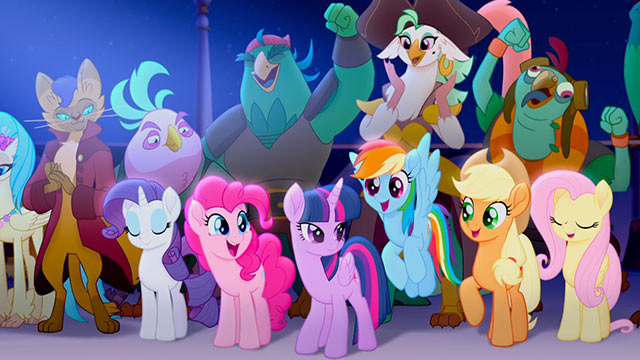 |
| You know it's big budget because there's shading and light effects. |
The
Movie was announced back in 2014 and became the second feature to be
produced through Hasbro’s AllSpark
Pictures (after the abysmal Jem and the Holograms)
alongside DHX Media, with Lionsgate releasing. Series director
Jayson Thiessen left the show to focus on directing the film, and showrunner
Meghan McCarthy wrote the screenplay with Rita Hsiao and Michael Vogel. The
forces of the Storm King (Liev Schreiber) invade Canterlot during Twilight’s
first Friendship Festival, sending the Mane 6 and Spike to new parts of
Equestria to find help and rescue Princesses Celestia, Luna (St. Germain) and
Cadence (Britt McKillip) from
capture. Series composer Daniel
Ingram also provided the music. Although other Friendship-related productions have seen theatrical releases before
airing on TV, this is the first to be made exclusively for theaters.
 |
| An image depicting a new undersea kingdom. |
The production took great pains to
ensure that the movie wasn’t just viewed as an extended episode of the show
(something that sunk the box office of many other show-to-film efforts,
particularly from DiC
Entertainment). As such, the movie features slightly tweaked character and
set models to add a sense of roundness and weight. At times, they almost
resemble a cross between the models from the show and the artwork of Jay Fogsit, one of the contributing
artists to IDW Publications’
ongoing My Little Pony comics. For
longtime fans of the show, this adjustment could be a bit jarring, but as the
movie goes on you become more accustomed to the new look. That’s helped by the
overall familiarity of the production which left it feeling close enough to the
show, from everything that transpired on screen to the opening notes of Ingram’s
enjoyable score. And there’s plenty of eye candy as many residents and visitors
to Ponyville make cameos throughout the opening sequence.
 |
| The Storm King and Tempest. |
The movie continues the ongoing
themes of season seven of introducing new locations and characters.
Unfortunately, this is where it stumbles a bit. Not much screen time is given to
these new characters to adequately develop them or their relationships. The
most developed is Tempest (Emily Blunt), who receives a flashback to explain
her lack of a horn and why she’s helping Storm King conquer the ponies. The
Storm King himself, however, only appears twice and is far less imposing a
threat than any that have come before him on the show.
 |
| New friends, including a con artist, pirates and an undersea pony. |
The ponies’ quest has them encountering
and befriending a variety of new species and characters, but these friendships
all form awfully fast and get no time to develop organically. We get a brief
glimpse into their world and a little backstory through exposition, but not
much else. Even the instances of allegiance changing can’t be explained
adequately beyond “because the script said so”. Perhaps there were just too
many to juggle in the movie’s short running time, or maybe they dedicated too
much time to ensure there was a song number in every new scene. These
characters do get a bit of fleshing out, but that’s only assuming you’ve read
the IDW prequel comics. Some of that material would have been beneficial here.
 |
| Celebrity cameo: Sia as Songbird Serenade. |
Overall, the movie felt like an
extension of the show, which was thanks to a lot of the same people working
behind and “in front” of the camera. Fans of Friendship is Magic will enjoy the movie on that basis alone. There
were also quite a few jokes and sight gags that will get a laugh (oh that
Pinkie Pie…). The story was fine, even though it wasn’t anything remarkably new
or wildly different, and the music was varied and fun. The new characters were
really shortchanged in the long run. They served little purpose beyond
advancing the Mane 6 to the next part of their journey and weren’t thoroughly
developed. Friendship is Magic has
done many instances of friendship building and credible threats to Equestria
that far surpass what was presented in the movie. These things just weren’t
given enough time to gestate on screen so that they’d feel real.
RATING: 3
out of 5 hooves. A nice, if flawed, addition to the My Little Pony canon. Fans of the show and kids will most likely
like it, although newcomers and general audiences may fail to find what made
the show so magical in the first place.
September 30, 2017
LITTLEST PET SHOP (2012)
LITTLEST PET SHOP (2012)
(The Hub/Hub Network/Discovery Family, November 10,
2012-June 4, 2016)
Hasbro Studios, DXH Media/Vancouver
MAIN CAST:
Ashleigh Ball – Blythe Baxter, Shea Butter, Lemonface, Hubble, Baa Baa Lou, Mitzi, Fluffy Lightning, Cindeanna Mellon, Alice
Samuel Vincent – Russell Ferguson, Esteban Banderas, Sam U.L., Sunil’s Dad, Steve, Sweet Cheeks, Canine Cop, Captain Cuddles, Panda Elder, Old Bananas, Speedy Shellberg, Weasel Whiskers, Fisher Biskit, Morgan Payne, Josh Sharp, Mr. Bromidic, various
Tabitha St. Germain – Pepper Clark, Gail Trent, Sunil’s Mom, Cairo, Mushroom, Delilah Barnsley, Parker, Nutmeg Dash, Philippa, McKenna Nicole, Finola Frum, Mona Autumn, Stephanie Hart, Tess McSavage, Clarissa Trent,
various
Peter New – Sunil Nevla, Mary Frances, 3DGB, Digby, Joey Featherton,
Whiskers, Dodger, Weber, Basil, Big Al, Harold Winston, Ivan, Vlad, Pete, Otto von Fuzzlebutt,
Tenzing Norgert, Francois LeGrande, Christopher
Lyedecker, Riley
Robinson, Littlest Pat,
John Trent,
various
Nicole Oliver – Zoe Trent, Genghis, Tiger, Cashmere Biskit,
Velvet Biskit, Scarletta Redd, Clover Fields, various
Kathleen Barr – Anna Twombly, Madame Pom, Poppy Pawsley, Scout Kerry, Sunshine Sweetness,
Dolores, Fleur le Moose, Jasper
Jones, Henrietta
Twombly, Vi
Tannabruzzo, various
Shannon Chan-Kent – Whittany
Biskit, Brittany Biskit, Youngmee Song, Madison, Brittman
Biskit, Whittman Biskit, Phoebe
Kylee Epp – Zoe
Trent (singing)
Laura Hastings –
Penny Ling (singing)
Littlest Pet
Shop was the product of two toylines coming together.
Littlest Pet Shop (LPS)
was introduced in 1992 by Kenner
as a line of tiny
collectible caricatures of animals. The pets came with accessories, like
carriers and pet supplies, and individual gimmicks, such as motion or color
changing with different temperatures. Shortly before the original line ended in
1996, Sunbow
Entertainment, Créativité
& Developpement and AB
Productions adapted the toys into a syndicated animated series. It ran from
October 16-December 8, 1995 over 40 episodes.
Hasbro, who had taken over Kenner in
1991, folded the company into its main operations in 2000. In 2005, they
decided to revive the LPS line with new designs that made the animals look more
cartoony, but kept a realistic color style. The pets came with symbols in their
eyes that meant different things. They also gained a new caretaker: Blythe.
 |
| The various Blythe dolls available in 1972. |
The Blythe doll was created in
1972 by designer Allison
Katzman for Marvin Glass
and Associates based on Betty Boop and
the “Big Eyes” paintings of Margaret
Keane. Kenner had purchased the rights and produced the doll in the United
States, the United Kingdom, Australia and Japan. The big head and large eyes
were deemed too scary for children, and the doll was pulled from shelves within
the year.
 |
| Gina Garan and some of her Blythe dolls. |
In 1997, video producer and doll collector Gina Garan
was made aware of a doll that resembled her and was given her first Blythe doll
from a friend. Becoming obsessed with the doll, she began to take hundreds of
photos of her in various places. In 2000, after acquiring permission from
Hasbro, she published her photos in the book This is Blythe and
reintroduced the doll to the world. She also introduced it to her Japan-based
agent Junko Wong, who
decided to use it in an ad campaign they were working on for department store
chain Parco. When demand for the doll
rose in Japan, Hasbro granted the license to CWC Group and their Transformers partner, Takara,
to produce new versions of it. As it was successful in Japan, Hasbro granted Ashton-Drake
Galleries the license in 2004 to resurrect the doll in the US.
In 2010, Hasbro brought Blythe back in house by combining her with the
LPS line and renaming it Blythe Loves
Littlest Pet Shop. Another animated series was commissioned in 2010 to
incorporate this change called Littlest Pet Shop Presents.
It was comprised of seven Flash animated shorts by Cosmic Toast Studios that
Hasbro released exclusively online. In
the show, Blythe would be involved with something fashion or pet-related while
the variety of animals in her care, resembling the current toys, would have
conversations she couldn’t understand and adventures in their imagination. Although
“pet shop” was in the name, the show took place anywhere but.
 |
| A new look and a new logo. Promo image for Littlest Pet Shop. |
Margaret Loesch,
then-CEO of The
Hub, the television network jointly owned by Hasbro and Discovery Communications,
commissioned the development of a new LPS series. Julie McNally-Cahill and Tim Cahill were put in charge of
developing the show, which used the Cosmic Toast short as a springboard. Blythe
was renamed Blythe Baxter, and instead of just having an interest in fashion
she was made an aspiring fashion designer. She was also given the ability to
communicate with animals, much like Dr. Dolittle. Blythe retained the scooter she had in
the web series as her primary mode of transportation.
 |
| Blythe with the pets: (from top) Sunil, Minka, Pepper, Vinnie, Zoe, Penny Ling and Russell. |
The setting of the show was a pastiche of New York called Downtown City, where
Blythe (Ashleigh Ball) moved with her father, Roger (Michael Kopsa), after he
was promoted in his work as an airline pilot. They ended up living in the
building above Littlest
Pet Shop, where an old dumbwaiter connected Blythe’s room to the daycare in
the store. She befriended the shop’s regular campers: Russell Ferguson (Samuel
Vincent), a hedgehog who took it upon himself to try and keep things orderly
and organized; Minka Mark (Kira Tozer), a hyperactive spider monkey who loved
to paint; Pepper Clark (Tabitha St. Germain), a skunk with ambitions of being a
comedian; Sunil Nevla (Peter New), a mongoose with a passion for magic; Vinnie
Terrio (Kyle Rideout), a gecko that loved to dance and Sunil’s best friend;
Penny Ling (Jocelyne Loewen), a sensitive panda interested in rhythmic
gymnastics; and Zoe Trent (Nicole Oliver), a diva show dog that could sing.
 |
| Mrs. Twombly always generates strange looks in those that know her. |
The owner of LPS was Anna Twombly (Kathleen Barr), a kind and off-beat
woman with a passion for doorknobs and who invented the martial art/sewing
style of Kung-Fu Quilting. Blythe’s arrival was fortuitous as LPS found itself
in dire straits due to the competition from Largest Ever Pet
Shop, owned by ruthless businessman Fisher Biskit (Vincent). Blythe helped
to save the store by marketing her pet fashions, known as Blythe Style (taken
from the
title of one of Garan’s books), in the store. Blythe also stayed on as a
part-time employee in the store.
 |
| LPS welcomes literally animals of all kinds. Even those that shouldn't really be pets...or in the city... |
Initially, Hasbro was reluctant to have the series set an actual pet
store; feeling that audiences would find it disconcerting that the animal
characters would change over frequently as they were sold. The Cahills
reassured them that modern pet stores didn’t just sell pets, but also catered
to them with grooming and day care services (in fact, Twombly’s phone greeting
was “We don’t sell pets, we cater to them.”). That allowed for a wide variety
of animals to cross paths with the main crew, including Buttercream Sundae (Cathy Weseluck), a hyperactive rabbit
from the Sweet Delights
candy store next door; Sugar
Sprinkles (Kelly Metzger), a
cat with sprinkles all over her that played the ukulele; Goldy (Brian Drummond), an adventurous
goldfish forced to live a dull life in a bowl; Madame Pom (Barr impersonating Eva Gabor), a snobby Pomeranian
show dog that was Zoe’s frenemy; Mr. Otto Von Fuzzlebutt (New), an energetic
raccoon that was prone to intense, deep power naps, and countless others.
 |
| Blythe with Youngmee, Sue and Jasper. |
Blythe and the main animals were determined by Hasbro for inclusion in
the show, but the Cahills wanted to also expand the human roster including
Twombly and the various pet parents. They gave Blythe a life away from the pet
shop, showing her in school, fashion camp and other places. Blythe’s best
friend was Youngmee Song (Shannon Chan-Kent), an intelligent (though spacey)
girl whose Aunt Christie (Tozer) owned the Sweet Delights shop. Blythe’s other
friends were Sue Patterson (Tozer), an athlete who was often envious about
Blythe’s sense of fashion and creativity, and Jasper Jones (Barr), a humoristic
and outgoing boy that was the first to greet Blythe at school. Then there was
Josh Sharp (Vincent), Blythe’s crush that often left her tongue-tied in his presence.
Blythe’s main enemies were the Biskit twins, Whittany and Brittany (both
Chan-Kent). The daughters of Fisher Biskit, they were spoiled rotten and
weren’t afraid to show it; constantly scheming on how to ruin Blythe’s efforts
in anything she did and make themselves look good (which wasn’t helped by the
fact that they weren’t all that intelligent). The characters were designed by Kora Kosicka and Amy He.
 |
| The Biskits and their chinchillas. |
Littlest Pet Shop debuted on
The Hub on November 10, 2012 with two episodes. Daniel Ingram and Steffan Andrews were the series composers, and
Ingram also composed the series’ theme with Dan Kuby similar to the web series’
one with different lyrics performed by Ball. In keeping with the fashion theme,
Blythe was depicted in at least two different outfits and hairstyles per
episode; a rarity in cartoons, and a complication that added some time to the
episode rendering. Each episode took about a year to complete, with four episodes
being worked on simultaneously in Flash. The Cahills,
who had a penchant for quirky comedy, were allowed by Hasbro to incorporate a
lot of slapstick into the episodes. Much like The Hub’s earlier, successful My Little Pony: Friendship is Magic, they
sought to take what was largely considered a girls’ property and make it
accessible to boys and adults as well. The show was also notable for sharing
several cast members from Friendship is
Magic and the 1990s LPS series.
 |
| Blythe with her crush, Josh. |
The show ran for four seasons, along with two mini-seasons of animated
shorts that aired online prior to the third and fourth season debuts. The
shorts were written by the Cahills, as was the main seasons along with Roger Eschbacher, Mitch Larson, Evan Gore, Heather Lombard, Corey Powell, Cindy Morrow, Merriwether Williams, Adam Beechen, Tom Minton, Guy Toubes, F.M. DeMarco, David Shayne, Nick Confalone, and Eric Rogers. Dallas Parker served as the
supervising director through season three, where he was succeeded by Joel Dickie after stepping down.
Steven Garcia served as a
director for the last two seasons, while Mike Myhre came on for the
final. It was nominated for a Daytime
Arts Emmy Award for the song “If You’re a Guy” in 2013. Oliver and New were
both nominated for ACTRA and the Union of British Columbia Performers awards for
their characters’ portrayals, which Oliver won. Ingram and Andrews were both
nominated for Leo Awards for their work
on “Lights, Camera, Mongoose!” Hasbro ultimately decided to end production on
the show as it failed to achieve its primary objective: sell the toys. The LPS
line was increasingly struggling through the show’s run, although the show
itself did remarkably well.
 |
| Eliza Biskit returns! |
The third season went on a four-month hiatus while the network was in the
process of changing its ownership and name to Discovery Family. The Biskits’
antagonistic roles gradually began to be reduced, and Blythe and the pets spent
more time having separate adventures. The fourth season had two ongoing
subplots: Blythe was learning about her mother through a journal found in the
possession of her mother’s childhood pet, an old tortoise named Speedy Shellberg
(Vincent), and Twombly seeking to expand her business across the whole
neighborhood as Littlest Pet Street. Throughout the course of the show, Blythe
kept her abilities largely a secret due to her fear of how she would be treated
once word got out. She was eventually forced to reveal her abilities to
Youngmee, which helped Youngmee to understand a lot of the strange happenings
the pair had been through, and to her father in the series finale, who had
suspected as much as her mother also had that ability. The fourth season also
saw the introduction of the Biskits’ mother, Eliza (Chan-Kent), who was the
opposite of the others: cheerful, bubbly and constantly breaking into song. Her
absence was explained by her having a bad headache and staying in another wing
of their mansion the whole time.
 |
| A page from the LPS comics. |
While the show was in production, the LPS toys were modified to closer
resemble the featured characters beginning in 2013. Gameloft developed a mobile game based on the
show, which saw players having to collect 150 pets and take care of them. In
2014, IDW Publishing published a five-issue mini-series
written by Georgia Ball and Matt Anderson with art by Nicanor Pena and Antonio Campo. Hasbro wanted the comic to
entertain readers and not really push a moral message. They also gave the
creators free reign to incorporate things that may not necessarily have been
established on the show. A one-shot, Spring Cleaning! was
released in 2015 and the various parts of the books were collected into digest-sized
hardcovers.
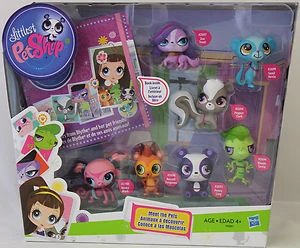
 |
| LPS DVD cover. |
The entire series has yet to be released to home media. Between 2013 and
2015, Shout! Factory released 45
episodes from the first three seasons across 9
DVD collections in North America. Primal
Screen released 11 episodes across 2
DVD collections in the United Kingdom and the Middle East. Beyond Home Entertainment released 30
episodes across 6
DVDs in Australia. The complete series has been made available on streaming
services, such as Amazon
Video.
EPISODE GUIDE:
Season 1:
“Blythe’s Big Adventure Part 1” (11/10/12) – Blythe and her father
move to Downtown City where she discovers she can communicate with animals.
“Blythe’s Big Adventure Part 2” (11/10/12) – The pets in the shop
below Blythe convince her to help save the shop from going out of business.
“Bad Hair Day” (11/17/12) – As Blythe gives Zoe a bad haircut, Minka
is pressured into becoming a famous artist.
“Gailbreak!” (11/24/12) – Zoe and her friends go to bust her sister
Gail out of Largest Ever Pet Shop.
“Penny For Your Laughs” (12/1/12) – Pepper takes to insult comedy
while the Biskits become Blythe’s friends after she defends them from a bully.
“Mean Isn’t Your Color” (12/8/12) – Blythe has a hard time with her
father having a date while Penny Ling struggles with the desire to tell Blythe
she doesn’t like her new outfit.
“Russell Up Some Fun” (12/15/12) – Being pestered to loosen up has
Russell create the alter ego “Fun Russell” while Sue begins dressing and acting
like Blythe.
“Blythe’s Crush” (12/22/12) – Sunil uses his “psychic abilities” to
try and locate Josh Sharp so that Blythe can return the keys he dropped.
“Dumb Dumbwaiter” (12/29/12) – Penny Ling leads the rescue when
Blythe, Zoe, Pepper and Minka end up stuck in the dumbwaiter.
“Eve of Destruction” (1/5/13) – Mrs. Twombly searches for her favorite
cleaning supply while Blythe referees Zoe and her rival, Madame Pom.
“Books and Covers” (1/12/13) – Blythe puts the Biskits on her Mathlete
team in order to compete while the pets think a new visitor is a spy from
Largest Ever Pet Shop.
“So You Skink You Can Dance” (1/19/13) – When Blythe and Vinnie go to
Hollywood, camera-shy Blythe is mistaken for a dancer on the program Shake-A-Leg.
“Lights, Camera, Mongoose!” (1/26/13) – Sunil and famous mongoose
Shahrukh trade lives.
“Topped with Buttercream” (2/9/13) – The pets end up stuck in Sweet
Delights with Buttercream and enjoy too many treats.
“Trading Places” (2/2/13) – Zoe asks Penny Ling to tell a new dog
camper that she likes him while Russell goes to Blythe’s school and gets lost.
“Sweet (Truck) Ride” (2/16/13) – When the pets accidentally send the
Sweet Truck careening down the street, Blythe gets the blame.
“Helicopter Dad” (2/23/13) – Roger surprises Blythe at school so theyc
an hang out and Minka makes a new friend.
“What’s in the Batter?” (3/2/13) – While helping Youngmee, Blythe
loses her necklace in cupcake batter.
“What Did You Say?” (3/9/13) – Blythe loses her ability to understand
the pets just as Vinnie accidentally ends up in the city dump.
“Bakers and Fakers” (3/16/13) – The pets learn the Biskits plan to
cheat to win the baking competition.
“Terriers and Tiaras” (3/23/13) – Blythe undergoes a bad
transformation when she agrees to be on a reality pet pageant show.
“Lotsa Luck” (3/30/13) – Blythe discovers Mrs. Twombly invented a
unique martial art while Pepper tries to make her hero, Old Bananas, laugh.
“Door-Jammed” (4/6/13) – Sunil and Vinnie suspect their friends became
werewolves while Mrs. Twombly seeks to reclaim a valuable doorknob from Fisher
Biskit.
“Frenemies” (4/13/13) – Zoe and Pepper become competitive in planning
a party for Penny Ling, and Vinnie learns he can dance better without his tail.
“Blythe’s Pet Project” (4/20/13) – Items go missing around the day
camp, including Mrs. Twombly’s glasses.
“Summertime Blues” (4/27/13) – Blythe gets anxiety over leaving after
she’s accepted into a junior program at a fashion school.
Season 2:
“Missing Blythe” (11/2/13) – The pets plan to visit Blythe at her
summer camp.
“The Nest Hats Craze!” (11/2/13) – A baby chick ends up in Blythe’s
nest hat.
“Eight Arms to Hold You” (11/9/13) – Russell’s slumber party is about
to be crashed by several uninvited guests.
“Heart of Parkness” (11/16/13) – Sunil rescues the racoons in City
Park and has to decide between being their king or returning to the pet shop.
“Pawlm Reading” (11/23/13) – A phony psychic tricks Mrs. Twombly into
a specific brand of pet food while the pets try to conform themselves to her
readings.
“The Treasure of Henrietta Twombly” (11/30/13) – A reality TV show
reveals a treasure is buried under the shop.
“What, Meme Worry?” (12/7/13) – Zoe becomes jealous when Sunil’s
picture goes viral.
“The Big, Feathered Parade” (12/14/13) – Blythe’s designs for the Big
Feathered Parade end up stolen and used by another designer named Ramon.
“A Day at the Museum” (12/21/13) – The pets get lost in a museum and
Blythe must find them before security does.
“Alligators and Handbags” (12/28/13) – The pets deal with a bully
while Blythe battles with self-confidence after a fashion icon gives her
designs a harsh critique.
“Blythe’s Big Idea” (1/4/14) – Blythe trades in her scooter for a
sales kiosk and Roger’s airline begins a Pet Jet service.
“Commercial Success” (1/11/14) – When business gets slow Mrs. Twombly
agrees to let Blythe shoot a commercial.
“So Interesting” (1/18/14) – The pets share interesting stories with
each other, which Penny Ling uses an opportunity to craft a wonderful fantasy.
“To Paris with Zoe” (1/25/14) – Blythe takes Zoe to Paris for a dog
show where Blythe falls for the city and Zoe falls for a miming street dog
named Phillippe.
“Super Sunil” (2/1/14) – Penny Ling convinces Sunil he has powers to
give him confidence, while Blythe helps out with the Sweet Delights truck.
“Sweet Pepper” (2/8/14) – Blythe babysits Buttercream while trying to
finish a new book, and Pepper isn’t sure how to profess her feelings for a new
camper.
“Shanghai Hi-Jinks” (2/15/14) – Blythe and the pets travel to Shanghai
where Mrs. Twombly receives and honor for inventing Kung Fu Quilting and Penny
Ling meets her family.
“Grounded” (2/22/14) – When Roger is laid off, he takes a job as the
Biskits’ personal assistant and chauffeur.
“Inside Job” (3/1/14) – Blythe runs for class president against the
Biskits while the pets try to locate the source of an annoying noise.
“Plane it on Rio!” (3/8/14) – Ramon reappears and tries to spoil
Blythe’s chances of competing in the Carnival parade.
“Littlest Bigfoot” (3/15/14) – Roger takes Blythe and the pets camping
to find Bigfoot where Penny Ling finds a friend and Blythe finds the Biskits
destroying the woods.
“Sunil’s Sick Day” (3/22/14) – Russell tries to help patch up Vinnie
and Sunil’s friendship.
“The Hedgehog in the Plastic Bubble” (3/29/14) – Russell and Blythe
find themselves alone.
“Standup Stinker” (4/5/14) – Blythe advises Pepper on her stand-up
while the pets try to convince Minka she’s the first monkey on Mars.
“The Expo Factor, Part 1” (4/12/14) – The stress over the
International Pet Fashion Expo increases when Blythe is asked to do a
photoshoot for the top fashion magazine.
“The Expo Factor, Part 2” (4/12/14) – The Biskits sabotage Blythe,
making all her fears about things going wrong seemingly come true.
Shorts Season 1:
“Tail-Rave-lum” (5/30/14) – L-Zard and his crew visit Vinnie for some
dancing.
“The Ladies of LPS” (6/13/14) – Blythe and the girl pets share some
quality time.
“Littlest Pet Peeves” (6/27/14) – Russell, Zoe and Sunil can’t seem to
stop annoying each other.
“Eau de Pepper” (7/11/14) – Pepper and Penny Ling try to capture her
happiest scent.
“Where’d the Escargot?” (8/1/14) – Vinnie and Penny Ling try to keep
snails from becoming food.
“Life of Cake” (8/8/14) – Sunil fights Steve for a piece of cake.
“The Fire Hydrant Song” (8/22/14) – Zoe sings to make herself feel
fabulous.
“Naptime’s a Ball” (9/19/14) – Russell wants a nap, but ends up on an
adventure instead.
“Just Not Into It” (10/3/14) – Russell, Vinnie and Sunil try on
clothes.
“Monkey Chase” (10/17/14) – Minka’s imagination runs wild as she
paints.
Season 3:
“Sleeper” (5/31/14) – Russell challenges Vinnie and Sunil to entertain
the new boarder, which they seemingly fail when he falls into a deep sleep.
“War of the Weirds” (6/7/14) – Blythe investigates a UFO the pets saw
while Twombly tries to figure out how to get more business.
“Some Assistance Required” (6/14/14) – Blythe becomes Mona Autum’s
assistant while Zoe and Russell deal with a pet model trying to sabotage
Russell’s photoshoot.
“Secret Cupet” (6/21/14) – Russell becomes the latest target of a
mysterious pet cupid.
“Hamster Hoods” (6/28/14) – Pepper and Vinnie investigate the
appearance of Largest Ever Pet Shop merchandise in the dumbwaiter.
“Tongue Tied” (7/5/14) – City pets flock from all over for help when
they learn of Blythe’s abilities, but she can’t seem to communicate with one
ferret.
“What’s So Scary About the Jungle? Everything!” (7/12/14) – Penny Ling
is disappointed when the host of her favorite nature show has developed a
phobia of pandas.
“Two Pets for Two Pests” (7/19/14) – Blythe tries to pair the Biskits
up with twin chinchillas while Vinnie proves he can paint to Minka.
“Feud for Thought” (7/26/14) – Whittany becomes jealous after Brittany
scores higher than her on a test, and arguing koalas cause chaos at the shop.
“Fish Out of Water” (8/2/14) – Blythe, Zoe and Minka try to rescue
Josh from working for the Biskits while the others work with an alligator to
save a goldfish in the sewer.
“If the Shoe Fits” (8/9/14) – The pets follow Blythe and Youngmee to
the Biskits’ party disguised as a tall man.
“The Very Littlest Pet Shop” (8/16/14) – A jungle curse shrinks the
pet shop and pets, and a little girl believes they are toys.
“The Secret Recipe” (8/23/14) – Blythe has to reveal her secret to
Youngmee to save their friendship.
“Winter Wonder Wha…?” (12/13/14) – Blythe and Zoe go to the Biskits’
winter chateau and the others work on cheering up a penguin.
“Snow Stormin’” (12/20/14) – A massive snowstorm traps Blythe and the
pets in the shop.
“Back Window” (12/27/14) – An injured Russell swears he sees Josh
stealing Blythe’s designs from the garbage.
“Room Enough” (1/3/15) – A visiting kitten wants to know why Blythe
can understand them as Blythe considers redecorating her room.
“Why Can’t We Be Friends?” (1/10/15) – Blythe makes a new friend at
the thrift shop and Vinnie has to hide his new spider friend from Sunil.
“Pet Sounds” (1/17/15) – Minka’s cousin believes his scientist owner
invented a helmet that lets him talk to pets.
“The Sister Story” (1/24/15) – Blythe’s competitive aunt comes for a
visit and she and Roger compete non-stop, while Vinnie and Sunil compete to see
who can predict the future best.
“A Night at the Pawza” (1/31/15) – Blythe and Twombly help a friend’s
hotel become a success to keep it out of Fisher’s hands.
“Proud as a…Peacock?” (2/7/15) – The pets try to help a shy peacock
gain confidence.
“Sue Syndrome” (2/21/15) – Sue is nervous about receiving an award in
front of the whole school while Pepper is jealous over a sweet-smelling
visiting skunk.
“In the Loop” (2/28/15) – Russell seems to be living the same day over
and over when a groundhog visits.
“It’s the Pet Fest! Part 1” (3/7/15) – Blythe scrambles to make her
Pet Fest happen.
“It’s the Pet Fest! Part 2” (3/7/15) – When the venue falls through,
Blythe must find a new one for the Pet Fest.
Shorts Season 2:
“The Biggity-Big Dog Show” (10/4/15) – Zoe gets a rash on the day of a
big dog show.
“Sour Puss” (10/4/15) – Blythe and the girl pets sing about having
girl time.
“So Like Bored” (10/4/15) – The Biskits think of ways to entertain
themselves.
“OmmmMG” (10/4/15) – Sunil tries to get Vinnie and Minka to sit still.
“What’s Next?” (11/5/15) – Blythe ponders what to do next in her life.
Season 4:
“The Tortoise and the Heir” (11/7/15) – Blythe meets a tortoise who
ends up being her mother’s former pet, and keeper of her journal.
“Pitch Purrfect” (11/7/15) – Zoe forms her own singing group after
being rejected from an all-cat one, and Twombly sells her doorknobs so that she
can buy the street.
“Ivan the Terrific” (11/14/15) – The pets deal with a lost circus bear
while Blythe helps Youngmee find her perfect pet.
“Senior Day” (11/21/15) – Russell’s father comes to stay with him when
his owner’s senior center says he can no longer stay.
“Littlest Pet Shop of Horrors” (11/28/15) – It’s Halloween, and the
pets and Blythe tell spooky stories.
“Game of Groans” (12/5/15) – Blythe, Russell, Vinnie and Sunil head to
the Renaissance Fair.
“The Tiniest Animal Store” (12/12/15) – The shop becomes the basis for
a new sitcom, but Blythe worries it could reveal her secret.
“Spendthrifty” (12/19/15) – Blythe becomes a sales clerk but is unable
to resist the bargains, while the pets distrust Blythe’s new doll Roger brought
her from Japan.
“Un-vetted” (12/26/15) – Blythe and Russell go camping while Zoe
develops a crush on her vet’s new dog.
“Pump Up the Panda” (1/2/16) – Blythe and the pets go to the beach
where Penny Ling gets a lobster personal trainer and Vinnie and Sunil have a
sandcastle building contest.
“Snipmates” (1/9/16) – Sugar Sprinkles is uncharacteristically grouchy
while Blythe competes against her former camp roommate in a fashion show.
“Guilt Tripping” (1/16/16) – Blythe accidentally gets the Biskits
suspended from school while Pepper waits for Vinnie’s punishment after breaking
his lucky rock.
“Petnapped!” (1/23/16) – A departed millionaire’s dog must determine
her new owner, while the pets try to reenact an episode of Russell’s favorite
show.
“Steamed” (3/26/16) – Blythe helps Twombly set up her new coffee shop
and Sugar Sprinkle’s song causes Pepper to unleash a coffee smell that attracts
customers.
“Two Peas in a Podcast” (3/26/16) – The Biskits try to create their
own vlog to compete with Blythe’s and the pets are devastated to learn Penny
Ling is moving away.
“Go Figure!” (4/2/16) – Minka wants to learn Zen from a grasshopper
more interest in Russell, and Vinnie accidentally gets sold as a toy when lost
at a sci-fi convention.
“A Doggie Biskit” (4/9/16) – Eliza’s dog Poppy Pawsley doesn’t want to
participate in a dog show.
“It’s a Happy, Happy, Happy, Happy World” (4/16/16) – Josh tries to
help Blythe find her mother’s journal while a quokka encourages Sunil to find
happiness in the city.
“Race Team: Buttercream” (4/23/16) – The starting bell in underground
bunny races turns Buttercream into a competitive brute, betting on whom costs
Sunil and Vinnie Blythe’s phone.
“On the Same Page” (4/30/16) – An entry in the journal has Blythe
worried she’ll lose her ability while the boys and girls have a falling out in
the daycare over the girls’ amount of stuff.
“Paint a Picture, it Lasts Longer” (5/7/16) – Blythe takes the credit
for a painting Minka’s embarrassed to have done.
“Bake it ‘til You Make It” (5/14/16) – Sunil pretends to be a doctor
for his visiting parents and Blythe has her famous cousin help around Sweet
Delights.
“LPS: The Moosical” (5/21/16) – A visiting moose nervously sings,
which bothers everyone except the part-Canadian Blythe.
“Seeing Red” (5/28/16) – Penny Ling becomes curious about a visiting
panda while Blythe writes a story about her parents as teenagers.
“Littlest Pet Street Part 1” (6/4/16) – Picking up a viral video star
for the street’s grand opening leads the Pet Jet to crash on an abandoned
island.
“Littlest Pet Street Part 2” (6/4/16) – Blythe, Roger and the pets try
to figure a way off the island while Twombly desperately tries to get
everything ready for the grand opening.
Subscribe to:
Posts (Atom)