Remember that one day when you could wake up without an alarm? When you would get your favorite bowl of cereal and sit between the hours of 8 and 12? This is a blog dedicated to the greatest time of our childhood: Saturday mornings. The television programs you watched, the memories attached to them, and maybe introducing you to something you didn't realize existed. Updated every weekend.
DiC
Animation City, Bustin’ Productions, Inc., Reteitalia
MAIN CAST: MC Hammer
– Himself (live) Clark Johnson
– Hammerman/Stanley Burrell Ron Rubin
– Righty Susan Roman
– Winnie Jeff
Jones – Gramps/Soul Man Miguel Lee
– Unspecified Maurice Dean Wint
– Showbiz Joe Matheson
– Unspecified Neil Crone
– Ludwig Stevie Vallance
(as Louise Vallance) – Jody, various Carmen Twillie
– Fly Girls Born in Oakland, California,
Stanley Kirk Burrell got his start at age 11, earning money by performing dance
routines outside Oakland
Coliseum during Oakland
A’s
home games. Team owner Charles
Finley took notice of young Burrell and eventually made him
the team’s batboy. While working for the A’s, he performed at various clubs
while they were on away games under the moniker “MC” for “Master of
Ceremonies”. “Hammer” was soon added due to his resemblance to home-run king Hank
“The Hammer” Aaron. Hammer’s life probably would have played
out very differently if he made the cut for the San Francisco Giants
when he tried out.
MC Hammer, rocking his trademark parachute pants.
While Hammer loved baseball, he
loved rapping and performing a bit more. After a stint in college and the Navy, Hammer borrowed
some money from former A’s Mike
Davis and Dwayne Murphy
and launched his own record label: Bust
It Productions. Through it, he released the albums Feel My Powerand
Let’s
Get It Started. Both sold well enough to get him signed
to Capitol Records.
His next album, Please
Hammer Don’t Hurt ‘Em, became
the most successful rap record of all time by selling 10 million copies and
dominating the airwaves with singles like “U Can’t Touch This”.
Hammer produced and starred
in a film titled after the album and quickly pushed out his
next one, Too
Legit to Quit, in late 1991 (which was
also the first released after he dropped the “MC” from his name).
Stanley's magic shoes turn him into...Hammerman!
Because Hammer’s lyrics were clean,
he had appeal to both adults and children. With that in mind, Andy Heyward
approached Hammer about developing a cartoon based around him and his music. That
series was Hammerman, which depicted Hammer as a rapping and dancing
superhero. In the series, the lead character was Stanley Burrell (Clark
Johnson), a rec center organizer in the city of Oaktown (named after Hammer’s other
record label) who loved to dance. He was discovered by
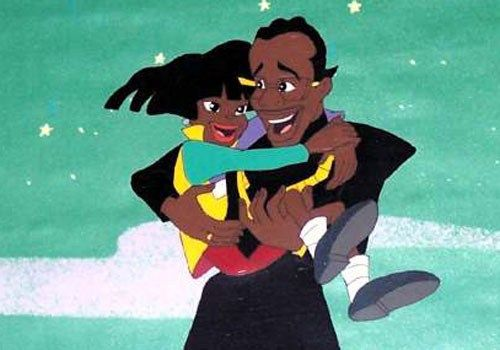
a man known simply as Gramps (Jeff Jones) and his granddaughter, Jody (Steve
Vallance). Gramps had been the superhero Soul Man (patterned after James Brown)
throughout his life, but it was time to retire and pass the mantle on. He gave
Stanley his magic talking dancing shows, Righty (Ron Rubin) and Lefty, and they
turned Stanley into Hammerman with a black shirt, black parachute pants, and a
gold chain. Hammerman could rap and dance his way through most situations;
using musical notes to bring inanimate objects to life or imprison bad guys,
defying the laws of gravity or physics, etc. His parachute pants also served as
an actual parachute. Because his powers were so ill-defined (and verging on
god-like), the actual threat in each episode came from Stanley’s opportunity to
transform in time either because he was already caught up in the action as Stanley
or his shoes were out of reach for some reason.
Fly, magical music notes!
Only
Gramps knew about Stanley’s alter-ego, which was odd considering Jody was a
part of the search and aware of Gramps’ past tenure as a hero. Other characters
included Winnie (Susan Roman), who worked at the rec center and was an aspiring
veterinarian; Showbiz (Maurice Dean Wint), who was always trying to act like
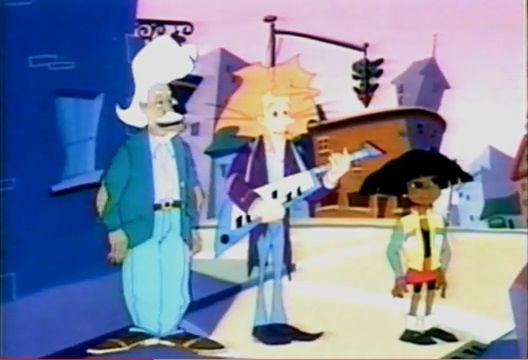
Stanley’s manager and turn him into a professional performer; and, Ludwig (Neil
Crone) a street musician that played keytar (like his namesake, Ludwig
von Beethoven). Additionally, two identical girls dressed in spandex called Fly Girls
(Carmen Twille) would pop up from time to time, acting like a Greek chorus and seemingly
unnoticed by the other characters (however, they tended to get
caught up in the events of an episode). Among Hammerman’s foes were Defacely
Marmeister (John
Stocker), who loved graffiti and looked like an abstract
painting; Paula Bunion, who was obsessed with shoes; and Boss Grindenheimer (Dan Hennessey),
an evil genius and mad scientist.
Hammerman rescues Jody.
Hammerman debuted on ABC on September 7, 1991, a
co-production of DiC Entertainment
and Bustin’ Productions, a spin-off to Bust It. Reportedly viewing it as his
social responsibility, the series took inspiration from Fat
Albert and the Cosby Kidsby
having live-action wraparound segments featuring Hammer discussing the plot and
moral of the story with a group of kids on animated backgrounds from the show.
Hammer also interacted with his animated counterpart in the series’ intro,
rapping the theme song by him and Felton Pilate
that spelled out Hammerman’s origins. Additional Hammer songs were integrated
into the show’s soundtrack with additional music by The Music Team and Chase/Rucker
Productions. The series was written by Reed Shelly,
Bruce Shelly,
Bob Forward,
Eve Forward,
Martha Moran,
Robert Askin,
Steven Weiss
and Paul
Dell,
with the Shellys serving as story editors. Ed
Lee handled the character designs.
Hammer hanging out on set with kids to spell out today's moral.
DiC Entertainment had earned itself
a bit of a reputation in the industry for trying to produce a product as
cheaply as possible. Many would come to regard the company’s initials as
standing for “Do It Cheap”. However, while many of their productions still
looked decent despite animation limitations, Hammerman became the one
program that most embodied that distinction. While the intro, animated by
Milimetros Dibujos Animados, S.A., was animated smoothly enough, the show
itself, animated by Pacific
Rim Animation L.T.D., was horrendous by comparison. Instead of
the traditional 24 frames per second, Hammerman ran at 10 or less,
depending on the episode and scene. Many times, it looked as if the only things
animated were the keyframes (the start and ending positions of a movement),
with the in-betweens (the drawings that create the illusion of movement between
the keyframes) skipped entirely. Continuity mistakes were also common; such as
Jody being tied up and captured in one shot but free and escaping the next
without any kind of context.
Gramps with Ludwig and Jody.
Needless to say, the show performed
abysmally in the ratings and only lasted a single season of 13 episodes. This
also coincided with a turn in Hammer’s personal fortunes as Too Legit to
Quit failed to perform as well as the previous album. He spent the money
faster than it came in, resulting in his declaring
bankruptcy in 1996. Hammer eventually rebounded and continued
making music, working in the industry and investing, as well as riding a wave
of nostalgia to appear in reality
shows and commercials,
but had never reattained the level of success he originally experienced.
The villainous Defacely Marmeister.
While
Hammer the man continued on, Hammerman wouldn’t been seen again until
2014. The Cartoon
Network series Robot
Chickenran an episode called “Welcome to the Golf Jam”,
which saw disgraced
golfer Tiger Woods
attempting to rebuild his reputation by making his own Space
Jammovie. However, the only company that
would agree to partner with him was DiC. As a result, poorly animated versions
of several DiC characters appeared, including Hammerman (Zeb Wells).
One of the VHS tapes.
There was some merchandising to go
along with the show. Three episodes were released to
VHS
by Buena
Vista Home Entertainment in 1992; the only official releases
to date, with more episodes being made available via uploads on YouTube (although not all
in English). View-Master
would adapt “Defeated Graffiti” into three
slide reels. JusToys produced
a set of temporary
tattoos featuring the main characters and Hammerman’s shoes,
while Thermos made a lunch box
depicting Hammerman and Gramps hanging out with some neighborhood kids. White Castle even
hosted a strange
promotion where they gave out Hammerman toothpaste, a
toothbrush, a sponge and a bar of soap.
EPISODE GUIDE (airdates approximate):
“Defeated
Graffiti” (9/7/91) – Defacely Marmeister tricks neighborhood kids into
graffitiing up the buildings with his special paint that he can bring to life. “Winnie’s
Winner” (10/19/91) – Knowing Hammerman is always hanging around the rec center,
three villains drop off a bugged dog so that they can find and trap him. “Rapoleon”
(11/16/91) – Feeling like nobody pays attention to his beats because he’s
short, Raopoleon’s plan to turn himself larger ends up giving him the means to
make the world smaller. “Will
and the Jerks” (11/23/91) – UNAVAILABLE. “If
the Shoe Fits” (11/30/91) – Paula Bunion makes off with Lefty, who happens to
be in love with one of her boots. “Nobody’s
Perfect” (12/7/91) – Stanley’s brother invents a robot designed to make
everything perfect, but failed to take into account that we live in an
imperfect world. “Dropping
Out” – Hammerman tries to keep one of the rec center kids from dropping out of
school to play pro ball by taking him to the future. “Lights,
Camera, Hammer!” – Showbiz drags Stanley to a movie production and they both
end up captured on celluloid—literally. “Blast
from the Past” – Gramps is feeling pretty useless until one of his old foes
returns and gives Hammerman some trouble. “Who’s
Who” – UNAVAILABLE. “Work
This” – UNAVAILABLE.
Disney’s The Owl House is a
groundbreaking animated series created by Dana Terrace. The series
follows ordinary human teenager Luz Noceda (Sarah-Nicole Robles) as she accidentally
finds her way into a magical land full of witches and demons. There, she finds
a new family—renegade witch Eda Clawthorne (Wendie Malik), wolf-like demon
King (Alex Hirsch), and
worm-like owl-faced house demon Hooty (also Hirsch)—makes new friends—illusion-casting
Gus (Issac Ryan Brown),
plant magic-based Willow (Tati
Gabrielle), and abomination-making Amity (Mae Whitman)—while also
fulfilling her dreams of learning how to be a witch, as well as becoming
embroiled in the schemes of the sinister Emperor Belos (Matthew Rhys).
The series
has earned a strong fan-following due to its characters, settings and
especially its diversity (the cast, crew and characters are all a mix of races
and sexual orientations). Currently on its second season, it has been wowing
fans even more with the densely packed stories full of character development
and lore. While currently on its mid-season hiatus, we thought it would be a
good time to check off our favorite moments of the season (so far). Do you
agree with our picks? Do you have different ones? Let us know in the comments, on Facebook, or on Twitter @SatMForever! Also, a SPOILER WARNING is in
effect, so if you haven’t watched any episodes yet (partially available now on Disney+), you’ve been warned!
FRIENDSHIP GOALS
Following the
conclusion of the first season, Eda’s sister Lilith (Cissy Jones) had left the Emperor’s
Coven, lost her magic and taken on half of Eda’s curse as penance for putting
it on her in the first place. She was at her lowest point and wanted to make it
up to Eda further by gathering the ingredients to concoct a potion that would
allow Eda to spy on the Emperor. And, much like other residents of the Owl
House, she found Hooty to be an annoyance. That is until he came to her rescue
in acquiring honey from fire bees. From that moment on, they became fast
friends: joking with each other, hanging out together, and even becoming pen
pals when Lilith left the Owl House to reunite with her family. If that’s not friendship
goals, what is?
CREEPY LUZ
In “Keeping
Up A-fear-ances”, we finally got to meet Eda’s mother (Deb Doetzer), who has been working
on finding a cure for Eda’s curse without much success. However, that wasn’t the
big part of this episode. No, it came in the last few seconds, where we got a
glimpse into Luz’s home in the human realm and found that her mother, Camila (Elizabeth Grullon), hasn’t been
missing her since she’s been trapped in the Demon Realm—because she’s already there?!
That’s right, someone who resembled Luz (dubbed “Creepy Luz” by the fandom) was
in her house, and Camila was none the wiser. We had gotten hints of the double
in the previous season when it was shown that Camila had been getting physical letters
from Luz (the real one had been texting her through the portal until she had to
destroy it), but this was the first time we saw her in the flesh and ominous
shadows.
LA CHANCLA
We hadn’t
seen much of Camila outside of the first episode, but “Yesterday’s Lie” changed
all that as we got to the bottom of the “Creepy” Luz subplot. It turned out the
doppelganger was none other than a basilisk named Vee (Michaela Dietz) that escaped captivity
by Emperor Belos and retreated to the human realm, taking Luz’s place in order
to get a new life. Unfortunately, a witch hunter that had encountered Eda
before managed to capture her, forcing Luz—who was able to peer through and
interact through reflections from a portal door she was able to build—to contact
Camila for help. Camila managed to keep it together long enough to whip out la
chancla (a flip flop) and give the witch hunter a sound thrashing, freeing Vee
and bringing her home. That moment, along with a few others of Camila’s, was
sure to have Hispanic fans dying over the accuracy.
AMITY TAKES A STAND
Amity had
long been subjected to the whims and desires of her family. Be the best,
associate with the best, live up to the Blight name. In “Escaping Expulsion”, Luz,
Gus and Willow were all expelled from Hexside at the behest of Amity’s mother
when she felt they were making her too distracted. Luz made a deal with Odalia
(Rachel MacFarlane) to get
them back into the school by being the target for their latest abomination
weaponry demonstration. Once Luz’s life was in danger, though, Amity jumped in
to rescue her; going against her mother’s wishes and destroying the necklace she
used to communicate telepathically with her. The episode showcased how strong
Amity had become both magically and psychologically since allowing herself to
be with people she wanted to be with. And, her awesome display managed to
finally switch something on in Luz that she began reciprocating the crush Amity
had on her since last season. But, we’ll get into that part later.
BARD MAGIC
We’d
already been introduced to various kinds of magic in the show: glyph magic; wild
magic, which was all-encompassing; plant magic; illusion magic; construction
magic, which could cause structures to rise up out of the ground; abomination
magic, which crafted semi-autonomous creatures out of a purple goo; healing
magic; oracle magic; beast-keeping, which could summon and control various
creatures; and potion magic. One we knew existed but never saw anything of was
bard magic. Until “Eda’s Requiem”. Eda was reunited with ex-lover Raine
Whispers (Avi Roque), who had just become the head of the Emperor’s Bard Coven.
As a result, we finally got to see bard magic in action: from controlling
people and objects to bathing the world in a glorious display of color
masterfully rendered by the animation team. Add to that it was partially introduced
to us by the first non-binary Disney character and that makes it all the more
memorable.
GUS LEVELS UP
Gus was beginning
to question his choice to pursue illusion-casting, feeling there isn’t much to
offer in creating something that isn’t really there. In “Through the Looking
Glass Ruins”, Luz encouraged him to go on an adventure with some Glandis
students (a rival school to Hexside) that led them to what turned out to be an
illusionist graveyard. Gus ended up creating the ultimate elaborate illusion to
keep the Glandis students from looting the graveyard, complete with body terror
and bleeding statues. Frankly, it’s amazing Disney let that go through! But as
awesome as this was, Gus’ adventure was unfortunately overshadowed by another
event from that episode…
THE KISS
While Gus was
on his adventure, Luz was having one of her own with Amtiy; seeking out the
journal of Philip Whittebane (Alex
Lawther), a human who had come to the Boiling Isles back in the 1600s. Amity,
of course, had been crushing hard on Luz and put her job on the line to help
her as a result. Unfortunately, it ended up with Luz accidentally getting Amity
fired when it was discovered an echo mouse had eaten the journal, and Amity now
needed to come to terms with all the new emotions that seem to be clouding her
judgement lately. Luz being Luz, she got Amity’s job back after some harrowing
tasks and made peace with the mouse when it was discovered it could project the
contents of the journal. In that moment of sweetness, Amity was overcome with
the desire to kiss Luz on the cheek and acted on it; a moment that surprised
both of them and had the fandom burst out in a cheer heard from space.
HARPY EDA
In “Knock,
Knock, Knockin’ on Hooty’s Door”, Hooty attempts to help his friends overcome
their problems in the most Hooty ways possible. Helping Eda get some rest forces
her into a dream encounter with the owl beast that inhabited her as part of her
curse. Through shared memories and symbolism, Eda decides instead of fighting
maybe they should form a truce. The result? Eda gained a new badass harpy form
while still being in full possession of her faculties.
LUMITY BECOMES CANON!
Lumity, the
fandom designation for the romance between Luz and Amity, became official in
the episode “Knock, Knock, Knockin’ on Hooty’s Door”. Hooty kidnapped Amity (as
one does) and dropped both girls into a tunnel of love he formed under the Owl House.
Now, keep in mind, at this point Amity thinks Luz only thinks of her as a
friend and Luz is afraid to make her own move because of bad experiences in the
past. While Amity enjoys the tunnel, Luz is too horrified to notice and
proceeds to destroy it in front of her, making Amity think Luz doesn’t like
her. Hooty throwing a devastating tantrum forces Luz to face her fear and
finally ask Amity out—only to have Amity beat her to it! It was such a cute and
realistically awkward moment, and made fans squeal with glee over Lumity
becoming official and being an actual on-screen same sex couple in a
Disney show.
AMITY VS. HUNTER
In “Eclipse
Lake”, Amity, Eda and King were on the hunt for some Titan’s Blood to create a
new portal back to the human realm. However, Emperor Belos needed it as well for
his own portal and his minions were looking for it at the same time; as was his
protégé, Hunter (Zeno Robinson),
in an attempt to prove himself. Discovering the Titan’s Blood had dried up,
Hunter was ready to give up on life. Amity attempted to take a page from Luz’s
book in trying to comfort him, but he snapped when he saw she had the original
portal door key. What followed was one of the most epic fight scenes in the
show yet, with Amity’s abomination-magic wielding being reminiscent of Whitman’s
previous water-bending character Katara from Avatar: The Last Airbender. The
battle ultimately ended in a badass stalemate, but Amity no doubt proved how
awesome a girlfriend she was (a term that was dropped FOUR TIMES this episode,
by the way).
MAIN
CAST: Wolfman Jack – Himself Robert Vega – Ricardo Siu Ming Carson – Sarah Noelle North – Sunny Frank Welker – Bopper Jason Bernard – Mr. Morris The man best known as Wolfman Jack was actually Robert Weston Smith from
Brooklyn, New York. He grew up listening to the radio and pretending to be the
DJ. At the age of 16, he decided to meet one of his idols: prominent DJ Alan
Freed, who broke down racial barriers by getting kids of all races to listen
to the same music (at a time when radio was as segregated as the rest of the
country) and helping to spread the
importance of rock and roll. After attending the National
Academy of Broadcasting in Washington, D.C., Smith got a job at
WYOU (now WTJZ) in Newport
News, Virginia. It was there he began experimenting with on-air personas. His first
was “Daddy Jules”, a tribute to the Black DJs who influenced him in his early
years, that played R&B. When the station changed formats, he became “Roger
Gordon and Music in Good Taste” and played classical. After moving to KCIJ (now
KOKA) in Shreveport,
Louisiana he became “Big Smith with the Records”, playing current hits.
Wolfman Jack.
It was at KCIJ that Smith developed his most famous persona: Wolfman
Jack. The name was derived from Freed’s original persona, “Moon Dog”, after New
York street musician Moondog, that was
accompanied by the recording of a howl, as well as Smith’s own love of horror
films and often playing the
wolfman role with his young nephews. The “Jack” portion came from hipster
lingo. The mannerisms he adopted for his personal were modeled after bluesman Howlin’ Wolf. It wasn’t until he
moved to XERF (now XHRF) in Ciudad
Acuña,
Coahuila, Mexico that Wolfman Jack became a household name. XERF
was what was known as a “border blaster” radio station; powerful enough to
transmit across North America and, at times, even Europe and the Soviet Union.
It was also known as “pirate radio” as they didn’t have to pay FCC licensing fees or
royalties. Border stations made their money by taking 50% of whatever products
were sold from their advertisements, and Wolfman’s show was done as a giant
overnight infomercial pitching various products with breaks of rock ‘n’ roll and
R&B music (many of which were songs banned on more conservative stations).
He refined his persona into a risqué exuberance, encouraging listeners to “get
naked” or “lay your hands on the radio and squeeze my knobs” and punctuating
his banter with howls. His signature gravelly voice (reportedly achieved with a
shot of whiskey) helped him further stand out from the other DJs on the air.
Wolfman leaning into his love of horror.
Part of Wolfman’s popularity stemmed from his anonymity. Nobody knew
what Wolfman looked like—not even Wolfman. When he did eventually start making
public appearances, Wolfman would look different each time (hairstyles, types
of facial hair, tone of his skin, etc.) as he decided on what the Wolfman would
be. It wouldn’t be until 1969’s A Session with the
Committeethat his audience would get their first major
glimpse of the Wolfman. Upon moving to Minneapolis, Minnesota to run KUXL (now KDIZ), Wolfman continued
to broadcast on XERF via taped shows. Eventually, this would lead to Wolfman
becoming one of the first rock and roll syndicated programs as he sold edited
versions of his Mexican radio tapes to radio stations everywhere.
While Wolfman’s notoriety and popularity grew to where he was recording
and producing his own albums and appearing in television programs and films,
his biggest break came from his appearance in George
Lucas’ second film, American Graffiti. Lucas was a fan of Wolfman’s
radio show and included him as the ever-present DJ in the film. Because of the
film’s enormous success and the deal Wolfman made to star in it, he ended up earning
a regular income for the rest of his life. This move into the mainstream seemed
like a betrayal of his rebellious origins to many longtime fans, but people
continued to listen and the work continued to come in.
Promo art featuring Ricardo, Sarah, Wolfman, Bopper and Sunny with some of their featured musical acts.
In 1980, Wolfman made the leap into lending his voice for animation. His
first outing was as the opening narrator for The
Fonz and the Happy Days Gang, which starred his American Graffiti co-star
Ron
Howard. So it was only natural for Wolfman to be tapped as the central
character to Dick Clark’s attempt to
capitalize on the popularity of MTV and further expand
his own music-based empire. Wolf Rock TV, co-produced by Dick
Clark Productions and DiC Enterprises, found Wolfman Jack
as the host of a rock music TV program. Aiding him were three teenagers: Sarah
(Siu Ming Carson), Sunny (Noelle North) and Ricardo (Robert Vega), along with
their pet breakdancing parrot, Bopper (Frank Welker). Always on their case to
make sure episodes were ready to air in time was the stuffy station manager Mr.
Morris (Jason Bernard), who didn’t approve of Jack’s style or music choices.
Ad for the Saturday Morning Preview Park special.
Wolf Rock TV debuted on ABC on September 8, 1984.
It was promoted the night before with ABC’s other new offerings on The ABC Saturday
Morning Preview Park special, hosted by “Weird Al” Yankovic and featuring an
appearance by Wolfman himself. The series was a hybrid of animation and
live-action, with actual music video clips as well as interviews with the
musicians themselves and factoids about the music. Unfortunately, banking on
the combined power of the growing MTV generation and the notoriety of Wolfman
Jack didn’t help the show fare all that well in the ratings. After 7 of the
planned 13 episodes aired, it was yanked off the air and replaced by the rerun
package Scary Scooby
Funnies. The next year, DiC would revisit and revamp the format for another musical
series: Kidd
Video. Along with music video clips, the series made heavy use of licensed
music and featured live-action music videos starring the fictional band created
for the show. It ended up being more successful, lasting 2 full seasons. Wolf
Rock TV wasn’t seen again until 1989, when it and Kidd Video were
combined into the syndicated Wolf Rock Power Hour.
A promo for the show featuring Wolfman and more featured video stills.
Because
of the licensed music as well as its overall failure, Wolf Rock TV hasn’t
been seen or broadcast since. A rarity for the internet age, no video footage
has managed to surface outside of the clips from the preview special and a
recording of the theme song. Mentions of it could only be found on DiC’s
old website before it was taken over by Cookie Jar
Entertainment. Wolfman’s and Clark’s own sites omitted
it altogether. A variety of merchandise, however, has been seen and included puffy
stickers and an album and sunglasses
mounted on a headband by Gordy International; an LCD watch
by Elgin
National Industries; a coloring
book
by Golden;
and a carry
tote.
Animation
cels
have also been found available online.
A young Wolfman at the microphone.
After
a storied career in radio, Wolfman performed what would be his last show from
the Hard
Rock Café in Washington, D.C.
On July 1, 1995, Wolfman returned home where he died suddenly from a heart
attack. Five years later, Wolfman
Jack Licensing was formed and began digitizing all of Wolfman’s old tapes,
allowing him to continue to be broadcast around the world.
EPISODE
GUIDE: “The
Video Nappers” (9/8/84) – UNAVAILABLE “Bad
News Birds” (9/15/84) – UNAVAILABLE “Bopper
Goes Ape” (9/22/84) – UNAVAILABLE “The
Nerds Who Fell to Earth” (9/29/84) – UNAVAILABLE “No
Time for Sarge” (10/6/84) – UNAVAILABLE “Rockin’
Robot” (10/13/84) – UNAVAILABLE “Wolfman’s
Granny” (10/20/84) – UNAVAILABLE