
For the history of the Harlem Globetrotters, check out the post here.
 |
| Globetrotters character model sheet. |
 |
| Close-up character art from the Globetrotters album. |
Harlem Globetrotters debuted on CBS on September 12, 1970. Like other Hanna-Barbera productions, the series followed a formula for each episode. Typically, they would find the Globetrotters winding up in a location where they get involved in some kind of conflict either voluntarily or by chance. The Globetrotters settled the matter with a basketball game in which the villains would constantly cheat to win. But, of course, the Globetrotters managed to turn it around in the second half and triumph over all adversity; driving home the pro-social message of sportsmanship and fair play. The series was written by Heywood Kling, Tom Dagenais, Michael Maltese and Dalton Sandifer, with Joe Ruby and Ken Spears serving as story editors.
 |
| Globetrotters 1971 program. |
Globetrotters was not only the first Saturday morning carton to feature
real sports stars, but it was the first to feature a predominantly
African-American cast; both on screen and in the recording booth. It shared a
distinction with another Hanna-Barbera property that aired earlier in the day: Josie
and the Pussycats, which featured the first African-American female character.
The year prior, Filmation’s The
Hardy Boys had the first African-American male (however, this would
eventually be retroactively replaced by their series Aquaman
when it was
revealed the villain Black Manta was
African-American in 1977).
 |
| The Globetrotters album. |
Don
Kirshner, music supervisor for the show, also
oversaw the production of a soundtrack featuring the music used in the program;
typically, from the basketball games in each episode. The record, The Globetrotters, was produced by series theme composer Jeff Barry and released in 1970 by Kirshner Records
featuring songs by Neil
Sedaka, Howard
Greenfield, Rudy Clark,
J.R. Bailey, Ken Williams,
Ron Dante and Jamie Carr. The
songs “Cheer Me Up” with “Gravy” and “Rainy Day Bells” with “Meadowlark” were released as two separate single albums. Three more
single albums were released with songs not featured on Globetrotters;
one of which included the actual Globetrotters’ theme, “Sweet Georgia Brown”. The real Meadowlark provided background vocals on
several of the tracks, making him the only Globetrotter to have any direct involvement
in the project.
 |
| Page from the Harlem Globetrotters comic by Gold Key. |
Globetrotters ran for a full first season and an abbreviated second
season before it was ultimately cancelled. The series did make a brief return
to television in reruns in 1978 as Go-Go Globetrotters on NBC. In
1971, the team made their first appearance in Gold Key Comics’ Hanna-Barbera
Fun-In #8 before getting their
own twelve-issue
series between 1972 and 1975. Whitman also published
several coloring
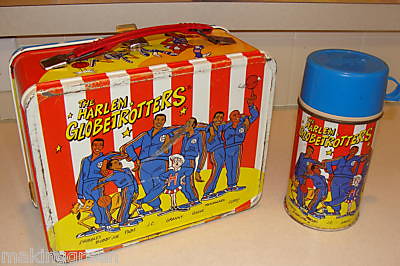
books. Milton Bradley produced a board game using the Hanna-Barbera character models, while Thermos released
two different lunchboxes; one of which depicted
an actual scene from an episode. Reruns
would air in 1999 on TV Land as part of
its TV Land Super
Retrovision Saturdaze programming block. The series, which is owned by co-producer
CBS and its parent company, has not yet seen a home video release.
 |
| The New Scooby-Doo Movies title card introducing the Globetrotters. |
The animated Globetrotters were featured guests
in three episodes of The
New Scooby-Doo Movies in 1972 and 1973.
In 1980, similar character models and their bus were used in the movie The Harlem Globetrotters
Meet Snow White; although it featured a
slightly altered cast to better represent the then-current line-up. In 1998,
the series was lampooned as part of Robert Smigel’s “TV Funhouse” on Saturday Night Live. In it, the
Globetrotters accidentally went back in time to the first
Christmas, instead of their first
Christmas together.
Originally posted in 2015. Updated in 2020.


No comments:
Post a Comment