

Remember that one day when you could wake up without an alarm? When you would get your favorite bowl of cereal and sit between the hours of 8 and 12? This is a blog dedicated to the greatest time of our childhood: Saturday mornings. The television programs you watched, the memories attached to them, and maybe introducing you to something you didn't realize existed. Updated every weekend.
June 29, 2019


SPIDER-MAN 3 CEREAL

SPIDER-MAN 3 CEREAL
General Mills
The final entry in what
would become the Sam Raimi Spider-Man
film trilogy came with 2007’s Spider-Man 3. Written by Raimi, his
brother Ivan, and Alvin Sargent, the film became
the victim of studio interference and more characters began being added than
could adequately be managed in a single film. Along with Sandman (Thomas Haden Church), there was
Harry Osborn’s (James Franco) transformation
into a new kind of Green Goblin and Peter Parker’s
(Tobey Maguire) new work
rival Eddie Brock
(Topher Grace) becoming the
symbiotic villain Venom. Also thrown in was Gwen Stacy
(Bryce Dallas Howard) to
create a love-triangle for Peter and Mary Jane (Kirsten Dunst). Sony Pictures released the film on May
4, 2007, and despite less-than-favorable reviews when compared to the first two
films, it ended up grossing a series high of $890.9 million; becoming the 3rd
highest of the year and setting a worldwide single-day record of $104 million.
Replacing Kellogg’s as the food tie-in partner of the
franchise, General Mills released Spider-Man
3 cereal. They chose to represent the cereal with red and blue ball puffs
that had a fruity flavoring. The back of the box was taken up by a single large
maze game set in a spider’s web. Like Kellogg’s, General Mills included tie-in
premiums in their other cereals in the form of squirt
toys in the shape of Spidey and the film’s three villains.
 |
| Back of the box. |
SPIDER-MAN MOVIE CEREALS

Kellogg’s
The comic book movie
revolution from campy novelty to summer blockbuster may have quietly begun four
years prior with Blade
and later X-Men,
but with 2002’s Spider-Man
it was in full (pardon the pun) swing.
Written by David Koepp
and directed by Sam Raimi, Spider-Man
presented a slightly modified origin for the titular
character (Tobey Maguire)
and his arch-nemesis, the Green
Goblin (Willem Dafoe),
as fate and circumstances brought the two to a head in a climactic battle.
Released by Sony Pictures on May 3,
2002, it became an instant hit. It was the first film to pass $100 million in
its opening weekend and the fastest to surpass that mark. By the end of its
run, it had grossed $821.7 million.
 |
| The back and side of the Spider-Man cereal box. |
That September, Kellogg’s announced its partnership with Marvel Comics and Sony Pictures to release
Spidey-themed food items, including a cereal (which they mistakenly touted as
the first, ignoring Ralston’s
1994 offering). The limited-edition Spider-Man cereal featured
“web”-shaped cereal pieces with artificial berry flavoring. While some of the
webs were naturally colored, others alternated between red and blue coloring.
Adorning the boxes was a foil-stamped logo and eyes in Spidey’s mask on the
front, a story on the back with some stock drawings of Spidey in various poses,
and a trivia game related to the story on the side panel. Later, when the film
was released onto home video, the boxes came with a small blurb advertising it
and a picture of the DVD set.
As part of their
promotional campaign, other cereals in the Kellogg’s line came with premiums
related to the film. Amongst them were glow-in-the-dark stickers, temporary
tattoos, and a web-shooter
water squirter. They also teamed-up with America’s
Dairy Farmers to offer a send-away promotion for a free Spidey CD-ROM game
(which was essentially the 2000 Spider-Man video
game with the character model altered to resemble the film’s suit and other
minor tweaks).
After such a
successful film, there was no doubt that a sequel was in order. Spider-Man
2, written by Alvin Sargent,
introduced Doctor
Octopus (Alfred
Molina); a scientist who became bonded to four-mechanical arms he invented
to aid in his scientific experiments and became mad with a desire to see his
experiment through at the risk of the city. Released on June 30, 2004, the film
was as well-received as the first and shattered its opening day record.
However, it ended up grossing about $40 million less with a total of $783.8
million.
 |
| The back of the Spider-Man 2 box. |
Kellogg’s was once again on board and re-released
their Spider-Man cereal. The cereal was essentially the same, except it
came in a new yellow orange box with Spidey in a new pose, and only on the back
was the Spider-Man 2 title present. For a time, the foil-stamped logo
and eyes also made a return before being replaced with standard art later in
its run (excluding the international box, which had no foil and came with a blue background). The back of the box this time was adorned with several Spidey-themed
games, including a trivia game, crossword puzzle, a maze, a match game, a
hidden item search, and a word scramble. This time, tie-in premiums included
web-shooter-like laser pointers that projected one of four different designs.
The Raimi film series would gain one more
less-welcomed entry in Spider-Man 3, but it was General Mills who made a cereal for
that one. Ultimately, Marvel and Sony decided to scrap Raimi’s proposed Spider-Man
4 in favor of rebooting the franchise with a new direction and a new cast.
Written by James Vanderbilt
and directed by Marc Webb, The
Amazing Spider-Man took Peter Parker (Andrew Garfield) back to high
school as he explored a mystery involving his parents, which took him to Oscorp
where, like in the original films, he was bitten by a genetically modified
spider and gained his powers. Meanwhile, Dr. Curt Connors
(Rhys Ifans) had transformed
himself into the monstrous Lizard in an attempt to stop his former boss (Irrfan Khan) from using ins
imperfect serum on unknowing test subjects. Ultimately, that led to his wanting
to transform all of New York into lizard people like him and forcing Spidey to
stop him.
 |
| The Amazing Spider-Man cereal back. |
The film was released on July 3, 2012 to generally
favorable reviews. Like the Raimi series, it managed to pull in a box office of
$757.9 million; becoming the 7th-highest grossing film of the year. As
part of the film’s promotion, Kellogg’s also rebooted their Spider-Man cereal
as The Amazing Spider-Man cereal. This time, the web pieces were all
colored red and two-toned green marshmallows were added to represent the
Lizard’s face. The back of the box featured a word, trivia and maze game.
FANTASTIC VOYAGE (1968)
FANTASTIC VOYAGE (1968)
(ABC, September 14, 1968-January 4, 1969)
Filmation Associates, 20th Century Fox
Television
MAIN CAST:
Marvin
Miller – Busby Birdwell, Guru, The Chief
Jane
Webb – Dr. Erica Lane
Ted
Knight – Commander Jonathan Kidd, Professor Carter, Narrator
Devised by Otto Klement and Lewis Bixby, Fantastic Voyage
is a 1966 science fiction film directed by Richard Fleischer about a crew
of explorers that utilized shrinking technology. Originally meant to be set in
the 19th Century with a heavy influence from Jules Verne
stories, all of that was abandoned for a more contemporary Cold War
setting by screenwriter Harry Kleiner.
Both the United States and the
Soviet Union had developed shrinking technology that can only be utilized for
an hour at a time before the shrunken objects revert to their original size.
Soviet scientist Dr. Jan Benes (Jean
Del Val) figured out how to keep things shrunken indefinitely and attempted
to defect to America. However, he ended up placed in a coma during an
assassination attempt. To save his life, the Combined Miniature Deterrent
Forces (C.M.D.F.) shrank a submarine populated by pilot Captain Bill Owens (William Redfield), Dr. Michaels
(Donald Pleasence), surgeon
Dr. Peter Duval (Arthur Kennedy)
and his assistant, Cora Peterson (Raquel
Welch) and sent it into Benes’ bloodstream to remove a blood clot from his
brain. Despite racing the clock and dealing with the dangers natural to the
inner workings of the human body, the crew also had to content with the
potential that one of them was an assassin sent to finish the job.
 |
| The movie crew navigating the blood stream. |
The film was released by 20th Century Fox on August 24,
1966. Despite favorable reviews and a box office of $12 million, the film ended
up taking a loss overall. It was nominated for five and won two Academy Awards. Isaac Asimov was
retained by Bantam Books to write
the novelization
of the film, and was allowed to deal with several plot holes he found in
the original script. Because of his writing speed and the film’s comparatively
slow production, the book ended up coming out 6 months before the film.
 |
| The cartoon crew: Guru, Erica, Kidd and Busby. |
Two years later, Filmation Associates
acquired the rights to make an animated series based on the film. However,
instead of being a direct continuation, they only took the basic premise and
introduced an all-new line-up of characters as well as several overall changes.
The name of the organization was changed to the Combined Miniature Defense Force;
which used their shrinking technology to infiltrate and investigate things that
normal-sized agents couldn’t. Instead of just the single hour, each episode of
shrinking could last 12. The team was comprised of scientist Busby Birdwell
(Marvin Miller), who created their special transport vehicle, the Voyager;
special agent Commander Jonathan Kidd (Ted Knight); doctor and biologist Erica
Lane (named for Erika Scheimer,
voiced by Jane Webb); and Guru (Miller), master of strange mystic powers. They
answered to a mysterious shadowy being known only as The Chief (Miller) and the
shrinking apparatus was overseen by its inventor, Professor Carter (Knight).
 |
| The Voyager preparing for shrinkage. |
Fantastic Voyage debuted on ABC on September 14, 1968. Each episode saw the team
tasked with dealing with strange biological life forms, radio waves, super
spies and master villains. The episode “The Mind of the Master” played out in a
similar fashion to the original film. The team’s mission would be laid out for
them in the opening minutes by the Chief and Carter before cutting to the show’s
introduction, which featured a descriptive narration by Knight. The series was
written by Ken Sobol, David Melmuth, Eric Blair and H.F. Mauberly, with Sobol
serving as story editor. Robert Allen
and Ray Ellis (as Spencer
Raymond) composed the series’ music.
 |
| Professor Carter watches the missions from HQ. |
The show only ran for a single
season. While it was in production, Aurora Model
Company was contracted to produce a model kit of
the Voyager. It was released months after the show’s
cancellation, and as a result only one press run was made. Due to the limited
availability and the generally poor care of sold models being treated as toys,
it has become an incredibly rare model and expensive on the secondary market. Polar Lights
(whose name was an homage to Aurora) had acquired the rights to reproduce the
kit, but passed on it citing a prohibitive cost for what was essentially a
niche item. Moebius Models would
eventually retool an original kit and put it back
into production. Milton Bradley released a board game based on the show in 1968, and Gold
Key Comics, who published the film adaptation comic, published a comic
series for the show that ran for two issues in 1969. To date, the
series has only been released
to DVD in 2011 by Revelation
Films in the United Kingdom.
EPISODE GUIDE:
“The
Gathering of the Team” (9/14/68) – The CMDF assembles a team and sends them on
a test mission in a drop of water, which becomes deadly when their ship becomes
damaged.
“The
Menace from Space” (9/21/68) – The team investigates how a rocket crew died
from oxygen loss.
“The
Magic Crystal of Kabala” (9/28/68) – The team heads inside of a magical crystal
ball to destroy the evil within.
“The
Atomic Invaders” (10/5/68) – The team investigates mysterious butterflies that
cause explosions at power plants.
“The
Master Spy” (10/12/68) – A spy infiltrates the CMDF and impersonates Carter to
sabotage the team’s mission.
“The
Mind of the Master” (10/19/68) – The team has to go inside Guru’s mind to
repair the damage of an enemy attack, unknowingly bringing with them the very
person that attacked him.
“Gone
Today, Here Tomorrow” (10/26/68) – The team finds themselves up against a
legion of miniature toys.
“The
Day the Food Disappeared” (11/2/68) – The team investigates an outbreak of rapidly-growing
weeds that destroy the nation’s crops.
“Revenge
of the Spy” (11/9/68) – Busby ends up trapped in an enemy base but manages to
send the ship back so that help can find and save him.
“The
Hobby House” (11/16/68) – Something disrupts the CMDF radio beam and causes the
ship to crash between the toys of Jacob’s Hobby House.
“The
Spy Satellite” (11/23/68) – The team is sent to sabotage a satellite capable of
taking pictures through walls.
“First
Men on the Moon” (11/30/68) – Commissioner Upjohn’s bratty son steals the ship
and strands himself and the team on an artificial moon used for missile
testing.
“The
Great Busby” (12/7/68) – Erica shrinks Busby to use as a puppet in a children’s
hospital show only to have him stolen by a jealous puppeteer.
“The
Barnacle Bombs” (12/14/68) – The team heads out to find a missing bathysphere
full of Navy soldiers investigating an evil professor.
“The
Perfect Crime” (12/21/68) – Kidd steals the portable miniaturization machine
and joins a criminal mastermind.
“The
World’s Fair Affair” (12/28/68) – The team has to save the World’s Fair from
being blown up.
“The
Most Dangerous Game” (1/4/69) – When radioactive ore is found in a mine the
team heads in to prevent it from contaminating the state.
June 22, 2019


BUZZ BLASTS CEREAL

BUZZ BLASTS CEREAL
Kellogg’s
Toy Story became the
first full-length completely computer-generated animated feature to hit
theaters in 1995, pulling in an impressive box office, igniting interest in
others studios for computer animation, and beginning the long-standing
relationship between Disney and Pixar Studios. The film centered on a world in
which toys came to life whenever people weren’t around. Woody (Tom Hanks), the pull-string
cowboy doll that was once the favorite in a group of toys, found himself
replaced by the newer, electronic talking Buzz Lightyear (Tim Allen) action figure. This
led to many quarrels fueled by Woody’s jealousy until Woody came to accept Buzz
and welcomed him into the group. Toy Story became a media franchise,
spawning sequels, specials, books, games and even a Buzz
Lightyear animated series.
In 2002, as part of a
multi-year deal with Disney, Kellogg’s
released three cereals based on Disney characters. One of them was Buzz Blasts
cereal, centered on the Buzz character. The timing of this release was
interesting as the animated series was currently in syndicated reruns at this
time and the next Toy
Story sequel was 8 years away.
Buzz Blasts featured
cereal pieces in the shape of flying saucers, the Little Green Men toys featured
in the movies and the cartoon, space ships and Buzz’s face. The pieces were
done in Buzz’s purple and green color scheme, with all the pieces being purple
and the flying saucers having an extra green ring as well as blue flecks. The
cereal actually had a long life, running until 2005. The initial box featured a
foil-stamped embossed logo and a game where you had to find the different space
ship amongst three different fleets. At one point, a music CD with an
exclusive song about Buzz was included as a premium. Another premium involved 3-D
glasses to use with a new game on the back panel.
 |
| Original back panel game. |
 |
| The 3-D Glasses premium box. |
BUZZ LIGHTYEAR OF STAR COMMAND
BUZZ LIGHTYEAR OF STAR COMMAND
(UPN, ABC, October 2, 2000-January 13, 2001)
Walt Disney Television Animation, Pixar Animation
Studio
MAIN CAST:
Tim
Allen – Buzz Lightyear (film)
Larry Miller
(weekday episodes) – XR
Neil
Flynn (Saturday episodes) – XR, computer, X-Treme
Frank
Welker – Grubs, various
Gary
Owens – Opening narration
While working for Walt Disney Feature Animation, John Lasseter became enamored with the possibilities that computer animation could offer when he was shown the lightcycle scene from Tron. He tried unsuccessfully to have Disney make The Brave Little Toaster into a completely computer-animated film before eventually being fired and moving on to Lucasfilm.
 |
| The short that started it all. |
Lasseter went on to become a founding member of animation studio Pixar where he created short, computer-animated films to show off the Pixar Image Computer’s abilities. His 1988 short Tin Toy, which was told from the perspective of a toy—in this case a one-man band made out of tin named Tinny—and catered to Lasseter’s love of classic toys, became the first computer-generated film to win the Academy Award for Best Animated Short Film. The short had gained Disney’s attention, and after a series of negotiations the two studios arranged to join together and turn Tin Toy into a feature film called Toy Story.
 |
| Concept art for Buzz Lightyear. |
The story was drafted by Lasseter, Andrew Stanton and Pete Docter to have Tinny from Tin Toy pairing up with a ventriloquist’s dummy to go on a grand adventure. Studio head Jeffrey Katzenberg felt the story was problematic and had them reshape it to be more of a mismatched buddy picture. Tinny, deemed too antiquated, became a military action figure before being given a space theme and named Buzz Lightyear (after Buzz Aldrin). His space suit was modeled after those worn by Apollo astronauts and G.I. Joe action figures, and colored green and purple as they were Nancy Lasseter’s favorite colors. Character designer Bud Luckey suggested that Woody (named for the material he was originally composed of) should be changed into a cowboy; a contrast of themes Lasseter liked. Eventually, they scrapped the dummy angle altogether and turned Woody into a soft pull-string doll (keeping the name as an homage to Western actor Woody Strode). The final script would be written by Stanton with Joel Cohen, Alec Sokolow and Joss Whedon and Lasseter would serve as director.
Toy Story centered on a world in which toys would come to life whenever people weren’t around. They had their own lives, personalities and autonomy, but they loved nothing more than to be played with. The world of a particular group of toys was changed when a new toy was introduced: the electronic talking Buzz Lightyear (Tim Allen); a toy based off of an in-universe popular cartoon show. Woody (Tom Hanks), the original favorite toy of young Andy (John Morris), had become jealous of Buzz and all the attention he was getting from Andy and his fellow toys. Buzz was also completely oblivious that he was a toy and believed himself to be THE Buzz Lightyear. Their squabbling resulted in Woody and Buzz ending up in the clutches of their toy-destroying neighbor, Sid (Erik von Detten). Woody and Buzz had to work together and escape in order to return home before their family was set to move away.
 |
| The ever-growing members of the Toy Story franchise. |
Toy Story has since become a franchise with several theatrical sequels, the spin-off film Lightyear, two holiday television specials, three theatrical shorts, video games, comic books, actual toys and more. While work was being done on Toy Story 2, which expanded both Woody and Buzz’s family of characters with companion toys from their respective franchises, the idea was floated of turning the Buzz Lightyear show into an actual program. Tad Stones was approached by Disney to create the series on an $8 million budget, along with Mark McCorkle and Robert Schooley. Initially, they had to juggle their duties on Buzz Lightyear with their work on Hercules: The Animated Series.
 |
| Buzz and Warp Darkmatter rescuing the LGMs. |
Buzz Lightyear of Star Command centered on the space-faring exploits of Space Ranger Buzz Lightyear (Patrick Warburton) as he protected the cosmos from the sinister machinations of his arch-rival, the evil Emperor Zurg (Wayne Knight, who voiced the human villain of the second movie). While on a mission to rescue three Little Green Men (or LGMs, the alien toys encountered in a claw machine in the first movie, all voiced by Warburton), Buzz’s partner Warp Darkmatter (Diedrich Bader) was lost, causing Buzz to vow to never have a partner again.
 |
| Team Lightyear: Buzz, Mira, XR and Booster. |
However,
fate had other plans. Buzz’s superior, Commander Zeb Nebula (Adam Carolla)
issued Buzz a new partner: Princess Mira Nova (Nicole Sullivan), heir to the Tangean
throne with the ability to “ghost” through solid matter and read minds. The
LGMs, who served as the loyal backbone of Star Command by developing and
maintaining all of their equipment, provided Buzz with another partner in the
form of the robot XR (Larry Miller & Neil Flynn). The eXperimental Ranger
(although called “eXpendable” by most), was originally emotionless and designed
to observe and learn from Buzz. And, in the event of his destruction (which
happened on every mission), the LGMs could rebuild him promptly (the first time
resulted in XR gaining an annoyingly animated personality). But yet a third
partner presented himself in the form of Booster (Stephen Furst), a super
strong and super dimwitted Star Command janitor who desired nothing more than
to become a Ranger and achieved his dream when he helped defeat one of Zurg’s
schemes. Together, they became Team Lightyear.
Originally, the series was going to have more of a lone-adventurer slant, but
McCorkle and Schooley suggested giving it more of a buddy-cop comedic tone.
 |
| Ty Parsec. |
Other
members of Star Command included Ty Parsec
(Steve Hytner),
an old friend of Buzz who got tired of always being rescued by him and ended up
being transformed into a Wirewolf
(a robotic werewolf); Rocket Crocket
(Phil LaMarr),
leader of Team Rocket and Buzz’s chief rival; Petra Hammerhold
(Nikki Cox),
forced to join Star Command by her father, Senator Hammerhold
(Corey Burton),
to keep her away from her boyfriend, Plasma Boy
(Michael Showalter),
who also later became a member of Star Command; and 42
(Joy Behar),
an A.I. that once possessed Buzz’s ship and was later given a robot body to
help the LGMs.
 |
| Emperor Zurg. |
Zurg
wasn’t without his own allies. The bug-like Grubs (all Frank Welker) served the
same functions as the LGMs, albeit less competently. The Brain Pods
(various) were brains in jars on robotic bodies that served as Zurg’s
scientists and researchers while constantly plotting their escape from Zurg’s
clutches. The Hornets
were Zurg’s robotic foot soldiers. They were largely ineffective and extremely
expendable, constantly being destroyed by the Space Rangers. It would come to
be revealed that Warp had secretly been working for Zurg all along and became
Agent Z after faking his death. He gained a robotic arm that could house
various attachments.
 |
| Gravitina has Buzz on the brain (and a lot of other stuff!). |
Other
foes included Gravitina
(Kerri Kenney),
a large-headed woman that could control gravity and was in love with Buzz; NOS-4-A2
(Craig Ferguson),
a robotic vampire created by Zurg that could drain anything powered by
electricity as well as control any machine he bit; Torque
(Brad
Garrett), a career criminal that could create unstable
duplicates of himself; and XL
(Bobcat Goldthwait),
XR’s predecessor who was initially shut down because of his villainous
tendencies.
Buzz
Lightyear of Star Command was finished long before Toy Story
2, so it was decided to hold on to it until after the film was released so
as not to confuse audiences and steal the film’s spotlight. This gave the
production crew a chance to work on a direct-to-video movie to introduce the
concept and new characters that would also double as the series’ first three
episodes. Pixar created a new short intro starring the Toy Story 2 characters
settling in to watch the movie, which was otherwise traditionally animated and
had the highest quality of the entire series. It was decided to have Allen
reprise his role as Buzz in the film and he re-recorded over Warburton’s performance
(which was restored when the movie was broken up into individual episodes, and
the Pixar portion omitted). Buzz Lightyear of Star Command: The Adventure
Begins was released on VHS
and DVD
on August 8, 2000, becoming the first spin-off of a Pixar film. The series
itself hit television screens on October 2, 2000. It aired both as a feature of
UPN’s
Disney’s
One Too weekday programming block
and as part of ABC’s
Disney’s
One Saturday Morning programming block,
effectively airing seven days a week as a result for its entire 65-episode run.
Each episode ended with Buzz saying his famous line: “To infinity…and beyond!”
A plan to feature parody shorts centered around other Toy Story characters
was ultimately abandoned.
 |
| Electric vampire NOS-4-A2. |
While
Pixar did provide some animation for the series’ opening titles, featuring
cameos of the Toy Story characters set to a narration by Gary Owens, the
rest of the intro and the series itself were traditionally animated by Walt
Disney Animation Japan, Sun
Min Co. Ltd. Animation Production, Toon City,
Jade
Animation Intl, Sunwoo
Animation Co. Ltd., Tama
Production Co., Ltd., Wang
Film Productions Co., Ltd. and Hana
Animation Co. The writing staff included Kevin Hopps, Rick Gitelson, Michael Price, James W. Bates, Bob Forward, Julia Lewald, Greg Weisman, Jules Dennis, Jess Winfield, Alexx Van Dyne, Doug Langdale, Robert Askin, Jan Strnad, Lisa Klink, Leslie Nordman, Zach Stones, Jim Staahl, Jim Fisher, Adam Armus,
John Behnke,
Cade Chilcoat,
Nick DuBois,
Nora Kay Foster,
Eddie Guzelian,
Rob Humphrey,
Greg Johnson,
Ken Koonce,
Michael A. Medlock,
Michael Merton,
Bill Motz,
Mark Palmer,
Jim
Peterson, Bob
Roth,
Gary Sperling,
Elizabeth
Stonecipher, and Stones. Adam Berry
provided the music. In 2001, the series won a Daytime Emmy Award
for “Outstanding Sound Editing – Special Class”.
 |
| Torque splitting. |
Production on the series ended after 65 episodes, as was the Disney rule at the time. Buzz Lightyear continued to air on UPN until 2003 when Disney’s partnership with the network came to an end. During that time, it also aired on the Disney Channel and again from 2006 to 2008, as well as on Toon Disney from 2003-2007 before leaving United States airwaves. The episodes “Inside Job” and “Conspiracy” were taken out of rotation following the 9/11 terrorist attacks due to their dealing with assassination elements, and “Super Nova” for its allusion to drug abuse.
Storyboard of the scrapped Buzz Lightyear cartoon opening of Toy Story.


Mattel, who released toys for the Toy Story franchise, released two waves of figures based on the show. The first wave, called Toy Story and Beyond, featured Buzz, Booster, XR, Zurg and Warp. The Space Rangers all came with a LGM while the villains came with a Grub. The second wave, called Cosmic Clash, featured new Buzz, Booster and XR figures without LGMs, and NOS-4-A2 as their primary foe. The following year, McDonald’s included six toys based on the show in their Happy Meals. Team Lightyear, Nebula and Zurg could all be launched from a spaceship part that could be assembled to create a larger spaceship. Random House published a series of story and glow-in-the-dark sticker books that adapted various episodes, as well as a pop-up book, punch-out doll book, and coloring books. Comic strips based on the show were published in the pages of Disney Adventures Magazine and its British counterpart, Disney’s Comic.
Traveler’s Tales developed a game
with Disney
Interactive that was published by Activision.
It was a rail shooting game that saw Buzz having to traverse various planets for
three missions: a race against a criminal, a time trial, and recovering all of
XR’s body parts. It featured the show’s voice cast and cut scenes comprised of
clips from various episodes. Originally released for the PlayStation, Game Boy Color, Sega Dreamcast and PC in
2000, it was later ported to PlayStation 4 and PlayStation 5 in 2023.
In 2026, Digital Eclipse and Atari would re-release the game as part of its
compilation Toy Story:
Retro Roundup!, which collected 9 Toy Story games and 2 based on
Pixar’s A Bug’s Life,
to coincide with the theatrical release of Toy Story 5.
EPISODE GUIDE:
“Buzz
Lightyear of Star Command: The Adventure Begins” (8/8/00) – Buzz swears off
partners after his is lost to Emperor Zurg, but ends up working with three
cadets to save the Little Green Men.
“The
Torque Armada” (10/2/00) – Zurg’s Hornets free Torque from prison and take him
to Planet Z.
“Gravitina”
(10/3/00) – Buzz and his team try to save Star Command from an asteroid field
but discover it’s being directed at the base by Gravitina.
“XL”
(10/4/00) – XR is used as bait for a high-tech robber, which turns out to be
his predecessor XL.
“Little
Secrets” (10/5/00) – Searching for a spy complicates Mira, Booster and XL’s
plans to hide a secret from Buzz.
“Inside
Job” (10/6/00) – Buzz teams up with Flash Flemming to stop an assassination.
“NOS-4-A2”
(10/8/00) – Zurg tricks the Rangers into bringing a box back to Star Command
that contains an energy-draining robotic vampire.
“The
Planet Destroyer” (10/9/00) – Buzz has to stop Zurg’s new weapon from claiming
its third world.
“Tag
Team” (10/11/00) – Buzz teams-up with Warp Darkmatter to find out who put
implants in them.
“The
Main Event” (10/12/00) – Buzz and XR end up stranded on a planet battling
against gladiators.
“The
Return of XL” (10/13/00) – XL kidnaps XR and steals a part from him, causing XR
to feel depressed and run off to Tradeworld for repairs.
“Lost
in Time” (10/14/00) – Zurg uses Buzz’s trip into a Black Hole to trick him into
thinking he’s wound up in the future.
“Strange
Invasion” (10/15/00) – Team Lightyear ends up stranded in another dimension.
“The
Taking of PC-7” (10/16/00) – Torque arranges for a jailbreak when Booster and
XR escort him to prison.
“Mindwarp”
(10/17/00) – Klerm kidnaps Buzz and uses his mind to create an army of
Slam-Bots.
“Mira’s
Wedding” (10/18/00) – Lord Angstrom arranges a marriage for Mira in order to
take attention away from his plan to overthrow King Nova.
“Panic
on Bathyos” (10/19/00) – Team Lightyear is sent to investigate the theft of
fusion crystals on Bathyos.
“Shiv
Katall” (10/20/00) – Brain Pod #13 defects from Zurg and Zurg hires infamous
bounty hunter Shiv Katall to eliminate him.
“Rookie
of the Year” (10/21/00) – Being nominated for “Rookie of the Year” causes Team
Lightyear to fight amongst themselves and allow Zurg to steal a matter
transporter from them.
“Stress
Test” (10/22/00) – Buzz is forced to go on vacation.
“A
Zoo Out There” (10/23/00) – Buzz has to find a group of kidnapped ambassadors.
“Root
of Evil” (10/24/00) – Team Lightyear investigates reports of mutant vegetables
terrorizing a planet.
“Super
Nova” (10/25/00) – A mission causes Mira to gain new powers, which gives her
the confidence to take on Zurg by herself.
“Downloaded”
(10/26/00) – XR becomes a target when he downloads the Galactic Alliance files
into himself.
“The
Plasma Monster” (10/27/00) – Booster ends up battling a new recruit’s boyfriend
when he becomes smitten with her.
“Wirewolf”
(10/29/00) – As Buzz and Ty Parsec battle NOS-4-A2, the radiation on Canis
Lunis ends up turning Ty into the Wirewolf.
“The
Crawling Flesh” (10/29/00) – Zurg manages to turn all of Star Command into blob
monsters.
“Dirty
Work” (10/30/00) – Cosmo’s new robotic appliance is bitten by NOS-4-A2 and ends
up taking over the diner.
“The
Slayer” (10/31/00) – Buzz and XR team-up with Savy SL2 to take down NOS-4-A2.
“The
Lightyear Factor” (11/1/00) – Zurg breaches another dimension and recruits an
evil Buzz.
“Clone
Rangers” (11/2/00) – Zurg creates clones of Buzz, Mira and Booster.
“Bunzel
Fever” (11/3/00) – Booster must return home to cure his case of Bunzel Fever.
“Rescue
Mission” (11/4/00) – Buzz is shrunk down to stop a threat that turns out to be
his own team.
“Devolutionaries”
(11/5/00) – Team Lightyear discovers that something is de-evolving the populace
of a planet.
“Head
Case” (11/6/00) – XL kidnaps XR after he’s damaged in battle.
“The
Yukari Imprint” (11/7/00) – Team Lightyear has to protect an ambassador and his
delegates.
“The
Shape Stealer” (11/8/00) – Zurg creates an assassin that can take over other
people’s bodies.
“Star
Crossed” (11/9/00) – Zurg hires Mira’s ex-boyfriend to retrieve Brain Pod #57
for him.
“Haunted
Moon” (11/10/00) – A ghost tries to prevent Team Lightyear from saving a
planet.
“Star
Smasher” (11/11/00) – Zurg takes one of the Little Green Men and plans to use
his knowledge to create a devastating device.
“Stranger
Invasion” (11/12/00) – Zurg invades Roswell to use it as a staging zone for his
next attack on Capital Planet.
“Eye
of the Tempest” (11/13/00) – Mad scientist Spyro Lepton lures Buzz into a trap.
“Revenge
of the Monsters” (11/14/00) – XL and NOS-4-A2 invade Star Command to turn Ty
Parsec back into the Wirewolf.
“Lone
Wolf” (11/15/00) – When lack of evidence is about to allow a criminal to go
free, Buzz regales his team with a story of a similar situation from his past.
“Planet
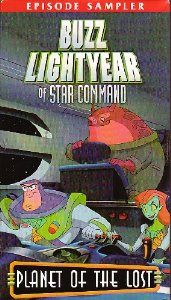
of the Lost” (11/16/00) – Investigating the disappearance of ships causes Team
Lightyear to become the next victims.
“Revenge
of the Raenoks” (11/17/00) – Booster is captured by the Raenoks to bargain for
the release of their leader, Varg.
“Enemy
Without a Face” (11/18/00) – Team Lightyear ends up in the middle of a 900-year
conflict.
“The
Starthought” (11/19/00) – Zurg takes over Star Command’s newest ship.
“Millennial
Bugs” (11/20/00) – Zurg attempts to hatch fossilized Millennial Bug eggs.
“Conspiracy”
(11/21/00) – Buzz is framed for the attempted assassination of the Galactic President.
“At
Large on a Small Planet” (11/23/00) – Buzz and Booster have to shrink down in
order to find out who kidnapped an ambassador.
“Sunquake”
(11/24/00) – Evil Buzz returns and enlists Gravitina in ruining Buzz’s
reputation.
“Good
Ol’ Buzz” (11/25/00) – Buzz from the future arrives to save Mira’s life.
“First
Missions” (11/26/00) – Trapped in a hopeless situation, Team Lightyear tells
their charge about their first meetings with Buzz to reassure him that Buzz
will save them in time.
“Large
Target” (11/27/00) – XR impersonates Buzz to gamble at a casino and ends up
attracting a load of trouble.
“War
and Peace and War” (11/29/00) – Suspicions about Guzelian’s desire to bring
peace to the galaxy has Buzz working with Zurg to investigate Guzelian’s true
intentions.
“Return
to Karn” (12/2/00) – Mira and the President are shot down and hunted by Zurg.
“Speed
Trap” (12/9/00) – Team Lightyear must stop a ship from crashing into the sun
and destroying it.
“Holiday
Time” (12/16/00) – Zurg steals Santa’s time-stopping device to go on a terror
spree.
“Opposites
Attract” (12/23/00) – Gravitina mutates Buzz’s head like hers in the hopes it
will make Buzz fall for her.
“Ancient
Evil” (1/6/01) – When the Little Green Men awaken space mummy Natron, Zurg wants
him for himself.
“42”
(1/13/01) – Buzz has to save XR and 42 from Valkyran raiders.
Originally posted in 2019. Updated in 2026.
Subscribe to:
Posts (Atom)