Showing posts with label Wacky Races. Show all posts

February 13, 2025

JERRY EISENBERG DEAD AT 87


You can read the full story here.


He did layouts for Frankenstein Jr. and the Impossibles, The Banana Splits Adventure Hour, Cattanooga Cats, Motormouse and Autocat, Josie and the Pussycats, Help!...It’s the Hair Bear Bunch!, The Amazing Chan and the Chan Clan, ; designed characters for The Atom Ant Show, The Secret Squirrel Show, Moby Dick and the Mighty Mightor, Wacky Races (also layouts), Dastardly and Muttley in Their Flying Machines, “The Adventures of Robin Hoodwink” and “Lost in Space” episodes of The ABC Saturday Superstar Movie, Inch High Private Eye, Yogi’s Gang, Super Friends, Speed Buggy, Wheelie and the Chopper Bunch, Hong Kong Phooey, Fangface (also producer), “The Puppy Who Wanted a Boy” and “The Puppy’s Great Adventure” episodes of ABC Weekend Specials, Plastic Man Comedy/Adventure Show (also producer), Heathcliff (1980) (also producer), Thundarr the Barbarian (also producer), Little Clowns of Happytown and Tom & Jerry Kids Show; storyboards for Muppet Babies, Rude Dog and the Dweebs, Tom & Jerry Kids Show (also producer and writer), Spider-Man: The Animated Series, Droopy: Master Detective (also writer), Dumb and Dumber: The Animated Series, Histeria!, House of Mouse, What’s New Scooby-Doo?, Angelina Ballerina: The Next Steps; and served as a producer on 8 episodes of ABC Weekend Specials, Meatballs and Spaghetti and Pandamonium (the latter two which he also created).

July 14, 2021

DON JURWICH DEAD AT 87


You can read the full story here.


He wrote for The Super 6, The Bugs Bunny Show, The New Tom & Jerry Show, The Mumbly Cartoon Show, Heathcliff (1980), Tom & Jerry Kids Show and Droopy: Master Detective, also serving as story editor for the latter two; worked as a layout artist for The Bullwinkle Show, Linus! The Lion Hearted, Wacky Races, Dastardly and Muttley in Their Flying Machines, Josie and the Pussycats, The Flintstone Comedy Hour, The ABC Saturday Superstar Movie, The Roman Holidays and Hong Kong Phooey; served as a designer for George of the Jungle (1967); was a story director for Jabberjaw, The All-New Super Friends Hour and The Kwicky Koala Show; a recording director for Challenge of the Superfriends, The World’s Greatest Superfriends, Scooby-Doo and Scrappy-Doo, The Richie Rich/Scooby-Doo Show and Droopy: Master Detective; production designer Emergency +4; director for Spider-Man (1981), supervising director Spider-Man and His Amazing Friends, and voice director for The Incredible Hulk (1982); and was a producer for Scooby’s Laff-A-Lympics, Challenge of the Superfriends, The World’s Greatest SuperFriends, Scooby-Doo and Scrappy-Doo, Captain Caveman and the Teen Angels, The Richie Rich/Scooby-Doo Show, The Fonz and the Happy Days Gang, The Incredible Hulk (1982), The Smurfs, Tom & Jerry Kids Show, Red Planet and Droopy: Master Detective.

April 25, 2020

1960s SATURDAY MORNING ADS


            It wasn’t until the late 60s that Saturday mornings were beginning to get into full swing. Content with airing primetime reruns and a few new shows here and there, that all changed in 1966 when CBS revitalized its schedule with an action-heavy slant. When CBS showed massive success, the other networks followed and Saturday morning suddenly became good business. So, how would the networks advertise to their targeted audiences to tune in every week? Simple: advertise in comic books! For almost every Saturday schedule for decades, there was an artfully designed cartoon representing the networks’ schedules in every major publication. They even made sure to cover their bases with ads in TV Guide and newspapers so that parents would be aware shows for their kids would be on.

Below are some of the ads that ran for the 1960s:


CBS

1966

1967

1968

1969

ABC

Ad celebrating The Beatles' success on ABC, reprinting the original 1965 ad.

1967

1967 black & white ad.

1969

1969 black & white ad.

NBC
1969

January 22, 2020

SATURDAY MORNING MASTERS: PAUL WINCHELL


PAUL WINCHELL
(December 21, 1922-June 24, 2005)

Notable Roles: Dick Dastardly, Clyde, Softie, Fleegle, Tigger, Gargamel, Baby Smurf, Goober, Woofer, Moe Howard, Marmaduke, Zummi Gummi

Winchell had ambitions to become a doctor, but the Great Depression eliminated any possibility of his family affording medical school. While sick with polio, he saw an ad for a ventriloquism kit and created his first dummy: Jerry Mahoney. He worked on his act and took it to the Major Bowes Amateur Hour in 1938, which he won. The prize included touring and playing with the Major Bowes Review. Bandleader Ted Weems saw Winchell and offered him employment, which Winchell accepted. He refined Jerry’s design and created a second dummy, Knucklehead Smiff. He also created Ozwald, a character rendered by drawing a face on his chin and filming himself upside-down. He and Jerry first appeared on radio in 1943, but was overshadowed by Edgar Bergen. They found success in the 1950s on television with The Paul Winchell Show, which aired in various timeslots under various names and formats for its duration. Following that, Winchell and his dummies appeared on various programs, with his last regular on-screen role being in the children’s game show Runaround. Beginning in 1968, Winchell became a voice actor, notably as the voice of Dick Dastardly for Hanna-Barbera and Tigger in Disney’s Winnie the Pooh franchise, and later on as Gargamel in The Smurfs franchise. In between, Winchell realized his medical ambitions by becoming a pre-med student at Columbia University, a graduate of The Acupuncture Research College of Los Angeles, working as a medical hypnotist at the Gibbs Institute in Hollywood, invented an artificial heart with Dr. Henry Heimlich, and developed over 30 patents. In the 1980s, he attempted to aid starvation in Africa by coming up with a way to cultivate tilapia fish in tribal villages, but was denied Congressional support. Winchell retired from acting in 1999 and died of natural causes in 2005.

Saturday Credits:
The Paul Winchell Show
Paul Winchell’s Cartoonies
The Lone Ranger (1966)
Wacky Races (1968)
The Pink Panther Show
Dastardly and Muttley in Their Flying Machines
The Perils of Penelope Pitstop
Storybook Squares
The Banana Splits Adventure Hour
Help!...It’s the Hair Bear Bunch!
The New Scooby-Doo Movies
Runaround
The ABC Saturday Superstar Movie
Yogi’s Gang
Goober and the Ghost Chasers
Wheelie and the Chopper Bunch
Hong Kong Phooey
These Are the Days
The Oddball Couple
Clue Club
The Skatebirds
CB Bears
Fred Flintstone and Friends
The Robonic Stooges
Casper and the Angels
The Super Globetrotters
Trolkins
Heathcliff (1980)
The Smurfs
Spider-Man (1981)
Meatballs and Spaghetti
Yogi’s Treasure Hunt
Disney’s Adventures of the Gummi Bears
The New Adventures of Winnie the Pooh
Garfield and Friends

January 15, 2020

SATURDAY MORNING MASTERS: DAWS BUTLER


DAWS BUTLER
(November 16, 1916-May 18, 1988)

Notable Roles: Huckleberry Hound, Yogi Bear, Dixie, Mr. Jinks, Hokey Wolf, Reddy, Snagglepuss, Wally Gator, Peter Potamus, Quick Draw McGraw, Scooby Dum, Augie Doggie, Jonathan Wellington “Mudsy” Muddlemore, Elroy Jetson, W.C. Cogswell, Henry Orbit, Chilly Willy, Cap’n Crunch

Regarded as the nicest man in the business, Butler began his career as an impressionist, winning most of the amateur contests he entered as a means to help him combat his shyness. That led him to gain professional gigs at vaudeville theaters. He joined Jack Lavin and Willard Ovitz to form the comedy trio The Three Short Waves, who played theaters, radio and nightclub engagemtns. After serving in WWII, he voiced his first theatrical short Short Snorts on Sports for Screen Gems in 1948. Following that, he became a regular performer in shorts directed by Tex Avery for MGM and the Warner Bros. puppet show Time For Beany working with Stan Freberg. Butler worked on several commercials and comedy albums with Freberg, and also appearing on Freberg’s radio show. In 1957, he became a regular player for Hanna-Barbera beginning with The Ruff & Reddy Show, and worked often with Jay Ward Productions first in The Adventures of Rocky & Bullwinkle and as the first voice for Cap’n Crunch in commercials. In 1975, Butler began an acting workshop that molded such stars as Nancy Cartwright, Corey Burton, Bill Farmer, Pat Parris, Bob Bergen, Mona Marshall and others. Butler died of a heart attack in 1988, and was succeeded by his protégé Greg Burson in many of his roles.

Saturday Credits:
The Ruff & Reddy Show
Rocky & Bullwinkle
The Bugs Bunny Show
The Space Kidettes
The Super 6
Wacky Races (1968)
Harlem Globe Trotters
The Banana Splits Adventure Hour
Help!... It’s the Hair Bear Bunch!
The Funky Phantom
The New Scooby-Doo Movies
The ABC Saturday Superstar Movie
The Roman Holidays
The Houndcats
Bailey’s Comets
Yogi’s Gang
Hong Kong Phooey
Sesame Street
Scooby’s Laff-A-Lympics
Posse Impossible
CB Bears
The Scooby-Doo/Dynomutt Hour
The All-New Popeye Hour
Galaxy Goof-Ups
Yogi’s Space Race
The Plastic Man Comedy/Adventure Show
Captain Caveman and the Teen Angels
Scooby-Doo and Scrappy-Doo
Yogi’s Treasure Hunt

SATURDAY MORNING MASTERS: DON MESSICK


DON MESSICK
(September 7, 1926-October 24, 1997)

Notable Roles: Ruff, Professor Gizmo, Ricochet Rabbit, Scooby-Doo, Scrappy-Doo, Muttley, Spike, Boo Boo Bear, Ranger Smith, Dr. Benton Quest, Mumbly, Godzooky, Bamm-Bamm Rubble, Papa Smurf, Azrael, Dreamy Smurf, Astro, R.U.D.I., U.N.I.B.L.A.B., Hamton J. Pig, Droopy Dog

Messick originally wanted to be a ventriloquist and made a living at it early on. After performing in front of the program manager and chief announcer of radio station WBOC in Salisbury, Maryland, he was given his own weekly show at age 15 where he performed all of the voices and sound effects. After serving in the U.S. Army’s Special Services unit, Messick was hired by the Mutual Broadcasting radio station in Los Angeles to play Raggedy Andy and Farmer Seedling on The Raggedy Ann Show. At the suggestion of Daws Butler, director Tex Avery hired Messick to perform the voice of Droopy Dog when his regular actor, Bill Thompson, was unavailable, giving Messick his start in animation. He and Butler joined Hanna-Barbera as regular players in 1957 and were often paired together. Messick typically played sidekicks like Boo Boo Bear, provided the narration for various shows, or sound effects for various creatures. He became a major headliner when he was cast as the voice of Scooby-Doo, which would turn out to be the studio’s most enduring character. However, after A Pup Named Scooby-Doo, he retired from the role, claiming quitting smoking robbed him of the rasp he needed to perform it (although he did perform one more time in a 1996 Burger King commercial). After suffering a stroke while recording in 1996, Messick retired from voice acting altogether. He died from a second stroke the following year.

Saturday Credits:
The Ruff & Reddy Show
The Secret Squirrel Show
The Atom Ant Show
Frankenstein, Jr. and the Impossibles
Space Ghost & Dino Boy
Super President
Moby Dick and the Mighty Mightor
The Atom Ant/Secret Squirrel Show
Space Kidettes
Fantastic Four (1967)
Herculoids
Shazzan
Birdman and the Galaxy Trio
Wacky Races (1968)
The Adventures of Gulliver
Cattanooga Cats
The Archie Comedy Hour
Dastardly and Muttley in Their Flying Machines
The Perils of Penelope Pitstop
H.R. Pufnstuf
Sabrina, The Teenage Witch (1969)
Scooby-Doo, Where Are You!
Doctor Dolittle (1970)
The Banana Splits Adventure Hour
Josie and the Pussycats (1970)
Help!... It’s the Hair Bear Bunch!
Harlem Globe Trotters
The Pebbles and Bamm-Bamm Show
The Funky Phantom
The Flintstone Comedy Hour
The Barkleys
The Houndcats
The Amazing Chan and the Chan Clan
Josie and the Pussycats in Outer Space
The ABC Saturday Superstar Movie
Jeannie
The Addams Family (1973)
Bailey’s Comets
The New Scooby-Doo Movies
Inch High, Private Eye
Yogi’s Gang
Wheelie and the Chopper Bunch
Hong Kong Phooey
These Are the Days
The New Tom & Jerry Show
The Oddball Couple
Jabberjaw
The Mumbly Cartoon Show
Dynomutt Dog Wonder
The Skatebirds
Scooby’s Laff-A-Lympics
CB Bears
Fred Flintstone and Friends
Baggy Pants & the Nitwits
Yogi’s Space Race
Captain Caveman and the Teen Angels
The New Fantastic Four
The Scooby-Doo/Dynomutt Hour
Challenge of the Superfriends
Dinky Dog
The New Fred and Barney Show
ABC Weekend Specials
Fred and Barney Meet the Thing
The Super Globetrotters
Godzilla (1978)
Fred and Barney Meet the Shmoo
The Plastic Man Comedy/Adventure Show
Scooby-Doo and Scrappy-Doo (1979)
The Flintstones Comedy Show
Drak Pack
The Richie Rich/Scooby-Doo Show
The Fonz and the Happy Days Gang
Space Stars
Heathcliff (1980)
Trollkins
The Kwicky Koala Show
Spider-Man (1981)
The Smurfs
The Scooby and Scrappy-Doo Puppy Hour
The New Scooby-Doo and Scrappy-Doo Show
Saturday Supercade
The New Scooby-Doo Mysteries
The Mighty Orbots
Get Along Gang
Yogi’s Treasure Hunt
Pink Panther and Sons
The 13 Ghosts of Scooby-Doo
Galtar and the Golden Lance
Scooby’s Mystery Funhouse
Popeye and Son
The Real Ghostbusters
Foofur
Pound Puppies (1986)
DuckTales (1987)
A Pup Named Scooby-Doo
Garfield and Friends
Cartoon All-Stars to the Rescue
The Funtastic World of Hanna-Barbera
Tom & Jerry Kids Show
Tiny Toon Adventures
Bobby’s World
Yo Yogi!
The Plucky Duck Show
Droopy, Master Detective
Freakazoid!


June 13, 2016

JANET WALDO DEAD AT 96


Actress Janet Waldo died on Sunday, June 12. You can read the full story here.

Best known for her role of Judy Jetson in every iteration of The Jetsons (excluding the 1990 movie where her lines were dubbed over), Waldo had a long Saturday morning career primarily working for Hanna-Barbera.

She lent her voice as Jenny in The Space Kidettes; Lana Lang in The New Adventures of Superman; Granny Sweet in The Atom Ant Show along with Flora Rugg in The Atom Ant/Secret Squirrel Show; Nancy in Shazzan; Princess Pearla in Fantastic Four (1967); Penelope Pitstop in Wacky Races, its spin-off The Perils of Penelope Pitstop, and Yogi’s Treasure Hunt; Jenny Trent in Cattanooga Cats; the eponymous Josie McCoy in Josie and the Pussycats and Josie and the Pussycats in Outer Space; Belinda Maze in Around the World in Eighty Days; Grandmama Addams in an episode of The New Scooby-Doo Movies; Curvia and Henrietta in The Roman Holidays; Marybell and Georgia in an episode of The ABC Saturday Superstar Movie; Morticia Addams in The Addams Family (1973); Mrs. Anders in Jeannie; Arlene Wilcox and Beth Crane in The Scooby-Doo/Dynomutt Hour; Circe in an episode of Thundarr the Barbarian; Zerona and Shanna the She-Devil in Spider-Man and his Amazing Friends; several roles in various episodes of ABC Weekend Specials; Mother in The Puppy’s Further Adventures; Hogatha in The Smurfs; and a female dinosaur in Dink, the Little Dinosaur.


She also provided a variety of voices for The Secret Squirrel Show, The Abbott & Costello Show, Help!...It’s the Hair Bair Bunch!, Inch High Private Eye, Hong Kong Phooey, The New Tom & Jerry Show, Clue Club, Jabberjaw, CB Bears, Yogi’s Space Race, The New Fred and Barney Show, Scooby-Doo and Scrappy-Doo, Captain Caveman and the Teen Angels, Rubik the Amazing Cube, The New Scooby and Scrappy-Doo Show, Mr. T, The Dukes, Alvin & the Chipmunks and Tom & Jerry Kids Show, as well as on The Jetsons. 

July 12, 2014

WACKY RACES

WACKY RACES
 (CBS, September 14, 1968-January 4, 1969)

Hanna-Barbera Productions, Heatter-Quigley Productions


MAIN CAST:
Daws Butler – Rock Slag, Big Gruesome, Red Max, Sergeant Blast, Peter Perfect, Rufus Ruffcut
Don Messick – Muttley, Gravel Slag, Little Gruesome, Professor Pat Pending, Ring-A-Ding, Sawtooth
John Stephenson – Luke, Blubber Bear
Janet Waldo – Penelope Pitstop
Paul Winchell – Dick Dastardly, Private Meekly, Clyde
Dave Willock - Narrator


             Racers, start your engines! CBS executive Fred Silverman sought to add comedy back into the superhero-dominated Saturday morning line-up in light of recent criticisms over violence and commissioned Hanna-Barbera to produce what would be the first of several race programs. Wacky Races featured a completely original cast of wacky characters in equally wacky vehicles competing for the title of World’s Wackiest Racer (think we have enough “wacky” in that one sentence?). Originally, the races were to be part of a proposed live-action quiz show by Heatter-Quigley Productions in which contestants would bet on which Wacky Racer would win. The quiz show element was eventually scrapped, and the races developed to follow the characters to various areas as they competed in impossible races fraught with perils; both natural and by design.

     Let’s meet the racers:


            In car #9 was Peter Perfect (Daws Butler) in the Turbo Terrific. Peter was a good-looking gentleman with an obvious crush on fellow racer Penelope Pitstop (Janet Waldo). He drove a dragster that was anything but terrific as it was prone to falling apart in the middle of a race.


            In car #10 was Rufus Ruffcut (Butler) and his pet beaver, Sawtooth (Don Messick), in the Buzzwagon. Rufus was a burly lumberjack whose theme carried over into his car; which was basically a wooden contraption with buzzsaw wheels that allowed him to cut through most obstacles.


            In car #6 was the loud Sergeant Blast (Butler) and the aptly-named Private Meekly (Paul Winchell) in the Army Surplus Special. The two soldiers drove a tank/jeep/steamroller hybrid and often used their cannon to give them an extra burst of power. Of course, in true cartoon fashion, the cannon could fire more than just explosive shells.


            In car #7 was the Ant Hill Mob and their Bulletproof Bomb. The Mob consisted of seven pint-sized (and harmless) gangsters led by Clyde (Winchell) driving a 1920s limousine sedan. Often during races, they found a need to evade the police who chased them for their various crimes.


            In car #3 was Professor Pat Pending (Messick) and his Convert-A-Car. This scientist’s car, which resembled a boat-shaped airplane with car wheels, could transform into any kind of vehicle or object and featured many defensive devices that were often used to help other racers out of jams.


            In car #5 was Penelope Pitstop and the Compact Pussycat. This Southern Belle, clad in 1930s racing gear, drove what was essentially a beauty parlor on wheels (whose gadgets often malfunctioned). As the lone female in the race, the male racers were often chivalrous towards her; especially the aforementioned Peter Perfect. Penelope was a last-minute addition to the show when producer Joseph Barbera realized that there were no women in the cast and thought it would be beneficial to have one. She was created within two hours by production designers Jerry Eisenberg and Iwao Takamoto.


            In car #1, fresh from the Stone Age, were the Slag Brothers in the Bouldermobile. Rock (Butler) and Gravel (Messick) Slag were hairy cavemen who hit their stone car--or each other--with their clubs in order to power it. Originally there was meant to only be one caveman, but it was decided by Barbera to have two of them instead.


            In car # 2 were the Gruesome Twosome in the Creepy Coupe. The large Big (Butler) and diminutive vampire Little (Messick) Gruesome were a horror-themed pair who drove an equally horrific car. The Creepy Coupe was modeled after a 1920s hearse with a belfry, in which all manner of creatures dwelled and could be summoned to aid in the race.


            In car #4 was the Red Max (Butler) in the Crimson Haybailer. A parody of the Red Baron, he drove a car/bi-plane hybrid capable of extremely limited flight with a mounted machine gun that fired more than conventional bullets.


            In car #8 were Luke and his pet, Blubber Bear (both John Stephenson), in the Arkansas Chugabug. A hillbilly, Luke drove a “car” built from wood and powered by a pot-bellied stove. Luke often drove half-asleep with his feet on the wheel while the cowardly Blubber often lived up to his name.


            And bringing up the rear in #00, the Mean Machine, was Dick Dastardly (Winchell) and his dog, Muttley (Messick). The villainous pair stopped at nothing to ensure they would finish first by using dirty tricks and schemes to either divert or stop the other racers. However, these schemes often backfired and resulted in Dastardly falling into last place. The irony was that if Dastardly had just raced the races, he actually could have won as he always managed to get ahead of the others to set his diabolical traps.

Never accuse Dastardly of being tack-less.


            Last but not least was the unseen character omnipresent in every episode: the narrator (Dave Willock). The narrator was utilized to help move the plot along and save on character exposition since the show dealt with so many. The narrator also interacted with the characters often as each would break the fourth wall to talk to him.

Concept sketch for the Creepy Coupe and the Gruesome Twosome.

      The cars were all designed by Eisenberg, utilizing both his imagination and recall about something he might have seen before and putting them all together. Barbera would then look over the designs and either picked his favorite or combined elements he liked from each design into one final one. Each car possessed several special “modes” that allowed the racers to gain an edge on each other in a comedic fashion. For instance, the Ant Hill Mob could shift into “getaway mode” which included their lowering their feet to the ground and running to give the car more speed.

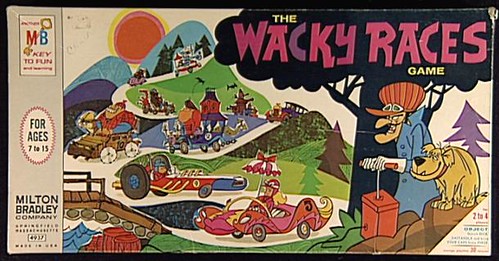
The Wacky Races board game by Milton Bradley.

             Wacky Races debuted on CBS on September 14, 1968. The show ran for a single season and continued in reruns until 1970. Larz Bourne, Tom Dagenais, Michael Maltese and Dalton Sandifer served as the series’ writers, with music provided by Hoyt Curtin. Despite the short run, the show was actually a success and became a springboard for future Hanna-Barbera projects. The Perils of Penelope Pitstop featuring Penelope and the Ant Hill Mob and Dastardly & Muttley in Their Flying Machines were both spun off from the show. Dastardly and Muttley would also later appear in 1985 in Yogi’s Treasure Hunt. Muttley’s appearance and speech pattern were recycled for a dog private-eye named Mumbly, who starred in the 1976 show The Mumbly Cartoon Show before going on to become a villain in Laff-A-Lympics when Heater-Quiggly wouldn’t allow Dastardly and Muttley’s use in the series. In 1977, the Slag Brothers’ design was recycled and refined into Captain Caveman for Captain Caveman and the Teen Angels. Blubber Bear would go on to appear in The New Yogi Bear Show in 1988. Even the concept itself was reused in 1978’s Yogi’s Space Race; right down to having a villain with a dog sidekick.

The Wacky Races Funko Pop figures.

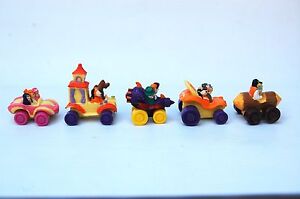
Amongst the initial wave of merchandising for the show was a coloring book and sticker book by Whitman; a board game by Milton Bradley; a General Mills cereal premium; a die-cast car by Corgi featuring Dastardly and Muttley on what was supposed to be the Mean Machine (though it hardly looked like it); and a seven-issue comic book series by Gold Key Comics. In 1996, South American dairy company Parmalat offered a promotional set of Hanna-Barbera toy cars modeled on the Compact Pussycat, the Creepy Coupe and the Mean Machine (only Penelope and Dastardly drove their respective vehicles). In 1997, Burger King released five of the racers as toys in their Kids Club meals. In 1998, Johnny Lightning released two die-cast versions of the Mean Machine and the Compact Pussycat complete with an animation cel. In 2003, Konami released a collection of trading figures and Epoch produced a miniature set that could combine together to create a diorama scene. In 2006, McFarlane Toys released a figure diorama featuring Penelope and Muttley as part of their Hanna-Barbera series. In Japan, Takara Co., Ltd. produced pull-back cars as both a set and individually and a Muttley figure in an exploding bomb. Funko’s POP! line featured the characters (many convention exclusives) and the Mean Machine either driven by Muttley or Dastardly, and eight of the respective characters were produced as vinyl dolls in their Fantastik Plastik line. Pop Arts Products made rubber keychains featuring Penelope, Dastardly and Muttley, and the Mean Machine. In 2019, CMON Global Limited, Asmodee, Delta Vision Publishing, Edge Entertainment and Galápagos Jogos released a new board game in a regular and deluxe edition featuring the racers as miniatures.

Muttley in the 1991 NES game.

The first Wacky Races video games were released in 1991. Atlus published the version for the Nintendo Entertainment System, which was a platforming game starring Muttley collecting items and defeating foes. No actual racing took place, but the other racers appeared as stage bosses. Atlus also released a Japan-exclusive for the Game Boy under the title Chiki Chiki Machine Mou Race. It was more of a “racing” game where you moved one of the cars around a course and attacked the others by picking up items from blocks you drive into. Hi-Tec Software released the ZX Spectrum and Commodore 64 versions that were also platformers. They, however, alternated between driving sections in the Mean Machine and timed levels where parts of a trap had to be collected by either Muttley or Dastardly, depending on the version. Sega would release a Japan-exclusive medal game whose outcome was entirely determined by luck. In 1994, Future Pirates released Wacky Races: A Tsuyoshi Takashiro Digital Film for CD-ROM in Japan.

Wacky Races: Crash and Dash takes the race into the third dimension.

Eden Entertainment Software developed their own Wacky Races on the Sega Genesis that ended up not being released. It was a Super Mario Kart clone, featuring a 3rd person racing view and the ability to attack other racers with items collected from W’s found on the tracks. A similar game was released for the Game Boy Color by Infogrames in 2000. Infogrames also released a 3D racing game for the Sega Dreamcast and PlayStation, and later Sony PlayStation 2 in PAL regions. In 2007, Blast! Entertainment released Wacky Races: Mad Motors for the PlayStation 2 in PAL regions, where players could collect coins to unlock upgrades and new vehicles. In 2008, Wacky Races: Crash and Dash was released for the Wii and DS by Eidos Interactive. Players could choose from three modes: Crazy Circuit, involving 6 sets of races with 4 tracks each; Wacky Race, allowing races on tracks unlocked in Crazy Circuit; and Trap Challenge, where traps set by Dastardly and Muttley had to be evaded. The following year, Banpresto released a more traditional racing game to the arcades.


The race continues!

A 2 ½ hour VHS collection was released in 1996 in the United Kingdom by First Independent Films. In 2001, the series was released to DVD in Japan by Warner Entertainment Japan containing both Japanese and English audio. In Britain, the set was released exclusively through Virgin Megastores and again as an HMV exclusive in 2006. It was released in three volumes in Australia between 2005 and 2007 by Warner Home Video. In 2012, two collections were released: Wacky Races: Dick Dastardly and Friends and Muttley and Friends. Warner Archive released the complete series in the United States in 2004 as part of their Hanna-Barbera Classics Collection, and then re-released it in 2017 as part of the Hanna-Barbera Diamond Collection. In 2012, Warner also released a collection called Hanna-Barbera 4 DVD Bumper Pack which contained the first volumes of Wacky Races, Dastardly & Muttley in their Flying Machines, Top Cat and Hong Kong Phooey.


             Wacky Races was revived as part of the 1990 syndicated series Wake, Rattle and Roll in a segment called Fender Bender 500. Dastardly (in Winchell’s final outing as the character) and Muttley returned in a revamped Mean Machine monster truck dubbed the Dirty Truckster against a new line-up of Hanna-Barbera stars from the golden age of the studio: Yogi Bear (Greg Burson) and Boo Boo (Messick), Huckleberry Hound and Snagglepuss (both Burson), Magilla Gorilla (Allan Melvin) and Wally Gator (John Mariano), Top Cat (Arnold Stang) and Choo-Choo (Marvin Kaplan), Quick Draw McGraw (Burson) and Baba Looey (Neil Ross); Pixie (Messick) and Dixie (Patric Zimmerman), Augie Doggie (Zimmerman) and Doggie Daddy (Stephenson), and Winsome Witch (Jean Vander Pyl); each in a racer themed to them. In 2006, Cartoon Network, where the series aired in reruns during the ‘90s, commissioned a pilot called Wacky Races Forever; which would feature updated versions of the Slag Brothers, Pat Pending, a teenaged Gruesome Twosome, and the children of Penelope (Kath Soucie) and Peter (Jeff Bennett) racing against Dastardly (Jim Cummings) and Muttley (Billy West & John Kassir) as they aided a new villain, Mr. Viceroy (Bennett), in trying to take over race sponsor Perfect Industries. The series, however, was not picked up.


A more successful revival attempt was made in 2017 with a reboot created by Rebecca Himot and Tramm Wigzell. The 2D computer-animated series followed the same relative format as its predecessor, but often deviated from the races to go off on adventures in other time periods (like medieval times) or to explore the personal lives of the racers. Also, there was never a clear winner by the end of each episode. Returning racers were Dastardly (Peter Woodward) and Muttley (West), Penelope (Nicole Parker), Peter (Diedrich Bader) and the Gruesome Twosome, Tiny (West) and Bella (Tom Kenny). Professor Pending was replaced by I.Q. Ickly (Jill Talley), a young boy genius who often didn’t participate in the races, and the unseen narrator was replaced by Brick Crashman (Christopher Judge). New characters were also introduced, including Pandora Pitstop (Parker), Penelope’s evil twin sister, and P.T. Barnstorm (Talley), owner and sponsor of the races. The show aired on Boomerang SVOD and Boomerang network.


The cast of Wacky Raceland.

The year prior, Wacky Races made its return in the comic book mini-series Wacky Raceland by DC Comics. The series was part of the first wave of reimagined Hanna-Barbera properties. The series was notably darker than its cartoon counterpart, as it followed the racers through a post-apocalyptic world as they raced for their lives under the control of the mysterious “Announcer” to find Utopia: the last safe haven for mankind. The racers’ cars were also outfitted with an A.I. system, giving them a bit of autonomy when needed. The series was written by Ken Pontac and drawn by Lenoardo Manco


Dick Dastardly in real life.

            Wacky Races continues to live on outside of television, especially in other countries. Between 2000 and 2008, life-sized working replicas of the cars were built and exhibited at the Goodwood Festival of Speed in England. In 2006, car manufacturer Vauxhall utilized the theme song and lettering while having their Corsa cars double for the racers in a commercial, and in 2013 Peugeot utilized live actors and versions of their cars to advertise their 208 GTI model. The online MMORPG City of Heroes featured a story arc which had characters named after some of the racers. In the 2020 film Scoob!, an arcade machine featuring the Wacky Races “W” logo appeared on an arcade machine in an abandoned amusement park arcade. In 2024, the series became part of the debut schedule for retro animation network MeTV Toons, alternating its timeslot with Perils and Flying Machines as each series ran out of episodes. In 2025, Dynamite Entertainment published a new comic based on the show, Giant-Size Wacky Races.


            And the Winning Results:

            The Bulletproof Bomb – 4

            The Compact Pussycat – 4

            The Arkansas Chugabug – 4

            The Turbo Terrific – 4

            The Boulder Mobile – 3

            The Buzzwagon – 3

            The Creepy Coup – 3

            The Crimson Haybailer – 3

            The Convert-A-Car – 3

            The Army Surplus Special – 3

            The Mean Machine - 0


EPISODE GUIDE:
“See-Saw to Arkansas / Creepy Trip to Lemon Twist” (9/14/68) – Penelope and the Ant Hill Mob get lost. / The Racers find ghosts in a bar in a deserted town.

“Why oh Why Wyoming / Beat the Clock to Yellow Rock” (9/21/68) – The Racers encounter Native Americans. / Rangers search the Racers for missing bears and assume Blubber is one.

“Mish-Mash Missouri Dash / Idaho a Go-Go” (9/28/68) – Luke finds his cousin Elmer. / The Racers all crash and Penelope falls for Dastardly’s “Little Red Riding Hood” routine.

“Baja-Ha-Ha Race / Real Gone Ape” (10/5/68) – Dastardly stops the Racers with a mud hole. / Dastardly hypnotizes a gorilla to stop the Racers.

“Scout Scatter / Free Wheeling to Wheeling” (10/12/68) – The Ant Hill Mob disguises themselves as scouts to evade the police. / Dastardly uses construction equipment to stop the Racers.

“By Rollercoaster to Upsan Downs / The Speedy Arkansas Traveler” (10/19/68) – Dastardly leads the Racers to an abandoned amusement park. / The Racers end up in the middle of a war game.

“The Zippy Mississippi Race / Traffic Jambalaya” (1026/68) – The Racers encounter an angry plantation owner. / Dastardly convinces the Racers to search for a gorilla worth $50,000.

“Hot Race at Chillicothe / The Wrong Lumber Race” (11/2/68) – Dastardly and the Ant Hill Mob play baseball. / Dastardly uses various wood and saws to win the race.

“Rhode Island Road Race / The Great Cold Rush Race” (11/9/68) – Dastardly uses every advantage to try to win the race. / Dastardly dresses up as a snow monster to scare the others off.

“Wacky Race to Ripsaw / Oils Well That Ends Well” (11/16/68) – Dastardly stops Penelope with a roadside beauty parlor. / Dastardly is up to his old tricks in Grease Gun, Texas.

“Whizzin’ to Washington / The Dipsy Doodle Desert Derby” (11/23/68) – Dastardly disguises himself as a master of ceremonies. / Dastardly finds a genie in a bottle.

“Eeny, Miny, Missouri Go! / Super Silly Swamp Sprint” (11/30/68) – Dastardly leads the Racers into a whale’s belly. / Dastardly dresses up as an alligator to scare off the Racers.

 “The Dopey Dakota Derby / Dash to Delaware” (12/7/68) – Dastardly disguises himself as a bandit he resembles. / Dastardly coats the road with icing.

“Speeding for Smogland / Race Rally to Raleigh” (12/14/68) – Dastardly plots to use a movie set against the Racers. / Dastardly’s oil slick sends the Racers crashing into a farm.

“Ballpoint, Penn. Or Bust / Fast Track to Hackensack” (12/21/68) – Dastardly uses tacks to give everyone flats. / Dastardly changes the speed limit sign from 35 to 85 MPH.

“The Ski Resort Road Race / Overseas Hi-Way Race” (12/28/68) – Dastardly causes an avalanche and uses a ski jump to get ahead. / The Racers race over the bridge connecting the Florida Keys.

“Race to Racine / The Carlsbad Or Bust Bash” (1/4/69) – Muttley infiltrates the Ant Hill Mob. / Dastardly employs a caveman to stop the Racers.


Originally posted in 2014. Updated in 2025.