Remember that one day when you could wake up without an alarm? When you would get your favorite bowl of cereal and sit between the hours of 8 and 12? This is a blog dedicated to the greatest time of our childhood: Saturday mornings. The television programs you watched, the memories attached to them, and maybe introducing you to something you didn't realize existed. Updated every weekend.
THAT’S SO RAVEN (Disney Channel,
January 17, 2003-November 10, 2007) It’s a Laugh
Productions, Brookwell McNamara Entertainment (season 1-3), That’s So
Productions (season 4), Warren & Rinsler Productions (season 4)
Created by Michael Poryes and Susan Sherman, That’s So
Raven (originally The Future Is on Me, and later Absolutely
Psychic before the lead was cast) focused on teenaged Raven Baxter (Raven-Symoné) who had something
special about her: she was psychic. Raven would receive random psychic visions
that she would misinterpret as bad, and tried to protect her friends and family
by taking steps to ensure the vision wouldn’t come true. Pratfalls ensued,
which often included costumes designed by her for herself and whatever friend
she roped into helping. Her secret was shared by her best friends Chelsea
Daniels (Anneliese van der Pol,
after Raven originally auditioned for it), an environmentalist, and Eddie
Thomas (Orlando Brown), a
girl-crazy aspiring rapper, and her family that included her father Victor (Rondell Sheridan), a chef that
would eventually open the teen hangout The Chill Grill, mother Tanya (T’Keyah Crystal Keymáh), a law
student, and brother Cory (Kyle
Massey), who had entrepreneurial ambitions.
The Baxter family.
That’s
So Raven debuted on Disney
Channel on January 17, 2003, with reruns airing on Disney-owned ABC
starting that fall as part of the ABC Kids
programming block. Raven and Brown would perform the series’ theme, composed by
John Coda. It was the
network’s first multi-camera sitcom and the highest-rated
original series in its history; surpassing Lizzie McGuire and
earning numerous award nominations. It also became the first to break Disney’s controversial
65-episode rule,
running for 100 episodes. Originally planned for only 3 seasons like other
Disney shows, the series was renewed
for a 4th. That ended up costing them Keymáh, who had to leave
to care for her ill grandmother. Tanya’s absence was explained by her going to
England to study. Raven was promoted to a producer on the series at
19-years-old, giving her more input on casting, scripts and special effects;
although she declined
an offer to direct an episode. During this season, the series took part in
a crossover with fellow Disney shows The Suite Life of Zack & Cody
and Hannah Montana called That’s So Suite Life of
Hannah Montana.
Raven with her besties Eddie and Chelsea.
Ultimately
Disney decided to end the show as the actors were aging out of their roles, and
a companion film slated for 2007 never saw production due to Raven’s
busy schedule. Instead, Disney commissioned its first Disney Channel
spin-off series Cory in the House, which would follow Cory and Victor to
Washington, D.C. where Victor served as the White House
executive chef. It lasted two seasons. An Indian version, Palak Pe Jhalak,
debuted on Disney
Channel India in 2015 and ran for a single season. 2017 saw the return of
Raven and van der Pol in Raven’s
Home, which initially followed the now adult friends that were both
divorced single mothers before a soft reboot sent Raven back to San Francisco to care for her ailing father. Her
son, Booker (Isaac Ryan Brown)
inherited his mother’s powers, creating a whole new generation of mishaps. It
lasted longer than the original series, running 6 seasons and 122 episodes.
Nickelodeon
struck gold when it debuted its kid-centric game show Double Dare
in 1986. Double Dare would pit two teams of two kids against each other
by having them win money answering trivia questions. If they didn’t know an
answer, or thought the other team didn’t, they could pass it over with a “dare”
for double the money. But it could be “double dared” back for four times the
money, in which case that dared team either had to answer or take a “physical
challenge”. These physical challenges often featured deceptively simple and
incredibly messy tasks; like building an ice cream sundae on their partner’s
head, popping goop-filled balloons with a needle headpiece, plucking cherries
out of gelatin with their mouths, etc. Success won them the money; failure gave
it to the opposing team. The team with the most money then went on to an even
messier obstacle course for a chance to win up to 8 prizes within a minute.
Slime being dumped on the losing team's teacher.
In the
world of entertainment, a success breeds imitators trying to duplicate that
success. One of the most blatant copycats was Slime Time; dubbed “the
messiest half hour on TV”. Slime Time was played between two teams
comprised of three students and a teacher, adorned in either red or blue sweat
pants and shirts (the same colors as Double Dare) supplied by Jerzees.
The students each had to answer questions and perform stunts with their teams
to build up their cash score to $1,000. The first team to do so got to watch
the opposing team’s teacher be doused with slime, along with taking home the
cash and additional prizesconsisting of educational items,
musical instruments, various electronics and clothing.
Host Marty Cohen between the two teams as they prepare to get messy with the opening stunt.
Similarly
to Double Dare, the show opened up with the two teams performing a stunt
that would net the winning team a $25 head start towards their cash goal (Double
Dare’s would decide which team would get to answer questions first). After
taking their places at their respective podiums and introducing themselves, one
student from each team would go up to the host podium to answer a buzz-in
toss-up question akin to Family Feud.
The correct answer would net $25 and a chance to choose a stunt; but an
incorrect answer would give that to the other team. A snafu in the production
was that sometimes these questions would be the same ones used during try-outs
or practice rounds, accidentally giving anyone paying attention a bit of an
edge.
Mr. Slimehead.
Stunts were
chosen from a giant ugly head on center stage dubbed “Mr. Slimehead”. The
students could pick either eye, ear, or nostril to have a card with the stunt’s
description pop out of Mr. Slimehead’s mouth on a slimy tongue. Sometimes the
stunt would have a prize attached to it that the team would keep, win or lose.
Both teams would then have to perform the prescribed stunt to win another $25
(awarded to both in the event of a tie). These could include “rescuing” a fake
spider or bobbing for worms with their mouths by plunging their faces into pie
tins of whipped cream and chocolate syrup; the teachers having to carry ice
cream sundaes in their mouths across the stage on tricycles so that the
students can cover them in whipped cream; putting novelty snakes back in their
cans (a stunt seen on Double Dare) with the addition of the teachers’
being made extra slimy with—you guessed it—whipped cream; finding the most “sea
creatures” in fish tanks full of murky water and oil; the teachers having to
catch and break goop-filled balloons tossed to them with symbols strapped to
their arms or through basketball hoops while they wore pin-tipped caps under
them; the students smearing peanut butter and sticking the most pieces of bread
to their teachers; and more. Any stunt with a time limit was always given 20
seconds.
The teachers under the slime faucet.
After two
questions and stunts, the game moved on to round two where the dollar values
were doubled and Mr. Slimehead was reloaded with new stunts and nicer prizes.
Once time for the round ran out, the game moved on to the final round. Unlike Double
Dare’s obstacle course, the final challenge was a series of toss-up
questions worth $100 apiece; with wrong answers giving the opposing team the
money. Mr. Slimehead was turned around to reveal the slime faucet, under which
each teacher stood. The faucet waved back and forth while the students answered
their questions. Once $1,000 was reached, the faucet would stop over the losing
team’s teacher and dump gallons of slime on them. The winning team got the cash
and a large prize package while the losing team got a consolation prize, along
with whatever else both teams won along the way.
Gunk-filled balloons being tossed and popped on the teachers' heads.
Slime
Time debuted in syndication on June 11th, 1988; usually paired
up with fellow children’s game show Treasure Mall. The series was
created by Barry Jaffe and Gary Hunt through
their company Hunt-Jaffe Productions in association with O.K.T., Inc. Jaffe
also served as the primary writer. Actor, stand-up comic, and frequent game
show guest Marty Cohen was the host and opened the show with a bit leading into
the first stunt. He was always dressed like a referee. Announcing duties went
to Dean Goss, marking his second children’s game show after I’m Telling!Joey Carbone was the series’
composer, with William Harris
(who also worked on another Double Dare clone, Fun House) and Fred Duer serving as the art
directors and James Hundhausen
operating Mr. Slimehead.
Popping goop-filled balloons with arm symbols.
Despite
copious amounts of messy shenanigans and going as far as they could to copy Double
Dare short of a lawsuit, Slime Time failed to garner the same
response as Double Dare. After 13 weeks, it was cancelled along with Treasure
Mall and has fallen into relative obscurity save for some video recordings
uploaded to YouTube. In a bit of turnabout,
Nickelodeon would later produce another game show called Slime Time Live from
2000 to 2004. It initially served as promotion for the launch of the
short-lived Double
Dare 2000, but ended up far outliving it. The series had nothing to do
with the original Slime Time beyond coopting the name and being as messy
as possible, reaffirming Nickelodeon’s place as home of the messy kids’ game
shows.
Real
Scary Stories was a documentary-style series that saw a different group of
teenagers from around the country set out to confront an unusual occurrence in
their area; from haunted mansions and firehouses to urban legends. The viewers
would then follow along as the teens trapsed around spooky locations, being
terrified by various sounds or near-encounters.
Exploring the U.S.S. Hornet.
Created,
produced and co-directed by Don
Wells through his production company, Highland
Entertainment, the series relied on the submissions of real teenagers who
have had ghostly encounters or knew of a local legend. Once the production
selected the story they wanted to follow, they organized an expedition to bring
those teens into a direct encounter with whatever entity was involved; most
commonly by having them spend the night in a haunted location or an
investigation of an affected area after sunset. Of course, since the
supernatural really doesn’t appear on camera on demand, these adventures were
often sweetened by clever sound design, specific editing cuts, and intentional
camera angles. Supplementing the main action and were interviews with other
locals and relatives to add more details to the phenomenon. After the encounter,
the teens would gather for a recap of what they just experienced.
Spending the night in a haunted firehouse.
Real
Scary Stories debuted on FOX Family (now Freeform)
on October 21, 2000; renamed Scary…But True for international airings.
Depending on length, two or three different story segments aired per half-hour episode.
Hollie Ralph and Patrick Russell served as the monotone narrators; introducing
the scenario and the players involved. The two would alternate turns, generally
marked by briefly overlapping and reading the same line together as one faded
in and the other faded out in order to create an eerie, otherworldly effect
with their voices. Each episode would end with a P.O. Box address that viewers
could send submissions to potentially wind up as a future segment. The series
was written by Wells along with Michael
Koegel, Christopher Manahl
and Helen Demeranville. Music was composed by Shuki Levy, Haim Saban (as Kussa
Mahchi), John Majkut and Barry Kolsky.
Strange emanations appear in photographs of Diane.
After 13
irregularly scheduled episodes, the series ultimately ended up being cancelled
in favor of the very similar Scariest Places on Earth, which debuted on
the network two days later and featured star power in the form of The Exorcist’s Linda Blair and Poltergeist’s Zelda Rubinstein. Real
would remain on the network for a while as a schedule-filler, even after it was
taken over by Disney and renamed ABC
Family. It last aired during 2002’s 13 Nights of Halloween
programming block, but would return for one more time in 2010 on the
now-defunct channel Chiller
TV under its Scary title. In the years since, almost every episode
has found its way to YouTube through fan
uploads.
EPISODE GUIDE:
“Rest in Peace / Haunted Home Video / Green Man Tunnel”
(10/21/00) – After buying a new bed from an antique shop, Jason feels a
presence in his room. / Heather discovers a ghost on her family’s Christmas
tape. / An antisocial figure haunts the train tunnels in a Pennsylvania town.
“Cell Block Four / Seacoast Theater Poltergeist” (10/28/00)
– Danny explores Eastern State Penitentiary with a team of ghost hunters. / A
poltergeist haunts a local theater and causes havoc during the final
performances of shows.
“Jersey Devil / The Grey Ghost / Ray the Banisher”
(11/18/00) – The 13th generational descendant of the Jersey Devil
decides it’s time that they meet. / Four teens investigate the possible
haunting of the USS Hornet. / Ray is your average teenager—except he’s
able to communicate with the dead.
“Bachelor’s Grove / The Vortex” (11/25/00) – Mark and his
classmates investigate the hauntings at Bachelor’s Grove Cemetery. / Ray and
his friends see if ghosts remain at the ruins of an exploded munitions factory.
“The Haunted Lighthouse / The Altamaha Sea Monster / Martha”
(12/2/00) – NO SYNOPSIS AVAILABLE.
“Anges, Are You There? / Room 347 / Bodie’s Curse”
(11/16/00) – Erin attempts to communicate with the ghost of the woman entombed
in her school’s walls. / C.J. returns to the hotel where he once befriended a
ghost girl. / Two girls investigate the curse of bad luck that befalls anyone
that removes something from the ghost town of Bodie.
“Virginia City Dare / 13 Curves” (1/20/01) – Jaena and Chris
dare each other to stay in Virgina City’s two most haunted houses until
midnight. / Joe sets out to make a documentary about a dangerous stretch of
road, complete with a séance led by a psychic.
“Gurdon’s Light / Condie’s Ghost” (1/27/01) – Teens
investigate the railroad tracks where a railroad foreman was murdered and his
headless ghost now roams. / While visiting her friend at college, Sarah
discovers that her dormitory is haunted.
“McPike Mansion / The Search for Bigfoot / The Haunting of
Diane” (2/3/01) – Drew and his friends investigate the ruins of the most
haunted mansion in town. / Richie leads an expedition into the woods to try and
discover if Bigfoot is really out there. / Diane looks into why strange objects
appear around her whenever she’s photographed.
“The Lady in Gray / The Deacon” (2/10/01) – Zach plots to
make a ghost angry enough to manifest in the library she haunts. / Local kids
investigate a ghost known as The Deacon that supposedly watches over the
Depreciation Lands Museum.
“Lemp Mansion / The Haunted Firehouse / The Winchester
Mansion” (2/24/01) – Teens investigate the abandoned home of a family driven to
extinction by madness. / Kurt plans to spend a night in the firehouse where a
heartbroken fireman killed himself. / Three teens investigate the mansion of
Sarah Winchester, designed to keep her safe from the spirits of those killed by
Winchester rifles.
“The Myrtle Plantation / Manresa Castle” (3/3/01) – Erin and
Shalita plan to spend the night at a haunted plantation. / Joey and Kasey spend
the night in a castle haunted by the ghost of a priest that committed suicide.
“Mansfield Prison / The Ghost of the Inyos” (3/10/01) – Rob
and his friends investigate the most haunted prison in the country. / Chareen
and Felicia see if the ghost of mass murderer Antoine Benoit is still haunting
the Inyo Mountains where he died.
Since the
year 2000, CBS’ Saturday morning programming
was handled by corporate cousin Nickelodeon
following the
merger between Viacom
and CBS Corporation.
5 years later, Viacom was again split
from CBS Corporation into two distinct companies under the ownership of National Amusements.
With Nickelodeon no longer under a common umbrella, CBS entered
into a partnership with DiC Entertainment to
take over their Saturday morning programming. DiC, in turn, partnered with KOL, internet provider America Online’s kid-centered website, to create
the KOL Secret Slumber Party programming block.
Amy, Miracle, Cake, and Benjamin.
One of the first
three programs launched under the block was Cake, created by Barbara Meyer and Maia Terzian and developed by Kaaren Lee Brown (not to be confused
with the 2019 series of
the same name). Cake was a how-to sitcom centered on a girl named
Cake (Christa B. Allen) who was heavily into fashion and arts and crafts;
inspired by her Grandma Crystal who used to design costumes and serve as a
roadie for famous rock stars. Along with her best friend Miracle Ross (Anna
Maria Pere de Tagle), who also loved fashion and art but was a bit on the
materialistic and spoiled side, and young neighborhood girl Amy Carson (Emily
Everhard), who was an environmentally-conscious jokester, Cake put on a public-access television show
called Cake TV. Handling the camera was their other friend, Benjamin
Turner (Keegan McFadden), whose stage fright left him happy to stay behind the
scenes. They operated out of Cake’s garage and Crystal’s nearby Airstream travel trailer, which was loaded
with supplies from her designing days. Despite other characters being mentioned
and often being a factor at the center of an episode’s story, nobody else
appeared on the show beyond a photograph of Cake with her mother and
grandmother or vocal cameos from the television set.
Amy, Cake and Benjamin out in the yard by Grandma Crystal's trailer.
Each episode began with Cake
showing the audience what craft project they’ll be working on later in the
episode; such as jazzing up an old purse, creating a custom CD case, or
revitalizing old plush toys. That was followed by a standard sitcom plot
designed to lead the characters into a need or inspiration for that particular
project. For instance, the first episode featured Miracle’s credit card being
cut off by her parents for repeatedly going over her limit, leaving her without
the ability to get a new dress (which was made for her by Cake) or a gift for a
friend’s Bat Mitzvah (which was the mentioned project). For a bit of corporate
synergy, one project was inspired by the success of pop group the Slumber Party Girls,
the hosts and namesake of the Slumber Party block. The rest of the
episode was dedicated to the filming of Cake TV and the craft project. The
show would end with the disembodied voice of Cake saying “It’s a piece of
cake!”
Amy, Cake and Miracle filming Cake TV.
As for the
show-within-a-show, Cake TV featured the girls all wearing shirts with
their names in creative lettering and Amy providing their introductions. Cake
would then describe the project they’ll be working on. However, before that
could begin, they played some stock footage of themselves marching out on the
lawn carrying signs that spelt out the acronym “PARTY TIME”. PAR stood for
“Permission Always Required”, reminding their viewers that they needed parental
supervision and/or permission to use the more dangerous tools like scissors or
a hot glue gun (Cake’s favorite). TYT stood for “Take Your Time”, encouraging
the organization of materials and proceeding at a casual pace. IME stood for
“Imagination Means Everything”, opening up their minds to allow their
creativity to flow. The girls then
guided the viewers along on a step-by-step process of what materials they’ll
need and what to do so they could follow along with their own craft project.
It's "PARTY TIME"!
Despite being nominated for two Young Artist Awards,
winning one,
the series was ultimately cancelled after the end of its only season of 13
episodes. A 14th episode titled “Amy Takeover” was planned, but was
never aired. Cake remained on the network in reruns until 2009. Following
DiC’s takeover by Cookie
Jar Group. CBS renewed its programming deal with Cookie Jar which then
subsequently replaced all of DiC’s programming with their own for new
programming block Cookie Jar TV. While
never released on home media, various episodes have been uploaded by fans to
video sites like YouTube and it was made
available for streaming on Tubi.
EPISODE GUIDE:
“Miracle on Ice…The Case of the Frozen Assets” (9/16/02) –
When Miracle’s parents freeze her credit card, she’s unable to buy a new outfit
or gift for a friend’s Bat Mitzvah.
“Flip-Flopped” (9/23/06) – Amy copies other people’s style
until Cake helps her discover her own individuality.
“Or-dis-ganized” (9/30/06) – Cake must help everyone get
over a spreading case of forgetfulness.
“Not Your Mama’s Piggy Bank” (10/7/06) – Amy’s desire to
help rebuild a playground destroyed by a tornado helps inspire that week’s
craft to renew old stuffed toys.
“You Tell Her” (10/14/06) – Everyone tries to figure out the
best way to tell Miracle that she stinks when she comes to the garage straight
from soccer practice.
“The Write Inspiration” (10/21/06) – The kids are inspired
by the Slumber Party Girls’ success and set out to achieve their own.
“Baby Blues” (10/28/06) – Amy decides that she’s tired of
being treated like a kid because she’s the youngest and starts dressing and
acting like a grown-up.
“Makin’ Up Is Hard to Do” (11/4/06) – A misunderstanding
breaks up the friendship between Miracle and Benjamin.
“A Cake Walk” (11/11/06) – Miracle is concerned that Cake’s
preoccupation with her grandmother’s hip surgery has drained her creative
spark.
“Trump-IT” (11/18/06) – Benjamin loses his passion for
trumpet-playing in the school’s concert band when the new exchange student
seems unimpressed by his skill.
“Flopportunity” (11/25/06) – Miracle’s fashion sense is
challenged when the ripped jeans she spent all her money on is deemed
inappropriate by the principal.
“Snack Attack” (12/2/06) – Cake is concerned about Miracle’s
unhealthy chocolate chip cookie addiction.
“Second Hand Woes” (12/9/06) – Amy hates getting
hand-me-downs, but Cake sees it as a creative opportunity.
In 1987, DiC Enterprises partnered
with Saban
Productions to co-produce several shows, which Saban would then handle the
international distribution of. Together, they entered into an agreement with NBC to provide them several programs for their
Saturday morning line-up. One of them was the live-action game show, I’m
Telling!, marking Saban’s expansion into the medium.
The contestants ready to play.
Created
by Ellen Levy and developed
by Levy and Saban co-founder Haim
Saban, I’m Telling! was essentially a kid version of The
Newlywed Game. However, instead of romantic partners, I’m Telling!
was played by three pairs of siblings—typically a brother and a sister, outside
of special “Brothers’ Day” or “Sisters’ Day” episodes featuring siblings of the
same sex. That comparison, by the way, didn’t go unnoticed by Newlywed Game
producer Chuck Barris, who filed
an injunction against Saban. Notably, Fast and the Furious
franchise star Paul Walker
appeared as a contestant with his sister, Ashlie, very early into his career.
A sister selecting a category.
The game
featured three rounds. The first two rounds saw one of the siblings
“teleported” to the “isolation zone” via special effects and video editing. In
actuality, they were taken from the stage and placed in a soundproof room. The
remaining sibling randomly selected one of three pun-laden categories by
hitting a button and were asked a question loosely based on that category about
their offstage sibling. Much like its inspiration, the questions were often
designed to lead to humorous and embarrassing answers. After the three siblings
answered every question, the isolated sibling was brought back out and the
teams were awarded points for how many of their answers matched; gaining 25
points for matching the first, 50 for the second, and 75 for the third. The
roles were then switched for the second round with the points increased to 50,
75 and 150, respectively.
The consolation prizes.
The team with the most points, or
with an uncatchable substantial lead, won a $1,000 savings bond and advanced to
the final round, while the other teams received consolation prizes that
included Huffy
bicycles, a 7-Eleven coupon book,
and a copy of the I’m
Telling! home game by Pressman Toy Corporation (now Goliath Games). In the event of a tie,
the winner was selected from the team that came closest to guessing how many
objects were placed into the “I’m Telling! Fun Box” or a jar without going over
before the show.
The Pick-A-Prize Arcade.
The final
round was the Pick-a-Prize Arcade, which was played after the set rotated 180
degrees to reveal 20 prizes in 2 rows of 10 on color-coded podiums; pink for
the girls, yellow for the boys. Before the show, each sibling had to make a
guess as to what 6 prizes the other would go for during this round. They then
took turns selecting their 6 desired prizes from their designated rows. If
their choices matched what their sibling selected beforehand, a light would
flash after they hit a corresponding button. The team then took home every
prize they matched (or, rather, a Service Merchandise
gift certificate of equivalent value). If they matched a combined total of 10 prizes,
they then won all 20 prizes.
Scoring a prize match.
I’m
Telling! debuted on NBC on September 12, 1987. The game was hosted by actor
Laurie Faso, with actor and veteran game show announcer Dean Goss announcing. Saban
and partner Shuki Levy provided the
series’ music. NBC would also have various stars from their shows appear in
interstitials leading into a commercial break. Two episodes were populated by
young NBC stars and their siblings, including Shannen Doherty (Our House) and her
brother, Sean; Mackenzie Astin (The
Facts of Life) and his brother, Sean; Heidi Zeigler (Rags
to Riches) and her brother, Chuck; Chad Allen (Our House)
and his sister, Charity; Benji
Gregory (ALF)
and his sister, Becky; and Ami Foster
(Punky Brewster)
and her brother, Shawn. For these shows, the equivalent of any winnings was
donated to charity on top of a guaranteed $500.
Faso with that episode's winners.
Unfortunately,
the show didn’t perform well on NBC’s already struggling Saturday morning
lineup. The final new episode aired on March 5, 1988 and remained in reruns
through August. On September 9, 1989, reruns aired on The
Family Channel (now Freeform) for a
year. It would return for two more runs on August 29, 1994 through September
30, 1995, and on October 30, 1995 through March 29, 1996. Notably, plugs for
7-Eleven and the commercial break between rounds 1 and 2 were edited out, and
the credits were redone and presented over the descriptions of the prizes won. In
the years since, several episodes of varying quality have found their way onto
video sites like YouTube. This would be
DiC’s only foray into game shows, while Saban would produce another for
syndication, Treasure Mall, reusing several sounds and a reworking of
the theme from I’m Telling!
COMMANDO CODY: SKY MARSHAL OF THE
UNIVERSE (NBC, July 16-October
8, 1955) Republic Pictures
Commando
Cody was a rocket-powered science-fiction action hero appearing in serials
produced by Republic
Pictures. Cody (George
Wallace) was a civilian researcher and inventor from the near future assisted
by Joan Gilbert (Aline Towne),
Ted Richards (William Bakewell)
and Dick Preston (Gayle Kellogg)
and often tasked by the government to defend the world from alien invaders. The
characters first appeared in Radar Men from the Moon,
where Cody discovered the Earth was under attack by Retik, the ruler of the
moon (Roy Barcroft). The
12-chapter serial began in theaters on January 9, 1952. It would be re-released
in 1957 and on television under the title Retik the Moon Menace in 1966.
The serial would often be confused with 1949’s King of the Rocket Men
due to its liberal use of that serial’s flying sequences and costumes to save
money.
Cody with Joan and Ted.
Republic’s
next Cody project was a television series that would serve as a prequel to Radar
Men. Cody (now Judd Holdren)
was tasked by the U.S. government to investigate strange climate changes
affecting the planet. Joan and Ted (now William Schallert) applied for
jobs with Cody as the story began, and together they discovered that the
disasters were being caused by space alien forces led by The Ruler (Gregory Gaye) from the planet
Venus. However, production on the series was put on hold after the first three
episodes to work on a direct sequel, Zombies of the Stratosphere.
While the serial still starred Holdren and Towne (Schallert was replaced by Wilson Wood due to availability),
it was decided shortly before shooting to completely rename the characters--with
Cody now “Larry Martin”--and make the film its own distinct thing. It was also
released in 1952 to a cooler reception than its predecessor, and was later
edited down and re-released as the 1958 feature film Satan’s Satellites.
Notably, Zombies marked one of the earliest film appearances of actor Lenoard Nimoy. Production
resumed on the television series, with Schallert having been replaced by Richard Crane (future star of Rocky
Jones, Space Ranger) as Dick Preston, and The Ruler gaining a new
henchwoman played by Gloria Pall.
The Ruler getting an update from his men.
Commando
Cody: Sky Marshal of the Universe ended up having to receive a theatrical
release due to contractual issues. It debuted in 1953 and ran as a typical
serial. However, a debate has arisen among film fans as to whether Sky
Marshall should be classified as a serial or not since it lacked the cliffhanger
endings at the end of each episode that defined the genre. Sky Marshal
eventually made its way to syndication on July 16, 1955 through Republic’s TV
arm, Hollywood
Television Service, and aired on NBC
stations. Ultimately, this wound up being the final Commando Cody project. The
series has seen numerous home media releases, including on
Blu-ray for the first time in 2016 by Olive Films.
Double
Up was one of two American game shows to use the name. The first, produced
by Dick Clark Productions and hosted by
Jamie Farr, never made it
past the pilot episode.
The second was created by Pat Jarvis and developed and produced by J.D. Roth
and Kurt Brendlinger.
Roth with that day's contestants.
The game
was essentially a kid’s version of The
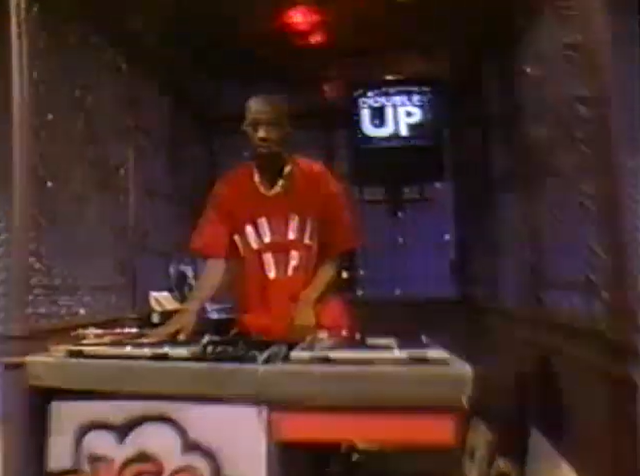
Dating Game hosted by Roth, who was backed up by rapping announcer
Darius Farrell, aka DJ Disco. Two siblings aged 13-16 were tasked with finding
dates for each other out of a selection of three choices; with the prize being
an all-expenses paid date chaperoned by a limo service. Neither could see their
potential date or knew them beyond a nickname, but they could hear their
answers to the sibling’s questions. After
two rounds of questions, the potential dates then had a few seconds to make the
case for why they should be chosen.
The potential dates seated above the large trash cans where they could end up dumped.
Once the
questioning was done, the audience would choose who they would pick, place
their name in a ball, and toss it on stage. Those votes would be tabulated and
the results fired to Roth by Disco with a NerfBow ‘n’ Arrow. The
siblings would then announce their choice and explain why they didn’t pick the
other two; pulling a lever to dump them into the confetti-filled giant garbage
cans they were perched over. If their choice matched one of the audience
choices, they won $100 towards the date. Matching both audience picks upgraded
the date to The Ultimate Double Up Night Out, which involved larger events like
a concert or wrestling match. Reportedly, actor Jennifer Love Hewitt was one of
the potential dates in an episode and ended up dumped.
DJ Disco in his booth.
Double
Up debuted on NBC on September 5, 1992, a
week before the debut of the Teen
NBC programming block it would then become a part of. The series was the
first production for Roth’s newly-formed Slam Dunk Productions,
making him the youngest executive producer after previously taking the title of
youngest game show host with Fun
House. TKD Animation handled the animation for the show’s intro—a
poster of Roth advertising the show folding itself up into a paper airplane and
flying into the studio—and on the TV in Disco’s booth that would illustrate
what’s included in The Ultimate Night as Disco explained it. The series’ theme
was done by Dis Style Productions with lyrics by Jonte
Ray. Farrelly served as the show’s music supervisor.
The audience pelts the stage with their votes.
The series
failed to find any significant audience and was quickly cancelled within a
month, replaced by NBA
Inside Stuff on the schedule. Roth would continue to go on hosting and
producing game shows and reality shows; however, Slam Dunk Productions only did
one more show: the Disney
Channel game show Mad
Libs, based on the popular word fill-in
books, co-produced by Dick Clark Productions. Roth would form another
basketball-themed production company, 3
Ball Productions, with Todd
Nelson in 2001.
FUN HOUSE / FOX’S FUN HOUSE (Syndication, FOX,
September 5, 1988-April 13, 1991) Stone Television/Stone
Stanley Productions, Lorimar-Telepictures (season 1), Lorimar Television
(season 2-3)
Nickelodeon struck gold when it debuted its
kid-centric game show Double
Dare in 1986. Double Dare would pit two teams of two kids
against each other by having them win money answering trivia questions. If they
didn’t know an answer, or thought the other team didn’t, they could pass it
over with a “dare” for double the money. But it could be “double dared” back
for four times the money, in which case that dared team either had to answer or
take a “physical challenge”. These physical challenges often featured
deceptively simple and incredibly messy tasks; like building an ice cream
sundae on their partner’s head, popping goop-filled balloons with a needle
headpiece, plucking cherries out of gelatin with their mouths, etc. Success won
them the money; failure gave it to the opposing team. The team with the most
money then went on to an even messier obstacle course for a chance to win up to
8 prizes within a minute.
A contestant making soup on top of her partner's head on Double Dare.
In the
world of entertainment, a success breeds imitators trying to duplicate that
success. One such attempt came in the form of Fun House, created by
veteran game show producer Bob
Synes. Tasked by Lorimar-Telepictures
with coming up with a kid’s show for syndication, Synes presented executive
producer Scott Stone with a
drawing of carnival midway games leading to a funhouse at the end. Stone scaled
down Synes’ ambitions a bit and suggested focusing on just the funhouse aspect
of it. Lorimar fronted the money to construct a massive set designed by Phyllis Hofberg, Rick Bluhm, Bill Harris and Anthony Sabatino (for which
they won an Emmy), and produce
a pilot to sell the series.
The teams and their respective cheerleaders taking their places at the podium.
The teams sitting in the "Slop Machine", where they got showered in either slime or candy.
Unlike Double Dare, Fun
House placed a greater focus on their “stunts”, which would then segue into
a single related toss-up question asked at a colorful podium equipped with
buzzers. Three timed stunts were played each episode; either with one player at
a time (alternating for each solo challenge) or both teammates together. Stunts
could involve using their faces to lift up a pie to find a “win” symbol on the
bottom of the tin; bobbing for bagels in chocolate milk; assembling a mixed-up
image on giant blocks; batting slimy softballs into the audience; pulling “hair
extensions” off a giant model’s head to place on their own while being covered
in goop; using their teeth to remove gum from under rows of seats; turning
their partner into the world’s largest sandwich; using a giant slingshot to
fire water balloons at pictures of the announcer; and more. Synes would come up
with a title for the stunt first, and then the crew, overseen by producer Stephen Brown, had to create a
stunt to go along with that name. The type of stunts featured were usually
related to the overall theme of that week’s batch of episodes in keeping with
Stone’s philosophy of everything telling a story. The winning team—or both, in
the case of a tie—won 25 points. Answering the question correctly earned them
an additional 25 points.
Piloting submarines in the Grand Prix Race.
The fourth and final round was The
Grand Prix Race. The teams had to race two laps on a track that circled the
studio; switching lanes on the second lap. There were two types of races: one
utilizing a vehicle of some kind that was ridden by one teammate and moved by
the other, switching between laps, and the other was a footrace with each
teammate running a lap. The races all featured a different theme with
associated challenges that had to be accomplished. For instance, a toy-themed
race saw the contestants riding/pulling little red wagons while picking up
various toys placed on the track. Additionally, the teams could snag white and
blue tokens from stations around the track for 10 and 25 extra points, respectively.
During the second season, a Token Bank was added on the second lap that
contained a pre-packaged bundle of tokens worth up to 200 points. The winning
team earned 25 points, but the ultimate winner was determined after the
acquired tokens were tallied by being dropped into slots at the podium. The
team with the most points went on to The Fun House obstacle course, while the
losing team left with consolation prizes. Ties were broken with a toss-up
question.
One of the many configurations of the Fun House obstacle course.
The titular
Fun House stood roughly 3-stories tall and featured several interchangeable
“rooms” of varying themes and obstacles. They could include toppling Styrofoam
skyscrapers; punching out thinly covered holes in a board; an “ice mountain”
climb; crawling through a tunnel full of balloons or one that’s spinning;
digging through school lockers; traversing a ball pit; etc. Each room contained
16 oversized price tags either plainly visible or hidden somewhere: 6 red
representing different prizes revealed before the course was run, and 10 green
ones representing cash amounts ranging from $50 to $300. The contestants had 2
minutes to collect as many tags as possible; grabbing three at a time before
switching with their partner. This continued until all tags were collected or
time ran out. Additionally, one tag was designated as the “Power Prize” that if
collected won them a bonus vacation along with everything else they picked up. For
the second season, the Fun House became larger and featured more intricate
elements like a swimming pool and shooting water.
Host J.D. Roth kicking off the show while John "Tiny" Hurley covers himself in mud.
Fun
House debuted in syndication on September 5, 1988. J.D. Roth served as host
for the entire run; becoming the youngest game show host in history at just 19.
Aiding Roth on the playfield were identical twin cheerleaders. They escorted
the teams to the podium, introduced them, and provided support to them based on
what color uniform the teams were assigned: Jackie (Jacqueline Forrest) for the
gold team and Sammi (Samantha Forrest) for the red. For the pilot, veteran
announcer Brain Cummings was utilized. Cummings had previously announced the
first season of the 1984-86
syndicated version of Let’s Make a Deal,
which Synes produced. John “Tiny” Hurley took over those duties once the series
went into production. Along with announcing, Hurley would appear on camera in
wacky costumes, participate in skits, or sometimes in various stunts. Other
differences in the pilot included playing for cash instead of points; four
stunts played instead of three; The Grand Prix awarding $50 for winning and
featuring a third red token worth $10 while blue was worth $50; contestants
only being allowed two prize tags at a time in the Fun House, with as many cash
tags as they wanted; a “Button Banger” in the Fun House awarding a random cash
bonus up to $2000 when hit; and the prize tags being scanned at the podium to
reveal the Power Prize, which awarded the contestants every prize in the
Fun House. Unlike the $2,000-$3,000 Double Dare or fellow Nickelodeon
game show Finders
Keepers—which filmed in the same complex as Fun House—paid out
in cash in prizes, Fun House offered contestants a potential prize
payout in excess of $10,000. Score Productions
composed the series’ music along with Matt Ender and Jonathan Firstenberg. Props
from the show were used in another Lorimar-Telepictures production, Perfect Strangers,
for the episode “Games People Play”. Series stars Mark Linn-Baker and Bronson Pinchot also filmed a promo for Fun
House as their characters Larry Appleton and Balki Bartokomous.
The show proved a success, becoming
the highest rated syndicated new show upon its debut and surpassing even Double
Dare (in response, Double Dare added theme weeks and upped the ante
in physical challenges by reinstating a previous limited time rebranding as Super Sloppy Double Dare).
In 1989, Fun House gained two spin-offs. In the United States, there was
College Mad House. Hosted by Greg Kinnear, it featured two
teams of four college students (two men, two women) from rival universities
playing it out. Rather than cheerleaders, Kinnear was assisted by referees Donna Wilson
and Richard
MacGregor, with Beau Weaver
announcing. Stunts involved the men or women going against each other, and then
all four together. The content of this show skewed a bit more risqué than the
original; involving more gross-out humor and lewd body movements. Rather than
the Grand Prix, the fourth round was the Finals Round. Each member of the team
took turns answering as many toss-up questions as possible within a minute and
a half; with the winner hitting their opponent in the face with a pie or
whipped cream each time. The Mad House, which featured college-themed rooms,
had each teammate getting 30 seconds to grab as many tags as they could in
order to “clean house” by getting them all. Getting all the tags awarded them a
trip; otherwise, they kept whatever prizes they collected for themselves with
any cash (up to $1000) going to their school. College Mad House only
lasted a single year, ending in September of 1990.
Over in the United Kingdom, ITV debuted their own version of Fun House
produced by Scottish Television. It
featured host Pat Sharp,
twin cheerleaders Melanie
and Martina
Grant, and announcer Gary King.
Played in much the same way as the original with minor gameplay and naming
differences, it actually outlasted its parent program to run a full 11 seasons,
ending in 1999. Their own adult-themed spin-off was planned and a pilot
produced, but it never went to series.
Playing hockey with pies.
Unfortunately, Fun House was
beginning to lose steam as sloppy game shows were wearing out their welcome.
They were finding difficulty remaining in syndication, despite their best
efforts. Enter: FOX. FOX was about to launch
its new kid-focused effort, Fox Kids Network,
and the show they wanted to acquire for it was…Double Dare. Previously, FOX
was pivotal in the success of Double Dare; having distributed it and
aired it regularly on affiliated stations, and even airing a version of the
show, Family Double
Dare, on their own network on Saturday nights. After attempting to
bring the show over to their new line up, FOX ended its direct affiliation with
the series over “creative differences” and abruptly
cancelled Family shortly before they were set to begin filming a new
season. Regular Double Dare continued on, however, and was still shown
on FOX affiliates, and Family was eventually revived by Nickelodeon two
years later. Looking for a replacement that could be just as popular, FOX
turned to Double Dare’s closest competitor: Fun House.
M.C. Mike rapping his intro.
Renamed FOX’s Fun House for
its third season, it joined the inaugural Fox Kids Saturday morning line-up on
September 8, 1990. It also became the first weekday Fox Kids show, filling in
for the delayed Peter Pan and the Pirates by airing a special week’s
worth of programs featuring some of the earlier-mentioned celebrity guests.
While essentially the same show, several changes were made. Hurley was replaced
by Michael Chambers, a.k.a M.C. Mike, best known as “Boogaloo Shrimp” from the Breakin’ films.
He opened each episode by showing off his rapping skills before the title
sequence. While Jackie and Sammi still escorted players to the podium,
introductions were now handled by Mike. Carrying over from College Mad House,
the player that answered a question correctly got to slap a pie into the face
of their opponent. The entire set also shed its carnival-like aesthetic in
favor of more urban flair; with distorted cartoon skyscrapers and riveted pipe
theming.
The all-new Fun House.
The Fun House itself was also
redesigned to emulate a slice of a city block. Starting at the top rather than
the bottom, Roth began the run by turning a large valve to activate the
“Whitewater Slide” that let one of the players splash down into a waiting pool
and officially start the clock counting down. From there, they could go into
the “Hardhat Hallway”, which looked like a scrapyard or garbage-filled empty
lot; the “Zippity Zoo Dah”, a zoo full of various stuffed animals, a performer
in a creature suit, and bendable cage bars; the “Funky Slop Sewer”, resembling
a slimy sewer pipe with fake rats and steamy sewage comprised of green balls in
water; the “Recycling Zone”, where pulling a lever dumped trash on the player
as well as a prize tag; “Bob’s Mad Mall”, which featured dummies holding
shopping bags on rotating doors, one of which held the prize tag; the “Kockeyed
Kitchen”, an upside-down kitchen whose cabinets held the tag (and was typically
filmed upside-down to make it seem like the player was walking on the ceiling);
“Flushing Meadows”, a bathroom-like area with three giant colored toilets that
sprayed water up when opened; “Fast Food Fight”, a diner area where the
opposing team got to impede the winning team by pelting them with food items; and
returning from the original Fun House was the rotating “Tubular Tunnel”.
Although cash tags were still in plain sight, the prize tags were now hidden
within each area. A large slimy alarm clock called the Crazy Glop Clock was
added that gave the team an additional 15 seconds in the Fun House when found.
Celebrity guest Kellie S. Williams receiving a pie to the face for a wrong answer.
Behind the scenes,
Lorimar-Telepictures was acquired by Warner
Bros. Lorimar-Telepictures served as the distributor during the first
season as well as the co-producer, but was replaced by Warner Bros. Domestic Television
Distribution for the remainder. This, along with Tiny
Toon Adventures, would begin Warner Bros.’ association with Fox Kids
that would prove mutually beneficial for both the studio’s burgeoning animation
efforts and the block’s legitimacy as a major player in broadcasting. British Knights was replaced as the
primary sponsor by LA
Gear, and everyone on stage wore the sponsoring company’s shoes. Synes,
sadly, died in 1990. Stone replaced him with David
G. Stanley and renamed his production company, Stone Productions, as Stone
Stanley Productions (now Stone & Company
Entertainment). Each episode of the third season was dedicated to Synes.
A trade ad celebrating Fun House's Emmy win.
FOX’s Fun House only lasted
a short time on the network, airing 22 episodes before it was replaced on the
schedule by the short-lived Swamp
Thing animated series in 1991. Despite being nominated for four
additional Emmys, winning one other, and winning a Young Artist Award,
the show disappeared from the airwaves….in the United States. The British
version has aired reruns and even got a special one-time
revival in 2015 as a promotional gimmick by Fayre & Square pubs and associated Wacky Warehouse play areas. The
American version only eventually resurfaced in videos of various quality on YouTube, including the pilot as a feature
entry of legendary game show host Wink
Martindale’s Wink’s Vault series. Roth would go on to acting and hosting
a few more game shows before moving into producing them—including Moolah
Beach, which would air during the final year of Fox Kids (meaning Roth both
opened and closed the block). Stone Stanly Productions continued
producing game shows, including Fun House spiritual successors Legends of the Hidden
Temple, geared towards kids, and Shop ‘til you Drop,
geared towards adults. Both featured stunt-heavy gameplay in an elaborate
setting: a Mayan temple for Legends, and a 2-story mall for Shop.
The latter also reused some of Fun House’s music. In 2022, YouTube channel Hosts at Home hosted a Fun House reunion
with Roth, Sharp, Stone, and Brown to discuss and reminisce about the show.
The Fun House NES game box.
In 1988, Pressman Toy Corp. published a board game version
of Fun House. A travel game was
made by Tiger
Electronics the following year as part of their Klix
Pocket Travel Games series, as well as their customary LCD handheld game.
Hi-Tech Expressions
produced a video game in 1989 for the Commodore 64 and MS-Dos, and in 1990 for the NES. No version fully
captured the show, but the computer versions were closer than the NES’ as they
featured some semblance of the stunts while the NES involved just throwing
balls at targets and avoiding obstacles in a top-down view. The board game, and
eventually the video games, were given out as consolation prizes on the show.
Exercising on the Fun House set.
The oddest
tie-in merchandise had to have been the workout videos. Stone had been on a
flight with Julie LaFond,
who ran the Jane Fonda exercise empire.
A conversation about fitness in kids led to a collaboration between Fonda and
the show. Fonda came to the set to introduce Roth, who then led the exercise
routines. Two videos ended up being made for the Fun House Fitness
series: The
Swamp Stomp for kids 3-7, and The
Fun House Funk for kids 7+. They were re-released together onto
DVD in 2005 as part of the Jane Fonda Collection compilation series.