Remember that one day when you could wake up without an alarm? When you would get your favorite bowl of cereal and sit between the hours of 8 and 12? This is a blog dedicated to the greatest time of our childhood: Saturday mornings. The television programs you watched, the memories attached to them, and maybe introducing you to something you didn't realize existed. Updated every weekend.
As Doc Brown once said: "30 years. It's a nice round number." We agree, and with that thought in mind, and what with it being September when new programs traditionally began airing, we figured we'd show you the Saturday morning television schedule for all the major networks (alphabetically) from the fall of 1988. While watching on Saturday morning, you may have seen these:
In 1994, Christian Williams created a
show that would launch a TV empire. Hercules: The Legendary
Journeyswas loosely based on the mythological Greek hero Hercules (Kevin Sorbo), and was produced by Renaissance Pictures;
the production company formed by Evil Deadcreators Sam Raimi, Robert Tapert and Bruce Campbell. The show followed
Hercules as he journeyed around a fantasy version of ancient Greece and helped
people along the way against warlords, mercenaries, mythological monsters and
the gods themselves. Occasionally joining him was his best friend, Iolaus (Michael Hurst), and fast-talking con
man, Salmoneus (Robert Trebor), as well as
other allies along the way. The series debuted as a series of five telefilms
before becoming a full one-hour series in 1995. It aired as part of the
syndicated Universal
Action Pack programming block.
Hercules, Xena and their sidekicks.
Hercules
became one of the highest-rated syndicated shows at the time, supplanting Baywatchin the
number one spot. The show introduced the character of Xena (Lucy Lawless), a former marauder
who changed her ways and became a heroic figure looking to make up for her dark
past. Initially going to die in her third and final appearance, Xena’s
popularity spared the character and landed her a spin-off show, Xena:
Warrior Princess. The spin-off ended up becoming more popular than Hercules, and both shows ran for six
seasons before their respective cancellations.
Young Iolaus, Hercules and Jason from The Legendary Journeys.
During that time, a second spin-off
was created. Hercules had featured
several episodes that explored Hercules’ past adventures from his youth. Ian Bohen portrayed a young
Hercules, with Dean O’Gorman playing Iolaus and Chris Conrad as Jason, of Jason and the Argonauts fame (retconning
the previous establishment of Jason being their elder as played by Jeffrey Thomas). It was soon
decided to expand on these adventures and develop a series around the younger
cast.
Developed by Tapert, Young Hercules saw its beginnings in a
made-for-TV movie written by Tapert, Andrew Dettmann and Daniel Truly and shown in February
of 1998. Hercules was sent by his mother, Alcmene (Rachel Blakely), to train at
the academy run by the centaur Cheiron (Nathaniel Lees). There, he met up with
Iolaus and Jason, as well as a female cadet named Yvenna (Johna Stewart-Bowden). However,
their studies were put on hold when Jason’s father, King Aeson (Mike McGee), was put on his
deathbed, necessitating their questing for the Golden Fleece to save
him. It was all a plot by Hercules’ jealous half-brother, Ares (Kevin Smith),
the God of War, and his underling, Discord (Meighan Desmond), This telefilm,
however, contradicted the accounts of this adventure established just the month
prior in the Hercules episode “Hercules on Trial”.
Ryan Gosling puts on the gauntlets.
When Young Hercules went to series, Bohen declined to continue with the
role as it would require him to relocate to New Zealand where it and the other
shows were filmed. He was replaced by an unknown Ryan Gosling, and his costume
and arm makeup were used to make him appear bulkier and more muscular than he
was. The character of Yvenna was also replaced by another cadet, Lilith (Jodie
Rimmer), who was described as the first female cadet ever to train at the
academy. The series also introduced Kora (Angela Marie Dotchin), a barkeep in
the town of Corinth who was secretly a devotee and servant of Artemis (Anna Bernard), goddess of the
hunt, and was revealed to possess powers granted by Artemis. Ares, Discord and
Strife (Joel Tobeck) served as the main antagonists; constantly attempting to
destroy Hercules and his friends with a variety of schemes. Other gods featured
were Hephaestus (Jason Hoyte), the god of
metallurgy; Bacchus (Anthony Ray
Parker & Smith), the god of wine; Hera (Elizabeth Hawthorne), queen of
the gods; and Zeus (John Bach), king of the gods
and Hercules’ father. Along with those reprising their roles, the series shared
many of the same actors that appeared in both Hercules and Xena.
The series became a case study in
efficiency in television production. As it only had a $20 million budget in
total, a number of cost-cutting measures were employed. It was filmed in
four-episode blocks with scripts designed to utilize the same sets as much as
possible. Each block was rotated between directors Chris Graves, Charlie Haskell and Andrew Merrifield; with Simon Raby handling a couple of
episodes. They had toyed with the idea of using digital cameras, but after
determining it wasn’t economically viable at the time went with the cheaper
16mm film. Filming in New Zealand also allowed the production to circumvent
costly Screen Actors Guild
regulations. Initially, visual effects were handled by Weta Workshop until they and a good
portion of the crew went to work on Peter Jackson’s The Lord of the Ringsfilm
trilogy. The other effects were handled by the franchise’s own Flat Earth Productions.
Hercules and Lilith narrowly escaping death.
Young
Hercules proved to be a success for FOX, becoming the 2nd
top-rated live-action series on the network just below Power Rangers. It was also nominated for a Daytime Emmy Award in 1999 and a Writers Guild of America Award in
2000. Despite that, however, FOX ultimately chose not to renew the series for a
second season and it ended its run after 50 episodes. The series was given a
bit of a coda in the Hercules episode
“The Academy”
which saw Hercules, Iolaus and Jason travel to the academy to help take it back
from mercenary students currently running the place. It was the first time
Lilith, played by Susan Brady,
was mentioned outside of Young Hercules. Gosling
portrayed the antagonist, Zylus, and Rimmer was Seska, the daughter of Lilith
and Jason from a dalliance during the Young
Hercules years before Lilith went on to become an Amazon. Later that year,
adult Lilith and Seska would make another appearance in the episode “A Wicked Good
Time”. Rimmer, Conrad, O’Gorman and Dotchin would continue to make
guest-appearances in Hercules and Xena, with Dotchin landing a starring
role in another Renaissance production, Jack of All Trades.
“The
Treasure of Zeus – Part 1” (9/12/98) – Ares has Strife trick Hercules into
stealing Hera’s chalice in an attempt to invalidate Zeus’ protection order on
him.
“Between
Friends (The Treasure of Zeus – Part 2)” (9/16/98) – After they survive
stealing the chalice, Strife frames Iolaus for theft.
“What
a Crockery (The Treasure of Zeus – Part 3)” (9/17/98) – Until the chalice is
returned, Zeus’ protection is lifted and leaves Hercules a target for Ares.
“Herc
and Seek” (9/22/98) – Iolaus’ former gang steals the academy’s tuition money.
“Girl
Trouble” (9/19/98) – Hercues, Jason and Iolaus discover enslaved Amazons on
their ship and free them.
“Teacher’s
Pests” (9/26/98) – Doing chores for punishment, Hercules and Jason cover for
Iolaus so that he can start his new job.
“Inn
Trouble” (10/1/98) – While Kora is on a mission for Artemis, Hercules and his
friends watch her restaurant.
“Keeping
Up with the Jasons” (10/2/98) – Hercules has Hephaestus make him unbeatable
weaponry so that he can defeat Jason.
“Amazing
Grace” (2/4/99) – Hercules invites Amazons to the academy.
“Cyrano
de Hercules” (2/23/99) – Hephaestus builds himself a woman out of metal, but
she ends up falling for Hercules.
“Battle
Lines – Part 1” (11/11/98) – Discord reignites an old hatred between the
centaurs and Amazons.
“Battle
Lines – Part 2” (11/13/98) – Hercules tries to prevent the war between the
centaurs and Amazons.
“Forgery”
(10/10/98) – Tired of being known as “boring”, Hercules uses Hephaestus’ forge
to change himself.
“No
Way Out” (9/25/98) – Trying to keep her from finding out about her surprise
party leads Hercules and Lilith to be trapped in a cave.
“Ares
on Trial” (9/29/98) – Ares is put on trial by the gods when he tries to kill
Hercules.
“Down
and Out in Academy Hills” (10/3/98) – Hercules and his friends rescue an
amnesiac man who fell from the sky.
“Winner
Take All” (10/30/98) – Discovering he has previously unknown brothers, Pollux
and Castor, Hercules forgets about his friends in his excitement.
“A
Serpent’s Tooth” (10/31/98) – Discord and Strife bring a baby monster to
Corinth to destroy the city, but Iolaus ends up coming to love it.
“The
Lure of the Lyre” (11/3/98) – Hercules and his friends have to defeat Bacchus
and keep Lilith from becoming one of his thralls.
“Fame”
(11/4/98) – Orpheus is forced to recruit more Bacchae in order to keep Eurydice
free.
“Lyre,
Liar” (9/18/98) – Eurydice promises to marry Bacchus if he leaves her friends
alone.
“A
Lady in Hades” (10/9/98) – Hercules and Jason head to the Underworld to try and
keep Eurydice out of Tartarus.
“The
Mysteries of Life” (10/7/98) – Hercules and his friends try to free the
formerly baby monster from a freak show.
“Dad
Always Liked Me Best” (9/24/98) – Hercules meets another brother who hunts
Pollux in order to put him to death for the murder of Castor.
“Herc’s
Nemesis” (10/29/98) – Hercules tries to convince Nemesis to defy Hera when
she’s ordered to kill a mortal.
“Cold
Feet” (11/5/98) – Fear over his pending kingship leads Jason to pose as a
farmhand in a small village that he ends up having to free from a warlord.
“Mommy
Dearests” (2/5/99) – Lucius tries to win Zeus’ affections by destroying
everyone Hercules cares about.
“In
Your Dreams” (3/2/99) – Hercules has to face his worst nightmare in order to
free his friends from Morpheus.
“Sisters”
(10/24/98) – Jealous over the attention her sister receives, Kora tries to
emulate her and ends up in trouble.
“The
Golden Bow” (11/6/98) – After Strife has Artemis’ bow stolen, Hercules discovers
Kora is Artemis’ servant and helps her try to retrieve it.
“Home
for the Holidays” (5/11/99) – Hercules brings his friends home only to discover
his mother has fallen in love.
“Cram-Pred”
(11/2/98) – Iolaus’ friends try to help him pass his final exam to keep him out
of prison.
“Con
Ares” (5/10/99) – In order to stop a war, Hercules and his friends have a
farmhand who resembles Ares pose as him.
“Get
Jason” (11/20/98) – The annual tradition of pranking seniors is darkened by a
very real attempt to kill Jason.
“My
Fair Lilith” (2/1/99) – Lilith pretends to be Jason’s wife so that he doesn’t
have to marry a princess sent to be his coronation present.
“Hind
Sight” (11/10/98) – Hercules tries to keep his friends from killing a Golden
Hind, which would result in their being killed by Artemis in turn.
“The
Head That Wears a Crown” (2/2/99) – Hercules and Jason fight over how to deal
with a monster in Corinth.
“Me,
Myself and Eye” (2/25/99) – Iolaus and Jason are cursed in an attempt to get a
future-seeing eye back from Hercules.
“The
Skeptic” (2/3/99) – Strife goes to great lengths to try and convince a skeptic
that the gods do exist.
“Iolaus
Goes Stag” (2/17/99) – Artemis curses Iolaus after he tries to kill the Golden
Hind to impress his uncle.
“Adventures
in the Forbidden Zone” (11/19/98) – A chariot race leads Hercules and new
instructor Theseus into a land where people never return from.
“The
Prize” (11/18/98) – Ares enters a talent contest in order to win the last piece
of the Chronus Stone, which will give him ultimate power.
“The
Beasts Beneath” (11/24/98) – Some of the cadets enter a land known for having
deadly sand sharks.
“Parents’
Day” (2/26/99) – In order to spare himself from his parents’ disappointment,
Iolaus hires actors to pose as them for the academy’s Parents’ Day.
“A
Life for a Life” (2/22/99) – Ares makes Hercules choose between his own life
and that of Chiron’s.
“Under
Siege” (2/24/99) – Hercules has to figure out why they Amazons are attacking
the academy.
“Mila”
(3/8/99) – An Amazon’s dreams lead her to believe her father is a god and she’s
come to find him.
“Apollo”
(5/12/99) – When Hercules tells Apollo that his friends are only friends out of
fear, Apollo attacks the academy in response.
“Ill
Wind” (5/13/99) – Amazon queen Cyane comes to Hercules for help in preventing
her murder.
“Valley
of the Shadow” (5/14/99) – A mysterious old man protects Hercules and his
friends from a monster guarding Hera’s Valley where a hunting trip ends up
taking them.
Film:
“Young
Hercules” (2/17/98) – Hercules is sent to Cheiron’s academy to train and ends
up journeying with Jason to get the Golden Fleece to save his father’s life.
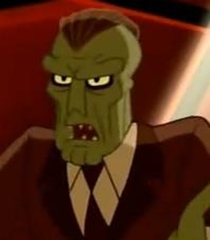
Reynolds was a rugged sex symbol on the big screen for much of his career, but he did get his start and made returns to television. He guest-starred in an episode of Duck Dodgers as Royal Serpenti.
Samson
& Goliath was an action series produced by Hanna-Barbera Productions
for NBC. It was sponsored by General Mills and distributed through
their advertising agency, Dancer Fitzgerald
Sample. It was the only DFS-sponsored cartoon to be outsourced to
Hanna-Barbera, as the agency’s own in-house studio, Gamma Productions, was
closed before production on the series began. It was also the only DFS show not
to be created by either Jay Ward Productions
or Total Television.
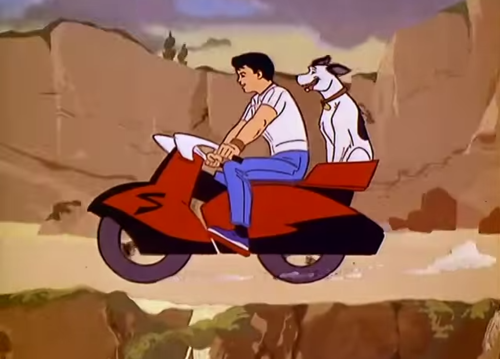
Samson and Goliath traveling the countryside.
The show followed a teenager named
Samson (Tim Matheson) who traveled around the country by motorcycle with his
dog, Goliath (Mel Blanc), helping those in need. Whenever they encountered
trouble, Samson would bring together his golden wristbands and say the words “I
need Samson Power” or “Time for Samson Power”, turning him into a superhero
version of the biblical Samson
complete with super strength. A second meeting of the wristbands would
transform Goliath into super-powered lion (ironic, since the biblical Samson
slew a lion as one of his feats). In his second form, Goliath gained a plethora
of abilities such as super strength and durability, a powerful roar, steel-slicing
claws, energy beams and heat generation and a vision obscuring smoke cloud. Unlike
the biblical Samson, this Samson’s strength wasn’t connected to the length of
his hair but could be enhanced by twisting his wristbands. Likewise, preventing
Samson from bringing his wristbands together could prevent his transformation.
His wristbands were also capable of generating an offensive shockwave attack. Their
de-transformation sequence was never shown.
Samson and Goliath transformed.
The pair encountered foes from both
science fiction and inspired by other mythological elements. There was a
creature created from the Aurora Borealis; the legendary Colossus of Rhodes
statue reanimated by energy from a fallen meteorite; Nerod, an avid collector
of Roman antiquities who modeled himself after Emperor Nero; Baron Von Skull,
an elderly WWI German pilot who created evil war machines; and the terrorist
organization P.E.R.I.L, led by Monarch (Don Messick), who created an
anthropomorphic fire monster, amongst other threats.
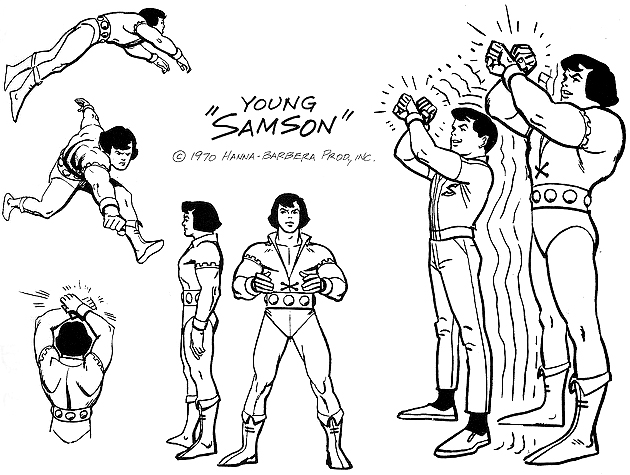
Concept art of Samson's transformation.
Samson
& Goliath debuted on NBC on September 9, 1967. The series ran for a
single season of 13 episodes, each containing two story segments. It was written
by Tony Benedict, Walter Black, Eddie Brandt and Dalton Sandifer,
with music by Ted Nichols. Like
with all of Hanna-Barbera’s other action-oriented series, Alex Toth handled the initial character
designs. Although its run was short, Samson
& Goliath continued to air well into 1968. That April, its name was
changed to Young Samson in order to
differentiate it from the Claymation series, Davey and Goliath.
Samson vs. the Colossus of Rhodes.
Later reruns saw the original name restored
and its segments separated and aired alongside segments from other General
Mills-sponsored programs Rocky & Bullwinkle, Tennessee
Tuxedo and Go Go Gophers to round
out the full half hour. When Samson &
Goliath entered syndicated reruns in 1989, it was combined with other
Hanna-Barbera cartoon The
Space Kidettesas The Space
Kidettes and Young Samson. This package was distributed by The Program Exchange,
which was founded by DFS in 1979. To make room for more commercials, the Kidettes segments were drastically
whittled down while the Samson segments
only had some minor trimming done. Unfortunately, both shows were edited
directly onto their master tapes, destroying their original broadcast versions.
Since Kidettes was only 20 episodes,
six segments of Samson weren’t used
and have been lost ever since.
EPISODE GUIDE (the accuracy
of this guide is in question; read text for more info):
“The
Curse of Monatabu / The Aurora Borealis Creature” (9/9/67) – Samson & Goliath
investigate a witch doctor terrorizing a remote village with a giant monster. /
An electricity monster manifested from the Aurora Borealis terrorizes an Eskimo
village.
“The
Great Colossus / Cold Wind from Venus” (9/16/67) – A meteorite brings the
Colossus of Rhodes to life and it goes on a rampage. / A pair of androids from
Venus arrive on Earth and begin freezing the planet to make it inhabitable by
Venusians.
“The
SSX-19 / Operation Peril” (9/23/67) – A terrorist group plots to steal a new experimental
plane and exchanges Samson’s bracelets with lead ones to keep him away. / PERIL
succeeds in capturing Professor Talos.
“The
Secrets of Evil Island / The Monsteroids” (9/30/67) – Samson & Goliath head
to Evil Isalnd to investigate the disappearance of a missile. / Samson &
Goliath teleport to an asteroid to deal with the alien Zargo and his robot
army.
“The
Idol Rama-Keesh / Salamandro” (10/7/67) – General Tong and Ramu send a
mechanical idol to terrorize a local village. / Villains teleport from an
undersea laboratory into a ship to steal the gold bullion it carries.
“Baron
Von Skull / Moon Rendezvous” (10/14/67) – Samson & Goliath face off against
a former WWI flying ace. / Samson & Goliath end up on the moon while trying
to recover a stolen graviton.
“The
Lost City of the Dragon Men / The Colossal Coral Creature” (10/21/67) – Samson
& Goliath have to save Professor Kinkaid from an underground city. / A pair
of criminals revive a monster and set it loose on an Australian city.
“Zuran’s
Creature / The Dome” (10/28/67) – Dr. Zuran transfers Samson’s super strength into
his robot. / Samson & Goliath have to stop The Dome from launching missiles.
“Nerod
/ The Terrible Dr. Desto” (11/4/67) – Samson & Goliath fight against Nerod
and his gladiators. / Dr. Desto uses a time machine to bring terrors from out
of the past.
“From
Out of the Deep / Thing from the Black Mountains” (11/11/67) – The Gill Men
interrupt Samson & Goliath’s vacation. / A missile awakens a monster in the
Black Mountains.
Every culture
has their fair share of myths and legends, passed down from generation to
generation. Over time, those stories have become the subject of books, plays,
movies, TV shows and, most importantly, Saturday morning cartoons. This month,
we’re going to take a look at some of the shows whose content was inspired by
mythology in some way or other.