Remember that one day when you could wake up without an alarm? When you would get your favorite bowl of cereal and sit between the hours of 8 and 12? This is a blog dedicated to the greatest time of our childhood: Saturday mornings. The television programs you watched, the memories attached to them, and maybe introducing you to something you didn't realize existed. Updated every weekend.
Hanna-Barbera sought to
further bolster their offerings in the growing fictional band genre while
duplicating the success they found with The Banana Splits Adventure Hour.
They created a new variety program with an anthropomorphic band as the
headliners. However, this time around, it would be completely animated. The
resulting program was Cattanooga Cats.
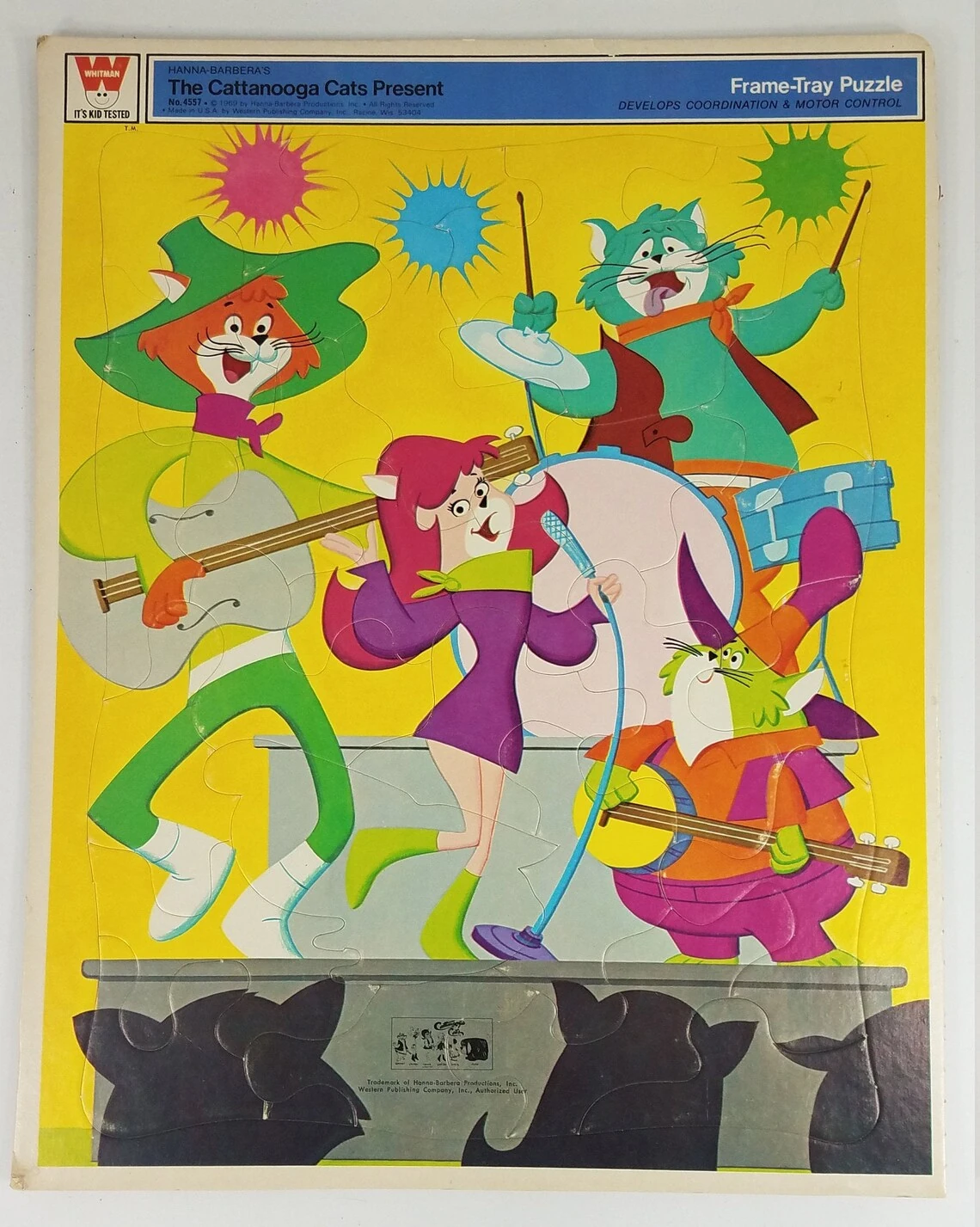
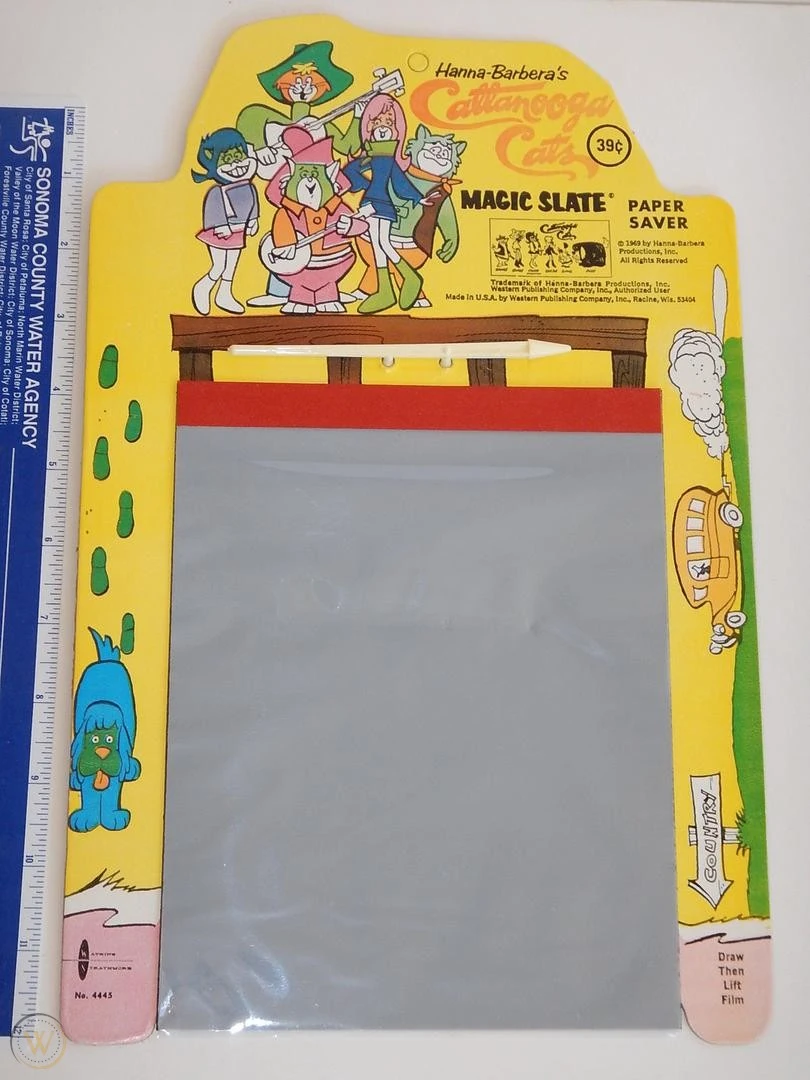
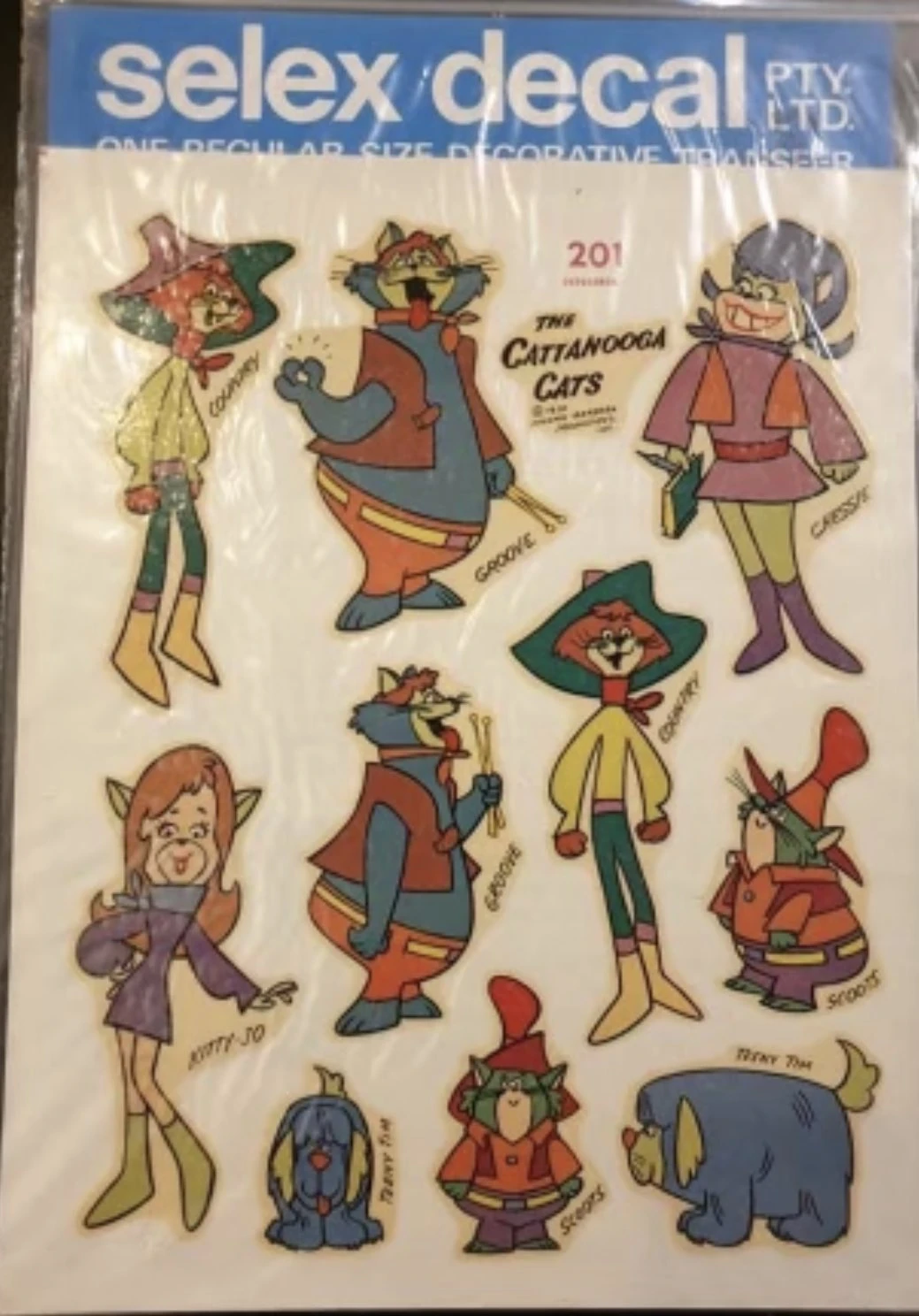
Promotional art of Groove, Country, Kitty Jo and Scoots with super-fan Chessie and Teeny Tim.
The titular
segment focused on the Cattanooga Cats (a play on Chattanooga, Tennessee) band comprised of
Country (Bill Callaway), the lead singer and guitarist who also drove their
converted bus, Gashopper; Kitty Jo (Julie Bennet), a singer and dancer that
occasionally also drove the bus; Scoots (Jim Begg), the bassist with a magic
crayon that could create anything out of thin air to get the group out of a jam;
and Groove (Casey Kasem), the drummer that always spoke in rhyme. A fifth
member, a keyboardist mouse named Cheesie, made it as far as storyboards but
ultimately cut out of the final production. Ads
for the series would also feature 5 members and presumably older,
mod-inspired designs, rather than their final ones. They usually ended up
embroiled in some kind of misadventure along the way to a gig; be it pestered
by the supernatural—both real and man-made—or eluding a persistent autograph
hound. Only nine full episodes were made with the Cats, however they would
appear in bumpers and musical numbers between the other cartoons with the
addition of Kitty Jo’s big blue dog, Teeny Tim (named after the Tiny Tim
character from A Christmas
Carol by Charles
Dickens).
Title card for It's the Wolf! featuring Bristlehound, Mildew and Lambsy.
It’s the Wolf! centered on
hungry wolf, Mildew (Paul Lynde, who was uncredited), attempting to make a
dinner out of sure-footed lamb, Lambsy Divey (inspired
by the lyrics of the 1943 novelty song “Mairzy Doats” composed
by Milton Drake, Al
Hoffman and Jerry
Livingston, voiced by Butler), utilizing
various schemes and disguises. A recurring gag would have Lambsy easily see
through Mildew’s disguises and give several incorrect rhyming guesses as to his
true identity before crying out “It’s the wool-uff!” Lambsy was under the watchful
guard of sheepdog Bristlehound (Melvin), and when Lambsy called out
Bristelhound would appear, snag Mildew with his cane, pound him and send him
flying off into the horizon. This segment was largely inspired by the Warner Bros. theatrical shorts featuring Ralph
Wolf and Sam Sheepdog, running from 1953-63. For Japanese airings, It’s
the Wolf! was renamed Ramji-chan, giving Lambsy top billing due to
their love of cute characters.
Around the World in 79 Days title card featuring Crumden and his crew looking at Phineas and his.
Around
the World in 79 Days was a sequel to the Jules Verne novel, Around the World
in Eighty Days. Phineas “Finny” Fogg Jr. (Bruce Watson) was the
American great-great-grandson of Phileas Fogg who set out to not only beat his
relative’s record, but gain a £1,000,000 inheritance by doing so. Joining him
along the way were teenaged reporters Jenny Trent (Janet Waldo) and Hoppy (Don
Messick). Attempting to stop him and get the money himself was Crumden (Daws
Butler), the crooked butler of Phileas, his idiotic chauffer, Bumbler (Allan
Melvin), and his pet monkey, Smirky (Messick). Unlike the other segments, 79
Days was serialized rather than episodic. Another unrelated
attempt at adapting the novel would come 3 years later on rival network NBC.
Title card for Motormouse and Autocat, with the titular characters in mid chase.
Motormouse
and Autocat was essentially a Tom
and Jerry clone; however, utilizing various wild vehicles. Autocat
(Marty Ingles) was a fast-talking race car-driving cat that was hired to get
rid of the motorcycle-riding Motormouse (Dick Curtis, using an over-enunciation
of various words) from a garage. To do so, he continually concocted bizarre
vehicle contraptions in order to snag him. Of course, those vehicles would
often fail on Autocat or Motormouse would simply outsmart his opponent.
Hanna-Barbera would also utilize strange vehicle chases as a central theme of
the concurrently-airing Dastardly
and Muttley in their Flying Machines.
The air race has turned into an ice race between Phineas and Crumden.
Unfortunately, the series failed to
achieve the success Hanna-Barbera was looking for. At least in part. It’s
the Wolf and Motormouse and Autocat turned out to be the stand-outs,
and were split off into their own half hour the following year with brand new
entries. Cattanooga Cats and 79 Dayswould be paired up for reruns on ABC Sunday mornings until both shows left the network the
following season. Reruns of the various segments, particularly Motormouse
and Wolf, would air intermittently on Cartoon
Network beginning in 1995 until 2000 and on sister
channel Boomerang beginning
in 2000 until 2012. The complete series has never seen a home media
release, but Walton Home Movies released
3 of the music videos and the theme and several episodes
of Motormouse on Super 8 in 1971, and 12 Wolf episodes were
released by Hanna-Barbera
Home Videoon VHS in
1988.
Mildew in Laff-A-Lympics.
Mildew would appear as an announcer
on the series Laff-a-Lympics,
voiced by John Stephenson
impersonating Lynde. Lambsy would appear on his own in 1972’s Yogi’s Ark Lark. Mildew
(Bernardo de Paula), Lambsy (Dana Snyder), and the Cattanooga
Cats (as animatronics) would go on to make appearances in the streaming series Jellystone! Plans
were in place to revive The Cattanooga Cats along with The Hair Bear
Bunch and Snooper and Blabber as rotating features of the second
season of 2 Stupid
Dogs, but were ultimately scrapped.
EPISODE GUIDE:
“Witch Whacky / It’s the Wolf! / The Race is On / Wheelin’
and Dealin’” (9/6/69) – A witch plans to make Kitty Jo her replacement so she
can finally retire. / Mildew Wolf plans to have Lambsy for dinner—if he can get
past Bristlehound first. / Crumden attempts to end Phinny’s trip early in
Paris. / Motormouse and Autocat compete with their newly-arrived upgrades.
“Geronihoho / When My Sheep Comes In / Swiss Mis-Adventure /
Party Crasher” (9/13/69) – The Cats deal with a Native American chief set on
chasing tourists off his land to preserve it. / Mildew attempts to snag Lambsy
while he’s on his way to an Australian sheep show. / A rescue dog saves the
crew after Crumden leaves them frozen in the Alps. / Autocat attempts to crash
Motormouse’s party.
“The Big Boo-Boo / A Sheep in the Deep / Arabian Daze / Water
Sports” (9/20/69) – A princess’ servant decides to kidnap Kitty Jo so that the
princess may learn the Cats’ dances. / Mildew finds Bristlehound and Lambsy on
a deserted island. / Crumden kidnaps Jenny to give to a sheik to be his
princess. / Autocat tries to get Motormouse back to the garage from vacation to
avoid being fired.
“The Wee Greenie Goofie / High Hopes / Winter Blunder-Land!
/ Madrid or Busted / What’s the Motor with You?” (9/27/69) – The Cats deal with
a mischievous leprechaun that followed Kitty Jo’s uncle home from Ireland. / Mildew
becomes the Crimson Baron in order to snatch Lambsy out of the sky. / Dinner
will be served cold if Mildew can catch Lambsy in the snow. / Crumden steals
the crew’s map, leaving them lost in Spain. / Autocat tries to stop
Motormouse’s testing of a new motorcycle.
“Mummy’s Day / Merry Go Roundup! / Mr. Bom Bom / Mini
Messenger” (10/4/69) – The Cats end up locked inside a museum for the night and
run afoul of a reanimated mummy looking to steal a ruby. / Bristlehound builds
an amusement park for Lambsy. / Crumden’s storm causes the crew to become
acquainted with a gorilla. / Autocat attempts to stop Motormouse’s new delivery
service.
“Zoo’s Who / Super Sceintific Sheep Sitting Service / India
or Bust / Wild Wheelin’ Wheels” (10/11/69) – The Cats try to figure out how to
get a homesick elephant out of the zoo and back home. / Bristlehound employs a
video security system to keep an eye on Mildew. / Crumden cuts away Phinny’s
balloon after failing to trick him with an abominable snowman. / Unable to
catch Motormouse, Autocat decides on some drastic actions and crafts new
automobiles.
“Autograph Hounded / Any Sport in a Storm / Snow Slappy / Soggy
to Me” (10/18/69) – The Cats try to get away from a very persistent autograph
hound. / Lambsy just wants to play sports, but Mildew has other plans. / Crumden
plots some dirty tricks at the North Pole. / Autocat ends up all wet after
Motormouse becomes a firefighter.
“The Caribbean Kook / Magic Wanderer / Finney, Finney, Fun,
Fun / Crash Course” (10/25/69) – The Cats take on a pirate that crashes their
cruise ship gig. / Mildew, Lambsy and Bristlehound add prestidigitation to
their chase. / Crumden forces the crew to land in an area where trespassing is
a jailable offense. / Autocat tries to keep Motormouse out of a motorcycle race
only to end up in it himself.
“Ghosting A-Go-Go / Runaway Home / The Argentiny Meany / Fueling
Around” (11/1/69) – The Cats end up in a haunted house where a ghost is
determined to put the fright into them. / Lambsy decides to run away from home
to seek his fortune. / Crumden and Bumbler saw off the spot where the crew
landed their balloon in Argentina. / Autocat tries to come up with his own
super fuel to rival Motormouse’s.
“Smart Dummy / The Tree Man / Buzzin’ Cousin” (11/8/69) –Mildew
increases his odds by creating mechanical duplicates of himself. / Bumbler
downs the crew’s balloon, but they end up rescued by a jungle man. / Motormouse
decides to have some fun with Autocat when his identical cousin comes to visit.
“Cat Caper / Saucy Aussie / Snow-Go” (11/15/69) – Paths get
crossed as a cat attempts to catch a bird while Mildew goes after Lambsy. / Kangaroos
help the crew retrieve the balloon Crumden lets loose. / Autocat comes up with
snow-bound vehicles to catch Motormouse in the winter.
“Mask Me No Questions / Crumden’s Last Stand / Hard Day’s
Day” (11/22/69) –Lambsy writes to his favorite TV super hero to help protect
him from Mildew. / Crumden ends up betrothed to an Indian chief’s daughter. / Autocat
creates a remote-controlled device to deal with Motormouse.
“Freeway Frenzy / Egyptian Jinx / Tally Ha Ha” (11/29/69) –Mildew
attempts to catch Lambsy as he plays on an unfinished highway. / Crumden
attempts to scare off the crew with a fake haunted pyramid. / Leadership of a
club comes down to who can capture Motormouse.
“Slumber Jacks / Border Disorder / Hocus Focus” (12/6/69) – Bristlehound
is unable to stay awake while Mildew pursues Lambsy. / Crumden recruits a
Mexican criminal to help stop the crew. / Motormouse takes pictures to win a
new motorcycle in a contest, despite Autocat’s best efforts to interrupt him.
“Pow-Wow Wolf / Troubles in Dutch / Kitty Kitty Bang Bang”
(12/13/69) –Mildew goes after Lambsy as he pretends to be a Native American. / Phinny
enters an ice-skating competition to pay for some prize-winning tulips Crumden
caused them to crush. / Autocat tries to keep Motormouse from going on his
cruise vacation.
“Ghost of a Chance / The Fiji Weegees / King Size Kaddy”
(12/20/69) – Mildew plays ghost when Bristelhound and Lambsy take shelter in an
abandoned house. / Crumden tricks a tribe into thinking the crew are evil
spirits. / Autocat interrupts Motormouse’s golf game.
For the history of Dennis the Menace, check out the post here.
Hank
Ketcham was inspired by the antics of his son, Dennis, to
create the comic strip Dennis the Menace.
The strip followed young Dennis as he inadvertently caused chaos for the
adults in his life through his well-meaning intentions. The strip became
immensely popular, and it wasn’t long before Hollywood came calling.
Dennis with his parents (front) and the Wilsons (back).
The first adaptation of the strip
was a sitcom for CBS,
who were looking to replace Leave it to Beaverafter
losing it to ABC,
produced by Dariell Productions and Screen Gems.
Like the strip, Dennis (Jay
North) was a well-intentioned mischievous boy whose antics
often came at the expense of his long-suffering neighbor, George Wilson (Joseph
Kearns). Dennis, at first, was more directly responsible for
the trouble he caused, but that was toned down at the network’s request to
avoid imitable behavior among younger members of their viewing audience. Herbert
Anderson and Gloria
Henry portrayed Dennis’ parents Henry and Alice, and Sylvia
Field played George’s wife, Martha. Missing was the
Mitchells’ dog, Ruff, who was replaced by the Wilsons’ dog, Fremont. Other
characters included Dennis’ best friend Tommy Anderson (Billy
Booth); Margaret Wade (Jeannie
Russell, cast at North’s suggestion), who had a crush on
Dennis though he found her annoying; Sergeant Harold Mooney (George
Cisar), a local policeman that took great pleasuring in
ruining Mr. Wilson’s day; Otis Quigley (Willard
Waterman), the local grocer; Miss Esther Cathcart (Mary
Wickes), a spinster that threw herself at every man she
could; and Grandma Mitchell (Kathleen
Mulqueen), Henry’s mother who stayed with them briefly while
Alice was away taking care of her father (a cover for Henry being on maternity
leave). Ron
Howard portrayed another of Dennis’ friends, Stewart, for
six episodes before he was cast to star in The Andy Griffith Show.
The replacement Wilsons.
Dennis
the Menace began on October 4, 1959 and ran for a total of four seasons.
North would also reprise the role for appearances on The Donna Reed Show, The Red Skelton Hour,
and in the film Pepe.
After the filming of the 100th episode, Kearns died
suddenly of a cerebral hemorrhage. For the remainder of the third season,
George was said to be out east settling an estate, and his brother, John (Gale
Gordon), was staying in his house as a guest. John,
interestingly enough, bore a stronger resemblance in appearance and personality
to the Mr. Wilson of the comic strip than George did. For the final season, the
original Wilsons were written out as having moved away, with John buying their
house with his wife, Eloise (Sara
Seegar). At the end of the season, CBS ultimately decided to
cancel the show as North, approaching 12-years-old, was getting too old to
believably be involved in the antics of the character. The show entered reruns on
NBC Saturday mornings
later that year before going into syndicated reruns in 1965. In the 1980s, it
began to make the rounds on various cable networks including Nickelodeon,
TV Land
and Antenna TV,
and on the streaming service Hulu.
Hollywood
Squares (also The Hollywood Squares) was a long-running game show
created by Heatter-Quigley
Productions. Two contestants competed against each other for cash and
prizes in a game of tic-tac-toe.
The twist? The game board was populated by celebrities.
The show’s
game board was comprised of a large 9-compartment grid in which celebrities
from various entertainment media sat. Contestants would pick out a celebrity
and the host would then ask them a trivia question, and it was up to the
contestant to figure out if the answer they gave was correct or not. Guessing
that correctly meant the contestant secured that square with either an “X” or
an “O”. A wrong answer awarded it to their opponent (except if that would lead
to an automatic win, in some versions of the rules). The game was won by lining
up 3 X’s or O’s in a row in any direction, or by capturing the most number of
squares if all the rows were blocked.
The celebrity grid, comprised of Rich Little, Rose Marie, John Davidson, Sandy Duncan, Paul Lynde, Totie Fields, Charley Weaver, Leslie Uggams and George Gobel.
The show,
however, was basically a backdrop for the comedy in the form of jokes—or “zingers”—delivered
by the celebrities before they answered. The writing staff supplied the jokes
when needed, and the celebrities were clued into the questions’ subjects (but
not the actual questions) prior to the show to help develop those
zingers as well as plausible bluff answers.
After two
pilots were filmed, NBC acquired the show and
debuted it on October 17, 1966. Two years later, it gained a nighttime version,
as well as a syndicated version in 1971. Peter Marshall was hired as host; his
taking the job only to prevent Dan
Rowan from getting it. Marshall had worked as a writer for Rowan along with
his partner, Tommy Noonan,
and took issue with the lack of respect he showed Noonan during his terminal
illness. Kenny Williams, a Heatter-Quigley regular, served as the announcer.
Although the celebrities were cast on a rotating basis, many became known as
regulars on the show and appeared often. Among these regulars were Cliff Arquette (as his
alter-ego “Charley Weaver”), Rich
Little, Wally Cox, Roddy McDowall, Rose Marie (playing to her
lovelorn persona), and Demond
Wilson. Most notable was Paul
Lynde, who was known for delivering outrageous and innuendo-laden jokes.
Not only did he earn a permanent spot in the all-important center square, but
he nabbed three daytime Emmy Award
nominations for his tenure as well.
Kenny Williams introducing Peter Marshall.
In 1969,
Heatter-Quigley decided to try a spin-off geared towards a younger audience,
having previously dabbled in children’s game shows with Video
Village Jr.and Shenanigans.
Dubbed Storybook Squares, the set behind the players was designed with a
medieval theme and featured children as contestants; always a boy, playing “X”,
and a girl, playing “O”. Williams appeared on camera as “The Guardian of the
Gate” in full costume, acting as a town crier by introducing the show and host
Marshall with a bell. Marshall would then introduce that episode’s panelists,
who emerged from a castle gate that appeared after Williams closed the “storybook”
the show’s name was emblazoned on.
Storybook Squares debuted on
NBC on January 4, 1969. Rather than cash and prizes, the contestants
played strictly for prizes for as many games as time permitted. A “Secret
Square” was in play for the first two rounds of the episode, similar to the
1968 primetime version. A random celebrity was labelled as the “Secret Square”
and awarded a prize for the contestant that correctly agreed or disagreed with
them. If the prize was missed in the first round, it was carried over into the
second. At the end of each episode, the contestants were brought over to the stage
entrance to meet the panelists as they walked off during the credits. Unfortunately,
the concept ended up being short-lived as it would end its run on April 19th.
Of the spinoff, Marshall would say in a 2003 interview for E! True Hollywood
Story that while the concept was good, the character introductions took
too much time away from actual gameplay. Heatter-Quigley would revisit the
concept during the 1976-77 season of Squares for special episodes of the
daytime series. The set was redesigned to expand the medieval theme around the
panel grid as well. This time around, a boy would play with his father and
grandfather against a girl and her mother and grandmother, alternating between
each family member per round. $50 was awarded for each captured square, $300
for each game, and the most money at the end of play won a large prize.
The
original Hollywood Squares ended its run in 1981 after moving to Las
Vegas from California for the final year. NBC, however, would attempt several
revivals not long after. In 1983, they combined Hollywood Squares with Match Game to form
the short-lived Match
Game Hollywood Squares Hour, with Jon Bauman of Sha Na Na serving as the host of the Squares
segment and long-time Match Game host Gene
Rayburn presiding over the rest. It returned on
its own again in 1986 until 1989, hosted by semi-regular original panelist John Davidson and announced by Shadoe Stevens, who himself
became a regular panelist occupying the bottom center square. Joan Rivers was that version’s
permanent center square starting in the second year. The next
revival came in 1998-2004 with Tom Bergeron as host, and executive
producer Whoopi Goldberg as
the center square until 2002. Stevens returned to announce for the first couple
of seasons. In 2023, BET had greenlit
a new revival of the series called Celebrity Squares
and CBStheir
own for 2025. There were also several spin-off versions: Hip Hop Squares was
a music-based version aired on VH1 and MTV2 in 2012 and 2017; The West Virginia Squares
in 2014 was a one-off limited stage production that had questions that dealt
with the history of the state; Nashville Squares
was a country music-themed version in 2019; and Hollywood Museum Squares
served as a fundraiser for the organization in 2021.
Gulliver’s Travels,
or Travels into Several Remote Nations of the World. In Four Parts. By
Lemuel Gulliver, First a Surgeon, and then a Captain of Several Ships is a
book written by Jonathan
Swift and first published in 1726. It was meant to be a satire of human
nature, English customs, politics of the day, and travelouges, and contributed
to the rise of the novel as a literary form in English.
A well-known image of Gulliver being tied down by the Lilliputians.
The book
was told in four parts from the first-person from the perspective of Lemuel
Gulliver, a surgeon and sea captain that travelled the world. The first part,
probably the most well-known, had Gulliver as the sole survivor of a shipwreck that
ended up in Lilliput, a land where the populace was only 6-inches tall.
Parodying the English political parties, the Tories
and Whigs,
the Lilliputians engaged in ridiculous customs and petty debates while court
positions were filled by those that were good at ridiculous feats of skill. Gulliver
is asked to help in the conflict with the empire of Blefuscu over which end of
an egg should be broken, their religious doctrine. After falling out of favor
with the Lilliputians he found a human-sized boat in Blefuscu and escaped back
to England.
Gulliver in the land of giants.
The second
voyage took him to Brobdingnag, this time populated by giants. Captured by a
farmer, Gulliver was put on exhibit and eventually purchased by their queen.
Their king, however, wasn’t quite as taken by him over his stories of England
and was horrified by Gulliver’s offer to make them projectile weapons. He was
snatched up by an eagle and rescued by normal-sized people at sea.
Gulliver spying Laputa.
The third
voyage saw him on the flying island of Laputa, whose populace were so lost in
thought they needed to be reminded to pay attention, and who loved mathematics
and music but had no practical applications for either. Visiting the continent
of Balnibarbi, the land below the island, he found the fields in ruin and
people living in squalor as the citizenry were governed by a learned academy
that spent all their time on impractical experiments; such as extracting sunbeams
from cucumbers. The island of sorcerers, Glubbdubdrib, yielded insights into
the great lies of history. Finally, he went to the kingdom of Luggnagg, whose
citizens were immortal but aged as if they were mortal, rendering them
miserable. From there, Gulliver was able to get to Japan and back to England.
The Houyhnhnms herding their Yahoos during a harvest.
The last
voyage took him to the land of the Houyhnhnms, intelligent horses who were superior
to the brutish humanoid race of Yahoos; some of whom were tamed in a twist on
the human-beast relationship. The Houyhnhnms were fascinated by Gulliver who
seemed to them to be a better version of the Yahoos, but his stories of England
led them to conclude they were just as bad as the Yahoos and that Gulliver must
leave. Upon his return to England, Gulliver decided to spurn human connections
and bought horses to converse with instead.
The first edition of the book.
The book
was first published in England by Benjamin Motte, utilizing
five printing houses for speedy production to avoid piracy. Fearing persecution
due to the book being transparently anti-Whig, he made several edits to the manuscript
without Swift’s input to soften the blow and added material defending Queen
Anne before publication. The book proved popular with the populace, although
Swift’s peers were often critical of its messages and depictions of humanity.
Naturally, members of the Whig party were offended at the mocking of their
politics. The book was reprinted in 1735 by Irish publisher George Faulkner with
Motte’s edits removed. Swift composed a “letter” from Gulliver to his cousin
Sympson complaining of Motte’s alterations to be included in the new edition,
as was a set of five Verses on Gulliver’s Travels written by Swift’s
friend, Alexander
Pope. Both versions of the book would be reprinted over the years with
additional material.
Gary with Tagg and the sinister Captain Leech.
As with
many other great works of literature that have endured over centuries, Gulliver’s
Travels has been adapted numerous times—although many put to film have
tended to focus only on the first two adventures—and there have been a wide
range of unofficial sequels and imitations. One of these efforts was made by Hanna-Barbera, loosely
borrowing the names and themes from the first adventure for an all-new animated
series. The Adventures of Gulliver followed father and son Thomas (mistakenly
called “Lemuel” by many sources, voiced by John Stephenson) and Gary Gulliver
(Jerry Dexter) as they went on a treasure-hunting voyage with their dog, Tagg (which
many sources mistakenly call “Bib”, voiced by Don Messick). However, the
sinister Captain Leech (Stephenson) also wanted the treasure and tried to steal
their map, resulting in their ship crashing on the rocks.
Our Lilliputian friends (clockwise from top): King Pomp, Flirtatica, Bunko, Eager and Glum.
Gary and
Tagg found themselves on the very island they were looking for, which turned
out to be the home of the Lilliputians—beings only 6-inches tall. After some
initial mistrust of their giant visitors, Gary’s rescuing of King Pomp
(Stephenson) put him in their good graces; particularly with Bunko (Allan
Melvin), Eager (Messick), Glum (Herb Vigran), and Flirtacia (who was never
indicated as being a princess despite many claims as such, voiced by Ginny
Tyler). As he helped protect their kingdom from assorted threats like giant
birds and other tiny people, they in turn helped him search for his father somewhere
in the perilous wilds of the island. Of course, additional danger continued to
lurk in the form of Captain Leech, pursuing Gary for the map he was initially unaware
his father hid in Tagg’s collar.
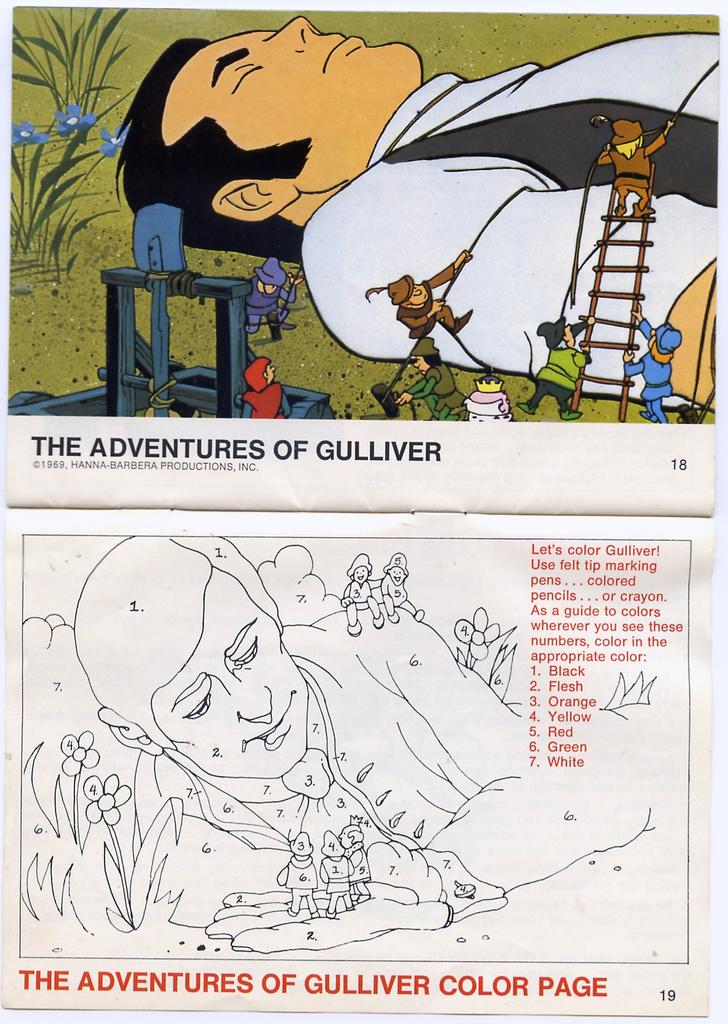
If someone doesn't end up tied down by little people, is it even a Gulliver adaptation?
The
Adventures of Gulliver debuted on ABC on
September 14, 1968. The series was written by Joe Ruby and Ken Spears,
with character designs by Alex Toth and music
by Ted Nichols. The biting
satire found in Swift’s novel was greatly reduced, if at all present, to
instead focus on fantastic adventure tales with the Lilliputians providing Hanna-Barbera’s
trademark comic relief. Further differences involved neither Gulliver being noticeably
British and being set in the present day. Although only 17 episodes were
produced, the series ran through the summer of 1970 before being integrated
into The Banana Splits and Friends Show syndicated package program. Reruns would eventually make their way to both Cartoon Network and its sister
channel, Boomerang. A decade after the
series’ production, Hanna-Barbera would return to Lilliput with a new
adaptation of Gulliver’s Travels for their anthology television series Famous Classic Tales.
This version would stick a bit closer to the book.
“Dangerous Journey” (9/14/68) – After being attacked on the
sea, Gary and Tagg end up on the island of the Lilliputians where Gary rescues
their king.
“The Valley of Time” (9/21/68) – Leech blackmails Gary for
the map by trapping him and his friends in a cave, only for them to find
another way out into a land stuck in prehistoric times.
“The Capture” (9/28/68) – Leech and Gary are conscripted by
Captain Cutler to serve as members of his pirate crew.
“The Tiny Vikings” (10/5/68) – Leech partners with a band of
tiny Vikings to help them on their raid on Lilliput if they help him get the
map.
“The Forbidden Pool” (10/12/68) – Gary and Tagg drink from a
pool that shrinks them down to Lilliputian size and must race to another to
restore themselves before it disappears at sunrise.
“The Perils of the Lilliputs” (10/19/68) – Bunko, Eager and
Glum are captured by a circus owner for his show when their ship stops on the
island for water.
“Exit Leech” (10/26/68) – Leech declares he’s leaving the
island, but returns disguised as a witch doctor to trick the Lilliputians into
giving him the map.
“Hurricane Island” (11/2/68) – Gary sets out to get an egg
his friends need for a festival while searching for his father, and Leech
watches over him believing he’s after the treasure.
“Mysterious Forest” (11/9/68) – A group of treasure-seeking
ghosts drags Gary off into the Mysterious Forest.
“Little Man of the Year” (11/16/68) – Gary offers to leave
for the duration of a contest so Eager could win “Man of the Year”, but Eager
causes a disaster that requires Gary’s help to fix.
“The Rescue” (11/23/68) – Leech captures Tagg and offers to
exchange him for the map, but with Gary gone searching his friends are left to
rescue Tagg on their own.
“The Dark Sleep” (11/30/68) – Leech attempts to slip Gary a
sleeping potion but Flirtacia takes it instead, leading the others to find the
antidote for her.
“The Runaway” (12/7/68) – When King Pomp comes across a
photo of an attractive woman Gary has, Flirtacia decides to leave the village
in a jealous rage.
“The Masquerade” (12/14/68) – Leech and an outlaw
Lilliputian gang decide they’ll acquire the map by replace the king with a
doppelganger.
“The Missing Crown” (12/21/68) – Bunko and Eager investigate
the disappearance of various items around the village, leading to the discovery
of clues that pit friend against friend.
“Gulliver’s Challenge” (12/28/68) – Gary challenges the
Black Knight to a duel for the freedom of his friends.
“The Hero” (1/4/69) – Eager becomes dejected when the others
reminisce about Gary’s heroic deeds and ends up eating a fruit that makes him
hallucinate that he is a superhero.