Remember that one day when you could wake up without an alarm? When you would get your favorite bowl of cereal and sit between the hours of 8 and 12? This is a blog dedicated to the greatest time of our childhood: Saturday mornings. The television programs you watched, the memories attached to them, and maybe introducing you to something you didn't realize existed. Updated every weekend.
He co-developed Road Rovers; did layouts for Yogi’s Gang,
Wheelie and the Chopper Bunch, CB Bears, Scooby’s Laff-A-Lympics, Yogi’s Space
Race, Jana of the Jungle, The New Shmoo, Godzilla (1978), Spider-Man and
His Amazing Friends, Meatballs and Spaghetti, The Incredible Hulk (1982),
Dragon’s Lair and Garfield and Friends; storyboards for Little
Muppet Monsters, The New Archies, Camp Candy, Little Shop, Garfield and Friends,
Superman: The Animated Series, Freakazoid!, Hercules: The Animated Series, Mickey
Mouseworks, Buzz Lightyear of Star Command, Xiaolin Showdown, Tutenstein, Tom
and Jerry Tales, and Captain Jake and the Never Land Pirates; was
story director for The Completely Mental Misadventures of Ed Grimley;
and did models for Garfield and Friends.
He appeared as the Award Show Host in an episode of The Weird Al Show;
Mr. Brown in an episode of City Guys; Cassandra's father Vic in several episodes of Hercules:
The Animated Series; Pa Munchapper in three episodes of Buzz Lightyear of Star
Command; Mr. Paulson in Teamo Supremo; Ross Darren and a speedway
announcer in two different episodes of The Batman; Swindle in Transformers:
Animated; Grandpa Murphy in Milo Murphy’s Law; and Pop-Pop in The
Loud House. He also provided voices for The Emperor’s New School and
appeared with his comedy troupe, Ace Trucking Company, in the 1974 ABC
Funshine Saturday Sneak Peak preview special.
Best known as the permanent voice of Minnie Mouse since 1986
as well as Donald Duck’s nephews Huey, Dewey and Louie since 1987. Along with their portrayal
in various media, she played Minnie in Mickey Mouse Works, House of Mouse and
Mickey Mouse (2103) and Huey, Dewey and Louie in DuckTales (1987),
Cartoon All-Stars to the Rescue and Mickey Mouse (2013).
She also had a long career on Saturday mornings. Her various
roles included Pebbles Flintstone and Cavemouse in The Flintstone Comedy
Show;Barbie Winslow in Heathcliff (1981); Pac-Baby in Pac-Man;
Hasty and Leota in episodes of ABC Weekend Specials;Gonzo, Robin
and Captain Blackwig the Blue Pirette in Jim Henson’s Muppet Babies;Rex’s
owner in the “Chocolate Fever” episode of CBS Storybreak;Hilda
Brewski in an episode of The 13 Ghosts of Scooby-Doo;Amber the
Fairie Dragon in an episode of Dungeons & Dragons;Grover’s Mommy
in Five Sesame Street Stories;Beehonie and Donna in an episode
of Kissyfur;Ralphie in Little Clowns of Happytown;Melissa,
Candy and Chinook Puppy in episodes of Pound Puppies (1986); a girl in an
episode of Yogi’s Treasure Hunt;Lana Lang in an episode of Superman
(1988); Laura in an episode of The Smurfs;Webby Vanderquack in
DuckTales and in an episode of Raw Toonage;a Louisiana
Boy in an episode of Teenage Mutant Ninja Turtles (1987); Ethalyn,
Emmadryl and Madame Placebo in episodes of Disney’s Adventures of the Gummi
Bears; a woman in an episode of Disney’s Aladdin;a fairy and
a puppet in an episode of The Lion King’s Timon & Pumbaa;kids
and voices in The Twisted Tales of Felix the Cat;a tour guide in
an episode of The Sylvester & Tweety Mysteries;Beck and an old
lady in episodes of Buzz Lightyear of Star Command;Clara Cluck
in Mickey Mouse Works and House of Mouse, where she also played
Fairy Godmother and Fauna; Fauna and Winifred in episodes of Sofia the First;Lorbs, Florina and Lorb Guard in episodes of Tangled: The Series;andYoung Donald in an episode of DuckTales (2017).
She also provided additional voices in The Little Rascals,
Laverne & Shirley with Special Guest Star the Fonz, The Littles, Saturday
Supercade, Jim Henson’s Little Muppet Monsters, The Smurfs, Dink the Little Dinosaur,
Rick Moranis in Gravedale High, TaleSpin, Wild West C.O.W.-Boys of Moo Mesa, What
a Mess and Star vs. the Forces of Evil.
Taylor made a rare live cameo appearance in the 1984 CBS
Saturday morning preview special Saturday’s The Place in a recording
booth with some of her Muppet Babies co-stars.
Toy Storybecame the
first full-length completely computer-generated animated feature to hit
theaters in 1995, pulling in an impressive box office, igniting interest in
others studios for computer animation, and beginning the long-standing
relationship between Disney and Pixar Studios. The film centered on a world in
which toys came to life whenever people weren’t around. Woody (Tom Hanks), the pull-string
cowboy doll that was once the favorite in a group of toys, found himself
replaced by the newer, electronic talking Buzz Lightyear (Tim Allen) action figure. This
led to many quarrels fueled by Woody’s jealousy until Woody came to accept Buzz
and welcomed him into the group. Toy Story became a media franchise,
spawning sequels, specials, books, games and even a Buzz
Lightyear animated series.
In 2002, as part of a
multi-year deal with Disney, Kellogg’s
released three cereals based on Disney characters. One of them was Buzz Blasts
cereal, centered on the Buzz character. The timing of this release was
interesting as the animated series was currently in syndicated reruns at this
time and the next Toy
Story sequel was 8 years away.
Buzz Blasts featured
cereal pieces in the shape of flying saucers, the Little Green Men toys featured
in the movies and the cartoon, space ships and Buzz’s face. The pieces were
done in Buzz’s purple and green color scheme, with all the pieces being purple
and the flying saucers having an extra green ring as well as blue flecks. The
cereal actually had a long life, running until 2005. The initial box featured a
foil-stamped embossed logo and a game where you had to find the different space
ship amongst three different fleets. At one point, a music CD with an
exclusive song about Buzz was included as a premium. Another premium involved 3-D
glasses to use with a new game on the back panel.
Lasseter went on to become a founding member of animation studio Pixar where he created
short, computer-animated films to show off the Pixar
Image Computer’s abilities. His 1988 short Tin Toy, which was told from
the perspective of a toy—in this case a one-man band made out of tin named
Tinny—and catered to Lasseter’s love of classic toys, became the first
computer-generated film to win the Academy Award for Best Animated
Short Film. The short had gained Disney’s attention, and after a series of
negotiations the two studios arranged to join together and turn Tin Toy into
a feature film called Toy Story.
Concept art for Buzz Lightyear.
The story was drafted by Lasseter, Andrew Stanton and Pete
Docter to have Tinny from Tin Toy pairing up with a ventriloquist’s
dummy to go on a grand adventure. Studio head Jeffrey
Katzenberg felt the story was problematic and had them reshape it to be more of a
mismatched buddy picture. Tinny, deemed too antiquated, became a military
action figure before being given a space theme and named Buzz Lightyear (after Buzz
Aldrin). His space suit was modeled after those worn by Apollo
astronauts and G.I. Joe action figures, and
colored green and purple as they were Nancy Lasseter’s favorite colors.
Character designer Bud Luckey suggested that Woody
(named for the material he was originally composed of) should be changed into a
cowboy; a contrast of themes Lasseter liked. Eventually, they scrapped the
dummy angle altogether and turned Woody into a soft pull-string doll (keeping
the name as an homage to Western actor Woody Strode). The final script
would be written by Stanton with Joel Cohen, Alec
Sokolow and Joss Whedon and Lasseter would serve as director.
Toy Story centered on a world in which toys would come to life whenever people
weren’t around. They had their own lives, personalities and autonomy, but they
loved nothing more than to be played with. The world of a particular group of
toys was changed when a new toy was introduced: the electronic talking Buzz
Lightyear (Tim Allen); a toy based off of an in-universe popular cartoon show. Woody (Tom
Hanks), the original favorite toy of young Andy (John
Morris), had become jealous of Buzz and all the attention he was getting from
Andy and his fellow toys. Buzz was also completely oblivious that he was a toy
and believed himself to be THE Buzz Lightyear. Their squabbling resulted in Woody
and Buzz ending up in the clutches of their toy-destroying neighbor, Sid (Erik
von Detten). Woody and Buzz had to work together and escape in order to return
home before their family was set to move away.
The ever-growing members of the Toy Story franchise.
Toy Story opened on November 22, 1995, becoming the first feature-length film to
be completely computer animated. The film was a massive success, earning $373.6
million at the box office, critical acclaim, and several awards and
nominations. The film not only began Disney and Pixar’s long-standing
partnership (which eventually culminated in Disney buying
the studio outright), but generated interest in the technology used for the
film and production of other computer-generated media.
Toy Story has since become a franchise with several theatrical sequels, the spin-off
film Lightyear,
two holiday television specials, three theatrical shorts, video games, comic
books, actual toys and more. While work was being done on Toy Story
2, which expanded both Woody and Buzz’s family of characters with companion
toys from their respective franchises, the idea was floated of turning the Buzz
Lightyear show into an actual program. Tad Stones was approached by
Disney to create the series on an $8 million budget, along with Mark
McCorkle and Robert Schooley. Initially, they had
to juggle their duties on Buzz Lightyear with their work on Hercules:
The Animated Series.
Buzz and Warp Darkmatter rescuing the LGMs.
Buzz Lightyear of Star Command centered on the space-faring exploits of Space
Ranger Buzz Lightyear (Patrick Warburton) as he protected the cosmos from the
sinister machinations of his arch-rival, the evil Emperor Zurg (Wayne Knight,
who voiced the human villain of the second movie). While on a mission to rescue
three Little Green Men (or LGMs, the alien toys encountered in a claw machine
in the first movie, all voiced by Warburton), Buzz’s partner Warp Darkmatter (Diedrich
Bader) was lost, causing Buzz to vow to never have a partner again.
Team Lightyear: Buzz, Mira, XR and Booster.
However,
fate had other plans. Buzz’s superior, Commander Zeb Nebula (Adam Carolla)
issued Buzz a new partner: Princess Mira Nova (Nicole Sullivan), heir to the Tangean
throne with the ability to “ghost” through solid matter and read minds. The
LGMs, who served as the loyal backbone of Star Command by developing and
maintaining all of their equipment, provided Buzz with another partner in the
form of the robot XR (Larry Miller & Neil Flynn). The eXperimental Ranger
(although called “eXpendable” by most), was originally emotionless and designed
to observe and learn from Buzz. And, in the event of his destruction (which
happened on every mission), the LGMs could rebuild him promptly (the first time
resulted in XR gaining an annoyingly animated personality). But yet a third
partner presented himself in the form of Booster (Stephen Furst), a super
strong and super dimwitted Star Command janitor who desired nothing more than
to become a Ranger and achieved his dream when he helped defeat one of Zurg’s
schemes. Together, they became Team Lightyear.
Originally, the series was going to have more of a lone-adventurer slant, but
McCorkle and Schooley suggested giving it more of a buddy-cop comedic tone.
Ty Parsec.
Other
members of Star Command included Ty Parsec
(Steve Hytner),
an old friend of Buzz who got tired of always being rescued by him and ended up
being transformed into a Wirewolf
(a robotic werewolf); Rocket Crocket
(Phil LaMarr),
leader of Team Rocket and Buzz’s chief rival; Petra Hammerhold
(Nikki Cox),
forced to join Star Command by her father, Senator Hammerhold
(Corey Burton),
to keep her away from her boyfriend, Plasma Boy
(Michael Showalter),
who also later became a member of Star Command; and 42
(Joy Behar),
an A.I. that once possessed Buzz’s ship and was later given a robot body to
help the LGMs.
Emperor Zurg.
Zurg
wasn’t without his own allies. The bug-like Grubs (all Frank Welker) served the
same functions as the LGMs, albeit less competently. The Brain Pods
(various) were brains in jars on robotic bodies that served as Zurg’s
scientists and researchers while constantly plotting their escape from Zurg’s
clutches. The Hornets
were Zurg’s robotic foot soldiers. They were largely ineffective and extremely
expendable, constantly being destroyed by the Space Rangers. It would come to
be revealed that Warp had secretly been working for Zurg all along and became
Agent Z after faking his death. He gained a robotic arm that could house
various attachments.
Gravitina has Buzz on the brain (and a lot of other stuff!).
Other
foes included Gravitina
(Kerri Kenney),
a large-headed woman that could control gravity and was in love with Buzz; NOS-4-A2
(Craig Ferguson),
a robotic vampire created by Zurg that could drain anything powered by
electricity as well as control any machine he bit; Torque
(Brad
Garrett), a career criminal that could create unstable
duplicates of himself; and XL
(Bobcat Goldthwait),
XR’s predecessor who was initially shut down because of his villainous
tendencies.
Buzz
Lightyear of Star Command was finished long before Toy Story
2, so it was decided to hold on to it until after the film was released so
as not to confuse audiences and steal the film’s spotlight. This gave the
production crew a chance to work on a direct-to-video movie to introduce the
concept and new characters that would also double as the series’ first three
episodes.Pixar created a new short intro starring the Toy Story 2 characters
settling in to watch the movie, which was otherwise traditionally animated and
had the highest quality of the entire series. It was decided to have Allen
reprise his role as Buzz in the film and he re-recorded over Warburton’s performance
(which was restored when the movie was broken up into individual episodes, and
the Pixar portion omitted). Buzz Lightyear of Star Command: The Adventure
Begins was released on VHS
and DVD
on August 8, 2000, becoming the first spin-off of a Pixar film. The series
itself hit television screens on October 2, 2000. It aired both as a feature of
UPN’s
Disney’s
One Tooweekday programming block
and as part of ABC’s
Disney’s
One Saturday Morningprogramming block,
effectively airing seven days a week as a result for its entire 65-episode run.
Each episode ended with Buzz saying his famous line: “To infinity…and beyond!”
A plan to feature parody shorts centered around other Toy Story characters
was ultimately abandoned.
Production
on the series ended after 65 episodes, as was the Disney rule at the time. Buzz
Lightyear continued to air on UPN until 2003 when Disney’s partnership with
the network came
to an end. During that time, it also aired on the Disney
Channel and again from 2006 to 2008, as well as on Toon Disney
from 2003-2007 before leaving United States airwaves. The episodes “Inside Job”
and “Conspiracy” were taken out of rotation following the 9/11
terrorist attacks due to their dealing with assassination
elements, and “Super Nova” for its allusion to drug abuse.
Storyboard of the scrapped Buzz Lightyear cartoon opening of Toy Story.
Lasseter
ended up not
being a fan of the series, resulting in Pixar barring any elements of it
from being used in any other Toy Story media and even disallowing the
mention of the cartoon in the movies. Artwork
reminiscent of the show, however, was featured at the entrance of the Buzz
Lightyear Astro Blasters ride at Disney parks, and Lightyear
director Angus MacLane would
say
in interviews that his film represented the live-action movie franchise
that would inspire the animated series that Andy would watch. To date, only The
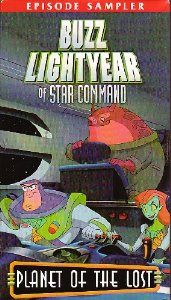
Adventure Begins has been released on home media, as well as the episode “Planet
of the Lost”. Nothing else has been made legally available,
not even on Disney’s own streaming platform, Disney+. While no specific reason for
Lasseter’s disdain has ever been revealed, Stone theorized he was hoping for a
more action-oriented series that would match the opening scene of Toy Story
2 or the scrapped
Buzz animated series Andy would have been watching in the first film.
Mattel,
who released toys for the Toy Story franchise, released two waves of
figures based on the show. The first wave, called Toy
Story and Beyond, featured Buzz, Booster, XR, Zurg and Warp. The Space
Rangers all came with a LGM while the villains came with a Grub. The second
wave, called Cosmic Clash, featured new Buzz, Booster and XR figures
without LGMs, and NOS-4-A2 as their primary foe. The following year, McDonald’s
included six
toys
based on the show in their Happy
Meals. Team Lightyear, Nebula and Zurg could all be
launched from a spaceship part that could be assembled to create a larger
spaceship. Random
House published a series of story
and glow-in-the-dark sticker books that adapted various episodes, as well as a
pop-up book, punch-out doll book, and coloring books. Comic strips based on the
show were published in the pages of Disney
Adventures Magazineand its British
counterpart, Disney’s
Comic.
“Buzz
Lightyear of Star Command: The Adventure Begins” (8/8/00) – Buzz swears off
partners after his is lost to Emperor Zurg, but ends up working with three
cadets to save the Little Green Men.
“The
Torque Armada” (10/2/00) – Zurg’s Hornets free Torque from prison and take him
to Planet Z.
“Gravitina”
(10/3/00) – Buzz and his team try to save Star Command from an asteroid field
but discover it’s being directed at the base by Gravitina.
“XL”
(10/4/00) – XR is used as bait for a high-tech robber, which turns out to be
his predecessor XL.
“Little
Secrets” (10/5/00) – Searching for a spy complicates Mira, Booster and XL’s
plans to hide a secret from Buzz.
“Inside
Job” (10/6/00) – Buzz teams up with Flash Flemming to stop an assassination.
“NOS-4-A2”
(10/8/00) – Zurg tricks the Rangers into bringing a box back to Star Command
that contains an energy-draining robotic vampire.
“The
Planet Destroyer” (10/9/00) – Buzz has to stop Zurg’s new weapon from claiming
its third world.
“Tag
Team” (10/11/00) – Buzz teams-up with Warp Darkmatter to find out who put
implants in them.
“The
Main Event” (10/12/00) – Buzz and XR end up stranded on a planet battling
against gladiators.
“The
Return of XL” (10/13/00) – XL kidnaps XR and steals a part from him, causing XR
to feel depressed and run off to Tradeworld for repairs.
“Lost
in Time” (10/14/00) – Zurg uses Buzz’s trip into a Black Hole to trick him into
thinking he’s wound up in the future.
“Strange
Invasion” (10/15/00) – Team Lightyear ends up stranded in another dimension.
“The
Taking of PC-7” (10/16/00) – Torque arranges for a jailbreak when Booster and
XR escort him to prison.
“Mindwarp”
(10/17/00) – Klerm kidnaps Buzz and uses his mind to create an army of
Slam-Bots.
“Mira’s
Wedding” (10/18/00) – Lord Angstrom arranges a marriage for Mira in order to
take attention away from his plan to overthrow King Nova.
“Panic
on Bathyos” (10/19/00) – Team Lightyear is sent to investigate the theft of
fusion crystals on Bathyos.
“Shiv
Katall” (10/20/00) – Brain Pod #13 defects from Zurg and Zurg hires infamous
bounty hunter Shiv Katall to eliminate him.
“Rookie
of the Year” (10/21/00) – Being nominated for “Rookie of the Year” causes Team
Lightyear to fight amongst themselves and allow Zurg to steal a matter
transporter from them.
“Stress
Test” (10/22/00) – Buzz is forced to go on vacation.
“A
Zoo Out There” (10/23/00) – Buzz has to find a group of kidnapped ambassadors.
“Root
of Evil” (10/24/00) – Team Lightyear investigates reports of mutant vegetables
terrorizing a planet.
“Super
Nova” (10/25/00) – A mission causes Mira to gain new powers, which gives her
the confidence to take on Zurg by herself.
“Downloaded”
(10/26/00) – XR becomes a target when he downloads the Galactic Alliance files
into himself.
“The
Plasma Monster” (10/27/00) – Booster ends up battling a new recruit’s boyfriend
when he becomes smitten with her.
“Wirewolf”
(10/29/00) – As Buzz and Ty Parsec battle NOS-4-A2, the radiation on Canis
Lunis ends up turning Ty into the Wirewolf.
“The
Crawling Flesh” (10/29/00) – Zurg manages to turn all of Star Command into blob
monsters.
“Dirty
Work” (10/30/00) – Cosmo’s new robotic appliance is bitten by NOS-4-A2 and ends
up taking over the diner.
“The
Slayer” (10/31/00) – Buzz and XR team-up with Savy SL2 to take down NOS-4-A2.
“The
Lightyear Factor” (11/1/00) – Zurg breaches another dimension and recruits an
evil Buzz.
“Clone
Rangers” (11/2/00) – Zurg creates clones of Buzz, Mira and Booster.
“Bunzel
Fever” (11/3/00) – Booster must return home to cure his case of Bunzel Fever.
“Rescue
Mission” (11/4/00) – Buzz is shrunk down to stop a threat that turns out to be
his own team.
“Devolutionaries”
(11/5/00) – Team Lightyear discovers that something is de-evolving the populace
of a planet.
“Head
Case” (11/6/00) – XL kidnaps XR after he’s damaged in battle.
“The
Yukari Imprint” (11/7/00) – Team Lightyear has to protect an ambassador and his
delegates.
“The
Shape Stealer” (11/8/00) – Zurg creates an assassin that can take over other
people’s bodies.
“Star
Crossed” (11/9/00) – Zurg hires Mira’s ex-boyfriend to retrieve Brain Pod #57
for him.
“Haunted
Moon” (11/10/00) – A ghost tries to prevent Team Lightyear from saving a
planet.
“Star
Smasher” (11/11/00) – Zurg takes one of the Little Green Men and plans to use
his knowledge to create a devastating device.
“Stranger
Invasion” (11/12/00) – Zurg invades Roswell to use it as a staging zone for his
next attack on Capital Planet.
“Eye
of the Tempest” (11/13/00) – Mad scientist Spyro Lepton lures Buzz into a trap.
“Revenge
of the Monsters” (11/14/00) – XL and NOS-4-A2 invade Star Command to turn Ty
Parsec back into the Wirewolf.
“Lone
Wolf” (11/15/00) – When lack of evidence is about to allow a criminal to go
free, Buzz regales his team with a story of a similar situation from his past.
“Planet
of the Lost” (11/16/00) – Investigating the disappearance of ships causes Team
Lightyear to become the next victims.
“Revenge
of the Raenoks” (11/17/00) – Booster is captured by the Raenoks to bargain for
the release of their leader, Varg.
“Enemy
Without a Face” (11/18/00) – Team Lightyear ends up in the middle of a 900-year
conflict.
“The
Starthought” (11/19/00) – Zurg takes over Star Command’s newest ship.
“Conspiracy”
(11/21/00) – Buzz is framed for the attempted assassination of the Galactic President.
“At
Large on a Small Planet” (11/23/00) – Buzz and Booster have to shrink down in
order to find out who kidnapped an ambassador.
“Sunquake”
(11/24/00) – Evil Buzz returns and enlists Gravitina in ruining Buzz’s
reputation.
“Good
Ol’ Buzz” (11/25/00) – Buzz from the future arrives to save Mira’s life.
“First
Missions” (11/26/00) – Trapped in a hopeless situation, Team Lightyear tells
their charge about their first meetings with Buzz to reassure him that Buzz
will save them in time.
“Large
Target” (11/27/00) – XR impersonates Buzz to gamble at a casino and ends up
attracting a load of trouble.
“War
and Peace and War” (11/29/00) – Suspicions about Guzelian’s desire to bring
peace to the galaxy has Buzz working with Zurg to investigate Guzelian’s true
intentions.
“Return
to Karn” (12/2/00) – Mira and the President are shot down and hunted by Zurg.
“Speed
Trap” (12/9/00) – Team Lightyear must stop a ship from crashing into the sun
and destroying it.
“Holiday
Time” (12/16/00) – Zurg steals Santa’s time-stopping device to go on a terror
spree.
“Opposites
Attract” (12/23/00) – Gravitina mutates Buzz’s head like hers in the hopes it
will make Buzz fall for her.
“Ancient
Evil” (1/6/01) – When the Little Green Men awaken space mummy Natron, Zurg wants
him for himself.
“42”
(1/13/01) – Buzz has to save XR and 42 from Valkyran raiders.