Remember that one day when you could wake up without an alarm? When you would get your favorite bowl of cereal and sit between the hours of 8 and 12? This is a blog dedicated to the greatest time of our childhood: Saturday mornings. The television programs you watched, the memories attached to them, and maybe introducing you to something you didn't realize existed. Updated every weekend.
Dunkin’
Donuts, now known as simply Dunkin’, is a
multinational quick service restaurant. Founded in 1950 by Bill Rosenberg
(after opening as Open Kettle in 1948), the chain’s original claim to fame was
its donuts and coffee; the two most popular items when he used to sell food to
factories and construction sites. The chain continued to expand to include more
items on its menu, particularly of the breakfast variety, and almost 13,000 restaurants.
Beginning in 1981, Dunkin’ Donuts ran an ad campaign with an advertising mascot
called Fred the Baker,
portrayed by actor Michael Vale,
whose catchphrase was “Time to make the donuts”. The campaign was incredibly
popular, with the phrase’s debut commercial being named one of the five best
commercials of the 1980s by the Television Bureau
of Advertising. When the character was retired in 1997, by fan demand the
company created an
entire celebration around him including a parade in Boston and a “free
donut” day. In 2019, the company
began removing “Donuts” from its name to symbolize its new status as a “beverage-led”
company, focusing on coffee, tea, and speedy to-go service.
In 1988,
the company attempted to expand into the breakfast market with Dunkin’ Donuts
cereal. Produced by Ralston,
the cereal featured three shapes representing their donuts: standard ring
shapes, round balls for their Munchkins (donut holes), and figure eights. They
came in two flavor varieties: glazed and chocolate. Of course, this wasn’t the
first donut-inspired cereal on the market, as Ralston had released on in 1980
called Dinky Donuts and General Mills’
Powdered Donutz. Dunkin’s cereal was as short-lived as those two; lasting only
a year despite the commercials and the box featuring Fred. Premiums included a send-away
offer for a Dunkin’ Donuts-branded duffle
bag, a flashlight,
a card
trick system branded by magician Harry Blackstone Jr.,
Nintendo trading cards with a
chance to win a NES, and
a back-to-school
kit featuring a pencil case with pencils, erasers, a ruler and a sharpener.
The cereal was also part of Ralson’s line-wide promotion offering
a real Porsche.
The Pink
Panther media franchise was conceived by writer/director Blake Edwards and ran as a
series of comedy mystery movies centered around an inept French detective,
Inspector Jacques Clouseau (Peter
Sellers), and beginning with the theft of the titular diamond with an
imperfection at the center that resembled a pink panther. While The Pink Panther
proved to be a hit upon its worldwide debut in 1964, an even bigger hit was the
animated titles featuring a caricature of Sellers being outwitted by a literal
Pink Panther. This title sequence was done by animation studio DePatie-Freleng
Enterprises.
Back of the RPX car promotion box.
Encouraged by audience reactions, DFE
struck up a deal with The Mirisch
Company, the film’s producers, and United Artists, the film’s
distributor, to produce a series of 156 6-minute theatrical shorts (of which
only 124 ended up being made) featuring Pink working through a given situation—sneaking
into an alcoholic’s house to spend the night, working as a secret agent, deciding
a pole would look better painted pink instead of blue, etc.—while often being
at odds with the Little White Man: a minimalist rounded figure of a person with
a large nose and mustache said to be modeled after DFE co-founder and initial
short director, Friz Freleng.
Each short, played in pantomime outside of the odd side character, was accompanied
by Henry Mancini’s catchy theme.
Back of the disappearing paper promotion box.
The Pink Panther shorts
proved popular enough for DFE to expand their library of offerings. They began
working on The Inspector,
Roland
and Rattfink, The
Ant and the Aardvark, Tijuana
Toads, Hoot Kloot,
The Blue Racer, The Dogfather, Misterjaw and Crazylegs Crane. However,
as the 1960s was coming to an end, the age of the theatrical short was
beginning to wane. Looking to keep their investment going, Mirisch decided to
follow other studios’ leads and import these shorts onto Saturday morning
television. Debuting in 1969, The
Pink Panther show packaged various combinations of DFE’s shorts during
its 11-year run with all-new bridging sequences and the occasional new short
being added.
Post Cereals, one of the sponsors
of the show, decided to create a cereal tie-in as promotion in 1972. Pink
Panther Flakes was essentially corn flakes with pink coloring added, which
would also turn the milk pink once it was added. Advertisements for the cereal
played out like a typical Pink Panther short: the Little White Man was
about to enjoy some Pink Panther Cereal when Pink decided to help himself in
some fashion. Part of Mancini’s theme played over them with new cereal-centric
lyrics. Among the cereal’s premiums were a 5-in-1
spy kit shaped like Pink (featuring The Inspector on the back), a zip-cord
powered “RPX Car”
that resembled the Panthermobile created for the show, a pad of “disappearing
paper” that could dissolve in water, and a pink ball.
Oreo is a cookie first introduced by Nabisco in 1912 as an imitation of the Hydrox cookie
manufactured by Sunshine
Biscuits. It has always featured some kind of filling between two cookie
pieces; only changing size (Double Stuf had double the crème, Big Stuf was a
giant version sold individually, Mini were bit-sized, etc.), flavor in both the
crème (lemon, mint, peanut butter, apple pie, etc.) and cookie (golden,
vanilla, etc.), and cookie design over the years. It began life as “The Oreo
Biscuit” before being renamed to “Oreo Sandwich” in 1921, “Oreo Crème Sandwich”
in 1948, and finally “Oreo Chocolate Sandwich Cookie” in 1974 (the origin of
the “Oreo” name itself remains a jumbled mystery). Oreos have also expanded to
products other than cookies, including brownies, ice cream, candy bars, and, of
course, cereal.
Oreo O’s was first
introduced in 1997 by Post
Cereals, conceived by an Ogilvy &
Mather NYC advertising employee. The cereal was made of chocolate
donut-like cereal pieces covered in crème-flavored sprinkles. Early marketing
for the cereal featured an ad campaign imply that the cereal was so in-demand,
it created a run on milk. One of the earliest commercials featured Shia LaBeouf and Rachel
Duncan as kids being “interviewed” by a reporter. The next campaign featured
kids being able to see an Oreo O’s-themed paradise by looking through the
cereal pieces. In 2001, marshmallow bits were added to give the cereal a new “extreme
crème taste”. New CGI marshmallow mascots called The Crème Team were introduced
in the commercials to
promote this change. Premiums included a Nickelodeon U-Pick live
Challenge Game and a free
ticket to the film Rugrats
in Paris featured in various Post cereals at the time; and a chance to
win a cruise by finding a blue-sprinkled
cereal piece.
The South Korean version.
The cereal
sold well enough for a decade. Unfortunately, behind the scenes circumstances
saw an end to its production. Kraft,
owner of both brands, sold off Post to Ralcorp Holdings in 2007, which
meant they lost the rights to the cereals they produced before and Post lights
access to the Oreo name. Interestingly, this wasn’t an issue in South Korea. Dongsuh Foods was a joint venture
between General Foods
(the parent company of Post) and Dongsuh Companies Inc., and they had the
rights to produce Post’s cereals in the country. With Kraft’s purchase of
General Foods, they became part owner of Dongsuh and thus the company was able
to retain both licenses needed to continue
production of Oreo O’s. An E.
coli concern caused a recall of the cereal in 2014, but Dongsuh resumed its
production in 2016.
The return varieties.
As for the
rest of the world, Oreo O’s would soon
be making a comeback—which was probably welcome news to those who had been buying it off
eBay or having friends in South Korea send them some. In 2012, Oreo’s
parent company became Mondelēz
International and talks were opened with Post on the cereal’s possible
return. In 2017, Post tested the waters by releasing a cereal called “Cookies & Cream”
through their Malt-O-Meal brand. They
sold well, and through a marketing deal made by Walmart for exclusive rights for the first
three months, Post announced that Nabisco could be co-branding
the cereal with the original 1997 recipe—however, without the marbits. In
2018, it became widely available for all stores to carry; along with a new
Golden Oreo variety by the middle of the year. In 2019, Walmart launched
another exclusive with the return of the marbits in Mega
Stuf Oreo O’s.
The
Smurfs is a successful franchise spinning out of a Belgium comic
created by Pierre Culliford, better known
as Peyo. Appearing in the pages of Spirou in October of 1958, the
Smurfs are long-lived little blue creatures that live in the middle of a
medieval forest in a village comprised of mushroom houses. Initially supposed
to be just a one-shot guest in Peyo’s already-running strip, Johan and
Peewit, they proved popular enough to be upgraded to their own feature.
Merchandisers quickly fell in love with them as much as audiences as their
similar appearance meant they had to do very little work to produce each
character.
NBC president Fred
Silverman decided that the Smurfs would make a good cartoon and
negotiated for their rights. The
Smurfs debuted on the network on September 12, 1981 and their
popularity only continued to grow. The show was quickly expanded to an hour,
then 90 minutes with syndicated reruns starting in 1986. It would go on to run
for 9 seasons, and changes made to the characters to better distinguish them
from each other would become the default appearance for those characters going
forward.
As part of
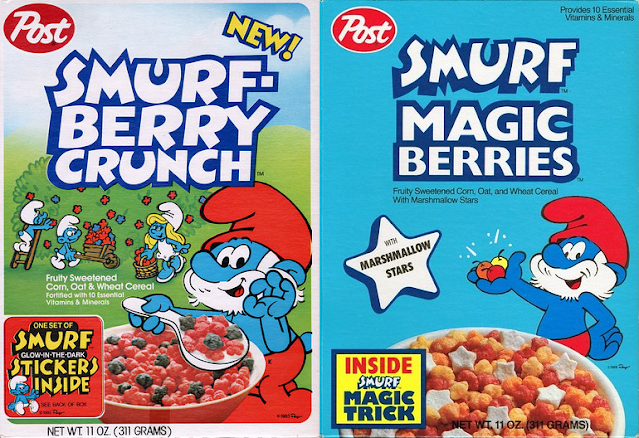
the merchandising blitz that followed the cartoon, Post joined in with a new cereal in 1983:
Smurfberry Crunch, named for the fruit that served as the primary food source
for the Smurfs. The cereal was comprised of berry-flavored red and dark blue
pieces that were six tiny balls assembled in a star shape. A number of premiums
were included during the cereal’s run, including Smurf rub-ons,
glow-in-the-dark
stickers, cut-out
award buttons, Presidential
campaign buttons, a game
on the back panel, tin
signs, and a contest to win an entertainment center. Most of the
commercials were animated, featuring the Smurfs producing the cereal and
singing a jingle to the tune of Tchaikovsky’s
“The Nutcracker Suite”
(which was in keeping with original showrunner Gerard Baldwin’s desire to
feature classical music in the series). Most of the primary cast reprised their
respective roles for the various commercials. Actor and musician Jack Black has claimed to have
appeared in a non-animated commercial being pulled in a red wagon (although
no visual evidence has been found as yet).
A small
issue arose with the cereal. Apparently, the blue dye used, if eaten in enough quantities,
would turn excrement blue. While not as concerning as the Franken
Berry incident a decade prior, Post still decided to address it by
rebooting the cereal in 1987. Now called Smurf Magic Berries, the cereal
maintained the same shapes but replaced the blue coloring with orange and yellow.
Also, white marshmallow stars were added to symbolize the magic; as evidenced
by Papa Smurf(Don
Messick) casting a spell with them against their enemy, Gargamel, in the
new commercial. It finally left shelves for the last time around the time the
cartoon was cancelled. Premiums for this version included gummi candies, simple magic tricks
and a game on
the back panel.
The final entry in what
would become the Sam RaimiSpider-Man
film trilogy came with 2007’s Spider-Man 3. Written by Raimi, his
brother Ivan, and Alvin Sargent, the film became
the victim of studio interference and more characters began being added than
could adequately be managed in a single film. Along with Sandman (Thomas Haden Church), there was
Harry Osborn’s (James Franco) transformation
into a new kind of Green Goblin and Peter Parker’s
(Tobey Maguire) new work
rival Eddie Brock
(Topher Grace) becoming the
symbiotic villain Venom. Also thrown in was Gwen Stacy
(Bryce Dallas Howard) to
create a love-triangle for Peter and Mary Jane (Kirsten Dunst). Sony Pictures released the film on May
4, 2007, and despite less-than-favorable reviews when compared to the first two
films, it ended up grossing a series high of $890.9 million; becoming the 3rd
highest of the year and setting a worldwide single-day record of $104 million.
Replacing Kellogg’s as the food tie-in partner of the
franchise, General Mills released Spider-Man
3 cereal. They chose to represent the cereal with red and blue ball puffs
that had a fruity flavoring. The back of the box was taken up by a single large
maze game set in a spider’s web. Like Kellogg’s, General Mills included tie-in
premiums in their other cereals in the form of squirt
toys in the shape of Spidey and the film’s three villains.
SPIDER-MAN / SPIDER-MAN 2 / THE
AMAZING SPIDER-MAN CEREAL
Kellogg’s
The comic book movie
revolution from campy novelty to summer blockbuster may have quietly begun four
years prior with Bladeand later X-Men,
but with 2002’s Spider-Manit was in full (pardon the pun) swing.Written by David Koepp
and directed by Sam Raimi, Spider-Man
presented a slightly modified origin for the titular
character (Tobey Maguire)
and his arch-nemesis, the Green
Goblin (Willem Dafoe),
as fate and circumstances brought the two to a head in a climactic battle.
Released by Sony Pictures on May 3,
2002, it became an instant hit. It was the first film to pass $100 million in
its opening weekend and the fastest to surpass that mark. By the end of its
run, it had grossed $821.7 million.
The back and side of the Spider-Man cereal box.
That September, Kellogg’s announced its partnership with Marvel Comics and Sony Pictures to release
Spidey-themed food items, including a cereal (which they mistakenly touted as
the first, ignoring Ralston’s
1994 offering). The limited-edition Spider-Man cereal featured
“web”-shaped cereal pieces with artificial berry flavoring. While some of the
webs were naturally colored, others alternated between red and blue coloring.
Adorning the boxes was a foil-stamped logo and eyes in Spidey’s mask on the
front, a story on the back with some stock drawings of Spidey in various poses,
and a trivia game related to the story on the side panel. Later, when the film
was released onto home video, the boxes came with a small blurb advertising it
and a picture of the DVD set.
As part of their
promotional campaign, other cereals in the Kellogg’s line came with premiums
related to the film. Amongst them were glow-in-the-dark stickers, temporary
tattoos, and a web-shooter
water squirter. They also teamed-up with America’s
Dairy Farmers to offer a send-away promotion for a free Spidey CD-ROM game
(which was essentially the 2000 Spider-Manvideo
game with the character model altered to resemble the film’s suit and other
minor tweaks).
After such a
successful film, there was no doubt that a sequel was in order. Spider-Man
2, written by Alvin Sargent,
introduced Doctor
Octopus (Alfred
Molina); a scientist who became bonded to four-mechanical arms he invented
to aid in his scientific experiments and became mad with a desire to see his
experiment through at the risk of the city. Released on June 30, 2004, the film
was as well-received as the first and shattered its opening day record.
However, it ended up grossing about $40 million less with a total of $783.8
million.
The back of the Spider-Man 2 box.
Kellogg’s was once again on board and re-released
their Spider-Man cereal. The cereal was essentially the same, except it
came in a new yellow orange box with Spidey in a new pose, and only on the back
was the Spider-Man 2 title present. For a time, the foil-stamped logo
and eyes also made a return before being replaced with standard art later in
its run (excluding the international box, which had no foil and came with a blue background). The back of the box this time was adorned with several Spidey-themed
games, including a trivia game, crossword puzzle, a maze, a match game, a
hidden item search, and a word scramble. This time, tie-in premiums included
web-shooter-like laser pointers that projected one of four different designs.
The Raimi film series would gain one more
less-welcomed entry in Spider-Man 3, but it was General Mills who made a cereal for
that one. Ultimately, Marvel and Sony decided to scrap Raimi’s proposed Spider-Man
4 in favor of rebooting the franchise with a new direction and a new cast.
Written by James Vanderbilt
and directed by Marc Webb, The
Amazing Spider-Man took Peter Parker (Andrew Garfield) back to high
school as he explored a mystery involving his parents, which took him to Oscorp
where, like in the original films, he was bitten by a genetically modified
spider and gained his powers. Meanwhile, Dr. Curt Connors
(Rhys Ifans) had transformed
himself into the monstrous Lizard in an attempt to stop his former boss (Irrfan Khan) from using ins
imperfect serum on unknowing test subjects. Ultimately, that led to his wanting
to transform all of New York into lizard people like him and forcing Spidey to
stop him.
The Amazing Spider-Man cereal back.
The film was released on July 3, 2012 to generally
favorable reviews. Like the Raimi series, it managed to pull in a box office of
$757.9 million; becoming the 7th-highest grossing film of the year. As
part of the film’s promotion, Kellogg’s also rebooted their Spider-Man cereal
as The Amazing Spider-Man cereal. This time, the web pieces were all
colored red and two-toned green marshmallows were added to represent the
Lizard’s face. The back of the box featured a word, trivia and maze game.
Toy Storybecame the
first full-length completely computer-generated animated feature to hit
theaters in 1995, pulling in an impressive box office, igniting interest in
others studios for computer animation, and beginning the long-standing
relationship between Disney and Pixar Studios. The film centered on a world in
which toys came to life whenever people weren’t around. Woody (Tom Hanks), the pull-string
cowboy doll that was once the favorite in a group of toys, found himself
replaced by the newer, electronic talking Buzz Lightyear (Tim Allen) action figure. This
led to many quarrels fueled by Woody’s jealousy until Woody came to accept Buzz
and welcomed him into the group. Toy Story became a media franchise,
spawning sequels, specials, books, games and even a Buzz
Lightyear animated series.
In 2002, as part of a
multi-year deal with Disney, Kellogg’s
released three cereals based on Disney characters. One of them was Buzz Blasts
cereal, centered on the Buzz character. The timing of this release was
interesting as the animated series was currently in syndicated reruns at this
time and the next Toy
Story sequel was 8 years away.
Buzz Blasts featured
cereal pieces in the shape of flying saucers, the Little Green Men toys featured
in the movies and the cartoon, space ships and Buzz’s face. The pieces were
done in Buzz’s purple and green color scheme, with all the pieces being purple
and the flying saucers having an extra green ring as well as blue flecks. The
cereal actually had a long life, running until 2005. The initial box featured a
foil-stamped embossed logo and a game where you had to find the different space
ship amongst three different fleets. At one point, a music CD with an
exclusive song about Buzz was included as a premium. Another premium involved 3-D
glasses to use with a new game on the back panel.
The Polar Express is
a 2004 3D computer animated film based on the 1985
children’s book by Chris
Van Allsburg. The film followed the adventures of a young boy (Daryl Sabara) who boarded a
mysterious train that pulled up outside of his house. The train was taking him
and several other children to the North Pole to visit Santa Claus (Tom Hanks) as he prepared for his
annual delivery. Co-written, co-produced and directed by Robert Zemeckis, the film
utilized live-action motion capture animation to create all the characters.
Hanks, who also served as executive producer, played six roles in the film and
provided the motion capture for the boy. It was also entered into the Guinness World Recordsfor
being the first all-digital capture film in 2006.
To promote the film, Post
acquired the rights to produce a limited-edition cereal based on it to coincide
with the film’s release. The Polar Express cereal featured
chocolate-flavored snowflake cereal pieces and marshmallows in the shapes of
bells, trains, mountains, snowflakes and reindeer. The back of the box featured
a simple maze game, three stills from the movie, and an ad for The Polar Express Train
Adventuregame that was featured on Post’s now-defunct
Postopia.com website, home to various Flash games based on Post’s cereal. Each
box came with a code inside for use in the game. The inside also featured
movie-themed gift tags that could be cut out, colored-in and used on Christmas
presents.
In 2013, Disney released their 53rd
animated feature film: Frozen, which was based on the fairy tale “The
Snow Queen” by Hans
Christian Andersen. Written by Jennifer Lee and directed by
Lee and Chris Buck, the film
centered on the recently-crowned queen of Arendelle, Elsa (Idina Menzel), accidentally exposing her ice
powers to the royal court and being branded a monster by the scheming Duke of
Weselton (Alan Tudyk). She
entered self-imposed exile casting the kingdom into eternal winter. Her sister,
Anna (Kristen Bell), sought
to find her and bring her back for the good of Arendelle. Along the way she
befriended an ice harvester named Kristoff (Jonathan Groff), his reindeer
Sven (Frank Welker), and a
snowman Elsa accidentally brought to life named Olaf (Josh Gad).
Frozen opened
in theaters on November 22, 2013 and ended up grossing over $1.2 billion,
turning it into a massive success. Naturally, it was met with a huge marketing
push from Disney, was adapted into a Broadway
play, the characters incorporated into other Disney projects and parks, and
drove a generation of parents crazy with constant repeated renditions of the
film’s signature song, “Let
it Go”.
The original back of the American box.
Interestingly enough,
it would take just over a year after the film’s release for a cereal
tie-in to come into play. Kellogg’s
licensed the use of the characters and crafted Disney Frozen cereal that
saw release in December of 2014. Marked as a “collector’s edition”, the cereal
featured square cereal pieces with “ice” and “snow” marshmallows (or blue and
white). The boxes featured Elsa and Anna on one side, Olaf on the side panel,
and they were all joined by Kristoff and Sven on the other side. The
backgrounds of the box featured foil enhancements. Eventually, the cereal would
become a “regular edition”, losing the foil and the collector branding.
New marshmallow shapes!
In 2016, the cereal received a bit of an upgrade as
the marshmallows all became “snowflakes” (although closely resembling stars).
They were either plain white or purple and blue with white swirls. While Elsa
and Anna were still on one side of the box, Olaf ended up getting the other
side by himself.
I'm ready for my close-up, Mr. Disney.
Internationally, a marshmallow-less cereal was
released featuring vanilla cereal pieces in the shapes of snowflakes and snowballs.
In the United Kingdom, Elsa and Anna adorned one side of the box with Olaf on
the other. In other countries, Elsa, Anna, Olaf and Sven were each showcased on
their own individual boxes in close-ups.
The Incredibles is
a 2004 Pixar film written and directed by Brad Bird and based on the
comics and spy films from his youth. Set in an alternate version of the 1960s
where superheroes and supervillains exist, public opinion soon turned against
them due to the repeated damage their fighting causes. Superheroes are
therefore outlawed and are forced to live ordinary, normal lives unless they
end up in jail. Bob Parr, aka the super-strong Mr. Incredible (Craig T. Nelson), was lured
back into costume by a mysterious woman named Mirage (Elizabeth Peña). However, it all turned out to be a plot
by a genius villain named Syndrome (Jason Lee), who was a fanboy
that felt spurned when Mr. Incredible refused to let him become his sidekick.
Bob’s family—his wife, the stretchy Elasti-Girl (Holly Hunter), and their kids,
the super-fast Dash (Spencer Fox)
and the invisibility-casting Violet (Sarah Vowell)—are forced to
come rescue him from the clutches of Syndrome.
The film opened on
November 5, 2004. Unlike Bird’s previous film, The Iron Giant,
The Incredibles went on to gross over $631 million. It received the highest
opening-weekend for a Pixar and non-sequel animated film, as well as the
highest November opening for a Disney film.
Such was the film’s reception that fans were eagerly awaiting a sequel that
wouldn’t arrive for 14 years.
To coincide with the release of the film, Kellogg’s produced a limited-edition cereal
based on it. The cereal featured strawberry-flavored pieces in star shapes with
red and yellow swirls, based on the colors of the Incredibles’ costumes. The
back of the box featured a simple word search game, and there was an offer to
send away for an Incredibles-themed race car.
Kicking off
Phase 3 of the Marvel Cinematic Universe was the third Captain America film, Captain America: Civil War. Loosely
based on the comic story of the same name, the film deals with the fallout from
Avengers:
Age of Ultronas governments decide to create
legislature to regulate how and when the Avengers do their heroing. Captain America (Chris
Evans) doesn’t feel they can
be as effective while they wait for permission to act, while Iron
Man (Robert
Downey, Jr.) believes it’s
the only way to prevent further disasters. Add to the fact that Cap’s
long-believed-deceased sidekick, Bucky Barnes (Sebastian Stan), was alive and well and seemingly bombed a
political conference, and the Avengers became split down the middle in a
conflict over whose ideals were right and how Bucky would be brought to
justice. Directed by Joe
and Anthony Russo off a script by Christopher
Markus and Stephen
McFeely, Civil War opened on May 6, 2016 and pulled in over $1.1 billion at
the box office.
Kellogg’s once again created a limited-edition cereal
to tie into the promotion for the film. In fact, they made two different cereals
for it. The first, Captain America: Civil
War cereal, was actually a repackaged version of their Age of Ultron Cereal from the previous year. However, this time the
marshmallow bits were changed to either red or blue with a white star shape in
the middle. The most interesting part of this cereal, however, was its box. On
one side was Cap, and on the other was Iron Man. When the two sides were put
together, they lined up perfectly to create a split image of the two heroes. On
the side panel showed the two about to clash over a bowl of their cereal.
Meanwhile,
outside of North America, there came a cereal called simply Avengers Cereal. It came with “choc
reactors” (after the arc reactor technology that powers Iron Man’s suit) and “crunchy shield”
pieces. The reactors were a grouping of three chocolate-flavored rings while
the shields were reminiscent of Krave Chocolate cereal pieces (and didn’t really represent
Cap’s round shield). Once again, Iron
Man and Cap were featured on either side of the box, with Hulk and Thor joining
them on the side panel. However, this time around instead of using images of
the film’s actors, the characters were drawn and shown in representations of
their more recent comic costume designs.
In 2012, Marvel Studios accomplished what until that
point seemed to be impossible: they produced a movie starring SEVERAL
characters from different film franchises.
Following several more solo hero movies, the second Avengers movie was released on May 1,
2015. Avengers: Age of Ultron followed
the Avengers as they retrieved Loki’s scepter and Tony Stark and Bruce Banner
discovered an artificial intelligence inhabiting the scepter’s gem. They
decided to use it to complete Stark’s Ultron Global Defense Program, designed
to protect the world from another invasion threat. However, Ultron (James Spader) gained
independent sentience and decided the best way to protect the world was to
eliminate all of humanity. Written and directed again by Whedon, the film ended
up earning just a few million less than its predecessor but still earned a
mostly positive reception.
Kellogg’s,
opting not to miss the bandwagon again, decided to produce a limited-edition
tie-in cereal for the film. Avengers: Age
of Ultron Cereal has largely been compared to Lucky Charms as it had sweetened oat
pieces with marshmallow bits. The bits were two-colored round pieces that were
meant to replicate the main color schemes of Iron Man, Captain America, Hulk
and Thor. Each box came with a special code printed inside that could be put
into an indicated website to unlock a free ticket to see the movie. The back of
the box featured the instructions for the codes, as well as a hidden message
that had to be deciphered using a symbol key. Interestingly enough, the box
came labeled as “Hero Edition” for an unspecified reason. There has been no
indication or witnesses to a “Villain Edition” having ever been released.