Remember that one day when you could wake up without an alarm? When you would get your favorite bowl of cereal and sit between the hours of 8 and 12? This is a blog dedicated to the greatest time of our childhood: Saturday mornings. The television programs you watched, the memories attached to them, and maybe introducing you to something you didn't realize existed. Updated every weekend.
Phantom Investigators followed
the exploits of four students of Lugosi Junior High (named for Bela Lugosi) in San Francisco as they took on jobs to deal
with the various menacing supernatural entities around the Bay Area. The team themselves,
however, were kind of supernatural themselves. Casey (Andrew Decker) was a
quiet and shy bookworm who possessed the ability to morph into any form he
wanted. Kira (Amber Ross) was a sassy fashionista with a desire to become a
professional DJ, and also happened to possess telepathic powers (her original name
was Nakisha, but was changed on request to be snappier). Jericho (Aleksander
Kocey) loved shredding on his skateboard, which he could do without the aid of
his telekinetic abilities. Their leader, Daemona Prune (Courtney Vineys) was
the only one who didn’t possess any kind of extra ability; however, what she
did have was an attic full of gadgets and artifacts from her late grandmother’s
days as one of the original Phantom Investigators. While on the job,
Daemona also donned a green coat (initially a lighter shade and adorned with a
skull and crossbones) and mask to obscure her identity.
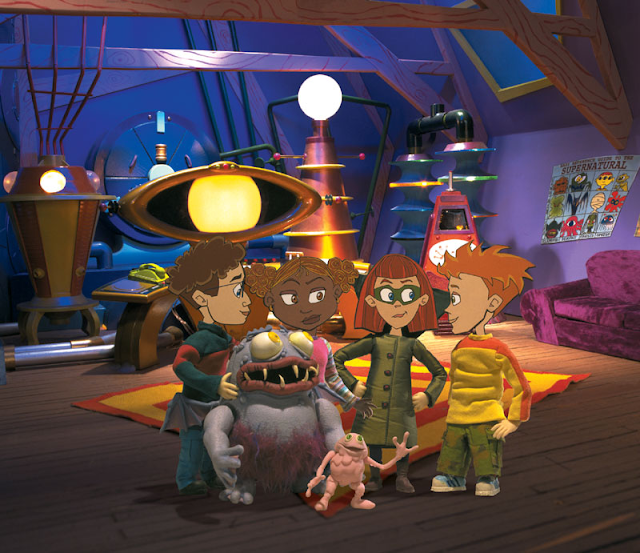
Casey, Kira, Daemona and Jericho with Jinxie and Wad in their base, aka Daemona's attic.
Aiding the P.I.s were Professor
Felix Navarro (Richard
Cansino), who ran a repair shop and served as a mentor to the PIs, as well upgraded,
designed and built all of their hunting/trapping equipment for them; Jinxie
(Holman), a bad luck demon who reluctantly provided supernatural insight to the
team; and Wad (Holman), a fun-loving Sprite comprised of chewing gum that lived
with Daemona and sometimes helped the team out on cases (usually with
disastrous results). The primary piece of equipment usually wielded by Daemona
was a specter detector, which could identify one of the four types of entity
they could be dealing with: Elementals, Demons, Spectres (ghosts and monsters)
and Sprites (wraiths, shadows, fairies, pixies, superstitions, folklore and
poltergeists). They all originated from another dimension known as the Nether
Realm.
Jinxy with his chart of Nether Realm hierarchy.
The series was created and directed by
the married team of Stephen
Holman and Josephine Huang
of (W)holesome Products, Inc.,
who had made the industry take notice of them with the successful Life with Loopyseries on Nickelodeon’s Kablam!Like that
previous series, Phantom Investigators was a serious mixing of media as
it was created by using stop-motion animation, puppetry and live-action blended
together. Non-supernatural characters were typically done using stop-motion
puppet bodies with cardboard heads and animated faces fabricated by Shelley Smith, Aurore Nightingayle, Lisa Davidson, Estelle Rand, Ellen Ridgway, Cynthia M. Star and Holly
Tanner Strauss. Demons and Elementals were generally seen as fully-realized
puppets operated by Ian Greeb,
or as live-action humans with prosthetics and masks. Ghosts were always
represented by translucent and glowing live-action humans in period or
scenario-specific clothing provided by costume designer Victoria Drake. These
encounters would be resolved by finding out the cause of the haunting or as a
result of karmic intervention as a consequence for an entity’s activities. Often,
a solution to a problem a character was having in their personal lives would be
presented as well.
Ghosts!
Phantom Investigators debuted
on Kids’ WB on May 25,
2002. It was produced with backing by Sony’s
Columbia
TriStar Domestic Television division and Hardee’s,
who released
toys based on it in their restaurants (before the show even aired due to a
scheduling snafu). Originally, the series was going to be named for Daemona
until the network asked for it to be changed, and Daemona would be her on-the-job
name while her real name was “Prunella”. Daemona ended up being the
most-developed of the characters, with her history and homelife seen and the
others’ relegated to behind-the-scenes
articles. The series was written by John Hoberg, Kat Likkel, Kevin Murphy, Dan Studney, Pete Goldfinger,
Josh Stolberg,
Jim Lincoln
and Alison
Taylor, with Murphy and Studney serving as story editors. They used
elements of San Francisco’s rich history to help ground their stories with some
semblance of reality, as well as educate their audience on various topics that
arose during investigations such as the process behind mummification in “From
Egypt with Love”.
Working on a scene.
At
any given time, the production’s studio space at Cluster Avenue Stages in San
Francisco was split into 30 mini staging areas where animators would simultaneously
film different scenes on their respective sets. Because of the old school methodology
employed, the cost per episode was an estimated 30 times more than an ordinary
animated series. James Wood Wilson
served as art director and set designer, which were built by Todd Lookinland, Qris Fry, Joe
Cairo, James K. Paerron, Kimberly Walton and Drew Yerys and dressed
by Solomon
Burbridge and Nick Mariana. Models were built by Philip Brotherton, Marc Ribaud, Jeff Cross, Terrance Graven, Patrick
McMillan, Bill Roth, Andrew Vogt, David Waddle and
Sally Waters. JD Reilly
composed the series’ music, along with Finetune
Music’s Nic tenBroek, Josh Meyers and Brad Segal.
Heading into the sunset in the Ghoul Mobile.
Despite all the love and hard work
that went into making the series, Phantom Investigators only ran for 6
weeks before Kids’ WB yanked it from their schedule and replaced it with X-Men:
Evolution. Holman would say on a podcast that its cancellation can in
spite of it being the top-rated program in its timeslot because it failed to
catch on with the demographic the network wanted. Kids’ WB was looking to attract
and maintain a strong viewership with young boys. Phantom Inspectors was
attracting more and more girls and losing the boys each successive week,
disappointing the network (who, ironically, took on the series in an attempt to
attract more female viewers). After the cancellation, Sony cut the funding
to the show killing any chance of finding a new network to take it on. The
remaining episodes eventually aired outside of the United States, first
debuting on Teletoon in Canada. To date, the series has not had any kind of
official home video or streaming release. Recordings of various qualities have
been made available on free streaming sites and YouTube, and two episodes can be
viewed on the (W)holesome website.
EPISODE
GUIDE: “Demon
Driver” (6/22/02) – The team investigates an old car that was built with
possessed parts and turns its driver into a reckless maniac. “Skating
the Plank” – The team discovers a local skateboarder’s self-carved board is
haunted by a pirate whose ship it was part of. “Omega
Pizza Pi” (6/29/02) – Pizza delivery drivers are being terrorized by the ghosts
of 1960s fraternity pledges under the control of a pizza-based demon. “Birthday
Presence (5/25/02) – The most popular kid in school suddenly finds himself
being haunted as he plans his annual parents-are-away birthday bash. “From
Egypt with Love” – A mummy wants the Phantom Investigators to help him to cross
over into the afterlife, and also wants Kira as his bride. “Haunted
Dreams” – As Kira considers quitting the team, a girl comes to them suffering
from haunted dreams that seems to be connected to a local roller coaster. “Stall
of Doom” (6/8/02) – One of the toilets at Lugosi Junior High contains a gateway
to the Nether Realm “Were-Dog”
(6/15/02) – Casey gets bitten by a werewolf while in dog form and ends up unable
to change back for the duration of the curse. “The
Year of the Snake” (6/1/02) – A virtual pet seems to have an unhealthy hold
over whoever plays with them. “The
5th P.I.” – Discovering a new kid with shrinking powers at school
leads the P.I.s to think they found a new member, but he ends up being a Nether Realm
cop intent on arresting them. “Ghosts
on Film” – A ghost from an old black and white movie exits through a VCR and
looks to conquer the world of color as the last character he played. “Think
Wad” – Wad has 24 hours to prove he’s worthy of restoration to his former
status by dealing with a serious situation seriously, otherwise he’ll remain
chewing gum forever. “Secrets
Exposed!” – A demon from Navarro’s past returns and leads to some revelations
about him and his connection to the original Phantom Investigators.
Wheel
2000, also known as Wheel of Fortune 2000, was a children’s spin-off
of the primetime game show Wheel of Fortune.
Chuck Woolery in front of a vertical wheel on the set of Shopper's Bazaar.
Wheel of
Fortune was created by television personality Merv Griffin through his
production company Merv Griffin
Enterprises. The show was inspired by two things: long car trips in his
childhood where he would pass the time with his sister playing hangman, and
being drawn to roulette wheels in casinos. Griffin pitched the show to Lin Bolen, then-head of NBC’s daytime programming, who greenlit the idea
so long as Griffin added a shopping element. In 1973, Griffin created the pilot
for Shopper’s Bazaar with Chuck
Woolery as host. Two more pilots tweaking the gameplay were filmed under
the name Wheel of Fortune, hosted by Edd Byrnes, until the show was
finally picked up in 1974 with Woolery again hosting and Susan Stafford as hostess. A
few years in they would be replaced by Pat Sajak and Vanna White, respectively.
Publicity shot of Woolery and Stafford on the Wheel of Fortune set.
Wheel debuted on NBC on January
6, 1975. Itfeatured three contestants competing against each other to
solve a themed word puzzle (person, place, thing, phrase, etc.) by gradually
filling in letters and calling out the solution once they knew it. They each
took turns spinning a wheel carved up into 24 sections comprised of different
money amounts or prizes (some changed each round), a “lose a turn” and two
“bankrupt” spaces. A correct letter guess netted the contestant whatever prize
the wheel landed on, with money amounts being multiplied by however many of the
letter appeared in the puzzle. Vowels had to be purchased from their
accumulated dollar amount during their turn. A contestant’s turn was over once
they landed on one of the bad spaces or made an incorrect guess.
Pat Sajak and contestants on a themed dressing of the Wheel set.
Initially, winners of a round were
allowed to spend their winnings on various prizes displayed on the stage, but
that was dropped by the end of the 80s. The ultimate winner would play a bonus
round where they blindly selected a prize, were spotted the letters R-S-T-L-N
and E, and had to provide three more consonants and a vowel. If they were able
to successfully guess the puzzle, they won the prize they had selected. While
the rules, format, set and even its broadcast network may have changed over the
years, the basic gameplay of the show has remained the same and the show has
become a worldwide franchise with over forty international adaptations.
The Wheel 2000 set.
In 1997, Scott Sternberg developed a
kid’s version of the show for American Saturday morning television (a German
version, Kinder-Glücksrad,
aired in 1992). The basic format remained the same, where kids aged 10-15
years would spin a wheel and guess a letter. However, instead of money, they
played purely for points and prizes (won on either the wheel or awarded to the
winner of the round). Each round, one of the contestants in succession would
get to choose the puzzle’s category from an option of three. The categories
were similar to the adult version, but used “hipper” designations like
“Globetrotter” (geography), “Lab Test” (science), “Book Soup” (literature),
“Above & Below” (stuff found above and below the Earth), and “Space Case”
(outer space), amongst others.
Publicity shot of David Sidoni.
Along with a more manic and
“kid-friendly” set, “lose a turn” was renamed the “Loser” spot (which netted
the player that landed on it a “Big L” gesture from the hosts) and “bankrupt”
became “The Creature”. “The Creature” caused the wheel to rise, belch smoke,
and an unseen creature would “eat” that player’s points (in the first two pilot
recordings, the Creature actually “ate” the player out of the remainder of the
round). There was also a spot marked “www.wheel2000.com”,
which allowed a player at home who registered on the site to win a prize, and a
special spot which allowed a player to play a stunt (like sending balls down a
tube system and guessing what color of a roulette wheel they’d land on) to earn
three extra letters to fill in the puzzle. The stunts were only included in the
first round; for the remainder of the game, they were replaced with large
250-point spots. The bonus round was the same as in the adult version, except
with only two prizes to choose from instead of five.
Cyber Lucy with the category choices.
Wheel 2000 debuted on CBS on September 13, 1997, and then aired a month
later on Game Show Network. David Sidoni
served as the show’s host. However, the hostess was decidedly different than
the adult version. Instead of an actual person, a real-time computer-generated
character known as Cyber Lucy (voiced and controlled by Tanika Ray) appeared on
the game board where the puzzle would appear and interacted with the players in
real-time. She would handle the category selections, tell players if they
selected a correct letter, and engage in some playful trash talk along with
Sidoni. Lucy was designed by Don Shank
and her animation provided by Modern
Cartoons. To meet FCC educational
requirements, Lucy would provide some kind of educational fact related to a
solved puzzle, and Eileen
McMahon served as the show’s educational consultant. Dan Sawyer was the show’s
composer.
Cyber Lucy with the puzzle in play.
In early 1998, Wheel 2000 went
on a 12-city tour sponsored by Discover
and coordinated by DVC Group. The show was set up in shopping malls where kids
could play the game live. Winners in each market were invited to appear as
contestants on the televised version for a grand finale. Unfortunately, the
show didn’t last beyond a single season of 24 episodes, ending that February. Reruns
continued to air on GSN until 2001 and later on Discovery
Kids Canada. The show’s website began to redirect to GSN in 2000 before
being disabled altogether in the following years. Two more attempts at an
international version of the concept were made: Cark 2000in
Turkey in 2000, and Chiếc
nón kỳ diệu 2000in Vietnam from 2007-2008. Both were as
short-lived as the other versions.
The film was originally conceived as
a more serious story by Don
Jakoby. Reitman had writers David Diamond
and David
Weissman turn it into a comedy, which Jakoby liked enough to
join in on the script rewrites. The film, set in Glen Canyon, Arizona, saw a
meteor crash near the town. Disgraced military scientist-turned-college
professor Ira Kane (David
Duchovny) and his colleague, Harry Block (Orlando Jones),
investigated and discovered the meteor contained an extraterrestrial
nitrogen-based single-celled organism that was capable of both mitosis for
reproduction and rapid evolution into more complex lifeforms. Their
investigation and experiments were cut short when Ira’s former superior, General
Woodman (Ted
Levine), and the US Army took over the site. It soon became
up to Ira and Harry to stop the military from causing the accidental takeover
of the world from the invading creatures using copious amounts of Head & Shoulders
shampoo, which contained a substance the aliens found poisonous: selenium. They
also gained the help of wannabe fireman Wayne Grey (Seann William Scott)
and clumsy scientist Dr. Allison Reed (Julianne Moore).
Promotional image of Lucy, Harry, Ira, Wayne and GASSIE.
Despite being about a couple of
blue-collar guys taking on an extraordinary threat to save the world, being
produced by Columbia
Pictures, Reitman and Joe Medjuck,
and even featuring a small role for Dan Aykroyd,
the comedy failed to attain Ghostbusters-level numbers. In fact, it
barely made back its $80 million budget when it opened on June 8, 2001, pulling
in just over $98 million worldwide. However, they were all-in on making sure it
would be like Ghostbusters and commissioned the creation of an animated
series that would continue the story. Medjuck would serve as the executive
producer as he had with both Ghostbusters cartoons, and the studio
behind The
Real Ghostbusters, DiC Entertainment,
was tapped to bring the series to life.
At the edge of a Genus forest.
Developed by Louis Gassin,
the series began as the movie ended: with Ira (Kirby Morrow), Harry (Cusse
Mankuma), Allison (Fiona Hogan) and Wayne (given the new surname Green, voiced
by Andrew Francis) using a firetruck full of “the blue goo dandruff shampoo” to
take out the aliens, now called the Genus. However, the Genus continued to live
on in other pockets around Glen Canyon forcing the one-time heroes, eventually
calling themselves “Alienators”, to step up and clean the city. However, this
time they were granted government backing by the President, much to the chagrin
of their overseer, General Woodman (John Payne). They received a new lab,
upgrades to the fire engine that included a variety of gadgets, a motorcycle
and a small detachable jet, and protective suits. Their primary weapon was a
Devolver gun that fired a mix of selenium, compressed carbon dioxide, and a
de-evolution ray developed by Allison. They also received a new field partner
in Lt. Lucy Mai (Akiko Morison); a by-the-book military combat expert whose
disciplined nature often clashed with the scientists’ more improvisational
methods. They also gained a mascot/hunting dog in the form of GASSIE
(Genetically Altered Symbiotic Stasis in Evolution, vocal effects by Lee
Tockar); a friendly Genus alien Ira created in the lab (and aptly named as he
emitted a stinky gas whenever the Genus was near). Allison remained in the lab
at the Center for Impending Disasters, working on ways to stop the Genus and to
keep Woodman in check to prevent him from simply bombing the town.
The highly-evolved Scopes.
The Genus upped their game as well
as they continued to evolve and develop an immunity to the selenium serum,
often requiring Ira to modify it in some way. Unlike the movie, when defeated
by selenium goo the Genus imploded and turned into a starfish-like thing that
the Alienators would proceed to collect and store in petri dishes. They also
gained a sort of leader in the most highly-evolved form to date. Named “Scopes”
by Ira (after teacher John T. Scopes
who was fined for teaching evolution in a Tennessee school in 1925, voiced by
Mark Acheson), he was a giant, red beast who learned how to speak in binary by
interfacing with a computer. No matter how many times the Alienators found a
way to defeat him, a new Scopes would emerge seemingly with the same knowledge
as the previous one.
General Woodman is an unhappy camper.
The
characters were designed by Francis Buchet,
Florence Demaret,
Sylvain
Fournier, Noëlle Geoffroy, Eric Gosselet,
Vincent Martin,
Nathalie Minard,
Anne
Pellerin, Arnaud
Roger and Hervé
Vautier. To avoid likeness rights, Ira was made to look
younger with a hipper hairstyle, Harry was given a buffer physique and long
cornrows, Allison shorter hair, and Woodman was given more hair on top of his
head and less on his face. Ira’s assuredness in his own abilities from the film
was ramped up in the series to his constantly stating he was a genius, while
Harry’s coaching of the girls’ volleyball team led to his not only
watching/listening to every sports game he could, but inserting sports
terminology into everything he said. The film’s romance between Ira and Allison
was also ignored, with Allison seemingly barley able to tolerate Ira at times. Wayne’s
status as a full fireman granted to him at the end of the film was changed to
his still being in training and even played a role in an episode. GASSIE’s
design was based on the three-eyed smiley face used in the film’s promotion.
The series proved about as popular
as its film counterpart; pulling in extremely poor ratings. It was dropped from
the network before the final three episodes could air in the United States.
However, before it left the airwaves, a Game Boy Advance
game based on the show was developed by Digital Eclipse
and released by Activision.
A line
of action figures was also produced by Bandai containing two
sets of hero figures, a miniature GASSIE playset, and three vehicles, and Taco Bell
released toys
in their kids’ meals. In 2002, Lions
Gate Home Entertainment released Evolution:
The Animated Movieon VHS and DVD
which contained the first three episodes edited together to form a movie. It
was re-released
the following year by Sterling
Entertainment and contained the 4th episode
as a bonus feature. In 2004, Anchor
Bay UK released the first four episodes onto
DVD
in the United Kingdom, while Avenue Entertainment released two
DVDs
containing two episodes each in 2006. The entire series was made available for
streaming on Amazon
Prime Video.
EPISODE GUIDE (* aired
outside the US):
“Survival
Part 1” (9/22/01) – Ira and Harry are lamenting the loss of their fame just as
a new batch of the Genus appears and begins their evolutionary invasion anew.
“Survival
Part 2” (9/29/01) – The government provides Ira and Harry with new equipment
and a new partner, Lt. Mai, to battle any new Genus threats.
“Survival
Part 3” (10/6/01) – The Alienators deal with a Genus tree that sprouts up in
the middle of town.
“Don’t
Drink the Water” (10/13/01) – Wayne accidentally washes Genus cells into the
water supply, causing the townspeople to become mutated.
“Slick”
(10/20/01) – A tanker full of Genus-infested petroleum runs aground in the
Galapagos Islands.
“Swarm”
(10/27/01) – The Alienators are sent to a farm to deal with a swarm of Genus
wasps.
“Fire
and Ice” (11/3/01) – An ice Genus is discovered in the French Alps when Woodman
accidentally frees it with a detonation.
“Meltdown”
(11/10/01) – The Genus plan to use old nuclear submarines to cause an explosion
that will greatly speed-up the Genus’ evolution.
“Junkyard
Dogs” (11/17/01) – Woodman has Ira and Harry thrown in the brig for destroying
government property just as Wayne and GASSIE discover a new Genus outbreak.
“French
Underground” (12/1/01) – Woodman causes an accident that frees the Genus into
the Paris metro, forcing him to ask the Alienators for help.
“Runaway
Strain” (12/8/01) – Woodman’s miracle anti-Genus germ turns out to be a strong
strain of airborne Genus that causes the CID base to go into quarantine
lockdown.
“Dead
Wayne Cells” (12/17/01) – Wayne’s partial Genus DNA leads to his creating clones
of himself.
“Roman
Holiday” (2/9/02) - The Alienators head to the Roman catacombs to snuff out a
Genus infestation.
“To
Carthage Then I Came” (2/16/02) – The Alienators find themselves up against
Genus sandworms in the Arizona desert.
“Year
of the Genus” (2/23/02) – The Alienators have to stop the New Year’s
celebration in Hong Kong before they set off Genus-infected fireworks.
“Hot
Java” (3/2/02) – Scopes plans to rapidly evolve a new batch of Genus at the
volcano on the Island of Java.
“Ira
Knows Best” (3/9/02) – Ira takes the team for a getaway at his family’s farm,
but the Genus come along for the ride.
“Itching
for the Genus” (3/16/02) – With it quiet on the Genus front, it seems like the
Alienators are no longer needed.
“Genus
in your Tank” (3/23/02) – Genus-infected fuel causes the cars in New York City
to become mutated Genus monsters.
“Cradle
Will Fall” (3/30/02) – Wayne finally becomes a full fireman, leaving the
Alienators to replace both hm and GASSIE on the team.
“Head
Case” (5/4/02) – The Alienators are called to investigate an old English castle
only to discover everything is absolutely normal.
“End
Game” (5/11/02) – The Genus launch missiles to help them cover the world.
“General
Disorder” (5/18/02) – The Alienators have to capture Scopes in order to
synthesize a cure for the bite it gave Woodman.
“REAPER
1: Countdown” (6/8/02*) – Woodman discovers a plot between General Granger and
Scopes.
“REAPER
2: The Ark” (6/15/02*) – The Alienators head into space to deal with an outbreak
on an experimental space station.
“REAPER
3: Alpha Omega” (6/22/02*) – Granger and Scopes attempt to blow up the moon.
Columbia TriStar Television (season 1-3), Netter
Digital Animation (season 1), Foundation Imaging (season 2), Mainframe
Entertainment (season 3 & films), Adelaide Productions
In the late 90s, Mattel was looking to
create a new action figure line inspired by the adventures of James Bond,
but aimed towards young kids. Ultimately, the new figure line ended up being a
retooled version of Mattel’s Big
Jimaction
figure from the 1970s. Big Jim was
inspired by the original G.I. Joeaction figure,
standing a full two inches shorter in comparison and featuring a karate chop
action and a variety of outfits and vehicles for sports, space exploration,
hunting and other situations. Big Jim was
marketed in Latin America as Kid
Acero(or
“Kid Steel”) and in Europe as Mark
Strong. In the 1980s, Big
Jim was converted to James
Bond, Agent 007until
the line ultimately ended.
Mattel’s new line was called Max
Steel,
which
centered around teenaged Josh McGrath whose body was infused with super
Nano-Technology, or N-TEK, which gave him superhuman physical attributes and
turned him into the super-agent Max
Steel. He worked for a secret global security force and
protected the world from a variety of threats. As with Big Jim, Max was released with a variety of outfits and vehicles
inspired by extreme sports, such as mountain
climbing, surfing
or skiing,
but also came with various military
or combat-related
attire. Amongst the line’s villains were Psycho,
a fiend with a dangerous bionic arm and face that could be hidden by a
flesh-like mask; the snake-man Bio-Constrictor;
and Vitriol,
who had light-up energy attack arms. The toys launched in 1999 with a 16-page
introductory mini-comic published by Mattel that discussed Max’s abilities from
the perspective of both the good guys and the villains.
Max in Turbo mode.
To help promote the toys, Mattel partnered
with Sony/TriStar
television’s Adelaide
Productions to produce an animated series featuring
the characters. The series was developed by Greg Weisman
and Jeff
Kline, which centered on 19-year-old extreme sports star
Josh McGrath (Christian Campbell, Matthew Kaminsky for two episodes). Josh was
an orphan who was adopted by his father’s best friend and partner, Jefferson
Smith (Chi McBride), who secretly worked for a counter-intelligence agency
known as N-Tek. N-Tek created sports equipment as a public front. When Psycho
(Keith Szarabaika) attacked the facility while Josh was visiting, Josh was
injured and exposed to a swarm of microscopic nanomachines called Nano-Tech Max.
The nanites began breaking down and killing Josh, until he was given a dose of
transphasic energy, or T-Juice, which the nanites needed to function. The
nanites bonded with Josh, making him able to turn invisible or alter his
appearance, and allowed him to “Go
Turbo” with the aid of a wrist device giving him super
strength, speed and agility. With these new abilities, Josh joined N-Tek and
adopted the code name Max Steel.
Jefferson addressing Max and Roberto.
Along with Jefferson, Max’s team was
composed of Dr. Roberto Martinez (Jacob Vargas), a teenaged genius who provided
equipment and technical support from the base; Rachel Leeds (Shannon Kenny),
Max’s partner who worked with him in the field while also training him to be an
N-Tek agent; Jean Mariot (Szarabajka using a French accent), second-in-command
under Jefferson who was the head of operations and showed faith in Max’s
abilities even when Max didn’t; and Charles Marshak (Ed Asner), a division
chief who was in charge of the flying fortress Behemoth that served as Max’s mobile base. Outside of N-Tek, Josh
had his girlfriend, Laura Chen (Lauren Tom), and his best friend, Pete Costas
(Thomas F. Wilson). Josh’s relationship with both of them became strained as
Max’s exploits gradually began taking over more of his life, although Pete was
eventually let in on the secret and joined in on several missions.
Max vs. Psycho.
N-Tek’s primary enemy was DREAD, an
evil organization led by the calculating and brilliant John Dread (Martin
Jarvis). Along with Psycho and Vitriol (August Paro), DREAD employed the likes
of L’Etranger (John de Lancie),
a mercenary terrorist who was essentially an electrical weapon, and Dragonelle
(Mia Korf),
who could mimic the actions and appearance of anyone she encountered. Other
foes included Woody Barkowski (Jeff Bennett),
who believed N-Tek sold him a faulty bike that caused him to break his leg and end
his sports career, and considered himself Max’s arch-nemesis (Max disagreed);
his sister, Annabelle (Susan
Eisenberg), who was mutated by a lab accident into the energy
vampire Elextrix; Bio-Constrictor (René
Auberjonois), a scientist who was injected with
electrified snake venom that turned him into a half-reptile mutant; Lance
Breamer, the self-proclaimed “King of the sky” who became an air pirate; and
several jilted inventors and people with connections to the sports world who
turned to illegal activities for various selfish reasons.
Because
of the similarities to the Big Jim line,
it was worked into the show that Jim was actually Max’s father, and that
Jefferson was based on the Big Jeff variant.
After the first season, Charles Marshak and Jean Mariot no longer appeared.
Mariot was revealed to have been an agent of DREAD and was seemingly killed in
an explosion in the season finale. Weisman planned to bring Mariot back as a
triple agent, but those plans were abandoned with his departure from the show.
Rachel was promoted at the start of season 2 and replaced by Kat Ryan (Debi Mae
West) as Max’s new partner. The cast was further streamlined in season 3 with
Laura and Pete being written out and Vitriol replacing Dread as the main
villain. The third season also saw N-Tek shut down after events of the prior
season and the characters becoming extreme sports stars. In keeping with the
theme, several real-life sports stars had guest appearances on the show: pro
skateboarder Tony Hawk,
BMX rider Mat Hoffman,
hockey player Luc
Robitaille, basketball player-turned-actor Rick Fox, and
Motocross/Supercross champion Jeremy
McGrath. After the September
11 terrorist attacks, the word “terrorist” was filtered out of
some episodes and figure packaging in the “Urban Siege” series were revamped to
remove “Secret Mission” Cards that contained stories about terrorist attacks on
American soil.
Max vs. the four Elementors.
Despite the initial success of the
toyline, sales in the North American market slumped while Latin America
continued to thrive. Mattel decided to end the show and focus their efforts on
those markets with a series of direct-to-video movies. Mattel and Mainframe began
producing them in 2004 and they were available as bonus gifts with the purchase
of other products, as well as a showcase of the products themselves. The first,
Endangered Species, was the only one
to maintain continuity with the show. While each additional film built on the
first’s story, facts established about Max’s creation and N-Tek differed; such
as the inclusion of an isotope called Elementium being embedded in Max to help
his survival of the nanites. Elementium would become a driving force behind the
films’ new primary foe, Elementor
(Scott McNeil). Max’s alter ego was also phased out, leaving him as Max 24/7. To
help keep Max in the public consciousness and to provide background to the new
continuity, a series of 1-minute mini clips called Max Steel’s Turbo Missions ran from 2008-11. While Campbell
continued on as Max, McBride was replaced by McNeil, Vargas by Alessandro
Juliani, and West by first Meghan Black and then Leisa Ann Beley.
The episodes “Strangers”,
“Snowblind”, “Sphinxes” and “Old Friend, New Enemy” were released onto VHS
tapes that were included with various action figures. The
complete first season was released to DVD across two
volumes and a collected edition by Sony Pictures Home
Entertainment. In 2001, Treyarch
developed a Max Steel video game
released by Mattel
Interactive for the Sega Dreamcast.
Max Steel: Covert Missions saw Max
having to stop DREAD’s new bio-weapon from ravaging the world. The game
utilized the series’ opening titles, however only Campbell returned to voice
his character. A version for the Game Boy Advance was planned, but ultimately
cancelled. While there was originally a visual disparity between the toys and
the show due to both being developed at the same time, the toys gradually fell
more in line to the style featured in the program. However, outside of
variations of Max and the main male villains, no other character was ever
released; most notably none of the very prominent female characters, as it was
a toyline marketed towards boys.
The movies and toyline wrapped-up in
2012 to make way for a reboot of the franchise. Mattel partnered with Playground Productions,
Nerd
Corps Entertainment, and FreemantleMedia
Kids & Entertainment to create a new Max
Steel cartoon to usher in the new toyline. Airing on Cartoon Network
and Disney
XD,
the series saw Maxwell “Max” McGrath (Andrew Francis),
a Tachyon-Human Hybrid able to generate TURBO energy, join N-Tek and merge with
a friendly technology-based alien named Steel (Sam Vincent)
that helped him control his powers. A live-action film version
of the reboot written by Christopher
L. Yost and directed by Stewart Hendler
was released by Open
Road Films on October 14, 2016, and was a critical and
commercial failure.
EPISODE GUIDE:
Season 1:
“Strangers”
(2/26/00) – Team Steel is meant to protect a Peace Conference in Berlin, but
L’Etranger manages to kidnap everyone at the conference including Rachel.
“Shadows”
(3/11/00) – A missile nearly blows Team Steel out of the sky and they’re led to
believe it’s part of an attack on the UN Secretary General.
“Sacrifices”
(3/4/00) – Psycho and Dread holds Paris hostage with an EMP device that can
shut Max down.
“Sportsmen”
(3/25/00) – Feeling his powers are an unfair advantage, Josh quits the Del-Oro
Extreme but mysterious circumstances forces him to compete as Max.
“Seraphim”
(5/13/00) – Team Steel has to retrieve a stolen computer disk in Shanghai while
Max is concerned about getting back in time to escort Laura to her brother’s
wedding.
“Spear-Carriers”
(9/23/00) – Team Steel uses their new mobile base as bait to find out who’s
stealing experimental aircraft out of the sky.
“Snowblind”
(5/20/00) – Dread impersonates Roberto to lure Max into a trap in a snowy ice
cave.
“Sharks”
(4/8/00) – Team Steel is sent to rescue plutonium for a freighter sunk by Woody
Barkowski’s hurricane machine.
“Sabres”
(4/1/00) – Psycho and Vitriol try to stop Max and Jake Nez from keeping N-TEK’s
SABRE space station from falling out of orbit.
“Sphinxes”
(4/22/00) – Team Steel investigates strange energy readings from the Great
Pyramid.
“Swashbucklers”
(9/16/00) – Josh and Laura’s spring break is interrupted by a mystery involving
pirates.
“Scions”
(9/30/00) – With his personal life falling apart, Josh decides to become Max
full-time just in time to investigate a strange volcano eruption.
“Shattered”
(10/14/00) – The UN building is threatened to be crushed by a strange fungus as
Vitriol escapes from N-TEK and Mariot turns out to be a Dread spy.
Season 2:
“The
Return” (10/28/00) – A string of accidents on campus lead Josh to believe
someone knows his identity.
“Fun
in the Sun” (11/4/00) – Josh brings Roberto to Honolulu to enjoy life just as a
tidal wave strikes the city.
“Amazon”
(11/11/00) – Max and Roberto meet and team-up with Kat to stop Psycho from
creating poison gas from tree sap.
“When
Lighting Strikes Twice” (11/18/00) – Annabelle Barkowski returns after a lab
accident transformed her into the power-feeding Electrix.
“Fire
and Ice” (12/2/00) – Max investigates Vitriol’s kidnapping of N-TEK scientists
in Alaska, but things are complicated when he learns Pete stowed away to
participate in the mission.
“Trapped”
(12/9/00) – A high-tech R&D company in D.C. is taken over by a former
employee who wants the powerful weapon he designed.
“Steel
vs. Steel” (12/16/00) – Team Steel heads to an N-TEK training facility to test
Roberto’s new Tek-Bots.
“Space
Opera (AKA Shooting Stars)” (1/20/01) – Roberto is selected to fly on the
launch of NASA’s next Space Cruiser.
“Old
Friend, New Enemy” (2/10/01) – Former N-TEK scientist Jerry Klemow was
researching biological weapons made from snake DNA when an accident turns him
into Bio-Constrictor.
“Extreme”
(2/17/01) – Max goes undercover to stop tech thieves at the annual Del Oro
Extreme.
“Best
Friend” (3/3/01) – Josh’s new friend has been brainwashed to kill Dr. Mark
Montgomery.
“The
Race” 93/10/01) – Max convinces Jefferson to let Team Steel test N-TEK’s newest
vehicle in an extreme off-road race.
“Breakout”
(6/23/01) – Max and Kat have to transport Dread to a new prison while the
recently escaped Bio-Constrictor is recruited by Psycho to break Dread out.
Season 3:
“Deep
Cover” (11/12/01) – Taking down Dread’s empire exposes N-TEK to the world.
“Survival
Instinct” (11/19/01) – Team Steel meets deadly opposition on a snowboarding
trip to the Alps.
“Cold
Sweat” (12/5/01) – Team Steel attends a hockey game that’s interrupted by
Vitriol attempting to kidnap the son of a wealthy media mogul.
“Fan
Appreciation” (12/6/01) – Team Steel attends the opening of a new Extreme
Sports Park created by a millionaire sports fanatic that happens to be a big
fan of Kat.
“Rough
Seats” (12/12/01) – Team Steel heads out on a sports fantasy cruise for a free
vacation of promoting N-TEK products.
“Prey”
(12/17/01) – Josh ends up stranded in the South African jungle where someone
appears to be watching him.
“Special
Delivery” (12/21/01) – Team Steel protects bike stunt legend Matt Hoffman after
he was almost kidnapped.
“Turbulence”
(1/5/02) – Psycho steals a prison transport plane to recruit the convicts
inside to help him rob the Federal Reserve.
“Truth
Be Told” (1/15/02) – Team Steel seemingly ends up in an inescapable Psycho
death trap with sports star Jeremy McGrath, and await their doom with stories
of past exploits.
Movie:
“Endangered
Species” (2004) – Psycho and Bio-Constrictor team-up to turn the world into
mutants that would be ruled over by them.