GARGOYLES/
GARGOYLES: THE GOLIATH CHRONICLES
(Syndication, ABC, October 24, 1994-Februar 15, 1997)
Walt Disney Television Animation
MAIN CAST:
Did you ever see a
gargoyle on a building and wonder what if it was alive?
 |
| Goliath holds the remains of his beloved Demona. |
In medieval times, gargoyles were the
defenders of humans and their kingdoms. Human-like with monstrous features and
massive wings, gargoyles possessed talons capable of slicing through solid
stone and could glide on wind currents. While at night they were a force to be
reckoned with, by day they turned to stone in order to sleep and heal from any
damage. In 994 A.D. Scotland, a particular clan of gargoyles was betrayed by
the humans they swore to protect; resulting in all but several members to be
smashed as they slept by their enemies. Still trying to do the right thing, the
gargoyles went to rescue Princess
Katherine (Kath Soucie)
and were permanently turned to stone for their troubles by The Magus (Jeff
Bennett), who mistaken believed their interference had led to her death. The
curse would remain until the castle rose above the clouds. In 1994, businessman
David Xanatos (Jonathan Frakes) bought Castle Wyvern and assembled it
brick-by-brick atop his New York City skyscraper, the Eyrie Building, bringing the
gargoyles back to life.
 |
| Castle Wyvern circa 994 A.D. |
Inspired by the deep mythology
behind Disney’s Adventures of the Gummi Bears, Greg
Weisman and his development team set out to emulate that formula while
avoiding the disrespect the show garnered by being aired concurrently with and
often mistaken for the saccharinely sweet-by-comparison Care Bears. Weisman took his fascination of stone gargoyle
statues and with his team developed a pitch for a show that would be an action
comedy with cute, multicolored gargoyle creatures that had a rich medieval
backstory. Then-head of Disney Michael Eisner promptly rejected it.
 |
| Castle Wyvern atop the Eyrie Building circa 1994. |
Believing in the project, Weisman
consulted with other Disney animators to find out where the pitch went wrong. Darkwing
Duck creator Tad Stones
suggested the creation of one, large gargoyle in the vein of the company’s
recent hit movie Beauty and the Beast. Inspired by
the suggestion, they took the idea and created the character of Goliath, while
reworking the rest of the cast in his image and turning the concept into an
action drama close to what the final show would become. Six months after the
initial pitch, the project was pitched to Eisner again. And it was promptly
rejected. Or, so Weisman thought, until Jeffrey Katzenberg, head of the
Walt Disney Studio, informed them that Eisner hadn’t passed--he just thought it
needed more work. Deciding the show wasn’t the problem, the team focused on
their pitch. Realizing that “less is more,” they gave the new pitch to Eisner
and he greenlit the series.
 |
| Goliath. |
The show centered on the survivors
of the 994 massacre as they became familiar with their new reality and the
perils they would face as a result. In gargoyle custom, none of them had names
save for Goliath (Keith David), who was named by the humans they had protected.
Initially conceived as “The Gargoyle,” an immortal magic creation of an evil
wizard before defying his master and becoming a hero, Goliath was instead
remade into the leader of the clan; a noble and wise soul who would embody the
spirit of a true hero.
 |
| Hudson and Bronx. |
His remaining clansmen took their
names from the places around them. Hudson (Ed Asner), the eldest amongst them,
was the former leader of the clan and served as Goliath’s advisor. In the
original pitch, he was named “Ralph Fullmoon” and was inspired by the Al Bundy character
from Married with
Children, but with worse luck; preferring to enjoy the comforts of
home, including TV, instead of going out. As the pitch evolved, Hudson’s
character became more inspired by that of Lou Grant (Asner’s
famous television role) and featured old scars in the form of a damaged eye,
but his enjoyment of modern living remained once he discovered TV and recliners
and was often in the company of Bronx (Frank Welker). Bronx was a dog-like
gargoyle who lacked wings, but was fiercely loyal to the clan and always jumped
into a fray to help them. Initially, he was planned as a comic relief character
that was angst-ridden about being in the future and could only hover a few feet
above the ground until they deemed the dog angle was more interesting.
 |
| Broadway, Brooklyn and Lexington. |
Broadway (Bill Fagerbakke) was
developed out of a female character called Isa Dora, and later Coco. He was heavy-set
compared to the others and loved food. Brooklyn (Bennett), was initially the
leader of the clan named “Nick” who came up with plans that never worked. He
was reworked as “Amp” and more resembled Lexington before evolving into the
hot-headed and brash Brooklyn; the least human-looking of the clan with a large
beak. Lexington (Thom Adcox-Hernandez) was intended to be an idiot savant named
“Lassie” who more resembled Brooklyn. Ultimately, he became the most curious
and intelligent of the clan with an affinity for technology and discovering how
things worked. Lexington was also the smallest member and, unlike the others,
had his wings under his arms rather than on his back. Together, the three of
them often provided the comic relief for the show.
 |
| Elisa Maza. |
Their first human ally was a police
detective named Elisa Maza (Salli Richardson) from the 23rd Precinct.
Elisa’s profession went through numerous changes before settling on a police
officer. She was also to be a mother and a descendant of the princess from 994,
and named “Morgan Reed” after architect Julia
Morgan. After Richardson was cast, a great deal of her was infused into
Elisa; from her ethnic heritage to her overall appearance. She was also renamed,
with “Morgan” being used instead for a recurring police officer character. Potential
last names for the character included “Chavez” (later becoming the name of her
captain, Maria Chavez, played by
Rachel Ticotin and Elisa Gabrielli in one episode),
followed by “Bluestone” (recycled into the name of her eventual partner, Matt
Bluestone, played by Thomas F. Wilson) until finally settling on “Maza”. Elisa
was a streetwise cop who lived alone with her cat, Cagney (Welker), and drove an
unmarked classic car. Initially being just a friend to the clan, a romance
developed between her and Goliath that would culminate in the final episode of
the series.
 |
| Xanatos with his right-hand-man Owen and Demona. |
Xanatos became the primary
antagonist of the gargoyles at first. Initially named Xavier, he was to be the
descendant of The Magus until changed into a businessman. His name was changed
to avoid confusion with the X-Men’s
Professor Xavier, inspired
by Thanatos, the Greek
God of Death, and “David” in order to contrast Goliath’s name (as in the legend
of David
and Goliath but with the roles reversed). Xanatos initially wanted the
gargoyles to help contribute to his crooked advancements to his company and
wealth, but when they turned against him he came up with an endless series of
plots and schemes against the gargoyles; from hiring mercenaries known as The Pack to developing robotic versions
of Goliath called The Steel Clan.
He also frequently teamed-up with Demona (Marina Sirtis); Goliath’s former lover
who survived the massacre and had spent the next thousand years growing
increasingly angry at the world—particularly humans—to the point she happily
turned against the clan to further her own ends. Demona was initially the
clan’s planner named “Georgette”, and later evolved into their leader, named “Dakota”.
Because Xanatos owned Castle Wyvern, the clan was forced to relocate to the
clock tower of Elisa’s precinct for a time for their own safety—especially
while they slept.
 |
| Macbeth with a Hunter mask. |
Outside of the main characters, the
gargoyle world boasted a rich and populated universe with a great many
characters ripped straight out of classic literature and mythology. Amongst
them were the Macbeth (John Rhys-Davies) and The Weird Sisters (all Soucie);
trickster-gods Puck (Brent Spiner) and Anansi (LeVar Burton); Egyptian
avatar of death, Anubis (Tony Jay); Norse all-father Odin (Morgan Sheppard); legendary King Arthur Pendragon (John St. Ryan); and many others.
Even minor characters served major roles down the line. Generic yuppie couple,
Margot (Sirtis and Tress
MacNeille) and Brendan (Pat Fraley), appeared frequently
in the background and eventually Margot became a district attorney against the
gargoyles. The aforementioned officer Morgan (David) would end up becoming a
human alternative for Elisa’s affections. And then there was Vinnie (Bennet, doing a Vinnie Barbarino
impression): a background character whose life kept taking a left turn whenever
the gargoyles were involved, gained some prominence when he had the B-plot of
the episode “Vendettas” dedicated to him seeking revenge.
Gargoyles debuted in
syndication on October 24th, 1995 as part of The Disney Afternoon 2-hour programming block. After a
special week-long run to air the five-part introduction story, it moved to its
regular spot on Fridays; sharing the timeslot with Aladdin. The series premier began
with a cold open and featured the standard intro with music by Carl Johnson at the
end. This was done to both establish that the series didn’t take place in just
medieval times and to prevent the intro from giving spoilers about the
characters and action. The series was considerably darker and more “adult” than
the other offerings on The Disney
Afternoon at the time, and also the first Disney production to feature a
serial storytelling format. Writers included Eric Luke, Michael Reaves, Brynne Chandler Reaves, Steve Perry, Lydia Marano, Marty Isenberg, Robert N. Skir, Cary Bates, Shari Goodhartz, Adam Gilad, Gary Sperling, Robert Cohen, Diane Duane and Peter Morwood. Animation was handled by Akom Production Company, Animal-ya, Hanho Heung-Up Company, Koko
Enterprises Company, Saerom Animation,
Sunmin Image
Pictures Co., Sunwoo
Entertainment, Hong
Ying Animation, Toon City Animation
and Wang Film
Productions Company.
 |
| 23rd Precinct clock tower, the gargoyle's second home. |
The show took over its timeslot when
Aladdin moved earlier, sharing it on
Fridays with Timon & Pumbaa for the second season. That season also
saw the introduction of additional gargoyle
clans around the world, including in London, Japan and the mystical island of Avalon where it was revealed the princess
from 994 escaped the castle with her subjects and the eggs from the gargoyle’s
rookery. The season also introduced a new gargoyle to the Manhattan clan:
Angela (Brigitte Bako), the biological daughter of Goliath and Demona who was amongst
the eggs rescued and who was still a young woman by the time Goliath met her,
thanks to the different flow of time on Avalon. For 19 episodes of the season,
Goliath, Elisa, Bronx and Angela traveled around the world, sent on a quest by
the magic of Avalon to places they “needed to be” that fans had dubbed the “Avalon World Tour.”
 |
| Macbeth and Demona bind each others' fates. |
The second season also brought about
several changes and character revelations. Xanatos and Fox (Laura San-Giacomo),
a former member of The Pack, were married and had a son named Alexander. It was
soon revealed that Fox was the daughter of Xanatos’ rival, Halcyon Renard (Robert Culp), and that her
mother, Anastasia, was actually Titania
(Kate Mulgrew), the mystical
queen of the magical Third Race.
Xanatos’ right-hand man, Owen Burnett (Bennett), was actually Puck who took on
the role after learning about Titania’s secret identity. Puck offered Xanatos a
choice between immortality and his eternal servitude, and Xanatos, believing
he’d achieve immortality on his own, chose the latter. Owen’s form was modeled
after Renard’s assistant Preston Vogel
(Peter Scolari). It also came
to light that Macbeth and Demona had become mystically linked by The Weird
Sisters, keeping them alive eternally and feeling each other’s pain when in
close proximity until they killed each other. Demona would also attempt to use
Puck to avoid turning to stone in daylight, which resulted in his making her
turn into a human instead—the very thing she despised most.
 |
Goliath, Elisa, Bronx and Angela on their quest.
|
The reason for all the new
characters and developments introduced this season was because Gargoyles was
meant to be the springboard for a shared Disney action universe; with any one
of those concepts available to be spun-off into their own series. Eisner had
discussed the concept with Weisman after a meeting where Disney considered
buying Marvel Comics (which wouldn’t happen
until 2009), wanting something similar to what they and rival DC Comics did with their properties.
However, the action universe was never to be and Gargoyles’ days were
numbered. Sparked by the sudden
death of Disney president and CEO Frank Wells, Eisner and Jeffrey Katzenberg found
themselves in constant conflict until Katzenberg left to found DreamWorks. With him also went several
bosses who loved Gargoyles, and the new management began to view the
show as a holdover from the old regime. Adding fuel to the fire was the
fact that Disney was disappointed that only 31 of their desired 52 episodes
were delivered by the fall of 1995, despite Weisman telling them it was impossible.
Then there was the fact that because the show was syndicated, it was constantly
preempted for the OJ Simpson
trial as the stations that carried it made significantly more money airing
the local news. Finally, while the show was #1 in its timeslot during the first
season, it fell to #2 when up against Mighty
Morphin Power Rangers. All of these factors led Disney to cancel
the show.
But then Disney bought ABC, and the network found itself needing a boys' action show. So, Gargoyles was revived for their Saturday morning
line-up. To separate it from the afternoon show, it was renamed Gargoyles:
The Goliath Chronicles and had a monologue by Goliath at the beginning and
end of each episode. The primary foes were The Quarrymen; an anti-Gargoyle group
that used technologically-enhanced sledgehammers. They were started by John Castaway (formerly Jon
Canmore, named for Weisman’s younger brother and voiced by Scott Cleverdon and Alan Cumming) who was originally a Hunter; a fanatical group that hunted
gargoyles after Demona slashed and scarred their founder a thousand years ago.
 |
| The Quarrymen. |
Because of the different standards a network show was held to over a
syndicated one—especially with a Standards and Practices board as notoriously
strict as ABC’s—a lot of the freedom the Gargoyles
crew experienced was suddenly gone and the working environment a lot more
restrictive. The entire production staff was completely replaced after they
finished the first episode of the season. The new crew, many of whom worked on FOX’s X-Men: The Animated Series, had very
little time to familiarize themselves with the series before beginning
production. As a result, a lot of continuity and characterizations were off,
and the animation and writing quality had suffered significantly. Many of
Weisman’s story ideas were used as springboards for episodes of the season, but
taken in completely different directions than Weisman intended. Weisman, who
received his first and only credit on the series during that season due to his
former status as a Disney executive, left the show and waived his contractual
consultant credit as he felt he didn’t really add much to the season as opposed
to making sure a lot of things managed to stay off the air. Weisman
wrote the first episode and Gilad, Marano and Bates remained, joined by Jan Strnad, Julia Lewald, Mark Edward Edens, Brooks Wachtel, Len Uhley, Len Wein and Steve Cuden. Animation was also moved
over to Nelvana, after Disney briefly
considered hiring DiC
Entertainment.
 |
| Angela. |
The Goliath Chronicles premiered
on September 7th, 1996 to negative fan reaction, leading to the
series’ ultimate cancellation after its 13 episodes finished airing. However,
despite the bittersweet ending of the series, the show had left its mark.
Beginning in 1997, fans gathered together to create The Gathering of the Gargoyles;
an annual convention that featured several regular guests close to the show
including Weisman, David and Adcox-Hernandez. The show featured a radio play
event where attendees could audition for speaking roles, a masquerade ball
where they dressed as their favorite characters, and an art show where artistic
fans could show off or sell their work. The Gathering ran for 13 years until
2009, taking place in various cities around America and one time in Canada.
Footage from the 2004 show was included as a special feature of the season 1
DVD. Also, in 1997 Weisman started an online forum called “Ask Greg” where he would answer
various questions about the show’s production, its future and his other work.
 |
| Demona in her human form. |
An interesting occurrence during
production was that the series employed many alums of the Star Trek franchise. After casting both Frakes
and Sirtis, who both starred in The Next Generation, the producers
began to think about what other Trek stars
they could cast in roles. From the original Star Trek and its related movies were Nichelle
Nichols, W. Morgan Sheppard, David
Warner, and Paul Winfield
(the latter two appeared in the spin-off films and later The Next Generation).
Also from The Next Generation were Michael Dorn, Brent Spiner,
LeVar Burton, Colm Meaney, Clancy Brown, Matt Frewer, Michael Bell, Gerrit Graham, Diedrich Bader, Clyde Kusatsu and Tony Jay. Avery Brooks from Deep Space Nine and
Kate Mulgrew from Voyager also had roles, and series regulars Richardson and Welker both
guested in Trek productions. Patrick Stewart was considered for a role, but the production couldn’t meet his regular
fees and thus he never appeared.
Gargoyles
received the full gamut of merchandising.
In 1994, Parker Brothers
produced 70-piece metallic
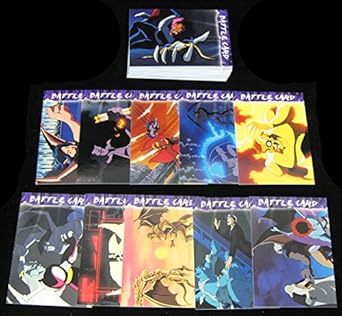
puzzle and a collectible card game called Gargoyles Stone Warriors Battle Card Game, while Skybox produced
two sets of traditional trading cards for the series in 1995
and 1996. Milton Bradley
produced a board
game based on the show. Another puzzle
of the castle was released as part of Wrebbit’s
Puzz-3D line. In 1995, Kenner
made a line of action
figures, two vehicles and a playset for the series. Applause produced a
line of 3” PVC figurines,
as well as vinyl figures slightly larger than standard action figure size
and character
mugs. Goliath was turned into a talking bank by Thinkway Toys and a costume
by Disguise Inc. Cross promotional
merchandising included ice
pops by Nestle, playing
cards by The United States Playing
Card Company, a Creepy
Crawlers mold
pak by Toymax
and a set of five Burger King Kids’ Club toys. In 2018, Funko would produce a line of POP!
figurines and keychains of the main gargoyle cast and Demona, and Neca would begin releasing a line of
highly-detailed “Ultimate”
figures in 2021.
 |
| Demona and Goliath in Disney Heroes: Battle Mode. |
Buena
Vista Interactive released a platforming action video game in 1995 in North
America only, developed by Disney
Interactive Studios. It ended up being exclusive to the Sega Genesis system as a Super
Nintendo version was cancelled; however, programmer Chris Shrigley would
make the source code available
for play in 2012. The player took control of Goliath as he sought to stop
the Eye of Odin, a magical talisman that could transform anyone, which ended up
in Demona’s hands. A remastered version of that game would later be made
available on modern consoles in late 2023. That same year, Tiger Electronics
would release the LCD handheld game Gargoyles – Night Flight.
Disney Interactive would release the mobile matching game Disney Emoji Blitz in 2016, taken
over by Jam City once Disney Interactive
was shut down. Goliath, Bronx and Demona appear in emoji form. In the 2018 RPG
mobile game Disney Heroes: Battle
Mode, developed and published by PerBlue,
Goliath and Demona would be featured as unlockable playable characters. They
would again appear along with Xanatos and the Steel Clan robots in the mobile
turn-based RPG Disney Sorcerer’s
Arena, released in 2020 by Glu Mobile.
 |
| Gargoyles promotional image. |
 |
| Marvel's Gargoyles #1. |
Disney Adventures magazine published 11 comics based on
the series, as well as several articles about the show. The story “Stone Cold”
from the December 1994 and January 1995 issues inspired the episode “The Price”
and the August 1996 story “The Expert” served as a promotion for Disney’s
then-new movie, The Hunchback of Notre Dame. Marvel Comics produced a series of comics
spinning out of the first season. Published between February and December 1995,
it ran for 11 issues and, while referencing events from the show, didn’t quite adhere
to the continuity of it. The comic was notable for introducing the characters
of Beth Maza (Monica Allison & Roxanne Beckford), Elisa’s
mother, and Petros Xanatos
(Sheppard), Xanatos’ father, before their actual on-screen appearances in the
series. Weisman had no involvement in the production of the book, but did write
an issue of it. However, it wasn’t published before the series was cancelled
due to Marvel’s bankruptcy. Weisman did write the entirety of the 2006 series published
by Slave Labor Graphics (SLG), picking
up the narrative from the end of season two and completely negating The Goliath Chronicles (which he deemed
as non-canon). He also used his unpublished Marvel script for the sixth issue
of the series. After eight issues and a mini-series entitled Bad Guys, SLG lost the Disney license due to rising costs.
Trades collecting their books were released, but Clan Building Volume Two also featured the unpublished issues
#9-12; with #10 featuring art by series character designer Greg Guler. In 2015, it was
revealed in the Previews
catalog that Joe Books was intending to
publish Cinestory Comics
(using film stills rather than original art) adapting episodes of the series
beginning the following year. However, nothing was ever released and Joe Books
confirmed their cancellation in 2017 on a now-deleted Twitter post (the company itself would shut
down in 2019). In 2022, Dynamite
Entertainment announced a new Gargoyles comic would be coming, again
written by Weisman, whose first issue would become Dynamite’s highest-selling
comic of the year at over
100,000 pre-orders. It’s being considered as the 4th season,
with the SLG comics remaining the canonical 3rd. A spin-off, The Dark Ages,
set in 971 when Hudson was still clan leader, debuted in 2023. Dark Ages
had previously been the name and premise of one of 6 proposed spin-offs from
the cartoon and the follow-up series after Bad Guys. For the series’ 30th
anniversary in 2024, Dynamite launched
a Kickstarter to fund complete collections of the pre-Dynamite Gargoyles
comics in various formats and with the option of being autographed by Weisman.
 |
| Gargoyles ad. |
In September of 1994, Disney wanted to preview the series at Walt Disney World. Weisman worked
with a different set of editors and sound mixers to compile and compress the
finished material of the first five episodes into an 80-minute movie. Because
the episodes weren’t complete, some parts were altered or left out from the
broadcast airing (although a few Weisman left out intentionally to hide key
plot points). Much to Weisman’s chagrin, Buena Vista Home Entertainment
later released the movie edit on VHS and Laserdisc in 1995 as Gargoyles the Movie: The Heroes Awaken.
Later that year and in 1996, four more VHS collections were released containing
the remaining episodes of season one. On the series’ 10th
anniversary in 2004, Buena Vista released Gargoyles: the Complete First Season on DVD with the episodes restored
following edits made when the show was rebroadcast on Toon Disney. A year later, Gargoyles: Season Two, Volume One was released. It wouldn’t be until 2013
when Volume Two would be released by Disney
Movie Club and the online Disney
Store, then widely in 2015. In 2019, it became one of the launch titles for
the streaming service Disney+.
EPISODE GUIDE:
Season 1:
“Awakening (Part 1)” (10/24/94) – The gargoyles help protect the
castle from Viking invaders, but they’re betrayed by the captain of the guards
and the Vikings smash them as they sleep.
“Awakening (Part 2)” (10/25/94) – Goliath leads the charge for vengeance
while rescuing the princess, the remainder of his clan being turned to stone
for their efforts.
“Awakening (Part 3)” (10/26/94) – Xanatos breaks the gargoyles’ curse
and recruits them to help reclaim three computer disks he claims were stolen
from him.
“Awakening (Part 4)” (10/27/94) – Elisa befriends the gargoyles and
explores the city with Goliath when they’re attacked, and upon learning Demona
survived he agrees to get the disks.
“Awakening (Part 5)” (10/28/94) – Goliath learns Xanatos deceived them
and Xanatos uses robotic gargoyles to try and destroy the real ones.
“The Thrill of the Hunt” (11/4/94) – Lexington’s heroes, The Pack,
turn out to be a group of mercenaries hired by Xanatos to take the gargoyles
down.
“Temptation” (11/11/94) – Demona tricks Brooklyn into bringing her a
spell book from the castle in order for her to enslave Goliath.
“Deadly Force” (11/18/94) – Broadway accidentally shoots Elisa when he
plays with her gun, setting him on an enraged quest to remove all firearms from
the city.
“Enter Macbeth” (1/6/95) – Macbeth offers to clear the gargoyles out
of the castle for Xanatos in order to get close to Demona.
“The Edge” (1/13/95) – Elisa is assigned a new partner, Matt
Bluestone, and they investigate the theft of The Eye of Odin artifact by a
gargoyle-like creature.
“Long Way to Morning” (1/20/95) – Hudson tries to keep an injured
Goliath away from Demona long enough for the sun to rise, allowing them to
heal.
“Her Brother’s Keeper” (1/27/95) – Elisa’s brother Derek is hired by
Xanatos while Jackal and Hyena target Xanatos in order to draw out the
gargoyles.
“Reawakening” (2/3/95) – Demona and Xanatos use magic and science to
resurrect Goliath’s rookery brother Coldstone.
Season 2:
“Leader of the Pack” (9/4/95) – Dingo and Coyote break the rest of The
Pack out of prison, except Fox, and plan their revenge while Coyote and Wolf
vie for leadership of the team.
“Metamorphosis” (9/5/95) – Xanatos hires Dr. Sevarius to create
replicas of the gargoyles, resulting in Derek becoming one of the mutant
results.
“Legion” (9/6/95) – Coldstone is reactivated and infected with a virus
that allows two other personalities to appear within him.
“A Lighthouse in the Sea of Time” (9/7/95) – Hudson befriends blind
writer Jeffrey Robbins while Macbeth steals a set of scrolls that presumably
belonged to Merlin.
“The Mirror” (9/11/95) – Demona frees Puck and he turns all humans
into gargoyles and vice versa, before making it so that Demona would become
human during the day rather than stone.
“The Silver Falcon” (9/12/95) – Elisa and Broadway investigate when
Matt disappears following a lead on the Illuminati.
“Eye of the Beholder” (9/13/95) – Xanatos proposes to Fox and gives
her the Eye of Odin, which changes her into a werewolf.
“Vows” (9/14/95) – Demona crashes Xanatos’ wedding and sends herself,
Goliath, Xanatos, Fox and Xanatos’ father back to Castle Wyvern in the past.
“City of Stone (Part 1)” (9/18/95) – Demona casts a spell that turns
humans to stone at night, allowing her to freely destroy them.
“City of Stone (Part 2)” (9/19/95) – Xanatos teams-up with the
gargoyles to find a way to break Demona’s spell.
“City of Stone (Part 3)” (9/20/95) – In the past, the Weird Sisters
bind Demona and Macbeth granting them eternal youth and binding pain until the
two kill each other.
“City of Stone (Part 4)” (9/21/95) – Macbeth is revealed to be The
Hunter while the gargoyles and Xanatos determine how to break Demona’s spell.
“High Noon” (9/25/95) – Macbeth and Demona try to free Coldstone’s
evil persona and Elisa discovers Demona’s human form.
“Outfoxed” (9/28/95) – Goliath seeks to protect Cyberbiotic’s new
flying fortress from Xanatos, owning up to helping destroy the first.
“The Price” (10/12/95) – Xanatos tries to find a test subject to endure
a cauldron that is supposed to grant immortality.
“Revelations” (10/26/95) – The Illuminati reveals the gargoyles to
Matt, and Matt recruits Goliath to help him similarly uncover the Illuminati.
“Double Jeopardy” (11/6/95) – Elisa and Goliath discover Goliath’s
clone Thailog who plots humanity’s domination.
“Upgrade” (11/9/95) – Coyote upgrades The Pack with genetics and
technology, making them more than a match for the gargoyles.
“Protection” (11/13/95) – Goliath and Broadway discover that Tony
Dracon is running a protection racket in which Elisa is a part of.
“The Cage” (11/16/95) – Goliath kidnaps Sevarius and forces him to
come up with a cure for Derek.
“Avalon (Part 1)” (11/20/95) – Tom, from Castle Wyvern, appears and
asks Goliath to help defeat the Archmage, Macbeth, Demona and the Weird Sisters
on Avalon island.
“Avalon (Part 2)” (11/21/95) – Goliath, Elisa and Bronx journey to
Avalon and learn the fate of their allies from 994 and how the Archmage
survived his battle against Hudson.
“Avalon (Part 3)” (11/22/95) – Goliath learns the rookery eggs
survived on Avalon and uses the children to help resurrect King Arthur to
defeat the Archmage.
“Shadows of the Past” (11/23/95) – Goliath, Elisa, Bronx and Angela
end up at the ruins of Castle Wyvern and discover two vengeful ghosts.
“Heritage” (11/27/95) – In Canada, Grandmother tries to teach
Natsilane so that he can face off against Raven.
“Monsters” (11/28/95) – In Scotland, Angela discovers she’s Goliath’s
daughter as she helps to save the Loch Ness Monster from Dr. Sevarius.
“Golem” (12/15/95) – In Prague, Renard desires to make himself
immortal by transferring his soul into a golem.
“Sanctuary” (12/18/95) – In Paris, Demona attempts to court Macbeth in
her human guise while Thailog has his own plans for him.
“M.I.A.” (12/21/95) – In London, Goliath uses the Phoenix Gate to
travel back to the Battle of Britain to find out what happened to the rest of
the London Clan.
“Grief” (12/28/95) – In Egypt, Emir attempts to gain control of Anubis
for Xanatos with Jackal and Hyena overseeing the operation.
“Kingdom” (2/5/96) – Brooklyn attempts to take control of the clan
while Fang does the same with the Mutates.
“The Hound of Ulster” (2/6/96) – In Ireland, Rory saves Goliath, Elisa
and Angela from the Banshee.
“Walkabout” (2/7/96) – In Australia, Dingo and Goliath go on a vision
quest in order to stop out of control nanobots.
“Mark of the Panther” (2/8/96) – In Nigeria, Elisa’s mother and a
group of story tellers are attacked by poachers, but they are saved by a man
who became a panther through Anasi.
“Pendragon” (2/12/96) – King Arthur and Griff journsey to New York for
Excalibur, but Macbeth is determined to get it first.
“Eye of the Storm” (2/13/96) – In Scandinavia, Odin wants to reclaim
his eye and Goliath uses it to battle the god.
“The New Olympians” (2/14/96) – Elisa is imprisoned in a hidden city
of mythological creatures who distrust humans.
“The Green” (2/15/96) – In Guatemala, a clan of gargoyles use
talismans to resist stone sleep in order to defend their temple from loggers,
Jackal and Hyena.
“Sentinel” (2/19/96) – On Easter Island, an alien sentry is convinced
the gargoyles are alien enemies of Earth.
“Bushido” (2/20/96) – In Japan, the local clan lives in harmony with
the humans, but one of the humans seeks to exploit the gargoyles.
“Cloud Fathers” (2/21/96) – In Arizona, Goliath, Elisa, Bronx and
Angela encounter Elisa’s father and sister and the trickster god Coyote.
“Ill Met By Moonlight” (2/22/96) – Oberon and Tatania return to Avalon
and seek to evict its current residents.
“Future Tense” (4/25/96) – Goliath, Elisa and Bronx return to New York
and discover 40 years have passed.
“The Gathering (Part 1)” (4/29/96) – Xanatos and Fox are expecting
their first child when Oberon comes to New York and puts the entire city to
sleep.
“The Gathering (Part 2)” (4/30/96) – Fox’s mother is revealed to be
Titania, and since Fox’s baby has the potential for magic Titania and Oberon
decide to bring it to Avalon for training.
“Vendettas” (5/1/96) – Wolf, wielding an axe possessed by Hakon, battles
Goliath and Hudson while another seeks his own revenge.
“Turf” (5/6/96) – Brooklyn, Lexington and Broadway are too distracted
with courting Angela to help Elisa avert a gang war.
“The Reckoning” (5/7/96) – Demona serves as bait for a trap set by Fang
and Thailog to sick his clones on the Manhattan clan while Demona tries to bond
with Angela.
“Possession” (5/8/96) – Puck places the spirits inside Coldstone into
Angela, Broadway and Brooklyn.
“Hunter’s Moon (Part 1)” (5/13/96) – The current generation of Hunters
attacks the Manhattan Clan.
“Hunter’s Moon (Part 2)” (5/14/96) – Demona allies with the clan
against the Hunters as the Hunters destroy the clock tower.
“Hunter’s Moon (Part 3)” (5/15/96) – The Hunters expose the gargoyles
to the world while Demona attempts to wipe out humanity with a mystical virus.
Season 3:
“The Journey” (9/7/96) – Xanatos hides the clan while John Castaway
forms the Quarrymen, an anti-gargoyle task force.
“Ransom” (9/14/96) – Lexington tries to rescue the kidnapped Alex Xanatos.
“Runaways” (9/21/96) – After an argument with Goliath, Brooklyn leaves
the castle and befriends two runaways.
“Broadway Goes to Hollywood” (9/28/96) – Fox helps Broadway get to
Hollywood for an interview, but the Quarrymen lie in wait.
“A Bronx Tail” (10/5/96) – Bronx befriends a runaway Amish boy.
“The Dying of the Light” (10/26/96) – Fearing he’s going blind, Hudson
visits Jeffery who encourages him to get medical attention, leaving him
vulnerable to the Quarrymen.
“And Justice for All” (11/2/96) – Goliath foils a robbery but is
arrested as one of the perpetrators.
“Genesis Undone” (11/9/96) – The Manhattan Clan seeks out Sevarius in
order to help Thailog and his clones avoid death by petrification.
“Generations” (11/16/96) – Angela has a falling out with Goliath,
driving her to seek refuge with Demona.
“For it May Come True” (11/23/96) – Titania gives Goliath a dream to
ease his doubts over the good he has done.
“To Serve Mankind” (11/30/96) – The Illuminati kidnaps and brainwashes
Goliath.
“Seeing isn’t Believing” (2/8/97) – Proteus escapes from New Olympus
and comes to New York, framing Goliath for a variety of crimes.
“Angels in the Night” (2/15/97) – Xanatos saves the gargoyles from a
Quarrymen trap, allowing the Quarrymen to show the world how insane they really
are and redeeming the gargoyles.
Originally posted in 2015. Updated in 2024.


.JPG)