Remember that one day when you could wake up without an alarm? When you would get your favorite bowl of cereal and sit between the hours of 8 and 12? This is a blog dedicated to the greatest time of our childhood: Saturday mornings. The television programs you watched, the memories attached to them, and maybe introducing you to something you didn't realize existed. Updated every weekend.
The
Neverending Story(Die unendliche Geschichte) is a 1979 fantasy
novel written by German author Michael
Ende. The book follows Bastian Balthazar Bux, an overweight and strange boy
who felt neglected by his father after his mother died. He escapes some bullies
by hiding in Carl Conrad Coreander’s bookstore where he finds a copy of The
Neverending Story. He becomes so interested in it that he steals it and
hides out in his school to read it. The book is set in Fantastica, a magical
place of wonder, ruled by the benevolent Childlike Empress. A formless entity
known as The Nothing threatens the kingdom and her people come to her for help,
but are informed she’s dying. A green-skinned boy warrior named Atreyu is
summoned to quest for a cure to help her. It turns out the Empress’ salvation
came from Bastian himself, who cured her by giving her a name: Moon Child.
Bastian.
As a result, Bastian ends up in Fantastica
and is given the powerful medallion Auryn that allows him to create anything he
wishes; however, unbeknownst to him, it came at the cost of his memories of his
life outside of the book. Bastian casts wish after wish in order to experience
great adventures, causing harm to Fantastica in the process. Eventually,
Bastian decides to take over Fantastica himself. Ultimately, Bastian becomes
repentant over his actions. Atreyu and the luck dragon Falkor accompany Bastian
into Auryn where the Water of Life demands Bastian’s name and to know if he
finished all the quests he had started for himself in order to allow Bastian to
return home. Atreyu gives Bastian’s name and offers to finish those quests,
allowing Bastian to return home and reconcile with his father. The book,
however, had disappeared. Coreander reveals to Bastian that Bastian will be
charged, like he was, to help the next possessor of the book find their way to
Fantastica.
The NeverEnding Story was
a hit. It stayed at the top of the sales charts for more than three years and
was ultimately translated into 27 different languages. Bernd Eichinger and Dieter Geissler
acquired the rights to Ende’s book and set about producing a film adaptation.
Co-written and directed by Wolfgang
Petersen, The NeverEnding Story largely covered the first half of
the book. As in the story, Bastian (Barret Oliver) ended up having
to save the life of the Childlike Empress (Tami Stronach) after witnessing
the adventures of Atreyu (Noah
Hathaway) and Falkor (Alan
Oppenheimer). A number of changes occur between the book and movie. Because
the make-up failed to look realistic, Atreyu was given normal skin color and
made to look more like a Native American. Falkor, an actual dragon in the book,
looked more like a dog-headed creature. Because of time, some characters were
cut out and their actions attributed to others. Although Bastian ends up
interacting with Fantasia (the name also changed from the book), he doesn’t end
up inside of it for the prolonged period he does in the book; instead, the film
ends with him and Falkor running down his bullies in the real world.
Bastian with Barktroll and Falkor.
Released on April 6 in Germany and July
20, 1984 in the United States, the film performed very well; earning $100
million worldwide despite some mixed reviews. The worst reviews of the film,
however, came
from Ende himself. He felt that the script he consulted on
was rewritten without his knowledge and that it completely ignored the point of
his book in an attempt to make money. When his request for production to be
halted was denied, Ende attempted to sue them but ultimately lost in court.
Instead, he settled for his name to be removed from the project.
Once legal issues with Ende were put to
rest, Geissler resumed work on the remainder of the film trilogy he envisioned
for The NeverEnding Story; acknowledging that the book was too rich for
just one film. The NeverEnding Story II: The Next Chapter adapted the
remainder of the book while also weaving in a new narrative, and The NeverEnding Story III:
Return (or Escape) to Fantasiautilized
only the characters in a completely original story.Each entry saw
increasingly negative reviews and diminishing returns; II only made
$17.4 million at the box office and III only saw a successful release in
its native Germany, its limited United States release ending as quickly as it
started.
The Childlike Empress gives Bastian the Auryn.
While producing the sequels, the idea to
adapt the franchise into an animated series came about. The NeverEnding
Story was a joint production between CineVox
Filmproduktion GmbH of Germany, Ellipse Programme of
France, Nelvana of Canada and HIT Entertainment of
the United Kingdom. The series followed Bastian’s (Christopher Bell) continuing
adventures in Fantasia; set after the first movie and ignoring all but
characters from the second two. He journeyed to the land whenever he wanted by
perusing the pages of the book in Mr. Correander’s (Chris Wiggins) shop. Often
times, he had to embark on a quest to save the land from some kind of evil
plight usually in the company of a variety of friends: the heroic Atreyu
(finally portrayed with his green skin, voiced by Dominic Zamprogna), Falkor (Howard Jerome), the bird-like
Nimbly (introduced in the second movie, voiced by Neil Crone), or the tree-like
Barktroll (introduced in the third movie, voiced by Richard Binsley). Other
characters returning from the films included the Empress (Lisa Yamanaka), her
aide Large Head (Colin Fox),
Mr. Rockbiter (Harvey Atkin),
gnome scientist Engywook (Wayne
Robson) and his witch wife Urgl (Barbara Byrne), the wise giant turtle
Morla (Pam Hyatt), and
Bastian’s father Barney (Geoffrey Bowes).
Evil sorceress Xayide.
There were several recurring villains on
the show. The Nothing was combined with the character of Gmork (Don Francks) to
be a black hole with evil red eyes that belonged to a white wolf that would
emerge from time to time; the evil sorceress Xayide (introduced in the second
movie, voiced by Janet-Laine Green), who used a variety of magic in her schemes
to conquer the land; Vermin (Len
Carlson), a bat-winged rat who kept an eye out for things worth stealing
around Fantasia; and Shadow Goblin (Benedict Campbell), a master
thief who wanted to become the richest being in Fantasia.
“The
Tears of Sadness” (12/2/95) – Bastian and Barktroll investigate why the water
is turning people into stone.
“The
Meek and the Mighty” (12/9/95) – Bastian tries to put a stop to Baby
Rockchewer’s destruction of the Tinies Village.
“The
Purple Buffalo” (12/16/95) – Bastian arrives in the Grassy Plains of the
Greenskin tribe to learn that the Purple Buffalo and Atreyu have disappeared.
“Morla’s
Wish” (12/23/95) – The Nothing is determined to get Bastian and Jacko before
they can deliver a package to Morla.
“Spook
City” (12/30/95) – Bastian has to help a spook he met in the Forbidden Forest
rescue her brother from Spook City.
“The
Save Falkor” (1/6/96) – Bastien ignores his doctor’s orders when he’s sick to
head to Fantasia and rescue Falkor.
“Missing
Memories” (1/13/96) – Bastian has to find out why parts of Fantasia are
mysteriously disappearing.
“Perilin”
(1/20/96) – Bastian has to help rescue the Fire Lion to stop the spread of the
Night Forest.
“The
Sea of Mist” (1/27/96) – Engywook’s latest expedition led him to discover the
Ancient Sea Scrolls, which contain answers to Fantasia’s mysteries.
“Promises”
(2/3/96) – Bastian helps Atreyu and Salya track down what’s causing a fissure
in the Grassy Plains.
“Through
the Misty Mountains” (2/10/96) – Bastian and Large Head look into a monster
that reportedly lives in the mountains.
“A
Friendship That Flames” (2/17/96) – Barktroll gets jealous of Bastian’s new
friend and tries to prove himself the better one.
“The
Three Feeling Stones” (2/24/96) – Xayide is able to quell good feelings in
Fantasia by removing two of the three ancient Feeling Stones.
“The
Belt of Invisibility” (3/2/96) – Bastian needs Xayide’s help to stop a pair of
invisible thieves.
“Good
Deeds” (3/9/96) – When Barktroll receives a reward for a good deed he begins to
expect one every time he does something nice.
“Barktroll’s
Blame” (3/16/96) – Barktroll is accused of starting a fire in the Howling
Forest.
“The
Searcher” (3/23/96) – A mistake sends Engywook to the Land of Cold Fire to
obtain all the knowledge he can.
“End
of Time” (3/30/96) – Time seems to be slowing down, affecting all of Bastian’s
friends.
“Thunder
and Lightning” (4/6/96) – Engywook sets out to build a rain-making machine to
end the drought in the Gnomic Forest.
“The
Everlasting Night” (4/13/96) – Xayide attempts to create a spell from a stolen
recipe book and ends up putting herself into a sleeping trance.
“After
the Falls” (4/20/96) – Bastian convinces Barktroll to accept a log-rolling
challenge issued to him by a bully over a beautiful tree they both like.
“Mirror,
Mirror” (4/27/96) – Xayide’s magic mirror creates an evil version of Bastian
and a good version of herself.
“The
Dreaming Fields” (5/4/96) – Xayide places Nightmare Weeds in the Dreaming
Fields that causes everyone’s dreams to become waking nightmares.
“The
Atonal Trolls” (5/11/96) – The Atonal Trolls abandon their homeland for the
Ivory Tower, but threaten its existence with the decibels of their shrieks.
“The
Race for the Ivory Tower” (5/18/96) – Everyone enters The Race, including
Shadow Goblin and Vermin who plan to cheat their way to victory.
“The
Perfect Gift” (5/25/96) – Bastian hopes Fantasia will inspire him to find the
perfect Father’s Day gift.
First final issue of Marvel's first Captain America series, not even starring the titular hero.
In the
years following World
War II, superheroes, which had dominated comics
since Superman’s first appearance in 1938, began to lose relevance with
readers. Without the Axis powers to fight against--which was the basis for many
of the characters--they were basically just treading water and the tastes of
their readers had changed towards a desire for sex and violence. Many
publishers ended their various hero titles and began to expand into other
genres such as western, romance, crime and, relevant for this particular entry,
horror.
The unholy trinity: the first Crypt-Keeper, the first issue of Crypt, and the first issue to don the familiar Crypt title.
1947’s Eerie Comicsby Avon Periodicals is often regarded as the first true horror comic. The
following year, American Comics Group’s Adventures
into the Unknownbecame the first ongoing horror comic title. In 1950, Entertaining Comics (EC)
publisher William
Gaines and editor Al Feldstein discovered
they had similar tastes in horror. They began to experiment with horror tales
in their crime titles, leading to the publication of Feldstein’s story “Return
from the Grave!” in Crime Patrol#15, cover-dated
December 1949/January 1950. The character of the Crypt-Keeper made his debut as
the host of that story. #16 featured a larger assortment of horror stories over
crime before the book ultimately shifted format entirely with #17. The title
was changed to The Crypt of Terror, although it kept the same numbering to save money on
second-class postage permits (a common practice throughout the early years of
the comics industry, which is why there are many titles out there without a #1
issue). With #20, the book finally became Tales
from the Crypt. Gaines would read many horror
stories and use them as springboards that he crafted new stories from with
Feldstein.
The Crypt-Keeper, the Old Witch, and the Vault Keeper hover over their publisher William Gaines.
As the
horror genre began to take off in comics, EC created two more horror books like Crypt.
With April/May 1950’s issue #12 of War Against Crime, the title became The Vault
of Horror, hosted by the Vault-Keeper. May/June 1950’s issue #15
of Gunfightersaw the series become The Haunt of Fear, hosted by The Old Witch after four issues. The hosts were
a lot more horrific at their inception. The Crypt-Keeper was a sinister hermit
whose face was hidden by his long hair and often seen within a half-opened
door. The Vault-Keeper was an ancient inquisitor in a hooded robe that presided
over the empty dungeon representing his bloody past. The Old Witch was inspired
by “Old Nancy, the witch of Salem”, host of radio series The Witch’s Talethat ran from
1931-38. Gradually, the hosts would be softened into comedic and pun-laden characters
designed to offset the horrors of the stories they presided over. Despite each
having their own books, they frequently crossed over into each other’s titles and
developed a comedic rivalry where they would try to usurp each other as the
ultimate singular host. Together, they were dubbed the GhoulLunatics.
Senator Robert C. Hendrickson displays an exhibit of "offensive" titles at the Senate hearings.
EC planned
to launch a fourth title in 1954, reusing The Crypt of Terror title,
but that was that year when everything changed for the comics industry. Comics,
especially in the crime and horror genres, came under fire as being harmful to
the well-being of children’s mental states. The highly publicized Senate
Subcommittee on Juvenile Delinquency hearings
did all but accuse those kinds of comics as being a catalyst for juvenile
delinquency.
Advertisement for the seal that appeared on all approved comics.
Reeling from the negative press, publishers,
led by Gaines (who had unsuccessfully testified at the hearings), quickly banded together to head off outside influence
and created two self-regulatory agencies: the Comics
Magazine Association of America and
the Comics Code
Authority. They placed strict guidelines on
publications, such as forbidding the use of “horror” or “terror” in titles, the
use of horror-themed beings and other gruesome characters, disrespect for
authority figures, excessive violence, sexual perversion, seduction, rape, and
other similar restrictions. Not what Gaines intended, he felt his books were
being directly targeted by the Code and was forced to cancel his three horror
books, publishing the one produced Crypt of Terror story as
the final issue of Tales from the Crypt.
As the guidelines of the Code began to
gradually loosen over time, Ballantine Books reprinted selected Crypt stories in
a series of EC anthologies in the 1960s. Later, the series was reprinted in its
entirety by Russ Cochran in The Complete EC
Libraryin 1979. Further reprints would come in the 1990s through
Cochran and Gemstone
Publishing. In the interim, a 1972 film
from Amicus
Productions adapted five stories from all
three horror titles, as did its sequel, The Vault of Horror, in 1973 (however, the sequel didn’t use any stories from
the comic for which it was named).
The new look for the Cryptkeeper.
In 1989, HBO, along
with The
Geffen Film Company and Warner
Bros. Television, collectively known as Tales
from the Crypt Holdings, developed a live-action anthology series based on the
original EC comics. Tales from the Crypt featured the
Cryptkeeper (John Kassir), now a rotting skeletal puppet created by Kevin Yagher,
who introduced the tales from his lair. Much like the comic Crypt-Keeper, the
show’s Cryptkeeper started off with a much deeper voice and had a more sinister
presence. Gradually, his voice and tone lightened up to become the pun-laden
host that his comic counterpart ended up being.
The series aired on HBO until 1996, allowing it
to avoid censorship that would come from being on a network and implant liberal
amounts of gore, profanity, nudity and sex more than even the original stories
had. Along with stories from all three horror titles, they used EC’s other
books Crime
SuspenStories, Shock SuspenStories, and Two-Fisted Talesfor inspiration. Following the Cryptkeeper’s introduction, each story
would begin with a comic book cover done by Mike Vosburg and Shawn McManus that resembled the covers used on the original books.
The series also featured a wide assortment of notable guest-stars and
directors, five of which served as executive producers on the show and owned
the rights to the EC stories: Richard Donner, David
Giler, Walter Hill, Joel
Silver and Robert Zemeckis.
The Cryptkeeper had never been so animated.
At the height of the series’ popularity, it was
decided that there was potential to tap into the children’s market with an
animated spin-off to replace Beetlejuice. Nelvana Limited and ABC partnered up
and set about toning down the series to be an acceptable Saturday morning program with
the aid of child psychologist Brian Newmark. The result was an anthology series that served a moral
lesson at the end of each story as the villains of the tales always received
their comeuppance. It was originally planned to use the puppet Cryptkeeper in
the show, but he was deemed too potentially frightening for younger viewers.
Instead, a full-bodied animated version with green skin (but emaciated to
retain a somewhat skeletal appearance) was used. Kassir was retained as the
voice, and he continued to deliver pun-laden one-liners from his lair while
being sure to strike the story’s message home for viewers.
Better run to your TV set before you miss the show.
The Vault Keeper and the Old Witch attempt to steal Cryptkeeper's show.
Renewed for a second season, some changes were
made to the overall format. The Vaultkeeper (David Hemblen) and the Old Witch
(Elizabeth Hanna) were introduced to the show. Their rivalry was reignited from
the old EC comics over the fact that they were jealous the Cryptkeeper had his
own show while they did not. This resulted in the Cryptkeeper leaving his lair
and heading to other locations to stay one step ahead of his rivals. There were
a couple of episodes where they would tell stories together, and even some of
the story characters from the previous season made appearances in sequel
stories. During this time, Ace Novelty released two
series of four figures based on the show:
two versions of the Cryptkeeper and the rest generic classic
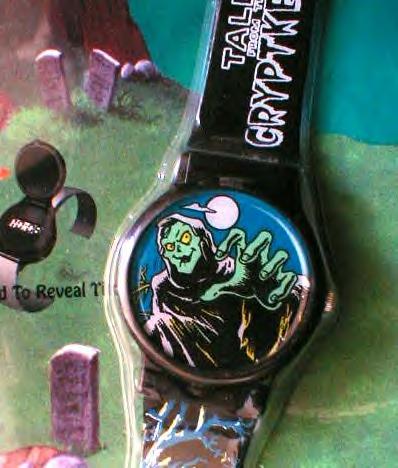
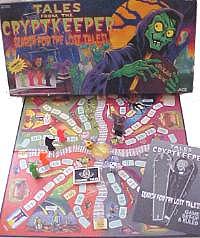
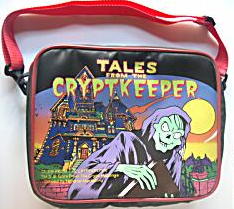
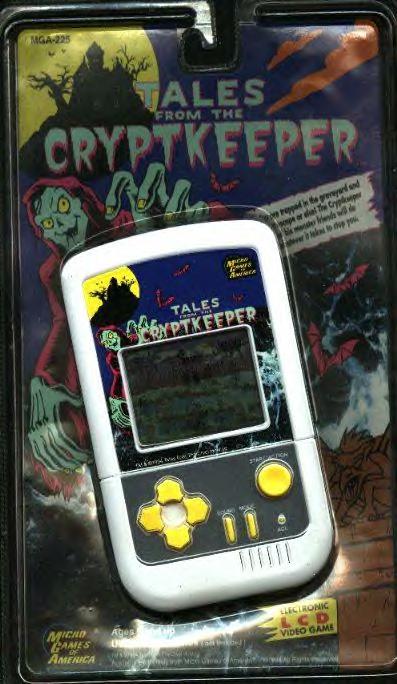
monsters. Other merchandise included a wrist watch, silly putty, play slime, a board
game, a lunch box, monster-faced balls, an electronic handheld game, googely eyes, and talking
Cryptkeeper dolls.
Traversing the graveyard in Secrets of the Cryptkeepr's Haunted House.
At the end of the second season, ABC cancelled
the series. But, that wasn’t the end of the story. CBS had acquired
the licensing rights to Crypt and created a kids’ game show
called Secrets
of the Cryptkeeper’s Haunted House that
aired on Saturday mornings from 1996-97. Following the end of that show, CBS
decided to make further use of the license and revived the Cryptkeeper cartoon.
Titling it New Tales from the
Cryptkeeper, the new batch of episodes debuted on October 10, 1999. They retained
Kassir as the voice but featured radically different animation. The style was
more rounded and cartoony when compared to that of the ABC episodes, which used
a more realistic style that almost emulated a comic book. The Cryptkeeper bore
greater resemblance to his puppet counterpart while maintaining his green skin,
and had a prominent tooth in each gum. Because of new FCC regulations
demanding more educational value from cartoons, the New episodes
were simplified and included more streamlined morality lessons. The Vaultkeeper
and Old Witch were also jettisoned in favor of having the Cryptkeeper in
“disguise” interacting with the characters in the episodes as well as
addressing the viewers, rather than bookending the story with an introduction
and the moral. The revival only lasted for a single season before the show was
cancelled once again.
An issue of the all-new Tales series by Papercutz.
Although Crypt left the
airwaves before the turn of the century, the producers of the HBO series
attempted to keep it going through another medium: radio. 8 of 13 radio shows
were recorded, still starring Kassir, and premiering for free on Seeing Ear Theater, an online subsidiary of the Sci-Fi Channel. 7 of
those were later released on CD by Highbridge Audio. In 2007, Crypt returned to comics
through Papercutz featuring the original GhoulLunatics and covers
reminiscent of the EC books. The new comics ran for 13 regular and 9 digest-sized issues, with
an editorial by Gaines’ daughter, Cathy Gaines Mifsud, on
censorship appearing in regular issue #8. Parodies and homages of the
classic Crypt covers pop up from time to time on various
modern comics and other visual merchandise.
“While the Cat’s Away” (9/18/93) – Two brothers plan to rob an
abandoned mansion and fall afoul of the Cryptkeeper’s monstrous security
system.
“Nature” (9/25/93) – Two brothers torment some ants before they’re
mysteriously shrunk down and forced to deal with the tribulations of being an
insect.
“Pleasant Screams” (10/2/93) – A teacher and his student find
themselves trapped in the fantasies of another student they have tormented.
“Gone Fishin’ / A Little Body of Work” (10/9/93) – A boy tries to warn
his wasteful fisherman uncle that the fish are looking for revenge. / Two thugs
challenge a boy to race them in the Mustang he’s restoring, but little do they
know the car has a mind of its own.
“The Works…In Wax” (10/16/93) – The statues in a boy’s favorite wax
museum come to life.
“The Sleeping Beauty” (10/23/93) – Vain prince Chuck and his nerdy
twin brother Melvin quest to awaken a sleeping princess, not knowing she’s
really a vampire.
“Cave Man” (10/30/93) – A caveman is thawed out and befriended by a
scientist’s son, but has trouble adapting to the modern world.
“Hyde and Go Shriek” (11/6/93) – Wendell drinks a formula that turns
him into a werewolf and allows him to torment his tormentors.
“Fare Tonight” (11/13/93) – Camille and Mildred create a vampire
detector and discover one is much closer than they ever thought.
“Gorilla’s Paw” (11/20/93) – An unpopular boy steals a gorilla’s paw
to get into a secret club, but discovers the wishes it grants come with twisted
results.
“This Wraps It Up” (12/4/93) – A girl teased because of her massive
height suddenly becomes the hero when a mummy unleashes a curse on everyone.
“Grounds for Horror” (12/11/93) – Campers befriend an invisible entity
who plays tricks on their no-nonsense counselor.
“Ghost Ship” (12/18/93) – Two shipwrecked joyriders are rescued by a
haunted ship full of pirates.
Season 2:
“Game Over” (9/10/94) – Two boys skip school to play video games, but
end up in for a fright when the game characters come to life.
“Cold Blood, Warm Hearts / The Spider and the Flies” (9/17/94) – A man
and woman investigating a monster in a lake discover they have much in common.
/ When spiders infest a town, two siblings discover the exterminator isn’t what
he appears to be.
“The Avenging Phantom / Myth Conceptions” (9/24/94) – Jimmy wishes he
could get revenge on bullies like his favorite super hero and gets his wish,
but with dire consequences. / An archaeologist discovers the tomb of Medusa and
discovers how his predecessors died.
“All the Gory Details” (10/1/94) – Two reporters try to track down an
old scientist for a story.
“The Weeping Woman” (10/8/94) – Camille and Mildred investigate a
woman’s ghost that haunts a local inn.
“Dead Men Don’t Jump” (10/15/94) – A boy challenges a monster to a
basketball game for his very life.
“The Haunted Mine” (10/22/94) – A boy ends up in an abandoned mine
that contains a dark secret.
“Growing Pains” (10/29/94) – Wendell returns as a plant enthusiast and
falls for a girl named Rose, whose family has a secret.
“The Brothers Gruff” (11/5/94) – A troll follows Eddie after he
crosses a bridge and kidnaps his brother, leaving Eddie and his friend Sheldon
to get her back.
“Uncle Harry’s Horrible House of Horrors” (11/12/94) – A boy’s
birthday is being spoiled by a skeptical uncle, but a frighteningly realistic
haunted house soon changes his tune.
“Hunted” (11/19/94) – A heartless hunter becomes the hunted when a
shape shifting monster frees his prey and comes after him.
“Chuck (and Melvin) and the Beanstalker” (12/3/94) – Chuck and Melvin
return to steal the treasure of the giant Cyclops Beanstalker.
“Transylvania Express” (12/10/94) – Two surfer dudes accidentally get
on a train headed for Transylvania--and a load of vampires.
Season 3:
“Sharon Sharalike” (9/9/99) – A selfish teenager steals her sister’s
doll and learns the doll doesn’t like when its owners don’t share.
“Imaginary Friend” (9/16/99) – A young kid’s imaginary friend gets
back at two bullies.
“Waste Not, Haunt Not” (9/23/99) – A bog monster is created when two
boys dump the chemicals from their science project into the bog.
“Unpopular Mechanics” (9/30/99) – Destructive inventor Randall creates
a remote control that causes machines to go haywire, but the machines revolt
against him.
“Competitive Spirit” (10/7/99) – Victor tricks his rival into thinking
a ghost lives in the mountains, but the real mountain spirit comes after Victor
for his ways.
“Trouble in Store” (10/14/99) – Two boys locked in a store after hours
discover the mannequins are alive and very protective of their home.
“So Very Attractive” (10/21/99) – An insecure girl buys a beauty cream
that makes her irresistible to everyone, regardless of species or status of
life.
“Drawn and Quartered” (10/28/99) – A magic pencil allows a boy to get
revenge on his bullies through his drawings.
“All Booked Up” (11/4/99) – A boy who hates to read ends up trapped in
a library and literally engulfed in the world of literature.
“Town Gathering” (11/11/99) – A girl discovers a group of businessmen
are actually carnivorous aliens, but no one will believe her because of her
tendency to pull pranks.
“It’s For You” (11/18/99) – A boy uses his new phone line to make
prank calls, and one of his pranks ends up becoming his phone stalker.
“Monsters Ate My Homework” (11/25/99) – A boy tells his teacher
monsters ate his homework, which comes true when monsters come after him for
his homework.
“Too Cool for School” (12/2/99) – Playing around in the school science
lab leads to two girls accidentally creating monstrous half-dinosaur, half-frog
creatures.