Remember that one day when you could wake up without an alarm? When you would get your favorite bowl of cereal and sit between the hours of 8 and 12? This is a blog dedicated to the greatest time of our childhood: Saturday mornings. The television programs you watched, the memories attached to them, and maybe introducing you to something you didn't realize existed. Updated every weekend.
20 years ago, the Forces of
Darkness came into power in a magic-filled dimension and began a war called The
Great Battle between good and evil. The army of monsters were opposed by five
wizards led by the most powerful of all, Leanbow (Chris Graham).
He cast a spell to seal the dark forces off from the other realms and went to
the other side himself to ensure it stayed closed. In the present, a massive
earthquake struck the city of Briarwood and broke
the seal, allowing evil to resume its invasion of Earth under the leadership of
Octomus the
Master (John Leigh), Supreme Master of the Underworld.
Sorceress Udonna (Peta Rutter) gathered the warriors of legend to fight against
them: Nick Russell (Firass Dirani), Xander Bly (Richard Brancatisano), Chip
Thorn (Nic Sampson), and sisters Vida (Angie Diaz) and Maddie Rocca (Melanie
Vallejo). Leanbow also returned as the evil Koragg until the power of good
restored his original personality, turning him into the Wolf Warrior and ally
of the Power Rangers. They were also aided by Daggeron (John Tui), who wielded the
power of the sun as the Solaris Knight, and his feline genie, Jenji (Oliver Driver).
The Mystic Force Rangers with the Wolf Warrior and the Solaris Knight.
Power Rangers Mystic Force
debuted on February 20, 2006 on Toon Disney’s Jetix block, with reruns later
airing on ABC as part of the ABC Kids
programming block. Jackie
Marchand was finally made story-editor by producer Bruce Kalish; a position she’d
hold until RPM.
Ron Wasserman pitched both a rap and a rock
theme for the series, but they were ultimately rejected and Disney went with
Chaka Blackmon as its composer. Because S.P.D.’s
finale cost so much, the production was under strict orders to use as much Sentai
footage as possible with a slashed budget for new material; which meant no
annual team-up episode was produced. That also had the unfortunate consequence
of giving an excessive amount of focus to the Red Ranger over the others, which
fans took issue with. Antonia Prebble, who previously played the Nova Ranger in S.P.D.
and Krista in Dino
Thunder, played the dual role of Clare, Udonna’s niece and apprentice,
and her mother, Niella. Tui had also played Anubis Cruger in S.P.D.,
and Machiko Soga, best known
as Rita Repulsa,
was the Mystic
Mother through posthumous use of footage from Magiranger.
(NHK BS2, April 7,
1998-March 21, 2000 JAP WB, June 17,
2000-December 14, 2001 US Teletoon, August 23,
2000-March 8, 2003 CAN) Madhouse, Kodansha
(Japanese), Nelvana, The Ocean Group (English)
Nicole
Oliver (English) – Meiling Li/Meilin Rae, Maggie
CLAMP is an all-female Japanese manga artist
collective, or “circle”, founded in the mid-1980s. Currently comprised of
leader and writer Nanase Ohkawa,
and artists Mokona Apapa
(who just goes by Mokona), Mick
Nekoi (now known as Tsubaki Nekoi) and Satsuki Igarashi,
they had also featured founding members O-Kyon, Sei Nanao (who both left by
1990), Tamayo Akiyama,
Leeza Sei (who
both left in 1992), Sōshi Hishika, Kazue Nakamori and Shinya Ōmi (who all left
in 1993). The group’s name came from the dictionary when they needed something alphabetically
close to “CLUB/Y” to remain seated near a prominent artist at an exhibition. They
started out creating dōjinshi (fan comics) of Captain Tsubasa,
Saint Seiya, and
Jojo’s
Bizarre Adventure before pivoting towards original work in 1987.
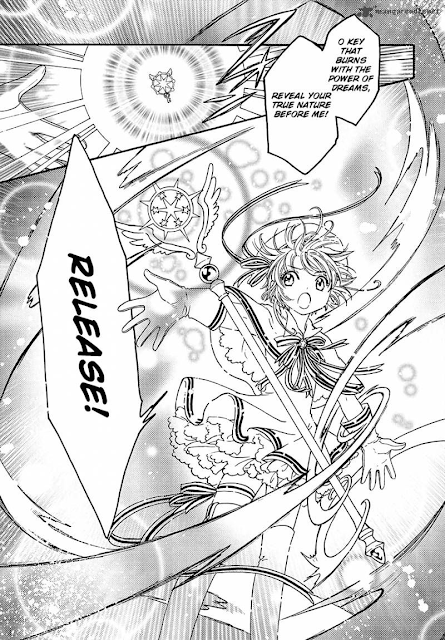
Sakura summoning her wand in the manga.
Their first original project was RG Veda, which got them
approached by an editor for Shinshokan’s
Wings manga magazine
about working for them. RG Veda ended up being serialized in Wings;
starting out a single story but expanded when sales and reader response were
higher than expected. Over the next decade, they would find themselves
published in various magazines and by various publishers. Nakayoshi magazine, published
by Kodansha, wanted CLAMP to produce
another series for them as their current one, Magic Knight
Rayearth, was about to wrap up. Ohkawa wanted to create a magical girl
series, despite not being well-versed in the genre, in order to have a
character roughly the age of Nakayoshi’s readership (the magazine was
targeted towards young girls) that they could relate to. They came up with Cardcaptor
Sakura, a title suggested by Nekoi. It debuted in May of 1996 and ran until
June of 2000.
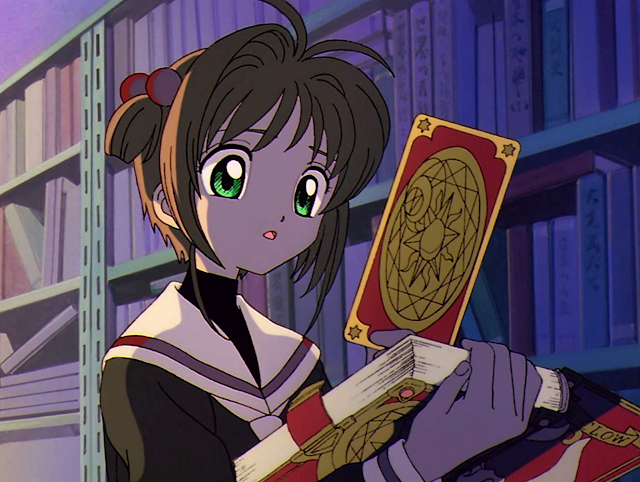
Sakura releases the Clow Cards.
The manga would focus on the
titular Sakura Kinomoto, a 10-year-old girl who ended up accidentally releasing
19 magical Clow Cards
(named after their former owner, sorcerer Clow Reed) from
a book found in her
family’s basement and was tasked with retrieving them. It would prove to be
different than all of CLAMP’s other series to date as it had a more hopeful
feeling to it with the theme of “if you try your best, it’ll work out”.
Additionally, there was a focus on various forms of love and relationships
between the characters without commentary, which sometimes took center stage
over the main plotline in various chapters. Artists Mokona, Nekoi and Igarashi
were asked by Ohkawa to use thin and curved lines and to keep the pages light
without a lot of ink to give the story a “soft, cute-like” feel. Additionally,
a lot of flower imagery was incorporated (while avoiding roses). While the
series continued the trope of standard magical girl transformation scenes in
the manga, CLAMP wanted Sakura to have different costumes as they felt “it’s
pretty sad for a girl to wear the same outfit all the time.”
The manga’s popularity spurred the
production of tie-in media, which included video games, art books and an
anime. The anime was produced by Madhouse
and directed by Morio Asaka,
with Ohkawa serving as head writer and Mokona overseeing costume and card designs.
Other writers included Hiroshi
Ishii, Jiro
Kaneko, Tomoko
Ogawa and Tomoyasu
Okubo. Katsufumi
Hariu handled art direction with Kumiko Takahashi
on character designs and Takayuki Negishi
on music. It aired 70 episodes across three seasons on NHK BS2 from April 7, 1998-March 21, 2000, as
well as two movies released by Bandai that
bridged between the first two seasons and served as the series finale. Despite
airing in a traditionally poor timeslot, the anime proved popular with viewers
and won the Animage Grand Prix award for
best anime in 1999.
As with the manga, the anime
centered on elementary school student Sakura Kinomoto (Sakura Tange) and her
quest to recover the now 52 Clow Cards, created by half-English, half-Chinese
sorcerer Clow Reed (Kazuo
Hayashi), before they wreaked havoc in the fictional Japanese town of
Tomoeda. She was an extremely sweet and energetic girl who was athletically
gifted in sports but a bit clumsy and naïve in life. She was also unaware that
she possessed any kind of magical ability until it was revealed that was the
only way she could have broken the seal on the Clow Book to free the cards. The
cards themselves had their own personalities ranging from good to malicious, as
well as an alternate form. They possessed powers typically embodying an
elemental force or related to a specific task as well as an ability to float,
and could possess objects and control people through them. In order to defeat a
Clow Card, their power had to be bound by someone signing their name at the
bottom of the card, signifying they are the card’s new owner. Once Sakura
captured a card, she was able to use its abilities when needed. Her primary
weapon was a staff called the Sealing Wand, which
shrank into a key Sakura wore around her neck until a magical chant was
recited. It gave the wielder the ability to seal or summon Clow Cards.
Sakura with her wand, Tomoyo with her camera, and Kero being a grump.
Guiding her on her mission was one
of the cards’ guardians, Cerberus (Aya Hisakawa), also called “Kero” after the
Greek version of his name, Kerberos. His primary form was that of a small
winged cat-like cub with a lion-like tail, while his true from (voiced by
Masaya Onosaka) was that of a large mountain lion with giant angelic wings and
armor. Cerberus was bossy, demanding and gluttonous, but cared about Sakura and
believed in her ability to accomplish her quest. Also helping wherever she
could was Sakura’s best friend and second cousin, Tomoyo Daidouji (Junko Iwao).
She would follow Sakura around with her video camera to record all her
exploits, as well as designed new costumes for her to wear into battle and
helped cover for her dual identity. Mature for her age, she gave off an air of
refinement while still being very sweet and caring. Her ability to sing often
made her the target of Voice and Song cards. Additionally, Sakura’s older
brother, Touya (Tomokazu Seki), had an ability that allowed him to sense when
his sister was in danger and did what he could to protect her, all the while
keeping his knowledge of her double life to himself.
Syaoran and Meiling join in on the hunt.
A second Cardcaptor was introduced
in the form of Syaoran Li (Motoko Kumai), a cold and cynical boy from Hong Kong
who was descended from Reed and a member of the Li clan of sorcerers. He
believed he should inherit the cards over Sakura and sought to capture them for
himself, often being antagonistic towards her and criticizing her flaws.
However, the more time he spent with her, the more he warmed up to and
eventually even developed feelings towards her, deciding to work with her in
capturing the cards. To find the cards, he utilized a special compass
created by Reed. Trying to help Syaoran was his first cousin and betrothed (in
Japan, first cousins are allowed to marry), Meiling Li (Nogami Yukana), who was
an original character in the anime. She possessed no magical ability herself
which often led to her hindering Syaoran more than helping, despite being
proficient in martial arts. While in Tomoeda, Syaoran and Meiling were watched
over by family butler Wang
Wei (Motomu Kiyokawa),
who was also created for the anime.
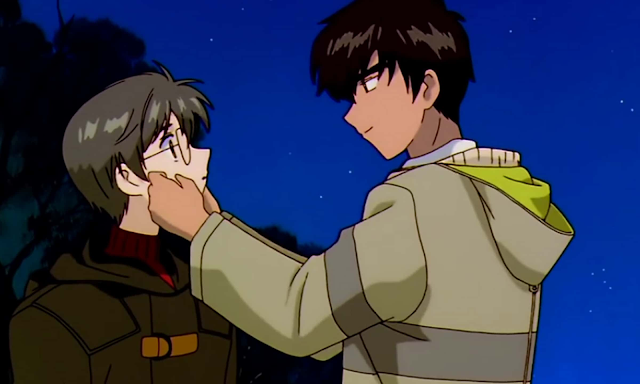
Yukito and Touya: just really good friends.
Additionally, there was Yukito
Tsukishiro (Megumi Ogata), who was Touya’s best friend and whom Sakura
initially had a crush on. Yukito had a kind and gentle personality, and was
very popular in school. He was also a complete lie as it turned out he was
unknowingly nothing but a false form for the other card guardian, Yue. Yue had
an angelic appearance with dark armor, and was in charge of judging if the next
Master of the Clow was worthy. Despite his cold demeanor, he had a kind heart.
His powers were reliant on those of his master, and Sakura had to build hers up
in order to sustain him. It would be this revelation that would explain
Syaoran’s own attraction to Yukito; originally mistaken as being a crush but
actually he was drawn towards the magical energies hidden within.
School life.
Other characters included Fujitaka Kinomoto
(Hideyuki Tanaka), the
widowed father of Sakura and Touya; Nadeshiko Kinomoto
(Yūko Minaguchi), the
deceased mother of Sakura and Touya who went against the wishes of her family
when she married Fujitaka; Sonomi Daidouji (Miki Itō),
Tomoyo’s wealthy mother and cousin of Nadeshiko who such deep romantic feelings
for her that she considered Fujitaka a rival; Yoshiyuki Terada (Tōru Furusawa & Katsuyuki Konishi), a teacher
at the elementary school who taught several classes and often chaperoned trips;
Rika Sasaki (Tomoko Kawakami), Sakura’s mature
yet shy classmate and friend who regarded Yoshiyuki as a father figure; Takashi Yamazaki (Issei Miyazaki), another
classmate who was known for creating highly-detailed fabricated stories on just
about any subject; Chiharu
Mihara (Miwa Matsumoto),
a cheerleader who was close friends with Takashi and often playfully strangled
him to stop one of his stories; Naoko Yanagisawa (Emi Motoi), a cheerleader---despite
being bad at gymnastics--with a love of fantasy and ghost stories; and Kaho Mizuki (Emi Shinohara), a shrine maiden that dated Touya
before leaving to study in England, who returned as a substitute teacher that
Sakura developed a crush on and seemed to have some knowledge in regards to the
Clow Cards.
Sakura with Cerberus and Yue.
After Sakura managed to reacquire all
of the cards and passed Yue’s judgement, her staff changed from having a
bird-like head to a
star with wings and give her the ability to convert the Clow Cards into Sakura Cards. Eriol Hiiragizawa
(Nozomu Sasaki), the
reincarnation of Reed, came to town and created a series of magical disasters
in order to force Sakura to do so as the cards could only maintain their power
by feeding off of their master’s magic. In the guise of a child, he attended
Sakura’s school and befriended her and Takashi. Assisting Eriol were two new
guardians he created: Spinel
Sun (Yumi Touma), whose
borrowed form resembled that of a cat with butterfly wings and true form
(Konishi) was that of a panther with butterfly wings and butterfly-shaped
armor, and Ruby Moon (Ryoka Yuzuki), who resembled a
human-sized fairy with butterfly wings, and assumed the form of high school
student Nakuru
Akizuki out of boredom. Both were the opposites of their fellow guardians,
with Spinel being calm and well-read while Ruby was more chaotic, always
teasing Spinel and proving a general nuisance to Touya in school.
The reincarnation of Clow Reed, Eriol, with guardians Spinel Sun and Ruby Moon.
As the manga was still ongoing at
the time, naturally the anime wasn’t a straightforward adaptation and several
changes were made. The series began with Sakura’s releasing of the Cards,
whereas the manga had depicted it in flashback after she was already on her
quest. Along with the number of Clow Cards, their capture happened in a
different order and sometimes at different locations and times of day. Cerberus
needed both The Earthy
and The Firey cards to
return to his original form, rather than just the Firey. Syaoran was made able
to activate the cards he owned via his sword, took part in Yue’s final
judgement, and was no longer living on his own. The fact that Sakura’s father
was created from half of Reed’s soul was omitted, eliminating his resistance to
the cards’ magic and his ability to see the spirit of his late wife, and making
Eriol the only aspect of the sorcerer. The Moon Bell created by Reed
to transform Sakura’s staff was meant to help her defeat Yue without hurting
him, but was used to give Sakura a second chance to pass his final judgement in
the anime.
Rika and Mr. Terada, gone from a problematic student/teacher infatuation to a father figure.
Several relationships in the anime
were altered from their presentation in the manga. Kaho and Eriol were revealed
to know each other, but don’t end up together romantically. Rika and Terada’s
relationship skewed uncomfortably more towards the romantic in the manga, with
the pair planning on getting engaged once Rika was old enough. Sakura was the
only one who really knew of their relationship and often came to Rika for
advice with her own love life. Chiharu and Takashi’s relationship was left
ambiguous, and Tomoyo having unrequited romantic feelings towards Sakura were
downplayed. Syaoran confessed his feelings to Sakura immediately after the
final battle and tried to hide the fact he was ordered back to Hong Kong by his
mother, and he ended up absorbed by The Nothing card when
she tried to reciprocate.
As anime was gaining in popularity
outside of Japan, Cardcaptor Sakura was licensed out for localization in
other markets. For the English-speaking markets, three different companies
created their own dubs independently of each other. Animax Asia’s dub was used for Southeast
Asia. The version to air in North America and Australia was handled by Canadian
company Nelvana in association with The Ocean Group, which included the first film. The second film, often
considered the 25th episode of the third season and the series
finale of the anime, was done by Bang
Zoom! Entertainment.
Sakura, Cerberus and Syoaran, now known as Li.
Nelvana spent roughly $100,000 per
episode on translation by Meredith Woodward, dubbing, and incorporating new
music composed by Lenz
Entertainment, as well sound effects when the originals couldn’t be
isolated from audio tracks. As with other anime imports, a number of changes
were made to bring the series more in line with Western sensibilities at the
time. For instance, elements of Japanese culture, signage and landmarks were
either altered to something more familiar to the target audience or eliminated
entirely when possible. All of the children, which were mostly polite and
soft-spoken, were made to be far more outspoken; particularly Sakura herself as
she was depicted as more assertive. The characters’ names were also mostly Westernized:
Sakura became Sakura Avalon (with a different pronunciation for her first name
which was only kept because it would have been too difficult to remove all
instances of it, voiced by Carly McKillip); Cerberus became Keroberos (Matt
Hill using a New York accent, and Richard Newman for his true form) and
retained his Kero nickname; Tomoyo became Madison Taylor (Maggie Blue O’Hara,
using a valley girl accent instead of the elegant style from the anime); Touya
became Tori Avalon (Tony Sampson); Yukito became Julian Star (although Yue’s
remained unchanged, both voiced by Samuel Vincent); Syaoran became Li Showron
(Rhys Huber & Jordan Kilik); Meiling became Meilin Rae (Nicole Oliver);
Reed’s name was pronounced as “klau” instead of “klo” (Dale Wilson); Fujitaka became
Aiden Avalon (Brian Drummond),
and his wife, Natasha (Janyse
Jaud); Sonomi became Samantha Taylor (Venus Terzo); Yoshiyuki was
addressed as simply Mr. Terada (Drummond); Rika became Rita (Dina Sherman); Takashi became
Zachary Marker (Philip Pacaud);
Chiharu became Chelsea (Jocelyne
Loewen); Naoko became Nikki (Kelly
Sheridan); Kaho became Layla MacKenzie (Linda Rae Jurgens); Eriol
became Eli Moon (Bill Switzer);
Spinel Sun became Spinner Sun (Colin
Murdock); and while Ruby Moon (Willow Johnson) kept her name,
her alternate form went by it as well. The town itself was also renamed
Reedington.
Li Showron, elevated to co-protagonist status and thinking Sakura is a joke upon first impressions.
Boys were determined to be the
larger demographic for animation, just like it was determined that girls were
more likely to watch shows targeted for boys than the reverse. Nelvana’s dub
tried to make the show as appealing for boys as possible by toning down
anything deemed “girly”. Sakura’s name was removed from the title, becoming
simply Cardcaptors; its plurality done to indicate Li’s elevation from a
supporting character to a central protagonist alongside Sakura in order to give
boys a character they could relate to. The episodes were reorganized so that
Li’s debut episode was the first and that more Li-centric episodes aired early
on, creating plot holes and inconsistencies in the overall story. While the
final episode remained in its correct place chronologically, it was combined
with the preceding episode and eliminated most of the romantic moments between
him and Sakura. Since Pokémon and Yu-Gi-Oh! were the big shows at
the time, it was decided to veer away from cutesy and slice of life moments and
put an emphasis on the card collecting (as collecting was the big hook in those
other shows) and the action and adventure.
No longer cousins, so it's okay for Meilin to crush on Li.
That meant romantic entanglements
were removed as much as possible, with the central romance between Sakura and
Li being drastically downplayed to the point that their love for each other was
never confessed and the series ended with Li simply returning home. Problematic
relationships were outright eliminated; such as teacher/student relationships
like Sakura’s father being a teacher at the high school her mother attended,
the remaining traces of Rita and Mr. Terada’s forbidden flirtations, and Tori’s
brief fling with student teacher Layla, and ones with an incestuous tone, such
as Meilin becoming a childhood friend of Li with a crush on him rather than his
cousin. Chelsea was also turned into Zachary’s cousin, removing all possibility
of their being a couple and her “strangling” him being given a twinge of
sibling energy. Additionally, the price for Sakura failing the final judgement
was changed from everyone connected to the cards losing their love for the
person they cared for most to everyone’s memory being erased from the time the
cards were released. The reason the cards needed to be changed to Sakura Cards
(Star Cards in the dub) was altered to their needing a reliable magical source
to survive on unless they ran wild looking for one and potentially destroyed
the world.
Strong feelings for Julian, or just put off by his personality?
It particularly meant the
elimination of any queer relationships, of which the manga featured many and
the anime carried over in some form. Li was no longer attracted to Julian
(magical influence or not), with his reactions to him being explained away as
being off-put by his general personality. Julian and Tori were no longer
attracted to each other and just remained the good friends they were initially
depicted as. Madison and Samantha both lost their attractions to their
respective cousins. In fact, Natasha’s familial connection to Samantha was
removed altogether to make them just friends, and Samantha’s dislike of Aiden came
from her feeling like a third wheel when they got together rather than romantic
rivalry. Sakura’s crush on Julian, which was prominent throughout the early
half of the series, was also downplayed.
Cardcaptors debuted on The WB as part of the Kids’ WB programming block
on June 17, 2000 in the United States, while Teletoon (now Cartoon Network) in Canada started
airing it on August 23, 2000 (along with a French dub). While all 70 episodes
were dubbed, further edits were made to the American version of the program.
The series was cut down to only 39 episodes—particularly eliminating ones that
didn’t center on Li—with Li’s first episode, the anime’s 8th, being
aired first to introduce him right away. Scenes were removed and replaced with
ones from other episodes, particularly ones focused on card collecting. To
further emphasize Li’s prominence, Kids’ WB’s promotions painted Li as the main
character and reduced Sakura to a secondary one. The episode title cards were
changed to include a CGI rendering of the Clow Book opening, which was also
featured in the original Nelvana intro. The three themes, while simply
translated in the original dub, was changed to more of a rocking one about
action and adventure performed by Dave
Doré. Retained at the end of the episodes was a special short segment
called “Leave
it to Kero-Chan!”, or “Kero’s Corner” in the dub, where Kero would recap
the episode and introduce a character to the audience.
Gotta catch 'em all!
The episodes “Sakura and Kero’s Big
Fight” and “The Summer House” never aired in North America; likely due to the plot
of Kero getting drunk being central in the former and Sakura befriending an old
man and going over to his house in the latter (despite the fact the old man
turned out to be her great-grandfather). Instead, two Kids’ WB-exclusive
episodes, “The Past, The Present and the Future” and “A Strange New Beginning”
which were combinations of different episodes from the anime, were aired in
their place to round out the full 70-episode run. These were the only American episodes
to air outside of the country, and were omitted from later reruns of the
Nelvana series. The Bang Zoom! dub of the second film would ignore all of
Nelvana’s changes and adhered closely to the original Japanese production
utilizing a different English voice cast.
Merchandising for the series
included a
line of toys by Trendmasters.
Action figures of Li, Mei Lin and Sakura in different outfits were released
alongside fashion dolls of those characters with cloth clothing, figurines
of Li, Sakura and Kero, a talking Kero doll, and a set of keychains.
Additionally, a roleplaying Clow Book and Clow Cards set and Sakura’s wand were
released. Tokyopop produced a series of 10 cine-mangas adapting
various episodes using stills from the anime. When they were translated into
English, the dub’s names and personalities were carried over and the books were
retitled Cardcaptors.
Scholasticpublished several
easy-reader adaptations of various episodes, a sticker book and a tattoo scrap
book, while Landoll released three punch-out activity books. As
part of the promotion for the English dub in 2002, four toys
were released through Taco Bell
restaurants. Once again, Li was put in a place of prominence as he was the only
character physically represented in the toys—the others being Madison’s
camcorder with a Sakura sticker and an episode still inside, Li’s compass
(called a Lasin Board in the dub), and the Clow book which contained 20 Clow
Cards—while Sakura was only seen on the advertising. Kero was featured as a small
plush for the younger kids. The restaurant came under
fire by religious groups as they felt the Clow Cards looked too close to
tarot cards, which represented the occult. Taco Bell issued an apology and
ended their distribution shortly after. Pioneer Entertainment released
the first 27 episodes of Cardcaptors on 9 VHS and DVD compilations
between 2000 and 2002, as well as the
first film. A 10th volume was planned but ultimately
cancelled. Rhino Entertainment released
the album Cardcaptors:
Songs from the Hit TV Series in 2001. While the original anime has been
made available to stream on Crunchyroll,
Netflix, Tubi,
Prime,
Google
Play and Apple
TV, the Nelvana dub could only be found from fan uploads on YouTube.
Alternate versions of some of Sakura’s
characters appeared in CLAMP’s Tsubasa:
Reservoir Chronicle manga in a crossover with some of their other
characters. It was published in Weekly
Shonen Magazine from May 2003 through October 2009. In 2016, CLAMP
began a sequel to Sakura subtitled Clear
Card that is, as of this writing, currently ongoing. It follows Sakura,
Syaoran and their friends into junior high school as they try to figure out why
the Sakura Cards have turned blank, rendering them powerless. As with the
original manga, Madhouse adapted the first 28 chapters of Clear Card
with the same staff and cast returning; with the exception of Kunihiko Hamda coming on as
character designer. A follow-up anime was
announced in 2023 that will adapt the rest of the series until its
conclusion. Bushiroad and Monster Lab
also created a mobile
game that was in service from October 2019 through June 2020.
EPISODE GUIDE (original anime synopses used, translated
Japanese titles in parenthesis):
Season 1:
“One Fateful Day (Sakura and the Mysterious Magic Book)”
(4/7/98 JAP, 3/7/01 CAN, 6/23/01 US*) – Sakura accidentally releases the Clow
Cards from a book in her father’s library, and Cerberus assigns her the task of
recapturing them.
*Combined with anime episode 41.
“Partners in Crime (Sakura’s Wonderful Friend)” (4/14/98
JAP, 3/11/01 CAN) – Sakura’s best friend learns her secret and her support
enables Sakura to fully embrace her role as a Cardcaptor.
“Allies (Sakura’s Heart-Racing First Date)” (4/21/98 JAP,
11/18/00 US, 1/14/01 CAN) – A casual aquarium date with Julian turns deadly
when The Watery Card attempts to drown Sakura.
“An Unexpected Find (Sakura’s Tiring Sunday)” (4/28/98 JAP,
3/18/01 CAN) – Sakura finds two seemingly-dormant Clow Cards in her house that
end up turning it into a jungle.
“Trouble at Twin Bells (Sakura, Panda, and a Cute Shop)”
(4/28/98 JAP, 3/18/01 CAN) – A new shop is unknowingly plagued by a Clow Card.
“Seeing is Believing (Sakura and Memories of Her Mother)”
(5/12/98 JAP, 4/1/01 CAN) – Investigating a ghostly encounter behind the school
leads Sakura to finding the ghost of her mother.
“The Mysterious Painting (Sakura’s First Attempt as a Thief)”
(5/19/98 JAP, 4/8/01 CAN, 7/7/01 US) – Sakura, Madison and Kero sneak into the
art museum to capture The Silent Card inhabiting one of the paintings.
“Sakura’s Rival (Sakura’s Rival Appears)” (5/26/98 JAP,
6/17/00 US, 8/23/00 CAN) – Li arrives in Reedington to capture the remaining
Clow Cards and take the ones Sakura’s already caught.
“Double-Edged Sword (Sakura and the Mysterious Brooch)”
(6/2/98 JAP, 7/15/00 US, 8/27/00 CAN) – Rita, Madison and Sakura all buy
brooches to cheer Sakura up from her encounter with Li, but Rita’s ends up
being The Sword Card and it possesses her.
“An Unexpected Reunion (Sakura and the Sports Day of
Flowers)” (6/16/98 JAP, 5/27/01 CAN) – Tensions arise on Sports Days as
Samantha’s hatred of Adrian over Natasha’s death ignites and the Merry Flower
Card causes a downpour of petals.
“The Special Box (Sakura. Tomoyo, and a Mansion)” (6/23/98
JAP, 9/9/01 CAN) – Sakura goes to Madison’s house for the first time and learns
that The Shield Card has taken control of Samantha’s prized jewelry box.
“Time and Again (Sakura’s Never-Ending Day)” (6/30/98 JAP,
6/24/00 US, 9/3/00 CAN) – The Time Card causes Sakura to relive the same day
over and over.
“Power’s Ploy (Sakura and the Elephant’s Test of Strength)”
(7/7/98 JAP, 7/29/00 US, 9/10/00 CAN) – The Power Card terrorizes the zoo but
it doesn’t look like Sakura can beat it, even with the help of the zoo’s
elephants.
“Play Misty for Tori (Sakura, Toya and Cinderella)” (7/14/98
JAP, 9/22/01 CAN) – While visiting the high school, a corrosive mist works its
way into the auditorium and into the play being put on by Tori and Julian’s
class.
“Sakura and Kero’s Big Fight (Sakura and Kero’s Big Fight)”
(7/21/98 JAP*) – After an argument, Kero gets himself drunk on liquor-filled
chocolate and ends up in the house of a young girl who lives alone with her
mother.
*Never aired in North America.
“The Summer House (Sakura and the Rainbow of Memories)”
(8/4/98 JAP*) – While on a vacation in the countryside, Sakura befriends the
old owner of a nearby mansion.
*Never aired in North America.
“The Cave (Sakura’s Scary Test of Courage)” (8/11/98 JAP,
7/8/00 US, 9/17/00 CAN) – During a beach trip their classmates all disappear
after entering a cave, leading Sakura and Li to believe a Clow Card is nearby.
“A Fair to Remember (Sakura, Yukito and the Summer
Festival)” (8/18/98 JAP, 9/29/01 CAN) – Sakura’s vision comes true when she and
Julian come across glowing lights falling from a tree like snow.
“Nothing to Report (Sakura and the Summer Holiday Homework)”
(9/1/98 JAP, 4/22/01 CAN) – Sakura and Li work together to capture The Move
Card, which has stolen a book they both need to finish their summer
assignments.
“The New Rival (Transfer Student vs. Sakura)” (9/8/98 JAP,
8/5/00 US, 9/24/00 CAN) – Sakura seeks to protect Tori from a woman challenging
people to fights and discovers it’s Meilin in possession of The Fight Card.
“The Long Marathon (Sakura’s Long Marathon Race)” (9/30/01)
– During a school race, Sakura and Li end up trapped running in circles by The
Loop Card.
“Practice Makes Perfect (Sakura, Tomoyo and the Wonderful
Song)” (9/29/98 JAP, 10/10/01 CAN) – The ghost rumored to be haunting the
school’s music room turns out to be The Song Card impersonating Madison’s
voice.
“No Problem Too Small (Sakura’s Little Adventure)” (10/6/98
JAP, 4/29/01 CAN) – Sakura ends up accidentally shrunken by The Little Card and
lost in the backyard.
“Double Take (Sakura and One More Sakura)” (10/13/98 JAP,
8/19/00 US, 10/1/00 CAN) – Sakura is confused as to why the town has branded
her a trouble maker until she discovers The Mirror card has assumed her form.
“No Way Out (Sakura and the Wonderful Teacher)” (10/20/98
JAP, 9/16/00 US, 10/8/00 CAN) – Suspicions surround the mysterious new
substitute teacher at school, especially when Li senses strong magical powers
from her.
“Return to the Future (Sakura and the Shrine of Memories)”
(10/27/98 JAP, 10/11/01 CAN) – The Return Card shunts Sakura to the past where
she witnesses the relationship between Tori and Layla.
“Buyer Beware (Sakura and the Enchanted Cards)” (11/3/98
JAP, 11/4/00 US, 1/3/01 CAN) – A new craze over cards that resemble the Clow
Cards results in Meilin unknowingly getting her hands on an actual one.
“How Sweet It Is (Sakura’s Sweet Cooking)” (11/10/98 JAP,
3/4/02 CAN) – Sakura and Li’s home economics class project ends up being
spoiled by The Sweet Card.
“The Race (Sakura and the Injured Card)” (11/17/98 JAP,
8/26/00 US, 10/15/00 CAN) – Sakura is reluctant to capture The Dash Card when
upperclassman Rei bonds with it and it helps her on the track team.
“Dragon Slayer (Sakura and the Nameless Book)” (11/24/98
JAP, 9/15/00 US, 11/1/00 CAN) – The Create Card takes the guise of a book that
brings to life anything Nikki writes in it.
“The Switch (Sakura, Kero and Syaoran)” (12/1/98 JAP, 9/23/00
US, 11/5/00 CAN) – While helping Sakura capture The Change Card, Li and Kero
end up switching bodies.
“Ice Breaker (Sakura’s Freezing Ice Skating)” (12/15/98 JAP,
9/30/00 US, 11/12/00 CAN) – The class trip to the ice skating rink goes cold
when The Freeze Card comes out to play.
“By the Light of the Full Moon (Sakura, Yukito and the
Midday Moon)” (12/22/98 JAP, 3/5/02 CAN) – A journey in the forest during a
full moon causes a series of mishaps to befall Sakura and Julian.
“The Third Element (Sakura’s Wonderful Christmas)” (12/29/98
JAP, 10/14/00 US, 11/19/00 CAN) – Sakura invites Julian to the amusement park
so that she can give him a Christmas present, but duty calls when The Firey
Card makes an appearance.
Season 2:
“Stormy Weather (Sakura and the Snow New School Term)”
(4/6/99 JAP, 11/11/00 US, 1/7/01 CAN) – The 5th grade semester
starts off with some unseasonably cold weather as The Snow Card causes a blizzard
in April.
“The Show Must Go On (Sakura and Tomoyo’s Lost Voice)”
(4/13/99 JAP, 3/8/02 CAN) – Madison is all set to sing as the lead in the
school choir when The Voice Card steals her voice.
“A Berry Strange Day (Sakura’s Fun Strawberry Picking Adventure)”
(4/20/99 JAP, 5/6/01 CAN) – On a class trip to a strawberry farm, everyone else
gets locked out of the building while Sakura, Madison, Li and Meilin get
trapped inside by The Lock Card.
“Under the Weather (Sakura’s Dizzy Fever Day)” (4/27/99 JAP,
6/3/01 CAN, 6/30/01 US) – Despite almost collapsing at school, a fever can’t
keep Sakura from her duty when The Cloud Card is near.
“Dream a Little Dream (Sakura and the Sakura from the Dream)”
(5/11/99 JAP, 3/14/02 CAN) – The Dream Card follows Sakura, Madison, Li and
Meilin to Tokyo and traps Sakura in a nightmare of the possible future when she
faces the Final Judgement.
“The Sands of Time (Sakura, Syaoran, and the Sea of Sand)”
(5/18/99 JAP, 5/13/01 CAN, 6/23/01 US*) – Sakura gets cast as the prince and Li
as the princess in the school production of Sleeping Beauty, but The
Sand Card interrupts their rehearsal before they can get to the kissing scene.
*Combined with anime episode 1.
“A Strange Intermission (Sakura and the Black Out School
Arts Festival)” (5/25/99 JAP, 5/20/01 CAN) – It’s the day of the play and once
again the kiss scene is interrupted by The Dark Card, which envelopes Sakura in
its darkness.
“Meilin’s Story (Sakura and Farewell to Meiling)” (6/1/99
JAP, 12/2/00 US, 1/21/01 CAN) – Meilin is devastated she’s been ordered to
return home, so Sakura invites her to a farewell sleepover that turns into a
mission when The Twin Card appears.
“The Last Card Part 1 (Sakura, Kero and the Mysterious
Teacher)” (6/8/99 JAP, 1/28/01 CAN, 7/21/01 US) – Sakura’s dreams become
stronger and feature Layla, from whom Kero senses tremendous magical power
from.
“The Last Card Part 2 (Sakura and the Final Clow Card)”
(6/15/99 JAP, 2/4/01 CAN, 7/28/01 US) – Sakura and Kero capture The Earthy
Card, transforming Kero into his true form and revealing that Julian has been the
guardian Yue the whole time.
“The Final Judgement (Sakura and the Final Judgement)”
(6/22/99 JAP, 2/11/01 CAN, 7/28/01 US) – Sakura initially fails to defeat Yue
and loses the Final Judgement, but Layla uses the Moon Bell to give her another
chance.
Season 3:
“The New Transfer Student (Sakura and the Mysterious
Transfer Student)” (9/7/99 JAP, 8/4/01 US*, 3/15/02 CAN) – New transfer
students arrive at the elementary and high schools just as a mysterious rain
falls over the town and Sakura finds she’s unable to use her abilities.
*Combined with anime episodes 48 & 58 to form the US episode
“The Past, The Present and The Future”, which was also aired in Canada.
“Unlocking the Key (Sakura and the Awakened Star Key)”
(9/14/99 JAP, 8/4/01 US*, 2/8/03 CAN) – Sakura, Kero, Yue and Madison
investigate the strange downpour and end up trapped by the torrents until
Sakura is able to create a new incantation that restores her powers.
*Combined with anime episode 47 to form the US episode “A
Strange New Beginning”, which was also aired in Canada.
“The Dangerous Piano (Sakura and the Dangerous Piano)” (9/21/99
JAP, 3/8/02 CAN) – Eli accompanies Madison on the piano and secretly enchants
it to attack the sound of her voice.
“The Threads That Bind (Sakura, Syaoran, and the Invisible
Threads)” (9/28/99 JAP, 8/25/01 US*, 2/8/03 CAN) – Eli takes control of Li’s
body using invisible strings after purchasing several spools from a craft store.
*Combined with anime episode 51 to form US episode “A New
Set of Wings”.
“Attack of the Teddy Bear (Sakura and the Big Teddy Bear)”
(10/5/99 JAP, 8/25/01 US*, 10/5/01 CAN) – Eli helps Sakura make a teddy bear
for Julian and enchants it, causing it to grow in size once she gifts it to
him.
*Combined with anime episode 50 to form US episode “A New
Set of Wings”.
“Trouble at the Park (Sakura’s Sheep Warning)” (10/12/99
JAP, 9/1/01 US, 10/7/01 CAN) – Yue reveals to Kero that Sakura’s magic isn’t
enough to sustain him for long while Sakura investigates a large hole in the
middle of a playground.
“Running Out of Time (Sakura and the Panicky Bike)”
(10/19/99 JAP, 8/11/01 US, 9/23/01 CAN) – Sakura hastily transforms several
Clow Cards into Sakura Cards at once to preserve her magic, causing The Dash
Card to flee in panic and possess Tori’s bike.
“Calendar of Memories (Sakura and the Calendar of Memories)”
(10/26/99 JAP, 2/15/03 CAN) – Sakura sets out to amend the rift between her
father and great-grandfather who didn’t approve of his marriage to Natasha.
“Sakura in Wonderland (Sakura and Sakura From Wonderland)”
(11/2/99 JAP, 12/3/01 US, 3/6/02 CAN) – Eli enchants a leaf he gives to Sakura
for a bookmark, causing her to be sucked into her copy of Alice in
Wonderland.
“Spinning Out of Control (Sakura, Kero and the Sweet
Meeting)” (11/9/99 JAP, 9/22/01 US, 10/12/01 CAN) – While hiding nearby in the
woods during the school bazar, Kero meets and befriends Spinner and introduces
him to sweets—causing him to go on a ravenous eating binge.
“Li’s Calling (Sakura Syaoran, and the Elevator)” (11/16/99
JAP, 10/8/01 US & CAN) – The bond between Li and Sakura steadily grows, especially
after Eli traps both of them in an elevator together.
“Double Trouble (Sakura and Double Trouble)” (11/30/99 JAP,
9/15/01 US, 10/9/01 CAN) – Eli casts a spell that prevents Cerberus and Yue
from assuming their alternate forms.
“Trapped (Sakura, Tomoyo, and the Ball Trap)” (12/7/99 JAP,
9/22/01 US, 10/13/91 CAN) – Yue confronts Eli and reveals he knows who he
really is, while an enchanted basketball warps space within the school and
causes Madison to be lost.
“Just Like Old Times (Sakura and the Precious Friend)”
(12/14/99 JAP, 10/14/01 CAN, 10/15/01 US) – Li is prepared to end his
engagement to Meilin as he loves Sakura, but first they must all deal with
enchanted penguin statues in the playground.
“A Present for the Cards (Sakura, the Cards, and the Presents)”
(12/21/99 JAP, 2/15/03 CAN) – Sakura uses The Mirror Card to duplicate herself
to go Christmas shopping with Tori while she deals with a pair of enchanted
fence bars with Li.
“Sakura’s Strange Fortune (Sakura and the Strange Written
Fortune)” (1/4/00 JAP, 2/22/03 CAN) – While at the shrine for the New Year’s celebration,
Eli gives Sakura a fortune that says a truth will be revealed to her during her
first dream of the year.
“A Wave of Danger (Sakura, the Pool and the Huge Wave)”
(1/11/00 JAP, 2/22/03 CAN) – Eli causes the pools at the indoor water park to
rise to dangerous levels, almost drowning Rita in the process.
“Slippery Slope (Sakura and the Snowy Ski Class)” (1/18/00
JAP, 12/11/01 US, 3/21/02 CAN) – During a class ski trip, Sakura and Eli go
hiking in the mountain when an avalanche threatens to bury the lodge.
“Lights, Camera, Vanish (Sakura, Yukito, and the Vanishing
Power)” (2/15/00 JAP, 12/10/01 US, 3/7/02 CAN) – When Julian collapses during production
of a student film, Tori gives up his abilities to sense Sakura in danger in
order to keep him from fading from existence.
“The Calm Before the Storm (Sakura, Syaoran, and the
Tsukimine Shrine)” (2/29/00 JAP, 3/1/03 CAN) – Sakura and her friends all go to
hang out at the shrine where Eli sends a strange-looking horse to cause
trouble.
“Sakura’s Return to the Past (Sakura, the Past, and Clow
Reed)” (3/7/00 JAP, 12/12/01 US, 3/22/02 CAN) – Sakura uses The Return Card to
go back in time to consult with Clow Reed, and discovers that he lives in the same
house Eli lives in now.
“Revelations Part 1 (Sakura Meets Clow Reed)” (3/14/00 JAP,
12/13/01 US, 3/8/03 CAN*) – Eli finally reveals that he’s the reincarnation of
Clow Reed and tasks Sakura with transforming the remaining cards or condemn the
world to remain in eternal sleep and darkness.
*Combined with anime episode 70.
“Revelations Part 2 (Sakura and Her True Feelings)” (3/21/00
JAP, 12/14/01 US, 3/8/03 CAN*) – Eli explains his reasons for the constant
attacks, and Sakura sees Li off as he returns to Hong Kong without confessing
her feelings for him.
*Combined with anime episode 69.
Films:
“The Movie” (8/21/99 JAP, 4/6/22 CAN) – Sakura and her
friends go to Hong Kong where a vengeful spirit seeks Clow Reed in order to
destroy him.
“The Sealed Card” (7/15/00 JAP, 11/18/03 US) – Sakura is
ready to tell Syoaran her feelings when he returns to town, but her cards and
people she cares about have begun going missing.
For the history of Sonic the Hedgehog, check out the post here.
After three American animated series
and a two-episode
OVA,
Sonic the Hedgehog was finally coming home to his native Japan in a long-form
anime. Sonic X was developed by TMS
Entertainment (which would become a subsidiary of
Sonic’s creators Sega
in 2005) and was designed with a Japanese audience in mind. As a result, it
featured none of the original characters introduced in DiC Entertainment’s
previous programs and relied heavily on established ones from the various games
intermixed with TMS’ original creations.
The series began with an original
storyline. Sonic (Jun-ichi Kanemaru & Jason Griffith) and his friends were
attempting to stop Dr. Eggman’s (Chikao Ohtsuka & Mike Pollock) latest scheme
when one of his own robots damaged a machine containing the mystically-powered Chaos
Emeralds. The resulting explosion teleported them all from
their native planet Mobius
(unnamed in the anime) to the planet Earth in another dimension populated by
humans. There, Sonic met and befriended 12-year-old Chris Thorndyke (Sana
Kobayashi & Jerry Lobozzo), had to find his missing friends, and keep Eggman
from conquering an entirely new world. The second season would incorporate
adaptations of Sonic
Adventure, Sonic Adventure 2and
Sonic
Battleinto its narrative, as
well as introduce the characters associated with them.
Amy Rose with Big the Cat, Cream the Rabbit and Cheese.
Among the misplaced Mobians was
Sonic’s ever-present sidekick, Tails (Ryō Hirohashi & Amy Palant): the
two-tailed flying fox and inventor. There was also Sonic’s friendly rival,
Knuckles the Echidna (Nobutoshi Canna & Dan Green), who had previously
appeared in animation in the OVA. He’s the guardian of the Master
Emerald, a powerful ancient relic, possesses super strength,
a short-temper and gullible nature, and could float via his dreadlocks. New to
animation was Amy Rose (Taeko Kawata & Lisa Ortiz), a pink hedgehog armed
with a giant mallet who could be bossy, stubborn, and constantly strived to get
Sonic to date her; Cream the Rabbit (Sayaka Aoki & Rebecca Honig), a
well-mannered young girl always in the company of her pet Chao, Cheese
(Hirohashi & Honig); Big
the Cat (Takashi
Nagasako & Oliver Wyman),
a large but gentle cat whose only desire in life is to just be fishing with his
best friend, Froggy (Tomohisa
Asō
& Amy Birnbaum); Rouge
the Bat (Rumi
Ochiai & Kathleen Delaney),
a jewel thief who is capable of altruistic deeds but always has her own agenda—usually
resulting in something being stolen; and the Chaotix,
a team of adventuring detectives consisting of Vector
the Crocodile (Kenta Miyake
& James
Carter Cathcart), Espio
the Chameleon (Yūki Masuda
& David
Wills) and Charmy Bee (Yōko Teppōzuka
& Birnbaum).
Sonic with Ella, Mr. Tanaka, Knuckls, Amy, Cream, Cheese, Tails, Chris and Chuck.
Newly created characters included
the rest of Chris’ family: Chuck Thorndyke (Bin Shimada & Lobozzo), Chris’
grandfather who was a scientist and inventor that became fast friends with Tails;
Ella (Kujira
& Pollock), the Thorndyke family maid who could be a force of nature when
made angry; Mr. Tanaka (Naoki
Imamura & Darren Dunstan), the Thorndyke’s butler and
bodyguard who enjoyed meditation and martial arts; Sam Speed
(Sōichirō
Tanaka & Frank
Frankson), Chris’ uncle who led a special unit of the Station
Square Police Department known as the Speed Team
that utilized high-speed race cars; Nelson Thorndyke (Ken Yamaguchi & Ted
Lewis), Chris’ father who was a wealthy industrialist and usually very absorbed
with work; and Lindsey
Thorndyke (Naomi
Shindō & Veronica Taylor),
Chris’ mother who was a famous actress and spent most of her time traveling
from one set to another. Chris’ human friends included Helen (Noriko Hidaka
& Birnbaum), a paraplegic that readily accepted Sonic and his friends; Danny
(Shindō & Rachel
Lillis as a kid, Frankson as a teen), an always-optimistic
athlete who approached everything with enthusiasm; and Frances
(Yuka Shioyama
& Kerry
Williams), a thrill-seeker who loved a challenge but would
always look to protect her friends from harm.
The President and his unscrupulous aide, Jerome Wise.
Other characters included The
President (a combination of George
W. Bush and Richard
Nixon, voiced by Tomohisa Asō
& Lewis), who was initially wary of the Mobians but came to regard their
value in defeating Eggman; Jerome Wise
(Kōji Haramaki
& David Lapkin),
the President’s aide who viewed the Mobians as a threat to the President’s
re-election and often worked against them; Mr. Stewart (Michio Nakao
& Rannells), a government agent initially assigned to pose as a teacher at
Chris’ school to keep an eye on the Mobians; and Topaz
(Yukari Hikida
& Jennifer
Johnson), a by-the-book agent of the President’s Guardian
Units of the Nations military organization (G.U.N. for short,
although not uttered on the English version of the show) that was eventually
partnered with Rouge.
Dr. Eggman with Bocoe, Bokkun and Decoe.
Eggman, not one to be kept down,
quickly set about establishing new bases and war machines on the planet, as
well as built his own robot army. Among his minions were Bocoe (Shimada &
Dunstan) and Decoe (Yamaguchi & Rannells), who served as his personal
assistants, and Bokkun (Yumiko Kobayashi & Rannells), a messenger robot
that communicated with Sonic on Eggman’s behalf via explosive televisions.
These three robots were all original to the series. The E-Series
of robots were Eggman’s primary soldiers in his attempts at world conquest and
reacquiring the Chaos Emeralds, each with a different appearance and
functionality. Eggman would come to free an ancient and immortal being from
their world called Chaos
to aid in his plans. Chaos was powered by the Chaos Emeralds and could assume
different and more powerful forms the more Chaos energy it was exposed to. To
aid Chaos, Eggman created the E-100
Series of robots which were powered by placing animals
inside of them. The most notable of these robots was E-102 Gamma (Imamura &
Rannells) who would defy his programming and seek to free the captured animals
and his brethren from Eggman’s control. There was also Shadow the Hedgehog
(Koji Yusa & Griffith), a dark version of Sonic created by Eggman’s
grandfather, Gerald Robotnik (Ōtsuka & Pollock). Faster and more powerful
than Sonic, Shadow wanted to destroy the world due to the death of his closest
friend, Maria Robotnik (Yuri
Shiratori & Honig), but ultimately fell into the role of
hero.
Gotta move fast!
Sonic X originally debuted on
TV Tokyo
in Japan on April 6, 2003. The series was preceded by two trailers: the first
featured most of the footage that would end up used in the series’ intro as
well as unused scenes featuring unique characters, and the second
was shown by Sega at the World
Hobby Fair video gaming event in February of 2003 comprised of
footage from the first few episodes. Notably, the second trailer ended with a
still frame of the original design for Super
Sonic—a Sonic super-powered by the Chaos Emeralds—that
ended up being changed by the time the episode went to air. Yuji Naka,
then-head of Sega’s Sonic
Team
(the group responsible for developing all Sonic games) served as an
executive producer, and several of the voice actors utilized had previously
voiced their characters in the games. The original anime writers were Chinatsu Houjou,
Hiro Masaki,
Kiyoko Yoshimura,
Koji Miki,
Masahiko Shiraishi
and Yoshio
Urasawa. The anime’s theme, “Sonic Drive”, was composed by Takeshi Aida
and Cher
Watanabe with vocals by Hironobu
Kageyama and Hideaki
Takatori. There were also three ending themes: “Future” by Kazuyoshi Baba
performed by Run&Gun,
“Shining Road” by Shun Taguchi
and Masataka
Matsutoya performed by Aya Hiroshige,
and “T.O.P.” by KP
and URU.
The characters were designed by Satoshi Hirayama, adhering closely to the
original game designs for the established characters.
Shadow reluctantly working with Rouge.
4Kids
Entertainment acquired the rights to handle the
localization for the American market. As with their other acquired programs,
4Kids made
extensive edits for content and length. They reduced
depictions of violence (like blood and death), removed instances of alcohol and
sexual innuendos, modified language (removed curses or lessened threats),
replaced gunfire with lasers, and eliminated instances of breaking the fourth
wall. Eyecatch
cards, which displayed information about a character at
various intervals utilizing game-inspired art, were also removed. The only
thing Sonic X managed to escape was having entire episodes cut out of
the rotation; something that befell other 4Kids acquired programs. Rather than
use the games’ voice actors, 4Kids cast all-new ones for the show since the
game cast didn’t live in New York. Norman J. Grossfeld
invited Pollock and Griffith to audition since he knew them from Kirby:
Right Back at Ya!and Ultimate
Muscle. Griffith, in fact, auditioned for the role of Chris thinking it
would be thrilling to be Sonic’s companion, but the producers felt his voice
fit Sonic better.The rest of the cast was found through general
auditions. Sega would go on to decide to recast their games as well with the
4Kids cast for their games made between 2005-10.
Despite being designed for a
Japanese audience, Sonic X actually performed quite poorly in Japan. In
contrast, it was a ratings hit in both the United States and France. This would
inspire TMS to focus on making properties that would sell well outside of
Japan, as well as continue on with the third season of Sonic X (known as
series 2 in Japan). Despite having a full Japanese audio track done, the third
season aired first in France on Jetix,
followed shortly by the 4Kids version later that same year. The third season
wouldn’t be seen in Japan until 2020 when Sonic X was re-aired on Kids Station as part of a promotional
campaign for the Sonic
the Hedgehogfilm.
The Metarex leadership: Dark Oak in front of Pale Bayleaf, Black Narcissus, Yellow Zelkova and Red Pine.
For the third season, the show was
given new foes in the forms of the Metarex:
a large army of cyborgs and robots equipped with advanced powerful weaponry.
The Metarex traverse the galaxy to claim objects of great power, in particular Planet Eggs. Planet Eggs
embodied the life force of the planet it rests on, causing the planet to begin
to die in a variety of different ways once removed (one planet went from desert
to flooded, one became an ice planet, vegetation died off on another, etc.).
Their leader was Dark Oak (Jōji Nakata with Katsuyuki Konishi as his alter ego,
Lucas, and Matt Hoverman), an incredibly powerful and brilliant schemer capable
of laying out complex plans that resulted in the Metarex’s continued success. Directly
under his command were his generals: Pale Bayleaf (Jūrōta Kosugi & Jim
Napalitano), a resourceful tactician with advanced reflexes, strength and
durability; Black Narcissus (Ken Narita & Sean Schemmel), a vain narcissist
who liked to study his opponents thoroughly, although he wasn’t initially a
particularly adept fighter; Yellow Zelkova (Takeshi Watabe & Lewis), a
dim-witted powerhouse who used brute force as his first course of action; and
Red Pine (Hōchū Ōtsuka & Jonathan Todd Ross), the most cool-headed of the
group who liked to plan carefully. Each one was capable of Mover Mode: the
shared ability of the males of their plant-like species to assume powerful
dinosaur-like forms for a limited time.
A budding romance between Tails and Cosmo?
Joining the heroes was a female from
their species, Cosmo (Etsuko Kozakura & Birnbaum), who could communicate
with plant life, jump high and float with her skirt, and unlock the power of a
Planet Egg. Cosmo’s homeworld was destroyed by the Metarex and she was raised
on a space colony until the Metarex came for that as well. She came to find the
legendary one—Sonic—who could wield the power of all the Chaos Emeralds to stop
the Metarex. Unfortunately, Sonic hand to scatter the Emeralds across the
cosmos to prevent the Metarex from getting them, leading to a hunt to retrieve
them that saw Eggman often joining in to help. Tails created the Blue Typhoon, a massive
space-faring vessel, to accomplish this task. Its primary weapon was the Sonic Power Cannon,
which fired Sonic as a projectile. Along for the ride was a now 18-year-old
Chris, who had invented a portal that allowed him to visit Sonic’s world. The
time differences between the dimensions (years for Chris, months for Sonic)
reverted him physically to his 12-year-old self, although he still retained his
mind and experiences from the years that passed.
Sonic and Shadow going Super.
At 78 episodes, Sonic X was
the longest-running Sonic animated series until it was passed by Sonic Boom in
2017, which ultimately topped-out at 104 episodes. It was also the longest
consistently-aired of the Sonic shows with reruns being continually broadcast
in various territories. Following 4Kids’ bankruptcy in 2012, Saban Brands’ Kidsco Media Ventures acquired
their rights to the series until 2014. As of 2015, the
American rights for Sonic X lie with Discotek Media.
The comic series from Archie Comics.
ShoPro licensed extensive waves of
merchandise for the show in North America, which included toys, bedding,
towels, backpacks, stationery and pajamas. Toy Island produced a line
of action figures for the 4Kids version, which actually began as repacked
versions of their line
for Sonic Adventure. Eventually, more on-model figures were
produced. FEVA distributed the toys in the United Kingdom, which also included
a radio-controlled
Sonic by Spin Master. While Archie Comics had the Sonic the
Hedgehog license, they began a tie-in series for the anime also titled Sonic X.
Beginning in 2005, it was originally set to be a 4-issue mini-series, but high
demand turned it into an ongoing series that ran for 40 issues (the same thing
happened with their main Sonic title).
The comics would follow the premise of the show, but greatly expand some of the
concepts and characters introduced; such as a new G.U.N. agent, Captain Westwood,
starting the secret group S.O.N.I.C.X.
(Society for Observing and Neutralizing Inter-dimensional Creatures and
Xenomorphs) comprised of characters somehow wronged by Sonic, such as Jerome
Wise. Some of the issues would be reprinted by Jetix Magazinein
the United Kingdom, Italy and Poland. In 2003, McDonald’s featured five LCD
sports games in their Happy Meals based on the show; with two featuring
Sonic and one each for Tails, Knuckles and Shadow. Another one with Big the Cat
arrived the following year. In 2007, they’d release another collection of spinner toys. LeapFrog Enterprises released an
educational Sonic X math game for its Leapster handheld consoles in 2005,
and the VortexxSonic X
website featured the browser game Sonic X Ring Thing.
There was also a collectible card
game produced by Score
Entertainment where two players competed to score three Chaos Emeralds in
order to win a game. Between 2005 and 2007, six novels
were published by Grosset
& Dunlap. Four of them were written by Charlotte Fullerton and the last
two by Paul Ruditis and Diana G. Gallagher,
respectively.
EPISODE
GUIDE (translated Japanese titles in parenthesis):
“Chaos
Control Freaks (Super Sonic Hero Appears!)” (4/6/03 JAP, 8/23/03 US) – Stopping
Eggman’s latest scheme sends Sonic and his friends to an alternate dimension
where humans are the dominant species.
“Sonic
to the Rescue (Infiltrate! Area 99)” (4/13/03 JAP, 9/13/03 US) – Sonic invades
a high security military research facility to rescue Cream and Cheese.
“Missile
Wrist Rampage (Dr. Eggman’s Ambition)” (4/20/03 JAP, 9/20/03 US) – Eggman
begins his attempted takeover of the world and Knuckles and Amy join in the
fight to drive him back.
“Chaos
Emerald Chaos (Get the Chaos Emerald!)” (4/27/03 JAP, 9/27/03 US) – The
government becomes aware of the ongoing battle as Sonic and his friends and
Eggman head out after a Chaos Emerald.
“Cracking
Knuckles (Clash! Sonic vs. Knuckles)” (5/4/03 JAP, 10/4/03 US) – Eggman manages
to convince Knuckles that he’s remorseful and just wants to get everyone home,
pitting him against Sonic for another Emerald.
“Techno-Teacher
(Fierce Battle! School Wars)” (5/11/03 JAP, 10/11/03 US) – Believing in
education for world conquest, Eggman sends a teaching robot to Chris’ school
but it becomes too enthusiastic and puts all the children in danger.
“Party
Hardly (Giant Free-for-All! Chris’ House Party)” (5/18/03 JAP, 10/18/03 US) – Chris
learns Mr. Stewart has been calling his home and tries to keep Sonic and his
friends secret from the rest of his family.
“Satellite
Swindle (Emergency Launch! X-Tornado)” (5/25/03 JAP, 10/25/03 US) – Eggman
gobbles up all the satellites, sending Sonic on a mission to discover why Cream
can’t watch her favorite show.
“The
Last Resort (Amy on the Beach)” (6/1/03 JAP, 11/1/03 US) – Eggman crashes the
opening ceremony of a beach resort, looking to build his own amusement park on
the site.
“Unfair
Ball (Fierce Fight! Sonic Baseball Team)” (6/8/03 JAP, 11/8/03 US) – Chuck
convinces Sonic and Eggman to have a baseball game to determine who gets to
claim an Emerald found in an abandoned ballfield.
“Fly
Spy (The Beautiful and Mysterious Thief Rouge)” (6/15/03 JAP, 11/15/03 US) –
The President sets a trap to try and capture and recruit Sonic and his friends,
but Rouge is the one that ends up taking the bait: a Chaos Emerald.
“Beating
Eggman, Part 1 (Attack on the Eggman Base! Part One)” (6/22/03 JAP, 11/22/03
US) – The President launches an attack on Eggman’s base with Rouge in the lead
while Sonic’s friends try to claim a Chaos Emerald from Eggman.
“Beating
Eggman, Part 2 (Atack on the Eggman Base! Part Two)” (6/29/03 JAP, 11/29/03 US)
– Eggman manages to grab the Chaos Emerald while the Eggman base invaders end
up trapped inside after planting some bombs.
“That’s
What Friends Are For (Chase the Hero Sonic!)” (7/6/03 JAP, 12/6/03 US) – In
order to help the President look good, an aide intends to get a picture of him
shaking hands with Sonic—no matter what.
“Skirmish
in the Sky (Mobile Fortress Egg Fort Attacks!)” (7/13/03 JAP, 12/13/03 US) – Eggman
renews his attack on the city with a flying Egg Fort.
“Depths
of Danger (Aim for It! The Sunken Ship in the Southern Sea)” (7/20/03 JAP,
1/17/04 US) – Sonic and his friends follow the Chaos Emerald as it leads them
to another one below the sea.
“The
Adventures of Knuckles and Hawk (Knuckles! Fist of Fury)” (7/27/03 JAP, 1/24/04
US) – Knuckles reunites with treasure hunter Hawk and they set out to find a
Chaos Emerald in Oriental City.
“The
Dam Scam (Huge Shoot-out on the Savanna!)” (8/3/03 JAP, 1/31/04 US) – Chris and
Tails try to get two men to stop building a dam in the middle of the Savanna
just as Eggman decides to attack.
“Sonic’s
Scream Test (Ghost of the Old Castle King Boom Boo)” (8/10/03 JAP, 2/7/04 US) –
Chris and his friends visit his mother’s film set to watch the shoot, but it
turns out someone accidentally released the ghosts haunting the old castle
there.
“Cruise
Blues (Departure! Egg Fort II)” (8/17/03 JAP, 2/14/04 US) – Sonic finds himself
going nuts with the slow pace the passenger boat they’re on travels and will do
anything to get to go home.
“Fast
Friends (Speed Match! Sonic vs. Sam)” (8/24/03 JAP, 2/21/04 US) – At the behest
of the President’s aide, Sam challenges Sonic to a race.
“Little
Chao Lost (Summer Vacation, a Chao Observation Diary)” (8/31/03 JAP, 2/28/04
US) – Chris goes away with some of the animals and his school friends only to
have their vacation interrupted by Eggman.
“Emerald
Anniversary (Mayhem! 6 Chaos Emeralds)” (9/7/03 JAP, 3/6/04 US) – Chris’ father
purchases a ring for his wife not knowing it’s actually a Chaos Emerald various
parties want to get their hands on.
“How
to Catch a Hedgehog (Sonic Goes Wild! Strategic Capture Operation)” (9/14/03
JAP, 3/13/04 US) – Sonic suddenly goes wild during a battle with Eggman and his
friends come up with more and more complicated plans to stop him.
“A
Dastardly Deed (The Last Chaos Emerald)” (9/21/03 JAP, 3/20/04 US) – Knuckles
wants to convince Sonic to work with Eggman to find the last Emerald but
instead manages to recruit Chris.
“Countdown
to Chaos (Birth! Super Sonic)” (9/28/03 JAP, 3/27/04 US) – Chris gives Eggman
the Emeralds they found in order to help his friends get home sooner.
Season
2:
“Pure
Chaos (The Beginning of Disaster)” (10/3/03 JAP, 9/18/04 US) – Eggman returns
with new robots piloted by animals and a monster called Chaos.
“A
Chaotic Day (The Mysterious Life Form Chaos)” (10/12/03 JAP, 9/24/04 US) – The
X-Tornado crashes during a battle with the Egg Carrier as Amy ends up captured
by Eggman while helping a small bird.
“A
Robot Rebels (Amy the Captive)” (10/19/03 JAP, 10/2/04 US) – Eggman’s robot
E-102 ends up releasing Amy after capturing Froggy while Sonic and Tails chase
after the Egg Carrier with Knuckles.
“Head’s
Up, Tails! (Battle on the Egg Carrier)” (10/26/03 JAP, 10/9/04 US) – The heroes
infiltrate the Egg Carrier and end up in a confrontation with Eggman and Chaos.
“Revenge
of the Robot (Gamma the Wanderer)” (11/2/03 JAP, 10/16/04 US) – While Sonic
infiltrates Eggman’s underground base, Gamma wanders around freeing the animals
captured by his fellow robots.
“Flood
Fight (The Scream of Perfect Chaos)” (11/9/03 JAP, 10/23/04 US) – Chaos defies
Eggman and uses the Chaos Emeralds to evolve into the ferocious Perfect Chaos.
“Project:
Shadow (The Mystery of Project Shadow)” (11/16/03 JAP, 10/30/04 US) – Eggman discovers
his grandfather had connections to GUN’s top-secret weapon and sets out to
steal it.
“Shadow
Knows (Sonic the Fugitive)” (11/23/03 JAP, 11/6/04 US) – Sonic ends up a
fugitive when GUN believes him to be the one that committed Eggman’s thefts.
“Sonic’s
Big Break (Escape from Prison Island)” (11/30/03 JAP, 11/13/04 US) – Sonic’s
friends set out to rescue him from Prison Island while Eggman, Shadow and Rouge
head there for the Chaos Emeralds.
“Shadow
World (Threat from Outer Space)” (12/7/03 JAP, 11/20/04 US) – Shadow
inadvertently rescues Chris from Prison Island’s destruction and takes him to
Space Colony ARK where Eggman threatens the planet with a cannon.
“Showdown
in Space (Maria’s Wish, Everyone’s Wish)” (12/21/03 JAP, 12/4/04 US) – The two
sides fight it out until they’re forced to come together and stop ARK from
crashing into the planet like a giant bomb.
“Defective
Detectives (Chaotix Detective Agency)” (12/28/03 JAP, 12/11/04 US) – Eggman
seemingly reforms and fixes up the moon he destroyed while strange detectives
have an interest in Cream.
“Sunblock
Solution (Eggman Corporation)” (1/4/04 JAP, 12/18/04 US) – Eggman’s moon covers
the sun, giving him leverage to offer the President a sunlight supply device.
“Eggman
for President (Give Us the Light!)” (1/11/04 JAP, 1/22/05 US) – The public
reacts badly to Sonic’s attempts to stop Eggman.
“A
Date to Forget (Amy, Love’s Escape?!)” (1/18/04 JAP, 1/29/05 US) – Sonic blows
off a date with Amy, prompting her to go on a trip with Sam Speed that lets
them discover a mech trying to free Eggman.
“Mean
Machines (Huge Home Electronics Panic!)” (1/25/04 JAP, 2/5/05 US) – Eggman,
Decoe and Bocoe are put to work in an electronics factory where they slip chips
that put the city’s appliances under Eggman’s control.
“Sewer
Search (The Ridiculous Epic Spy Battle)” (2/1/04 JAP, 2/12/05 US) – Chris and
his friends join in Stewart’s search for the escaped Eggman.
“Prize
Fights (Sonic Battle: Face Off!)” (2/8/04 JAP, 2/19/ 05 US) – The President
sets up a martial arts tournament with a Chaos Emerald prize in order to lure
out Eggman.
“A
Wild Win (Sonic Battle: Finale!)” (2/15/04 JAP, 2/26/05 US) – Emerl has a
strange reaction to the Chaos Emerald and goes wild.
“Map
of Mayhem (Big Decisive Battle on Lattitude 0!)” (2/22/04 JAP, 3/5/05 US) –
Eggman uses a giant battleship to threaten the planet with destruction by
triggering the “navel of the world”.
“The
Volcanic Venture (Sonic vs. the Underground Monsters)” (2/29/04 JAP, 3/12/05
US) – Sonic and his friends follow Eggman to an underground world where they
meet giant ferocious creatures.
“The
Beginning of the End (The Day the World Stood Still)” (3/7/04 JAP, 3/12/05 US)
– Sonic and his friends must return home to prevent a time stagnation phenomenon
from occurring, but Chris doesn’t want them to go.
“Running
out of Time (Morning of Farewells)” (3/14/04 JAP, 3/19/05 US) – Tails and Chuck
work to make a device to send the animals home while GUN launches an
unsanctioned attack on Eggman’s base.
“Friends
‘till the End (Chris’ Long Journey)” (3/21/04 JAP, 3/19/05 US) – Chris snatches
Sonic away from returning home and runs off with him.
“A
New Start (Memories of the Wind)” (3/28/04 JAP, 3/26/05 US) – Sonic finally
returns home while a now 18-year-old Chris works on a portal to allow him and
his friends to visit Sonic’s world.
Season
3:
“A
Cosmic Call (The Messenger from a Meteor Shower)” (3/12/05 FR, 9/10/05 US,
3/25/20 JAP) – The Metarex attack Sonic’s world and steal its life source, causing
Sonic to scatter the Chaos Emeralds across the galaxy just as Chris warps to
the planet to visit.
“Cosmic
Crisis (The Spaceship Blue Typhoon)” (3/12/05 FR, 9/17/05 US, 3/26/20 JAP) –
Alien being Cosmo comes to recruit Sonic’s help in defeating the Metarex and
restoring all the planets they’ve visited.
“H2
Whoa (The Water Planet Hydo)” (3/13/05 FR, 9/24/05 US, 3/27/20 JAP) – While
looking for planet Hydo’s Planet Egg to restore it, Sonic ends up captured by
the Metarex and Chris has to save him.
“An
Enemy in Need (Dr. Eggman Joins the War!)” (3/14/05 FR, 10/1/05 US, 3/31/20
JAP) – Eggman tricks Knuckles into helping him steal a Chaos Emerald, but the
Metarex end up taking it first.
“A
Chilling Discovery (The Battle on the Ice Palace)” (3/15/05 FR, 10/8/05 US,
4/1/20 JAP) – Sonic and his friends track a Chaos Emerald to an ice palace
where the Metarex are holed up working on some kind of procedure.
“Desperately
Seeking Sonic (The Maidens’ Jungle Trap)” (3/16/05 FR, 10/15/05 US, 4/2/20 JAP)
– Sonic’s friends manage to repel the Metarex stealing a jungle planet’s Planet
Egg, but he ends up being hurled towards the planet and lost in the process.
“Galactic
Gumshoes (The Chaotix Go Into Space)” (3/17/05 FR, 10/22/05 US, 4/3/20 JAP) –
Cream’s mother hires the Chaotix to take the items sent from Chris’ world to
the Blue Typhoon.
“Trick
Sand (Shadow Rebirth)” (3/18/05 FR, 10/29/05 US, 4/6/20 JAP) – Sonic finds a
Chaos Emerald on a dead planet only to fall into a trap set by Deserd.
“Ship
of Doom (Metarex Battleship Attacks!)” (3/19/05 FR, 11/5/05 US, 4/7/20 JAP) –
Sonic’s friends, Eggman and Shadow find themselves at the mercy of the Metarex
Hellship.
“An
Underground Odyssey (The Secret of the Underground Valley)” (3/20/05 FR,
11/12/05 US, 4/8/20 JAP) – In an underground cavern, Tails and Cosmos stumble
upon the Metarex creating copies of the Chaos Emeralds.
“Station
Break-In (Space Fortress Metal Plant)” (3/21/05 FR, 11/19/05 US, 4/9/20 JAP) –
Eggman teams up with Sonic and his friends in order to get the last two Chaos Emeralds
out of the Metarex fortress.
“A
Metarex Melee (Clash! Sonic vs. Shadow)” (3/23/05 FR, 11/26/05 US, 4/10/20 JAP)
– The Metarex army descends on the fortress to spring their trap while Sonic
ends up locked into battle with Shadow.
“Mission:
Match Up (The Chaotix’s Incredibly Shocking Lovey-Dovey Operation)” (4/5/05 FR,
12/3/05 US, 4/13/20 JAP) – The Chatoix decide that Tails has feelings for Cosmo
and decide to help him along in expressing them.
“Clash
in the Cloister (Cross the Galaxy Corridor!)” (4/6/05 FR, 2/4/06 US, 4/14/20
JAP) – The Blue Typhoon’s path is blocked by cosmic roots that allows Yellow
Zelkova the time to attack.
“Teasing
Time (Black Trap)” (4/7/05 FR, 2/11/06 US, 4/15/20 JAP) – The heroes track down
large amounts of Chaos Emerald signals to an old asteroid factory where they
discover an Emerald production plant.
“A
Revolutionary Tale (Upon a Destroyed Planet)” (4/8/05 FR, 2/18/06 US, 4/16/20
JAP) – Eggman’s group arrives on Cascade tracking a Chaos Emerald signal and
discover one of the group of heroes protecting the planet may be working with
the Metarex.
“The
Planet of Misfortune (Please Marmolim!)” (4/9/05 FR, 2/25/06 US, 4/17/20 JAP) –
The heroes recover a Chaos Emerald from three aliens, and then proceed to free
their planet’s Planet Egg from a diseased part of the world.
“Terror
on the Typhoon (The Eggman Fleet Appears!)” (4/10/05 FR, 3/4/06 US, 4/20/20
JAP) – The heroes discover that Eggman has joined forces with the Metarex.
“Hedgehog
Hunt (Café Chaotix)” (4/11/05 FR, 3/11/06 US, 4/21/20 JAP) – The heroes are
stranded on an alien planet with the Chaotix with Pale Bayleaf lying in wait
above, until Eggman arrives and disguises his ship as the Blue Typhoon as a
decoy.
“Zelkova
Strikes Back (The True Form of the Metarex?!)” (4/12/05 FR, 3/18/06 US, 4/22/20
JAP) – Zelkova’s ambush backfires as the heroes manage to take him out, and
Shadow and Rouge end up coming upon some information that will help them defeat
the Metarex.
“The
Cosmo Conspiracy (Shadow the Assassin!)” (4/13/05 FR, 4/1/06 US, 4/23/20 JAP) –
Shadow invades the Blue Typhoon to kill Cosmo, leaving a desperate Tails to try
and save her.
“Eye
Spy (Lost Planet)” (4/15/05 FR, 4/8/06 US, 4/24/20 JAP) – It’s discovered that
Cosmo has unknowingly been spying on the heroes for Dark Oak, but instead of
letting her leave they vow to help free her of the Metarex.
“Agent
of Mischief (The Day of the Forestation)” (4/15/05 FR, 4/15/06 US, 4/27/20 JAP)
– The heroes confront the Metarex and the plant dragon they summoned while
Chris infiltrates Dark Oak’s ship to free Eggman.
“The
Light in the Darkness (Decisive Battle! Dark Oak)” (4/16/05 FR, 4/22/06 US,
4/28/20 JAP) – The heroes use the Master Emerald to strike at the dragon,
rendering it powerless and only succeeding in taking out Black Narcissus and
Pale Bayleaf.
“A
Fearless Friend (What Can I Do For You)” (4/17/05 FR, 4/29/06 US, 4/29/20 JAP) –
The Chaos Emeralds regain their power, turning Sonic and Shadow super and
allowing them to take on the dragon’s nut-like form.
“So
Long, Sonic (The Place Where Planets Are Born)” (4/18/05 FR, 5/6/06 US, 4/30/20
JAP) – With the threat eliminated, Eggman sends Chris home so that he and Sonic
can resume their rivalry.