Showing posts with label Marvel Comics Animation. Show all posts

May 26, 2018

FANTASTIC FOUR (1978)

FANTASTIC FOUR (1978)
(NBC, September 9-December 16, 1978)

DePatie-Freleng Enterprises, Marvel Comics Animation


MAIN CAST:
Mike RoadMr. Fantastic/Reed Richards
Ginny TylerInvisible Girl/Susan Richards
Ted CassidyThe Thing/Benjamin J. Grimm, Mole Man
Dick Tufeld - Narrator


For the history of the Fantastic Four, check out the post here.

            The second Fantastic Four cartoon was probably the most hated. The reason being? One word: H.E.R.B.I.E.

The Fantastic Four, featuring H.E.R.B.I.E.

Before Marvel became an entertainment powerhouse at the box office, they were constantly struggling to bring their characters out of the comics and onto the screen. They often had to rely on other studios, and thus made deals licensing out their characters for production. In 1977, Universal Studios optioned an assortment of characters for various live-action productions. Most famously in that deal was the Hulk for The Incredible Hulk television series starring Bill Bixby and Lou Ferrigno. Universal also optioned the Human Torch. JUST the Human Torch.


H.E.R.B.I.E. helping work the Fantasticar.

When NBC’s Fred Silverman wanted to commission a new Fantastic Four series, Universal would not allow the use of the Torch (ironically, NBC would come to share owners with Universal decades later). A popular myth that had spread over the years was he was left out in fear kids would try to emulate him and set themselves on fire (forgetting that Hanna-Barbera had successfully produced a show with the Torch back in 1967 with nary a reported fatality). In the comics up to this point, the Inhumans Crystal and Medusa and hero for hire Luke Cage served as alternate members of the team, as others would as well down the line. But, instead of using an established Marvel character, they decided to use an all-new one: H.E.R.B.I.E. (Frank Welker).


The strange Inhumans.

H.E.R.B.I.E., or Humanoid Experimental Robot, B-Type, Integrated Electronics, was a robot created by Mr. Fantastic (Mike Road) to aid in his experiments and their exploratory missions. Stan Lee pitched the idea of a cute robot sidekick to DePatie-Freleng Enterprises, with comic artist Dave Cockrum commissioned to design it. However, Cockrum ended up disliking the character immensely and was replaced by Fantastic Four co-creator Jack Kirby.  Lee would also serve as a writer for the show, while Kirby provided storyboards.


The menace of Magneto!

Like the previous Fantastic Four series, it adapted some of the plots from actual comic stories, albeit heavily altered especially for the inclusion of H.E.R.B.I.E. For instance, “Medusa and the Inhumans” adapted the first encounter of the Inhumans and the Fantastic Four from Fantastic Four vol. 1 #45 (1965), but they were led by Medusa instead of her husband, Black Bolt, and had typical villain plans for world conquest. Medusa later returned as a member of the Frightful Four in the same-titled episode, however as a willing member and not under the influence of amnesia as depicted in Fantastic Four vol. 1 #36 (1965). “Calamity on Campus” was based on Fantastic Four vol. 1 #35 (1965) but relocated the story’s setting to St. Louis, Missouri instead of the fictional New York State town of Hegeman and omitted the alchemist villain Diablo. Along with the standard Fantastic Four foes, like armored arch-nemesis Dr. Doom (John Stephenson), the android Dragon Man, the subterranean Mole Man (Ted Cassidy), and the shape-changing alien Impossible Man (Welker), there were also appearances by some original characters and even the X-Men’s Magneto (although, he wasn’t called a mutant during his appearance and was depicted as a typical crook, voiced by Stephenson).


Ad for the series.

Fantastic Four, also known as The New Fantastic Four, debuted on NBC on September 9, 1978. The series actually began development at Hanna-Barbera when Marvel decided they wanted to shift the show over to DePatie-Freleng. As a trade-off, Hanna-Barbera got the Godzilla cartoon DePatie-Freleng was working on. Along with Lee, the series was written by Roy Thomas, Bob Johnson, Christy Marx and Bob Stitzel. In an unusual move, the episode would begin immediately after the intro with narration by Dick Tufeld, and then cut to the title card shortly after instead of at the traditional start of the episode following the intro. The series’ theme was composed by Dean Elliott and Eric Rogers, with the remainder of the music done by Elliott. 


Even Dr. Doom is a completionist when it comes to his action figure collection.


The result was that nobody was particularly happy with the show—especially Silverman. Lee even sent a letter to Hanna-Barbera’s Margaret Loesch detailing his desire for the next attempt at the Fantastic Four to be more action-oriented. Despite DePatie-Freleng’s attempts to salvage the license with a proposed Thing spin-off, Silverman was ready to move on entirely. He took back the rights to the Thing and gave them back to Hanna-Barbera to combine with an idea they had to make The Thing. DePatie-Freleng turned their attentions to another Marvel hero, Spider-Woman, before eventually being taken over by Marvel’s parent company, Cadence Industries, to become Marvel’s first studio, Marvel Productions.

H.E.R.B.I.E.'s comics debut.

At 13 episodes, this was the shortest Fantastic Four cartoon to date. H.E.R.B.I.E., while not a popular character, soon found his way into the comics in Fantastic Four vol. 1 #209 (1979) by Marv Wolfman, John Byrne, Joe Sinnott, Glynis Wein and Tom Orzechowski. The story’s explanation for his creation was that Mr. Fantastic was inspired to build H.E.R.B.I.E. after the character was included in an in-universe television show as a replacement for the Torch who was unavailable to give permission to use his likeness. H.E.R.B.I.E. has since appeared in a variety of comics, programs, movies and merchandise. 

The cover to Fantastic Four #236, celebrating 20 years of the comic.

For the comic’s 20th anniversary celebration in Fantastic Four vol. 1 #236 (1981), Marvel decided to include finished and reworked storyboards from the episode “The Challenge of Dr. Doom” as a clunky 14-page back-up story without Kirby’s knowledge or permission. At this time, Kirby’s relationship with Marvel was strained—along with the comic industry in general—as he was trying to reclaim his original artwork from the company, and had refused to provide a new story for the issue. While his name was used to promote the story on the cover, a caricature of Kirby standing next to Lee was removed from the cover drawn by Byrne at Kirby’s behest.


One of the VHS release covers.

            Milton Bradley made a board game inspired by the show, which had players rescuing H.E.R.B.I.E. from Dr. Doom. Prism Entertainment Corp. released six episodes to VHS as part of their Marvel Comics Video Library across several volumes. A two-video set featuring “Meet Doctor Doom” and “The Olympics of Space” was also released. Morningstar Entertainment transferred several of the videos in the Marvel Library series to DVD for release in Canada, which included ‘Meet Doctor Doom” and “The Impossible Man”. The complete series was released to DVD in the United Kingdom in 2010 by Clear Vision Ltd. In 2012, scenes from the series were used and reworked as comical shorts for Disney XD’s Marvel Mash-Up as part of their Marvel Universe on Disney XD programming block.


EPISODE GUIDE:
“A Monster Among Us” (9/9/78) – The Fantastic Four take on an alien monster that crash-landed on Earth.

“The Menace of Magneto” (9/16/78) – Magneto wins leadership of the team from Mr. Fantastic and turns them into criminals.

“The Phantom of Film City” (9/23/78) – The Fantastic Four’s movie is plagued by Skrulls.

“Medusa and the Inhumans” (9/30/78) – The Fantastic Four investigate reports of strange beings in the Alps and end up prisoners of the Inhumans.

“The Diamond of Doom” (10/7/78) – The sinister Queen Sebel enlists the Fantastic Four’s aid in retrieving the Great White Stone stolen from her.

“The Mole Man” (10/14/78) – The Fantastic Four have to stop Mole Man’s theft of power plants around the world.

“The Olympics of Space” (10/21/78) – Thing is abducted by warring aliens and made to compete in their contests.

“The Fantastic Four Meet Doctor Doom” (10/28/78) – Doctor Doom forces the Fantastic Four to go back in time to steal the treasure of Blackbeard.

“The Frightful Four” (11/4/78) – Wizard creates his own team, the Frightful Four, to combat the Fantastic Four.

“Calamity on the Campus” (11/11/78) – Gregson Gilbert’s robotic Dragon Man ends up stolen by his assistant for his own sinister purposes.

“The Impossible Man” (11/18/78) – A shapeshifting alien comes to Earth and inadvertently befriends a criminal who makes use of his abilities.

“The Final Victory of Doctor Doom” (11/25/78) – Doctor Doom blackmails the United States into turning the country over to him.

“Blastaar, the Living Bomb Burst” (12/2/78) – The discovery of the Negative Zone leads to Mr. Fantastic accidentally unleashing Blastaar on the planet.


Originally posted in 2018. Updated in 2025.

May 23, 2015

SPIDER-WOMAN

SPIDER-WOMAN
(ABC, September 22, 1979-January 3, 1980)


DePatie-Freleng Enterprises, Marvel Comics Animation


MAIN CAST:
Joan Van ArkSpider-Woman/Jessica Drew
Bruce Miller – Jeff Hunt
Bryan Scott – Billy Drew
Dick Tufeld – Opening narrator


There have been several heroines in Marvel Comics that have donned the mantle of Spider-Woman. But, without Jessica Drew, there would have been none (at least as far as Marvel was concerned).


Marvel's original Spider-Woman? Valerie the Librarian from Spidey Super Stories.

Then-publisher Stan Lee realized that the name was fair game for anyone who wanted to use it. In 1964, when Marvel debuted the character of Wonder Man in the pages of The Avengers, rival publisher DC Comics sued them due to the fact they owned Wonder Woman, resulting in that character begin dropped from the books for a time. However in 1976, DC would go on to introduce their character Power Girl while Marvel had already had a Power Man in play since 1972. Getting word that Filmation was planning on creating a “Spider Woman” cartoon (which would become Web Woman of Tarzan and the Super 7), Lee rushed production of a character of their own with the name to ensure it would belong to Marvel. Although, it should be noted that a Marvel book did feature a character called Spider-Woman in Spidey Super Stories #11 (1975). That version was a non-powered character named Valerie the Librarian (Hattie Winston) from the children’s show The Electric Company.


Marvel Spotlight #32.

Fleshed out by Archie Goodwin and designed by Marie Severin, the new Spider-Woman made her debut in Marvel Spotlight #32 (1977) by Goodwin, Sal Buscema, Jim Mooney, Janice Cohen and Irving Watanabe. Only intended to be a one-off, the issue sold incredibly well and Marv Wolfman was tasked with bringing the character into her own series. Goodwin had envisioned her to be an actual spider evolved into a human. Feeling that concept too implausible for 1970s audiences, Wolfman retconned Goodwin’s origin to be false memories implanted by the terrorist group Hydra. Instead, she became Jessica Drew (named after Wolfman’s daughter and the fictional detective Nancy Drew) whose scientist parents worked in a lab at Mount Wundagore with their partner, Herbert Wyndham, who would go on to become the High Evolutionary. When she was exposed to lethal doses of uranium over time, Jessica’s father injected her with a serum based on irradiated spider blood and placed her in a genetic accelerator to allow the serum proper incubation time. 


Modred the Mystic helps Jessica learn the truth about herself.

She ended up remaining there for decades, aging at a decelerated rate, and emerged only 17-years-old with her new spider powers. Her new abilities initially included superhuman strength, speed, stamina, agility and reflexes, the ability to cling to surfaces and glide on air currents, enhanced pheromone projection that could cause a variety of effects on others, and bio-energy discharges from her hands she dubbed “venom blasts.” Wundagore had become populated by Evolutionary’s strides in genetic manipulation known as New Men; animals who were transformed into human hybrids. Ostracized for being originally human, Jessica left for the human world where she was captured and brainwashed by Hydra to be their agent, Arachne. She escaped and was recaptured by Hydra again until their brainwashing was ultimately removed by Modred the Mystic


Ad for Spider-Woman.

Spider-Woman returned to comic pages in 1977’s Marvel Two-In-One #30-32 by Wolfman, John Buscema, Pablo Marcos, Ron Wilson, Sam Grainger, John Costanza, Cohen and Watanabe, before winging her way over to her own series with the first Spider-Woman #1 in 1978 by Wolfman, Carmine Infantino, Tony DeZuniga, Glynis Wein and Joe Rosen. There, her costume received a minor tweak by Carmine Infantino, opening up her enclosed mask to allow her hair to flow freely. Wolfman established a macabre theme for Jessica’s world, which writer Mark Gruenwald continued upon inheriting the book from Wolfman with issue #9. Gruenwald focused on Jessica’s struggles to assimilate into society while her fear-inducing pheromones worked against her by producing negative reactions in people she met. Gruenwald also introduced Jessica’s friend and social opposite Lindsay McCabe; an outgoing aspiring actress that would remain Jessica’s close friend for years to follow.


Gives a new meaning to the term "sticky fingers."

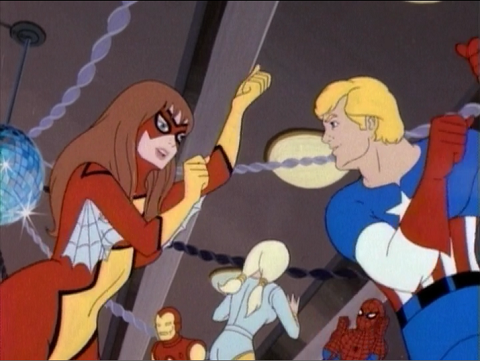
With Spider-Woman’s popularity high, Marvel decided to try their hand at making her their next animated star through DePatie-Freleng Enterprises. The series was developed by Stan Lee and took tremendous liberties with the source material. Outlined in the opening titles by narrator Dick Tufeld, Jessica Drew (Joan Van Ark) was bitten by a poisonous spider as a child and her father saved her life with an experimental serum that also granted her powers. While still possessing her comic powers, she was made closer to Spider-Man (whom she originally had no connection to beyond the similar name) by being given a clairvoyant spider-sense that allowed her to see dangers no matter where they happened (shown in an image outlined by a spider web), and the ability to produce webs from her hands or individual fingers. Her ability to glide was upgraded to actual flight (which would later make its way into the comics) and use of her venom blasts was dictated by how much strength she possessed at the time. She would gain random abilities as situations arose that required them; such as a sonic scream or the ability to communicate with spiders. Taking a cue from the then-popular Wonder Woman series, Jessica was able to instantly don her costume by spinning around.


Jeff Hunt, Billy and Jessica Drew on a story and in peril.

Unlike the comics, Jessica lived a relatively normal life as the editor of Justice Magazine. Her supporting cast included photographer Jeff Hunt (Bruce Miller), a cowardly braggart who fancied himself the heroic-type, and her teenaged nephew, Billy (Bryan Scott). While not exactly following the macabre setting Wolfman established, Jessica did encounter demons including Dr. Strange villain Dormammu, ghostly Vikings, Dracula and the other Universal Monsters, and a variety of aliens. Then-Spider-Man villain Kingpin made an appearance as well, although not quite in his capacity as a kingpin of crime. Spider-Man guest-starred a couple of times on the show with Paul Soles reprising the role from his 1967 series, something which the comic series tried to avoid for as long as they could in order to allow Jessica to stand apart. 


Behind every good Spider-Man is a Spider-Woman.

Spider-Woman debuted on ABC on September 22, 1979, becoming the first female superhero to lead her own independent animated series (the aforementioned Web Woman was always aired as a segment of the Super 7 programming block). It was written by Jeffrey Scott and Tom Swale, with music by Eric Rogers. The series only lasted a single season of 16 episodes before it was cancelled. Jessica’s comic wasn’t faring much better. The series saw a high turnover rate of writers, which raised a red flag with readers. Fans of the series were turned off when the macabre elements and various plotlines were dropped after Michael Fleisher took over writing with #20, making her a more cookie-cutter superhero. And, despite their best efforts to avoid it, Jessica was ultimately viewed as derivative of Spider-Man and dismissed as such. Jessica’s sales steadily slipped, dropping out of the top spot by the time the cartoon premiered, and her series was ultimately cancelled with her death in issue #50. Gruenwald, the book’s editor by the series’ end, came to regret that decision and had the series’ former editor and then-current Avengers writer Roger Stern resurrect Jessica in Avengers #240-241 (1984). 


Firestar decked out as Spider-Woman in Amazing Friends.

Jessica made other appearances on television in the form of a costume worn by the fire-powered Firestar (Kathy Garver) on an episode of Spider-Man and his Amazing Friends and in a live-action cameo appearance on the short-lived comedy, Once a Hero. In the comics, she was relegated to a number of guest appearances and a status as a Wolverine supporting character in the early issues of his first ongoing series, working as a non-costumed private eye. It wouldn’t be until 2005 that Jessica returned as Spider-Woman in the pages of New Avengers that the character gained new exposure. After a short-lived 2009 revival series that later became a motion comic, Jessica returned to her own series in 2015 (complete with a new costume) spinning out of the Spider-Verse event.


Legion of Spider-Women: Jessica with her modern costume, Julia with her Arachne costume, Mattie in one of her many costumes, Charlotte, Ultimate Jessica and her Black Widow guise, and Gwen.

As for those other Spider-Women mentioned? While Jessica was out of the costume, several others stepped up to fill the void. The first was Julia Carpenter, who was accidentally given spider-like powers by the government when they were trying to create their own superhero. She had her own mini-series and was part of Force Works and later Omega Flight as Arachne before becoming the new version of Madame Web. Next was Mattie Franklin, the niece of J. Jonah Jameson who gained hers through a mystical ritual called The Gathering of Five. An evil version who fought Mattie, Charlotte Witter, was a fashion designer and granddaughter of Madame Web who was mutated by the female Dr. Octopus in order to destroy Spider-Man. In recent years in the alternate universe pages of Ultimate Spider-Man, Spider-Woman was the female clone of Peter Parker. She took up the name Jessica Drew, but also called herself Julia Carpenter and eventually became Black Widow as part of The Ultimates, that world’s version of the Avengers. And, although initially marketed as Spider-Gwen, an alternate version of Peter’s deceased college girlfriend Gwen Stacy was bitten by the irradiated spider instead and became Spider-Woman during Spider-Verse. Eventually, in deference to Drew since she frequented her dimension, she started calling herself Ghost-Spider.   


As for the animated series, it has yet to see a release in the United States. In 2008, Liberation Entertainment planned to release the series to DVD in the United Kingdom, but their bankruptcy ended those plans. In 2009, Clear Vision finally released the complete series. In 2019, it became one of the launch titles for the streaming service Disney+.


EPISODE GUIDE:
“Pyramids of Terror” (9/22/79) – The Mummy Khufu leads an alien invasion of Egypt.

“Realm of Darkness” (9/29/79) – Dormammu appears and attempts to enslave mankind.

“The Amazon Adventure” (10/5/79) – Shanna, the leader of the Amazons, plans to take over the world.

“The Ghost Vikings” (10/12/79) – Spider-Woman journeys back in time to stop Vikings who came to the present to steal the world’s wealth.

“The Kingpin Strikes Again” (10/19/79) – A scathing article about him leads Kingpin to steal an invisibility ray to get revenge on Jessica, but he ends up discovering her dual identity instead.

“The Lost Continent” (10/26/79) – An investigation into the loss of Air Force plans in the Bermuda Triangle strands the reporters in another dimension.

“The Kongo Spider” (11/2/79) – A giant spider threatens a movie production.

“Games of Doom” (11/9/79) – Jessica goes undercover to discover who is replacing athletes with android doubles.

“Shuttle to Disaster” (11/16/79) – Steeljaw hijacks a space shuttle to the moon in order to control humanity and have it dig for valuable gems for him.

“Dracula’s Revenge” (11/23/79) – Dracula plots to turn the populace into vampires, werewolves and Frankenstein’s monsters.

“The Spider-Woman and the Fly” (11/30/79) – Jessica’s father’s former research assistant is mutated into a human fly, but he’s still able to figure out a formula to rob her of her powers.

“Invasion of the Black Hole” (12/7/79) – A UFO attempts to absorb Earth into a black hole to ready it for an invasion.

“The Great Magini” (12/14/79) – A crooked magician sets his sights on the world’s famous landmarks.

“A Crime in Time” (12/21/79) – Jessica has to choose between her secret identity and saving the world from an invasion of bestial creatures from a time machine.

“Return of the Spider-Queen” (12/28/79) – Alien humanoid spiders believe Spider-Woman is their long-lost queen.

“The Deadly Dream” (1/3/80) – An alien’s sleep powers allow her to take over the world.


Originally posted in 2015. Updated in 2023.