Showing posts with label Marvel Comics. Show all posts

July 29, 2023

WOLVERINE AND THE X-MEN


WOLVERINE AND THE X-MEN
(Nicktoons, January 23-November 29, 2009)
 
Noxxon Entertainment Inc., Toonz Entertainment, First Serve International, Liberation Entertainment, EVA Finance GmbH, Marvel Entertainment


MAIN CAST:
Steve BlumWolverine/Logan, Vanisher/Telford Porter, Vindaloo/Venkat Katregadda, Berzerker/Ray Carter, Fever Pitch, various
Susan DalianStorm/Ororo Munroe, Dr. Kavita Rao
Jennifer HaleJean Grey, Boom Boom/Tabitha Smith
Danielle JudovitsShadowcat/Kitty Pryde, Tildie Soames
Tom KaneMagneto/Erik Lehnsherr, Professor Truett Hudson
Yuri LowenthalIceman/Bobby Drake
Nolan NorthCyclops/Scott Summers, Colossus/Piotr Rasputin, Pyro/St. John Allerdyce, Berzerker
Liam O’BrienAngel/Archangel/Warren Worthington III, Nightcrawler/Kurt Wagner, Nitro/Robert Hunter
Roger Craig SmithForge, Hellion/Julian Keller, Kamal el Alaqui
Fred TatascioreBeast/Dr. Henry “Hank” McCoy, Hulk, Blockbuster/Michael Baer, Juggernaut/Cain Marko, Harpoon/Kodiak Noatak
Kieren van den BlinkRogue/Anna Marie
Kari WahlgrenEmma Frost, Magma/Amara Juliana Olivians Aquilla, Dr. Sybil Zane, Kristie Nord
Jim WardProfessor Charles Xavier, Rover the Sentinel, Warren Worthington II, Dr. Abraham Cornelius, Sentinels


            Wolverine and the X-Men was the third animated series based on the X-Men family of comics by Marvel Comics. It was the first and only production by Toonz First Serve, a partnership between Toonz Animation and First Serve International to secure enough funding to approach Marvel about doing the series. Developed by Craig Kyle and Greg Johnson, the series focused on the X-Men disbanding after an explosion at the X-Mansion seemingly killed Professor Xavier (Jim Ward) and Jean Grey (Jennifer Hale). However, within a year, Wolverine (Steve Blum) decides the team needs to reform in order to deal with government-sponsored mutant cops called the Mutant Response Division, the mutant-hunting robot Sentinels (Ward), Senator Rober Kelly’s (Richard Doyle) Mutant Registration Act, Magneto (Tom Kane) trying to incite a race war from his new island kingdom of Genosha, the Brotherhood of Mutants causing chaos, and prevent a dystopian future (based on Days of Future Past) that Xavier found himself in from occurring. With Xavier found to be in a coma, Cyclops (Nolan North) despondent over Jean’s death, and Storm (Susan Dalian) in Africa, Wolverine takes the uncomfortably unfamiliar role of leader as he recruits his X-Men.

Wolverine leads Nightcrawler, Iceman, Storm, Cyclops, Emma Frost, Beast, Angel and Shadowcat.


            The show began life as a Wolverine solo series until it evolved into its final form. The stories and character designs took greater inspiration from the comics of the past decade, as well as cues from the 20th Century Fox live-action film series about to release its 4th entry, X-Men Origins: Wolverine. While Wolverine and his team—comprised of Cyclops, Storm, Beast (Fred Tatasciore), Iceman (Yuri Lowenthal), Shadowcat (Danielle Judovits), Forge (Roger Craig Smith), Emma Frost (Kari Wahlgren) Angel (Liam O’Brien) and eventually Nightcrawler (also O’Brien) and Rogue (Kieren van den Blink)—dealt with troubles in the present, Xavier was trying to survive the future with his allies—Bishop (Kevin Michael Richardson), Berzerker (Blum), Domino (Gwendoline Yeo), Hellion, Kamal (both Smith), Marrow (Tara Strong), Polaris (Liza del Mundo), Vanisher (Blum), and a reprogrammed Sentinel named Rover (Ward)—while searching for clues to send back to his past to try and prevent it from occurring.
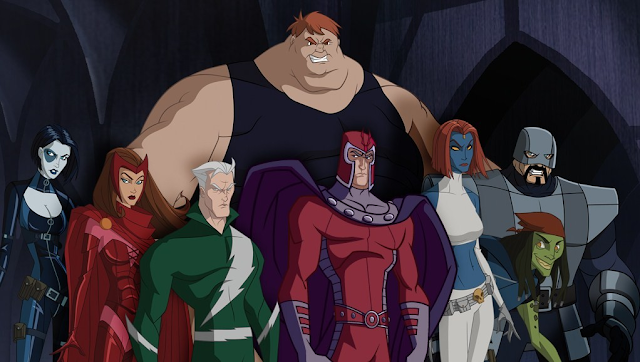
Magneto always ready to make trouble with the likes of Domino, Scarlet Witch, Quicksilver, Blob, Mystique, Toad and Avalanche.


            Wolverine and the X-Men debuted on Nicktoons on January 23, 2009, airing its first two episodes back-to-back before rerunning on Nickelodeon two days later. Before it even aired, development had begun on the second season, with associate producer and writer Joshua Fine stepping into the supervising producer role exited by Kyle when went to go work on the first Thor film. Plans were in place to continue on from the new terrible future the series ended on based on the Age of Apocalypse storyline, as well as lead into potential crossovers with The Avengers: Earth’s Mightiest Heroes (which Fine was also heading up) and The Spectacular Spider-Man. New character designs were shown off at Comic Con 2009 and things reportedly got as deep as a full season bible and the first eight episodes being written. Unfortunately, work came to a grinding halt when Toonz First was unable to secure the full funding they would need. The idea of Marvel funding it themselves was floated, but as new owner Disney sought to starve Fox of any new adaptable content over their refusal to give up the licenses they acquired during Marvel’s more precarious financial situation, it was promptly nixed and the show was allowed to just end. A decade later, that situation would resolve itself as Disney acquired Fox, allowing Wolverine and the X-Men to be featured on the streaming service Disney+. Could it lead to a revival like X-Men: The Animated Series’ with X-Men ’97? Time will tell.

July 08, 2023

AVENGERS ASSEMBLE

AVENGERS ASSEMBLE
(Disney XD, May 26, 2013-February 24, 2019)
 
Marvel Animation


MAIN CAST:
Adrian PasdarIron Man/Tony Stark (season 1-3), Bruto the Strongman/Bruce Olafsen
Mick Wingert – Iron Man/Tony Stark (season 4-5), Doctor Faustus/Johann Fennhoff
Roger Craig SmithCaptain America/Steve Rogers, Torgo, Great Gambonnos, Grim Reaper/Eric Williams, J.O.E.Y., Radioactive Man/Dr. Chen Lu, Nightmare, Winter Soldier/Bucky Barnes, Orka
Travis WillinghamThor, Bulldozer/Henry Camp, Brok, Trickshot/Buck Chisholm, Growing Man, Executioner/Skurge
Laura BaileyBlack Widow/Natasha Romanoff, Gamora (2nd appearance), Darkstar/Laynia Petrovna
Fred TatascioreHulk/Bruce Banner, Thunderball/Dr. Eliot Franklin, Volstagg, Ringmaster/Maynard Tiboldt, Crimson Dynamo/Anton Vanko, Nightmare Ultron, Black Bolt/Blackagar Boltagon, Crossbones/Brock Rumlow
Troy BakerHawkeye/Clint Barton, Loki, Doombot, Red Guardian/Alexei Shostakov, Whiplash/Mark Scarlotti, Kraven the Hunter/Sergei Kravinoff
Bumper RobinsonFalcon/Sam Wilson, Human Cannonball/Jack Pulver


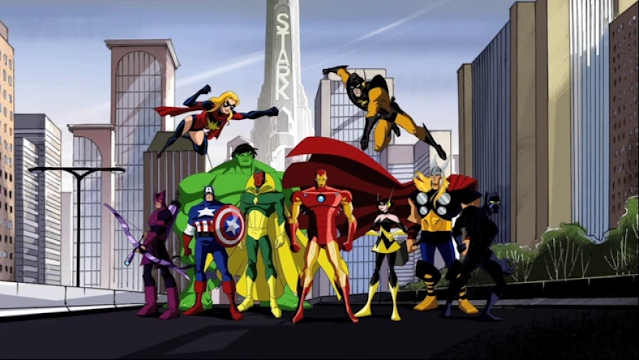
            It took 36 years for Marvel ComicsAvengers to get their own animated series, with the short-lived Avengers: United They Stand. It only took another decade for them to get not one, but TWO more shows. The first began development in 2008 as a pitch for a solo Hulk series—his fourth, counting The Marvel Super Heroes shorts and the live-action CBS series—but was decided to expand the focus to the entire team. Developed by Ciro Nieli, Joshua Fine and Christopher Yost, The Avengers: Earth’s Mightiest Heroes took heavy inspiration from the comics run by Stan Lee and Jack Kirby—going so far as to emulate the original line-up of Iron Man (Eric Loomis), Giant-Man (Wally Wingert), Hulk (Fred Tatasciore), Thor (Rick D. Wasserman) and Wasp (Colleen O’Shaughnessey), initially—while also blending in later stories and elements of the burgeoning Marvel Cinematic Universe. The series debuted on Disney XD on September 22, 2010, and then joined the channel’s Marvel Universe programming block alongside new series Ultimate Spider-Man in 2012.

Earth's Mightiest Heroes (top) vs. Avengers Assemble.


            After two seasons, Marvel decided to cancel EMH in favor of a retooled show that would bring things closer to the MCU’s depiction in The Avengers film. Avengers Assemble was developed by Man of Action, who were given control over the final 12 episodes of EMH, and featured the film-inspired line-up of Captain America (Roger Craig Smith), Iron Man (Adrian Pasdar & Mick Wingert), Thor (Travis Willingham), Black Widow (Laura Bailey), Hawkeye (Troy Baker) and Hulk (Tatasciore), with newcomer Falcon (Bumper Robinson) serving as the entry point for the audience.

Thunderbolts? Assemble did it first.


            Avengers Assemble debuted on Disney XD on May 26, 2013, airing as part of the Marvel Universe block. It was joined by and shared a continuity with Ultimate Spider-Man (as well as its replacement, Marvel’s Spider-Man, when the former was cancelled), Hulk and the Agents of S.M.A.S.H. and Guardians of the Galaxy. It ran for 5 seasons, with seasons 3-5 receiving the subtitles Ultron Revolution, Secret Wars and Black Panther’s Quest, respectively (a trend all of Marvel Animation’s shows would follow after reaching a 3rd season). Assemble would feature crossovers with its fellow shows, as well as a variety of characters from across the Marvel universe (excluding the X-Men, although some of their villains did appear). While starting out from the MCU, the quicker production schedule of an animated series vs. a feature film slate meant that Assemble often introduced characters before the MCU did; such as Falcon, who wouldn’t debut until Captain America: The Winter Soldier the next year, and characters the MCU yet couldn’t, such as the Fantastic Four (whose rights were tied up over at 20th Century Fox until Disney bought them in 2019).

Bring on the bad guys! Two established MCU villains, two future ones, and one not yet seen.


            All of the Marvel Universe programs were cancelled in 2019 due to internal restructuring at Marvel. Marvel Television, under which Marvel Animation operated, was a separate division from Marvel Studios, which handled the films. It was decided to fold Television into Studios under the stewardship of studio head Kevin Feige, who became the Chief Creative Officer of Marvel as a whole. Television’s output was either outright cancelled or allowed to wrap-up as Marvel Studios began looking into developing MCU-connected content for Disney’s new streaming platform, Disney+, and the Animation division was extremely pared down in favor of the all-new Marvel Studios Animation. Assemble would continue to be rerun on Disney XD and was made available to stream on Disney+ alongside EMH.

April 27, 2019

COMMERCIAL BREAK: HONEYCOMB STARRING HULK

While watching on Saturday morning, you probably saw this:


CAPTAIN AMERICA: CIVIL WAR / AVENGERS CEREAL


Kellogg’s


Kicking off Phase 3 of the Marvel Cinematic Universe was the third Captain America film, Captain America: Civil War. Loosely based on the comic story of the same name, the film deals with the fallout from Avengers: Age of Ultron as governments decide to create legislature to regulate how and when the Avengers do their heroing. Captain America (Chris Evans) doesn’t feel they can be as effective while they wait for permission to act, while Iron Man (Robert Downey, Jr.) believes it’s the only way to prevent further disasters. Add to the fact that Cap’s long-believed-deceased sidekick, Bucky Barnes (Sebastian Stan), was alive and well and seemingly bombed a political conference, and the Avengers became split down the middle in a conflict over whose ideals were right and how Bucky would be brought to justice. Directed by Joe and Anthony Russo off a script by Christopher Markus and Stephen McFeely, Civil War opened on May 6, 2016 and pulled in over $1.1 billion at the box office.


Kellogg’s once again created a limited-edition cereal to tie into the promotion for the film. In fact, they made two different cereals for it. The first, Captain America: Civil War cereal, was actually a repackaged version of their Age of Ultron Cereal from the previous year. However, this time the marshmallow bits were changed to either red or blue with a white star shape in the middle. The most interesting part of this cereal, however, was its box. On one side was Cap, and on the other was Iron Man. When the two sides were put together, they lined up perfectly to create a split image of the two heroes. On the side panel showed the two about to clash over a bowl of their cereal.


Meanwhile, outside of North America, there came a cereal called simply Avengers Cereal. It came with “choc reactors” (after the arc reactor technology that powers Iron Man’s suit) and “crunchy shield” pieces. The reactors were a grouping of three chocolate-flavored rings while the shields were reminiscent of Krave Chocolate cereal pieces (and didn’t really represent Cap’s round shield). Once again, Iron Man and Cap were featured on either side of the box, with Hulk and Thor joining them on the side panel. However, this time around instead of using images of the film’s actors, the characters were drawn and shown in representations of their more recent comic costume designs.

AVENGERS: AGE OF ULTRON CEREAL


AVENGERS: AGE OF ULTRON CEREAL

Kellogg’s


In 2012, Marvel Studios accomplished what until that point seemed to be impossible: they produced a movie starring SEVERAL characters from different film franchises.


2012 saw the release of Marvel’s The Avengers; the culmination of the four-year journey since the release of 2008’s Iron Man. Written and directed by Joss Whedon, the film saw Iron Man (Robert Downey, Jr.), Captain America (Chris Evans), Hulk (Mark Ruffalo), Thor (Chris Hemsworth), Black Widow (Scarlett Johansson) and Hawkeye (Jeremy Renner) united by Nick Fury (Samuel L. Jackson) to battle the threat of Thor’s half-brother, Loki (Tom Hiddleston), and his army of aliens known as the Chitauri. The ambitious film was a huge gamble as nothing like that had ever been done in cinema before, and it paid off. Avengers earned over $1.5 billion at the box office making it the highest-grossing movie of the year and cementing the tour de force that is the Marvel Cinematic Universe.


Following several more solo hero movies, the second Avengers movie was released on May 1, 2015. Avengers: Age of Ultron followed the Avengers as they retrieved Loki’s scepter and Tony Stark and Bruce Banner discovered an artificial intelligence inhabiting the scepter’s gem. They decided to use it to complete Stark’s Ultron Global Defense Program, designed to protect the world from another invasion threat. However, Ultron (James Spader) gained independent sentience and decided the best way to protect the world was to eliminate all of humanity. Written and directed again by Whedon, the film ended up earning just a few million less than its predecessor but still earned a mostly positive reception.


Kellogg’s, opting not to miss the bandwagon again, decided to produce a limited-edition tie-in cereal for the film. Avengers: Age of Ultron Cereal has largely been compared to Lucky Charms as it had sweetened oat pieces with marshmallow bits. The bits were two-colored round pieces that were meant to replicate the main color schemes of Iron Man, Captain America, Hulk and Thor. Each box came with a special code printed inside that could be put into an indicated website to unlock a free ticket to see the movie. The back of the box featured the instructions for the codes, as well as a hidden message that had to be deciphered using a symbol key. Interestingly enough, the box came labeled as “Hero Edition” for an unspecified reason. There has been no indication or witnesses to a “Villain Edition” having ever been released.

HULK CEREAL


HULK CEREAL

Post


Before there was a Marvel Cinematic Universe, there were a few independent attempts at adapting Marvel Comics properties to the big screen. One of the more divisive ones was Ang Lee’s Hulk.


Hulk centered on the origin of the character, with Dr. Bruce Banner (Eric Bana) becoming exposed to an overdose of gamma radiation during an experiment mishap that turned him into a giant, green, rage monster. The military, led by General Ross (Sam Elliott), relentlessly pursued Banner to put a stop to his alter-ego, as did his biological father (Nick Nolte) who wanted to use his son’s new powers for his own ends. The film opened on June 20, 2003 to mixed results. Lee chose to make his film more of a psychological drama with elements of a Greek tragedy and utilized a style reminiscent of comic book panels. While its ambition was praised, the bleak tone, pacing, lack of action and poor CGI were heavily criticized. Despite becoming a box office success with over $245 million, the next outing for the Hulk would come as the 2008 reboot, The Incredible Hulk.


As part of several food tie-in promotions for the film, Post released a limited-edition Hulk Cereal. The cereal was largely similar to Kellogg’s Corn Pops with added marshmallow bits in the shape of Hulk, a beaker, a brick and an explosion. The box featured Hulk clobbering the cereal while the back had stills from the film and Hulk trivia. 

November 12, 2018

STAN LEE DEAD AT 95


You can read the full story here.


Writer, editor, publisher, and the self-proclaimed “King of Cameos”. Stan was one of the architects for what would become known as the Marvel Universe, involved in the creation of Spider-Man, the X-Men, the Incredible Hulk, the Avengers, Iron Man, the Fantastic Four, the Mighty Thor, Daredevil and others, as well as the foundations for their individual worlds and supporting characters. His bombastic personality and engaging prose led to his becoming the face of Marvel comics, and one of its most well-known creators.


As Marvel expanded its characters into other media, Stan had various levels of involvement with their productions; particularly during the brief existence of Marvel Productions. Traditionally, Stan has received an “executive producer” credit on any Marvel-based project, including the Marvel-produced Biker Mice From Mars (1993). However, he was actively involved as the story and art consultant for Spider-Man (1967) and Fantastic Four (1967), wrote several scripts for The New Fantastic Four, was the executive story editor for RoboCop: The Animated Series and the supervising producer for Pryde of the X-Men. He also developed Spider-Woman and oversaw the development of X-Men: The Animated Series’ first season and Spider-Man: The Animated Series.


Some of his legendary cameos came in the form of the narrator for Spider-Man and his Amazing Friends, The Incredible Hulk (1982), and Pryde of the X-Men. He appeared on screen as himself in a fantasy sequence of Muppet Babies, meeting Spider-Man in Spider-Man: The Animated Series, and pulled double-duty as a cameraman in Marvel’s Spider-Man. He also reprised his role as Fred’s Dad from the Big Hero 6 film in a recurring role in Big Hero 6: The Series.


October 06, 2018

THE VENOM SAGA


            Venom is one of Spider-Man’s greatest and scariest enemies. He possesses all of Spidey’s powers, and none of the responsibility. With Sony’s Venom hitting theaters this weekend (and it being Halloween month), we’re going to take a look at one of Spidey’s scarier rogues.

Note to self: avoid self-making costumes.

            Venom has a very intricate backstory. The look that Venom traditionally sports was actually intended as a new costume for Spidey, making its debut in The Amazing Spider-Man vol. 1 #252 (1984). However, chronologically, it first appeared in the pages of Marvel Super Heroes Secret Wars #8 (1984). Secret Wars was the first large-scale crossover in comics that saw a group of various heroes and villains whisked away to an alien planet to do battle. There, Spidey, using what he thought was a costume-repairing machine, actually housed a living entity known as a Symbiote. It bonded with Spidey and created his new black costume designed by artist Mike Zeck.

Out! Out, damn spot!

            The idea for Spidey’s new look came from reader Randy Scheuller, who had submitted it as part of a competition for aspiring writers and artists. Then-editor-in-chief Jim Shooter liked the idea and bought it from Randy for $220. The idea for the suit to be a biological material that could self-heal was one abandoned by John Byrne during his run on Iron Fist, but used by Roger Stern when he plotted Amazing #252. After Stern left the book, writer Tom DeFalco and artist Ron Frenz were the ones who established it as a sentient being vulnerable to fire and high sonic energy. Learning the nature of his costume, Spidey used a church bell to remove it from his body in Web of Spider-Man vol. 1 #1 (1985).

Mary Jane gets an unwelcome guest.

            That wasn’t the end of the story. Over the next year, Spidey would find himself the target of a stalker that wouldn’t set off his spider-sense. The creature that would become known as Venom would make a cameo in The Amazing Spider-Man vol. 1 #299 (1988) terrorizing Spidey’s wife, Mary Jane Watson, before making his first full appearance in #300 by David Michelinie and Todd McFarlane. It turned out that reporter Eddie Brock had misreported the identity of serial-killer Sin-Eater on the word of a chronic confessor, resulting in his disgrace in the industry and being banished to the pages of the tabloids after Spidey captured the real one. His depression took him to the very church where Spidey freed himself of the Symbiote, causing it to be drawn by their mutual hatred of Spidey and bonding together. Because of the Symbiote’s earlier bond to Spidey, Brock had gained access to all of Spidey’s memories, all of his powers, and the ability to evade detection by his spider-sense.


            The character proved immensely popular, appearing several more times as a villain in Spidey comics before turning into an anti-hero and getting a number of books of his own. Over the years, the Venom symbiote has changed hands. For a time, former Scorpion Mac Gargan became the new Venom. Later, the Symbiote was bonded with Spidey friend Flash Thompson, turning him into Agent Venom. The Symbiote was also briefly joined with gang member Lee Price before ultimately returning to Brock and resuming his career as an anti-hero with villainous tendencies.

Dance, puppet, dance!

            While Venom had appeared in toys and video games since his creation, his first time being adapted to other media was in Spider-Man: The Animated Series. After Spidey (Christopher Daniel Barnes) rescued John Jameson (Michael Horton) and his crew from a downed space shuttle, he found himself covered in a black goo that turned out to be the Symbiote. In this version, Eddie Brock’s (Hank Azaria) fall from grace came when he teamed-up with Norman Osborn (Neil Ross) and Spencer Smythe (Edward Mulhare) to capture and unmask Spidey, but ended up with Flash Thompson who was pulling a prank in a Spidey costume instead. Brock’s second fall from grace came when he attempted to accuse Spidey of robbing the space shuttle, leaving out the involvement of Rhino (Don Stark). After Spidey rejected the Symbiote, it found Brock and they became Venom in order to achieve mutual vengeance against him.

Ain't no wall high enough...

            His next appearance was in Spider-Man Unlimited. Venom (Brian Drummond) and his adversarial offspring, Carnage (Michael Donovan), hitched a ride on John Jameson’s (John Payne) space shuttle to follow a compulsion to journey to Counter-Earth: an exact duplicate of Earth on the other side of the son. Fully bonded to their respective Symbiotes, the pair attempt to help conquer that world for the Synoptic, a hive-minded legion of Symbiotes.

One can never have too many mouths.

            The Spectacular Spider-Man had Eddie Brock (Benjamin Diskin) be deeply connected to Peter Parker (Josh Keaton). Both orphaned, the boys grew up together but Brock was secretly jealous that Peter had his relatives to look after him. A series of misunderstandings causes a rift to grow between the boys, but the final straw came when Spidey bonded with the Symbiote being studied by Dr. Curt Connors (Dee Bradley Baker). Without the Symbiote, the lab lost its funding and Brock his job. When Spidey tried to get free of and destroy the Symbiote, it unleashed Brock’s animosity towards both Spidey and Peter and drew the Symbiote to bond with him and become Venom.

Grabby grabby.

            Venom continued to appear in various forms throughout subsequent animated Marvel shows, but returned to Saturdays with Marvel’s Spider-Man. The show found the Symbiote being an unknown substance labeled V-252 from the space program that was donated to Horizon High for study. Using it in a project sees Spidey (Robbie Daymond) become bonded to the substance, making him more powerful. However, upon realizing it also made him more aggressive, he separated himself from it and the V-252 eventually wound up in the “safe” hands of the Avengers’ lab. The V-252 escaped and bonded with Flash Thompson (Diskin), before eventually finding its way to Eddie Brock (Ben Pronsky), who was jealous of Peter outdoing him in obtaining footage of Spidey’s latest battle.

July 06, 2018

STEVE DITKO DEAD AT 90


You can read the full story here.

Ditko was an artist and writer that worked in comics. He was one of the architects for the original Marvel Comics universe, co-creating Spider-Man and Dr. Strange and their worlds, as well as the Hulk's Glenn Talbot. He also created The Creeper and Shade the Changing Man for rival DC Comics. Many of these characters would be used in various media adaptations over the years, especially on Saturday mornings. Ditko's later career involved a lot of licensed work, amongst which included several issues of Marvel's Mighty Morphin Power Rangers comic.


May 30, 2018

THE VOICES OF THE X-MEN

Celebrating the 25th anniversary of X-Men: The Animated Series, as well as the 55th anniversary of the X-Men, we present this infographic highlighting every actor to take on the Saturday morning versions of Marvel's Merry Mutants.


May 26, 2018

FANTASTIC FOUR (1978)

FANTASTIC FOUR (1978)
(NBC, September 9-December 16, 1978)

DePatie-Freleng Enterprises, Marvel Comics Animation


MAIN CAST:
Mike RoadMr. Fantastic/Reed Richards
Ginny TylerInvisible Girl/Susan Richards
Ted CassidyThe Thing/Benjamin J. Grimm, Mole Man
Dick Tufeld - Narrator


For the history of the Fantastic Four, check out the post here.

            The second Fantastic Four cartoon was probably the most hated. The reason being? One word: H.E.R.B.I.E.

The Fantastic Four, featuring H.E.R.B.I.E.

Before Marvel became an entertainment powerhouse at the box office, they were constantly struggling to bring their characters out of the comics and onto the screen. They often had to rely on other studios, and thus made deals licensing out their characters for production. In 1977, Universal Studios optioned an assortment of characters for various live-action productions. Most famously in that deal was the Hulk for The Incredible Hulk television series starring Bill Bixby and Lou Ferrigno. Universal also optioned the Human Torch. JUST the Human Torch.


H.E.R.B.I.E. helping work the Fantasticar.

When NBC’s Fred Silverman wanted to commission a new Fantastic Four series, Universal would not allow the use of the Torch (ironically, NBC would come to share owners with Universal decades later). A popular myth that had spread over the years was he was left out in fear kids would try to emulate him and set themselves on fire (forgetting that Hanna-Barbera had successfully produced a show with the Torch back in 1967 with nary a reported fatality). In the comics up to this point, the Inhumans Crystal and Medusa and hero for hire Luke Cage served as alternate members of the team, as others would as well down the line. But, instead of using an established Marvel character, they decided to use an all-new one: H.E.R.B.I.E. (Frank Welker).


The strange Inhumans.

H.E.R.B.I.E., or Humanoid Experimental Robot, B-Type, Integrated Electronics, was a robot created by Mr. Fantastic (Mike Road) to aid in his experiments and their exploratory missions. Stan Lee pitched the idea of a cute robot sidekick to DePatie-Freleng Enterprises, with comic artist Dave Cockrum commissioned to design it. However, Cockrum ended up disliking the character immensely and was replaced by Fantastic Four co-creator Jack Kirby.  Lee would also serve as a writer for the show, while Kirby provided storyboards.


The menace of Magneto!

Like the previous Fantastic Four series, it adapted some of the plots from actual comic stories, albeit heavily altered especially for the inclusion of H.E.R.B.I.E. For instance, “Medusa and the Inhumans” adapted the first encounter of the Inhumans and the Fantastic Four from Fantastic Four vol. 1 #45 (1965), but they were led by Medusa instead of her husband, Black Bolt, and had typical villain plans for world conquest. Medusa later returned as a member of the Frightful Four in the same-titled episode, however as a willing member and not under the influence of amnesia as depicted in Fantastic Four vol. 1 #36 (1965). “Calamity on Campus” was based on Fantastic Four vol. 1 #35 (1965) but relocated the story’s setting to St. Louis, Missouri instead of the fictional New York State town of Hegeman and omitted the alchemist villain Diablo. Along with the standard Fantastic Four foes, like armored arch-nemesis Dr. Doom (John Stephenson), the android Dragon Man, the subterranean Mole Man (Ted Cassidy), and the shape-changing alien Impossible Man (Welker), there were also appearances by some original characters and even the X-Men’s Magneto (although, he wasn’t called a mutant during his appearance and was depicted as a typical crook, voiced by Stephenson).


Ad for the series.

Fantastic Four, also known as The New Fantastic Four, debuted on NBC on September 9, 1978. The series actually began development at Hanna-Barbera when Marvel decided they wanted to shift the show over to DePatie-Freleng. As a trade-off, Hanna-Barbera got the Godzilla cartoon DePatie-Freleng was working on. Along with Lee, the series was written by Roy Thomas, Bob Johnson, Christy Marx and Bob Stitzel. In an unusual move, the episode would begin immediately after the intro with narration by Dick Tufeld, and then cut to the title card shortly after instead of at the traditional start of the episode following the intro. The series’ theme was composed by Dean Elliott and Eric Rogers, with the remainder of the music done by Elliott. 


Even Dr. Doom is a completionist when it comes to his action figure collection.


The result was that nobody was particularly happy with the show—especially Silverman. Lee even sent a letter to Hanna-Barbera’s Margaret Loesch detailing his desire for the next attempt at the Fantastic Four to be more action-oriented. Despite DePatie-Freleng’s attempts to salvage the license with a proposed Thing spin-off, Silverman was ready to move on entirely. He took back the rights to the Thing and gave them back to Hanna-Barbera to combine with an idea they had to make The Thing. DePatie-Freleng turned their attentions to another Marvel hero, Spider-Woman, before eventually being taken over by Marvel’s parent company, Cadence Industries, to become Marvel’s first studio, Marvel Productions.

H.E.R.B.I.E.'s comics debut.

At 13 episodes, this was the shortest Fantastic Four cartoon to date. H.E.R.B.I.E., while not a popular character, soon found his way into the comics in Fantastic Four vol. 1 #209 (1979) by Marv Wolfman, John Byrne, Joe Sinnott, Glynis Wein and Tom Orzechowski. The story’s explanation for his creation was that Mr. Fantastic was inspired to build H.E.R.B.I.E. after the character was included in an in-universe television show as a replacement for the Torch who was unavailable to give permission to use his likeness. H.E.R.B.I.E. has since appeared in a variety of comics, programs, movies and merchandise. 

The cover to Fantastic Four #236, celebrating 20 years of the comic.

For the comic’s 20th anniversary celebration in Fantastic Four vol. 1 #236 (1981), Marvel decided to include finished and reworked storyboards from the episode “The Challenge of Dr. Doom” as a clunky 14-page back-up story without Kirby’s knowledge or permission. At this time, Kirby’s relationship with Marvel was strained—along with the comic industry in general—as he was trying to reclaim his original artwork from the company, and had refused to provide a new story for the issue. While his name was used to promote the story on the cover, a caricature of Kirby standing next to Lee was removed from the cover drawn by Byrne at Kirby’s behest.


One of the VHS release covers.

            Milton Bradley made a board game inspired by the show, which had players rescuing H.E.R.B.I.E. from Dr. Doom. Prism Entertainment Corp. released six episodes to VHS as part of their Marvel Comics Video Library across several volumes. A two-video set featuring “Meet Doctor Doom” and “The Olympics of Space” was also released. Morningstar Entertainment transferred several of the videos in the Marvel Library series to DVD for release in Canada, which included ‘Meet Doctor Doom” and “The Impossible Man”. The complete series was released to DVD in the United Kingdom in 2010 by Clear Vision Ltd. In 2012, scenes from the series were used and reworked as comical shorts for Disney XD’s Marvel Mash-Up as part of their Marvel Universe on Disney XD programming block.


EPISODE GUIDE:
“A Monster Among Us” (9/9/78) – The Fantastic Four take on an alien monster that crash-landed on Earth.

“The Menace of Magneto” (9/16/78) – Magneto wins leadership of the team from Mr. Fantastic and turns them into criminals.

“The Phantom of Film City” (9/23/78) – The Fantastic Four’s movie is plagued by Skrulls.

“Medusa and the Inhumans” (9/30/78) – The Fantastic Four investigate reports of strange beings in the Alps and end up prisoners of the Inhumans.

“The Diamond of Doom” (10/7/78) – The sinister Queen Sebel enlists the Fantastic Four’s aid in retrieving the Great White Stone stolen from her.

“The Mole Man” (10/14/78) – The Fantastic Four have to stop Mole Man’s theft of power plants around the world.

“The Olympics of Space” (10/21/78) – Thing is abducted by warring aliens and made to compete in their contests.

“The Fantastic Four Meet Doctor Doom” (10/28/78) – Doctor Doom forces the Fantastic Four to go back in time to steal the treasure of Blackbeard.

“The Frightful Four” (11/4/78) – Wizard creates his own team, the Frightful Four, to combat the Fantastic Four.

“Calamity on the Campus” (11/11/78) – Gregson Gilbert’s robotic Dragon Man ends up stolen by his assistant for his own sinister purposes.

“The Impossible Man” (11/18/78) – A shapeshifting alien comes to Earth and inadvertently befriends a criminal who makes use of his abilities.

“The Final Victory of Doctor Doom” (11/25/78) – Doctor Doom blackmails the United States into turning the country over to him.

“Blastaar, the Living Bomb Burst” (12/2/78) – The discovery of the Negative Zone leads to Mr. Fantastic accidentally unleashing Blastaar on the planet.


Originally posted in 2018. Updated in 2025.