Hey, it's a nice round number! We're celebrating the shows turning...
Remember that one day when you could wake up without an alarm? When you would get your favorite bowl of cereal and sit between the hours of 8 and 12? This is a blog dedicated to the greatest time of our childhood: Saturday mornings. The television programs you watched, the memories attached to them, and maybe introducing you to something you didn't realize existed. Updated every weekend.
Showing posts with label Skeleton Warriors. Show all posts
July 06, 2024
August 06, 2022
SATURDAY MORNING MASTERS: GARY OWENS
GARY OWENS
(May 10, 1934-February 12, 2015)
Born Gary
Bernard Altman, Owens was
notable for his baritone speaking voice and deadpan comedic delivery that made
him an ideal narrator and announcer for various projects—particularly of the
humorous kind. He began his career as a news reporter on radio station KORN in 1952 in Mitchell,
South Dakota, and was
promoted to news director two years later. In 1956 he left to be a newscaster
at KMA in Shenandoah, Iowa, before becoming a disc jockey at KOIL in Omaha, Nebraska. After bouncing around a few other stations, he finally ended up in
California in 1959. He began a two-decade tenure at 710 KMCP (now KSPN
AM) where he displayed his surrealistic humor and tendency
for puns, as well as inventing nonsense words and doing amusing radio
promotions. He also developed several alter-egos: gruff old man earl C. Festoon
and his wife, Phoebe; stuffy businessman Endocrine J. Sternwallow; goofy good
ol’ boy Merle Clyde Gumpf; and crochety old Mergenthaler Waisleywillow. In 1961
he started transitioning into film and television by providing the uncredited
prologue narration for The
Naked Witch (although it wasn’t released until 1964). In 1965, he made a couple of appearances on McHale’s
Navy and voiced the titular character in the animated Roger
Ramjet.
His most well-known role came in 1968 as the
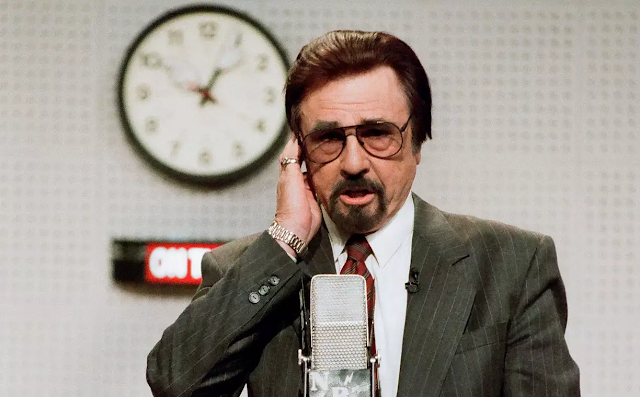
announcer for the sketch comedy series Rowan & Martin’s Laugh-In, where he established his trademark routine of holding his hand on his
ear as he spoke into the microphone. Owens had a long association with Hanna-Barbera
Productions, providing
either opening narrations or episode narrations for various shows like The Perils of Penelope Pitstop, Yogi’s Space Race and Captain Caveman and the Teen Angels, as well as various roles including the heroes Space Ghost in Space Ghost and Blue Falcon in Dynomutt, Dog Wonder and supporting antagonist Commander Ulysses Feral
in SWAT Kats. Additionally, he voiced various cartoon
characters on Sesame
Street, the characters of Powdered
Toast Man in The Ren & Stimpy Show and Captain Squash in Bobby’s
World, and was even one of the prospective
voices for Inspector Gadget in one of the pilot episodes. In 2004, Owens
co-wrote the book How to Make a Million Dollars with
Your Voice (Or Lose Your Tonsils Trying)
with Jeff Lenburg,
an anecdote-laden guide on how to get into voice acting. In his final years,
Owens served as the promotional announcing voice for retro network Antenna TV until his death in 2015 due to complications from
his life-long bout with Type-1 diabetes.
Space Ghost and Dino Boy
Sesame Street
The Perils of Penelope Pitstop
Dynomutt, Dog Wonder
Scooby’s Laff-A-Lympics
Yogi’s Space Race
Captain Caveman and the Teen Angels
Space Stars
The Mighty Orbots
Inspector Gadget (1 pilot version)
Yogi’s Treasure Hunt
Bobby’s World
Defenders of Dynatron City
Tom & Jerry Kids Show
Eek! the Cat
Goof Troop
Raw Toonage
Skeleton Warriors
The Twisted Tales of Felix the Cat
The Mask: The Animated Series
Nightmare Ned
101 Dalmatians: The Series
The New Batman Adventures
Buzz Lightyear of Star Command
Teamo Supremo
July 06, 2019
May 15, 2018
RIP DEAN STEFAN
Also known as Sandy Scesny, he was a writer on The Smurfs, Darkwing Duck, Goof Troop, X-Men: The Animated Series,
Skeleton Warriors, The Savage Dragon, Ace Ventura: Pet Detective, The Mask: The
Animated Series, Men in Black: The Series, Big Guy and Rusty the Boy Robot,
Jackie Chan Adventures, The Penguins of Madagascar, Ben 10: Omniverse, and Transformers: Rescue Bots. He also
served as a producer on Men in Black and
the story editor for Goof Troop.
October 31, 2015
SKELETON WARRIORS
SKELETON WARRIORS
(CBS, October 1-December 24, 1994)
Landmark Entertainment Group, Graz Entertainment, Inc.,
Westinghouse Broadcasting International
MAIN CAST:
Jeff Bennett – Lightstar/Prince
Justin, King Luminicity, Skeleton Lancer
Jennifer Hale –
Talyn/Princess Jennifer
Kevin Schon –
Grimskull/Prince Joshua
Danny Mann –
Guardian/Uncle Ursak, Dagger
Nathan Carlson – Dr.
Cyborn
Philip L. Clarke –
Baron Dark
Michael Corbett
– Aracula
Valery Pappas –
Shriek
Skeleton
Warriors came to creator Gary Goddard when he was
spending time with his godson at the stage show The Adventures of Conan: A
Sword and Sorcery Spectacular.
When his godson had a reaction to the skeletons featured in the show,
Goddard realized how powerful the image of a skeleton could be and how
universal it was. From there, an idea came to mind. (Although, it should be
noted in an article
about the series’ debut Goddard had stated that his godson’s reaction came from
a book he would read him, and that his ideas also stemmed from a childhood
interest in skeletons being an avid reader of The Phantom).
![]() |
| Drew Struzan promotional poster. |
Goddard envisioned a
legion of skeleton warriors, representing death, and a group of heroes fueled
by the abilities of animals, representing life, in the usual good versus evil
conflict. Goddard drew heavily on his love of comic books as he drafted his
concept, even going so far as to have comic book artist Neal Adams draw up
the original concept designs. Ian McCaig rendered the
initial character designs that were used as the basis for character statutes
for his presentation to either a toy company, television network, or both.
Goddard brought the idea to Richard Sallis at Playmates,
who loved the concept and bought it. Goddard also brought it to the attention
of CBS
television’s vice president of children’s programs, Judy Price, having already
lined up an animation studio in Graz Entertainment.
Price, at the time, was already considering picking up two comic-based
properties, WildC.A.T.S. and Savage
Dragon, and needed a
pilot episode to determine if Skeleton
Warriors could fit the bill. Writers Steve Cuden, Eric
and Julia
Lane Lewald, and Len Uhley were contracted
to write the pilot episode in four days. The Lewalds became the head writers
for the series, which also included scripts from Goddard, Ty Granoroli,
Doug
Booth, Stephanie Mathison, Sandy Scesny,
Jan
Strnad, Susan Talkington and Brooks Wachtel.
![]() |
| Dagger, Cyborn, Baron Dark, Aracula, and Shriek action figures. |
Meanwhile, Playmates
planned to debut the action figures at the 1994 American International Toy
Fair in New York City. Playmates’ sculptors managed to maintain the
high level of detail Goddard had on his models, making them highly praised by
industry publications and fellow toy designers. They even had a seven-foot
puppet of the principal villain made to go along with their display. It was
during the Toy Fair when the producers received word that CBS decided to pick
up the series, and, with it, numerous merchandising deals.
![]() |
| Baron Dark. |
The show focused on
the planet Luminaire, which was a futuristic place with medieval overtones. The
capital city of Luminicity held a powerful crystal called The Lightstar
Crystal. Baron Dark (Phillip L. Clarke), the king’s advisor, wanted it for
himself in order to obtain absolute power and used Prince Joshua’s (Kevin
Schon) jealousy towards the temporary rule of his brother, Justin (Jeff
Bennett), to trick Joshua into helping him steal the Crystal. Justin tried to
prevent the theft, resulting in the crystal splitting and changing Dark and the
Lightstars.
![]() |
| Grimskull, Lightstar and Talyn. |
Dark became a skeleton with the ability to transform
others into one, which was how he created his entire army starting with his
generals. He recruited the once-lovely Amazon, Shriek (originally named
Banshee, voiced by Valery Pappas); his servant, Dagger (Danny Mann), who had a
massive spy network around the kingdom; and the half-cyborg, Dr. Cyborn (Nathan
Carlson), who had designed most of Luminicity’s technology and became mentally
twisted in the accident that took half his body. Dark also recruited the
multi-armed Aracula (Michael Corbett) and the wolf-like bounty hunter, Claw, to
his cause.
![]() |
| The skeleton legion. |
It also bestowed fantastic powers on the Lightstar
family: Justin could project beams of light energy; Joshua became zombie-like
with the ability to traverse through shadows and who often walked the line
between good and evil; and their sister, Jennifer (Jennifer Hale), gained the
ability to fly. With the help of their Uncle Ursak (Danny Mann), the Lightstars
gathered the Legion of Light to oppose Dark’s skeleton warriors, reclaim their
kingdom, and protect the other half of the crystal. The Lightstars’ codenames
were given to them by Ursak, who was dubbed Guardian by Justin.
![]() |
| CBS Action Zone promo comic. |
The series debuted on
CBS on October 1, 1994, after being delayed from September 17 (despite many sources saying the contrary), as part of their
Action
Zone block; placed alongside Teenage Mutant Ninja Turtles and WildC.A.T.S.
Each episode featured a Golden Skull (Tony Jay) rendered by computer animation.
The Skull was Goddard’s attempt to catch the attention of viewers and encourage
them to watch the show. As such, the Skull was seen before the intro played
over Gary Guttman’s theme.
Inspired by The Twilight Zone’s Rod Serling, the Skull served to
set up the moral conflict within each episode’s story as well as drop subtle
clues about the development the story would have taken had the series gone to
term. Had CBS greenlit the series sooner, Goddard and his team would have had
sufficient production time to make the entire series CGI as Goddard felt the
technology had advanced enough to do so. If that happened, it would have become
the second computer animated cartoon after ReBoot, which also featured Jay. The CGI effects were handled by Foundation Imaging.
![]() |
| The cancelled Talyn figure prototype. |
Unfortunately, the
series failed to find a sustainable audience as CBS continually shifted it
around in its schedule. The action figure line didn’t perform much better,
although the show wasn’t to blame for that. Playmates opted to just release the
villains for the first wave, and parents were hesitant to buy just skeletons
without any heroic characters. By the time Lightstar and Grimskull’s figures
were released, the show and the line were effectively dead. Future waves would
have featured Talyn,
a skeleton dragon for Dark to ride, and a playset.
![]() |
| Skeleton Warriors the comic. |
Besides the action
figures, Skeleton Warriors was placed
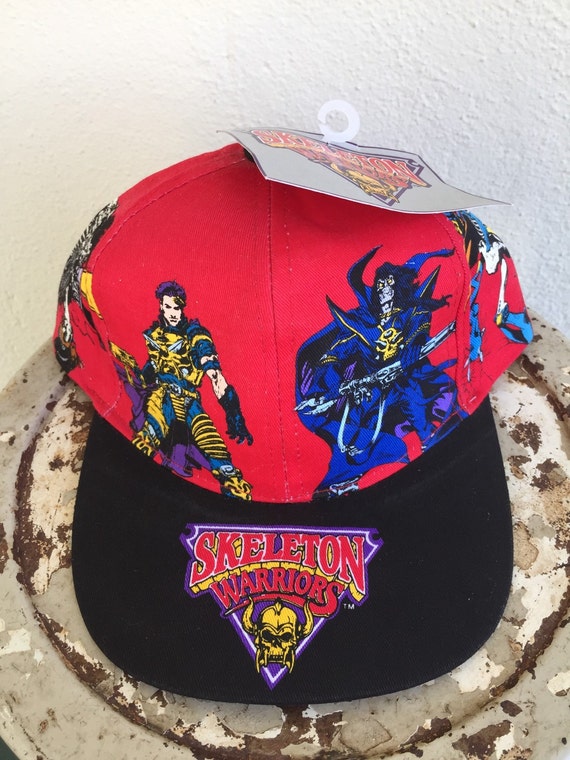
on everything from party supplies, to hats,
shoes and lunchboxes
by Thermos.
Milton Bradley
released a board
game based on the show the same year it debuted. Tiger Electronics
acquired the license for one of their handheld games,
while Neversoft
Entertainment developed a video game for
the Sega
Saturn and Sony Playstation,
released by Playmates
Interactive. Fleer released a set of
100 trading
cards which gave brief background on all the primary characters and
summarized the episodes and events within them. In 1994, CBS Publishing
produced a promotional comic
centered around their Action Zone block featuring Teenage Mutant Ninja Turtles, WildC.A.T.S. and Skeleton Warriors. Marvel Comics published a four-issue
mini-series in 1995.
![]() |
| VHS cover. |
EPISODE GUIDE:
“Flesh and Bone” (10/1/94) – Baron Dark convinces Justin to take the Lightstar Crystal, which Dark breaks into two transforming the Steeles and creating his own skeleton army.
“Trust and
Betrayal” (10/8/94) – Lightstar and Talyn try to recruit soldiers amidst talk
Grimskull is in collusion with Dark, but both end up captured by the skeletons.
“Heart and
Soul” (10/15/94) – The lone survivor of a settlement only lived because he
allowed Dark to transform him into a skeleton.
“Bones of
Contention” (10/22/94) – A data crystal reveals Grimskull’s involvement in the
skeleton epidemic, and Lightstar takes his punishment while Grimskull tries to
redeem himself.
“Zara” (10/29/94)
– An old friend of the Steeles sells them out to Dark in the town of Romney.
“Mind Games” (11/5/94)
– Dark attempts to penetrate Grimskull’s mind through his dreams.
“Harmonic
Divergence” (11/12/94) – Guardian goes undercover in Dark’s bomb factory as a
loyalist.
“Past Perfect,
Future Tense” (11/19/94) – Dr. Jenna’s machine allows Guardian to see a grim
future for Lightstar.
“Brawl and
Chain” (11/26/94) – Lightstar and Talyn attempt to get ahead of Dark’s new
Gorgon battleship but end up imprisoned by a town with his minions.
“Overload” (12/3/94)
– Dark seeks to supercharge his half of the crystal while the Legion of Light
searches for a lost Talyn.
“Long Live the
King” (12/10/94) – Baron Dark finally ascends to the throne.
“Conflict and
Consequences-Part 1” (12/17/94) – The Legion of Light launches an attack on
Dark’s forces while Grimskull tries to steal his half of the crystal, only to
be caught by Dark.
“Conflict and
Consequences-Part 2” (12/24/94) – Dark manages to unite the two halves of the
crystal and engages in a final battle with Lightstar.
“Flesh and Bone” (10/1/94) – Baron Dark convinces Justin to take the Lightstar Crystal, which Dark breaks into two transforming the Steeles and creating his own skeleton army.
Originally posted in 2015. Updated in 2018.
Subscribe to:
Posts (Atom)