Remember that one day when you could wake up without an alarm? When you would get your favorite bowl of cereal and sit between the hours of 8 and 12? This is a blog dedicated to the greatest time of our childhood: Saturday mornings. The television programs you watched, the memories attached to them, and maybe introducing you to something you didn't realize existed. Updated every weekend.
Emboldened by the success of Final Fightin
the arcades, Capcom decided
to revisit their Street Fighterconcept
and try to make it a better game. Street Fighter II:
The World Warrior, released
in 1991, followed a lot of the same conventions as its predecessor, but it
allowed players the options of playing with eight characters each with distinct
fighting styles and the ability to chain moves into combos (which came from a
bug in the programming). Coupled with brilliantly animated sprites and a
soundtrack by Yoko Shimomura,
the game became a hit and helped to revitalize the arcade game industry and
redefine the fighting genre.
Street Fighter II print ad.
Over the next few years, Capcom would refine the play
mechanics, graphics, character roster and more with a series of updated versions of Street
Fighter II in both the arcade and later on home consoles. While each
version was better than the last, the endless revisions became a running gag in
the video game community. Meanwhile, other game publishers looked to latch on
to Capcom’s success and began developing their own fighting games. Soon, there
was Mortal Kombat, Killer Instinct, Samurai Showdown, King of Fightersand
many others. The fighting genre was beginning to become saturated, and
another Street Fighter II revision just wasn’t going to cut it
to maintain Capcom’s dominance in the field.
The Darkstalkers universe.
Capcom decided to use their unique Street
Fighter II game engine for a new kind of fighting game. Producer Alex Jimenez suggested
making a game involving the Universal Monsters,
based on his love of the properties. When Universal
Studios denied them the license, Jimenez decided to
create their own characters based on those and other monsters; a process which
he claimed took about an hour. The resulting game became Darkstalkers:
The Night Warriors (known as Vampire: The Night Warriors in
Japan). The game was similar to Street Fighter, but was
rendered with the most fluid sprite animation yet to convey each character’s
distinct personality, gorgeous background level designs, and introduced concepts
of midair blocking and extra-powerful attacks that would be integrated into
future Capcom fighters.
Character sprites (from top): Demitri, Victor, Raptor, Morrigan, Jon Talbain, Pyron, Sasquatch, Anakaris, Felicia, Bishamon, Rikuo and Huitzil.
The game was centered on the conflict of supernatural
beings known as Darkstalkers who came to inhabit Earth through the gradual
merging of the Earth realm with the demon world known as Makai. Cosmic being
Pyron came to Earth with the intentions of conquering and devouring it, and
only the Darkstalkers stood a chance of stopping him and saving the world. The
game featured ten playable characters: Demitri Maximoff, a vampire lord who was
banished to Earth from Makai; Morrigan Aensland (named for the Celtic Phantom
Queen), a succubus (initially a vampire but changed to add
some monster variety) and adopted daughter of Belial, the king of Makai;
Felicia, a catwoman (or bakeneko) raised in a nunnery with a desire to become an actress;
Jon Talbain (after the character John Talbot from
the Wolfmanmovies),
a werewolf struggling to control his animalistic urges through the study of
martial arts; Anakaris, a 5,000-year-old resurrected mummy; Bishamon (based on
Japanese god of war Bishamonten), a cursed suit of samurai armor that takes over whoever
wears it and fills the host with its bloodlust; Rikuo (named after Ricou
Browning who played the Gill-man in Creature from the
Black Lagoon), a merman whose race was
wiped out by the coming of Pyron; Sasquatch, a member of a race of yetis in the
Canadian wilderness with a fondness for bananas; Victor von Gerdenheim, a
dimwitted Frankenstein
monster whose creator died shortly after making him; and
Lord Raptor, an Australian speed metal guitarist resurrected as a zombie that
could transform his limbs into chainsaws. The two unplayable boss characters
were Pyron and his robotic minion, Huitzil (named for the Aztec god of sun and
war, Huitzilopochtli).
Initially, Jimenez wanted Felicia to be from Africa with the ability to turn
into a panther as her special move, as well as the sexy character. Morrigan’s
change to a succubus made her the default sexy one, leaving Felicia to become a
cute white cat at Capcom’s request.
The arcade game was released in Japan in early July of
1994 to generally favorable reviews, then worldwide later that month. When it
became one of the best-selling fighting
games, Capcom was quick to give Darkstalkers the Street
Fighter II treatment and released an updated version the following
March in Japan, which also saw a North American release in April. Night
Warriors: Darkstalkers’ Revenge (Vampire Hunter in Japan)
featured new combos, two types of special moves that required different levels
of the special gauge to utilize, and made the bosses playable. It also
introduced two new characters: Hsien-Ko and Donovan Baine. Hsien-Ko was
transformed into a jiangshi, a type of Chinese reanimated corpse, with formidable
magical powers. Her sister, Mei-Ling, keeps her in check as the Ofuda (a
talisman believed to be imbued with the power of the deities) on Hisen-Ko’s
hat. Donovan was a dhampir that wielded a magical sword called “Dhylec” that
can channel divine and elemental powers. Donovan traveled with and protected
emotionally-detached young girl Anita,
who possessed powerful psychic powers. Both Hisen-Ko and Donovan were Dark
Hunters and gave the sequel its Japanese name.
Pyron and Huitzil hold Rikuo captive.
The series proved popular enough for Capcom to begin marketing it
in other media. Graz Entertainment optioned the license to produce an animated series based
around the game in North America. Expanding upon the game’s limited story,
Pyron (Richard Newman) had returned to Earth to find it teaming with humans. To
restore the balance where Darkstalkers ruled them and, in turn, served him,
Pyron recruited Demitri Maximoff (Michael Donovan, using a slight Transylvanian
accent) and Morrigan Aensland (Saffron Henderson, using an Irish accent) to
head up his army.
Morrigan and Demitri take down Victor.
Demitri used Pyron’s ship’s tractor beam to recruit
said army. He awakened Anakaris (Scott McNeil & Zoltan Buday, using an
Egyptian accent) from his deep sleep, which seemed to have warped his mind and
caused him to speak gibberish at times; Bishamon (Colin Murdock, using a
Japanese accent), who was dismayed to discover his curse persisted; and Lord
Raptor (McNeil, using a British accent), after resurrecting him from the plane
he crashed in while on tour in 1970. He also attempted to recruit Jon Talbain
(Lee Tokar) while he was on a hunt; the vain Rikuo (McNeil) as he lamented the
loss of his kind while also admiring himself; Victor von Gerdenheim (Ian James
Corlett, impersonating Arnold Schwarzenegger)
who was dormant in a movie studio prop room; Bigfoot (Sasquatch renamed, voiced
by Dale Wilson) as he was with his nephew, Hairball (Laura Harris); and Felicia
(Lisa Ann Beley) as she was rejected from yet another stage role. However, they
avoided his efforts.
Harry tries to keep Donovan from killing Felicia.
Felicia attempted to find help against Pyron’s forces
by heading to the home of Elijah Grimoire; a powerful wizard descended
from the legendary Merlin (Newman). Instead, she found young Harry Grimoire (a
new character originally named Bobby Bridges meant to serve as an audience
surrogate, voiced by Kyle Labine) who had inherited his ancestor’s power, but
not the knowledge to use it. Complicating matters were the Darkstalker hunters
Donovan Baine (Garry Chalk) and Hsien-Ko (Beley, using a Chinese accent), who
attacked without discrimination regardless of their targets’ intent. Felicia
and Harry served as the series’ primary protagonists as they sought to increase
Harry’s powers and thwart Pyron’s plans by teaming-up with the random
Darkstalker they encountered. Likewise, Morrigan and Dimitri served as the
primary antagonists with the others appearing every so often.
Jon Talbain, Rikuo, Klaus, Bigfoot, Harry, Felicia and Victor at Victor's castle.
Anakaris joins a video conference on Pyron's ship.
The show took some liberties with the source material in order to
make it more suitable for their intended young audiences. Instead of using the
Japanese character designs, the characters’ models were redesigned by Frank Brunner, Patrick
Gleason, James Glader and Paula
LaFond. As a result, Morrigan and Felicia’s
bodies were toned down and covered up a bit more. While still a succubus,
Morrigan was made the descendant of legendary enchantress Morgan
le Fey (also Henderson). Donovan’s sword was
simply called the “spell sword”, and Anita (renamed “Amanda” as she was in the
North American versions of the game) absorbed the power of the sword after
surviving an attack by Demitri (her origin remained consistent, but the
identity of the attacker tended to change between media). Raptor relied on
sonic attacks from his guitar rather than transforming his limbs into chainsaws
as in the game, and often spoke in song titles. Bishamon’s curse was housed in
the sword he possessed rather than in the armor, and once freed from the curse
he had to fight on the side of good in order to be reunited with his dead wife.
Victor was made a bit more intelligent and was given a manservant in his
father’s castle in the form of Klaus Schmendrick (Gerard Plunkett), whose family had always served the von Gerdenheim’s. Similarly,
Hsien-Ko was in the service of the goddess Quan Yin (Venus
Terzo), who was responsible for her creation
and her mission.
The series didn’t perform well with audiences. Many criticized the
writing and poor animation, as well as the addition of the annoying lead
character, Harry. As a result, the show was cancelled after its single season.
A second attempt at a Darkstalkers animated series came
when Madhouse and DR
Movie produced a four-episode OVA in Japan
called Night Warriors: Darkstalkers’ Revenge. McNeil was
retained to once again voice Lord Raptor (called Zabel Zarock), while Kathleen Barr, who played Harry’s mother, became the voice of Morrigan. In
comparison, the OVA was better received than the North American series.
Concept art for Marvel vs. Capcom 3 (2011) showcasing the Darkstalkers members of the roster.
Following the release of Darkstalkers 3 in
1997, the game series was allowed to stagnate with only revisions and re-releases
to sustain it. Lackluster
reception to these efforts prompted Capcom to cancel
any plans for future installments. However, their representation continued
as Morrigan and Felicia, the most popular characters with gamers, would appear
in many of Capcom’s later fighting games and merchandise.
In comics,
the Darkstalkers would appear nearly a decade later in a mini-series by Devil’s Due Publishing, and then in
various books published by UDON Comics.
EPISODE GUIDE:
“Out
of the Dark” (9/30/95) – Pyron returns to Earth and summons the Darkstalkers to
help him conquer it, and the only one Felicia can find to stop him is the
descendent of a powerful sorcerer.
“Donovan’s
Bane” (10/7/95) – Harry and Felicia head to Great Britain to find a ring
connected to his family, while Morrigan seeks out her own heirloom to take on
the Dark Hunter.
“Pyramid
Power” (10/14/95) – Morrigan, Demitri and Anakaris travel back in time to find
out the fate of an ancient gem while Mrs. Grimoire heads to Egypt to
investigate a floating pyramid.
“The
Game” (10/21/95) – Pyron pits Morrigan and Demitri against each other to see
who can capture the most heroes.
“And
the Walls Come Tumblin’ Down” (10/28/95) – Raptor’s guitar, Harry’s ring and
Anakaris’ computer all detect something strange that sends their respective
owners to investigate.
“Ghost
Hunter” (11/4/95) – Raptor investigates a possible Darkstalker to be recruited
while Felicia asks Rikuo to look into the mysterious death of a man in Africa.
“Little
Bigfoot’s Last Stand” (11/11/95) – Pyron abducts Harry and Hairball, leaving
Felicia and the Bigfoot tribe to figure out how to rescue them both.
“My
Harry’s in the Highlands” (11/18/95) – It’s a race to retrieve a magical ring
from Harry’s ancestor before Morrigan gets her hands on her own.
“Aliens
Keep Out” (11/25/95) –Rikuo recuperate in Atlantis after escaping the Dark
Hunter, but their rest is cut short when Pyron appears and is captured by an
ancient robot.
“Samurai’s
Honor” (12/2/95) – Donovan stops Demitri from devouring a young girl and takes
her to Felicia and Harry for help, only to discover there’s more to her than
there seems.
“There’s
No Business Like Dragon Business” (12/9/95) – Harry and Hairball find a dragon
in the snow who’s turned against Felicia by Raptor.
“Darkest
Before the Dawn” (12/16/95) – Demitri comes to possess a powerful mystical
crystal.
“Everyone’s
a Critic” (12/23/95) – Pyron is forced to team-up with the heroic Darkstalkers
in order to save the world from his brother, Terramon. Originally posted in 2017. Updated in 2024.
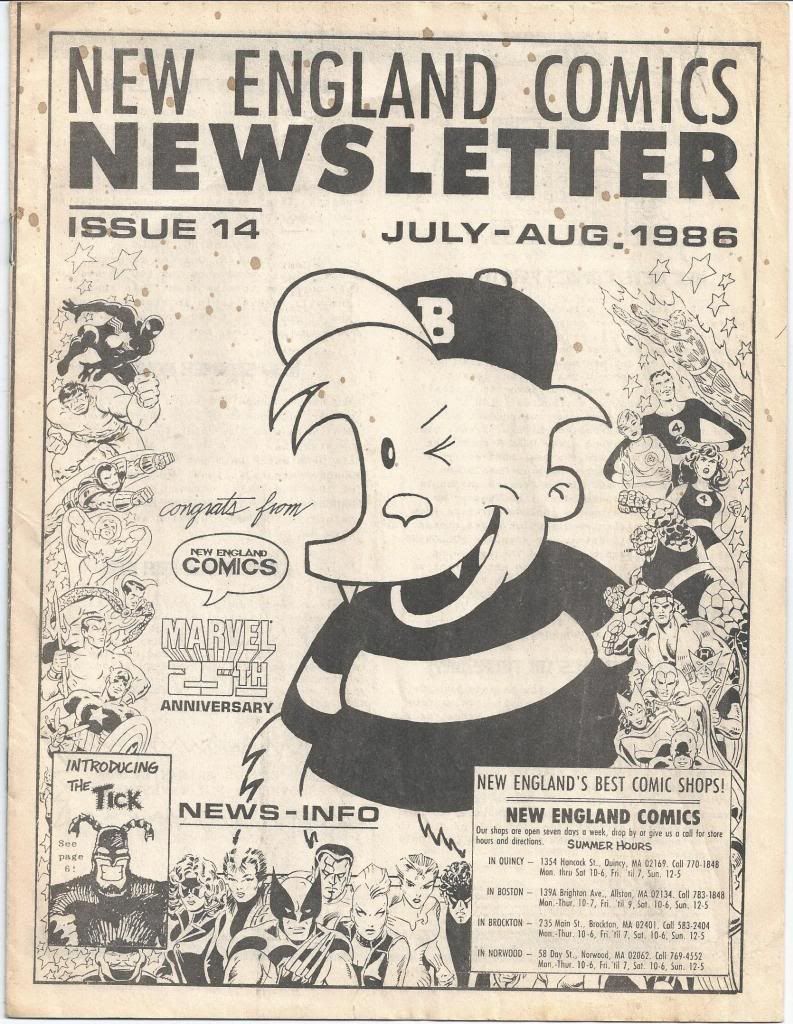
The Tick was created by
high-schooler Ben Edlund and
went on to become the mascot for the comic shop he frequented. New England Comics in Norwood,
Massachusetts, in 1986. The Tick first appeared in the fourteenth
issue of their newsletter, and after some well-received stories in following
editions, New England Comics financed the production of a black-and-white comic
series. The series debuted in June of 1988 and released twelve issues over
the next five years.
The Tick's first appearance.
The Tick is a parody of superheroes and super hero comics. Initially having
escaped from a mental institution, he possessed no memory of his past before
becoming The Tick. Incredibly strong and durable while also being klutzy and
incompetent, he became the protector of The City. He took a day job at the Weekly World Planet newspaper with
fellow superhero Caped
Wonder, aka Clark Oppenheimer (a Superman pastiche, but
more of a jerk). Initially, Edlund wanted The Tick’s costume to be brown, but
it was decided that blue looked better in print when the comics switched to
color.
The Tick meets Arthur.
The Tick’s sidekick was Arthur; an accountant who one day found and put
on a moth suit, never taking it off again. His suit gave him the ability to fly
with retractable wings in his backpack and he was often mistaken for a bunny
due to his long antennae. He would serve as the voice of reason to Tick’s
enthusiasm. The City was also populated by a cast of equally absurd heroes and
villains, many of whom were parodies of various Marvel
and DC Comics characters. A lot of the
humor would come from dark comedy and sexual innuendos.
"We will bring the tangy sweetness of justice to the airwaves!"
When toy licensing and design company Kiscom discovered The Tick, they approached Edlund with
the possibility of merchandising The Tick
much the same way Teenage Mutant Ninja Turtleshad just recently been. However,
networks and studios were reluctant to take on the property until finally Sunbow Entertainment
expressed interest. Sunbow paired Edlund up with writer Richard Liebmann-Smith to work
up the series proposal, despite neither having experience in animation. After
two months, they presented the proposal to the fledgling FOX network who, rightfully so in the minds of
both men, turned it down. FOX did give them five days to refine the idea and
pitch it again, which they did over the course of a weekend. The new proposal
was accepted by FOX and the series was greenlit.
The Tick promo image.
Edlund served as a producer of the show and was very hands-on in every
aspect of its production. Along with contributing to the series’ scripts
alongside Liebmann-Smith and former The
Tick comic book writer Christopher
McCulloch, Edlund also dabbled with the character designs and the
storyboarding for the episodes. As a result, the series was delayed for over a
year from its intended debut date. The
Tick finally premiered on September 10, 1994 on the FOX Kids block. Other writers
included Martin Pasko, Henry Gilroy, Art Vitello, Michael Rubiner, Pippin Parker, Jed Spingarn, Ralph Soll, Andy Yerkes, Randolph Heard, Eric Stangel and Justin Stangel. The series’
theme, as well as the entire score, was composed by Doug Katsaros
consisting of big band music and campy scat singing.
The "I've got a show!" strut.
Although a lot of the tonality from the comic had to be removed for a
Saturday morning audience (such as removing all traces of Tick’s time in the
institution, instead replaced by his crashing a superhero convention), the
satirical roots were firmly in place and didn’t hesitate to fully immerse
itself in parody. Tick’s job was also a casualty of the change in media; with
his now being a permanent boarder on Arthur’s couch after pulling him into a
hesitant partnership. Essentially, episodes would consist of the Tick (Townsend
Coleman) emphatically charging head first into all situations with his battle
cry “SPOOOOOOON!!!!” (thought up during a cereal breakfast one morning) like a
bull in a china shop. Arthur (Micky Dolenz & Rob Paulsen) wound up
providing a well-thought and reasoned solution to the conflict once he stopped
cowering and exclaiming “Not in the face! Not in the face!” The Tick would then
sum up their adventure with a moral full of absurd hyperbole. Arthur would eventually
come to meet, and date, the daughter of the scientist who invented his suit,
Carmelita Vatos (Jennifer Hale), who had a moth
suit of her own.
Sewer Urchin, Die Fledermaus, Fish Boy and American Maid.
Like the comics, The City had its share of superhero protectors—although
some were better at it than others. Created specifically for the show was Die
Fledermaus (Cam Clarke), a parody of Batman with a more
bat-like costume, who avoided conflict with full cowardice and spent his time
hitting on pretty women; Sewer Urchin (Jess Harnell), an Aquaman riff with a Rain Man-like personality who was virtually ineffectual
everywhere but the sewers he called home; and American Maid (Kay Lenz), a blend
of Captain
America and Wonder
Woman with a weaponized tiara and stiletto heels who was possibly the most
effective, though least-powerful, hero in the city. Other heroes from the
comics included Big
Shot (Kevin Schon), a
heavily-armed anti-hero ala Punisher who
eventually goes to anger-management therapy; Fish Boy (Clarke), an Aqualad
parody who was a completely useless lost prince of Atlantis; and The Mighty
Agrippa (Harnell), the Roman God of the Aqueduct who could move huge volumes of
water. The super team The Civic-Minded Five also appeared from the comics,
however they only retained Feral Boy (Schon), a boy who acted like an animal,
from their original line-up. The rest of the team was comprised of
mucilage-spraying Captain Mucilage (Paulsen), static electricity-generating The
Carpeted Man (Pat Fraley),
the four-legged 4-Legged Man (Roger Rose)
and the athletic (and competent) Jungle Janet (Susan Silo).
Chairface Chippendale.
What good are heroes without some equally absurd villains to fight?
Joining from the comics was Chairface Chippendale
(Tony Jay), a crime boss with
a chair for a head obsessed with putting his name and likeness on important
objects (like the moon); Barry
Hubris (Jim Cummings), a
glory-seeking “hero” who also called himself The Tick and used a shield device
to give him incredible strength; The Man-Eating Cow (Coleman), whose name is
very literal (although she’s never been seen actually eating anyone) and was originally
a superhero in the comics; The Terror (Paulsen), a Golden Age-era
supervillain who doesn’t seem to want to retire; Thrakkorzog (Cummings,
impersonating James Mason),
an alien from Dimension 14B that lived across the hall from The Tick and
Arthur; and Tuun-La: Not of This World (Pat Musick), a woman who could
tuck in her legs and emit fire from their bases. New foes included El Seed (named for Spanish hero El Cid, voiced by Ed Gilbert), who could
manipulate plants through chemicals; The
Evil Midnight Bomber What Bombs at Midnight (Maurice LaMarche), an explosives
expert (duh); The
Human Ton, an enormous moron who was accompanied by his intelligent hand
puppet, Handy (both LaMarche); Sheila Eel, who wore an electric eel; Eastern Bloc
Robot Cowboy (Fraley), a Communist cyberneticist who put his mind into a
mobile vending machine; the Mother of Invention
(Paul Williams), an
androgynous inventor who wanted to steal credit for all the inventions of
history, and many others.
Barry Hubris, the other Tick.
The series was nominated for five Annie
Awards, winning two of them in 1995, and three Daytime Emmys. Comedy Central began syndicating the
series during its run, premiering the episodes “Devil in Diapers” and “Tick vs.
Education” before their FOX airings, and introduced it to a more adult
audience. However, while the show brought the cult comic national attention,
the series failed to achieve the same level of commercial success as Ninja Turtles had, reducing its
merchandising potential. That, coupled with frequent production delays, led to
FOX cancelling the series instead of going forward with the planned fourth
season. FOX did enter into negotiations with Sunbow to produce a prime time Tick special the following year, but the
idea never materialized.
Coinciding with the series, Bandaireleased
two series of 6” action figures, five talking Tick figures (one of them 16
inches tall), and a set of 2” PVC figurines. In 1995, Gordy toys produced a
line of bendable
action figures both individually and in a box
set. In 2013, Shocker Toys released three
figures based on the show as part of their Indie Spotlight series. Pressman
created a board game and FOX
Interactive a video game in 1995. Inverse Ink adapted
the episode “The Tick vs. the Uncommon Cold” into an interactive CD-ROM comic. As this was the
90s, no merchandising blitz would have been complete without a set of officially
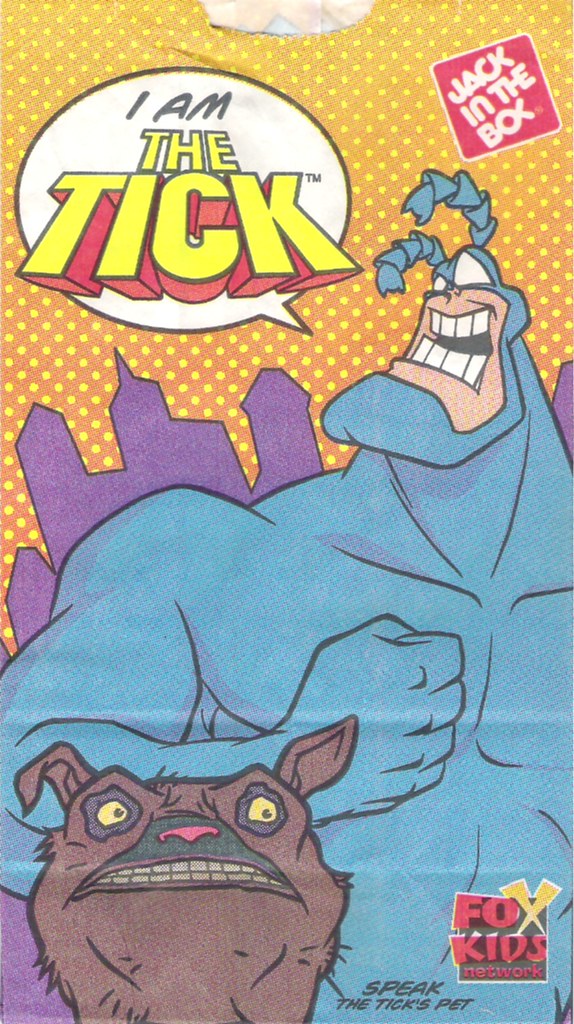
licensed POGS by the World POG Federation. Hardee’s, Carl’s Jr., Jack-in-the-Box
and Taco
Bell also partnered with the show to release a series of toys with their
kids meals. In 1997, Greg Hyland
wrote The Tick: Mighty Blue Justice!which served as a virtual episode guide
for the 34 episodes available at the time of its publication along with
background info on the various characters. The Tick was also one of the feature
characters in the two-issue FOX Kids Funhouseseries
and the Fox
Kids trading cards from Fleer.
To capitalize on the growing adult fanbase, FOX commissioned the
production of a new live-action prime time series starring Patrick Warburton in the title
role and reimaginings of American Maid and Die Fledermaus. The Tick debuted in the fall of 2001 and lasted only eight of its
nine episodes before it was cancelled despite praise from fans and critics. A
poor timeslot, lack of promotion and production costs were often cited as the
reasons behind FOX’s ultimately abandoning the show. Amazon Studios, however, had begun production on a reboot
of the live show in 2014, which saw its debut on Amazon
Prime Video in 2016 and ran for 2 seasons before it was cancelled—again despite
audience praise. The Tick cartoon,
meanwhile, has been regarded as one of the best cartoons in the years
following. Coleman’s character of Sentinel Prime on Transformers Animatedwas
purposely modeled after The Tick, and Chairface Chippendale (Seth Green) made an appearance on Robot Chicken. The Tick comic
continues to be published sporadically, particularly with an annual offering as
part of Free Comic Book Day,
although with minimal involvement from Edlund as his work on the show led to a
career in filmmaking.
EPISODE GUIDE:
Season 1:
“The Tick vs. The Idea Men” (9/10/94) – The Tick comes to The City and
meets former accountant Arthur, convincing him to become his sidekick in the
battle against evil.
“The Tick vs. Chairface Chippendale” (9/17/94) – Chairface wants to
commit the crime of the century by writing his name onto the moon.
“The Tick vs. Dinosaur Neil” (9/24/94) – Paleontologist Dinosaur Neil
attempts to grow a dinosaur from some found tissue but accidentally ingests
some of it and mutates into a dinosaur.
“The Tick vs. Mr. Mental” (10/1/94) – Mr. Mental takes control of The
Tick and has him steal the Thinking Cap to enhance his powers.
“The Tick vs. Breadmaster” (10/8/94) – The Breadmaster seeks to make a
City-smothering lemon soufflé.
“The Tick vs. El Seed” (10/15/94) – The Tick and Arthur have to
team-up with the Civic-Minded Five to battle the insane plant man El Seed.
“The Tick vs. The Tick” (10/22/94) – While The Tick battles another
The Tick for the rights to the name, The Evil Midnight Bomber What Bombs at
Midnight plans a bombing.
“The Tick vs. the Uncommon Cold” (10/29/94) – The Tick’s cold prevents
him from stopping the alien Thrakkorzog from conquering Earth with an army of
Tick mucous clones.
“The Tick vs. Brainchild” (11/5/94) – Brainchild plans to use his
device to slam the moon into the Earth.
“The Tick vs. Pineapple Pokopo” (11/12/94) – The Tick, Arthur and
American Maid are sent to Pokoponesia to rescue hyper intelligent astronaut
monkey Yank.
“The Tick vs. the Mole-Men” (11/19/94) – The Tick and Arthur play host
to a group of Mole-Men and their king.
“The Tick vs. The Proto-Clown” (2/4/95) – A genetically engineered
Proto-Clown terrorizes The City while The Tick ends up taking a journey through
his own mind.
“The Tick vs. Arthur’s Bank Account” (2/11/95) – The Terror comes to
The City and tries to conquer it.
Season 2:
“The Little Wooden Boy and the Belly of Love” (9/9/95) – When Arthur
ditches The Tick for a date, The Tick builds himself a new sidekick out of
wood.
“Alone Together” (9/16/95) – The Tick heads to the moon to fix the
damage Chairface did to it and The City believes he is dead.
“Armless but Not Harmless” (9/23/95) – Venus and Milo steal The Tick
and Arthur’s arms and put them on crude look-a-likes to do their evil bidding.
“Coach Fussell’s Lament” (9/30/95) – Brainchild uses his babysitter,
The Mad Nanny, to turn The Tick into a bird.
“Leonardo da Vinci and His Fightin’ Genius Time Commandos!” (10/7/95)
– The Mother of Invention seeks to alter time so that he can create the world’s
greatest inventions himself.
“Bloomsday” (10/21/95) – El Seed returns with his monster, Rosebud.
“Evil Sits Down for a Moment” (11/4/95) – Ottoman attempts to corrupt
Die Fledermaus through marriage in order to take over The City.
“Heroes” (11/11/95) – The Tick and Arthur are followed by a camera
crew to appear on the show “Heroes.”
“Ants in Pants!” (11/18/95) – While The Tick is in a sanatorium, a
large colony of ants capture the other heroes and lock them into a giant ant farm.
“The Tick Loves Santa!” (11/25/95) – When a crook dressed as Santa is
electrocuted by a billboard, he gains the ability to duplicate himself.
“Tick vs. the Big Nothing” (2/3/96) – The alien race The Whats kidnap
The Tick and Arthur in order to defeat their enemies, The Heys.
“Tick vs. Reno, Nevada” (2/10/96) – The Tick’s gambling problem may
keep him from saving Reno from being buried under a wave of fish.
“Grandpa Wore Tights” (2/17/96) – The Terror sends his son to recover
his weapon from the Decency Squad.
Season 3:
“That Mustache Feeling” (9/14/96) – The Tick wakes up with a sentient
mustache that Jim Rage wants.
“Tick vs. Dot and Neil’s Wedding” (9/21/96) – Chairface spoils Neil’s
wedding by having his medication mucked with, turning him back into Dinosaur
Neil.
“Sidekicks Don’t Kiss” (9/28/96) – When Arthur is kidnaped, The Tick
teams-up with his girlfriend Carmelita to rescue him.
“Tick vs. Arthur” (10/5/96) – Arthur finds a belt that gives him
muscles, but unknown to him it also has the side-effect of increasing his ego.
“Devil in Diapers” (10/6/96) – Mr. Mental disguises himself as a baby
to hide out in The Tick and Arthur’s apartment while working on his next
scheme.
“Tick vs. Filth” (10/26/96) – The Tick and Arthur witness Sewer Urchin
in his element and realize he’s a competent hero.
“Tick vs. Europe” (11/2/96) – The Tick is sent to Belgium on a
superhero exchange program.
“Tick vs. Science” (11/9/96) – Professor Chromedome uses a
mind-swapping machine to cover his escape, putting The Tick’s mind in
Carmelita’s body.
“Tick vs. Prehistory” (11/16/96) – The Tick and Arthur head three
million years in the past and end up with jobs in a restaurant.
“Tick vs. Education” (11/24/96) – The Tick and Arthur become teachers
to a class of wannabe superheroes.