TARZAN, LORD OF THE JUNGLE
(CBS, September 11, 1976-November 3, 1979)
Filmation Associates
(CBS, September 11, 1976-November 3, 1979)
MAIN CAST:
Robert Ridgely – Tarzan (speaking), various
Danton Burroughs – Tarzan (yell)
Lou Scheimer – N’Kima, various
Robert Ridgely – Tarzan (speaking), various
Danton Burroughs – Tarzan (yell)
Lou Scheimer – N’Kima, various
Edgar Rice Burroughs
had wandered from job to job and one failed enterprise to another, making
darkly humorous cartoon sketches and writing fairy tales set on other worlds to
amuse himself and distract from his string of bad luck in life. Having indulged
in some pulp publications during his downtime, he felt he could write better
than what he read and began work on his first pulp story: Under
the Moons of Mars, which would become the first entry in his Barsoom
series about Confederate
Army captain John Carter suddenly finding himself on the planet Mars and embroiled in the conflict
between its peoples. After finishing half of it, he submitted it to The All-Story
magazine under the pseudonym “Normal Bean” (fearing his reputation would be
damaged if connected to the work). Managing editor Thomas Newell Metcalf liked
what he read, and after some polish and its completion, he bought the
serialization rights from Burroughs for $400 USD (equivalent to $13,283.92 as
of this writing). It was first published in the February-July 1912 issues of The
All-Story.
 |
| Cover to The All-Story magazine's October 1912 edition. |
Burroughs
took up writing full time. Although initially discouraged when his next story
idea was rejected, encouragement to keep at it led him to create the first
entry in his most successful series: Tarzan
of the Apes. Tarzan was the son of a
British Lord and Lady who were marooned on the West coast of Africa before he
was born. Neither survived his infancy and he was adopted and raised by Kala,
member of the ape tribe known as the Magani. His name, Tarzan, meant “White
Skin” in their language. Tarzan would eventually ascend to king of the apes,
learned about his past upon discovery of his family’s hut, people in general
when another group wound up stranded in the jungle, and eventually of love when
he met Jane Porter—who would
eventually become his wife. Although his adventures would often take him out of
the jungle, it wouldn’t be long before he was drawn back to it.
 |
| Front page artwork from the 1914 edition of Tarzan of the Apes. |
Tarzan
of the Apes was published in The All-Story in October of 1912. After
being rejected by several publishers, A.C. McClurg and Co.
finally agreed to release it in novel form in 1914, becoming a best-seller. Burroughs
would go on to publish 24 books in the Tarzan series—two posthumously
after his death in 1950—along with several novellas. Recognizing how popular
Tarzan was with his audience, Burroughs went against advice and planned to
exploit the character through whatever other media he could: a comic strip
that ran from 1929-2002 and continues on in reruns; films beginning with the 1918
silent film Tarzan of
the Apes and still being produced in the present; stage plays starting in
1921; radio
shows beginning in 1932 which Burroughs was involved with; and various merchandise. For tax reasons and
to maintain control over his works, Burroughs formed Edgar Rice Burroughs, Inc. which
is still run by his family today and continues to license and manage Burroughs’
creations that have not yet fallen into the public
domain.
 |
| Jane, Tarzan and Cheeta from Tarzan the Ape Man. |
The films introduced many of the
characteristics most people associate with Tarzan. 1932’s Tarzan the Ape Man
introduced Tarzan’s sidekick Cheeta; a chimpanzee that provided comic relief
and correspondence between Tarzan (Johnny Weissmuller) and his
allies, and led other animals to come to Tarzan’s aid. This character replaced
Nkima from the books; an African monkey that first appeared in Tarzan
and the Lost Empire who exhibited great bravery in Tarzan’s presence
but was otherwise cowardly on his own. The film also introduced the version of
Tarzan’s yell synonymous with the character (and whose vocal origins have been an
ongoing debate). His son with Jane (Maureen O’Sullivan), Jack, that
first appeared in The
Eternal Lover, was also replaced by an adopted son known only as “Boy”
(Johnny Sheffield) in 1939’s
Tarzan Finds a Son!
The 12 films starring Weissmuller established Tarzan as a noble savage speaking
in broken English, rather than the cultured aristocrat he was portrayed as
being in the novels. The 1935 serial The
New Adventures of Tarzan, which was one of a competing series of films allowed
by licensing issues and the only film production with Burroughs’ direct
involvement, featured an educated Tarzan. When television emerged as a dominant
medium, many of the Tarzan films were brought to Saturday morning television.
The character’s first television series, Tarzan starring Ron Ely, aired on NBC between 1966-68 as essentially a continuation
of the films made under producer Sy
Weintraub that began with 1959’s Tarzan’s Greatest
Adventure.
 |
| The animated Tarzan and his animal friends. |
Eight years later, Filmation co-founder and
producer Lou Scheimer decided he wanted to try his hand at producing his own
Tarzan series. Scheimer, at this time, resided in Tarzana, California;
the town that sprang up when Burroughs gradually sold off portions of his
massive 550-acre Tarzana Ranch named after Tarzan. ERB, Inc.’s office was also
located in Tarzana just a few minutes away from Scheimer’s house. Scheimer met
with the Burroughs estate to convince them that Tarzan would be perfect for
animation; starting with a film to explain his origins. Unfortunately,
Burroughs’ grandson, Danton, wasn’t thrilled with the changes writer David Gerrold wanted to make
for the film to have the story flow better, and the resulting heated exchange
between them would be one of the reasons Gerrold left Filmation to work with Krofft
Productions. Eventually, a deal was struck and Filmation acquired the
rights. They, in turn, sold the show to CBS.
 |
| Tarzan gives his traditional call. |
The goal was to have the series
appear as lush and illustrative as the work of Burne Hogarth, Burroughs’
favorite artist from the Tarzan comic strip that worked on it between
1937 and 1950, while keeping it within the scope of their budget. Knowing how
physical a character Tarzan was, and since was meant to be a real man rather
than a superhero who could fly like Superman, Filmation decided
to make use of rotoscoping for their library of stock footage. They shot a lot
of film of a model—who was a bartender from the animators’ favorite nearby
hangout called The Dug-Out—walking, running, jumping, diving, swimming and
whatever other common movements an ape-man would need to make in the jungle.
The animators would then draw off of that footage to perfectly emulate how the
human body would move.
 |
| Character models for Tarzan's foes from Zandor. |
The series featured the smallest
cast of any Filmation project; with the main characters only being Tarzan
(Robert Ridgley) and his companion N’Kima (Scheimer providing vocal effects).
Danton Burroughs himself provided Tarzan’s iconic yell (once; that single
recording was reused for each instance in the series). Some of the recurring
characters included the Mangani apes that raised him; Jad-bal-ja, the lion he
raised and trained; African elephants, called “Tantor” in the Mangani language,
that would come to Tarzan’s aid when called; Queen Nemone (Joan Gerber & Hettie Lynne Hurtes), the ruler
of Zandor; Tomos (Alan
Oppenheimer), Nemone’s prime minister and lackey; Belthar, Nemone’s pet
lion; and Phobeg (Ted Cassidy
& Oppenheimer), the strongest man in Zandor and one of the royal guards.
Jane (Linda Gary) only
appeared in one episode, and that was by special request from the Burroughs
estate to resecure the character’s rights as she hadn’t appeared in visual
media since 1959. The series made heavy use of the Mangani language from the
books, having all animals be called by their Mangani names and even making up a
few words when none existed, and retained Tarzan’s intellect.
 |
| Enter: evil robot Tarzan. |
Tarzan,
Lord of the Jungle debuted on CBS on September 11, 1976 and ran for four
seasons; however, only the first was its own separate entity. For the second
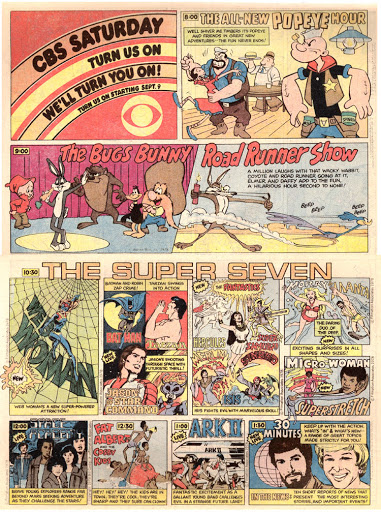
season, 6 new episodes and reruns were paired with repeats of The
New Adventures of Batman to form The Batman/Tarzan Adventure Hour.
They were joined by The Freedom Force, Jason
of Star Command, Manta and Moray, Superstretch
and Microwoman and Web
Woman to form the 90-minute Tarzan and the Super 7
for the next two seasons. Tarzan’s runtime was reduced to 17 and 11
minutes as part of the block, depending on the episode, and longer reruns were
trimmed down to run within the allotted time. 6 and 8 new episodes were made
for each season, respectively. When the other series—excluding Jason—moved
to NBC to air in reruns as Batman and the Super 7, reruns of Tarzan
were joined by The New Adventures of The Lone Ranger to form The
Tarzan/Lone Ranger Adventure Hour. For the final season, those shows were
joined by The New Adventures of Zorro to make The Tarzan/Lone
Ranger/Zorro Adventure Hour.
 |
| You encounter all sorts of strange beings in the jungle. |
Much of the
series was written by Len Janson
and Chuck Menville, who also
served as associate producers, with additional scripts from Paul Dini, Kathleen Barnes, David Wise, Tom Ruegger, Dale Kirby, Don Heckman, Michael Reaves and Fred Ladd. Many episodes were
based off of Burrough’s books and tried to remain as faithful to them as
possible; however, tempered for a more modern audience and infused with
pro-social messages about preservation and treating animals and other cultures
properly. Topping that off was Filmation’s customary coda at the end where
Tarzan would relay a moral message to the viewers. Notably, Tarzan’s adventures
seemed to be set in the present day with the appearance of robots, satellites
and airplanes rather than the late 19th and early 20th
Century of the books. Additionally, there were strong science fiction elements
through the presence of mad scientists and extra-terrestrials. Lacking their
desired film, storyboard director Bob
Kline was able to provide at least a glimpse of Tarzan’s origins in the
series’ opening sequence, supported by narration from Ridgely. Horta-Mahana
Corp. was responsible for the music and sound effects used, with background
music provided by Ray Ellis
(as Yvette Blais) and producer Norm
Prescott (as Jeff Michael).
 |
| The DVD cover. |
Following
the last run of episodes in the Adventure Hour, Tarzan took a
two-year hiatus from the network before returning for a brief seven month run
in February of 1984. The series largely disappeared, with Scheimer stating in
his book, Creating
the Filmation Generation, that he was often asked about when it would
be released to home media. Warner Bros.
eventually released the episode “Tarzan and the Colossus of Zome” as part of
their compilation DVD Saturday
Morning Cartoons: 1970s Volume 1; itself collected
with other entries in that series in 2018. The complete
first season was released to DVD in 2016 by Studio
Distribution Services in time for its 40th anniversary; just
weeks before Warner Bros.’ (a part owner of SDS with Universal Pictures) new film, The Legend of Tarzan,
hit theaters. It was also made available for purchase to stream on Prime
Video.
EPISODE GUIDE:
Season 1:
“Tarzan and the City of Gold” (9/11/76) – Tarzan ends up a prisoner of Zandor when he attempts to help Athne of the City of Ivory return home after Zandorians drove her off.
“Tarzan and the Vikings” (9/18/76) – Tarzan is captured by
jungle Vikings to be a slave to the chieftain’s daughter and ends up
discovering a plot to overthrow the chieftain.
“Tarzan and the Golden Lion” (9/25/76) – Tarzan comes to the
aid of the Monkey People being enslaved by the Bolmangani and teaches them how
to stand up for themselves.
“Tarzan and the Forbidden City” (10/2/76) – Tarzan must
rescue two groups of visitors seeking the Forbidden City for different reasons
after they’re captured by the soldiers living there.
“Tarzan and the Graveyard of Elephants” (10/9/76) – The
Novardians demand Tarzan’s aid in finding the Graveyard of the Elephants so
that they may harvest the tusks from their bones.
“Tarzan’s Return to the City of Gold” (10/16/76) – Tarzan
ends up saving Athen’s brother and attempts to get him home, but Queen Nemone
has ordered her soldiers to capture Tarzan.
“Tarzan and the Strange Visitors” (10/23/76) – Tarzan meets
an anthropologist as aliens arrive in the jungle to capture animal specimens to
bring back to their planet.
“Tarzan and the Land of Giants” (10/30/76) – Tarzan discovers
a hidden valley full of giants being terrorized by tyrant King Odysseus and
Buto, the latter whom they believe is a god.
“Tarzan and the Knights of Nimmr” (11/6/76) – Tracking the
occupant of a crashed balloon leads Tarzan to be captured by knights and
stumbling upon a plot to rob the queen.
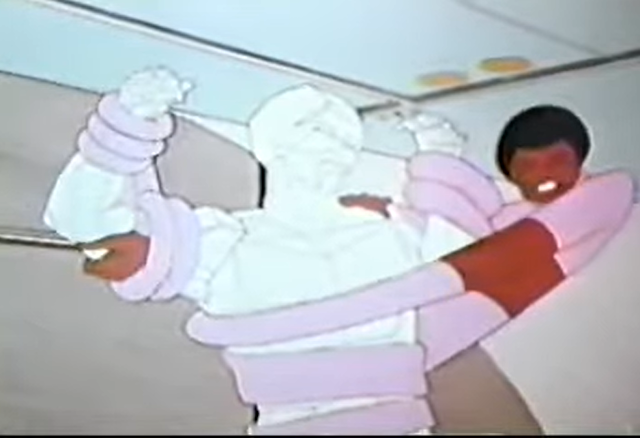
“Tarzan’s Rival” (11/13/76) – Tarzan is villainized by a
robot duplicate so that Mr. Senti can steal the Jewels of Opa.
“Tarzan and the City of Sorcery” (11/20/76) – Tarzan meets a
boy who claims his father has been transformed by a sorceress queen, and Tarzan
travels to the city of Rashid to confront her.
“Tarzan at the Earth’s Core” (11/27/76) – Tarzan journeys to
the prehistoric land of Pellucidar in order to help unite two kingdoms.
“Tarzan and the Ice Creature” (12/4/76) – A volcano eruption
frees the gigantic ice creature Glakor from his slumber.
“Tarzan and the Olympiads” (12/11/76) – After meeting two
escaped slaves, Tarzan heads to Olympus to free the remaining slaves and make
Emperor Cronus change his ways.
“Tarzan’s Trial” (12/18/76) – The aliens return and capture
Tarzan so that their commander can learn all of his abilities and use them to become
supreme ruler of the space fleet.
“Tarzan, the Hated” (12/18/76) – The Bolmangani Emperor
plans to turn a tribe of gorillas against Tarzan and rebuild their city in the
Opar Region despite an archaeologist’s claims it’s unsafe.
Season 2:
“Tarzan and the Sunken City of Atlantis” (9/10/77) – Tarzan seeks to free whales enslaved to power Atlantis, but deny the city power will cause it to flood.
“Tarzan and the Bird People” (9/17/77) – Aiding an injured
member of the Bird People gets Tarzan involved in the conflict between them and
the Land People.
“Tarzan and the Colossus of Zome” (9/24/77) – The inches-high
people seek to enlist Tarzan in their war against the Zomans, but the Zomans
need help as well when their weapon turns against them.
“Tarzan and the Beast in the Iron Mask” (10/1/77) – Tarzan
must restore Chief Denat after his twin brother has assumed his identity in
order to mine for gold in a volcano.
“Tarzan and the Amazon Princess” (10/8/77) – Tarzan returns
a long-lost Amazon to her home only to learn the captain of the royal guard
seeks her extermination to become next in line to rule.
“Tarzan and the Conquistadors” (10/15/77) – Tarzan must
protect the Donlumangani from Conquistadors searching for their captain’s
ancestors’ treasure.
Season 3:
“Tarzan and the Spider People” (9/9/78) – Tarzan tracks large spiders abducting elephants to a treetop city where he discovers that the spiders are actually robots under their control.
“Tarzan and the Space God” (9/16/78) – Tarzan rescues a
professor from a crashed plane who convinces him to lead him to an area where
the Mayans are believed to have disappeared.
“Tarzan and the Lost World” (9/23/78) – Tarzan must help a
scientist retrieve a downed satellite from the Minotaur before it explodes and
destroys the valley.
“Tarzan and the Monkey God” (9/30/78) – N’Kima winds up in a
village being terrorized by a gorilla where he’s believed to be a monkey god.
“Tarzan and the Haunted Forest” (10/7/78) – Tarzan partners
with the inhabitants of the Haunted Forest in order to stop Queen Tara’s
deforestation to power her machines.
“Tarzan and the Island of Dr. Morphos” (10/14/78) – Tarzan pursues
an abducted N’Kima to an island where a mad scientist plans to perform genetic
experiments on Tarzan.
Season 4:
“Tarzan and the Sifu” (9/15/79) – Tarzan is captured in Tao Ching when their Sifu is overthrown, and their new leader plans to conquer other cities in the jungle and take control of a dragon.
“Tarzan and Jane” (9/22/79) – Tarzan rescues Jane and her
father after a mutiny during an archaeological exposition and helps lead them
back to civilization.
“Tarzan and the Land Beneath the Earth” (9/29/79) – Tarzan and
his friends end up in the land of the mole people who have been using Makos
Trees to power their furnace.
“Tarzan and the Drought” (10/6/79) – Tarzan tries to convince
the Monkey People to tear down their dam during a drought.
“Tarzan and the Soul Stealer” (10/13/79) – Tarzan learns Zandor
and Athne are at war again, and Queen Nemone has acquired magical powers.
“Tarzan and the Future King” (10/20/79) – King Torg’s Vizier
plans to foil Prince Yaru’s final trial in order to become king of the Red
Gorilla Kingdom himself.
“Tarzan and the Huntress” (10/27/79) – Tarzan must rescue
Fana the Huntress from Kerlock and his men when they believe her to be an ally
of Tarzan’s.
“Tarzan and the White Elephant” (11/3/79) – Tarzan must
convince a kingdom to leave a White Elephant calf with its mother instead of
taking it to protect against invading Rhino Riders.
Season 1:
“Tarzan and the City of Gold” (9/11/76) – Tarzan ends up a prisoner of Zandor when he attempts to help Athne of the City of Ivory return home after Zandorians drove her off.
“Tarzan and the Sunken City of Atlantis” (9/10/77) – Tarzan seeks to free whales enslaved to power Atlantis, but deny the city power will cause it to flood.
“Tarzan and the Spider People” (9/9/78) – Tarzan tracks large spiders abducting elephants to a treetop city where he discovers that the spiders are actually robots under their control.
“Tarzan and the Sifu” (9/15/79) – Tarzan is captured in Tao Ching when their Sifu is overthrown, and their new leader plans to conquer other cities in the jungle and take control of a dragon.