Remember that one day when you could wake up without an alarm? When you would get your favorite bowl of cereal and sit between the hours of 8 and 12? This is a blog dedicated to the greatest time of our childhood: Saturday mornings. The television programs you watched, the memories attached to them, and maybe introducing you to something you didn't realize existed. Updated every weekend.
Before Robin Williams
became a household name, he was a hyperactive alien who sat on his head.
Mork with Richie and Fonzie at Arnold's.
The retro 1950s
sitcom Happy Dayswas entered into the world of science fictionby having an alien attempt to abduct Richie Cunningham (Ron Howard) only to be saved by
the show’s most popular character, the Fonz (Henry Winkler). Creator Garry Marshall cast Williams in
the role of Mork from Ork almost immediately after Williams sat on his head at
the audition (a move that was worked into the character), stating that he was
the only alien to audition for the role. The season five episode “My Favorite
Orkan” was initially planned to be an elaborate dream sequence, but when the
character proved to be popular they re-edited the ending to have Mork wipe the
memories of the experience from everyone’s minds. Mork’s creation was inspired
by director Jerry Paris’ previous
series, The Dick Van Dyke Show. In particular, the episode “It
May Look Like a Walnut” which featured a dream with an alien encounter.
Mork (and Williams)
was given his own show in Mork &
Mindy, which was set in present day Boulder, Colorado. Mork was assigned by
his unseen and long-suffering superior, Orson (Ralph James), to travel to Earth
and study human behavior (as well as get rid of Mork who was a practitioner of
humor, which was forbidden on Ork). Mork arrived in an egg-shaped spacecraft
and eventually met and befriended Mindy McConnell (Pam Dawber), who allowed him
to move into her attic. The series focused on Mork’s attempts to assimilate into
and understand human behavior while his own Orkan customs tended to get in the
way (thanks in part to the manic and improvisational comedic stylings of
Williams). Mork’s greeting of “Na-nu na-nu” and expletive declaration of
“shazbot” became popular sayings outside of the show.
Mork, Mindy and their little bundle of aging comedian.
The sitcom debuted on
ABC on September 14, 1978 and eventually
outperformed both Happy Days and its
other successful spin-off, Laverne & Shirley. The network attempted to use the
show’s popularity in a bit of counter-programming against the competition and
moved it to a new timeslot. They also attempted to attract a younger
demographic by giving the theme song a disco aesthetic, dropping the characters
of Mindy’s father, Frederick (Conrad Janis), and his mother-in-law, Cora (Elizabeth Kerr) and replacing
them with new ones, and changing the focus to the developing romance between
Mork and Mindy. These changes, however, proved detrimental to the series and it
suffered a dramatic drop in ratings. For the third season, it was moved back to
its original timeslot and Fred and Cora were reinstated in an attempt to bring
the show back to basics. When that failed, wilder ideas were pushed in order to
make full use of Williams’ talents. ABC reluctantly renewed the show for a
final season in which one of Williams’ idols, Jonathan Winters, was added as Mork
and Mindy’s adult child, Mearth (Orkans age in reverse), and numerous special
guest-stars made appearances. But, the show’s ratings continued to plummet. Even
though it ended in 60th place in the ratings, it certainly helped to
launch Williams’ long and varied career.
Fred, Eugene, Caruthers, Doing, Mork, Mindy and Hamilton.
Encouraged by the
show’s earlier success and furthering their attempt for a younger demographic,
ABC commissioned an animated version of the show for their Saturday morning
line-up. ABC had done so previously with The Fonz and the Happy Days Gangand Laverne
& Shirley in the Army. The premise of the animated Mork & Mindy was largely the same as its parent show, except
both Mork and Mindy were de-aged to teenagers attending high school run by
Principal Caruthers (Stan Jones). Williams, Dawber, Janis and James all
returned to voice their respective characters (the first of many voice-over
credits for Williams to come), and Eugene, Mork’s child friend from the live
show’s first season, returned voiced by Shavar Ross. The snobbish bully
Hamilton DuPont, Jr. (Mark L. Taylor) was introduced as a villain-type, trying
to win over Mindy when not causing trouble for others. The character of Cora
made no appearances. Mork was given a pet to accompany him on his mission: a
pink, six-legged dog-like creature named Doing (Frank Welker). Of course, while
Mork was still bizarre by Earth standards, his antics were comparatively toned
down due to the limitations of animation and lack of room for the improvisation
that made the character stand out.
This promotional art for the series was the only time the characters ever met.
The animated Mork & Mindy was featured on ABC’s Saturday Morning Pac Preview Partyhosted by Dick Clark
the night before its debut on September 25, 1982; four months after its live
counterpart was cancelled. It was aired alongside the second season of Laverne & Shirley in the Army, which
was renamed Laverne & Shirley with
the Fonz after the characters of Fonzie (Winkler) and Mr. Cool (Welker)
were added to the cast upon the cancellation of Happy Days Gang. Both shows were given the blanket title of The Mork & Mindy/Laverne &
Shirley/Fonz Hour, with the introduction largely focused on establishing
the Mork cartoon.
“Who’s Minding the Brat?” (9/25/82) – Mork babysits the principal’s
daughter, which leads her to accidentally be changed into a Cave Ork.
“The Greatest Shmo on Earth” (10/2/82) – Mork, Mindy and Eugene have
to rescue Doing from an evil circus ringmaster.
“To Ork or Not to Ork” (10/9/82) – Mork attempts to learn about love
from Eugene while Mindy and Hamilton are cast in the school play: Romeo & Juliet.
“Orkan Without a Cause” (10/16/82) – Feeling lonely and neglected,
Mork joins a motorcycle gang and unknowingly aids their crimes.
“Mork Man vs. Ork Man” (10/23/82) – When Mork accidentally breaks the
video game Orson sent him for his birthday, Mork uses his powers to fix it and
brings the main character to life.
“Which Witch is the Witch’ (10/30/82) – Orson sets Mork up with a
witch date who takes a fancy to Hamilton and gives him magical powers.
“Every Doing Has His Day” (11/6/82) – Mork plans to fake a robbery in
order to get Mr. McConnell to allow Doing back into the house.
“Beauty or the Beast” (11/13/82) – Mork attempts to use his powers to
heal Mindy’s bug bite before her beauty contest, but accidentally turns her
into a gorilla.
“Morkel and Hyde” (11/20/82) – Mork splits himself so he can be at two
places at once, unfortunately one of the Morks turns out to be evil.
“The Wimp” (11/27/82) – NO SYNOPSIS AVAILABLE.
“Ride ‘em, Morkboy” (12/4/82) – The eggs Mork prepared for Orson ends
up being eaten by rodeo animals, which causes them to act uncharacteristically.
“Meet Mork’s Mom” (12/11/82) – When Mork’s parents are sent to Earth
for a meeting with the principal, they’re abducted by a wealthy man who
believes they’ve found the fountain of youth.
“Muddle in a Huddle” (12/18/82) – A rival football team feeds Mork’s
team his eggs so that they’ll play poorly.
“The Incredible Shrinking Mork” (12/25/82) – Mork shrinks himself,
Mindy and Doing in order to pursue a sewer rat that steals the principal’s
watch.
“The Invisible Mork” (1/8/83) – After challenging a bully to a
wrestling match for Mindy, Mork drinks a protein shake that activates an
allergy that turns him invisible.
“The Fluke Spook” (1/15/83) – A sudden rainstorm interferes with a
picnic outing and causes Mork, Mindy and friends to take refuge in a haunted
house.
“Mayhem for the Mayor” (1/22/83) – Mork and Mindy continue an injured
Fred’s campaign for mayor against the unscrupulous DuPonts.
“Coo Coo Caveboy” (1/29/83) – NO SYNOPSIS AVAILABLE.
“A Treasure Ain’t No Pleasure” (2/5/83) – NO SYNOPSIS AVAILABLE.
“The Mork with the Midas Touch” (2/12/83) – NO SYNOPSIS AVAILABLE.
“Extra-Terrestrial Toddler” (2/19/83) – Mistaking a movie robot for an
Orkan creature, Mork zaps it back to Ork and he and Mindy have to retrieve it.
“Time Slipper Slip-Up” (2/26/83) – Mork uses his diamond slippers to
take him and Mindy back to ancient Egypt for their report.
“Super Mork” (3/5/83) – After screwing up on the school paper, Orson
grants Mork’s wish to be more like Superguy and sends him a super-powered suit.
“Mork P.I.” (3/12/83) – Mork becomes a private eye to prove he was
framed for stealing a test’s answers from the principal’s office.
“Monkey on My Back Pack” (3/19/83) – Mork inadvertently helps foreign
spies steal the Army’s new top secret rocket pack.
“On Your Mork, Get Set, Go!” (3/26/83) – When Mork accidentally
destroys the prize money for a race, he enters so that he can win and prevent
anyone from thinking Mindy stole it.
Actor Barry Jenner died on Tuesday. You can read the full story here.
Perhaps best known for his appearances on various Star Trek programs or his recurring role on Family Matters, his sole Saturday credit was as a traveler in an episode of Aaah!!! Real Monsters.
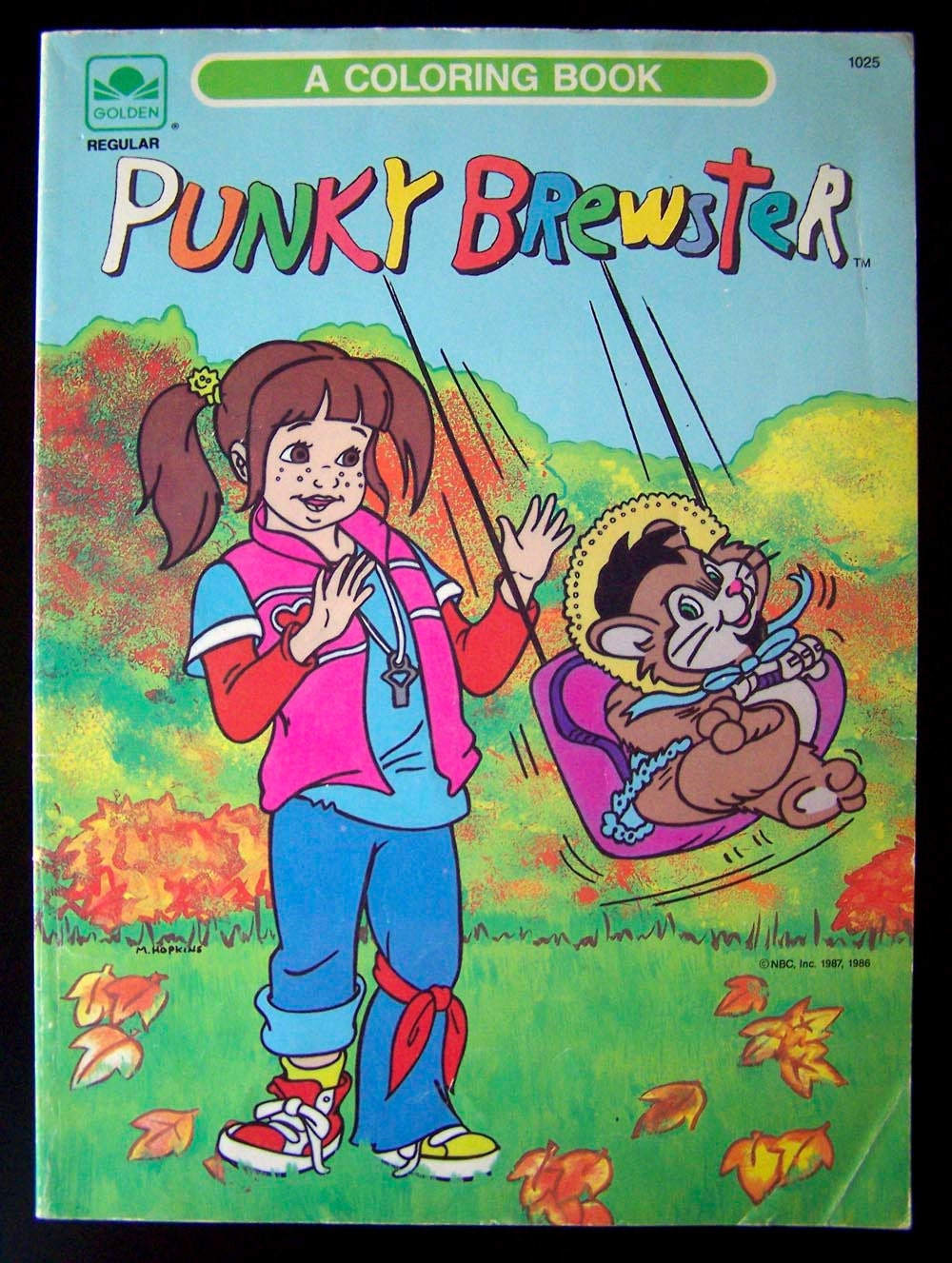
Penelope “Punky” Brewster (Soleil
Moon Frye) was a unique young girl whose father walked out on her and mother
abandoned her. She took residence in an empty apartment with her dog, Brandon,
where she was eventually discovered by the building manager, photographer and
curmudgeon Henry Warnimont (George Gaynes). Despite some personality conflicts
and the best efforts of social services to put her in a “better” environment,
she ended up becoming Henry’s adopted daughter. Punky’s friends included
neighbor Cherie Johnson (niece of the series creator who used her own name) and
her grandmother, Betty (Susie
Garrett, who was actually her grandmother), geeky Allen Anderson
(Casey Ellison), and stuck-up rich girl Margaux Kramer (Ami Foster).
Punky Brewster was created by
David W. Duclon with input
from NBC’s programming chief Brandon Tartikoff (for whom the
dog was named). Tartikoff’s involvement was what led to the lead character’s
unique name: taken from a childhood crush named Peyton “Punky” Brewster. NBC
secured the rights to use her name for the show and even hired her to do a
cameo in an episode (credited as Peyton
B. Rutledge, her married name). It was one of the first primetime shows
geared towards children, an intended audience that Tartikoff hoped would allow
them to compete against CBS’ 60
Minuteson Sunday nights, and one of the few featuring a female
lead. It would tackle the world from a kid’s perspective, dealing with issues
real kids would face in their everyday lives.
Punky with Cherie, Allen, Glomer, Brandon and Margaux.
The show ran for two seasons on NBC
between 1984 and 1986 and seemed to
be a hit with kids; with the production receiving up to 10,000 pieces of
fan mail a week and a high demand for merchandise. Unfortunately, it didn’t perform
as Tartikoff had hoped in the ratings and was cancelled by the end of the
second season. The show was quickly revived for syndication by Columbia
Pictures Television through their Coca-Cola
Telecommunications division and the third season went into production;
although it wasn’t broadcast until 1987. The series came to a final end in
1988, just in time for the Writers
Guild of America strike. While NBC still had the rights, they sought to
spin Punky off into two programs. The
first was Fenster Hall, named after
the foster home where Punky was placed at the end of the first season, which
never took off. The second was It’s Punky
Brewster (“It’s” was never seen in the actual title), an animated spin-off airing on Saturday mornings.
Poor Henry was kept in the dark.
It’s
Punky Brewster featured the entire Punky
cast reprising their roles with the exception of Garrett and T.K. Carter as Mike Fulton, a
resident-turned-administrator at Fenster Hall (and would-be star of the
unproduced series). They were joined by a new character: Glomer (Frank Welker).
Glomer was a magical being from Chaundoon, a city at the end of the rainbow. Glomer
used his powers to transport the kids to various places, gave Brandon the
ability to talk (courtesy of Welker), transformed the kids into statues or
shrank them, and sometimes just caused general chaos that he’d have to
straighten out. Glomer was added as a way to keep kids interested in the show,
as well as have the characters perpetually thrown in adventures befitting
Saturday mornings.
In 1985, various episodes were released on several VHS
tapes by Celebrity
Home Entertainment. Between 2004 and 2008, Shout! Factory released all
four seasons of the live show. Included as special features were episodes
of the animated series split between them. “The Shoe Must Go On” was the only
episode missing as Shout! ran into rights issues with the licensed song “Axel F” by Harold Faltermeyer. However,
in 2021 they released the complete
series with the indication that it included all episodes of the cartoon.
Cartoon Network’s Robot Chickenparodied
the cartoon in two episodes with Frye returning to voice her character. Seth Green took over as
Henry while Tom Kane filled in as Glomer.
In the wake of many pop-culture nostalgic revivals, NBCUniversal
revisited the idea of Punky Brewster by greenlighting production on a
new series in 2019 developed by Steve
and Jim Armogida. Rather
than a reboot, it was a continuation of the original focusing on an adult Punky
(still Frye) who was now a divorced mother of two, Diego (Noah Cottrell) and Daniel (Oliver De Los Santos), working
as a photographer (like Henry), and living once again in her childhood
apartment, and still marching to the beat of her own drum. Cherie was still her
best friend and now working at Fenster. Punky would also take in another
abandoned resident of Fenster, Izzy (Quinn Copeland).
Foster also reprised her role as Margaux for an episode. The series dropped all
10 episodes on February 25, 2021 on the streaming service Peacock. Unfortunately, the series failed to
garner much in the way of ratings or attention compared to other Peacock
offerings and was cancelled
just a few months later.
EPISODE GUIDE:
Season 1:
“Punky to the Rescue / The Quartrsize Quaterback” (9/14/85) – Punky
convinces Henry to take a photography job in a Florida swamp where they think
he catches a sea monster. / Glomer gives Allen the skills of a professional
football player.
“The Gold Rush / Phar Out Pharaoh” (9/21/85) – Glomer accidentally
frees an evil leprechaun. / Glomer takes the kids to ancient Egypt to return a
necklace Margaux has and she’s mistaken for a princess.
“Pretty Ugly / Glomer’s Story” (9/28/85) – Glomer changes Margaux’s
face just before a party. / Punky recalls the day she met Glomer.
“Brandon the Dialogue Dog / Winning Isn’t Everything” (10/5/85) – Glomer
allows Brandon to talk and he catches the attention of a magazine writer. / The
kids scheme on how to win a TV in a contest.
“Punky Wise and Pound Foolish / Christmas in July” (10/12/85) –
Brandon is locked in a pound after Punky spends his license money. / A trip to
Santa’s workshop leads to an accident that causes it to snow around the world.
“Return to Chaundoon / A Small Mistake” (10/19/85) – Glomer takes
Pinky to Chaundoon where they discover everyone asleep due to the theft of the
town’s clock. / Glomer’s drink causes the kids to shrink.
“Halloween Howlers / The Perils of Punky” (10/26/85) – Glomer changes
whoever doesn’t give him candy into a Jack-O-Lantern. / Glomer takes the kids
into an adventure movie.
“Glomer Punks Out / Louvre Affair” (11/2/85) – Glomer’s musical act
attracts the attention of a crooked record producer. / Glomer turns Henry into
a statue of Julius Caesar, and when he’s declared a forgery Punky must save him
before he’s destroyed.
“Growing Pain / Double Your Punky” (11/9/85) – Punky discovers that
pepperoni pizza makes Glomer grow. / Glomer creates a Punky clone to keep him
company and accidentally zaps the original back into the photograph he used.
“Spellbound / The Shoe Must Go On” (11/16/85) – Glomer zaps a bee and
it gives people the ability to spell words. / The school diva wants the magical
dancing shoes Glomer made Cherie.
“Switchin’ Places / How the Midwest Was Won” (11/23/85) – Allen
switches bodies with Glomer to impress a girl. / Glomer takes the kids to 1803
Chicago where a fur poacher tries to prevent the city’s development.
“Any Wish Way You Can / The Bermuda Tangle” (11/30/85) – Glomer’s
spell accidentally hits Margaux and she wishes she was a queen with everyone as
her servants. / Glomer takes the kids to a tropical island and loses his powers
after a coconut hits his head.
“Unidentified Flying Glomer / Fish Story” (12/7/85) – A pet groomer
chases after Glomer. / Glomer turns Punky into a mermaid to help her land a
part in the school play.
Season 2:
“Little Orphan Puny / Punky’s Millions” (9/13/86) – Punky is taken
from home and put into a home where girls are used as slave labor in a candy
factory. / Punky has to spend $1 million in a week so she and Henry can win a
game show.
“Punky, Snow White and the Seven Dwarves / Punky the Heiress”
(9/20/86) – Glomer brings the characters of Snow
White to life. / Punky’s aunt and uncle use her in an embezzlement scheme.
“Fair Feathered Friend / Be My Glomley” (9/27/86) – Glomer gets
jealous when Punky nurses a bird back to health. / A female glomley may help
Glomer get back to Chaundoon.
“All in Henry’s Family” (10/4/86) – Henry takes Punky and Cherie to
visit his eccentric sisters.
“Call Me Ms.” (10/11/86) – Glomer turns Punky into an adult.
“Punky P.I.” (10/18/86) – Punky decides to open a detective agency in
school.
“Mississippi Mud” (10/25/86) – Glomer takes the kids to an old
Mississippi riverboat.
“Punky’s Little Acre” (11/1/86) – Margaux visits Punky’s pen pal’s
farm and creates chaos.
“Camp Confusion” (11/8/86) – Camp Tumbleweeds takes on Camp Towering
Pines in an athletic competition.
“Bright Eyes” (11/15/86) – Cherie’s deaf friend wants to keep a lost
puppy.
“Mother of the Year” (11/22/86) – Glomer creates a mother for Punky.
“Allen Who?” (11/29/86) – Allen wishes he was never born and Glomer
grants it.
“Caught in the Act” (12/6/86) – Henry spots Glomer and Glomer gives
him amnesia just before an important photography assignment.
It’s not unusual for
people to look back on a certain era (usually when they were kids) with
fondness and fascination (heck, we’re living that now). For people of
the 1970s, that era was the 1950s. Garry
Marshall attempted to capture that nostalgic interest by creating a show
set in an idealized version of 1950s America. Unfortunately, the networks
passed on his pilot and it was used instead as an episode of the anthology
series Love, American Stylecalled “Love and the Television Set”
(later renamed “Love and the Happy Days” in syndication). The episode ended up
being used by George Lucas in
his decision to cast the pilot’s star, Ron Howard, in his upcoming 1950s movie,
American Graffiti.
After the success of Graffiti, Marshall and ABC recast and reshot the pilot and it was picked
up as the series Happy Days. The
sitcom originally revolved around the Cunningham family in 1950s Milwaukee,
Wisconsin. Howard returned as middle child Richie, as did Marion Ross as his mother Marion
and Anson Williams as one of
his best friends, Potsie Weber. Joining them was Tom Bosley as patriarch Howard, Gavan O’ Herlihy and then Randolph Roberts as older
brother Chuck (who was written off in the second season), Erin Moran as youngest daughter
Joanie, and Donny Most as Richie’s other best friend, Ralph Malph. The breakout
character, however, was initially a secondary one: Arthur Fonzarelli (Henry
Winkler), aka “The Fonz” or “Fonzie” to his friends. Fonzie was the
personification of cool: he wore a leather jacket (originally a windbreaker as
the network was concerned the leather would make him seem too shady) and rode a
motorcycle (which was always with him at first as he was allowed to wear the
leather jacket when riding it), could summon a legion of pretty girls with a
snap of his fingers, play the jukebox without any money, and when he spoke
everyone listened. Fonzie connected with audiences, and his role grew and
evolved to become the star of the show. Plots would begin to move away from the
family experiences in a 1950s backdrop to follow the antics of Fonzie and the
people he interacted with.
The original principal cast of Happy Days: Winkler, Bosley, Williams, Most, Moran, Ross and Howard.
Happy Days debuted on January 15, 1974, using Bill Haley & His Comets’
“Rock Around the Clock”
as its theme before adopting the more-recognized “Happy Days” by Norman Gimbel and Charles Fox. The series proved to be a success, although it would take a
few seasons for it to reach the top of the ratings charts. The show managed to
run for 11 seasons and became the launching point for several spin-off series:
Fonzie’s gal pals Laverne DeFazio (Penny
Marshall, Garry’s sister) and Shirley Feeney (Cindy Williams) became single
roommates working at a brewery in Laverne & Shirley;Initially appearing in a dream sequence,
the alien Mork from Ork (Robin
Williams) was given a human friend in Mindy McConnell (Pam Dawber) and his own show, Mork & Mindy; Howard
Cunningham’s cousin and former Las Vegas showgirl, Nancy Blansky (Nancy Walker), was the subject
of Blansky’s Beauties; After
Blansky’s cancellation, Scott
Baio’s character of Chaci was added to the Happy Days cast where he and Joanie eventually married and received
their own brief show, Joanie Loves Chachi;and finally, Angel-in-training
Random (Jimmy Brogan) acted as a
guardian angel for a family in Out of the Blue (although a scheduling error had the show debut
before the character’s technical first appearance on Happy Days).
Happy Days also became the origin of the phrase “jump the shark.” The phrase was
coined by Jon Hein in 1986 and is a term
used to describe when something in entertainment begins using desperate
attempts to keep viewers interested or boost ratings. It’s become the
indication that something has gone on long past its prime and the people behind
it are clearly running out of ideas. In the case of Happy Days, the term was quite literal as the
show had Fonzie jump over a shark on water skis during the fifth season
premier. Although the episode’s writer, Fred Fox, Jr., debated the
validity of that phrase considering the show ran an additional six seasons,
there was no stopping its entering into the American lexicon.
Fonzie, Mr. Cool, Cupcake, Richie and Ralph.
While the Happy Days universe was spread out all
over prime time, it was decided that wasn’t quite enough and the producers set
their sights on their younger audience on Saturday morning. Often viewed as one
of the show’s “jump the shark” moments, The
Fonz and the Happy Days Gang was produced by Hanna-Barbera and Paramount Network
Television and featured Fonzie, Richie and Ralph being whisked away in a
malfunctioning time machine by the magical future girl Cupcake (Didi Conn).
Also joining them was Fonzie’s new anthropomorphic dog, Mr. Cool (Frank
Welker). The three Happy Days cast
members supplied the voices for their animated counterparts (billed as “guest
appearances”), despite the fact that Howard and Most had left the main show at
the conclusion of the seventh season months before the cartoon premiered. The
characters were designed by Ruben
Aquino, Curtis Cim, Debbie Hayes,
Don Morgan
and Lew Ott.
Getting a Geico quote?
Debuting on ABC on
November 8, 1980, The Fonz and the Happy
Days Gang followed the characters as they travelled from one era to another
looking to return to 1957 Milwaukee. However, the faulty time machine and
Cupcake’s screwy magic usually ended up sending them farther and farther away
from their goal. Cupcake also used her magic to disguise themselves in loosely
era-appropriate attire (read: not very convincing disguises). Radio personality
Wolfman Jack, who had worked with Howard in American
Graffiti, was tapped to provide the opening narration for the program
explaining the overall plot to the audience over a backdrop of 50s-esque music
by Hoyt Curtin and Paul Dekorte. The show was
written by Duane Poole, Tom Swale, Diane Duane, Joan Brooker, Paul Haggis, Michael Maurer, Jeffrey Scott and Alexandra Stoddart. Poole and
Swale served as story editors with Barry Blitzer
and Ray Parker.
Chariots of fire.
The series ran for
two seasons. During the second season, a Laverne
& Shirley animated spin-off debuted called Laverne
& Shirley in the Army. Upon the conclusion of The Fonz, Fonzie and Mr. Cool were moved over to that show for its
8-episode second season where the show was renamed Laverne & Shirley with the Fonz. It aired alongside the
animated spin-off of Mork & Mindy as
part of the Mork & Mindy/Laverne & Shirley/Fonz
Hour. Originally,
Hanna-Barbera wanted to pair Fonzie up with Scooby-Doo,
but beyond some artwork
for the potential series no production had ever moved forward on it.
“King for a Day” (11/8/80) – The gang ends up in 1 Million B.C. where
Ralph is made the king for a day of a tribe of cave people, which could end up
costing him his life.
“May the Farce Be With You” (11/15/80) – The time machine and
Cupcake’s magic send the time machine to the moon in 2057 where the gang has to
foil an alien invasion plot.
“Arabian Knights” (11/22/80) – In ancient Iraq, the gang is enlisted
to help King Nebuchadnezzar
II rescue his Hanging Gardens from an evil prince.
“Bye-Bye Blackbeard” (11/29/80) – The gang has to help Blackbeard
find a lost treasure.
“Westward Whoa!” (12/6/80) – The gang ends up in the Old West and in
the company of Billy the Kid.
“Ming Fu to You, Too!” (12/13/80) – Cupcake uses her magic to defeat
an evil sorcerer and retrieve the Hongwu Emperor’s throne.
“The Vampire Strikes Back” (12/20/80) – The time machine finally ends
up back in 1957, but in Transylvania courtesy of Count Dracula.
“You’ll Never Get Witch” (12/27/80) – Cupcake is captured by a witch
hunter during the Salem
Witch Trials.
“The 20,000 Drachma Pyramid” (1/3/81) – Ralph falls in love with Cleopatra in
ancient Egypt.
“It’s a Jungle Out There” (1/10/81) – The gang has to save the Incas
from Francisco
Pizzaro.
“Gone with the Wand” (1/17/81) – The gang must rescue King Arthur
from the clutches of the evil Black Knight.
“Science Friction” (1/24/81) – Cupcake uses her magic to bring the
gang into Jules
Verne’s imagination.
“Greece is the Word” (1/31/81) – The gang has to save Hercules from Medusa.
Season 2:
“The French Correction” (9/12/81) – In 1625 France, the gang has to
find the missing king while protecting the queen from an evil count set on
conquering the kingdom.
“The Ridiculous Renaissance” (9/19/81) – The gang ends up in Italy
where they meet Leonardo da Vinci.
“Fonz Boone” (9/26/81) – Ending up in the days of the American
frontier leads the gang to save the legend of Daniel Boone.
“Haiku Humor” (10/3/81) – In 17th Century Japan, the gang
meets poet Matsuo
Basho and Ralph is challenged to a samurai showdown.
“It’s All Downhill From Here” (10/10/81) – The time machine ends up at
the 1953 Mount Everest Expedition led by Sir Edmund
Hillary.
It’s Prime Time Spin-Off Month on Saturday
Mornings Forever.
When a show or character becomes
popular enough, the creators or network look to expand their franchise by
producing a spin-off. Saturday mornings were no different, as networks would
always be looking for a way to attract younger viewers to their various properties.
As a result, a good number of prime time programs, usually sitcoms, had an
animated counterpart airing at or around the same time.
This month, we’ll be looking at
those animated counterparts to some of your favorite shows. Heck, maybe we’ll
even bring up a few shows you didn’t even know got the Saturday treatment.