Remember that one day when you could wake up without an alarm? When you would get your favorite bowl of cereal and sit between the hours of 8 and 12? This is a blog dedicated to the greatest time of our childhood: Saturday mornings. The television programs you watched, the memories attached to them, and maybe introducing you to something you didn't realize existed. Updated every weekend.
Among his many founded cable networks was Cartoon Network, whose airtime
was populated by the acquired libraries of MGM/United Artists, Hanna-Barbera
and Ruby-Spears. His environmental initiatives resulted in the creation of Captain
Planet and the Captain Planet Foundation.
Knight Rider burst
onto the scene in 1982. The series was about a lone man, Michael Knight (David Hasselhoff), travelling
around and doing good wherever he wound up. His partner in these endeavors was
a technologically advanced Pontiac
Trans Am, the Knight Industries Two Thousand—or K.I.T.T.
K.I.T.T. was nearly indestructible, could perform amazing feats at the push of
a button, and was in possession of an advanced artificial intelligence (voiced
by William Daniels) that
could allow it to operate autonomously when needed. Critics found the concept
unbearably silly, but audiences showed up and allowed it to run for four
seasons. In the wake of its success, an imitator was inevitable.
Promotional artwork of Brett changing into his car form.
That came
in the form of Ruby-Spears
Productions’ Turbo Teen. However, rather than give a character an
intelligent super car, they decided to make the character the
intelligent super car. The series centered on teenager Brett Matthews (Michael
Mish) who was out joyriding when a lightning strike sent him barreling into a scientific
experiment. Exposed to a molecular beam invented by Dr. Chase (Pat Fraley) for
a government agent named Caldwell (Clive Revill), Brett became fused with his
car and was able to transform into it when exposed to heat. He not only
retained his full faculties as the car, but could move at will and perform an
almost limitless number of stunts far beyond the realm of physics. He could
only transform back to human form after being exposed to the cold. As this
change was involuntary, it often happened at inopportune times.
Brett micro-sized with Alex, Rusty and Pattie.
While Chase
and Caldwell worked to find a permanent cure, they decided to put his new
abilities to use and sent him to investigate local mysteries or put a stop to
criminal activity around the world under the codename Turbo Teen. Joining him
on his adventures was his girlfriend, freelance reporter Pattie (Pamela
Hayden), his best friend, mechanic Alex (T.K. Carter), and his dog, Rusty
(Frank Welker). A recurring villain was the unseen Dark Rider (Welker); a
master of disguise that plagued the Turbo Team in an advanced monster truck of
his own design. The Dark Rider had apparently designed a supercar that
resembled Brett’s and sought revenge for what he believed was his stolen
design. Additionally, their classmates from Hillmount High, Eddie (Fraley) and
Flip (Welker), would cause the Turbo Team some trouble by being typical
dim-witted bullies constantly looking to show up Brett and his car.
Just a car enjoying some arcade games.
The Knight
Rider inspiration was very evident. Aside from being self-driving, Brett’s
car and his car form was very much modeled after a 1984 Trans Am; however
colored red instead of black. To avoid a lawsuit from General
Motors or paying them a licensing fee, the car did have some differences: the
tail lights were reminiscent of the third generation Chevrolet
Camaro, the pop-up headlights were removed with the turn signals serving as
the headlights, and the center roof bar that would make it a T-top was removed
(however, the official
press photo was not shy about showing a very clearly black Trans Am). As with K.I.T.T.,
a voice modulator was present on the dashboard that reacted to whenever Brett spoke
in car form; however, it was located in the lower center rather than over the
wheel and was represented by a horizontal line and waves instead of vertical
lines (or a flashing box, in Knight Rider’s earlier episodes). The Dark
Rider having a connection to Brett’s vehicle form and driving his own much
larger super vehicle was similar to the character of Garthe Knight
(Hasselhoff), the evil son of K.I.T.T.’s creator who drove a souped-up semi-truck
named Goliath. Not
to mention that Brett just happened to be driving the exact make and model of a
super car that was already in development (before meeting K.I.T.T., Michael
Knight drove a regular black Trans Am in the series pilot). Then there was the
fact that in car form, Brett could pull of impossible stunts (more so than even
Knight Rider, since they didn’t have to worry about the expense of
replacing actual cars) and was seemingly indestructible.
The original concepts for Cary Becomes a Car by Jack Kirby.
The concept for the series started
out a bit differently. Originally pitched as Cary Becomes a Car, the
legendary Jack Kirby whipped
up several concept sketches. Under Kirby, the series had a decidedly more
action flare. Cary was still a teenager, but his transformation appeared to be
more deliberate. Although it was written that Cary transformed into a Camaro,
the car he drew more closely resembled a Ford Mustang. This sketch was featured
in the biographical graphic novel Jack
Kirby: The Epic Life of the King of Comics by Tom Scioli during the section on Kirby’s
Ruby-Spears tenure. There were also concepts for several villains—many with
car-themed names: Mogal, the Magi-Mechanic was a sorcerer that carried around a
magic tool box; Super Sonica was a super-speed witch; Hot Rodney Rumpkin was an
overweight race car driver always in the company of his butler, Dingy
Doolittle; and Barney Brannigan, a leprechaun-esque figure that conjured up
crazy obstacles for drivers. Most notable was Speed Demon, described as a
“sinister driver of unknown origin shadows hero”. He seemed to be the prototype
for what would become The Dark Rider—albeit minus being an actual demon.
Additional Kirby sketches have surfaced showing the slow evolution from Cary
Becomes a Car into Turbo Teen, including depictions of Brett
as a hatchback encountering more science-fiction fare; Brett as a sportier-looking
car surrounded by a legion of human characters and early versions of Pattie
and Rusty; and Pattie
and Alex riding in Brett’s final form while evading some unusual-looking
enemies (under the name Turbo-Teens). Along with Kirby, characters were
designed by Duncan Marjoribanks,
Doug Wildey and Thom Enriquez.
ABC had
originally planned to have certain shows within its 1984 line-up—Turbo Teen
being one, The Mighty Orbots another—include a faux 3D effect. This was
accomplished by producing those programs with a higher percentage of moving
overlays and underlays panning at different speeds, coupled with a pair of 3D
glasses that had one polarized lens and one blank lens to give the illusion of
depth. Turbo Teen’s 3D sequences were signaled by flashes within the
show to indicate when to put on and take off the glasses. However, story
director Tom Minton stated
that ABC was told by
their legal department at the last minute that they couldn’t promise every
viewer that experience or supply enough free glasses to viewers. As a
result, all advertising about the gimmick had to be dropped and those became
very expensive and pointlessly elaborate sequences.
The Dark Rider's monster truck.
The novel
notion of a kid turning into a car was ultimately failed by its execution. Retrospectives
about Turbo Teen would sum up its problems as having poor scripts, even
worse animation, and a nightmare-inducing transformation sequence whenever
Brett changed. Storyboard supervisor James
Woodring would go on to lambast the series
as “one of the masterpieces of s--t” in various interviews; a sentiment he
claimed was shared by others in Ruby-Spears’ employ at the time. Viewers and
the network seemed to back up his estimation as Turbo Teen was cancelled
by the end of its sole season.
Rolling down the roller coaster tracks.
Not much
was released in terms of merchandise for the show. There was a coloring book
published by Golden,
and a transforming model kit by Monogram that was originally
made for the product-exclusive GoBots
character Trans
Am. The model was a stock Trans Am complete with a decal of the trademark Screaming
Chicken graphic for the hood. However, it could be changed into a humanoid
body. The Turbo Teen version got a new head sculpt
representing Brett. None of the episodes have been released to home media
legally in North America, although some can be found on video hosting sites
like YouTube. Internationally, at least 6
episodes have been released
on VHS.
Cold soda about to change Turbo Teen back into Brett.
EPISODE GUIDE: “Turbo Thieves” (9/8/84) – A pair of thieves learn of Turbo
Teen’s existence and plot to kidnap him to make themselves rich. “The Dark Rider” (9/15/84) – The Dark Rider pursues Turbo
Teen while he participates in an exhibition. “Mystery of Fantasy Park” (9/22/84) – Turbo Teen and his
friends investigate strange goings on at a local amusement park. “No Show UFO” (9/29/84) – Agent Cauldwell tasks the Turbo
Team with investigating UFO sightings. “Micro-Teen” (10/6/84) – Dr. Chase’s team creates a shrink
ray that will allow the Turbo Team to go on an infiltration mission. “The Sinister Souped-Up Seven” (10/13/84) – His friends must
help Brett get over his amnesia while preventing the destruction of a mission
on a reservation. “Video Venger” (10/20/84) – The Turbo Team discover an
arcade game is a training program for an invasion on Washington, D.C. when the
war machines inside it come to life. “Dark Rider and the Wolves of Doom” (10/27/84) – Dark Rider
kidnaps a scientist whose formula can regress dogs to their primitive state. “The Curse of the Twisted Claw” (11/3/84) – The Turbo Team
heads to India to stop an archaeological discovery from unlocking a weapon of
great destruction. “Daredevil Run” (11/10/84) – The Turbo Team enter a
cross-country race as a cover to get a witness to court to testify against a
jewel thief. “The Amazon Adventure” (11/17/84) – A trip to the Amazon
sees the Turbo Team and Brett’s father embroiled in a conflict with a local
thug. “Fright Friday” (11/24/84) – A campfire story about a local
legend comes true and endangers the Turbo Team’s friends. “The Mystery of the Dark Rider” (12/1/84) – Turbo Teen must
clear his name after a clone robs a bank while also uncovering the identity of
the Dark Rider once and for all.
THE PUPPY’S NEW ADVENTURES / THE
PUPPY’S FURTHER ADVENTURES / THE PUPPY’S GREAT ADVENTURES (ABC, September 25,
1982-October 29, 1983) Ruby-Spears
Enterprises, Hanna-Barbera Productions (season 1)
Catherine Woolley was a
prolific writer best known for her children’s books under both her name and her
pen name, Jane Thayer. Her first book, I
Like Trains, was published in 1944 and her last, Writing
for Children, in 1989. Within that 45-year timeframe, she had penned 87 children’s books,
including 1958’s The
Puppy Who Wanted a Boy. It was the story of a puppy named Petey who
wanted a little boy of his own for Christmas in a town where they were in short
supply. After trying and failing to convince several dogs to give up their
boys, he would eventually find Ricky at an orphanage, and found himself with
not one but many boys.
The original book.
20 years
later, the book got a second life as it was one of the ones chosen for an
adaptation into an episode of the anthology series ABC
Weekend Specials. Produced by Ruby-Spears Enterprises,
it followed Beagle mix Petey
(Todd Turquand), the only
member of a litter not to be adopted, as he searched for a boy of his own. Like
the book, he tried to convince a couple of dogs to give up their boys to no
avail. In order to expand the story to a full 22-minutes, Barbara Avedon and Barbara Corday added Petey
encountering two dog bullies and foiling their attempt to steal food; escaping
capture from a cruel dog-seller with a group of strays; and attempting to pass
himself off as a toy dog so a boy and his mother would buy him. He finally
found his boy, now named Tommy, at the orphanage.
The original special title card.
The episode performed well enough
to not only earn Ruby-Spears its first Emmy
nomination, but gained something the book itself never did: sequels. “The
Puppy’s Great Adventure” saw Petey (now Bryan Scott) have to win over
Tommy’s dog-hating adoptive parents. “The Puppy’s Amazing Rescue” had Petey and
his friend/love interest, a Cocker Spaniel mix
named Dolly (Nancy McKeon), try to avoid dangers while getting help for their
humans trapped in an avalanche. “The Puppy Saves the Circus” gave Petey (now Sparky Marcus) amnesia and saw
him becoming a breakout performer in a struggling circus.
Dash, Duke, Lucky, Dolly and Petey.
With the
sequels also being well-received, and reruns of the original still getting high
ratings, ABC decided to take things to the
next level and greenlight a full animated series. Dubbed The Puppy’s New
Adventures, Petey’s (now Billy Jacoby) family decided to move overseas by
ship and took Dolly with them. Stowing away were Petey’s friends from his days
as a stray: Duke (Michael Bell), a German shepherd/Labrador Retriever
mix who looked after the group; Dash (also Bell), a sleek and speedy Greyhound who was both the
smartest of the group and also the most cowardly; and Lucky (Peter Cullen), a
big and strong St. Bernard
who was a little light in the brains department. A freak storm washed the dogs
overboard and they had to journey through various counties looking for Tommy
(Tony O’Dell) and his parents. Along the way, they encountered people (understanding
them perfectly, although they couldn’t speak back) or animals who needed their
help before they could move on to the next destination. Each episode featured
an opening narration by Petey setting up the circumstances of their upcoming
adventure.
The
Puppy’s New Adventures debuted on ABC on September 25, 1982. Inexplicably,
it was combined with the dissimilar Scooby-Doo
and Scrappy Doo (1980) in a block called The Scooby & Scrappy-Doo/Puppy
Hour. Hanna-Barbera,
makers of Scooby-Doo, and Ruby-Spears were both owned by the same parent
company, Taft
Broadcasting, and Joe Ruby
and Ken Spears
were former employees of Hanna-Barbera and the creators of Scooby-Doo.
While Hanna-Barbera continued the pre-production and voice-over work for their
half of the block, Ruby-Spears handled the actual production of the entire
program, resulting in some of their unique sound effects library being heard in
the Scooby segments. The series was written by Mark Jones, Buzz Dixon, Diane Dixon, Jack Enyart, Steve Gerber and Gary Greenfield, with Jones
serving as executive story consultant and Michael Maurer as story editor. Dean Elliott and Hoyt Curtin were the musical
directors, with Paul DeKorte
as the musical supervisor.
The series
was renewed for a second season, this time airing independently as The
Puppy’s Further Adventures. The globe-trotting storyline was ended in a
two-part episode resulting in Petey being reunited with his family and his
friends being adopted by them. Their new adventures usually involved joining
Tommy as his father (John Stephenson) went on scientific expeditions or visited
friends. A new recurring dog character was introduced named Glyder (Josh Rodine), whose enormous
ears caused him to constantly trip when on the ground, but allowed him to glide
in the air. Writers for this season included Jones, Gerber, Flint Dille, Michael J. Reaves, Marc Scott Zicree, Janis Diamond, Martin Pasko and Sheldon Stark, with Diamond
serving as story consultant. Although no new episodes were made for the third season,
a third season of reruns did air as The Puppy’s Great Adventures from
September 8-November 10, 1984. Great Adventures would return for a final
run on CBS from September 13-November 8,
1986.
Ad for CBS Saturday morning's initial 1986 line-up.
“The Treasure of the Ancient Ruins” (9/25/82) – NO SYNOPSIS
AVAILABLE.
“The Puppy’s Dangerous Mission” (10/2/82) – The dogs must
keep a serum meant to heal an ailing young king out of the hands of enemy
spies.
“An American Puppy in Paris” (10/9/82) – NO SYNOPSIS AVAILABLE.
“The Puppy and the Pirates” (10/16/82) – NO SYNOPSIS AVAILABLE.
“The Mystery of the Wailing Cat” (10/23/82) – NO SYNOPSIS AVAILABLE.
“The Puppy’s Australian Adventure” (10/30/82) – NO SYNOPSIS
AVAILABLE.
“Puppy and the Reluctant Bull” (11/6/82) – The dogs must
rescue a gentle bull that has been abducted to participate in a bullfight.
“The Puppy’s Hong Kong Adventure” (11/13/82) – NO SYNOPSIS AVAILABLE.
“Honolulu Puppy” (11/20/82) – NO SYNOPSIS AVAILABLE.
“The Puppy’s Great Escape” (11/27/82) – The dogs attempt to
reunite a grandmother separated from her grandchildren by the Berlin Wall.
“The Puppy’s Great Race” (12/4/82) – NO SYNOPSIS AVAILABLE.
“The Puppy’s Amazon Adventure” (12/11/82) – NO SYNOPSIS AVAILABLE.
“Petey and the 101 Seals” (12/18/82) – The dogs must protect
a baby seal from some poachers.
Season 2:
“Glyder, the Misfit Puppy” (9/10/83) – The dogs try to keep
a puppy with enormous ears from becoming a sideshow attraction.
“Puppy Goes Home” (9/17/83) – Thieves kidnap Petey’s family
to get inside a top-secret government crate.
“Puppy and the Badlands” (9/24/83) – Petey’s family goes on
an archaeological dig where bandits happen to be looking for lost Civil War
gold.
“Puppy in Omega World” (10/1/83) – Tommy and the dogs are
taken on a tour of futuristic theme park Omega World where things are
mysteriously going haywire.
“Puppy and the Spies” (10/8/83) – Duke, Dash and Lucky get
themselves “recruited” into the scheme of enemy spies looking to steal plans
from NASA.
“Puppy Goes to College” (10/15/83) – Glyder ends up
performing at Tommy’s father’s old college where a plot is in the works against
the governor.
“Puppy and the Brown Eyed Girl” (10/22/83) – NO SYNOPSIS AVAILABLE.
“Biggest Diamond in the World” (10/29/83) – Tommy ends up
kidnapped by a pair of jewel thieves whose crime he stumbles across.
Born
Laurence Tureaud, Mr. T was the youngest son in a family of twelve children in Chicago, Illinois. Having grown
up facing constant lack of
respect because of the color of his skin--hearing his father, uncle and
veteran brother constantly called “boy”--he legally changed his name in 1970 to
“Mr. T” so that “the first word out of everybody’s mouth is ‘Mr.’” He played
football, wrestled and studied martial arts at Dunbar
Vocational High School and became the citywide wrestling champion two years
in a row. He won a football scholarship to Prairie
View A&M University where he majored in mathematics, but was expelled
after a year.
Fools, consider yourself pitied.
1975 saw
Mr. T join the Army’s Military
Police Corps for several years before trying out of the Green Bay Packers football team, but a knee
injury kept him out. Instead, he became a bouncer for the club Dingbats
Discotheque where the Mr. T persona began to take shape. He started wearing
gold chains adorned with various pieces of jewelry that essentially served as a
“lost and found” box; the items typically left behind by patrons after a fight
broke out who could then reclaim them from him without going back into the
club. They were also meant to represent the chains that were used to bring his
ancestors to the country and held them down. While reading National Geographic, Mr.
T noticed the hairstyle on a Mandinka warrior
and decided to adopt it as his own as a simpler, more permanent visual
signature and a powerful statement about his African origins. His tenure as a
bouncer led to his also becoming a bodyguard whose reputation garnered him
clients such as Steve McQueen,
Michael Jackson, Muhammad Ali,
Diana Ross, Joe Frazier and
more.
B.A. Baracus and his signature van.
In 1980,
Mr. T took part in NBC’s Games People Playin
the “America’s Toughest Bouncer” competition,which he won by knocking
out Honolulu bouncer Tutefano Tufi in a
boxing match. This caught the attention of Sylvester Stallone, who had Mr. T
cast as the antagonist Clubber Lang in Rocky III. It was
this film that introduced his catchphrase: “I pity the fool!” He appeared again
as a boxer in the film Penitentiary
2and then in a
bit on the sketch comedy series Bizarrewith Super
Dave Osborne (Bob Einstein) before
landing a starring role as Sergeant Bosco “B.A.” Baracus on the series The A-Team. The
series was a massive hit in its first three years, and Mr. T became the most
popular character on it—especially with children.
Animated Mr. T helping out one of his charges, Kim.
What better
way to capitalize on that than with a cartoon centered around Mr. T? Then-network
president Brandon Tartikoff
ordered one from Ruby-Spears
Enterprises. Steve
Gerber and Martin Pasko
were given the assignment and came up with three different proposals for the
network. None of them, however, were selected. Instead, the show became yet
another in a long line of Scooby-Dooclones (almost fitting, as Joe
Ruby and Ken
Spears were the original co-creators of that successful franchise during
their tenure at Hanna-Barbera).
However, instead of a talking dog, Mr. T would be joined by the youth
gymnastics team that he coached. This emulated real life as, before joining the
Army, Mr. T had worked as a gym instructor for a government program where he
discovered a gift for helping children and continued to do so throughout his life
and career. Not only did Mr. T voice himself, but he appeared in live-action
segments at the beginning to introduce the story and at the end to deliver a moral lesson
to the audience.
Mr. T and his crew (clockwise from top left): Ms. Bisby, Kim, Jeff, Woody, Vince, Robin, Spike, Dozer and Garcia.
Mr. T and
the team would travel around the world to compete. Along the way, they would
end up encountering some kind of crime or mystery that they couldn’t help but
attempt to solve; such as the wreckage of a ship that doesn’t exist, spies
seeking to sabotage the space shuttle program, and even a relative of one of
the characters being framed. The team consisted of Robin O’Neill (Amy Linker),
the second-in-command eager to jump into situations; Spike O’Neill (Teddy Field
III), Robin’s little brother who worshiped Mr. T to the point he dressed and
talked like him; Jeff Harris (Shawn Lieber), a wise guy with a big ego; Woody
Daniels (Phil LaMarr in his first voice acting role), Jeff’s friendly rival
with aspirations of becoming a lawyer; Kim Nakamura (Siu Ming Carson), who
possessed a photographic memory; Sky Redfern (Cathy Cavadini in her first voice
acting role), a Native American; Garcia Lopez, an aspiring photographer; Vince
D’Amato, who wanted to be a movie star; Courtney Howard, who had an ex-con
uncle that turned into a magician; and Grant Kline, an ex-gang member Jeff
helped reform. Additionally, there was Ms. Priscilla Bisby (Takayo Fischer), their
mystery book-loving bus driver, and Bulldozer aka Dozer, Mr. T’s bulldog that
shared his taste in hairstyles.
“Mystery of the Golden Medallions” (9/17/83) – Woody tries
to adjust to being the new member on the team while they solve the mystery of
crooks smashing gold medals around town.
“Mystery of the Forbidden Monastery” (9/24/83) – After being
invited to a phantom competition, members of the team begin disappearing when
they investigate a nearby monastery.
“Mystery of the Mind-Thieves” (10/1/83) – The team
investigates who robbed the minds of a group of scientists that includes Kim’s
father.
“Mystery of the Rocky Mountain Express” (10/8/83) – Garcia
ends up exposed to a top-secret virus smuggled onto the team’s train by some
criminals.
“The Hundred-Year-Old Mystery” (10/15/83) – The team wants
to set up a gymnastics camp in Mississippi, but a local gang intends to stop
them.
“The Crossword Mystery” (10/22/83) – Solving a crossword
puzzle’s clue leads Ms. Bisby into discovering a word that puts her and two
professors into a trance.
“The Ninja Mystery” (10/29/83) – Vince is interested in a
movie location in New York City not too far from where mysterious ninjas are
robbing stores.
“Dilemma of the Double-Edged Dagger” (11/5/83) – The team
must clear Mr. T’s name when he’s arrested for robbing a museum.
“Secret of the Spectral Sister” (11/12/83) – While visiting
her family, Robin gets a mysterious call from her thought-dead sister just as
burglars break into her bedroom to look for something.
“Mystery of the Silver Swan” (11/19/83) – Investigating a
classic car leads the team to discover a counterfeit car ring.
“Case of the Casino Caper” (11/26/83) – Courtney gets the
team in trouble when she attempts to take down a pair of casino robbers on her
own.
“Fade Out at 50,000 Feet” (12/3/83) – Jeff’s cousin goes
missing from an air show while Woody falls for a shady woman named Vanetta.
“Riddle of the Runaway Wheels” (12/10/83) – Crooks have
their sights set on the Turbo Team’s prize stunt car to help them acquire their own prize.
Season 2:
“Mystery in Paradise” (9/15/84) – Despite a loss, the team
enjoys their time in Hawaii until a confrontation with pirates tests Courtney’s
fear of water.
“Mystery of the Black Box” (9/24/84) – After recovering a
black box from a downed supersonic jet, the team is being pursued by a group
that wants it back.
“Mystery of the Panthermen” (9/29/84) – The team
investigates an island in San Francisco where people are being frightened away
and abducted from.
“Mystery of the Ghost Fleet” (10/6/84) – While Mr. T
investigates a ship that doesn’t exist, Kim puts herself on a crash diet for an
upcoming meet that takes its toll on her.
“Mystery of the Ancient Ancestor” (10/13/84) – The team
works to get to the bottom of why the family that owns the town they’re in has
a grudge with Skye’s family.
“Magical Mardi Gras Mystery” (10/20/84) – Everyone suspects
Courtney’s criminal-turned-magician uncle when a jazz singer’s diamonds
disappear.
“Mystery of the Disappearing Oasis” (10/27/84) – Mr. T
braves his fear of flying so the team can go with Kim to meet her pen pal, who
just happens to end up abducted over her necklace.
“Fortune Cookie Caper” (11/3/84) – When a string of arson
attacks affects Jeff’s parents’ bookstore, the team investigates.
“U.F.O. Mystery” (11/10/84) – Woody’s stubbornness to avoid
getting glasses hinders the team and their investigating when their professor
friend ends up kidnapped by…aliens?
“Mystery of the Stranger” (11/17/84) – The team attempts to
rescue Spike after he’s abducted by a married couple.
“The Cap Cod Caper” (11/24/84) – When Spike accidentally
takes attention away from her victory, Robin attempts to top him and ends up
captured by oil smugglers.
Season 3:
“They Williamsburg Mystery” (9/14/85) – While restoring an
old house, the team get embroiled in a mystery of two colonial soldiers looking
for a buried secret diary.
“Mission of Mercy” (9/21/85) – The team must recover a cargo
ship full of donated goods from a team of mercenaries.
“Mystery of the Open Crates” (9/28/85) – Mr. T helps out an
old friend keep his youth center out of the hands of drug dealers while
Courtney learns a lesson about meeting one’s heroes.
“The Playtown Mystery” (10/5/85) – Nobody believes Spike
when he tries to point out that two amusement park mascots are acting
suspiciously.
“The Comeback Mystery” (10/12/85) – The team’s newest member
has connections to a gang and are using his past with them to keep him quiet
about their activities.
“The Cape Kennedy Caper” (10/19/85) – While visiting Cape
Canaveral, Robin stumbles upon two spies with plans to blow up the space
shuttle in orbit.
New Gottlieb programmer Warren Davis was
looking for ways to practice his craft; particularly randomness and gravity
mechanics. He came across artist Jeff
Lee’s doodles of characters and concepts he had been drawing since
childhood and asked if he could use them in his efforts.
The resulting game is what would
eventually be known as Q*bert. The player controlled the titular
character, a round creature with no arms and a long nose, as they moved him
diagonally around various pyramids comprised of cubes designed to give the
illusion of being in 3-D, inspired by the works of M.C. Escher. The player was tasked with
changing each cube to a target color by jumping on them—a suggestion from vice
president of engineering Ron
Waxman—while avoiding enemies and jumping off of the pyramid into the black
void that filled up the rest of the screen.
Flyer describing Q*bert and its characters.
Those enemies included Coily, a
purple snake that hatched from an egg that bounced down the pyramid and
actively pursued Q*bert; Ugg and Wrongway, two purple creatures that moved up
the sides of the pyramid to the top until they fell off; and Slick and Sam (a
play on “spick and span”), two green creatures that descended on the pyramid
and reverted the colors of blocks Q*bert already changed. Additionally, there
were bouncing balls: a red one that would kill Q*bert on contact, and a green
one that would immobilize enemies for a brief period. Additional help came in
the form of multi-colored discs located near the bottom of the pyramids that
could bring Q*bert quickly back to the top in order to escape enemies (if Coily
was close enough, this would cause him to leap off the pyramid in pursuit).
Whenever Q*bert ran into something that hurt him, a word balloon would appear
with “@!#?@!” in it accompanied by a gibberish voice sample designed by audio
engineer David Thiel when
he was unable to create coherent English phrases on the synthesizer he was
using (meant to be gibberish, not swearing). Falling deaths were
accompanied by a thud created by a pinball machine spring hitting the inside of
the game cabinet; a contribution from technician Rick Tighe.
Flyer touting Q*bert's success.
Davis began working on the game in
April of 1982, and several months later it became an official Gottlieb project.
Most of the decisions in the crafting of the game came from Davis’ desire to
keep it simple for himself, as well as try to keep it simple for players. He
championed his unusual directional controls against strong opposition, feeling
players would appreciate their simplicity. While initial test audiences did
find it difficult at first, many were able to adapt. The battle Davis lost,
however, was in the game’s challenge level as Gottlieb had him make it slower
and easier. The biggest hurdle, however, was the game’s name. Throughout its
development it was given the unofficial title “Cubes”. Lee wanted to call it Snots
and Boogers after the original concept of Q*bert firing “mucus bombs” from
his nose, which Davis did away with because of its complexity to program. It,
along with a list of suggestions from various employees, was discarded. Vice
president of marketing Howie Rubin pushed for @!#?@! to become the
official name, with some test cabinets being released emblazoned
with it. This was rejected as a silly notion as nobody could pronounce it.
Eventually, it was decided to name it after the character, with “Hubert”
becoming a strong contender. The name was ultimately combined with “Cubes” to
become “Cubert”, and art director Richard Tracy stylized it as “Q-Bert”, with
the hyphen eventually giving way to the asterisk.
Attempting to expand the Q*bert empire.
Q*bert
was
officially released between October and December of 1982, becoming Gottlieb’s
fourth title and only critical and commercial success with the sale of around
25,000 cabinets. It was among the 13
highest-grossing arcade games of 1983, and was widely merchandised with the
character appearing on coloring
books, board games
and toys.
A flyer
released by Gottlieb boasted that the game was included on over 125 different
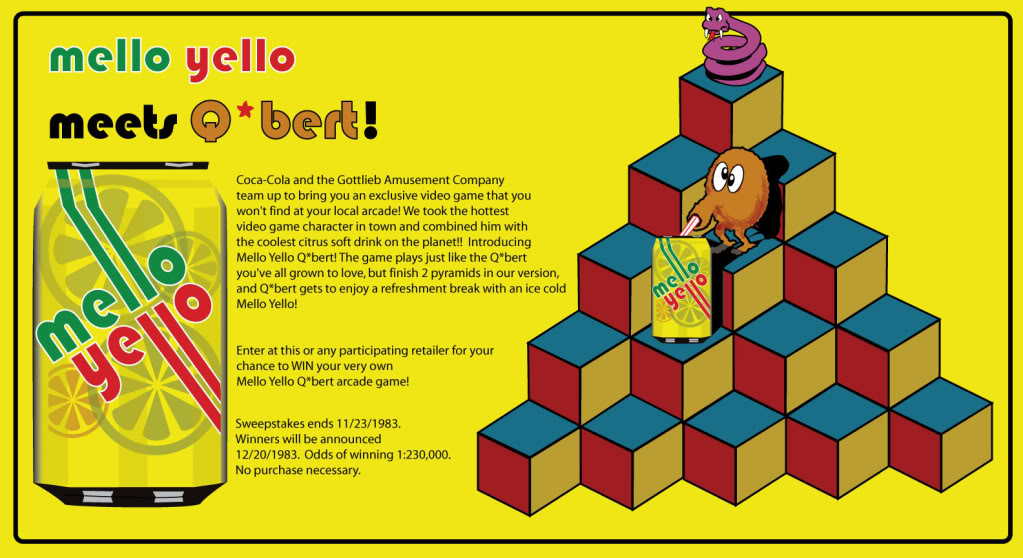
products. A variant version of the game cross-promoting Mello Yello, Mello Yello
Presents Q*bert, was released as a sweepstakes
prize; with Gottlieb hosting a competition that would net a player 5 cases
of the soda if they finished the game 10 times and sent a picture of Q*bert
drinking it in the new cutscene. Gottlieb, at the time, was owned by Columbia Pictures
who in turn was owned by Coca-Cola,
the makers of Mello Yello. Gottlieb would also translate the game into a
pinball machine called Q*bert’s Quest, but that only performed well in
Japan.
Q*bert with Q*tee and Q*ball in the car, Slick and Sam, and Q*bit.
Q*bert saw the titular
character (Billy Bowles) as a high schooler—with arms!—in the town of Q*burg. It
was a 1950’s-inspired world full of cube shapes (food, plates, records, even
the buildings were cubes stacked on cubes) with names either containing the
word “cube” or beginning with “Q*” (the asterisk was often replaced visually by
the original hyphen). He was joined by a cast of new characters: his
girlfriend, Q*tee (Robbie Lee); his little brother, Q*bit (Dick Beals); his
laid-back and constantly hungry friend, Q*ball (Frank Welker); Valley girl
Q*val (Lee); and monstrously-strong Q*mungus (Welker).
Coily with Wrongway, Ugg and Viper.
While
the town was primarily populated by “nosers”, there were some that stood out;
particularly snake Coily (Welker) and his gang of bullies: dim-witted Ugg and
Wrongway (Welker) and his girlfriend, Viper (Julie McWhirter, impersonating Mae West). Coily and Ugg were
dressed like greasers,
while Wrongway wore tattered clothing and looked ferociously monstrous. Slick
and Sam (both Welker) were also present, but they were more well-meaning
troublemakers and friends of Q*bert’s rather than enemies (although, with
friends like those…).
Wrongway and Ugg always causing trouble.
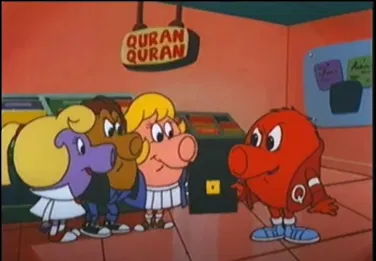
Most
stories centered around Q*bert and his friends hanging out at school, Cube
Pizza or the Sweet Shoppe (complete with a row of arcade games) and engaging in
various activities with each other and around town while Coily and his gang
always sought to disrupt their fun or show them up through underhanded means
and pranks. Reintroduced was the original concept of Q*bert firing projectiles
from his nose; in this case his “Slippy-Doos”, black balls that turned into oil
slicks and tripped up enemies. In keeping with the games, the rainbow discs
were present as the equivalent of skateboards (or, more accurately, the hoverboards
eventually seen in Back
to the Future Part II) and the surface of objects changing color when Q*bert
bounced on them during a chase (although an explanation for the color change
was ever given, nor acknowledged). Also, whenever Q*bert ended up hurt or
annoyed, he would get his signature word balloon and the gibberish dialogue
would be played.
Hanging out at the music story with Q*val.
Q*Bert
made
its Saturday Supercade debut on October 1, 1983 after two episodes of Pitfall!
aired in a row. It was primarily written by story editor Gary Greenfield, with
additional writing from Tony
Benedict and Kayte Kuch.
The Supercade theme was composed by Haim Saban
and Shuki Levy,
while the Q*bert theme was done by John Bahler
and Rick
Segall. When Supercade was renewed for a second
season, Q*bert was the only returning feature along with Donkey Kong.
The other three segments were replaced by adaptations of Kangarooand
Space
Ace.
Q*ball should know better than to hit on the girlfriend of Q*jock.
Despite
the initial marketability of the original game, follow-up efforts hadn’t
received as much fanfare. The reception of the home ports by Parker Brothers
varied from system to system. Bowles would reprise his role in animated commercials for
them. The sequel, Q*bert’s
Qubes, was released under Gottlieb’s new name, Mylstar
Electronics, in 1984 and utilized free-floating rotating cubes and new
enemies. It went beneath the public’s notice. Konami,
who handled Gottlieb’s international distribution, produced their own Q*bertin 1986 for MSX computers
utilizing the Qubes mechanic with Q*bert replaced by a dragon. Future
home releases of the original would update the game to
include new levels and visuals, while a cancelled version more in line with
Davis’ original vision called Faster Harder More
Challenging Q*bertwas released by him onto the internet in 1996.
Q*bert on DVD.
To
date, Saturday Supercade hasn’t seen any form of release on home media. Warner
Archive announced via their Facebook page
in 2010 that plans were underway to release Supercade
to DVD, but because of rights issues with the various game properties the
project needed extensive research before it could happen. However, unlike the
other parts of Supercade, the rights to Q*bert remained with
Columbia after they sold off Gottlieb, and came under the ownership of Sony with the rest of the studio. To coincide
with the release of the Sony film Pixelsin 2015,
which featured an appearance by Q*bert (Billy West) along with a variety
of other video game characters, Sony
Pictures Home Entertainment released The
Best of Q*bertonto DVD. The title
alluded to the fact that only 17 of the 19 episodes were available to transfer
onto the disc for release, preventing it from being the complete series.
EPISODE GUIDE:
Season 1:
“Disc
Derby Fiasco” (10/1/83) – Coily steals Q*bert’s new disc so he can’t win the
upcoming derby.
“The
Great Q*tee Contest” (10/15/83) – Coily plots to spoil Q*tee’s chances to win a
teen contest and make Viper the winner.
“Q*bowl
Rigamarole” (10/29/83) – Coily plans to cheat his way into becoming a star
quarterback.
“Crazy
Camp Creature” (11/12/83) – After Q*bert makes Coily look like a coward, he
plans to crash their campout and return the favor.
“Thanksgiving
for the Memories” (11/26/83) – Q*bert’s class gets a history lesson about the
first Thanksgiving in Q*Burg.
“Dog
Day Dilemma” (12/10/83) – Q*bert and Coily intern at a dog groomer for the
hopes of winning a permanent position.
Season 2:
“Take
Me Out to the Q*game” (9/8/84) – Worried about his father’s job if they beat
Q*boss in the father/son ball game, Q*bert tries to convince his friends to
help him lose.
“Noser
P.I.” (9/15/84) – Q*bert and his friends have to find who took Q*Puppy before Q*Ball
ends up expelled.
“Hook,
Line and Mermaid” (9/22/84) – Q*bert accidentally hooks a mermaid on a cruise,
and Coily plots to capture her and sell her to the zoo.
“Q*historic
Days” (9/29/84) – Taking refuge from a storm in a cave, Q*bert translates some
cave paintings for his friends to pass the time.
“Q*bert’s
Monster Mix-Up” (10/6/84) – Q*ball is accidentally turned into a monster and
joins Coily’s gang.
“Game
Shoe Woe” (10/13/84) – NO SYNOPSIS AVAILABLE.
“The
Wacky Q*bot” (10/20/84) – Q*bert and his friends try to help a klutzy robot
prove he’s useful to prevent his being sent back to the factory and dismantled.
“Q*beat
It” (10/27/84) – Q*bert and his friends are making a music video to win a
contest, and Coily plans to sabotage them so that his group’s video will win.
“Q*urf’s
Up” (11/3/84) – A trip to Q*waii gets interrupted by bullies who challenge
Q*bert to a surfing contest.
“Little
Green Nosers” (11/10/84) – Q*bert and his friends accidentally get launched
into space and encounter aliens that want them for scientific experiments.
“Rebel
Without a Q*ause” (11/17/84) – Q*bert and Viper have to join forces with their
friends to get their stuff back from Q*bully and his gang.
“Looking
for Miss Q*right” (11/24/84) – The gang tries to help Q*ball get a date for the
dance.
“The
Goofy Ghostgetters” (12/1/84) – Q*bert and his friends set out to ensure three
troublesome ghosts are sent back to the afterlife from whence they came.