Remember that one day when you could wake up without an alarm? When you would get your favorite bowl of cereal and sit between the hours of 8 and 12? This is a blog dedicated to the greatest time of our childhood: Saturday mornings. The television programs you watched, the memories attached to them, and maybe introducing you to something you didn't realize existed. Updated every weekend.
In 1942, Terrytoons
writer Izzy
Klein became fascinated by the Fleischer StudiosSuperman
theatrical shorts and decided to
create a parody starring an insignificant animal with similar powers. He
proposed “Super Fly” at a Terrytoons story conference, but boss Paul Terry nixed the idea.
Instead, he wanted to the idea to feature his
go-to animal: a mouse.
Super Mouse and his original damsel, Mitzi.
“Super Mouse” made his debut in
theaters on October 16, 1942 in The Mouse of Tomorrow(a
play on a nickname often attributed to Superman, “the man of
tomorrow”) released by 20th
Century Fox. In it, the city of
Mouseville was under constant siege by cats until one mouse went to a
supermarket, bathed in super soap and ate super celery and cheese that gave
him the powers to fight back and save the populace. Among the standard powers
of flight, super strength and invulnerability, he was also shown to have x-ray
vision, psychokinesis, time-manipulation abilities and could even use the red
contrail he left when he flew as a band of solid, flexible matter.
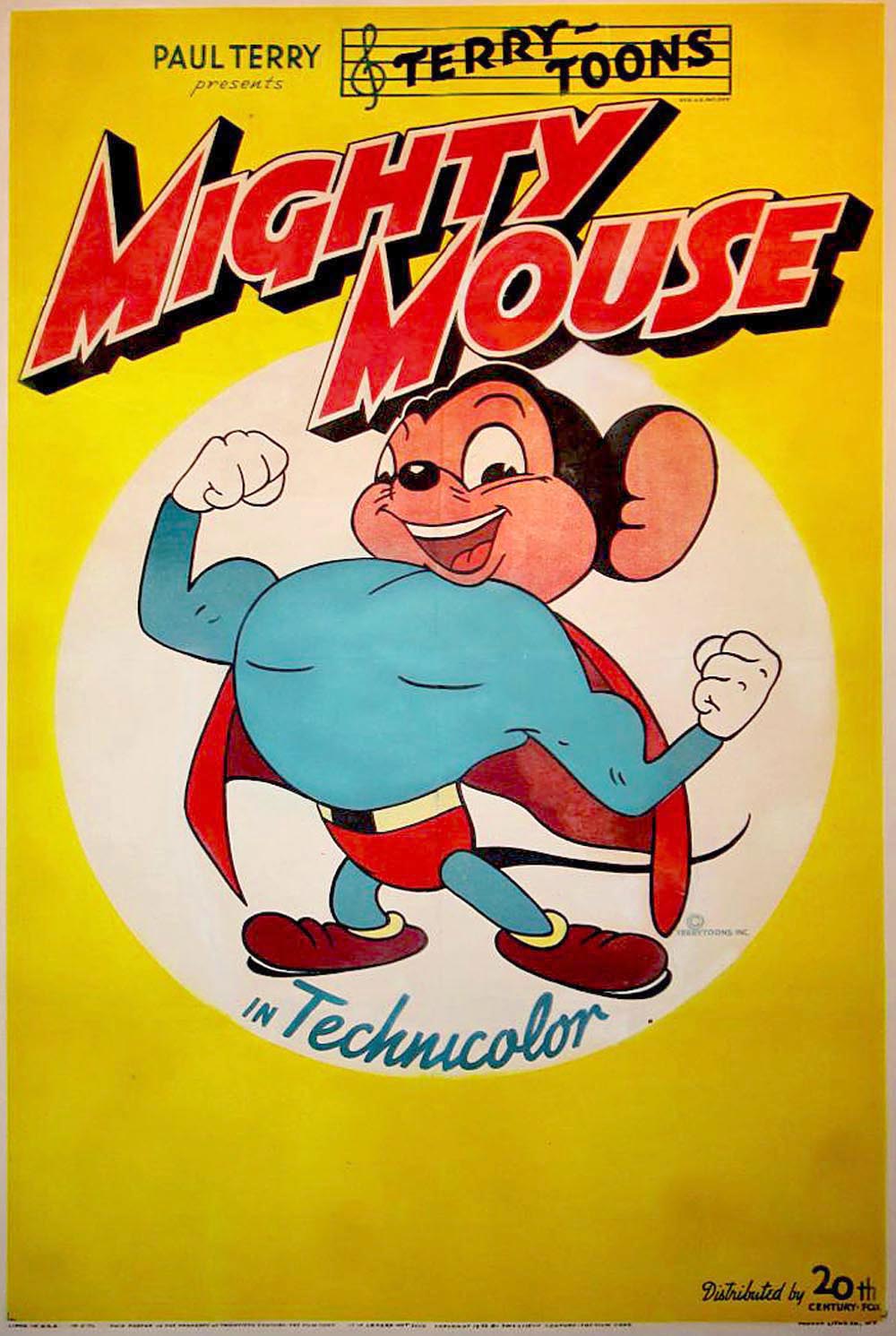
Poster showing the new name over the original colors.
Super Mouse (Roy Halee, Sr., Tom
Morrison & Allen Swift at various points in the series) appeared in six
subsequent shorts between 1942 and 1943 when Terry learned of the existence of
another Supermouse
appearing in the pages of Nedor Publishing Co.’s
comic, Coo Coo Comics,
who made his debut just before the first short was released. Not wanting to
promote another company’s creation, Terry renamed his character “Mighty Mouse”
and later altered the color of his uniform from blue and red to yellow and red.
The newly christened Mighty Mouse made his debut in 1944’s The Wreck of the
Hesperus. The original shorts were later altered to reflect the new
name.
Mighty Mouse's new supporting characters.
Although Mighty Mouse never reached the
heights of popularity as other theatrical cartoon stars, he became Terrytoons’
most popular character; often appearing on promotional material for other Terrytoon
projects and in Terrytoon Comics, published
by Timely Comics (precursor to Marvel). In
1945, Terrytoons decided to change the format of the series. Until that point,
Mighty Mouse would only appear in the last third of his shorts for a
last-minute rescue. It was decided to give him a new rival in old Terrytoon
villain Oil Can Harry (Morrison), remade a cat that always had evil intentions
towards Mighty Mouse’s new main squeeze, Pearl Pureheart. Their adventures were
done completely in mock opera beginning with Mighty Mouse and
the Pirates, similar to how they were presented in Harry’s original
theatrical outings in the Fanny Zilch series.
1947’s A Fight to the Finishbegan
the plot device of starting each short off with Mighty Mouse and Pearl in peril
as if a continuation from a previous chapter’s cliffhanger ending. It was
during this period that Mighty Mouse’s catchphrase “Here I come to save the
day!” debuted.
By the 1950s, theatrical shorts began to
fall out of fashion due to the loss of audiences in favor of the growing medium of
television and the popular and financially beneficial low-budget, stylized,
limited animation techniques presented there. In 1955, Terry retired and sold his studio to CBS; however, Fox retained the theatrical distribution
rights. CBS decided to take the existing Mighty
Mouse library and broadcast them on television. On December 10, 1955, they
launched Mighty Mouse Playhouse, which
was comprised entirely of the 80 theatrical shorts produced during Terrytoons’
run. The only new content were commercial bumpers and Colgate commercials with
Morrrison reprising his role, as well as a half-hour 1961 cartoon made in
cooperation with UNICEF. The show’s theme
was the theatrical theme written by Marshall Barer and
composed by Philip Scheib, was
originally credited to The Terrytooners
with Mitch Miller and orchestra,
but in later years it was revealed it was actually done by a group called The
Sandpipers (not to be confused with the more well-known band of
the same name).
The Mighty Heroes: Diaper Man, Cuckoo Man, Strong Man, Rope Man and Tornado Man.
The show ran for an impressive 11
seasons pulling in respectable ratings. However, as the 1960s rolled on,
networks began producing more and more new content for Saturday mornings that
began to overshadow and edge out the increasingly dated animation presented in
the low-budget Terrytoons shorts. CBS decided to compliment the show with a new
feature and eventually settled on Ralph Bakshi’s The Mighty Heroes.
The
Mighty Heroes was a play on the growing superhero
genre, particularly the successful premiere of the live-action Batman
earlier in the year, with the most goofy and impractical heroes imaginable
protecting the city of Goodhaven. The team was comprised of Strong Man, a farm
boy-turned-big city mechanic with super strength; Tornado Man, a weather forecaster
who could create tornadoes by spinning very fast; Diaper Man, a fully articulate
baby that led the team and could use his bottle as a bludgeon weapon or to fire
high-pressure streams of liquid (all Herschel Bernardi); Rope Man, a British
sailor that could turn into an unlimited length of rope (and often got tangled
into knots); and Cuckoo Man, a bird-shop owner with avian powers that changed
into costume by jumping up into a cuckoo clock and popping out its little door
(both Lionel G. Wilson). All of the heroes could fly, but a running gag had the
rest of the team emitting jet sounds while Cuckoo Man would always lag behind
with jalopy sounds.
Only 20 episodes of The Mighty Heroes were produced before Bakshi left Terrytoons. The
show alternated between showing two Heroes
episodes around a Mighty Mouse short,
and breaking up a singular episode to bookend two shorts. The series was also
renamed Mighty Mouse and the Mighty
Heroes. Unfortunately, the show went up against DePatie-Freleng’s
similar, and more popular, series, The
Super 6, and little was done to ease the declining ratings. CBS removed the
show from the schedule the following season and allowed it to enter syndicated
reruns; both together and with the two different shows separated (Mighty Mouse ran considerably longer
than the Heroes). The Heroes did get a brief second life as
the first ten episodes were released as theatrical shorts by Fox between 1969
and 1970. They made one additional appearance with Mighty Mouse in an episode
of the Bakshi-produced Mighty Mouse: The
New Adventures.
“The
Plastic Blaster” – The Raven uses the Plastic Blaster to terrorize Goodhaven.
“The
Frog” – The Frog plans to flood Goodhaven with water from the swamp.
“The
Junker” – The Junker’s robot dogs eat anything metal, and he sets them loose on
Goodhaven.
“The
Shrinker” – The Shrinker shrinks the Goodhaven bank in order to steal it.
“The
Ghost Monster” – The Heroes face the Ghost Monster that terrorizes the city
every century.
“The
Stretcher” – The Stretcher’s robots steal everything made of rubber in town.
“The
Monsterizer” – The Monsterizer uses his machine to change the Mayor and Police
Chief into monsters.
“The
Drifter” – The Drifter uses his anti-gravity gun to lift Goodhaven up and hold
it for ranom.
“The
Shocker” – The Shocker attempts to steal Goodhaven’s power supply.
“The
Enlarger” – The Enlarger calls out the Heroes by unleashing giant bugs on the
city.
“The
Toy Man” – The Toy Man’s toys come to life at night and rob their owners blind.
“The
Dusters” – The Shrinker’s new sidekicks sprinkle dust that makes the citizens
fall asleep or laugh hysterically.
“The
Big Freeze” – A mad scientist uses his genius to freeze all the citizens of
Goodhaven.
“The
Timekeeper” – NO SYNOPSIS AVAILABLE.
“The
Scarecrow” – A lightning bolt brings a scarecrow to life and he’s determined to
spread fear throughout Goodhaven.
“The
Time Eraser” – NO SYNOPSIS AVAILABLE.
“The
Return of the Monsterizer”
“The
Paper Monster” – NO SYNOPSIS AVAILABLE.
“The
Raven” – NO SYNOPSIS AVAILABLE.
“The
Bigger Digger” – The Frog return and uses his Bigger Digger to cut away pieces
of land in order to replace it with swamp water. Original post 2017. Updated in 2020.
Welcome to Hero High, where the
heroes of tomorrow learn today.
A modern depiction of Archie's Super-Teens.
Hero
High was the idea of producer Lou Scheimer, who originally wanted to
develop a series exploring the retirement years of superheroes. However, as the
idea was shot down by the network, Scheimer reworked it to be about heroes
learning how to be heroes in high school. With the suggestion of adding a band
element, it was decided to make the show the eighth installment Filmation’s
ongoing Archiefranchise. The Archie kids had already been depicted as
the superheroes Pureheart
the Powerful and the Super-Teens
in the 1960s comics, and sporadically thereafter. Unfortunately, during
production, Filmation’s rights to the Archie
Comics characters expired and weren’t renewed. The characters
were quickly modified by Kevin
Frank, Tim
Gula,
Mel Keefer
and Janice
Stocks to become completely original creations; although,
their Archie influences were still
evident.
The cast of Hero High.
Hero
High followed the misadventures of the student body as they learned to use
their powers while foiling the occasional supervillain or two. Among the main
cast was A.W.O.L. (Scheimer), who could go completely or partially invisible;
Brat-Man (Erika Scheimer), who caused earthquakes or sonic blasts by throwing
super tantrums; Captain California (Christopher Hensel), who had a super-shine
smile an flew with his semi-intelligent surfboard, Wipeout; Glorious Gal
(Rebecca Perle), who had a variety of mental powers, super strength and could
fly; Misty Magic (Jere Fields), who possessed magical powers; Punk Rock (Johnny
Venocour), who had sonic powers and super speed while playing his guitar; and
Weatherman (Jim Greenleaf), who could control the weather and fly on clouds.
Although they also attended Hero High, Rex Ruthless (John Berwick) and Dirty
Trixie (Maylo McCaslin) were often the sources of trouble on the show, trying
to foul-up their classmates with the dirty tricks located on their belts.
The kids with Police Chief Hardy.
They were joined by their pet sidekicks
Peter Penguin, who was an avian version of Harpo Marx,
and Giggler the hyena, who shared Rex and Trixie’s dirty ways, as well as their
long-suffering teacher Miss Grimm (Linda Gary) and Principal Sampson (Alan
Oppenheimer). Sometimes, the kids had to aid Misty’s uncle, Police Chief Hardy,
on various cases. Background characters included the aptly named Li’l Sumo,
Captain Walla Walla, Kangaroo Ken, and Coach Cosmo.
Live Rex Ruthless, Glorious Gal, Punk Rock, Capt. California, Dirty Trixie, Weatherman and Misty Magic.
The programming block featured live-action
wraparound segments starring the Hero
High actors in full costume as their characters with the exception of
A.W.O.L. and Brat-Man. The group would perform in front of an audience of kids,
telling kid-friendly jokes and playing songs for them. A total of 13 original
songs were made including the show’s theme, all composed by Ray Ellis
(as Yvette Blais) and producer Norm Prescott
(as Jeff Michael) with Dean
Andre. The live segments were filmed at Filmation West,
with the voice recording for the animated segments happening at Filmation East.
Johnson wrote all the live segments, which were directed and produced by Arthur H. Nadel.
Isis drops by Hero High.
It was intended for the show’s music
to be published on an album with the actors going on a concert tour, but the
show’s cancellation after its single season ended those plans. Three of the songs
for Hero High were released the year
before the show even aired as part of the album Rock ‘n’ Roll Disco by Fat Albert
& The Junkyard Band, recorded by different performers.
The show was nominated for “Best Children’s Television Series” by the annual
Youth in Film Awards (now the Young
Artist Awards), and Perle walked away with “Best Young
Actress in a Daytime Series”. Berwick walked away with something a little more
as he married Nadel’s daughter after meeting her at the show’s wrap party.
Shazam helps out Capt. California and Brat-Man.
One of the lasting influences of the
show came years later when Ruegger became the steward of Warner
Bros. Animation’s television renaissance. The episode
“The Big Bang Theory” featured a villain named Brain, whose voice was patterned
after Edward
G. Robinson. The episode was written by Ruegger with
consultation from Tom
Minton, and it was storyboarded by Eddie Fitzgerald.
Ruegger’s Brain character, along with Fitzgerald and Minton, inspired the
creation of would-be world conquerors Brain (Maurice LaMarche)
and Pinky (Rob Paulsen)
on Animaniacsand Pinky and the Brain.
The Hero High DVD.
Hero
High was released onto DVD
in 2007 by BCI
Eclipse LLC under license from Entertainment
Rights. The set was full of extra features, including audio
commentaries, spotlight interviews with some of the people who worked on the
show, a documentary about Filmation, photo and art galleries, DVD-ROM scripts
and storyboards, and a booklet with an episode guide and trivia. Although the
full animated show was present, only 20 minutes of the live-action footage was
included as a bonus feature on the set.
EPISODE GUIDE:
“The
Art of the Ballot” (9/12/81) – Glorious Gal runs against Captain California in
the school election to prove the girls are just as good as the boys.
“What’s
News” (9/19/81) – Rex hogs the spotlight when a reporter comes to the school to
do a story.
“Rat
Fink Rex” (9/26/81) – Rex goes power-crazy after he’s made the new Hero High
Honor Guard.
“Do
the Computer Stomp (10/3/81) – A new computer is allowed to decide who takes
who to the upcoming dance.
“Malt
Shop Mayhem” (10/10/81) – The kids are made to get jobs for their training, and
things don’t exactly turn out right.
“Boo
Who” (10/17/81) – The kids head to a haunted house.
“Cover
Twirl” (10/24/81) – Glorious Gal tries to get Captain California’s mind off of
the visiting Isis.
“My
Job is Yours” (10/31/81) – The kids are allowed to take control of the school
for the day.
“Girl
of His Dreams” (11/7/81) – Rex falls for the visiting Mary Marvel just as his
powers disappear.
“The
Not So Great Outdoors” (11/14/81) – The kids are forced to camp out when their
bus breaks down in the woods.
“Off
Her Rocker” (11/21/81) – Misty disappears after the others make fun of her
botched trick.
“Follow
the Litter” (11/28/81) – Rex and Trixie attempt to foil the others’ plans to
clean up the school.
“Jog-a-Long”
(12/5/81) – The boys and girls decide to compete in the local marathon against
each other, and Rex and Trixie have plans to foul things up for them.
“He
Sinks Seaships” (12/12/81) – The kids help Chief Hardy recover an ocean liner
from Captain Seaweed.
“Starfire,
Where Are You?” (12/19/81) – The kids search for a stolen top-secret shuttled
named “Starfire”.
“The
Captives” (12/26/81) – The kids have to rescue Misty Magic and AWOL from two
thieves hiding in the mountains.
“High
Rise Hijinx” (1/2/82) – The kids have to rescue a stolen statue from thieves
held up in a penthouse apartment.
“Track
Race” (1/9/82) – The kids have to rescue the governor from a sabotaged
high-speed train.
“A
Clone of His Own” (1/16/82) – Criminals replace Police Chief Hardy with a clone
under their control.
“Game
of Chance” (1/23/82) – A rigged carnival leads the way to a diamond smuggling
operation.
“The
Umpire Strikes Back” (1/30/82) – The kids help Chief Hardy track down a spy
disguised as an empire at the baseball stadium.
“The
Human Fly” (2/6/82) – The tiny Human Fly plots to steal an emerald from the
museum.
“Big
Bang Theory” (2/13/82) – Big Brain and Tiny plan to use explosives on bank
vaults.
“Law
of the Pack” (2/20/82) – The kids try to stop an evil animal trainer who steals
pets and trains them to commit crimes.
“A
Fistful of Knuckles” (2/27/82) – Captain Marvel helps the kids recapture the
criminal they accidentally helped free from jail.
“The
Blow-Way Blimp” (3/6/82) – The Chameleon steals the box office from Punk Rock’s
concert.
The
Zeta Project was a spin-off from the Batman
Beyondsecond season episode “Zeta.” It centered on Infiltration
Unit Zeta (Diedrich Bader), a synthoid designed to carry out covert
assassination missions for the National
Security Agency through the use of his holographic disguises. However,
it was learned that his creator, Dr. Selig (George Segal & Hal Linden), installed a module in Zeta
that gave him a conscience. On his last mission for the NSA, Zeta’s target
proved to be innocent and he decided he could no longer kill.
Zeta and Ro running from Agents Bennet and West.
The agency, believing Zeta a dangerous rogue element that joined the terrorist
organization he was investigating, Brother’s Day, dispatched a team with the
sole purpose of either retrieving or destroying him. It was led by Agent James
Bennet (Kurtwood Smith), who strongly believed Zeta was simply reprogrammed by
enemies and not an actually sentient being. Under him was the young and
egotistical Agent West (Michael Rosenbaum) and Agent Lee (Lauren Tom), who grew
to see there was more to Zeta than they believed and began to subtly help him
evade capture. When Lee left the team and was subsequently promoted, she was
replaced by by-the-book Agent Rush (Erika Alexander & Dominique Jennings).
Other foes during the series included the cybernetically-enhanced bounty hunter Krick (Keith Szarabajka & Richard Moll), cyber-hackers Plug (Paul Amendt), Meg (Amy Danles) and Buss (Googy Gress), high-ranking
Brother’s Day terrorist Titus Sweete (Robert Costanzo), and his
more-advanced counterpart, Infiltration Unit 7 (Bader).
Infiltration Unit 7.
Joining Zeta on his adventures was 15-year-old orphan Rosalie “Ro” Rowan (Julie
Nathanson). Initially seeing Zeta as an opportunity, Ro came to care about Zeta
and decided to help him on his quest. Zeta also worked to help her locate her
biological family. Occasionally, they were aided in their efforts by child
genius Bucky Buenaventura (Ulises Cuadra & Blayn Barbosa), a technology
whiz. Batman (Will Friedle) also made a
singular appearance on the show, aiding Zeta against Infiltration Unit 7.
The Zeta Project debuted on The WB on January
27, 2001 as part of their Kids’ WB! programming
block. The series was developed by Robert Goodman, who created Zeta
and wrote his debut episode. “Zeta” wasn’t originally intended as a backdoor
pilot, but Goodman decided that the concept could make a decent series and,
within the year, the network agreed. Zeta’s appearance was reworked to make him
appear more human, and he and Bennett’s voices were recast having been
originally played by Gary Cole and Joe Spano, respectively.
Zeta's original appearance on Batman Beyond.
Although it was part of the DC
Animated Universe and produced by Warner
Bros. Animation, the series’ first season had a decidedly different appearance
than all of the other programs. The scenery was generally very light and the
characters lacked any sort of shading, as well had an overall differing
appearance from the models seen since the debut of Superman:
The Animated Series. The stories themselves also took on a comparatively lighter
tonality than the rest of the DCAU. For the second season, the animation
was modified to bring it more in line with the other DCAU shows with darker
settings, shadows, and a sleeker design for Zeta. The stories were also more
action-oriented and intense, increasing the level of danger and excitement in
each episode.
The Zeta Project managed to generate
decent ratings and a loyal fanbase despite episodes being constantly delayed to
allow the network time to run new--and often failed--programs in its timeslot.
The network handed down a mandate that if the production wanted to see a third
season, the second had to end on a cliffhanger. They also had plans for the
third season that took the show places that Goodman wasn’t completely
happy about. All of that proved moot, however, when the network
ultimately decided to cancel it at the end of the second season. During its
run, it managed to earn four Annie Awards and two Daytime Emmy Awards nominations,
and won two Women’s Image
Network Awards. Zeta’s debut also earned an Annie nomination.
Promotional material for the original DVD release.
“The
Accomplice” (1/27/01) – Zeta is joined by 15-year-old runaway Ro after saving
her, and she convinces him to find his creators to help prove his innocence.
“His
Maker’s Name” (2/3/01) – Finding one of Zeta’s creators takes him and Ro on a
detour with some space hippies, and when they find the scientist he lures them
into a trap.
“Change
of Heart” (2/17/01) – Zeta and Ro track his creator, Dr. Selig, to a museum but
a malfunctioning fusion reactor and the NSA prevent them from making contact.
“Remote
Control” (2/10/01) – At a science convention, the brilliant young Bucky takes
control of Zeta in order to use him to get revenge over a stolen invention.
“The
Next Gen” (2/24/01) – Zeta stumbles upon the mission of another infiltration
unit and decides to stop it.
“West
Bound” (3/10/01) – The NSA pursues Zeta and Ro on a train just as Zeta’s
hologram projector malfunctions, causing him to take the appearance of anyone
he sees.
“Hicksburg”
(3/31/01) – Ro and Zeta visit her foster family to try and find information on
her biological one.
“Shadows”
(4/7/01) – IU 7 returns and causes the destruction of a mall Ro and Zeta
visits, bringing them to the attention of Batman.
“Crime
Waves” (4/14/07) – Zeta and Ro are framed for the kidnapping of the son of a
wealthy robotics manufacturer.
“Taffy
Time” (5/5/01) – A bounty hunter stakes his claim on Zeta and threatens to kill
Agent Lee unless he turns himself over to him.
“Ro’s
Reunion” (5/12/01) – Zeta convinces Ro to go on a show that helps people find
their families, but soon discovers the show uses fakes and turns runaways back
over to the state.
“Kid
Genius” (8/11/01) – Bucky asks Zeta and Ro to help him find his kidnapped
parents.
“Absolute
Zero” (3/23/02) – Zeta attempts to meet Dr. Selig at a cryogenics lab, but his
presence there causes a disruption that results in Selig getting trapped in a
freeze unit.
Season 2:
“Wired:
Part 1” (3/30/02) – Ro and Zeta encounter a seemingly friendly trio of hackers,
but Bucky soon gets word to them that two of them want to strip Zeta for parts.
“Wired:
Part 2” (4/6/02) – The NSA captures Zeta and wipes his memory for
reprogramming, discovering an unknown module in his head not part of his
schematics.
“Hunt
in the Hub” (4/20/02) – An associate of Selig’s takes away Zeta’s cred card
ability unless he and Ro steal parts for him.
“Ro’s
Gift” (4/27/02) – The Brain Trust witnesses Zeta, disguised as Ro, take down a
robot and end up kidnapping the real Ro in order to get her to join their
group.
“Quality
Time” (7/13/02) – Bennet has to join forces with Zeta in order to rescue his
son and Ro from a damaged submarine.
“Resume
Mission” (4/13/02) – Jason Foley unknowingly helps reactivate IU 7, allowing
him to reassemble himself and resume his mission to destroy Zeta.
“Lost
and Found” (5/11/02) – Zeta malfunctions while escaping from Krick and recalls
his final mission before going rogue.
“On
the Wire” (7/20/02) – Bucky reunites Ro with her brother, a reporter, whose
boss recognizes her and decides to get an exclusive on Zeta’s capture.
“Cabin
Pressure” (7/27/02) – Zeta and Ro have to rescue Bucky from the NSA, his having
been captured under suspicion of working for a terrorist group.
“The
Wrong Morph” (4/20/02) – Ro and Zeta get involved in a theft and end up causing
a disabled boy to be framed for it.
“Eye
of the Storm” (5/18/02) – Genius brothers devise a way to stop tornados, but
the younger of the two attempts to stop one on his own to escape his brother’s
shadow.
“The
River Rising” (8/3/02) – Zeta and Ro take refuge in a “No-Tech” village.
“The
Hologram Man” (8/10/02) – Zeta and Ro finally find Selig and learn the module
is Zeta’s conscience, but Tidus Sweete destroys Selig’s lab and seemingly kills
him in the process.
When it comes to superheroes, there’s generally an image
that pops into our heads. Typically, we view our potential saviors as fit and
often attractive super-powered beings that plod around wearing their underwear
outside their clothing.
Of course, we all know that heroes come in all shapes and
sizes—and often in those you wouldn’t expect! This month, we’ll look at a few
shows that featured the most unlikely heroic characters who have dedicated
themselves to saving the world and protecting the innocent. Sure, they may not
look like much, but their deeds speak volumes.