Remember that one day when you could wake up without an alarm? When you would get your favorite bowl of cereal and sit between the hours of 8 and 12? This is a blog dedicated to the greatest time of our childhood: Saturday mornings. The television programs you watched, the memories attached to them, and maybe introducing you to something you didn't realize existed. Updated every weekend.
Gwen Stefani with her Harajuku Girls: (from left) Maya Chino, Jennifer Kita, Rino Nakasone & Mayuko Kitayama.
Harajuku
Girls was also the name she gave the group of backup dancers she hired for the
tour, wearing make-up and clothing meant to be evocative of the Japanese
aesthetic. The Harajuku Girls were comprised of Maya Chino,
Jennifer
Kita,
Rino Nakasone
and Mayuko
Kitayama, who performed under the stage names “Love”, “Angel”,
“Music” and “Baby”, respectively, after the album. Along with the tour, the
Harajuku Girls served as Stefani’s entourage in public (it was alleged that
they were contractually
obligated to speak only Japanese in that instance), appeared with her
on interviews (where part of her gimmick was that she considered them imaginary
friends), and starred in 8 of her music videos (three of them would also appear
in No Doubt’s “Settle
Down”
video, sans Harajuku styling). Stefani would go on to use the name “Harajuku Lovers”
for a line of fragrances,
which came in caricature bottles fashioned after her and the Girls, and fashion
for Target
also adorned with those caricatures. During this period, many critics would
come to regard Stefani’s Harajuku Girls as not so much cultural appreciation,
but more along the lines of cultural
appropriation as well as reinforcing negative
ethnic stereotypes.
An example of the kawaii design applied to the scenery.
Fast forwarding to 2014, Stefani announced the next Harajuku-inspired
product: an animated series. A desire to turn the Harajuku Girls into some kind
of media project existed since the initial album’s release, but it wouldn’t be
until 2013 that she pitched it at Kidscreen’s Asian
Animation Summit. Australia’s Network
Ten liked the idea and greenlit the production. Although this would be
Stefani’s first involvement with an animated series, she had a familiarity with
their inner workings through her brother, No Doubt co-founder and former member
Eric
Stefani, who worked as an animator on cartoons like A
Pup Named Scooby-Dooand The Simpsons.
HJ5: Love, Angel, G, Music and Baby, along with their manager, Rudie.
Initially titled Koo Koo Harajuku, the show was developed by Steve
Aranguren, Gillian Carr and Madellaine
Paxson and co-produced by Vision Animation, Red Flags Fly and Moody
Street Kids, with DHX Media (now WildBrain) handling
distribution. Animated in Flash, the series followed
the adventures of teenaged band HJ5 as they often met with challenges that
prevented them from playing their gigs peacefully; such as unruly fans,
fun-hating despots, or inventions gone amok. HJ5 was comprised of leader G
(modeled after Stefani, voiced by Maggie Cheretien), the glue of the band who kept
them together through tough times and represented bows; Love (Daisy Masterman),
the group genius whose inventions often caused more problems than they solved and
represented hearts; Angel (Emma Taylor-Isherwood), a bubbly and cheerful
fashionista that could be a bit of an airhead at times and represented stars; Music
(Sally Taylor-Isherwood), the sarcastic and strong-willed second-in-command of
the band who was both an amazing fighter and dancer and represented musical
notes; and Baby (Charlotte Nicdao), sweet and carefree to a fault who loved
adorable things and giving hugs (and was constantly hungry) and represented
cuteness. Their manager was Rudie Rhodes (Danny Smith), who was enthusiastic
but hard-lucked and clumsy, and tended to get the band into trouble through his
antics and forgetfulness. Additionally, the band had a sassy robotic personal
assistant and chauffer named R.O.D. (Robotic Obedient
Driver), as well as several monster pets (cute little creatures that could be
domesticated or wild) and a Pomeranian named Chewie (based on Stefani’s
own pet). The characters, designed by Kyla May, were heavily
influenced by the Harajuku Girls while remaining ethnically ambiguous.
General Nofun holds HJ5 captive.
The series featured a number of antagonists bent on ruining HJ5’s
careers any way they could. Chief amongst them was General Ira S.
Nofun (Paul Heng, Ian Bliss in Australia), the
leader of Nofunland who hated anything fun. His top man was Commander
Bo-ring (Bliss), who led a double life as pop star Baron Von Melody. Nofun also
had a cat, Moods
Meow, who had designs on world domination. Other antagonists included Madame
Shhh, who hated noise and wanted to soundproof everything through magic
spells and bubbles; Sammy
Starr, Rudie’s arrogant rival who used leetspeak and tried everything to sign
HJ5 to him; Say-Wah (Nicdao), a technological whiz who wanted revenge on the
band for not accepting her into their ranks; The Kimberlys, a rival band
comprised of similar-looking girls all named Kimberly who wanted to be famous
without doing any of the actual work; Tizzie
Lizzie (Natalie Bond), the band’s biggest
(and obsessive) fan and daughter of an incredibly wealthy man who attempted to
subjugate HJ5; Angelica (Amanda
Harrison), a young inventor and Love’s chief rial; Cici, the leader of a
mermaid singing group who felt they had sole performing rights in oceanic
territories; Panda Pete, a panda-obsessed businessman who wanted to make the
whole world kawaii (the Japanese
culture of cuteness); Mimi
Di Pollo, an extreme fashion designer who wanted revenge on HJ5 for firing her
because of her impractical outfits for them; and Bertrand, a smartphone
modified by Love to never become obsolete that evolved into a sentient despot,
among others.
Baby and the monster pets.
Other characters included Colonel Spyke (Jaqueline
Brennan), captain of the Harajuku Defense Squad who disliked HJ5’s music but
didn’t hesitate to employ their services on missions when needed; Twisty-T (Smith), a prominent
music producer Rudie always strove to impress; Jo
Jo Jolie, a fashion designer and Twisty T’s wife; Mauve Madison (Brennan in
Australia, Chrehtien in the US), a popular talk show host; Trixie
La Trill (Bond), a hair stylist and Rudie’s aunt with a desire to be famous; Sparski, a sentient computer
virus; and Krispin
Krouton, a tabloid journalist, among others.
Much like Stefani’s Harajuku Girls, reception to the series was mixed
and labeled as cultural appropriation. Reviewers pointed out the whitewashing
and Westernization of Japanese culture while simultaneously eliminating
anything remotely Japanese from the show. Despite that, the series was able to
churn out 3 seasons and was nominated for an Asian
Television Award in 2016. For the third season, HJ5 embarked on
a world tour that took them out of Harajuku City to new and exotic locations
with their own crazy themes--such as bubblegum, musical instruments or yo-yos--via
a teleporting tour bus concocted by Love. The last five episodes of the series
aired initially on Disney
Channel Australia before airing on 10 Peach.
A G figure with the tour bus playset.
Mattel acquired the license
to produce
toys based on the show, including fashion dolls and playsets, as well as
packs of small charms to decorate the dolls or an included wearable ring. Shout! Factory struck a deal with DHX to
release home media for the series. To date, they’ve only released 20 episodes
from the first season across three
DVDs. An official YouTube channel, KuuKuuTube, contained full
episodes and clips. The entire series was made available to stream on Amazon
Prime Video and Pluto TV, Apple
TV+ and most of it on Google
Play. In 2016, Nickelodeon uploaded a music video of Stefani singing
an expanded and remixed version of the show’s theme. EPISODE GUIDE: Season1: “Totally
Teen Genie / Angel’s Flight” (11/1/15 AU, 10/3/16 US) – Angel discovers a sassy
genie in a bottle of hair gel. / Angel is determined to restore her reputation
when an unflattering picture of her is released online. “Music
Baby / Wanted Audience” (11/8/15 AU, 10/4/16 US) – A gig in Newfunland ends up
with the band being arrested by General Nofun. / The band discovers that their
gig is missing something: an audience. “Game
Over / Phony Ponies” (11/8/15 AU, 10/5/16 US) – The band ends up sucked into a
computer game. / Baby enters her new ponycorn into the Ponycorn Cup which
unfortunately has been targeted by a disgruntled former rider. “Hello
Puppy / G, This is Awfully Deep” (11/15/15 AU, 10/6/16 US) – G is given a new
puppy that isn’t quite what he seems. / A sinkhole swallows the band and their
stage and dumps them into an underground city. “Baby’s
Birthday / Labor of Love” (11/29/15 AU, 10/7/16 US) – Opening her presents
early causes Baby to accidentally unleash one of Love’s inventions. / An
advanced computer virus attacks HJ5’s headquarters. “Bad
Boy and Little Girl / Yummy Bear Nado” (11/29/15 AU, 10/8/16 US) – Baby ends up
stuck in the cockpit of their mecha robot. / Love befriends a monster pet that
helps upgrade her weather invention. “Drums
of Doom / Adventures in Housesitting” (10/15/16) – When Angel neglects her new
drums, they take to playing themselves. / In order to audition for Twisty T,
the band must housesit for him. “The
Kawaiifler / Super Kawaii Sunday” (12/20/15 AU, 10/22/16 US) – General Nofun is
determined to spoil the Kawaiification Festival. / Things get out of hand when
the band enters a contest to get on the cover of a magazine. “Detectabubbles
/ Kablooey Chewie” (10/29/16) – A gig in Bubble Land is interrupted by the
silence-loving Madame Shhh. / Chewie gets himself not only blasted off into
space, but cloned numerous times. “Water
Baby / Music Zoo” (11/5/16) – The band’s gig is interrupted by an Octacorn
attack. / Music becomes Muzaka and the band has to get her back to normal to
salvage their zoo gig. “The
Dotted Line / Life is But a Dream” (11/12/16) – The band is offered a recording
contract with one provision: they have to change absolutely everything about
themselves. / Love invents a machine that will let the band share a concert
dream to help G overcome her stage fright. “Oh,
G / Greenhouse” (5/7/16 AU, 11/19/16 US) – A painting comes to life and
anything it touches turns into a work of art. / Rudie forgets to tell the band
that he promised they would take care of Twsity T’s rose garden while he’s
away. “Control
+ Alt + Dimension / Angel Hair” (2/4/17) – Love’s latest invention sends her to
another dimension where she encounters an evil HJ5. / A bad case of bedhair
sends Angel to Trixie La Trill for a makeover. “Inside
Job / Sea Monkeying Around” (2/11/17) – Rudie accidentally shrinks the band and
they get eaten by a monster pet. / Rudie’s promotional scheme goes wrong and
ends up flipping an entire undersea mall upside down, threatening to break the
dome that keeps the water out. “Trust
Your Inner Uniphant / Starr Power” (2/25/17) – Rudie lies to a zookeeper that
the band knows how to handle Uniphants in order to get a gig at the zoo. / Sammy
Starr wants to sign HJ5 by any means necessary. “Zero
G / Angel Food” (3/4/17) – Aliens take offense to an HJ5 song and crash their
concert. / Dressing in food costumes for their gig has the band looking like
lunch for a group of hungry monster pets. “Happy
Slam / Retro Fiasco” (4/7/17) – Baby uses one of Love’s rejected inventions to
try and improve her dance moves. / Retro Day at the mall is spoiled by a shop
full of retro clothing takes over. “HJ10
/ Waves of Love” (4/14/17) – Invading aliens resembling HJ5 land in Harajuku. /
Love must choose between staying with the band and accepting a job at Harajuku
University. “Sand
and Deliver / Moods Meow” (4/21/17) – A lightning strike brings sculpted sand
bunnies to life. / The band must rescue a cat to save their gig. “Yeti
in the House / The Young and the Reckless” (4/28/17) – Music must overcome her
Yeti phobia in order to help the band get him back home. / An old children’s TV
host wants to reclaim his glory days by reverting his audience back to a young
age. “Brodie
on Board / Womzilla” (7/9/16 AU, 5/5/17 US) – The band takes on Rudie’s cousin
as an intern. / While making a film, Rudie accidentally unleashes a great
wombat on the city. “Emotizoms
/ The Big Time” (5/12/17) – Emoticuddlies with an advanced AI become vicious
Emotizoms and disrupt the biggest wedding in the city. / Baby’s Queueby doll
runs into some experimental fertilizer and becomes giant. “Un-Bear-able
/ Snowy the Frostman” (5/19/17) – Rudie uses a bear that says uncomfortable
things to apologize for hurting Angel’s feelings. / An event’s mascot tries to
destroy Rudie. “Kawaii
Cake Mix Up / Angel Fever” (6/2/17) – The girls shrink themselves to find a
micro-sized USB key with their latest song that fell onto a cupcake. / Angel’s
new shoes puts the city under a spell. “Candy
Blossom Flower Festival / Princess Power” (6/9/17) – A kiss on the forehead
transfers some of Shu Shu the Silver Shimmer Squirrel’s powers onto Music. /
Rudie causes a mechanical dragon to go berserk during a gig. “Hark!
A Quarkle! / The Ends of the Earth” (8/13/16 AU, 6/16/17 US) – Love
accidentally creates an energy organism that threatens Jo Jo Julie’s new
fashion launch. / The band uses Love’s time machine to find a way to play their
gig without ending the world. Season
2: “Training
Day / Multi Tasking” (7/1/17 AU, 7/7/17 US) – Performing for passengers causes
the band to miss their train. / The band tries to play the two concerts Rudie
booked them for at the same time. “Hot
Rod / Over and Out” (7/8/17 AU, 7/14/17 US) – Love’s upgrade for R.O.D. makes
him a hit with all the electronics in town. / A prank goes wrong when The
Reversilator turns Baby into a bad girl that wants to leave the band. “Stage
Magic / The Sixth Wheel” (7/15/17 AU, 7/21/17 US) – Rudie decides to add magic
tricks to the band’s act. / Rudie pretends to be the band’s leader to impress
his grandma. “Trash
Talk / iTeeth” (7/22/17 AU, 7/28/17 US) – The band tries to stop Krispin
Krouton from spreading lies about them on his blog. / Candy causes Baby’s
retainer to pick up radio transmissions, making her unable to sing at an
audition. “Spies
Like Spyke / The Fabulous Baron Von Melody” (7/29/17 AU, 8/4/17 US) – Spyke
recruits the band to help catch a thief at Jo Jo Jolie’s winter ball. / HJ5
learns their opening act has a double identity. “Game
Show Offs / Monster Mash” (8/5/17 AU, 8/11/17 US) – Rudie and the band are
pitted against each other on a game show. / The band gets their minds swapped
with monster pets right before an important concert. “You
Are What You Eat / Supersonic HJ5” (8/12/17 AU, 8/18/17 US) – Snacks from a
vending machine gives the band new powers. / The band uses supersonic speed to
keep Say-Wah from bombing their photos. “Tizzie
Lizzie / Caught in the Web” (8/19/17 AU, 8/25/17 US) – Playing a private
concert for their biggest fan may become a permanent gig when she refuses to
let the band leave. / A computer malfunction causes the band to become trapped
on the internet. “57
Channels (and Nothin’ On) / Getting’ Kinda Late with Mauve Madison” (8/16/17
AU, 9/8/17 US) – Rudie and the band get trapped on the airwaves and must
navigate various channels to get to their gig on time. / Rudie takes over Mauve
Madison’s talk show. “Ladybug
Power / Wrestle Pop” (9/2/17 AU, 9/15/17 US) – Rudie’s game uses up all the
electricity for the band’s benefit concert. / A gig at a wrestling match
reveals Music’s wrestling past. “Angel
Changel / Coulda Been” (9/9/17 AU, 9/22/17 US) – A desire to quit the band
takes Angel on a journey through her history. / Love’s unfinished invention
traps Rudie in another dimension. “Catnapped
/ Roundabout Roundup” (9/16/17 AU, 9/29/17 US) – When HJ5 gives Moods Meow an
experimental voice chip, he announces his plans to conquer the world. / Nofun
sabotages a mechanical bull at a Wild West theme park, causing it to rampage
out of control. “Meerkatz
/ Pandamonium” (9/23/17 AU, 10/6/17 US) – Angel goes undercover to put a stop
to the city’s villains teaming up together. / A toy maker plans to make the
whole world into Kawaii through Baby’s cuteness. “Kawaii
Fidelity / Rocky Road” (9/30/17 AU, 10/13/17 US) – The band has to figure out
why their new song transforms people into kawaii monster pets. / On their way
to meet an influential producer, the band’s van breaks down in a small town
they can’t find a way to leave. “This
Place is a Zoo / Wacky Wednesday” (10/7/17 AU, 10/20/17 US) – The band is
tasked with taking care of zoo animals while vying for a contract. / A
lightning strike causes Rudie and Music to switch bodies. “Dream
Escape / The Kimberlys” (10/14/17 AU, 11/3/17 US) – Creatures from Baby’s dream
escape into the real world thanks to one of Love’s inventions. / Rudie manages
a new band determined to replace HJ5. “Cecil
G. Demille / Sky High Kawaii” (10/21/17 AU, 11/10/17 US) – Rudie informs the
band that they have 6 hours to film a new music video before it airs. / HJ5
competes against The Kimberlys to get the most-liked video on the internet. “And
the Winner is… / The Trouble with Trillbys” (10/28/17 AU, 11/17/17 US) – The
band is unaware that the contest they’re in is rigged to make them look like
fools. / Looking for his birthday present causes Rudie to unleash chaos with
one of Love’s incomplete inventions. “Who
Are You Calling Cupid? / Beach” (11/4/17 AU, 11/24/17 US) – When Cupid loses
his contact lenses his arrows hit all the wrong marks. / Love’s competition
with Angelica gets out of control. “Maxi-Mini
Golf / White Glitter Glider” (11/11/17 AU) – G is asked to throw a golf game to
get a music contract. / Angel desires a white glitter glider. “The
Fantabulous Five / Mist-ery Guest” (11/18/17 AU) – A meteor gives the band
superpowers. / The band’s tropical island adventure on a reality TV show is
going to be anything but a vacation. “An
Imaginary Friend in Need / Snowbound for Greatness” (11/25/17 AU) – Love’s new
invention accidentally brings the band’s childhood imaginary friends to life. /
G takes the band back to where they wrote their first song, disturbing a giant
snowman that just wants quiet. “The
Gnome Ultimatum / G Force” (12/2/17 AU) – A failed singing duo from the 90s
take over the band’s home so that they can relaunch their music careers. / Angelica
joins with The Kimberlys to help them beat the band in a competition. “KuuKuuBall
Run / Feline’s Finest” (12/9/17 AU) – Love and Angelica compete against each
other in designing an eco-friendly car. / Rudie has the band enter Twisty T’s
cat into a local cat show to get him to notice the girls. “Debut
Album / Love’s Lamentations” (12/16/17 AU) – Using Twisty T’s studio to record
the band’s first album turns to chaos when Rudie causes everything to come to
life. / Unable to come up with a special kind of lip gloss, Love gives up on
science. “Studio
No-No / The Gig is Up” (12/23/17 AU) – Getting to record in a prestigious
studio turns out to be a trap for the band. / The band plans to broadcast their
best concert ever and Nofun is determined to make sure it ends up being the
worst. Season
3: “Kawaii
to the World Tour / Mind Games” (8/10/18 US, 8/11/18 AU) – The band rushes
around to try and prepare for a world tour within two hours. / When the
Bubblegumburg concert goes poorly, G has Love invent a mind-reading device to
find out how to reach their audience. “Bye
Bye Baby / Super Awesome Galacto Rudie” (8/17/18 US, 8/18/18 AU) – The band not
only leaves Baby behind but Nofun decides to steal their home. / When Rudie
sends out the bands’ costumes to be cleaned he gets a super hero’s super suits back
by mistake. “Family
Affair / It’s All About Mimi, Me” (8/24/18 US, 8/25/18 AU) – The band learns
that Rudie’s family has been having a music feud with another family. / A rift
forms when Angel hires a fashion genius to make their wardrobe for the tour whose
designs the rest of the band doesn’t like. “Monkey
Business / Southern Sparkles” (8/31/18 US, 9/1/18 AU) – Getting lost in a
jungle ends up getting the band captured by cute creatures that want them to
stay forever. / The band’s cruise concert is interrupted by a mermaid group who
claim dominance to perform in the water. “Monster
Pets on the Bus / Kawaii-Saurs” (9/7/18 US, 9/8/18 AU) – G tells Mauve how they
came to have monster pets staying with them on the tour bus. / Getting lost
after a concert leads the band to find three Kawaii-Saurs eggs that Baby
intends to make dinner, but end up hatching first. “Oh,
Boya! / Rudie’s Law” (9/14/18 US, 9/15/18 AU) – Music ends up stuck to a pop
star she can’t stand via a virtual leash. / Rudie messes with a device to enhance
his gaming experience causing it to be projected in the real world while
shutting down the city’s internet. “The
High C / Aller-G” (9/21/18 US, 9/22/18 AU) – The girls try to relax to help G get
over being sick, but their cruise ship ends up trapped in the Harajuku Parallelogram.
/ G ends up developing an allergy to Rudie that causes her to sneeze into
various monster pet forms. “Groovy
Beach Goes Bonkers / Smart Phone” (9/28/18 US, 9/29/18 AU) – The band
accidentally goes back in time and ends up replacing the star of their favorite
old beach movie. / Love decides to upgrade her smart phone so that it’ll never
go obsolete, causing it to come to life and declare humans obsolete. “Hotel
Kawaii-fornia / Boo Boo Harajuku” (10/5/18 US, 10/6/18 AU) – The band checks into
a strange hotel that they can’t seem to check out of. / Angel discovers an
alternate universe inhabited by perfume scents that are big fans of the band. “Future
Tense / Pamperlona” (10/12/18 US, 10/13/18 AU) – When Rudie knocks Love’s new
camera drone into another invention it begins producing recordings from the
future. / Mimi Di Pollo lures a tired HJ5 to an automated spa to enact her
revenge for their firing her. “My
Way or the Kawaii Way / Tinselfest” (10/20/18 AU) – A deranged hair stylist
sets out for revenge against the band when Angel asks for a slight modification
to her new hair style. / A decorating mishap as a child causes Nofun to seek to
destroy the Tinselfest celebration. “Planet
of the Rudies / Fan Fun Day” (10/27/18 AU) – A directional mishap lands the
band on a planet inhabited entirely by Rudies. / A fan wins a chance to spend a
day with the band for some fun, but no matter what they do they can’t seem to
put a smile on her face. “Happy
100th / The Sweet Life” (11/3/18 AU) – Rudie convinces the band to
go all-out for their 100th live show. / Rudie promised the band that
legendary fashion designer Gwen would make their costumes, not knowing she
retired after an unfortunate incident at the Ponycorn Cup. “Must
the Show Go On? / Lights! Camera! HJ5!” (11/10/18 AU) – When Nofun learns
Bo-ring is making a musical about HJ5, he orders him to wreck the show on
purpose. / The band heads to Kawaiiwood to discover Nofun is directing a nasty
exposé film about them. “Marshmallow
Madness / Social Media” (11/17/18 AU) – Baby rescues a living artifact to send
back home, but decides to have a day of fun with him first not realizing he’s
turning people into marshmallows. / Angel becomes obsessed with increasing her
social media follower count. “That’s
So Five Minutes Ago / Messy Magic” (11/24/18 AU) – Angel is determined to beat
her rival during fashion week, but she somehow seems to keep ahead of Angel’s
innovations. / A book Rudie gives G unleashes a cleaning magic that goes out of
control. “Lather,
Rinse, Repeat / Sing Thing” (12/1/18 AU) – Love and Angelica get into a feud
over who has the better super shampoo. / Love invents a robot to control the
sounds and lights during their shows, which Rudie promptly causes to
malfunction when he drops his phone inside of it. “Baby
Rudie / Rock Your Socks” (12/8/18 AU) – Attempting to grant their wish of letting
the day last longer, Rudie messes with the teleportation device and turns
himself into a baby. / Baby attempts to find out where socks disappear to in
the dryer and ends up sent to another dimension. “What’s
in a Name? / Joy Ride” (12/15/18 AU) – G suffers an identity crisis when she
discovers her name is “J” on her birth certificate. / Love’s smart phone kidnaps
most of the band, leaving Baby and Rudie to rescue them. “The
Fabulous Baron Von Rudie / Mappy Birthday Music” (12/22/18 AU) – Using one of
Love’s inventions, Rudie erases his memory and believes he’s Baron Von Melody.
/ Rudie gives Music a treasure map for her birthday that will lead her to the treasure
she needs most. “Hologrammed
/ Good Old Rod” (12/29/18 AU) – Say-Wah haunts the band as a hologram
projection. / Believing G wants to replace him, Baby and Rudie attempt to make
R.O.D. more kawaii so she’ll want to keep him around. “Teen
Genie Strikes Back / Clueless in Sweetropolis” (11/5/19 AU) – Angel ends up
picking up Teen Genie’s bottle in a retro store, and she makes them grant her
3 wishes. / Baby is accused of eating the crown jellies meant to be worn by
the new queen of Sweetropolis. “Rumor
Has It / The Princess and the Rocker” (11/6/19 AU) – When searching for her
missing monster pet causes Angel to miss an interview, the rest of the band
ends up misquoted and fake news about her is generated. / Music trades places
with a lookalike princess for a day. “G-Whizz
/ Mind Over Manager” (11/7/19 AU) – Angel tries to solidify their chances at
winning a Bestie by hiring an unusual award-winning choreographer. / When Rudie
breaks Love’s mental image projector, the band ends up trapped inside the happy
place in his mind. “Razzle
Dazzle / Project Runaway” (11/8/19 AU) – The band mistakes Love’s quantum 3D
printer for a graphics tablet, causing what they draw to become real. / The
band meets an influential fashionista who’s dedicated to ruining the city’s
fashion event. “Run
to the Sun / That Sinking Feeling” (11/11/19 AU) – The band must teleport around
the world to make all the concerts Rudie booked for the same day. / Mimi
supposedly funds a concert to make amends with the band, but frequent bad accidents
has them suspecting an ulterior motive.
DiC
Animation City, Bustin’ Productions, Inc., Reteitalia
MAIN CAST: MC Hammer
– Himself (live) Clark Johnson
– Hammerman/Stanley Burrell Ron Rubin
– Righty Susan Roman
– Winnie Jeff
Jones – Gramps/Soul Man Miguel Lee
– Unspecified Maurice Dean Wint
– Showbiz Joe Matheson
– Unspecified Neil Crone
– Ludwig Stevie Vallance
(as Louise Vallance) – Jody, various Carmen Twillie
– Fly Girls Born in Oakland, California,
Stanley Kirk Burrell got his start at age 11, earning money by performing dance
routines outside Oakland
Coliseum during Oakland
A’s
home games. Team owner Charles
Finley took notice of young Burrell and eventually made him
the team’s batboy. While working for the A’s, he performed at various clubs
while they were on away games under the moniker “MC” for “Master of
Ceremonies”. “Hammer” was soon added due to his resemblance to home-run king Hank
“The Hammer” Aaron. Hammer’s life probably would have played
out very differently if he made the cut for the San Francisco Giants
when he tried out.
MC Hammer, rocking his trademark parachute pants.
While Hammer loved baseball, he
loved rapping and performing a bit more. After a stint in college and the Navy, Hammer borrowed
some money from former A’s Mike
Davis and Dwayne Murphy
and launched his own record label: Bust
It Productions. Through it, he released the albums Feel My Powerand
Let’s
Get It Started. Both sold well enough to get him signed
to Capitol Records.
His next album, Please
Hammer Don’t Hurt ‘Em, became
the most successful rap record of all time by selling 10 million copies and
dominating the airwaves with singles like “U Can’t Touch This”.
Hammer produced and starred
in a film titled after the album and quickly pushed out his
next one, Too
Legit to Quit, in late 1991 (which was
also the first released after he dropped the “MC” from his name).
Stanley's magic shoes turn him into...Hammerman!
Because Hammer’s lyrics were clean,
he had appeal to both adults and children. With that in mind, Andy Heyward
approached Hammer about developing a cartoon based around him and his music. That
series was Hammerman, which depicted Hammer as a rapping and dancing
superhero. In the series, the lead character was Stanley Burrell (Clark
Johnson), a rec center organizer in the city of Oaktown (named after Hammer’s other
record label) who loved to dance. He was discovered by
a man known simply as Gramps (Jeff Jones) and his granddaughter, Jody (Steve
Vallance). Gramps had been the superhero Soul Man (patterned after James Brown)
throughout his life, but it was time to retire and pass the mantle on. He gave
Stanley his magic talking dancing shows, Righty (Ron Rubin) and Lefty, and they
turned Stanley into Hammerman with a black shirt, black parachute pants, and a
gold chain. Hammerman could rap and dance his way through most situations;
using musical notes to bring inanimate objects to life or imprison bad guys,
defying the laws of gravity or physics, etc. His parachute pants also served as
an actual parachute. Because his powers were so ill-defined (and verging on
god-like), the actual threat in each episode came from Stanley’s opportunity to
transform in time either because he was already caught up in the action as Stanley
or his shoes were out of reach for some reason.
Fly, magical music notes!
Only
Gramps knew about Stanley’s alter-ego, which was odd considering Jody was a
part of the search and aware of Gramps’ past tenure as a hero. Other characters
included Winnie (Susan Roman), who worked at the rec center and was an aspiring
veterinarian; Showbiz (Maurice Dean Wint), who was always trying to act like
Stanley’s manager and turn him into a professional performer; and, Ludwig (Neil
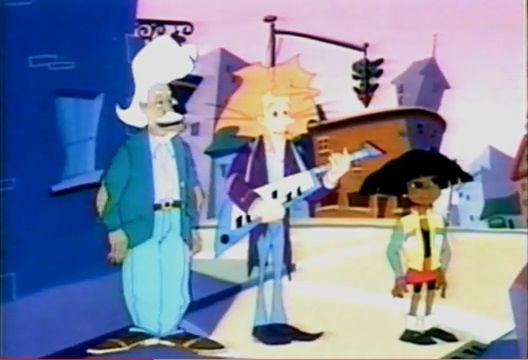
Crone) a street musician that played keytar (like his namesake, Ludwig
von Beethoven). Additionally, two identical girls dressed in spandex called Fly Girls
(Carmen Twille) would pop up from time to time, acting like a Greek chorus and seemingly
unnoticed by the other characters (however, they tended to get
caught up in the events of an episode). Among Hammerman’s foes were Defacely
Marmeister (John
Stocker), who loved graffiti and looked like an abstract
painting; Paula Bunion, who was obsessed with shoes; and Boss Grindenheimer (Dan Hennessey),
an evil genius and mad scientist.
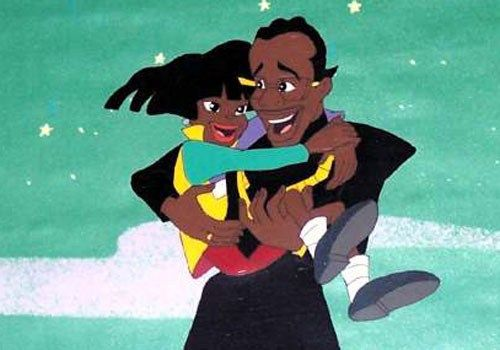
Hammerman rescues Jody.
Hammerman debuted on ABC on September 7, 1991, a
co-production of DiC Entertainment
and Bustin’ Productions, a spin-off to Bust It. Reportedly viewing it as his
social responsibility, the series took inspiration from Fat
Albert and the Cosby Kidsby
having live-action wraparound segments featuring Hammer discussing the plot and
moral of the story with a group of kids on animated backgrounds from the show.
Hammer also interacted with his animated counterpart in the series’ intro,
rapping the theme song by him and Felton Pilate
that spelled out Hammerman’s origins. Additional Hammer songs were integrated
into the show’s soundtrack with additional music by The Music Team and Chase/Rucker
Productions. The series was written by Reed Shelly,
Bruce Shelly,
Bob Forward,
Eve Forward,
Martha Moran,
Robert Askin,
Steven Weiss
and Paul
Dell,
with the Shellys serving as story editors. Ed
Lee handled the character designs.
Hammer hanging out on set with kids to spell out today's moral.
DiC Entertainment had earned itself
a bit of a reputation in the industry for trying to produce a product as
cheaply as possible. Many would come to regard the company’s initials as
standing for “Do It Cheap”. However, while many of their productions still
looked decent despite animation limitations, Hammerman became the one
program that most embodied that distinction. While the intro, animated by
Milimetros Dibujos Animados, S.A., was animated smoothly enough, the show
itself, animated by Pacific
Rim Animation L.T.D., was horrendous by comparison. Instead of
the traditional 24 frames per second, Hammerman ran at 10 or less,
depending on the episode and scene. Many times, it looked as if the only things
animated were the keyframes (the start and ending positions of a movement),
with the in-betweens (the drawings that create the illusion of movement between
the keyframes) skipped entirely. Continuity mistakes were also common; such as
Jody being tied up and captured in one shot but free and escaping the next
without any kind of context.
Gramps with Ludwig and Jody.
Needless to say, the show performed
abysmally in the ratings and only lasted a single season of 13 episodes. This
also coincided with a turn in Hammer’s personal fortunes as Too Legit to
Quit failed to perform as well as the previous album. He spent the money
faster than it came in, resulting in his declaring
bankruptcy in 1996. Hammer eventually rebounded and continued
making music, working in the industry and investing, as well as riding a wave
of nostalgia to appear in reality
shows and commercials,
but had never reattained the level of success he originally experienced.
The villainous Defacely Marmeister.
While
Hammer the man continued on, Hammerman wouldn’t been seen again until
2014. The Cartoon
Network series Robot
Chickenran an episode called “Welcome to the Golf Jam”,
which saw disgraced
golfer Tiger Woods
attempting to rebuild his reputation by making his own Space
Jammovie. However, the only company that
would agree to partner with him was DiC. As a result, poorly animated versions
of several DiC characters appeared, including Hammerman (Zeb Wells).
One of the VHS tapes.
There was some merchandising to go
along with the show. Three episodes were released to
VHS
by Buena
Vista Home Entertainment in 1992; the only official releases
to date, with more episodes being made available via uploads on YouTube (although not all
in English). View-Master
would adapt “Defeated Graffiti” into three
slide reels. JusToys produced
a set of temporary
tattoos featuring the main characters and Hammerman’s shoes,
while Thermos made a lunch box
depicting Hammerman and Gramps hanging out with some neighborhood kids. White Castle even
hosted a strange
promotion where they gave out Hammerman toothpaste, a
toothbrush, a sponge and a bar of soap.
EPISODE GUIDE (airdates approximate):
“Defeated
Graffiti” (9/7/91) – Defacely Marmeister tricks neighborhood kids into
graffitiing up the buildings with his special paint that he can bring to life. “Winnie’s
Winner” (10/19/91) – Knowing Hammerman is always hanging around the rec center,
three villains drop off a bugged dog so that they can find and trap him. “Rapoleon”
(11/16/91) – Feeling like nobody pays attention to his beats because he’s
short, Raopoleon’s plan to turn himself larger ends up giving him the means to
make the world smaller. “Will
and the Jerks” (11/23/91) – UNAVAILABLE. “If
the Shoe Fits” (11/30/91) – Paula Bunion makes off with Lefty, who happens to
be in love with one of her boots. “Nobody’s
Perfect” (12/7/91) – Stanley’s brother invents a robot designed to make
everything perfect, but failed to take into account that we live in an
imperfect world. “Dropping
Out” – Hammerman tries to keep one of the rec center kids from dropping out of
school to play pro ball by taking him to the future. “Lights,
Camera, Hammer!” – Showbiz drags Stanley to a movie production and they both
end up captured on celluloid—literally. “Blast
from the Past” – Gramps is feeling pretty useless until one of his old foes
returns and gives Hammerman some trouble. “Who’s
Who” – UNAVAILABLE. “Work
This” – UNAVAILABLE.
Disney’s The Owl House is a
groundbreaking animated series created by Dana Terrace. The series
follows ordinary human teenager Luz Noceda (Sarah-Nicole Robles) as she accidentally
finds her way into a magical land full of witches and demons. There, she finds
a new family—renegade witch Eda Clawthorne (Wendie Malik), wolf-like demon
King (Alex Hirsch), and
worm-like owl-faced house demon Hooty (also Hirsch)—makes new friends—illusion-casting
Gus (Issac Ryan Brown),
plant magic-based Willow (Tati
Gabrielle), and abomination-making Amity (Mae Whitman)—while also
fulfilling her dreams of learning how to be a witch, as well as becoming
embroiled in the schemes of the sinister Emperor Belos (Matthew Rhys).
The series
has earned a strong fan-following due to its characters, settings and
especially its diversity (the cast, crew and characters are all a mix of races
and sexual orientations). Currently on its second season, it has been wowing
fans even more with the densely packed stories full of character development
and lore. While currently on its mid-season hiatus, we thought it would be a
good time to check off our favorite moments of the season (so far). Do you
agree with our picks? Do you have different ones? Let us know in the comments, on Facebook, or on Twitter @SatMForever! Also, a SPOILER WARNING is in
effect, so if you haven’t watched any episodes yet (partially available now on Disney+), you’ve been warned!
FRIENDSHIP GOALS
Following the
conclusion of the first season, Eda’s sister Lilith (Cissy Jones) had left the Emperor’s
Coven, lost her magic and taken on half of Eda’s curse as penance for putting
it on her in the first place. She was at her lowest point and wanted to make it
up to Eda further by gathering the ingredients to concoct a potion that would
allow Eda to spy on the Emperor. And, much like other residents of the Owl
House, she found Hooty to be an annoyance. That is until he came to her rescue
in acquiring honey from fire bees. From that moment on, they became fast
friends: joking with each other, hanging out together, and even becoming pen
pals when Lilith left the Owl House to reunite with her family. If that’s not friendship
goals, what is?
CREEPY LUZ
In “Keeping
Up A-fear-ances”, we finally got to meet Eda’s mother (Deb Doetzer), who has been working
on finding a cure for Eda’s curse without much success. However, that wasn’t the
big part of this episode. No, it came in the last few seconds, where we got a
glimpse into Luz’s home in the human realm and found that her mother, Camila (Elizabeth Grullon), hasn’t been
missing her since she’s been trapped in the Demon Realm—because she’s already there?!
That’s right, someone who resembled Luz (dubbed “Creepy Luz” by the fandom) was
in her house, and Camila was none the wiser. We had gotten hints of the double
in the previous season when it was shown that Camila had been getting physical letters
from Luz (the real one had been texting her through the portal until she had to
destroy it), but this was the first time we saw her in the flesh and ominous
shadows.
LA CHANCLA
We hadn’t
seen much of Camila outside of the first episode, but “Yesterday’s Lie” changed
all that as we got to the bottom of the “Creepy” Luz subplot. It turned out the
doppelganger was none other than a basilisk named Vee (Michaela Dietz) that escaped captivity
by Emperor Belos and retreated to the human realm, taking Luz’s place in order
to get a new life. Unfortunately, a witch hunter that had encountered Eda
before managed to capture her, forcing Luz—who was able to peer through and
interact through reflections from a portal door she was able to build—to contact
Camila for help. Camila managed to keep it together long enough to whip out la
chancla (a flip flop) and give the witch hunter a sound thrashing, freeing Vee
and bringing her home. That moment, along with a few others of Camila’s, was
sure to have Hispanic fans dying over the accuracy.
AMITY TAKES A STAND
Amity had
long been subjected to the whims and desires of her family. Be the best,
associate with the best, live up to the Blight name. In “Escaping Expulsion”, Luz,
Gus and Willow were all expelled from Hexside at the behest of Amity’s mother
when she felt they were making her too distracted. Luz made a deal with Odalia
(Rachel MacFarlane) to get
them back into the school by being the target for their latest abomination
weaponry demonstration. Once Luz’s life was in danger, though, Amity jumped in
to rescue her; going against her mother’s wishes and destroying the necklace she
used to communicate telepathically with her. The episode showcased how strong
Amity had become both magically and psychologically since allowing herself to
be with people she wanted to be with. And, her awesome display managed to
finally switch something on in Luz that she began reciprocating the crush Amity
had on her since last season. But, we’ll get into that part later.
BARD MAGIC
We’d
already been introduced to various kinds of magic in the show: glyph magic; wild
magic, which was all-encompassing; plant magic; illusion magic; construction
magic, which could cause structures to rise up out of the ground; abomination
magic, which crafted semi-autonomous creatures out of a purple goo; healing
magic; oracle magic; beast-keeping, which could summon and control various
creatures; and potion magic. One we knew existed but never saw anything of was
bard magic. Until “Eda’s Requiem”. Eda was reunited with ex-lover Raine
Whispers (Avi Roque), who had just become the head of the Emperor’s Bard Coven.
As a result, we finally got to see bard magic in action: from controlling
people and objects to bathing the world in a glorious display of color
masterfully rendered by the animation team. Add to that it was partially introduced
to us by the first non-binary Disney character and that makes it all the more
memorable.
GUS LEVELS UP
Gus was beginning
to question his choice to pursue illusion-casting, feeling there isn’t much to
offer in creating something that isn’t really there. In “Through the Looking
Glass Ruins”, Luz encouraged him to go on an adventure with some Glandis
students (a rival school to Hexside) that led them to what turned out to be an
illusionist graveyard. Gus ended up creating the ultimate elaborate illusion to
keep the Glandis students from looting the graveyard, complete with body terror
and bleeding statues. Frankly, it’s amazing Disney let that go through! But as
awesome as this was, Gus’ adventure was unfortunately overshadowed by another
event from that episode…
THE KISS
While Gus was
on his adventure, Luz was having one of her own with Amtiy; seeking out the
journal of Philip Whittebane (Alex
Lawther), a human who had come to the Boiling Isles back in the 1600s. Amity,
of course, had been crushing hard on Luz and put her job on the line to help
her as a result. Unfortunately, it ended up with Luz accidentally getting Amity
fired when it was discovered an echo mouse had eaten the journal, and Amity now
needed to come to terms with all the new emotions that seem to be clouding her
judgement lately. Luz being Luz, she got Amity’s job back after some harrowing
tasks and made peace with the mouse when it was discovered it could project the
contents of the journal. In that moment of sweetness, Amity was overcome with
the desire to kiss Luz on the cheek and acted on it; a moment that surprised
both of them and had the fandom burst out in a cheer heard from space.
HARPY EDA
In “Knock,
Knock, Knockin’ on Hooty’s Door”, Hooty attempts to help his friends overcome
their problems in the most Hooty ways possible. Helping Eda get some rest forces
her into a dream encounter with the owl beast that inhabited her as part of her
curse. Through shared memories and symbolism, Eda decides instead of fighting
maybe they should form a truce. The result? Eda gained a new badass harpy form
while still being in full possession of her faculties.
LUMITY BECOMES CANON!
Lumity, the
fandom designation for the romance between Luz and Amity, became official in
the episode “Knock, Knock, Knockin’ on Hooty’s Door”. Hooty kidnapped Amity (as
one does) and dropped both girls into a tunnel of love he formed under the Owl House.
Now, keep in mind, at this point Amity thinks Luz only thinks of her as a
friend and Luz is afraid to make her own move because of bad experiences in the
past. While Amity enjoys the tunnel, Luz is too horrified to notice and
proceeds to destroy it in front of her, making Amity think Luz doesn’t like
her. Hooty throwing a devastating tantrum forces Luz to face her fear and
finally ask Amity out—only to have Amity beat her to it! It was such a cute and
realistically awkward moment, and made fans squeal with glee over Lumity
becoming official and being an actual on-screen same sex couple in a
Disney show.
AMITY VS. HUNTER
In “Eclipse
Lake”, Amity, Eda and King were on the hunt for some Titan’s Blood to create a
new portal back to the human realm. However, Emperor Belos needed it as well for
his own portal and his minions were looking for it at the same time; as was his
protégé, Hunter (Zeno Robinson),
in an attempt to prove himself. Discovering the Titan’s Blood had dried up,
Hunter was ready to give up on life. Amity attempted to take a page from Luz’s
book in trying to comfort him, but he snapped when he saw she had the original
portal door key. What followed was one of the most epic fight scenes in the
show yet, with Amity’s abomination-magic wielding being reminiscent of Whitman’s
previous water-bending character Katara from Avatar: The Last Airbender. The
battle ultimately ended in a badass stalemate, but Amity no doubt proved how
awesome a girlfriend she was (a term that was dropped FOUR TIMES this episode,
by the way).