Remember that one day when you could wake up without an alarm? When you would get your favorite bowl of cereal and sit between the hours of 8 and 12? This is a blog dedicated to the greatest time of our childhood: Saturday mornings. The television programs you watched, the memories attached to them, and maybe introducing you to something you didn't realize existed. Updated every weekend.
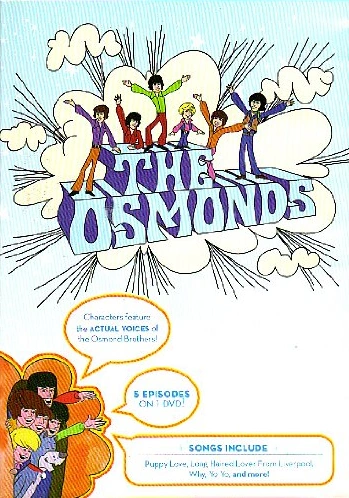
The Osmonds
were an American family musical group that were very popular in the 1970s. George Virl Osmond Sr.
and Olive Osmond
resided on a farm in Ogden, Utah, and
were musicians within their church. They had nine children: Virl, Tom, Alan, Wayne, Merrill, Jay,
Donny, Marie and Jimmy.
In 1958,
Alan (9), Wayne (7), Merril (5) and Jay (3) began singing as a barbershop
quartet around the town and during church services as a way to earn money for
hearing aids for their brothers Virl and Tom, both born with severe hearing
impairments, and to finance future church missions. Their
talent and stage presence encouraged their father to take them to an amateur
barbershop singing competition in California. While there, the family took a
trip to Disneyland where the
Osmonds performed with the park’s own barbershop quartet, The
Dapper Dans. Having been seen by Tommy Walker,
Director of Entertainment and Customer Relations, they were hired to perform at
the park the following summer. It also landed them minor roles in the Kurt Russell television series The Travels of Jaimie
McPheeters and an appearance during a segment of the “Disneyland After Dark”
episode of Walt
Disney’s Wonderful World of Color, where Walt Disney
himself took viewers around Disneyland at night and showed off the nighttime
entertainment; complete with numerous entertainment guest stars.
When singer
Andy Williams’ father
Jay saw them at the park, he
encouraged his son to book the Osmonds on his show, The Andy Williams Show.
The Osmond Brothers became regulars on it from 1962-67, earning the nickname
“one-take Osmonds” amongst the staff due to their professionalism and constant
rehearsing. Donny would join the group in 1963, with Marie and Jimmy making
appearances later on and Jimmy eventually joining in 1967 (Marie would be the
last to join up a few years after in 1973). When the show ended in 1967, the
Osmond Brothers were signed to The Jerry Lewis Show
until it was cancelled in 1969; at which point they rejoined The Andy
Williams Show for its second run.
Osmonds LP sleeve featuring The Osmond Brothers and Donny in the middle.
Deciding
they wanted to get away from variety shows and perform as a rock and roll band,
The Osmond Brothers recorded and released their first single, “Flower Music” with the
B-side “I Can’t Stop”,
in 1967 for UNI Records.
Record producer Mike Curb saw the
Osmonds perform and recognized their talent. He signed them to MGM Records and paired
them with producer Rick
Hall. Now known as The Osmonds, they released their first hit single, “One Bad Apple” written
by George
Jackson, in November of 1970, along with their first MGM album, Osmonds. It hit
#1 on the Billboard
Hot 100 and stayed there for five weeks in early 1971. The album itself hit
#14 on the Billboard Top Lps chart and was certified gold later that
year. Their second album, Homemade, was
recorded in just 6 days and released in August of 1971; with the single “Double Lovin’” peaking
at #14 on the Billboard Hot 100. It was certified gold in early 1972.
Osmonds Greatest Hits album featuring Jimmy with the group.
With their
third MGM album, Phase
III in 1972, the Osmonds began writing and performing their own music,
gravitating towards a rock sound. Their fourth album, Crazy Horses,
went even harder
on the rock; going over into heavy metal territory. They wrote all the
songs, played all the instruments, and sang all the vocals. Merrill and Donny
were the co-lead vocalists—with Donny mostly singing the chorus of the
songs—until Donny’s voice began to change, forcing him to drop back to largely
instrumental contributions. The band compensated by progressively lowering the
key until his voice finished changing. While still working with his brothers,
Donny had also engaged on a solo career; releasing his own albums alongside the
group’s. Jimmy would follow suit with his own solo work beginning in 1972.
Rankin/Bass' caricatures of The Osmonds: Jimmy, Donny, Jay, Wayne, Merrill and Alan.
Rankin/Bass
Productions partnered with MGM to bring the Osmonds to Saturday mornings
for ABC; similarly to how they had The Jackson Five the year prior. In fact,
both cartoons were very much identical in their structure and presentation. The
Osmonds would follow the brothers as they embarked on a world tour after
winning a contest to become musical goodwill ambassadors. They traveled on a provided
psychedelic jet plane piloted by Alan, accompanied by their anthropomorphic
dog, Fuji (Paul Frees in 4th wall-breaking internal monologues, using
a Japanese accent). Unlike The
Jackson 5ive where a touring schedule kept the Jacksons too busy to
participate in the show, the Osmonds provided all of their own voices; with
Frees and Iris Rainer doing all the rest. Along with the interesting characters
they met in each new location, trouble usually followed the brothers due to
Jimmy’s immaturity and impetuousness and Donny’s tendency to be girl-crazy. One
girl Donny wasn’t crazy about was his self-proclaimed #1 fan: Hortense
Bird (Frees), an old lady with missing teeth who decided to follow the Osmonds
on their tour.
Dancing through the streets.
The
Osmonds debuted on ABC on September 9, 1972, airing right after The
Jackson 5ive. The series was a showcase for the music of the Osmond
brothers, with two songs being worked into every episode accompanied by a
music-video like sequence. All of the songs--with the exception of “Getcha Goin’ My Way”,
which wouldn’t be released until 2012--were taken from the albums Osmonds,
Homemade, Phase III and Crazy Horses;the Donny solo albums The Donny Osmond
Album, To You with
Love, Donny, Portrait of DonnyandToo
Young; and the Jimmy solo album Killer
Joe. “One Bad Apple” was used as the series’ theme, with episode titles
appearing at the end of the intro in an apple shape. Maury Laws provided the rest of
the music, and Curb served as an executive producer. The show was written by
Rainer, Earle
Doud, William
J. Keenan, Claire Merrill
and Romeo
Muller, and animated by Halas
and Batchelor. This was the second—and last—series to feature Rankin/Bass’
new and improved laugh track; which had better modulated laughs than their
previous one and benefitted from better timing by the sound engineers. It only
ran a single season of new episodes, with a second season comprised entirely of
reruns on Sunday mornings. Several episodes would be released to VHS in
the early 1990s by The ABM
Group, and Donny would release a DVD
compilation of 5 episodes through his website in 2007. While the complete
series has never been released, episodes have been uploaded to YouTube by fan accounts.
The
Osmonds’ popularity began to decline following the release of their ambitious
1973 album, The
Plan, which carried a strong religious message and a progressive rock
sound. Within three years, the band put out music in a variety of genres
including bubblegum pop, hard rock and easy listening, giving them an
inconsistent sound and took them away from the pop music that made them popular
in the first place. Not helping matters was Donny’s voice change taking away
their younger fans and his tendency to cover oldies on his solo albums. Alan,
Wayne and Merrill had all gotten married between 1973 and 1974, which led to
the band reducing their touring schedules to spend more time with their
families. Finally, the Osmond brand had gotten diluted with Donny, Marie and
Jimmy emerging as solo artists, and Donny and Marie recording duets together.
By 1976, album sales were slumping and The Osmonds had only one last Top 40 hit
with “The Proud One”,
a cover of a Frankie Valli
minor hit.
Donny & Marie billboard during their residency at the Flamingo.
The Osmonds all together for Marie's 60th birthday.
Alan,
Wayne, Merril and Jay returned to The Osmond Brothers to earn money for their
debts. A handful of their songs just missed breaking the top 40, and their
record sales were reduced by their unwillingness to tour and desire to only
promote their music through music videos, but they were able to pay off their
debts by 1983. They continued to perform with various line-ups, including their
children, as well as independently with other performers. Alan retired from the
group in 2007 and Wayne in 2012 after a stroke left him unable to play guitar;
although they played one more performance with them in 2018 and again
in 2019 for Marie’s 60th birthday. Merril planned to retire in
2022, but continued on for a limited run in 2024. Jay continues to perform with
Alan’s son, Nathan,
and they plan
to begin a residency in Branson,
Missouri in October of 2024. Jimmy suffered a second stroke in 2018 and had
dropped out of showbusiness to recover, with Merril hoping he’d eventually
return to the group.
EPISODE GUIDE:
“And Away They Go” (9/9/72) – The Osmonds have a chance to
audition for a world tour, but Jimmy and Fuji ruin their chances.
Meet the band: Stephanie, Merilee, Butch, Wally and Elvis.
Butch
Cassidy and the Sundance Kids were a teenaged rock band that worked as secret
government agents for the World-Wide Talent Agency; solving crimes as they toured
around the world with the help of local agents (although you’d think being
famous musicians would make keeping a low profile for investigating difficult).
The band was comprised of lead singer and guitarist Butch Cassidy (Lloyd “Chip”
Hand II), tambourine player Merilee (Judy Strangis), bass guitarist Stephanie
(Kristina Holland), and drummer Wally (Micky Dolenz), as well as Wally’s trusty
anthropomorphic (though non-speaking) dog, Elvis (named after The King, voiced by Frank Welker). They
were given assignments and advised by a giant supercomputer named Mr. Socrates
(named for the Greek
philosopher, voiced by John Stephenson using a stereotypical robotic voice),
who was housed inside the WWTA and could communicate with Butch, codenamed “Sundance
1”, through the device in the ring he wore. Despite being an artificial
intelligence, somehow Mr. Socrates had a strong allergy to dogs which meant
Elvis had to be kept out of the lair. A running gag featured Elvis managing to
find his own way in or Wally forgetting about Socrates’ allergy and bringing Elvis
in with them. The characters were designed by Takashi Masunaga.
The Hex Girls poster in Scoob! baring the Sundance Kids' name (among others).
The characters would go on to make
appearances in several episodes of Sealab 2021: playing
as a band in “All That Jazz”; as residents of SeaLab Pod Six in “Let ‘Em Eart
Corn!” (with Butch and Wally sporting mustaches); “Butchslap”, where the
character of Marco (Erik Estrada)
was revealed to have been a Sundance Kid; and the character models for Butch
and Wally were recycled for the appearances of writer John Miller and creator/writer Adam Reed, respectively, in the
episodes “Swimming in Oblivion” and “Return to Oblivion”. The band was also
listed as a featured act for the Hex Girls—the fictional goth female group within the Scooby
universe—on a poster in the 2020 film, Scoob!
EPISODE GUIDE:
“The Scientist” (9/8/73) – The band must smuggle a scientist
out of a foreign country without being discovered.
“The Counterfeiters” (9/15/73) – The band investigates a
Latvanian baron for his connection to a counterfeiting ring.
“One of Our Ships is Missing” (9/22/73) – The band ride on a
cruise ship that’s targeted by a group of boat thieves.
“Double Trouble” (9/29/73) – The band must expose an
imposter prince put in place to hide his kidnapping.
“The Pearl Caper” (10/6/73) – The band heads to Honolulu to
search for pearl thieves and their stolen loot.
“The Gold Caper” (10/13/73) – The band goes to London to
uncover a gold smuggling ring.
“Road Racers” (10/20/73) – A diamond theft coincides with
The Grand Prix Cross-European race that begins in Venice.
“Hong Kong Story” (10/27/73) – The band deals with both
their fan club and the theft of a priceless jade statute.
“Operation G-Minus” (11/3/73) – An anti-gravity device is
stolen from a Munich toy expo.
“Orient Express” (11/10/73) – Mr. Socrates is taken over by
an enemy agent while the band is off delivering an important document.
“The Parrot Caper” (11/17/73) – The band escorts a parrot
that memorized an important formula to Switzerland.
“The Super Sub” (11/24/73) – The band sets out to retrieve a
stole experimental submarine.
“The Haunted Castle” (12/1/73) – Wally inherits a castle
that appears to be haunted.
A spin-off of The
Brady Kidsand a precursor in concept to The
Magic School Bus, Mission: Magic! was the fulfilment of producer Lou Scheimer’s desire to show
how important a teacher could be to children. The series would center around a
teacher with magical powers named Miss Tickle (a play on “mystical”, voiced by
Lola Fisher) that had a special rapport with her small yet diverse class of kids—The
Adventurers Club comprised of the quirky Socks, word-confusing Vinnie (both
Howard Morris), their leader Kim, lovestruck Carol (both Erika Scheimer), nerdy
Harvey and athletic Franklin (both Lane Scheimer)—and her cat, Tut-Tut, who
could turn to and from a statue via a magical incantation. Her lessons would
become enhanced adventures as she was able to open a portal through her
blackboard, with Tut-Tut’s help and transport them all to magical worlds beyond
such as a world ruled by magic, one where everyone did things in reverse, or
even an underwater city. Filmation
sold the idea to ABC’s Michael Eisner, however there was
a catch: they wanted the series to feature Australian musician Rick
Springfield.
Miss Tickle and The Adventurers Club: Harvey, Carol, Kim, Franklin, Vinnie and Socks.
After learning to play the guitar at age 13,
Springfield joined various bands in England and Australia before winding up
with pop rock band Zoot
as a backing vocalist; eventually becoming the lead guitarist and vocalist in
1969. Zoot’s gimmick, wearing head-to-toe pink satin, earned them significant
attention and numerous teenaged female fans, but cost them being taken
seriously as musicians. After the band broke up in 1971, Springfield signed with
Sparmac Records and his debut
single, “Speak to the Sky”,
peaked at number 5 on the Go-Setsingles chart and at number 14 on the BillboardHot 100. His debut album, Beginnings,
became the first of seven of his top 40 albums on the Billboard 200. Springfield moved to the United
States in 1972 and signed with Capitol
Records until a scandal broke out that Capitol was paying people to buy his
albums, resulting in a radio station boycott. Springfield moved to Columbia Records in 1973 where he
recorded his second album, Comic
Book Heroes. His looks and style had earned him the status as the next
teen pop idol.
The psychedelic sounds of Rick.
ABC had
entered into an arrangement to help promote Springfield and felt that the
cartoon would be a good showcase for his music. It was decided that while Miss
Tickle would be the children’s steward, Springfield would be their guide once
they went through the portal with his owl Ptolemy (named for the Greek mathematician and astronomer
and playing with Tut-Tut on the nonsensical poem “The
Owl and the Pussycat” by Edward
Lear); either filling them in on the goings on or actively calling for
their help through a magic gramophone in dealing with situations like thieves,
despots and disasters. Springfield would go on to write and perform a song in
each episode related in some way to the story, albeit in truncated form to accommodate
episode runtimes, and the series’ theme. Fisher, an accomplished singer herself,
was able to perform a song of her own in an episode—not written by Springfield—as
well as some melodic spell casting. According to Scheimer in the book Creating
the Filmation Generation, she likely would have had more opportunities had
Springfield not been involved. Carol was depicted as having a crush on Rick,
not unlike the legion of his young female fans.
Drawing the magic door.
Mission:
Magic! debuted on ABC on September 8, 1973, airing alongside The Brady
Kids. This was one of the few Filmation series to not rely heavily on stock
footage, making it one of the more expensive they produced. Outside of the main
characters, each new world they visited necessitated new designs for both them
and their related characters. It was a way to give the series a different look,
compared by Scheimer to a Peter Max
painting or the designs for Yellow Submarine,
and to make sure each place fit the story being told. Additionally, the musical
numbers would be accompanied by their own kind of psychedelic visuals. In typical
Filmation fashion, each story contained a pro-social message. Marc Richards
wrote the entirety of the series as he did with The Brady Kids, and the
rest of the series’ music was composed by Ray Ellis and Norm Prescott as Yvette Blais
and Jeff Michael, respectively.
The magical Land of Prestidigitation.
The series
ultimately did no one any favors. It didn’t hit with audiences and only lasted a
single season. It did nothing for Springfield’s career that he wouldn’t do for
himself with the release of the album Working
Class Dogand its hit single “Jessie’s Girl”, as well
as his prominent role as Dr. Noah Drake in the soap opera General Hospital. He has
since continued to perform on stage and screen, as well as dabbled in writing
with his autobiography and a novel. While this and Miss Tickle ended up being
Fisher’s only credit for Filmation, she was the wife and manager of Jackson Bostwick who would become the
titular hero of their live-action effort Shazzam!in 1974.
Tut-Tut and the magical gramophone.
In 1974, Springfield released the
album Mission:
Magic!in Australia through Wizard Records.
The album contained the full version of all the songs he performed of the show
except for “Yes I Am”. While none of the songs have been included on any of
Springfield’s official compilation albums, the album itself has been re-released
in various territories under different names and lengths: Just Gotta
Sing(13 tracks), Big Hits(10
tracks), Backtracks,
Speak
to the Sky(9 tracks plus the titular single), Catch Me
If You Can(including 2 singles), Fan-Tastic
Rick Springfieldand Rick
Springfield. The album was reissued on CD in 2004. In 2007, BCI Eclipse
released the digitally remastered complete
series to DVD with additional special features.
EPISODE GUIDE:
“The Land of Backwards” (9/8/73) – The Adventurers Club
finds themselves in trouble when returning stolen jewels lands them in jail.
“Modran” (9/15/73) – The Adventurers Club tries to stop
crooked Modran from cheating to win a tournament, but he takes some of the kids
captive as insurance that he will.
“The City Inside the Earth” (10/6/73) – Rick calls the
Adventurers Club to a subterranean city where a scientist seeks to claim the
underground for himself.
Song: “Yes I Am”
“2600 A.D.” (10/13/73) – The Adventurers Club heads to the
future where they find Omni the robot is ruler over all humans, and he needs
help to save the Earth from a meteor.
“Giant Steppes” (10/27/73) – Miss Tickle must rescue Rick
and his friend Billy from a giant while the kids figure out how to get Billy
back to his throne.
“Will the Real Rick Springfield Please Stand Up?” (11/10/73)
– Rick and Ptolemy are acting strangely, and it turns out both have been
replaced by crooks that can change their shape.
“A Light Mystery” (12/22/73) – The Adventurers Club heads
through the door to find out which of three rulers stole a generator to help
them conquer the entire land.
Gwen Stefani with her Harajuku Girls: (from left) Maya Chino, Jennifer Kita, Rino Nakasone & Mayuko Kitayama.
Harajuku
Girls was also the name she gave the group of backup dancers she hired for the
tour, wearing make-up and clothing meant to be evocative of the Japanese
aesthetic. The Harajuku Girls were comprised of Maya Chino,
Jennifer
Kita,
Rino Nakasone
and Mayuko
Kitayama, who performed under the stage names “Love”, “Angel”,
“Music” and “Baby”, respectively, after the album. Along with the tour, the
Harajuku Girls served as Stefani’s entourage in public (it was alleged that
they were contractually
obligated to speak only Japanese in that instance), appeared with her
on interviews (where part of her gimmick was that she considered them imaginary
friends), and starred in 8 of her music videos (three of them would also appear
in No Doubt’s “Settle
Down”
video, sans Harajuku styling). Stefani would go on to use the name “Harajuku Lovers”
for a line of fragrances,
which came in caricature bottles fashioned after her and the Girls, and fashion
for Target
also adorned with those caricatures. During this period, many critics would
come to regard Stefani’s Harajuku Girls as not so much cultural appreciation,
but more along the lines of cultural
appropriation as well as reinforcing negative
ethnic stereotypes.
An example of the kawaii design applied to the scenery.
Fast forwarding to 2014, Stefani announced the next Harajuku-inspired
product: an animated series. A desire to turn the Harajuku Girls into some kind
of media project existed since the initial album’s release, but it wouldn’t be
until 2013 that she pitched it at Kidscreen’s Asian
Animation Summit. Australia’s Network
Ten liked the idea and greenlit the production. Although this would be
Stefani’s first involvement with an animated series, she had a familiarity with
their inner workings through her brother, No Doubt co-founder and former member
Eric
Stefani, who worked as an animator on cartoons like A
Pup Named Scooby-Dooand The Simpsons.
HJ5: Love, Angel, G, Music and Baby, along with their manager, Rudie.
Initially titled Koo Koo Harajuku, the show was developed by Steve
Aranguren, Gillian Carr and Madellaine
Paxson and co-produced by Vision Animation, Red Flags Fly and Moody
Street Kids, with DHX Media (now WildBrain) handling
distribution. Animated in Flash, the series followed
the adventures of teenaged band HJ5 as they often met with challenges that
prevented them from playing their gigs peacefully; such as unruly fans,
fun-hating despots, or inventions gone amok. HJ5 was comprised of leader G
(modeled after Stefani, voiced by Maggie Cheretien), the glue of the band who kept
them together through tough times and represented bows; Love (Daisy Masterman),
the group genius whose inventions often caused more problems than they solved and
represented hearts; Angel (Emma Taylor-Isherwood), a bubbly and cheerful
fashionista that could be a bit of an airhead at times and represented stars; Music
(Sally Taylor-Isherwood), the sarcastic and strong-willed second-in-command of
the band who was both an amazing fighter and dancer and represented musical
notes; and Baby (Charlotte Nicdao), sweet and carefree to a fault who loved
adorable things and giving hugs (and was constantly hungry) and represented
cuteness. Their manager was Rudie Rhodes (Danny Smith), who was enthusiastic
but hard-lucked and clumsy, and tended to get the band into trouble through his
antics and forgetfulness. Additionally, the band had a sassy robotic personal
assistant and chauffer named R.O.D. (Robotic Obedient
Driver), as well as several monster pets (cute little creatures that could be
domesticated or wild) and a Pomeranian named Chewie (based on Stefani’s
own pet). The characters, designed by Kyla May, were heavily
influenced by the Harajuku Girls while remaining ethnically ambiguous.
General Nofun holds HJ5 captive.
The series featured a number of antagonists bent on ruining HJ5’s
careers any way they could. Chief amongst them was General Ira S.
Nofun (Paul Heng, Ian Bliss in Australia), the
leader of Nofunland who hated anything fun. His top man was Commander
Bo-ring (Bliss), who led a double life as pop star Baron Von Melody. Nofun also
had a cat, Moods
Meow, who had designs on world domination. Other antagonists included Madame
Shhh, who hated noise and wanted to soundproof everything through magic
spells and bubbles; Sammy
Starr, Rudie’s arrogant rival who used leetspeak and tried everything to sign
HJ5 to him; Say-Wah (Nicdao), a technological whiz who wanted revenge on the
band for not accepting her into their ranks; The Kimberlys, a rival band
comprised of similar-looking girls all named Kimberly who wanted to be famous
without doing any of the actual work; Tizzie
Lizzie (Natalie Bond), the band’s biggest
(and obsessive) fan and daughter of an incredibly wealthy man who attempted to
subjugate HJ5; Angelica (Amanda
Harrison), a young inventor and Love’s chief rial; Cici, the leader of a
mermaid singing group who felt they had sole performing rights in oceanic
territories; Panda Pete, a panda-obsessed businessman who wanted to make the
whole world kawaii (the Japanese
culture of cuteness); Mimi
Di Pollo, an extreme fashion designer who wanted revenge on HJ5 for firing her
because of her impractical outfits for them; and Bertrand, a smartphone
modified by Love to never become obsolete that evolved into a sentient despot,
among others.
Baby and the monster pets.
Other characters included Colonel Spyke (Jaqueline
Brennan), captain of the Harajuku Defense Squad who disliked HJ5’s music but
didn’t hesitate to employ their services on missions when needed; Twisty-T (Smith), a prominent
music producer Rudie always strove to impress; Jo
Jo Jolie, a fashion designer and Twisty T’s wife; Mauve Madison (Brennan in
Australia, Chrehtien in the US), a popular talk show host; Trixie
La Trill (Bond), a hair stylist and Rudie’s aunt with a desire to be famous; Sparski, a sentient computer
virus; and Krispin
Krouton, a tabloid journalist, among others.
Much like Stefani’s Harajuku Girls, reception to the series was mixed
and labeled as cultural appropriation. Reviewers pointed out the whitewashing
and Westernization of Japanese culture while simultaneously eliminating
anything remotely Japanese from the show. Despite that, the series was able to
churn out 3 seasons and was nominated for an Asian
Television Award in 2016. For the third season, HJ5 embarked on
a world tour that took them out of Harajuku City to new and exotic locations
with their own crazy themes--such as bubblegum, musical instruments or yo-yos--via
a teleporting tour bus concocted by Love. The last five episodes of the series
aired initially on Disney
Channel Australia before airing on 10 Peach.