Remember that one day when you could wake up without an alarm? When you would get your favorite bowl of cereal and sit between the hours of 8 and 12? This is a blog dedicated to the greatest time of our childhood: Saturday mornings. The television programs you watched, the memories attached to them, and maybe introducing you to something you didn't realize existed. Updated every weekend.
The question of whether or not we’re alone in the
universe is one that has danced in the minds of scientists and common man
alike. Is there life on other planets? In other galaxies? Have they ever been
to Earth? And if so, why do they only target rednecks and cattle? And don’t
they have anything better to do than make lawn art? These are the kinds of
questions answerable only by the Men in Black.
The original comic.
Men in Blackstarted out as a three-issue mini-series published by Aircel Comics, the
insulation company-turned-independent publisher run by Barry Blair, in 1990. The
concept was created by writer Lowell Cunningham
after his friend introduced him to the concept of the men in black: government
agents that wore suits and sunglasses and drove around in black vehicles to
hide all evidence of the existence of aliens by any means necessary. Similarly, Cunningham’s Men in Black (also
known as MIB) used the same--if not more extreme--methodology. To keep the
premise from getting stale, his MIB also dealt with all aspects of the
paranormal including ghosts and monsters.
Agent K "recruits" Agent J.
The primary focus of the book was Agents K (sometimes
depicted as Kay) and J (sometimes Jay). Agent K forcibly recruited Agent J, a DEA agent, during an undercover drug sting. He
threatened J with a memory-wipe from his “neuralyzer” device that
would leave him unable to explain the operation’s failure to his bosses unless
he joined the agency. The neuralyzer was the key instrument in the agency’s
ability to keep the public unaware of strange phenomenon by wiping out all
memory of an encounter and replacing it with a new memory suggestion.
Farmer vs. alien. It doesn't end well.
While Agent J became K’s partner, K regarded him as
completely expendable, kept secrets from him, and made morally questionable decisions
involving him. Essentially, K was corrupted by the love of the power the agency
gave him, according to an interview by Cunningham in the series’ first issue. Their
direct supervisor was Agent Zed who was heard but never seen and hinted at not
actually being human. Another agent, Agent Ecks, went rogue when he discovered
that the MIB’s true purpose was to reshape the world into their own image by
keeping the supernatural hidden.
First film promo poster.
The series proved a success and was followed-up the
next year by a second three-issue series called Book II; published by Aircel’s
new owner, Malibu Comics.Both series were drawn by Sandy Carruthers.
Producers Walter F. Parkes
and Laurie MacDonald came
across the comic and optioned the rights to it in 1992. They hired Ed Solomon to write a script that
was very faithful to the comics and sought Barry Sonnefeld to direct after
seeing his darkly humorous films The Addams Familyand
Addams Family Values, which were adapted from the Charles Addams comic strip.When Sonnefeld was unavailable, Parkes
and MacDonald considered other options before deciding to wait for him to be
free.
The main receiving area of MIB HQ.
Production began on Men in Black in 1996. While filming, numerous changes were made to
the concept and the script. The agency became more benevolent, focused solely
on monitoring and policing alien visitors and those who remain as secret
citizens on the planet since they made first contact back in the 1960s. The
secret, of course, was to avoid a worldwide panic at discovering not only are
we not alone in the universe, but the universe was already here. Sonnefeld set
the movie in New York City as a result, feeling its citizenry would be more
tolerant to oddly-behaving aliens disguised as humans as well as a great number
of the buildings there resembled space transports. Operating independently of
the government, MIB was financed by patents on technology appropriated from
alien encounters such as Velcro and minidisc. Unlike the traditional firearms
of the comics, the MIB used more advanced weaponry and tools, including the
neuralyzer (whose effects could be blocked by the sunglasses they wore). Their
primary mode of transport was an unassuming black 1987 Ford LTD Crown
Victoria that held an advanced power plant under its hood and could
transform for a burst of speed. As MIB headquarters was the arrival point for
aliens to arrive on Earth, production designer Bo Welch modeled it after the TWA
terminal at John F.
Kennedy International Airport.
Agents K, J and L.
The characters were given backgrounds, something the
comics stayed away from. Agent K (Tommy
Lee Jones) was just a kid who stumbled upon the first meeting between the
aliens and the agents; opting to join the organization and cut off all ties to
his former life as all agents are required to do. Agent J (Will Smith) was NYPD detective James
Darrell Edwards III who was recruited by K when he ran down an alien
perpetrator on foot. Smith was cast after the original choices of Chris O’Donnell and David Schwimmer turned down the
part because Sonnefeld liked his performance in Six Degrees of Separationand his wife was a fan of The Fresh Prince of Bel-Air.
K, while grizzled and jaded, was more human than his comics counterpart and
took a mentorship role to J. Agent Zed (Rip Torn) was also fully seen,
and the center of the MIB’s intelligence-gathering and communications were
handled by a pair of one-eyed tentacle aliens known as The Twins: Idikiukup and
Bob.
Agent L faces down Edgar's brother.
Men in Black dealt
with the arrival of Edgar the Bug (Vincent
D’Onofrio), who wanted to take the tiny galaxy possessed by the Arquillian
race in order to destroy them. The MIB had to stop Edgar and retrieve the
galaxy before the Aquillians destroyed the planet in order to keep it out of
the Bugs’ hands. The film ended with K wanting to retire, having trained J to
be his replacement rather than his partner. J in turn gained a new partner in
Laurel Weaver (Linda Fiorentino),
a coroner who became entangled in their adventure.
Released by Columbia
Pictures on July 2, 1997, the film became a box office success grossing
$589.4 million. Marvel Comics, who came to
own the franchise through their purchase of Malibu in 1994, released several
comics to promote the film. One was an adaptation of the film;
another was Retribution, which followed the first movie and saw K returned to active duty
via de-neuralization (similar to what would happen in Men in Black 2); Far Cry had Cunningham return to write a continuation of the
original comics’ continuity; and a reprint of the original
first issue in association with defunct retailer American Entertainment.
Making animation look good.
To capitalize on the film’s success, an animated
series based on the movie was put into production by Amblin Television,
Adelaide
Productions and Columbia
TriStar Television. Developed by Duane Capizzi, Jeff Kline and Richard Raynis, the series
largely took up where the film left off, however there were some changes made.
Agent K (Ed O’ Ross & Gregg Berger) didn’t retire and was made to seem more
stiff and emotionless. Agent J’s (Keith Diamond) personality contrasted K’s as
he was lively and held on to his humanity. He was depicted as more of a rookie
for comedic effect, however; particularly every time he was sent flying by the
kickback from his signature weapon from the film, the Noisy Cricket (J
would later acquire a silencer that put an end to that recurring gag). J’s new
partner from the end of the film, Agent L (Jennifer Lien & Jennifer
Martin), became a veteran agent who spent most of her time in MIB’s lab before
eventually becoming a field agent. Zed (Charles Napier) was just as no-nonsense
as K, rather than displaying some of the sarcastic wit he did in the film. Also
present were the coffee-mooching Worm Guys (Patrick Pinney and Pat Fraley) that
hung out in MIB’s break room, the Twins (also Pinney and Fraley), and MIB
informant Frank the Pug (Eddie Barth).
Jack Jeebs.
Tony Shalhoub reprised his role of Jack Jeebs from
the movie for the first season. Jeebs was an alien who worked in a pawn shop
that was actually a front for illegal alien goods and sometimes informant for
the MIB (after they shot head his off first, usually—don’t worry, it grows
back). He was replaced by Billy West for the remainder of the show’s run.
D’Onofrio also returned in several episodes to voice other Bugs that came to Earth as
well as the Emperor
Worm. Agent Ecks from the comic was reimagined as Alpha (David Warner), K’s
former mentor who became corrupt and sought to become all-powerful by grafting
alien parts onto his body. The Agent X name was recycled into L’s new partner (Adam Baldwin), a green-skinned
alien from the G-Dan galaxy as a means to smooth human-alien relations.
Although a toy line by
Toysite was announced and promoted at the 2000 Toy Fair, it was never released. Instead
the only toys based on the series came from both Burger King and Wendy’s as part of their kids meals. In 2000, Crave Entertainment
produced two video games based on the series for the Game Boy Color. In the
first, Men in Black: The Series, the player was only allowed to play as
Agent J while using various weapons to work through levels reminiscent of
episodes. Men in Black: The Series 2allowed the player to switch between
Agents J and K. In 2001, Infogrames
released Men in Black: The Series –
Crashdown for the PlaySation that
had Agents J and K in a first-person shooter combining multiple episodes
together into one story.
The American DVD release.
In March of 1999, Sony Pictures released three
two-episode VHS
collections; one containing a bonus episode. The remainder of the first
season saw
release in 2003 outside of North America. In 2004, UCA Pictures released
the first three episodes to DVD
outside of North America, however low sales resulted in no further releases. Sony
Pictures Entertainment released the complete first season on DVD in 2007 as a
box set in Australia and between two
volumes in the United Kingdom. In May of 2012, in time for the release of Men in Black 3, the
first season came
to DVD in the United States initially as a Target
exclusive. No further releases of the series have been planned or announced,
but the entire series was made available for streaming on Netflix.
Now, just look right here for a moment...
EPISODE GUIDE:
Season 1:
“The Long Goodbye Syndrome” (10/11/97) – When J destroys a Skraaldian
on a mission, he becomes the most wanted man on the planet Skraal.
“The Buzzard Syndrome” (10/18/97) – J and K help alien cop Treblor
track down escaped convict Z-Ron, but Treblor may not be who he says he is.
“The Irritable Bow-Wow Syndrome” (10/25/97) – The Charnock pursue
Frank after he accidentally swallows a black hole generator.
“The Alpha Syndrome” (11/1/97) – J and K stumble upon a theft
committed by K’s former mentor Alpha, who has upgraded himself with alien body
parts.
“The Undercover Syndrome” (11/8/97) – J goes undercover as a Tarkan
bodyguard to protect the Trade Minister of Tarka at an alien conference.
“The Neuralyzer Syndrome” (11/15/97) – J trying to learn more about
K’s past leads him to accidentally neuralyze K back to the age of 16.
“The Symbiote Syndrome” (11/22/97) – J fills in for an infected K on a
mission to transport a symbiote to New York, but Buzzard has his sights set on
the symbiote for his boss.
“The Inanimate Syndrome” (12/6/97) – Intergalactic cop Eileen, an old
flame of K’s, helps the MIB track down an escaped shapeshifter.
“The Psychic Link Syndrome” (12/13/97) – Forbus is absorbing human
body fluids and allowing K to share in his experiences through a psychic bond.
“The Head Trip Syndrome” (12/20/97) – J uses a device that
accidentally increases his intelligence, but before he can fix himself he has
to stop an alien bigot from wiping out the MIB in the past.
“The Elle of My Dreams Syndrome” (1/10/98) – When the MIB attempt to
save the crew of a space shuttle, L has to enter J’s dreams to save him from a
Vermax.
“The I Married an Alien Syndrome” (2/14/98) – J believes K is an alien
spy for the Blastula who are currently increasing Earth’s temperature to
colonize it.
“The Take No Prisoners Syndrome” (5/16/98) – MIB’s inmates escape and
take over the HQ, leaving only J and the worms to stop them.
Season 2:
“The Little Big Man Syndrome” (9/19/98) – J is shrunk down to
investigate the Fmeks thefts of Arquillian human suits.
“The Quick Clone Syndrome” (9/26/98) – J uses quick clones to get some
rest, but Alpha uses one of them to steal Zed’s brain.
“The Heads You Lose Syndrome” (10/3/98) – Alpha’s alien attachments
are failing and decides to use Troy the symbiote to rectify that.
“The Dog Eat Dog Syndrome” (10/10/98) – Frank’s old associate Drekk is
running loose on Earth, but if he helps MIB he could be boiled alive.
“The Big Bad Bug Syndrome” (10/24/98) – The Queen of the Bugs puts a
bounty on the heads of J, K and L for the death of Edgar.
“The Jack O’Lantern Syndrome” (10/31/98) – While trick-or-treating
with the worms, J discovers an alien kidnapping children.
“The Sonic Boom Syndrome” (11/7/98) – J and K team-up again with
Eileen and her partner to track down an escaped alien.
“The Bad Seed Syndrome” (11/14/98) – Parasites from alien seeds take
over MIB and threaten the world.
“The Fmall, Fmall World Syndrome” (11/21/98) – The Fmeks break into
MIB to steal a growth formula and kidnap one of the worms, believing him to be
its creator.
“The Black Christmas Syndrome” (12/12/98) – MIB has to rescue Santa
Claus from Drekk.
“The Supermen in Black Syndrome” (1/16/99) – J, K, L and three alien
criminals are all given super powers.
“The Star System Syndrome” (1/23/99) – K and J are sent to Hollywood
to investigate the disappearance of alien actors.
“The Blackguard Syndrome” (2/6/99) – J and K head into space to rescue
MIB’s satellite from Alpha and Dak Jeebs.
Season 3:
“The Worm-Guy Syndrome” (10/30/99) – J and K are merged with the worms
while trying to stop Kalifadik law enforcement agents from sending the guilty
to alien prisons via teleportation guns.
“The Cold Sweat Syndrome” (11/6/99) – Alpha and Dak, now merged, end
up in Antarctica where they discover a powerful alien spaceship.
“The Puppy Love Syndrome” (11/13/99) – Frank’s new girlfriend Veronica
secretly works for Javkor who is out to steal MIB’s secrets.
“The Lost Continent Syndrome” (11/20/99) – K and J have to prevent the
restoration of the continent of Atlantis.
“The Way Out West Syndrome” (11/27/99) – J and K travel back in time
to the wild west to stop an alien in his vulnerable state before he can
threaten Phoenix in the present.
“The Mine, Mine, Mine Syndrome” (12/4/99) – MIB faces problems when
The Bug Queen and The Emperor Worm end up staying at the same hotel.
“The Bye-Bye Worm Syndrome” (12/11/99) – J tries to clear the worms’
names after Zed deports them for their latest mishap.
“The Lights Out Syndrome” (1/29/00) – J has to help a blinded K to
stop the Darkons from creating a permanent eclipse.
“The Out to Pasture Syndrome” (2/12/00) – Zed retires, K is put in
charge, and Alpha returns more powerful than ever.
“The Sardines and Ice Cream Syndrome” (2/26/00) – While the Fmeks
shrink everything, J becomes pregnant when he accidentally swallows an alien
egg.
“The I Want My Mummy Syndrome” (3/12/00) – A Hyperian, dressed like an
Egyptian mummy, is awakened.
“The Baby Kay Syndrome” (4/23/00) – When the delegate’s daughter
they’re watching is kidnaped, K is exposed to her age-regressing spray and
de-ages into a baby.
“The Bad Doggie Syndrome” (4/30/00) – Frank’s body is taken over by
the king of the Tunstons, who are trying to conquer Earth.
“The ‘J’ is for James Syndrome” (5/7/00) – J joyrides in the LTD and
ends up fired just as the bugs attack.
Season 4:
“The Musical Chairs Syndrome” (9/16/00) – Dr. Zeeltor takes over the
lab for new field agent L while New York is threatened by the Barooga.
“The Spectacle Syndrome” (9/23/00) – J and K have to rescue the worms
from an alien world resembling ancient Rome.
“The Back to School Syndrome” (9/30/00) – J poses as a high school
student to protect an alien prince.
“The Opening Gambit Syndrome” (10/7/00) – MIB has to get information
from Alpha about how he stopped Vangus the first time he came to Earth.
“The Future’s So Bright Syndrome” (10/21/00) – J gets sent to the
future and discovers worms rule the Earth.
“The Loose Ball Foul Syndrome” (4/14/01) – K is on the same
baseball-like tiny planet that the Fmeks decide to conquer.
“The Hots for Jay Syndrome” (4/21/01) – Alien food gives J the ability
to throw fire.
“The Circus Parade Syndrome” (4/28/01) – An alien gang comes to Earth
after discovering someone they’re looking for is hiding out there.
“The Virtual Crossfire Syndrome” (5/5/01) – When J attempts to beat a
virtual reality training program, the program goes haywire and becomes deadly.
“The Breaking News Syndrome” (5/12/01) – An alien film crew follows
the MIB around on the job just as Drekk returns.
“The Zero to Superhero Syndrome” (5/26/01) – When an alien becomes a
superhero, MIB seeks to stop him before his actions attract unwanted galactic
attention.
“The Endgame Syndrome: Episode 1” (6/23/01) – Zed decides to reveal
MIB to the world after Alpha, Vangus and the Ixions band together.
“The Endgame Syndrome: Episode 2” (6/30/01) – Despite MIB successfully
resisting the attack, the Ixions plan to unleash their ultimate weapon that
will kill everyone on the planet.
Alan Young died on May 19. You can read the full story here.
Best known as the long-serving voice of Disney’s Scrooge McDuck since
1974, Young was also Mr. Frump in Spider-Man and His Amazing Friends; the
Cyclops Computer in The Incredible Hulk (1982); Gaggy Rogers in an
episode of The New Scooby-Doo and Scrappy-Doo Show; Farmer Smurf,
Scaredy Smurf, and Miner Smurf in The Smurfs; Tod Baker in an episode of
Batman: The Animated Series; Mr. McDonald in an episode of Static
Shock; and several roles in episodes of ABC Weekend Specials. He
also provided additional voices in Scooby-Doo and Scrappy-Doo (1979), Rubik
the Amazing Cube, The Dukes and Alvin & the Chipmunks (1983).
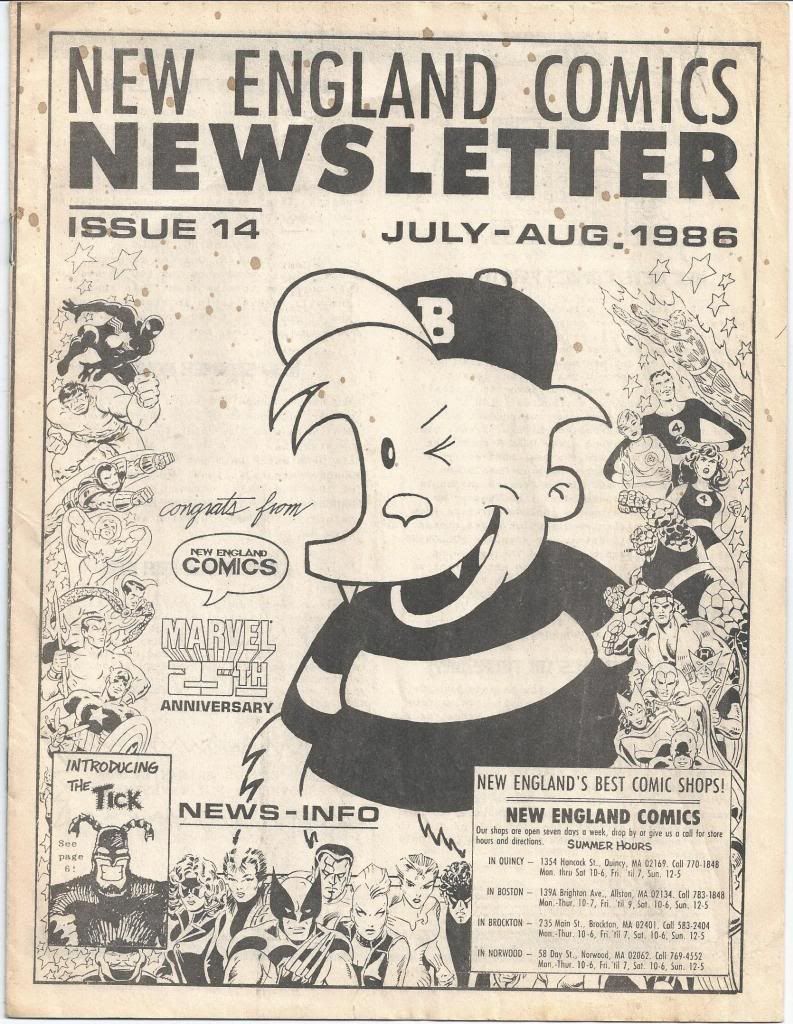
The Tick was created by
high-schooler Ben Edlund and
went on to become the mascot for the comic shop he frequented. New England Comics in Norwood,
Massachusetts, in 1986. The Tick first appeared in the fourteenth
issue of their newsletter, and after some well-received stories in following
editions, New England Comics financed the production of a black-and-white comic
series. The series debuted in June of 1988 and released twelve issues over
the next five years.
The Tick's first appearance.
The Tick is a parody of superheroes and super hero comics. Initially having
escaped from a mental institution, he possessed no memory of his past before
becoming The Tick. Incredibly strong and durable while also being klutzy and
incompetent, he became the protector of The City. He took a day job at the Weekly World Planet newspaper with
fellow superhero Caped
Wonder, aka Clark Oppenheimer (a Superman pastiche, but
more of a jerk). Initially, Edlund wanted The Tick’s costume to be brown, but
it was decided that blue looked better in print when the comics switched to
color.
The Tick meets Arthur.
The Tick’s sidekick was Arthur; an accountant who one day found and put
on a moth suit, never taking it off again. His suit gave him the ability to fly
with retractable wings in his backpack and he was often mistaken for a bunny
due to his long antennae. He would serve as the voice of reason to Tick’s
enthusiasm. The City was also populated by a cast of equally absurd heroes and
villains, many of whom were parodies of various Marvel
and DC Comics characters. A lot of the
humor would come from dark comedy and sexual innuendos.
"We will bring the tangy sweetness of justice to the airwaves!"
When toy licensing and design company Kiscom discovered The Tick, they approached Edlund with
the possibility of merchandising The Tick
much the same way Teenage Mutant Ninja Turtleshad just recently been. However,
networks and studios were reluctant to take on the property until finally Sunbow Entertainment
expressed interest. Sunbow paired Edlund up with writer Richard Liebmann-Smith to work
up the series proposal, despite neither having experience in animation. After
two months, they presented the proposal to the fledgling FOX network who, rightfully so in the minds of
both men, turned it down. FOX did give them five days to refine the idea and
pitch it again, which they did over the course of a weekend. The new proposal
was accepted by FOX and the series was greenlit.
The Tick promo image.
Edlund served as a producer of the show and was very hands-on in every
aspect of its production. Along with contributing to the series’ scripts
alongside Liebmann-Smith and former The
Tick comic book writer Christopher
McCulloch, Edlund also dabbled with the character designs and the
storyboarding for the episodes. As a result, the series was delayed for over a
year from its intended debut date. The
Tick finally premiered on September 10, 1994 on the FOX Kids block. Other writers
included Martin Pasko, Henry Gilroy, Art Vitello, Michael Rubiner, Pippin Parker, Jed Spingarn, Ralph Soll, Andy Yerkes, Randolph Heard, Eric Stangel and Justin Stangel. The series’
theme, as well as the entire score, was composed by Doug Katsaros
consisting of big band music and campy scat singing.
The "I've got a show!" strut.
Although a lot of the tonality from the comic had to be removed for a
Saturday morning audience (such as removing all traces of Tick’s time in the
institution, instead replaced by his crashing a superhero convention), the
satirical roots were firmly in place and didn’t hesitate to fully immerse
itself in parody. Tick’s job was also a casualty of the change in media; with
his now being a permanent boarder on Arthur’s couch after pulling him into a
hesitant partnership. Essentially, episodes would consist of the Tick (Townsend
Coleman) emphatically charging head first into all situations with his battle
cry “SPOOOOOOON!!!!” (thought up during a cereal breakfast one morning) like a
bull in a china shop. Arthur (Micky Dolenz & Rob Paulsen) wound up
providing a well-thought and reasoned solution to the conflict once he stopped
cowering and exclaiming “Not in the face! Not in the face!” The Tick would then
sum up their adventure with a moral full of absurd hyperbole. Arthur would eventually
come to meet, and date, the daughter of the scientist who invented his suit,
Carmelita Vatos (Jennifer Hale), who had a moth
suit of her own.
Sewer Urchin, Die Fledermaus, Fish Boy and American Maid.
Like the comics, The City had its share of superhero protectors—although
some were better at it than others. Created specifically for the show was Die
Fledermaus (Cam Clarke), a parody of Batman with a more
bat-like costume, who avoided conflict with full cowardice and spent his time
hitting on pretty women; Sewer Urchin (Jess Harnell), an Aquaman riff with a Rain Man-like personality who was virtually ineffectual
everywhere but the sewers he called home; and American Maid (Kay Lenz), a blend
of Captain
America and Wonder
Woman with a weaponized tiara and stiletto heels who was possibly the most
effective, though least-powerful, hero in the city. Other heroes from the
comics included Big
Shot (Kevin Schon), a
heavily-armed anti-hero ala Punisher who
eventually goes to anger-management therapy; Fish Boy (Clarke), an Aqualad
parody who was a completely useless lost prince of Atlantis; and The Mighty
Agrippa (Harnell), the Roman God of the Aqueduct who could move huge volumes of
water. The super team The Civic-Minded Five also appeared from the comics,
however they only retained Feral Boy (Schon), a boy who acted like an animal,
from their original line-up. The rest of the team was comprised of
mucilage-spraying Captain Mucilage (Paulsen), static electricity-generating The
Carpeted Man (Pat Fraley),
the four-legged 4-Legged Man (Roger Rose)
and the athletic (and competent) Jungle Janet (Susan Silo).
Chairface Chippendale.
What good are heroes without some equally absurd villains to fight?
Joining from the comics was Chairface Chippendale
(Tony Jay), a crime boss with
a chair for a head obsessed with putting his name and likeness on important
objects (like the moon); Barry
Hubris (Jim Cummings), a
glory-seeking “hero” who also called himself The Tick and used a shield device
to give him incredible strength; The Man-Eating Cow (Coleman), whose name is
very literal (although she’s never been seen actually eating anyone) and was originally
a superhero in the comics; The Terror (Paulsen), a Golden Age-era
supervillain who doesn’t seem to want to retire; Thrakkorzog (Cummings,
impersonating James Mason),
an alien from Dimension 14B that lived across the hall from The Tick and
Arthur; and Tuun-La: Not of This World (Pat Musick), a woman who could
tuck in her legs and emit fire from their bases. New foes included El Seed (named for Spanish hero El Cid, voiced by Ed Gilbert), who could
manipulate plants through chemicals; The
Evil Midnight Bomber What Bombs at Midnight (Maurice LaMarche), an explosives
expert (duh); The
Human Ton, an enormous moron who was accompanied by his intelligent hand
puppet, Handy (both LaMarche); Sheila Eel, who wore an electric eel; Eastern Bloc
Robot Cowboy (Fraley), a Communist cyberneticist who put his mind into a
mobile vending machine; the Mother of Invention
(Paul Williams), an
androgynous inventor who wanted to steal credit for all the inventions of
history, and many others.
Barry Hubris, the other Tick.
The series was nominated for five Annie
Awards, winning two of them in 1995, and three Daytime Emmys. Comedy Central began syndicating the
series during its run, premiering the episodes “Devil in Diapers” and “Tick vs.
Education” before their FOX airings, and introduced it to a more adult
audience. However, while the show brought the cult comic national attention,
the series failed to achieve the same level of commercial success as Ninja Turtles had, reducing its
merchandising potential. That, coupled with frequent production delays, led to
FOX cancelling the series instead of going forward with the planned fourth
season. FOX did enter into negotiations with Sunbow to produce a prime time Tick special the following year, but the
idea never materialized.
Coinciding with the series, Bandaireleased
two series of 6” action figures, five talking Tick figures (one of them 16
inches tall), and a set of 2” PVC figurines. In 1995, Gordy toys produced a
line of bendable
action figures both individually and in a box
set. In 2013, Shocker Toys released three
figures based on the show as part of their Indie Spotlight series. Pressman
created a board game and FOX
Interactive a video game in 1995. Inverse Ink adapted
the episode “The Tick vs. the Uncommon Cold” into an interactive CD-ROM comic. As this was the
90s, no merchandising blitz would have been complete without a set of officially
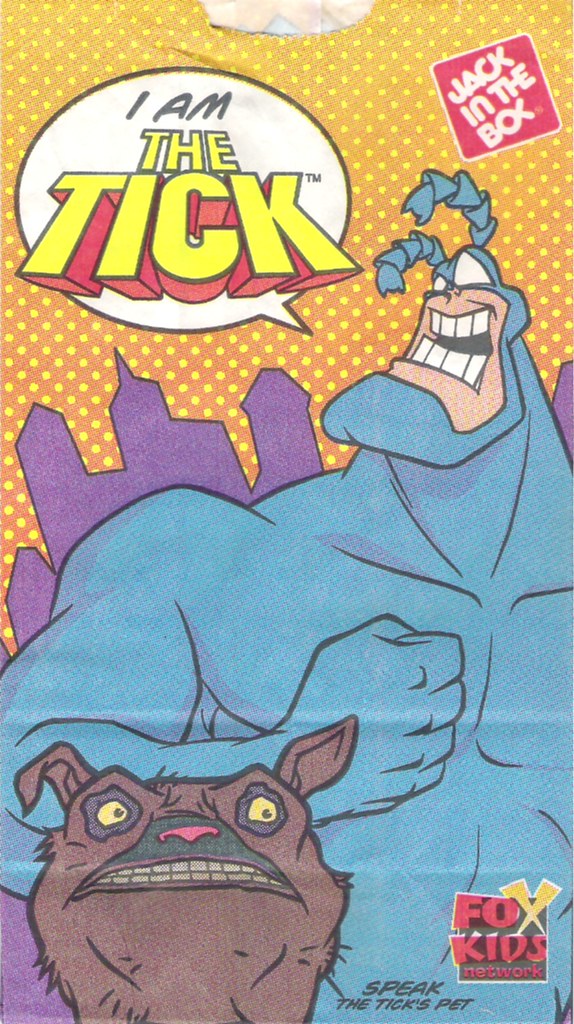
licensed POGS by the World POG Federation. Hardee’s, Carl’s Jr., Jack-in-the-Box
and Taco
Bell also partnered with the show to release a series of toys with their
kids meals. In 1997, Greg Hyland
wrote The Tick: Mighty Blue Justice!which served as a virtual episode guide
for the 34 episodes available at the time of its publication along with
background info on the various characters. The Tick was also one of the feature
characters in the two-issue FOX Kids Funhouseseries
and the Fox
Kids trading cards from Fleer.
To capitalize on the growing adult fanbase, FOX commissioned the
production of a new live-action prime time series starring Patrick Warburton in the title
role and reimaginings of American Maid and Die Fledermaus. The Tick debuted in the fall of 2001 and lasted only eight of its
nine episodes before it was cancelled despite praise from fans and critics. A
poor timeslot, lack of promotion and production costs were often cited as the
reasons behind FOX’s ultimately abandoning the show. Amazon Studios, however, had begun production on a reboot
of the live show in 2014, which saw its debut on Amazon
Prime Video in 2016 and ran for 2 seasons before it was cancelled—again despite
audience praise. The Tick cartoon,
meanwhile, has been regarded as one of the best cartoons in the years
following. Coleman’s character of Sentinel Prime on Transformers Animatedwas
purposely modeled after The Tick, and Chairface Chippendale (Seth Green) made an appearance on Robot Chicken. The Tick comic
continues to be published sporadically, particularly with an annual offering as
part of Free Comic Book Day,
although with minimal involvement from Edlund as his work on the show led to a
career in filmmaking.
EPISODE GUIDE:
Season 1:
“The Tick vs. The Idea Men” (9/10/94) – The Tick comes to The City and
meets former accountant Arthur, convincing him to become his sidekick in the
battle against evil.
“The Tick vs. Chairface Chippendale” (9/17/94) – Chairface wants to
commit the crime of the century by writing his name onto the moon.
“The Tick vs. Dinosaur Neil” (9/24/94) – Paleontologist Dinosaur Neil
attempts to grow a dinosaur from some found tissue but accidentally ingests
some of it and mutates into a dinosaur.
“The Tick vs. Mr. Mental” (10/1/94) – Mr. Mental takes control of The
Tick and has him steal the Thinking Cap to enhance his powers.
“The Tick vs. Breadmaster” (10/8/94) – The Breadmaster seeks to make a
City-smothering lemon soufflé.
“The Tick vs. El Seed” (10/15/94) – The Tick and Arthur have to
team-up with the Civic-Minded Five to battle the insane plant man El Seed.
“The Tick vs. The Tick” (10/22/94) – While The Tick battles another
The Tick for the rights to the name, The Evil Midnight Bomber What Bombs at
Midnight plans a bombing.
“The Tick vs. the Uncommon Cold” (10/29/94) – The Tick’s cold prevents
him from stopping the alien Thrakkorzog from conquering Earth with an army of
Tick mucous clones.
“The Tick vs. Brainchild” (11/5/94) – Brainchild plans to use his
device to slam the moon into the Earth.
“The Tick vs. Pineapple Pokopo” (11/12/94) – The Tick, Arthur and
American Maid are sent to Pokoponesia to rescue hyper intelligent astronaut
monkey Yank.
“The Tick vs. the Mole-Men” (11/19/94) – The Tick and Arthur play host
to a group of Mole-Men and their king.
“The Tick vs. The Proto-Clown” (2/4/95) – A genetically engineered
Proto-Clown terrorizes The City while The Tick ends up taking a journey through
his own mind.
“The Tick vs. Arthur’s Bank Account” (2/11/95) – The Terror comes to
The City and tries to conquer it.
Season 2:
“The Little Wooden Boy and the Belly of Love” (9/9/95) – When Arthur
ditches The Tick for a date, The Tick builds himself a new sidekick out of
wood.
“Alone Together” (9/16/95) – The Tick heads to the moon to fix the
damage Chairface did to it and The City believes he is dead.
“Armless but Not Harmless” (9/23/95) – Venus and Milo steal The Tick
and Arthur’s arms and put them on crude look-a-likes to do their evil bidding.
“Coach Fussell’s Lament” (9/30/95) – Brainchild uses his babysitter,
The Mad Nanny, to turn The Tick into a bird.
“Leonardo da Vinci and His Fightin’ Genius Time Commandos!” (10/7/95)
– The Mother of Invention seeks to alter time so that he can create the world’s
greatest inventions himself.
“Bloomsday” (10/21/95) – El Seed returns with his monster, Rosebud.
“Evil Sits Down for a Moment” (11/4/95) – Ottoman attempts to corrupt
Die Fledermaus through marriage in order to take over The City.
“Heroes” (11/11/95) – The Tick and Arthur are followed by a camera
crew to appear on the show “Heroes.”
“Ants in Pants!” (11/18/95) – While The Tick is in a sanatorium, a
large colony of ants capture the other heroes and lock them into a giant ant farm.
“The Tick Loves Santa!” (11/25/95) – When a crook dressed as Santa is
electrocuted by a billboard, he gains the ability to duplicate himself.
“Tick vs. the Big Nothing” (2/3/96) – The alien race The Whats kidnap
The Tick and Arthur in order to defeat their enemies, The Heys.
“Tick vs. Reno, Nevada” (2/10/96) – The Tick’s gambling problem may
keep him from saving Reno from being buried under a wave of fish.
“Grandpa Wore Tights” (2/17/96) – The Terror sends his son to recover
his weapon from the Decency Squad.
Season 3:
“That Mustache Feeling” (9/14/96) – The Tick wakes up with a sentient
mustache that Jim Rage wants.
“Tick vs. Dot and Neil’s Wedding” (9/21/96) – Chairface spoils Neil’s
wedding by having his medication mucked with, turning him back into Dinosaur
Neil.
“Sidekicks Don’t Kiss” (9/28/96) – When Arthur is kidnaped, The Tick
teams-up with his girlfriend Carmelita to rescue him.
“Tick vs. Arthur” (10/5/96) – Arthur finds a belt that gives him
muscles, but unknown to him it also has the side-effect of increasing his ego.
“Devil in Diapers” (10/6/96) – Mr. Mental disguises himself as a baby
to hide out in The Tick and Arthur’s apartment while working on his next
scheme.
“Tick vs. Filth” (10/26/96) – The Tick and Arthur witness Sewer Urchin
in his element and realize he’s a competent hero.
“Tick vs. Europe” (11/2/96) – The Tick is sent to Belgium on a
superhero exchange program.
“Tick vs. Science” (11/9/96) – Professor Chromedome uses a
mind-swapping machine to cover his escape, putting The Tick’s mind in
Carmelita’s body.
“Tick vs. Prehistory” (11/16/96) – The Tick and Arthur head three
million years in the past and end up with jobs in a restaurant.
“Tick vs. Education” (11/24/96) – The Tick and Arthur become teachers
to a class of wannabe superheroes.