Showing posts with label CBS Productions. Show all posts

July 01, 2023

THE TWILIGHT ZONE (1959)


THE TWILIGHT ZONE
(CBS, October 2, 1959-June 19, 1964)
 
Cayuga Productions Inc., CBS Productions


MAIN CAST:
Rod Serling – Narrator


The Twilight Zone was an anthology series created, produced and written by Rod Serling that delivered morality lessons and delved into modern day issues with often fantastical and science-fiction elements to make the messages more palatable to the average viewer. Serling had gained prominence in American television during the 1950s, but dealt with the constant aggravation of his stories being altered on the whims of the networks and their sponsors. He figured that robots, aliens and the supernatural might significantly remove things from reality and give him more leeway to present thought-provoking controversial ideas. In 1957, he wrote the pitch pilot “The Time Element”, depicting a man sent back to 1941 Honolulu who tried to warn everyone about the eminent attack on Pearl Harbor unsuccessfully, but it was ultimately rejected and shelved. Bert Granet rediscovered it a year later and produced it as an episode of Westinghouse Desilu Playhouse, and its success allowed Serling an opportunity to do his series.


The Twilight Zone debuted on CBS on October 2, 1959, running for 5 seasons. While reviewers praised the series, it initially struggled in the ratings with audiences until close to the end of the first season. Serling wrote or co-wrote 92 of the show’s 156 episodes and served as the narrator, delivering monologues that set up the moment when the story’s characters “entered the Twilight Zone” and the story’s moral at the end. While he appeared in promos for the series, it wouldn’t be until the second season that he would appear on screen to deliver those monologues. Additional writers included Charles Beaumont (until complications from a developing brain disease reduced his involvement), Richard Matheson, George Clayton Johnson, Montgomery Pittman, Earl Hamner Jr., Reginald Rose, Jerry Sohl, John Tomerlin (both of whom ghostwrote for Beaumont), and Richard De Roy. Bernard Hermann composed the series’ theme for the first season, but was replaced from the second season on by Marius Constant’s more-familiar composition. As it was an anthology series, it had no permanent characters and a rotating roster of actors; some well-known at the time, and others just beginning their careers. Several actors would make return appearances in various episodes as other characters, including William Shatner, Burgess Meredith, William Windom, Jack Klugman and Martin Landau, with Robert McCord having appeared in the most.


Difficulties in finding a sponsor for the 4th season resulted in the show being replaced by Fair Exchange, although it was ultimately renewed as a mid-season replacement for the replacement. To fill that timeslot, CBS demanded the series be expanded to an hour-long format, which didn’t sit well with Serling and the production crew. Serling’s involvement as an executive producer was reduced this season, and his monologues were filmed against a gray background back-to-back during his infrequent trips to Los Angeles. “The” was also dropped from the title. The 5th season returned to the half-hour format, but was plagued by a number of unpopular decisions by new producer William Froug; such as shelving a script for “The Doll” which was later made an episode of Amazing Stories (and won a Writer’s Guild Award nomination) and alienating Johnson by having De Roy rewrite and dilute his screenplay for what would become “Ninety Years Without Slumbering”. CBS head Jim Aubrey ultimately decided to cancel the series, having disliked it since his instatement during the 2nd season as it was an expensive series to produce and using the season’s middling ratings as further justification. Serling, severely burnt out by this time, sold CBS his 40% share of the series and left it behind until returning in 1969 with the similar series Night Gallery on NBC.


The Twilight Zone was nominated for 4 Primetime Emmy Awards, winning 2, and continued to be broadcast in syndicated reruns, initially less the episodes “Sounds and Silences”, “Miniature” and “A Short Drink From a Certain Fountain” due to copyright lawsuits, “An Occurrence at Owl Creek Bridge” which was a French short film whose airing as part of the series as a limited-time agreement, and “The Encounter” due to racial overtones. Notably, the series airs on Syfy regularly in late-night slots and as part of marathons for New Year’s and the 4th of July, although they’re usually altered to allow for more commercials. Three revivals have been attempted—one in 1985 lasting two seasons, one in 2002 lasting one, and one in 2019 which concluded after two—as well as an infamous film version in 1983 that resulted in the deaths of actor Vic Morrow and two children, and a 1994 made-for-television film comprised of two stories found by Serling’s widow, Carol.

September 03, 2022

FLYING RHINO JUNIOR HIGH


FLYING RHINO JUNIOR HIGH
(Teletoon, CBS, October 3, 1998-January 22, 2000)
 
Big Daddy Productions, Flying Rhinoceros, Inc., Neurones France S.A.R.L., Scottish Television Enterprises, Nelvana Limited, TPS Jeunesse, CBS Productions


MAIN CAST:
Ashley Brown – Billy O’Toole
Tracey Moore – Marcus Snarkis
Tracy Ryan – Ruby Snarkis
Terri Hawkes – Lydia Lopez
Richard Binsley – Earl P. Sidebottom/The Phantom
Ron Rubin – Raticus, Rod Hargrove
Eddie Glen – Fred Spurtz, Johnny Descunk
Lindsay Leese – Mrs. Snodgrass
Len Carlson – Principal Buzz Mulligan
Paul Haddad – Buford, Mr. Needlenose
Catherine Gallant (season 1) & Julie Lemieux (season 2) – Nurse Cutlip


            In 1993, Ray Nelson, Jr., Mike McLane, Douglas Kelly and Jeff Nuss decided to create a company that would develop entertaining educational content for children. They formed Flying Rhinoceros and published a variety of books featuring colorful characters—yes, even a rhinoceros. Each book tackled a different subject both tangible and conceptual, such as insects, dinosaurs, U.S. Presidents, creativity, drawing, self-esteem and more. Flying Rhinoceros attempted to recruit an expert on each subject to oversee their work for accuracy as well as write introductions for the books. Among them was Smithsonian Institution bug expert Sally Love; Raymond T. Rye of the National Museum of Natural History; astronaut Buzz Aldrin; NBA player Clyde Drexler; Sydney Butler, Executive Director of The American Zoo and Aquarium Association; former President Gerald Ford; and former U.S. Senator Bill Bradley.

Principal Buzz Mulligan.


            In addition to a series of educational shorts that were distributed directly to schools, an opportunity arose to adapt the books into a television series that exhibited the same sense of education through fun. Created by Nelson, Flying Rhino Junior High was set in the eponymous school whose principal, Buzz Mulligan (Len Carlson), happened to be an anthropomorphic rhinoceros. Inside the school was a statue of himself piloting an airplane, reminiscent of Flying Rhinoceros’ company logo. Mulligan was a well-meaning and jovial fellow that cared about his students and their education, but he was completely oblivious to a lot of the goings on in the school.

The Phantom and Raticus.


            Those goings on in question were the chaos perpetrated by former student Earl P. Sidebottom, aka The Phantom (Richard Binsley). Earl was a genius with the grade point average to match—until the one fateful day he was given a “D” in shop class, ruining his perfect record.  Shamed, he descended to the depths of the school’s boiler room only to reinvent himself as The Phantom (a pastiche of The Phantom of the Opera, complete with a ready organ) to seek revenge on the school. He did so by developing a supercomputer capable of altering the fabric of reality itself, usually taking inspirations from the day’s lessons. The students are learning about ancient Egypt? He’ll bring the pyramids complete with mummies and curses. The prehistoric age? A jungle and dinosaurs to roam the halls freely and destroy the school. Aiding him in his schemes (however ineptly) was Ratticus (Ron Rubin), a rat that Earl bestowed upon (so-called) intelligence.

Billy, Lydia, Marcus and Ruby.


            Standing against The Phantom was one particular group of classmates: Billy O’Toole (Ashley Brown), a mechanically inclined athlete with an aversion to bathing; Marcus Snarkis (Tracey Moore), a hyper-intelligent boy that skipped a few grades and was Billy’s best friend; Ruby Snarkis (Tracy Ryan), Marcus’ older sister that was a bit of a diva with acting ambitions; and Lydia Lopez (Terri Hawkes), the smartest girl in the class. They often must work together with their various skills and quirks to save the school and throw a wrench into The Phantom’s plans; occasionally learning a life lesson along the way.

Mrs. Snodgrass looking on at Fred's..."presentation".


            Other characters included Mrs. Snodgrass (Lindsay Leese), the class’s teacher that remained unphased by The Phantom’s shenanigans and often used them to aid in her lesson; Fred Spurtz (Eddie Glen), a slovenly classmate that enjoyed eating bugs and fish; Johnny Descunk (also Glen), a troublemaker that often wound up in detention; Nurse Cutlip (Catherine Gallant & Julie Lemieux), the school nurse; Mr. Needlenose (Paul Haddad), the former shop teacher that failed Earl and now teaches drama; and Buford (also Haddad), the school janitor and the only other anthropomorphic animal, being a pig, who claimed to have once been a secret agent.

Messing with gravity.


            Flying Rhino Junior High aired simultaneously on Teletoon in Canada and CBS in the United States, debuting on October 3, 1998. As the show was produced by Nelvana Limited, it aired as part of the CBS Kidshow programming block that the studio programmed for the network. Through another deal with Nelvana, it was co-produced and distributed in the United Kingdom by Scottish Television Enterprises (now STV Studios). The series was written by David Finley, Joseph Mallozzi, J.D. Smith, Gary Wheeler, Brent Piaskoski, Erika Strobel, Paul Mullie, Ian James Corlett, John Pellatt, Kenn Scott, Kathy Slevin, Michael Leo Donovan, Shelley Hoffman, John Mein and Robert Pincombe, with Finley and Mallozzi serving as story editors. The theme was composed by Alex Khaskin, George Axon and Ed Roth, with the rest of the series’ music done by Pure West.

The Phantom in disguise falling prey to his own schemes.


            Flying Rhino ran for a total of two seasons. The series was cancelled in early 2000 along with the rest of Nelvana’s shows. CBS had opted not to renew Nelvana’s contract, instead turning to then-sister network Nickelodeon to take over programming. Teletoon continued to air the series in syndication until 2007, and then YTV began reruns in 2011. In 1999, Alliance Atlantis released several episodes to VHS, and in 2000 Hardee’s included four toys based on the show in their kids’ meals. Nelvana has the entire series available to view on their YouTube Keep it Weird channel, and in 2022 the series began streaming on Tubi. Although the Flying Rhino series has long been discontinued, the various books are still available directly from the company and the characters continued to be used by Nelson across various educational platforms through his Really Big Creative studio.
 
 
EPISODE GUIDE:
Season 1:
“Prehysterical” (10/3/98) – Earl ends up turning the school into a prehistoric jungle after answering Mrs. Snodgrass’ dinosaur questions.
 
“Phantu’s Curse” (10/10/98) – When Earl transforms the school into a pyramid, Lydia takes a golden scarab as the others escape and unleashes the mummy’s curse.
 
“Underwaterworld” (10/17/98) – Mrs. Snodgrass’ lesson on underwater environments leads Earl to transform the school into an ocean.
 
“Solar Flexus” (10/24/98) – After Earl turns the school into the solar system, the others must correct the planets’ orbits before Earth falls into the sun.
 
“Frankensidebottom” (10/31/98) – A lesson on Frankenstein leads Earl to creating his own monster, and transforming the school into a horror movie town to go along with him.
 
“Comic Book Chaos” (11/7/98) – Earl unleashes four comic book villains on the school, and Lydia leads the others in stopping them.
 
“A Star is Boring” (11/14/98) – Ruby gets lost in a sea of Rubies after Earl turns her into hundreds of self-multiplying clones.
 
“Inverted and Unglued” (11/21/98) – Earl changes the school to a Victorian stamp factory to get a collectible stamp from the source when Ratticus fails to steal it from Marcus.
 
“The Game” (11/28/98) – Marcus losing his computer to Billy and unable to finish his video game leads Earl to reminisce about losing his and changes the school into Marcus’ game.
 
“Quit Buggin’ Me” (12/5/98) – Showing off bugs in school causes Earl to remember when his was crushed by a bully and inspires him to enlarge all of the bugs into giants.
 
“Phantom Christmas” (12/12/98) – When Earl refuses the Christmas spirit, Ratticus confronts him as The Phantom and forces him to relive all the chaos he’s caused at the school.
 
“Weather Waterloo” (12/19/98) – When Earl’s weather project is rejected by the class, he activates it and belts the school with a combination of bad weather.
 
“Pal 9000” (12/26/98) – Earl gets jealous of the AI friends Marcus created and implants a virus in Pal 9000 to turn him against Marcus and his friends.
 
Season 2:
“Live and Let Spy” (10/2/99) – Earl is determined to get his hands on his classmates’ journals to find out if they’ve been gossiping about him.
 
“Wag the Rat” (10/9/99) – Earl decides to have the school shut down during class elections as retaliation for having lost his,
 
“It’s Greek to Me” (10/16/99) – Earl changes the school to ancient Greece and the students must compete against the gods for their freedom.
 
“Yo Ho Ho and the Phantom’s a Bum” (10/23/99) – Earl transforms the school into a pirate galleon where the other kids have to figure out how to escape the pirates’ clutches.
 
“Junior High Noon” (10/30/99) – Earl turns the school into the Wild West just as Lydia is made a prefect, which turns her into a mega control freak Sheriff that jails everyone for anything.
 
“Out of Time” (11/6/99) – Earl uses his time machine to send Lydia, Marcus Ruby and Billy back to prehistoric times, but instead sends them back 20 years to when he was a student.
 
“Career Day” (11/20/99) – After Ruby insults Earl during career day, he turns the school into a dangerous sewer complex.
 
“Daredevil O’Toole and the Amazon Adventure” (11/27/99) – Earl ends up trapped in the school disguised as a girl when Ratticus turns the school into an Amazon jungle.
 
“Raging Rubbish” (12/4/99) – A lesson in environmental preservation inspires Earl to create a monster out of a mound of garbage.
 
“Better Safe than Silly” (12/11/99) – Earl is determined to ensure the school fails its fire safety inspection.
 
“Phantomatic Voyage” (12/18/99) – Lessons about the body and proper diets come in handy when Earl transports the school into his own body.
 
“All Green Thumbs” (1/15/00) – Earl has Ratticus dump plant-mutating fertilizer on the grounds’ greenery, causing them to grow fast and gigantic.
 
“Seeing Double” (1/22/00) – Tired of failing, Earl sends Billy, Marcus, Lydia and Ruby to a parallel dimension while their counterparts cause havoc in this one.

July 16, 2022

BLASTER'S UNIVERSE

BLASTER’S UNIVERSE
(CBS, September 4-November 27, 1999)
 
Nelvana, Hong Guang Animation, CBS Productions, Knowledge Adventure


MAIN CAST:
Jonathan Wilson – Max Blaster
Maryke Hendrikse – GC
Juan Chioran – MEL
 
 
            Educator Jan Davidson always sought to get her students more involved in the learning process. When the personal computer came around in the 1970s, she decided it would be a useful tool for that methodology since it required people to actively use one. However, by that time, there were no software offerings to fit her needs. So, she decided to create her own. With the help of a contracted programmer, her first game was Speed Reader designed to help kids learn how to read quicker. Then came Math Blaster and the vocabulary game Word Attack. Shortly after, she and her husband, Bob, created their own publishing company, Davidson & Associates, Inc., to continue to develop computer games and turn PCs into a valuable educational tool.

The original Math Blaster.


            Their most popular software line was the Blaster series, known as the Blaster Learning System, developed out of the original Math Blaster game. The game initially featured a stick figure man in a circus-like setting having to be maneuvered over the cannon under the correct answer to the problem, in which he would then fall into and be shot out of. A seal bouncing a ball served as a timer, with the added challenge of the man having to keep a balloon from landing on a nail on the other side of the screen. A revision was made in 1987 called Math Blaster Plus!, which replaced the non-descript player character with a little alien in a green space suit (although it was purple in the actual game) called the Blasternaut and the cannons with rocket ships, space stations they could blast off to, and a countdown timer. The second revision in 1990, New Math Blaster Plus!, changed things up entirely with better graphics, animations and four separate mini-games. In Plus!, the player needed to solve problems correctly to build his ship, power a tractor beam to pull in space trash that would then be recycled into fuel, and then using an anti-gravity pad to zip up to one of the waiting space stations to stop the alien invasion that now represents the timer. A bonus level was included that allowed the player to control Blasternaut on his jetpack to collect some items for points. This formula would become the standard for the Blaster series of games featuring the Blasterpals. Two spin-offs, Alge-Blaster Plus! and Math Blaster Mystery, were released in 1989.

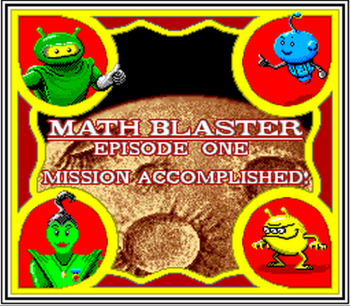
Victory screen from the home console version of Episode I, featuring Blasternaut, Spot, G.C. and the trash alien.


            In 1993, the original game was revised again as Math Blaster Episode I: In Search of Spot, this time introducing Blasternaut’s (Mark Sawyer) companion, an alien robot named Spot (also Sawyer using a Brooklyn accent), and boss/best friend, Galactic Commander aka G.C. (voiced by Laura Boedeker, the three known collectively as the Blasterpals), the leader of the Galactic Patrol to which Blasternaut belonged. The major difference in the game was the addition of the narrative to rescue spot from an evil trash alien (also Sawyer), as well as a platforming segment that required Blasternaut to have a particular number to continue onward (changed by positive or negative numbers that appeared as water droplets). 1994’s Episode II: Secret of the Lost City was geared towards an older age group and featured the characters in 3-D models during cutscenes for the first time. Math Blaster Jr. in 1996, made for pre-schoolers, returned to a purely sprite-based design and depicted Blasternaut, G.C. and Spot as kids. The Blasterpals would expand beyond basic math into Reading Blaster, Spelling Blaster and Science Blaster, sometimes facing off against appropriately-themed foes. Davidson also dabbled with other characters in other Blaster entries, including little green monster Rave, round alien Cosmic MC, and human girl Andi, but the Blasterpals were the most prominent throughout the line.

Spot, Blasternaut and G.C. learning they're about to be replaced.


            The Blaster Learning System was a major success, pulling in millions of dollars for Davidson & Associates. Naturally, the company used that to grow itself by purchasing software firms and studios (at one point they owned what would become Blizzard Entertainment), becoming publicly traded on the stock market, and creating their own distributor in partnership with Mattel. In 1996, CUC International bought Davidson & Associates and eventually combined it with another acquisition, former competitor Knowledge Adventure (now JumpStart Games, Inc.), under which all future Blaster games would be released. Along with that change came another: the decision to revise the Blaster characters.

G.C. and Blaster admiring their new creation, MEL.


            Taking a cue from the various Junior games in the series, the Blasterpals were reduced to childhood age. C.G. (Jennifer Hale) kept the purple hair she eventually wound up with through design revisions, but her skin was changed from green to lavender and her suit to orange. Blasternaut became a human boy named Max Blaster (Dee Bradley Baker) from a futuristic planet Earth. While he retained his green space suit (which now gave him enhanced strength and the ability to fly), he was given a clear bubble helmet. Spot was replaced by a robotic dog the pair built named MEL (Mechanically Enhanced Lapdog, voiced by Michael Gough). From 1999-2006, the new Blasterpals would adorn all of the future Blaster packaging and star in several games of their own; however, the original Blasterpals would remain included in future re-releases of previous games.

Blaster and G.C. doing some futuristic skateboarding on Earth.


            To promote the new Blaster era, Nelvana was commissioned to produce an animated series starring the characters developed by Jamie Tatham and Dale Schott. Set in the year 2222, Blaster (Jonathan Wilson) was best friends with G.C. (Maryke Hendrikse), a princess from the planet Omega who teleported to Earth via the ring she wore daily to attend Earth school as she loved learning—in stark contrast to the more free-spirited Blaster. When she held her ring towards Blaster’s watch, it allowed Blaster to go to teleport with her and gain his green spacesuit. While other aliens were aware of Earthlings, it seemed as if Earth was unaware of aliens as G.C. tried to pass herself as an ordinary Earth girl. Together, they built MEL (Juan Chioran) who often aided them in their studies and adventures when not maintaining his cover as a common dog. And those adventures often saw them going up against villains (some directly from the games) who threaten the universe with their educational-themed crimes: the history-loving (and altering) Major History; the word-stealing Illitera; the mathematical fiend Number Cruncher; and mad scientist Dr. Dabble. Because the series was produced in Canada, a Canadian voice cast had to be used instead of the games’ already established cast. To combat these foes, the Blasterpals had to rely on their brains and various things they had learned, cementing the educational message of the show.

Illitera up to no good.


            Blaster’s Universe debuted on CBS on September 4, 1999, as part of the programming block CBS Kidshow that was programmed by Nelvana. It was written by Schott along with Hugh Duffy, Ben Joseph, Dave Dias, Kim Thompson and Ken Ross, with Duffy serving as story editor. Miki Baumgarten, PhD was retained as the educational consultant to ensure it met the educational requirements expected of children’s television at the time. Ray Parker and Tom Szczesniak composed the series’ music, while Grayson Matthews for Tantrum Productions did the theme. Hong Guang Animation (now Brilliant Pictures) handled the animation duties.

MEL, Blaster and G.C. learning they're about to be replaced.


            Blaster’s Universe only ran for a single season, airing on Teletoon in early 2000 shortly after its CBS run concluded. Reruns were sparse and home media non-existent. In 2013, Russian-dubbed episodes found their way to YouTube followed by several of the English versions. For a time, Bell Media offered the entire series for viewing in Canada with a paid subscription on their website.

The current Math Blaster, Blaster Prime.


            In 2006, the Blaster series got another revamp with yet another new Blasternaut. This time it was Blaster Prime (Scott Allen Katz), the newest member of the long-forgotten Blaster Corps and the only living being who remembers math in the universe. With the aid of an AI program named AIMEE (Karen Strassman), Prime was on a mission to restore math and free the galaxy from the powerful Cyclotron X (Kevin Delaney), a math-teaching program that became sentient. The new 2.5-D platforming series began with Master the Basics before jumping over to Nintendo DS with 2008’s In the Prime Adventure. Since 2013, the Blaster series has been relegated to mobile devices and a via a subscription on the official Math Blaster website. As for the Davidsons, after they left their company in the late 90s, they started up the Davidson Institute for Talent Development; a nonprofit that ensures the nation’s most gifted and talented kids are supported and nurtured so that they can develop their talents and make a positive difference.
 
 
EPISODE GUIDE:
“You’re History” (9/4/99) – Major History intends to rewrite history with himself as a central figure, forcing Blaster and G.C. to use history against him.
 
“A Bridge Too Weak” (9/11/99) – Nothing is as it seems as the Number Cruncher plans to spoil G.C.’s father’s ceremony to open a new bridge.
 
“Misplaced Weekend” (9/18/99) – Only Blaster seems to realize the weekend completely disappeared, and he intends to find out why.
 
“A Spot of Trouble” (9/25/99) – MEL’s dog act suddenly becomes real, bringing him to the attention of Omegan Dog Catcher Von Shtoopenscooper.
 
“Uncool Copycat” (10/2/99) – Artist Deja Vu decides to make life-sized copies of everything, but when he copies the Blasterpals and the Commander it almost leads to an intergalactic war.
 
“Mind Over Manners” (10/9/99) – Illitera eliminates politeness across the universe, which could end up leading to war unless the Blasterpals can get her to return it.
 
“Body Electric” (10/16/99) – Illitera decides to get revenge on a childhood of losing spelling bees to the Commander by shrinking down and manipulating him from the inside.
 
“Hero Today, Gone Tomorrow” (10/23/99) – When it comes to a choice between cleaning his room and chasing a pirate ship, Blaster chooses the ship.
 
“Sound Advice” (10/30/99) – G.C. can’t wait to see her favorite musician in concert, but The Maestro may have other plans.
 
“Math Schmath” (11/6/99) – Blaster and G.C. are tasked with tutoring their bully in math just as the Number Cruncher issues a challenge for the fate of the galaxy.
 
“Nowhere to Hide” (11/13/99) – When Blaster accidentally breaks a statue in the Omegan library, he decides to hide it and avoid trouble only to find that it’s been stolen.
 
“Gym Nausium” (11/20/99) – Blaster and G.C. get conscripted into a high stakes boat race, but their recent bout of laziness leaves them in little shape to compete.
 
“Buggin’ Out” (11/27/99) – Blaster’s fear of bugs is challenged when the Exterminator appears and threatens to re-release the dreaded Y2K bug.

February 14, 2015

HARLEM GLOBETROTTERS

HARLEM GLOBETROTTERS
(CBS, September 12, 1970-October 16, 1971)

Hanna-Barbera Productions, CBS Productions


MAIN CAST:
Nancy Wible – Granny
Don Messick - Dribbles

For the history of the Harlem Globetrotters, check out the post here.

             CBS executive Fred Silverman secured the rights to the Harlem Globetrotters in the hopes to bring their zany antics from the court to the small screen and maybe attract some of their fans to the network. Turning to Hanna-Barbera, the result was Harlem Globetrotters.


Globetrotters character model sheet.

            The series adapted the then-current team of Globetrotters into animated form; however, seasoned voice actors were used as not all of the players could actually act. The team included their leader, who always got them in--and out--of trouble, Meadowlark Lemon (Scatman Crothers), bald Freddie “Curly” Neal (Stu Gilliam), Hubert “Geese” Ausbie (Johnny Williams), giant strongman J.C. “Gip” Gipson (Richard Elkins), diminutive Pablo “Pabs” Robertson (Robert DoQui) and scatterbrained Bobby Joe Mason (Eddie Anderson) as they traveled around in their American flag-colored bus. Originally coach Leon Hillard was going to be featured in the series, but as production began he was cut out and replaced with original character Granny (Nancy Wible), who served as the team’s coach and driver. The team was also given a dog mascot in the form of Dribbles (Don Messick).


Close-up character art from the Globetrotters album.

            Harlem Globetrotters debuted on CBS on September 12, 1970. Like other Hanna-Barbera productions, the series followed a formula for each episode. Typically, they would find the Globetrotters winding up in a location where they get involved in some kind of conflict either voluntarily or by chance. The Globetrotters settled the matter with a basketball game in which the villains would constantly cheat to win. But, of course, the Globetrotters managed to turn it around in the second half and triumph over all adversity; driving home the pro-social message of sportsmanship and fair play. The series was written by Heywood Kling, Tom Dagenais, Michael Maltese and Dalton Sandifer, with Joe Ruby and Ken Spears serving as story editors.


Globetrotters 1971 program.

Globetrotters was not only the first Saturday morning carton to feature real sports stars, but it was the first to feature a predominantly African-American cast; both on screen and in the recording booth. It shared a distinction with another Hanna-Barbera property that aired earlier in the day: Josie and the Pussycats, which featured the first African-American female character. The year prior, Filmation’s The Hardy Boys had the first African-American male (however, this would eventually be retroactively replaced by their series Aquaman when it was revealed the villain Black Manta was African-American in 1977).


The Globetrotters album.

Don Kirshner, music supervisor for the show, also oversaw the production of a soundtrack featuring the music used in the program; typically, from the basketball games in each episode. The record, The Globetrotters, was produced by series theme composer Jeff Barry and released in 1970 by Kirshner Records featuring songs by Neil Sedaka, Howard Greenfield, Rudy Clark, J.R. Bailey, Ken Williams, Ron Dante and Jamie Carr. The songs “Cheer Me Up” with “Gravy” and “Rainy Day Bells” with “Meadowlark” were released as two separate single albums. Three more single albums were released with songs not featured on Globetrotters; one of which included the actual Globetrotters’ theme, “Sweet Georgia Brown”. The real Meadowlark provided background vocals on several of the tracks, making him the only Globetrotter to have any direct involvement in the project.


Page from the Harlem Globetrotters comic by Gold Key.

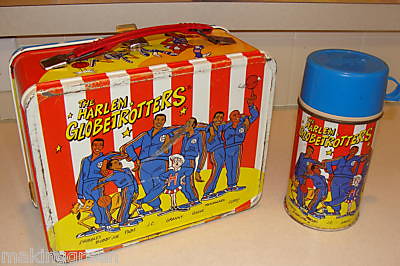
Globetrotters ran for a full first season and an abbreviated second season before it was ultimately cancelled. The series did make a brief return to television in reruns in 1978 as Go-Go Globetrotters on NBC. In 1971, the team made their first appearance in Gold Key Comics’ Hanna-Barbera Fun-In #8 before getting their own twelve-issue series between 1972 and 1975. Whitman also published several coloring books. Milton Bradley produced a board game using the Hanna-Barbera character models, while Thermos released two different lunchboxes; one of which depicted an actual scene from an episode. Reruns would air in 1999 on TV Land as part of its TV Land Super Retrovision Saturdaze programming block. The series, which is owned by co-producer CBS and its parent company, has not yet seen a home video release.


The New Scooby-Doo Movies title card introducing the Globetrotters.

The animated Globetrotters were featured guests in three episodes of The New Scooby-Doo Movies in 1972 and 1973. In 1980, similar character models and their bus were used in the movie The Harlem Globetrotters Meet Snow White; although it featured a slightly altered cast to better represent the then-current line-up. In 1998, the series was lampooned as part of Robert Smigel’s “TV Funhouse” on Saturday Night Live. In it, the Globetrotters accidentally went back in time to the first Christmas, instead of their first Christmas together.


EPISODE GUIDE (the series was never released, making episode data hard to come by):
Season 1:
“The Great Geese Goof-Up” (9/12/70) – The team mistakenly believes a mad scientist has turned Geese into a kangaroo, who happens to be wanted for a jewel theft.

“Football Zeros” (9/19/70) – The team takes the place of a delayed team in a charity football game while two criminals plan to make off with the proceeds.

“Hold That Hillbilly” (9/26/70) – In order to stop a feud and allow their game to get underway, the team must unite the only two eligible members of the fighting families.

“Bad News Cruise” (10/3/70) – The team takes a cruise to Hawaii on a ship involved in a race for a contract against another ship with a despicable crew.

“Rodeo Duds” (10/10/70) – The team enters a local rodeo in order to help a poor family get the money they need to pay off their mortgage.

“Double Dribble Double” (10/17/70) – A mad scientist performs experiments on the team when they come to his house after their bus gets stuck.

“Heir Loons” (10/24/70) – Bobby Joe gains an inheritance that his crooked cousin would love to get his hands on.

“From Scoop to Nuts” (10/31/70) – The team decides to help a struggling newspaper get back on its feet in order to get their exhibition game back on.

“What a Day for a Birthday” (11/7/70) – Granny unknowingly borrows the money the team saved for her birthday present forcing the team to figure out ways to raise more quickly.

“It’s Snow Vacation” (11/14/70) – The team wants to help their friend Sam fix up his ski resort, but Sam’s competition wants to keep that from happening.

“The Great Ouch Doors” (11/21/70) – A youth center asks the team to calm down their clientele through sportsmanship before the kids’ behavior forces the center to be shut down.

“Hooray for Hollywood” (11/28/70) – NO SYNOPSIS AVAILABLE

“Shook Up Sheriff” (12/5/70) – The team arrives to help Wally Weakness raise money for his sheriff campaign in order to keep his opponent and his gang from winning the election.

“Gone to the Dogs” (12/12/70) – The team believes Dribbles is jealous of the dog they’ve been asked to babysit.

“The Wild Blue Yonder” (12/19/70) – In order to pay off the bills on the airplane they won in a raffle, the team sets out to open their own airline.

“Long Gone Gip” (1/2/71) – Believing he’s caused Pabs to never play again, Gip leaves the team.

Season 2:

“A Pearl of a Game” (9/11/71) – The team offers to help a private eye find the giant pearl that was stolen from the museum right under his nose.

“Nothing to Moon About” (9/18/71) – The team is invited to a space center to play an exhibition game in a dome that duplicates the gravity of the moon.

“Pardon My Magic” (9/25/71) – NO SYNOPSIS AVAILABLE

“Granny’s Royal Ruckus” (10/2/71) – NO SYNOPSIS AVAILABLE

“Soccer to Me” (10/9/71) – NO SYNOPSIS AVAILABLE

“Jungle Jitters” (10/16/71) – NO SYNOPSIS AVAILABLE


Originally posted in 2015. Updated in 2020.