You can read the full story here.
He was a musical guest on American Bandstand and wrote some songs for The Harlem Globetrotters cartoon.


Remember that one day when you could wake up without an alarm? When you would get your favorite bowl of cereal and sit between the hours of 8 and 12? This is a blog dedicated to the greatest time of our childhood: Saturday mornings. The television programs you watched, the memories attached to them, and maybe introducing you to something you didn't realize existed. Updated every weekend.
You can read the full story here.
He was a musical guest on American Bandstand and wrote some songs for The Harlem Globetrotters cartoon.

(May
23, 1910-November 22, 1986)
Notable
Roles: Cheshire Cat, Scat Cat, George “Meadowlark” Lemon,
King Louie, Hong Kong Phooey/Penrod “Penry” Pooch, Louie Wilson, Rosey, Liquid
Man/Nate Branch, Dick Hallorann, Sam the piano player, Uncle Moses, Jazz,
Eugene the Genie, Excell Dennis
Born
Benjamin Sherman Crothers, he began a musical career as a teenager; teaching
himself how to sing and play the guitar and drums. He would play with a band in
speakeasies throughout his native Terre
Haute until he ended up performing five days a week on a radio show in Dayton, Ohio in the 1930s. It was there
the station manager suggested he needed a catchier name, so Crothers called
himself “Scatman” after his scat
singing style. He released several singles through Capitol Records, and an album with
High
Fidelity Records, went on USO tours with
Bob Hope and performed with bandleader Slim Gaillard. Crothers
appeared in 3 short films before making his feature-film debut with 1953’s Meet Me at the Fair.
He appeared in four Jack
Nicholson films; notably Stanley
Kubrick’s The
Shining for which he won an Academy
Award. His television career began in 1957 on an episode of The Adventures of Jim Bowie
and went on to include programs like Dragnet, McMillan & Wife, Kojak, Ironside, Charlie’s Angels, The Love Boat, Magnum P.I. and Laverne & Shirley. In
1966, Crothers went into voice acting when he took over the role of the Cheshire
Cat from Sammy Davis, Jr. for Hanna-Barbera’s album
for The
New Alice in Wonderland (or What’s a Nice Kid Like You Doing in a Place Like
This?) animated special, as Davis was signed exclusively to Reprise Records, and in
1970 he voiced Scat Cat in the animated film, The Aristocats.
The following year, he was cast as the voice of the animated version of Harlem Globetrotter George “Meadowlark” Lemon in The
Harlem Globe Trotters and The
New Scooby-Doo Movies. He would later play fellow Globetrotter Nate Branch in the
follow-up, The
Super Globetrotters, as Meadowlark had left the team by then. In 1974
he played the title character in Hong
Kong Phooey, which he reprised for Laff-A-Lympics,
and provided additional voices for several other Hanna-Barbera shows.
During the 1980s, he starred in three short-lived live-action series--One of the Boys, Casablanca (1983)
and Morningstar/Eveningstar--as
well assumed the role of the Autobot Jazz
in the Transformers franchise. He was also given an NAACP Image Award and a star on the Hollywood Walk of Fame.
After a four-year struggle with lung cancer, Crothers died in 1986 at the age
of 76. He was posthumously inducted into the Black
Filmmakers Hall of Fame the following year.

Spinning off from Hanna-Barbera’s
earlier Harlem Globetrotters, The Super Globetrotters saw The Harlem Globetrotters serving
as the cover for their true identities: The Super Globetrotters. To protect the
world from evil, the Globetrotters would challenge the villains and their
henchmen to basketball games for whatever goal or object they have in mind for
their nefarious plans.
 |
| Character model sheet. |
Like the earlier series, while the show featured the names and likenesses
of members of the actual Globetrotters team, they were instead voiced by
professional voice actors. Reprising their earlier roles were Stu Gilliam as
Freddy “Curly” Neal and Johnny Williams as Hubert “Geese” Ausbie. Scatman
Crothers also returned, was instead cast as Nate Branch. Also new to the
animated line-up were James “Twiggy” Sanders (Buster Jones) and Louis “Sweet Lou”
Dunbar (Adam Wade).
 |
| Multi-Man, Super Sphere, Gizmo, Spaghetti Man and Liquid Man. |
Each Globetrotter possessed incredible powers granted to them whenever
they stepped into magical portable lockers. Hanna-Barbera recycled the powers,
identities and moves of three of the Globetrotters from the Impossibles segment of Frankenstein, Jr. and the Impossibles: Branch was Liquid Man (sometimes
referred to his Impossibles counterpart’s
name of “Fluid Man” or “Aquaman”, and still bore the former’s “F” logo on his
suit) and could turn himself into water; Sanders was Spaghetti Man (based on
Coil Man), who could stretch and manipulate his body; and Ausbie was Multi Man,
who could create duplicates of himself. New for the series was Neal as Super
Sphere, who could retract his limbs into his basketball head in order to
bounce, smash and grow; and Dunbar as Gizmo, who could pull an unlimited supply
of gadgets for any situation out of his afro (including their lockers). They
were alerted to problems and aided by a basketball-shaped satellite called
Crime Globe (Frank Welker).
 |
| Attila and his Huns. |
Facing off against the Globetrotters was an eclectic blend of colorful
one-off foes voiced by an assortment of frequent Hanna-Barbera players. Amongst
them was Museum Man (Herb Vigran),
a disgruntled janitor who had a remote control that could bring fossils and
statues to life; Facelift (John
Stephenson, who also portrayed several other villains), a nuclear-powered
alien that could steal anyone’s face for use on his Demon Droids; Whaleman
(Michal Rye), a pirate who used a mechanical whale in his crimes; Bad Blue Bart
(Paul Winchell), a western
outlaw who used a remote-controlled Phantom Cowboy (also Winchell) to take over
a ranch; The Time Lord (Don
Messick), who could alter time using a crystal and summoned villains of
history to aid him; and Count Bragula (Lennie Weinrib), a vampire with
ambitions to dominate Transylvania. A real person also crossed paths with the
Globetrotters in the form of Attila the Hun (Welker), who was shunted forward
in time by following a scientist through his time machine. Although the Super
Globetrotters would often attempt to stop the villains through comical heroics,
things were always ultimately settled with a basketball game like the original
cartoon.
 |
| Teamwork makes the dream work! |
The Super Globetrotters followed
executive Fred Silverman
from CBS, home of the original, to NBC where it debuted on September 22, 1979. The
series was written by Tom Dagenais, Rowby Goren, Andy Heyward, Robby London and Larry Parr. It ran until
December 1st when it was combined with Hanna-Barbera’s Godzilla to create The
Godzilla/Globetrotters Adventure Hour. Both shows played out their
respective seasons as part of this block and continued on as reruns until
September 20, 1980. Instead of using the team’s theme song “Sweet Georgia
Brown” by Brother
Bones, the series employed a sound-alike whistle theme composed by Hoyt Curtin.
 |
| Ad for the DVD release. |
Reruns would air on Cartoon
Network from 1994-2004, and on sister network Boomerang from 2001-2012. Because the
series was solely produced and owned by Hanna-Barbera, it was the first of the
two shows to be released to DVD through Warner
Archive’s Hanna-Barbera
Classics Collection. The original Globetrotters
series was co-owned by CBS Productions who
maintain its rights. This was also the final series starring the Globetrotters,
although they were the stars of the 1981 television movie The Harlem Globetrotters on Gilligan’s Island. The team and their various members
continued to appear or be referenced on television programs, films and
documentaries over the years while also continuing to perform on the court
almost 500 times a year shared between three different rosters.

 |
| The Savoy Big Five team. |
 |
| Abe Saperstein and the new Harlem Globetrotters. |
 |
| Poster for the 1951 film The Harlem Globetrotters. |
From the outset, the Globetrotters were a standard team of
highly-talented individuals; gradually becoming one of the best teams in the
country. Comedic
antics began working their way into the Globetrotters’ games; both as a
means of keeping fans entertained during dull matches against weaker opponents
and as a way to give the players a much-needed break. These would ramp up at
the beginning of the 1940s, credited to an initiative spearheaded by player Reece
“Goose” Tatum. These bits would go on to showcase their tremendous skill
and coordination as they dealt with one or multiple balls at once.
This ended up being the team’s saving grace. They
began
to be eclipsed by the rising National
Basketball Association (NBA) after the
league started recruiting Black players in the 1950s. Especially when players
of the Globetrotters were lured away by the better pay being offered. Becoming an
exhibition team, they’ve played more than 26,000 games in 124 countries; often
against other exhibition teams created to be their straight men opponents. Brother Bones’ whistled version of “Sweet Georgia Brown” had become the team’s signature song; played during their
exhibitions and advertisements.
In 1951, the team took their first leap off the
court in the movie The Harlem Globetrotters; a drama about young Bill Townsend (Billy Brown) dropping out of college to join the team and finding love
along the way. It was followed up in 1954 with the sequel, Go,Man, Go!. On television, twelve members of the team were featured
on What’s
My Line? in 1956. Then, in 1970, the Globetrotters came to Saturday
mornings…
 |
| Globetrotters character model sheet. |
 |
| Close-up character art from the Globetrotters album. |
Harlem Globetrotters debuted on CBS on September 12, 1970. Like other Hanna-Barbera productions, the series followed a formula for each episode. Typically, they would find the Globetrotters winding up in a location where they get involved in some kind of conflict either voluntarily or by chance. The Globetrotters settled the matter with a basketball game in which the villains would constantly cheat to win. But, of course, the Globetrotters managed to turn it around in the second half and triumph over all adversity; driving home the pro-social message of sportsmanship and fair play. The series was written by Heywood Kling, Tom Dagenais, Michael Maltese and Dalton Sandifer, with Joe Ruby and Ken Spears serving as story editors.
 |
| Globetrotters 1971 program. |
Globetrotters was not only the first Saturday morning carton to feature
real sports stars, but it was the first to feature a predominantly
African-American cast; both on screen and in the recording booth. It shared a
distinction with another Hanna-Barbera property that aired earlier in the day: Josie
and the Pussycats, which featured the first African-American female character.
The year prior, Filmation’s The
Hardy Boys had the first African-American male (however, this would
eventually be retroactively replaced by their series Aquaman
when it was
revealed the villain Black Manta was
African-American in 1977).
 |
| The Globetrotters album. |
Don
Kirshner, music supervisor for the show, also
oversaw the production of a soundtrack featuring the music used in the program;
typically, from the basketball games in each episode. The record, The Globetrotters, was produced by series theme composer Jeff Barry and released in 1970 by Kirshner Records
featuring songs by Neil
Sedaka, Howard
Greenfield, Rudy Clark,
J.R. Bailey, Ken Williams,
Ron Dante and Jamie Carr. The
songs “Cheer Me Up” with “Gravy” and “Rainy Day Bells” with “Meadowlark” were released as two separate single albums. Three more
single albums were released with songs not featured on Globetrotters;
one of which included the actual Globetrotters’ theme, “Sweet Georgia Brown”. The real Meadowlark provided background vocals on
several of the tracks, making him the only Globetrotter to have any direct involvement
in the project.
 |
| Page from the Harlem Globetrotters comic by Gold Key. |
Globetrotters ran for a full first season and an abbreviated second
season before it was ultimately cancelled. The series did make a brief return
to television in reruns in 1978 as Go-Go Globetrotters on NBC. In
1971, the team made their first appearance in Gold Key Comics’ Hanna-Barbera
Fun-In #8 before getting their
own twelve-issue
series between 1972 and 1975. Whitman also published
several coloring
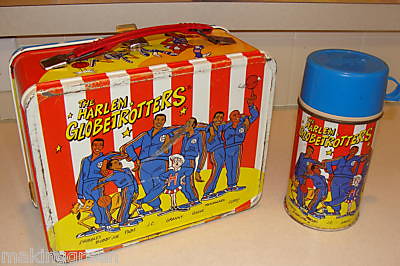
books. Milton Bradley produced a board game using the Hanna-Barbera character models, while Thermos released
two different lunchboxes; one of which depicted
an actual scene from an episode. Reruns
would air in 1999 on TV Land as part of
its TV Land Super
Retrovision Saturdaze programming block. The series, which is owned by co-producer
CBS and its parent company, has not yet seen a home video release.
 |
| The New Scooby-Doo Movies title card introducing the Globetrotters. |
The animated Globetrotters were featured guests
in three episodes of The
New Scooby-Doo Movies in 1972 and 1973.
In 1980, similar character models and their bus were used in the movie The Harlem Globetrotters
Meet Snow White; although it featured a
slightly altered cast to better represent the then-current line-up. In 1998,
the series was lampooned as part of Robert Smigel’s “TV Funhouse” on Saturday Night Live. In it, the
Globetrotters accidentally went back in time to the first
Christmas, instead of their first
Christmas together.