Showing posts with label video game adaptation. Show all posts

April 29, 2023

DEFENDERS OF DYNATRON CITY


DEFENDERS OF DYNATRON CITY
(FOX, February 22, 1992)
 
DiC Animation City


MAIN CAST:
Whoopi Goldberg – Ms. Megawatt/Mary Middlefield
Pat Fraley – Jet Headstrong/Brett Headlong
Candi Milo – Buzzsaw Girl/Wendy Weedwacker
David Coburn – Toolbox
Brian Stokes Mitchell – Monkey Kid
Tim Curry – Atom Ed the Floating Head
Christopher Walken & Charlie Adler – Dr. Mayhem
Gary Owens – Announcer


Defenders of Dynatron City was Lucasfilm Games’ attempt at spawning an all-new multimedia franchise. It all began with a NES game developed by Gary Winnick and published by JVC Musical Industries, Inc. Dynatron City was a futuristic city where atomic energy was in every part of life; from transportation to toasters. The evil Dr. Mayhem (Christopher Walken until producers inexplicably decided to replace him with Charlie Adler) was a mutated genius who wanted to run the people out of the city so that he could easily take it over. To do so, he developed Proto Cola: a soft drink that was liquid radioactive energy that would cause various mutations in the people who drank it (extra appendages, giant eyes for heads, becoming the embodiment of an element, etc.). Unfortunately, the soda ended up being so good that everyone was willing to put up with some genetic anomalies to get more. With mutation a failure, Mayhem turned to the next best thing: an evil robot army.

The Defenders: Toolbox, Ms. Megawatt, Buzzsaw Girl, Monkey Kid, Jet Headstrong and Radium Dog.


The only thing standing against him were the self-proclaimed Defenders of Dynatron City: a group of working-class slobs mutated by Monkey Kid (Brian Stokes Mitchell), a monkey Mayhem regressed into a human, when he dumped Proto Cola syrup on them and zapped it with electricity. Handywoman Wendy Weedwacker (Candi Milo) became Buzzsaw Girl, a woman with a buzzsaw for feet; Wendy’s trusty toolbox turned into the humanoid tool man Toolbox (David Coburn); Proto Cola delivery man Brett (Pat Fraley) became Jet Headstrong, a muscle-man who could fire his head like a bullet; electric company technician Mary Middlefield (Whoopi Goldberg, modulated beyond recognition) became Ms. Megawatt, a being of pure electrical energy; Brett’s dog Rex could fly, had an enormous chomp, and had an explosive atom floating above his head, earning him the name Radium Dog; and Monkey Kid gained a supply of explosive bananas, as well as became the defacto leader of the team.


The game was released in July of 1992. The player got to select from any of the Defenders and could change between them at any point; and often needed to in order to acquire certain items. Each Defender acted as a life, with them being “captured” for the remainder of the game once their health was depleted. The objective was to go through (and under) the city, defeating Mayhem’s robot legions and collecting items, all within a 1200 second time limit.

Dr. Mayhem.


To compliment the game, a pilot for a potential cartoon series from DiC Animation City and a comic series from Marvel Comics were commissioned. The pilot was written by Bob Forward—with concept credit going to Winnick, Steve Purcell, Howard Roffman and Cynthia Wuthmann—introducing the characters and the overall plot, and ended with Mayhem gaining a new tool in Atom Ed (Tim Curry), a piece of machinery accidentally mutated by Monkey Kid who was able to mutate other machinery and beings into new soldiers for Mayhem. The characters were designed by Donn Greer, Sandy Kopitopoulos, Ed Lee, Don Spencer and Charles Zembillas, with music by Chase & Rucker Productions and animation from Spectrum Animation Studios. To punch things up, some shots of the city were rendered in some rather crude computer-generated imagery from DiC Graphics, Richard Sher and Seth Levenson. The pilot aired on FOX as part of the Fox Kids programming block on February 22, 1992, and was rerun a few times after that.

The first issue of the Marvel comic.


The comic was written by Purcell from a story by both him and Winnick, art by Frank Cirocco and Mark McKenna, colored by Tom Vincent, Renee Witterstaetter and Gina Going, and lettered by Ken Bruzenak. Running for 6 issues, the comic featured generally new way-out comedic adventures of the Defenders in their ongoing battle against Mayhem and his schemes; however, the second issue was essentially an adaptation of the pilot.

Mayhem's robots.


Unfortunately, the lofty ambitions Lucasfilm had for the property were ultimately dashed. The game was eviscerated in reviews for its difficulty, poor hit detection and unclear objectives (such as certain characters only being able to pick up certain items with no indication as to who); although it was praised for its characters and charm. The pilot was also never picked up, as the choices made in its production—from the casting to the CGI—rendered it more expensive than a network budget could handle. It was released to VHS by Buena Vista Home Video, and can be found on platforms like YouTube.

April 15, 2023

MEGA MAN: FULLY CHARGED


MEGA MAN: FULLY CHARGED
(Cartoon Network, August 5, 2018-May 23, 2019 US
Family Chrgd, September 8, 2018-June 22, 2019 CAN)
 
Capcom, Dentsu Entertainment USA, DHX Media, DXH Media Studios Vancouver


For the history of Mega Man, check out the post here 


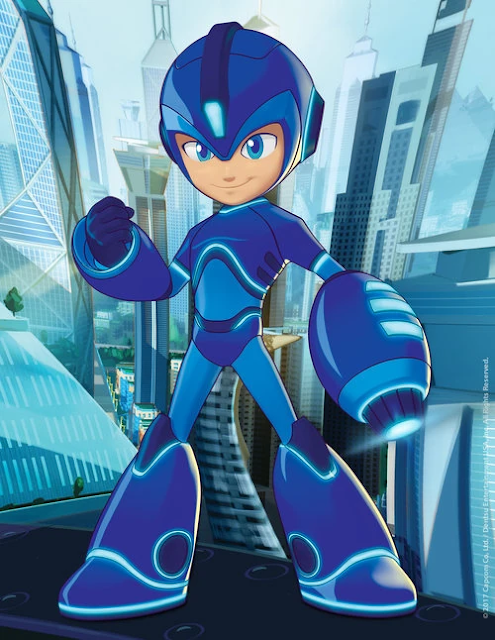
Mega Man: Fully Charged was the second western-developed animated series featuring the Blue Bomber since 1994’s Mega Man from Ruby-Spears, and the fifth solo series overall including the OVA series Upon a Star, NT Warrior and Star Force. It was meant to coincide with the 30th anniversary of the franchise.

The new generation of Mega Man.


In 2015, Capcom entered into a production deal with Dentsu Entertainment USA to create a new 26-episode Mega Man series. Dentsu chose the writing team Man of ActionJoe Casey, Joe Kelly, Duncan Rouleau, and Steven T. Seagle—to oversee the development of the series, considering their successful billion dollar franchise Ben 10, which also starred a heroic young boy with various abilities. While they issued assurances that they would be sticking closely to the spirit and established look of the franchise, there would be some changes made and an attempt to appeal to western audiences with the storytelling.

Mega Man's new alter-ego, Aki Light.


Mega Man was now Aki Light (“Aki” could mean “bright” or “sun”, voiced by Vincent Tong), a robot who looked like an ordinary boy and attended junior high school with other children in Silicon City. He could summon his Mega Man armor in a stock transformation sequence, which resembled the game’s depiction of it with a few added flourishes. Along with his regular Mega Buster blaster, Mega Man could fire a beam onto a robot that would copy their abilities after about a minute and allow him to use them. As a side effect, Mega Man would also gain some of their personality traits as well that would often work against him. Unlike the games where he could hold onto all of the boss abilities, this Mega Man was limited to only three at a time via a safeguard; otherwise, his blaster would overheat and cause personality glitches. Being a little boy, he displayed a level of self-confidence and cockiness that often led to his being impetuous and leaping without thinking. He also had some locked-away memories from being in the Hard Wars, a period when humans were at war with robots at a time known as the Hard Age.

The Light family: Dr. Thomas, Suna, Aki and Rush.


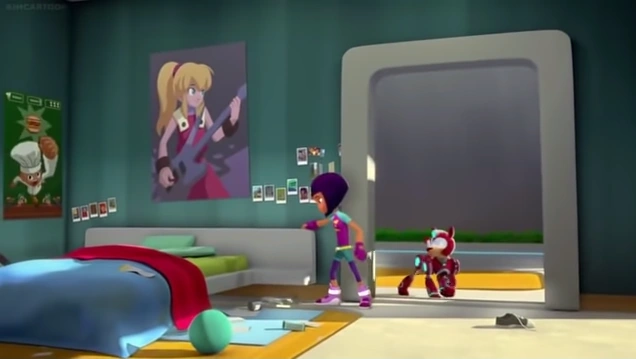
Dr. Thomas Light (Garry Chalk, who played various roles in the 1994 series) was Aki’s father and strong advocate for human/robot relations, having been a veteran from the Hard Wars. He knew Aki was secretly Mega Man, but kept it to himself for a while. He was the keeper of the Mega Key: a device that could grant complete access to the schematics and programming of any robot placed inside it. Suna Light (a play on “sun light”, voiced by Caitlyn Bairstow) was Aki’s intelligent human sister who had a variety of gadgets at her disposal. She openly knew of Aki’s double life and often aided him. She was this show’s version of Roll (who appeared on a poster in her bedroom), and later revealed to become their version of Zero from the Mega Man X spin-off game series. Rush was Aki’s loyal robot dog as in the games, but colored a normal brown instead of red (although he would be upgraded with armor that would bring him closer to his original look). After being injured in a supervillain battle, Rush developed a fear of them and often froze up when Aki took him into a fight. A new addition to the Mega crew was Mega Mini (Ryan Beil), a small quippy robot that lived in Aki’s head and monitored his circuits, offered (often ignored) advice, and handled his transformation into Mega Man.

Bert Wily, not the bad guy.


Aki’s best friend was Bert Wily (Cole Howard, who voiced Mega Man in Mega Man Powered Up), designed to resemble both Alan from the Dreamwave comics and traditional arch villain Dr. Wily (the latter of whom was actually his grandfather). He was a genius inventor whose devices tended to be adorned with a skull motif reminiscent of the bad doctor. Other characters included Principal 100100 (Brian Drummond), the building-sized school principal that used to be a battle robot; Peter Punkowski (Howard), a know-it-all with a love for history and a perpetually runny nose; Ashley Adderley (Shannon Chan-Kent), a semi-egotistical science lover that Aki had a crush on, but who had a crush on Mega Man (not knowing they’re one and the same); Junk Man, a robot made out of scrap by Aki and Suna as a training dummy for Rush, later turned into a lab protector by Dr. Light; Man Man (Ian Hanlin), a bumbling human who wanted to be like Mega Man (modeled after Bad Box Art Mega Man); and The Good Guild, Silicon City’s robotic peacekeeping force that served as various public services such as police and firefighters.

Two villains in one: Sgt. Breaker Night (above) and his alter-ego, Lord Obsidian.


The primary antagonist of the series was Sgt. Breaker Night, aka Lord Obsidian (Michael Adamthwaite). As Sgt. Night, he was a human veteran of the Hard Wars that lost an arm and had it replaced with a robotic one by Dr. Light. He sought to destroy human/robot relations by encouraging some robots to attack humans to turn them against them, and believed humans were superior to robots since they created them. Sgt. Night shared a lot of similarities with the villain Xander Payne from the Archie Comics Mega Man series. Night donned powerful armor to become his alter ego Lord Obsidian, a robot supremacist seeking to turn Mega Man into the perfect weapon for his goals (essentially playing both sides of the conflict he sought to create). He desired the Mega Key to obliterate all robot kind. His second-in-command was Namagem (Tong), who shared all of Mega Man’s abilities but could hold up to five copied powers at once. It turned out that Namagem was actually Aki’s long-lost twin brother who was stolen and brainwashed by Sgt. Night at the end of the Hard Age. He was this series’ version of Proto Man.

Lord Obsidian leading Air Man, Blasto Woman, Drill Man, Namagem, Wave Man, Fire Man and Guts Man.

The Robot Masters that often caused trouble around town were comprised of Fire Man (Hanlin), a hot-headed former construction robot that grew to despise humans; Drill Man (Andrew McNee), a perpetually angry robot whose unfeeling father replaced his hands with drills to take part in the family construction business, rather than pursue his musical passions; Wave Man (Samuel Vincent), a sanitation robot who took his job too far and almost flooded the city; Ice Man (Travis Turner), a glitched robot who takes everything too literally and believes he’s helping bring humans and robots together by freezing them; Air Man (Hanlin), a wind-blowing robot with a superiority complex and quirky siblings called The Bluster Bunch (he’s a composite of Wind Man and Tengu Man); Guts Man (Peter New), a powerful waste-disposal robot powered by eating garbage who took issue with Dr. Light’s eco-friendly recycling program; Elec Man (McNee), a hyperactive robot with electrical abilities; Cut Man (Colin Murdock), the Lights’ perfectionist gardener who flew off the handle whenever that perfection was disturbed or challenged; and Wood Man (Mark Oliver, who voiced FreezeMan.EXE in Mega Man: NT Warrior), a paranoid who was deactivated during the Hard Wars and believed he was still fighting in them when accidentally reawakened (although he’s a Robot Master as far as the games go, he operated independently of the others and Night).

Chaotique: friend or foe?


Additionally, three series-exclusive Robot Masters were introduced: Hypno Woman, a robot with hypnotic abilities that used to be a guidance counselor until she got tired of listening to students’ problems; Blasto Woman (both Kathleen Barr), a former flying cargo-delivering robot who sought to make money through illegal means; and Chemistry Man (New), a former chemistry teacher that Sgt. Night convinced to go rogue when he was fired for putting his students to sleep with boring lectures. Other foes included Chaotique (Rhonda Rees), a prankster fun-loving robot who tended to be a bad influence on Mega Man and worked as a double agent of Obsidian; and The Hoover Gang, former custodians-turned-criminals that carried non-lethal weapons, comprised of humans Duane (Adamthwaite) and Wayne (Beil), and a vacuum robot.

Mega Mini inside Mega Man's head.

The first 10 episodes of Mega Man: Fully Charged were made available through the Cartoon Network app and website on August 3, 2018 before debuting on the network itself on August 5. It was initially reported that the series would air on Disney XD (where it would air in Southeast Asia in 2019). Despite a traditionally-animated demo reel being leaked by studio Film Roman featuring Mega Man battling Fire Man and Drill Man, DHX Media was announced as the animation studio for the series in 2016 and that they would be using a computer-generated 3D style. It would be one of the last shows made under the DHX name before they became WildBrain in 2019.

Elec Man crashes Ashley's play, starring Aki as--of all things--Mega Man.


Originally intended for a 2017 debut, Dentsu and DHX announced it would be delayed until 2018. DHX revealed the show’s title at the 2018 Licensing Expo and held its premiere on July 20 at the San Diego Comic-Con. Sister network Boomerang began airing reruns as early as August 12th, however it was removed from both channels’ schedules after 10 weeks until January. Internationally, DHX-owned Family Chrgd (now WildBrainTV) broadcast the show in Canada beginning on September 8th; POP in the United Kingdom on October 1st; and 9Go! in Australia on July 15th, 2019.

Iced-up Mega Man and Ice Man putting out fires.


The series was written by Man of Action with Marcus Rinehart, A.J. Marchisello, Michael Oliver, Joe Barnathan, Justin Peniston, Janis Robertson, Kevin Somers, Lawrence H. Levy, Kevin Grevioux, Beata Harju, Sean Kennedy Moore (as Sean Patrick Geraghty), Jeff Treppel, Rocco Pucillo, Ricky Mammone, Dan Goldman, M.J. Offen, Greg Hart, Bob Fingerman, Patricia Villetto, Dan Marmor, Ian Drazen, Tanner Marchisello and Henry Stukenbog. Peter DeTina was the lead designer, with Derek Weselake, Diane Quach, Francine Delgado, Harrison Hemeon and Lera Nyukalova serving as designers. Mega Man’s machinery graphics were handled by Greg Sepelak. The modelers included Colin Robinson, Aldrich Chung, Ezra Petruik, Ben Hutchinson, Ingrid Clemeno, Brooke Schlaphoff, Derek Levesque, Jaroslav Chorny, Jin Man Kim, Jin Sung Jim, Kenneth Ma, Melissa Sylvana and Snehal Gopal. Episodes ran for 11 minutes and were typically shown together until they were split up halfway through the run. The series’ music was composed by Steffan Andrews. As a nod to the franchise’s video game origins, there were times when the animation switched to 2-D pixel art; typically in flashbacks, fantasy sequences, enemy encounters and images displayed during the end credits. These was done by Gurkan Tenekecioglu, Juan Carlos Lopez and Paul Johnson.

Man Man, following Mega Man's example. Unfortunately.

Cartoon Network has been noted as having not been very supportive of Fully Charged (or, frankly, any third-party programs). There was little to no promotion on the network’s part for it, instead all promotion came from the websites of the companies involved with making it and advertisements could only be found on YouTube. Cartoon Network initially placed it at 6:30 AM on Sunday morning. After, it bounced between Saturdays and Sundays before ending its season in a Monday-Thursday 12:30 PM timeslot. Most of the episodes were released in batches on the Cartoon Network app just before they began airing on the network itself. While Cartoon Network’s YouTube channel previewed the first few episodes, the official Fully Charged channel had very little activity. The series was once available to stream on Cartoon Network’s website, and available to purchase digitally on Prime Video.

Fire Man's 8-bit origin story.


There was some question as to whether or not a second season was happening. An online article posted by Rockman Corner had anonymous sources claim that they were told that a renewal was “99% greenlit” with some minor things to iron out. Those minor things ended up being a disagreement over DHX wanting to take the funding for several of the episodes to make promotional Mega Man shorts for their YouTube channel—like music videos or “a day in the life” of characters—and Dentsu not wanting to allow it. Production on the new season had begun halfway during production on the first, so things were ready to go. All they needed was the word. Unfortunately, between that disagreement and the abysmal ratings due to Cartoon Network’s neglect of the series, Fully Charged was effectively dead.

Mega Man, Drill Man, Guts Man, Wave Man, Ice Man, Air Man and the Mega Buster lab playset.


In 2019, Jakks Pacific released a line of Fully Charged toys. Mega Man, Air Man, Ice Man and Wave Man were included in the basic set, while Drill Man, Guts Man and Mega Man with Drill Man’s schematics were included in the deluxe. There were two Mega Busters; one for kids to wear, and one that opened up into Dr. Light’s lab. A second wave was planned but ultimately cancelled. The toys were used in cheaply-made “Toyplay” shorts and stop-motion videos on the series’ official YouTube channel. In 2020, BOOM! Studios published a 6-issue comic series set after the events of the show. Written by A.J. Marchisello and Reinhart with art by Stefano Simeone, colors by Igor Monti and letters by Ed Dukeshire, the series saw the Robot Masters gain a new leader in Skull Man, who seemed to have insights into Aki’s role during the Hard Age. He faced off against them and Namagem with the aid of the mysterious Zero and Hard Age authority Dr. Wily.


EPISODE GUIDE:
“Throwing Shade Part I / Throwing Shade Part II” (8/3/18 app, 8/5/18 CN) – When Sgt. Night crashes Dr. Light’s speech on human/robot coexistence, Fire Man arrives to make an example out of him. / Mega Man must fight to control his anger after copying Fire Man’s powers.
 
“Drilling Deep / Videodrone” (8/3/18 app, 8/12/18 CN) – Aki ends up humiliated in school when he has trouble controlling Drill Man’s copied powers. / When everyone but Aki and Suna end up hypnotized at school, they discover it’s the work of former teacher robot Hypno Woman.
 
“Please Rush Home / Blaze of Glory” (8/3/18 app, 8/19/18 CN) – Aki searches for Rush after he runs away from home but ends up having to deal with a sanitation robot flooding the city. / Cooling mechanisms fail throughout the city during a heatwave, and Fire Man is the culprit.
 
“Nice on Ice / Hard Times in Silicon City” (8/3/18 app, 8/26/18 CN) – Ice Man decides the best way to help human/robot relations is to freeze them all together. / An educational trip to the museum results in Aki having to deal with Blasto Woman trying to rob the artifacts.
 
“Tripping the Light Fantastic / Running Wild” (8/3/18 app, 9/2/18 CN) – Dr. Light’s new date turns out to be Hypno Woman in disguise. / Copying Air Man results in Aki becoming vain and arrogant, which he puts on full display when he runs for school president against Bert and Peter.
 
“Unfriendly Competition / Opposites Attract” (8/3/18 app, 9/9/18 CN) – Aki makes fun of Bert for using robot legs and a speed button to join the track team just as Chemistry Man attacks the school. / A weekend vacation is put on hold when Aki and Suna discover Fire Man and Wave Man working together.
 
“I.C.E. (In Case of Emergency) / Trust Your Guts, Man!” (8/3/18 app, 9/16/18 CN) – Ice Man’s heroics cause Aki to doubt himself, and copying his powers ends up making him take things too literally. / Guts Man becomes offended by Dr. Light’s new garbage recycling device and decides to destroy his lab.
 
“Drill of the Hunt / Power Cycle” (8/3/18 app, 9/23/18 CN) – After using hypnosis on Drill Man to turn him good, Aki unintentionally hypnotizes others around him. / Copying Elec Man’s abilities makes Mega Man just a bit too hyper for anyone’s good.
 
“Bored to Be Wild / Enter the Wood Man” (8/3/18 app, 9/30/18 CN) – Megan Man is forced to rely on classmate Ashley’s help to solve Chemistry Man’s riddles. / Aki and Suna are attacked in the woods by Wood Man who still believes he’s fighting in the Hard Wars.
 
“Lightfall Part I / Lightfall Part II” (10/5/18 app, 10/7/18 CN) – Mega Man foolishly agrees to a battle with Lord Obsidian and loses handily. / Obsidian invades the Lighthouse and attempts to take the Mega Key unless Mega Man can stop him with some new tricks.
 
“Rush to Greatness” (11/11/18 CAN, 1/4/19 app, 1/5/19 US) – Despite his fear of villains, Rush speeds out to try and stop Wave Man on his own.
 
“S.W.I.S.H.” (11/11/18 CAN, 1/4/19 app, 1/6/19 US) – Mega Man is easily bested by Namagem until he has Rush retrieve a force field device that causes Namagem’s blaster to overheat.
 
“Minus Mini” (11/18/18 CAN, 1/4/19 app, 1/12/19 US) – Mega Mini ends up falling out of Mega Man’s head and Blasto Woman intends to sell him on the black market.
 
“A Cut Above” (11/18/18 CAN, 1/4/19 app, 1/13/19 US) – Upset over the accidental destruction of a tree, the Lights’ robotic gardener is upgraded by Obsidian to get his revenge.
 
“A Bot and His Dog” (11/25/18 CAN, 1/4/19 app, 1/19/19 US) – Mega Man feels the “emergencies” he’s called on are beneath him until Hyno Woman takes over the city power plant.
 
“This Man, This Man Man” (11/25/18 CAN, 1/4/19 app, 1/20/19 US) – Mega Man is upset by a bumbling wannabe that interferes with stopping Guts Man from attacking the school.
 
“A Guilded Cage” (1/4/19 app, 1/26/19 CN) – Aki’s new love of mystery films comes at the perfect time as The Good Guild is suddenly causing trouble around town.
 
“To Air Is Robot” (1/4/19 app, 1/27/19 CN) – Aki must overcome Air Man’s arrogance when he uses his schematics to stop him from leveling buildings around the city.
 
“Watt’s Happening” (1/4/19 app, 2/3/19 CN) – Aki auditions to play himself in Ashley’s Mega Man play, but needs to stop acting when Elec Man crashes the show.
 
“Chill Out, Bruh” (1/4/19 app, 2/10/19 CN) – The Lights rehabilitate Ice Man by giving him a device that balances his emotions, but Sgt. Night secretly sticks a counter-device on him.
 
“Big Bad Dreams” (1/4/19 app, 2/17/19 CN) – Sgt. Night has Hypno Woman attack Aki’s dreams at night, giving him nightmares about Namagem.
 
“License to Drill” (1/4/19 app, 2/24/19 CN) – Aki is dismissive of Bert’s interest in Hover-Surfing until he needs his hoverboard to help him defeat Drill Man.
 
“All Good in the Wood” (3/1/19 app, 3/3/19 CN) – Mega Man copies Wood Man’s abilities and gains his paranoia just as Suna and Ashley needs his help to stop their science project run amok.
 
“Fire Man in the Hole” (3/1/19 app, 3/10/19 CN) – When lava blocks their exit during a fight, Mega Man and Fire Man work together to get to safety.
 
“A Split End” (3/1/19 app, 3/11/19 CN) – Cut Man has become a barber, but a customer complaint sends him back over the edge into supervillainy.
 
“All Play and No Work” (3/1/19 app, 3/12/19 CN) – Mega Man hangs out with Chaotique to relax until she frames Bert for theft.
 
“More More More!” (3/1/19 app, 3/13/19 CN) – Mega Man copies Guts Man’s schematics to beat him, but ends up acquiring a voracious appetite as the Robot Masters erect a wall through the city.
 
“Blast Resort” (3/1/19 app, 3/14/19 CN) – Blasto Woman tricks Mega Man into helping her steal an EMP device, which she promptly uses on him to hand him over to Obsidian.
 
“Too Much is Never Enough” (3/1/19 app, 3/15/19 CN) – Mega Man has his schematic safeguard removed so he can carry more, but he becomes moody and overloads as a result.
 
“The Bluster Bunch” (3/1/19 app, 3/24/19 CN) – Mega Man battles Air Man to stop him from ruining his siblings’ work.
 
“It’s Chemistry, Man” (3/1/19 app, 3/31/19 CN) – The new chemistry teacher proves a boon when Chemistry Man attacks and turns robots into other metals.
 
“Flower Power” (3/29/19 app, 4/7/19 CN) – Mega Man pursues Wood Man who has taken a Corpse Flower that is stinking up the entire city and giving Mega Man an allergy attack.
 
“Enemy of My Enemy” (3/29/19 app, 4/14/19 CN) – Unable to talk sense to Namagem, Mega Man teams up with Fire Man to take him down.
 
“Old School” (3/29/19 app, 4/21/19 CN) – Chaotique crashes a school assembly to steal a device that can make things vanish and make the school disappear.
 
“This Is Not a Drill” (4/26/19 app, 4/28/19 CN) – Mega Man goes on patrol after a fight with Dr. Light and ends up having to stop Drill Man from destroying a tunnel his father is working on.
 
“A Man Man for All Seasons” (4/26/19 app, 5/5/19 CN) – Man Man causes Mega Man’s systems to be gummed up by the Hoover Gang, leaving him unable to transform.
 
“Change the Charge” (4/26/19 app, 5/12/19 CN) – A blast from Elec Man causes Mega Man to take everything literally again and leads to him helping Elec Man carry out his task.
 
“Hide and Secrets” (4/26/19 app, 5/19/19 CN) – Using Wood Man’s schematics prompts Mega Man to try and get the Mega Key to use against Namagem.
 
“Make the Cut” (5/20/19) – An exhausted Mega Man must protect Suna and Ashley from Cut Man.
 
“Panic in the Lighthouse” (5/21/19) – Obsidian convinces Chaotique to invade the Lighthouse and steal the Mega Key to get back at Mega Man.
 
“The Gauntlet Part I” (5/22/19) – Obsidian and the Robot Masters attack the Lighthouse, but the Lights stand together to defend the Mega Key.
 
“The Gauntlet Part II” (5/23/19) – Mega Man combines all of his schematics to take on a powerful form to defeat Obsidian once and for all.

April 08, 2023

WING COMMANDER ACADEMY


WING COMMANDER ACADEMY
(USA Network, September 21-December 21, 1996)
 
Universal Cartoon Studios


            Chris Roberts had always been fascinated by science fiction movies and shows. He liked the special effects, the variety of imaginative characters, the futuristic alien worlds, and the space battles. He decided he wanted to bring that experience to the home computer; creating a game that would be as much like an interactive movie as possible.

Chris Roberts standing next to a display full of Wing Commander II games.


            Already a freelance author for Origin Systems, Roberts proposed the idea to Vice President of Product Development Dallas Snell. Snell gave him the go ahead to develop a workable concept to present to the company, and Roberts spent the next few months working 16-hour days to learn how to use 3D programming and achieve his vision. What he ended up with was enough to convince Snell there was something feasible behind his idea and allowed Roberts to use one of their artists, Denis Loubet, to work on some designs for it. Loubet came up with the cockpit display, a few ships and explosions. Roberts also pulled in a long-time programming associate, Paul Isaac, to help write the code. Together, they whipped up an impressive-looking demo where you could fly around in space and blast a few enemy ships. Origin was convinced and the game, then titled Squadron, officially entered production in early 1990.

Battling in space.


            Roberts served as the game’s director. Writer Jeff George, who had worked with Roberts before on the game Bad Blood and the unproduced sequel to Times of Lore, as well as helped produce the pitch for Squadron, was brought onto the project to write the storyline and conversations between the characters. One of his contributions was to talk Roberts out of making the heroes out to be a vast human empire as, in science fiction, “empire” usually has a villainous association, as well as to nix an ethics-based decision system in favor of keeping things unquestionably black and white (good guys are good, bad guys are bad). Artist Glen Johnson joined the crew early on in the development. He came up with the characters from scratch, not having been given any kind of description beforehand. He assigned them call signs upon completion, and after Roberts approved them, Johnson would transfer them from paper to computer renders. Loubet, meanwhile, would use basic ideas for scenes from Roberts as a springboard to design a wide array of ships and sets. Programmers Stephen Beeman and Ken Demarest would join later on in the process and designed all the dogfighting sequences; with Demarest implementing a limited artificial intelligence system for enemy ships.

The Deluxe Edition game box.


            Roberts envisioned the game having a dynamic musical soundtrack that would change given the events going on in the game. The MS-DOS computer and 604K of RAM they were working with finally gave him an opportunity to explore that notion, and he devised up to 30 different tunes with producer Warren Spector. George “The Fatman” Sanger and Dave Govett were then tasked with composing songs that could seamlessly flow into each other as the game dictated.

The opening ceremonies of the 1990 Consumer Electronics Show.


            When it came time for that year’s Consumer Electronics Show, resources had to be pulled away from actual game development to whip up a workable demo and artwork to present at the show that may never be used in the actual game. It also yielded a problem: Origin couldn’t trademark the name Squadron. Rechristened Wingleader, the game was a hit at the show and generated huge levels of excitement and anticipation for its release; now set for that September. And as the replacement name was too similar to some earlier published game titles, the game received its third and final title: Wing Commander.


        Wing Commander released on September 26, 1990 for MS-DOS, and was later ported to the Amiga, CD32, Sega CD and Super Nintendo. A space flight simulation game, it was set in the 27th century and told of humanity’s war against a race of cat-like humanoid beings called the Kilrathi (inspired by Larry Niven’s Man-Kzin Wars stories). Standing against them was the Terran Confederation: an alliance of systems and regional governments that provided unified protection and economic growth. Players took control of a nameless rookie pilot (later called Christopher “Maverick” Blair), known internally as “Bluehair” due to his, well, blue hair, aboard the TCS Tiger’s Claw; essentially a galactic aircraft carrier. The core feature of the game was an AI-controlled wingman that the player could give orders to for support. The game featured a branching open-ended story told through a number of cinematic cutscenes, and overall performance in missions affected the campaign. Completing mission objectives earned medals, promotions in rank and the opportunity to pilot better ships. Failing these objectives led to more difficult missions and inferior ships. It was designed so that losing players could return to the winning path and winning players could make enough mistakes to end up on the losing one.

In-game cutscene.


        Wing Commander became a best-seller, credited as redefining the genre and raising the bar for other developers to compete against. In the wake of the game’s success, Roberts wanted to release expansions that would contain content they were forced to cut due to the limited number of discs they could include for the game in order for it to be profitable. In November, Origin released the first expansion pack for the game, The Secret Missions, which added new ships, a new storyline and increased difficulty; however, it lacked the branching paths of the original. A second expansion, The Secret Missions 2: Crusade, was released in March of 1991. In 1994, the game would be re-released as Wing Commander I and would receive an enhanced remake called Super Wing Commander.


        A year after the original’s release, Origin released Wing Commander II: Vengeance of the Kilrathi. It maintained everything its predecessor did while putting a greater emphasis on storytelling through sprite-animated cutscenes and included some of the industry’s first examples of voice acting. The storyline was also less open-ended, promotions and medals no longer awarded, and wingmen couldn’t be killed outside of pre-scripted moments. Again, it was successful and received its own pair of expansion packs. A standalone spin-off, Wing Commander Academy, was released in 1993 as a budget game meant to keep the franchise on players’ minds during the development of Wing Commander III. Academy was a mission builder primarily using the assets developed for II where players, said to be students at the Terran Confederation Space Naval Academy, could design their own levels that could be saved and shared with other players (think of it as a predecessor to Super Mario Maker), as well as had 15 pre-designed missions to play and new ships and weapons. Two other spin-off games were released in 1993 and 1994: Privateer, where the player took on the role of a freelancer who could choose to be a pirate, merchant and/or mercenary, and Armada, which was the first to feature a new graphics engine and to offer a multiplayer mode.


           Wing Commander III: Heart of the Tiger was a major departure for the franchise. The technology of the last two games were abandoned in favor of software-driven texture-mapped polygonal 3D images. The Terran Confederation and Kilrathi Empire were given entirely new designs for their fleets; made a bit blockier to compensate for the then-primitive state of polygon graphics as true 3D video cards were a few years off. It used the then-new CD-ROM technology rather than floppy disks to compensate for the high memory demands of the branching “interactive” conversations the player had with other characters, choosing responses that would affect their attitudes towards the player and the morale of the entire crew. But the biggest change was the use of extensive live action full-motion video to deliver the story to add an interactive movie-style presentation to the gameplay.

Paladin having a personal moment with Maverick.


        A number of established actors were cast to star in the game. Mark Hamill assumed the role of the player character, now officially known as “Maverick”. He was joined by Malcolm McDowell as Admiral Geoffrey Tolwyn, John Rhys-Davies as James “Paladin” Taggart and the voice of Prince Thrakhath Nar Kiranka, Tom Wilson as Major Todd “Maniac” Marshall, Josh Lucas as Major Jace “Flash” Dillon, Courtney Gains as Lt. Ted “Radio” Rollins, François Chau as Lt. Winston “Vagabond” Chang, Ginger Lynn Allen as Rachel Coriolis, Barbara Niven as reporter Barbara Miles, John Schuck as the voice of Kilrathi defector Ralgha Nar “Hobbes” Hhallas, and Tim Curry as the voice of Melek Nar Kiranka, to name a few. The overall budget ended up being between $4-5 million, and considering the game was a massive hit for the franchise, selling over 700,000 copies after it was released on December 8, 1994, it was more than worth it. The next game, Wing Commander IV: The Price of Freedom, continued on with most of the same cast and innovations.

Maverick, Maniac, Archer and Tolwyn.


        Moves had already been made to expand and supplement the franchise with novelizations and collectible card games. The next step was to expand into other media. Origin, now owned by Electronic Arts, partnered with Universal Cartoon Studios to create an animated adaption. Although it shared the name of Wing Commander Academy, the game was an entirely new story set before the events of the game series. It was also a bit misleading, as the Academy itself only appeared in the first episode. Set in the year 2655, the endless Terran/Kilrathi war has resulted in heavy losses, necessitating the early activation of Academy recruits. The 201st Pleeb class were enlisted to continue their training while engaging in routine patrols and flight training, but the unpredictability of war often meant they were drawn into the conflict. At the end of their training, the most outstanding of 12 2nd Lieutenants would receive their golden wings, the designation of “Wing Commander”, and reach the first step of “flag rank”.

The Kilrathi.


            Carrying over from the games were Hamill, Wilson and McDowell, as well as their characters. Commodore Tolwyn was the captain of the Tiger’s Claw and overseer of the cadets. He was a brilliant tactician that was tortured by his own inner demons. “Maverick” Blair was a patriotic, enthusiastic pilot with a military pedigree and a strong sense of honesty and fair play. “Maniac” Marshall was an impetuous daredevil that often got on Maverick’s nerves. Newly created for the series was Gwen “Archer” Bowman (Dana Delany), who was serious-minded and strove for perfection in everything she did. The leader of the Kilrathi forces was Prince Thrakhath Nar Kirkanka (Kevin Schon), a ruthless commander who often demanded a high price for failure from his followers. His bullheaded leadership style served the Kilrathi well in their early campaigns, but proved an equal match for Tolwyn’s command.

The TCS Tiger's Claw.


            Originally, the plan was to do a prequel to the third game only. Somewhere along the way, it was decided to roll the clock back further as a prequel to the entire game series; creating some continuity issues with the overall franchise. The cadets, for instance, wore uniforms and encountered ships that didn’t appear until the third game. Prince Thrakhath, while in command as of said game, was actually under his father, Gilkarg nar Kiranka, in the original two. The date of 2655 was also problematic, as the events of the first game dictate that Academy should have taken place sometime before 2654. The ships the cadets flew, the Scimitar fighters, were noted in the first game as being reserved for more experienced pilots. The characters of Robin “Flint” Peters (Jennifer MacDonald), Laurel “Cobra” Buckley (B.J. Jefferson), and Hobbes were to be among the cadets included in the series, but were instead swapped out for Archer and other original cadets Lindsay “Payback” Price (Lauri Hendler), the rebellious martial artist, and Hector “Grunt” Paz (Schon), a stubborn and fearless pilot who was a wounded veteran of the stalemated Battle of Repletha. Additionally, earlier character appearances and traits were abandoned in favor of their established looks and personalities from III forward, such as Tolwyn lacking his mustache from the second game and Maniac wasn’t the reckless pilot the first game made him out to be.

Wingmen.


            Wing Commander Academy debuted on USA Network on September 21, 1996 as part of the USA Action Extreme Team programming block. The series was developed and story edited by Mark and Michael Edens, who also wrote it along with Shari Goodhartz, Richard Mueller, Matthew Edens, Brooks Wachtel, Ted Pedersen, Francis Moss, Ralph Sanchez and Steve Cuden. Sanchez served as an executive consultant, and Richard Hilleman and Adam Foshko as executive story consultants. Characters were designed by producer Larry Latham with Gerard Forton and Tim Eldred, while Derek Carter designed the backgrounds. Alexander Van Bubenheim composed the music. Madhouse Animation was the primary animation studio with Koko Entertainment Co. Ltd. doing a couple of episodes. 


Maverick with The Warrior King.


        As with the other entries in the Extreme Team--Savage Dragon, Street Fighter, and Mortal Kombat: Defenders of the RealmWing Commander took part in “The Warrior King” crossover event on November 16. Developed by Will Meugniot, the titular barbarian (Michael Dorn) crossed between dimensions to find and acquire the Orb of Power, which could control the weather of any planet. While The Warrior King was seen in all four shows, their respective characters didn’t cross over. It was coordinated so that each episode would air on the same day, resulting in each series being shown outside of their regular timeslots. However, the event received little to no promotion, and outside of the rearranged schedule there was no indication that there was anything special about that day.

A primitive race worshipping the Kilrathi.


            The series only ran a single season of 13 episodes before it was cancelled. The last line-up of the Extreme Team remained on the network until September 11, 1998, when USA stopped airing cartoons on the network. The complete series was released to DVD in 2012 by Visual Entertainment, Inc. The episode line-up in the collection doesn’t follow the airdate or production order. In 2020, it was included as one of the launch programs of NBCUniversal’s streaming service, Peacock; however, the sound mixing made dialogue difficult to hear at times.


            In 1996, Roberts left Origin to found his own company, Digital Anvil, with his brother, Erin, and Tony Zurovec. One of the first projects of the company was to acquire the rights to Wing Commander and develop a feature film based on it, which would contain effects produced by Digital Anvil’s artists, that would offer a new interpretation of the franchise’s beginnings. The film was rushed into production to try and beat Star Wars: Episode I to the box office, resulting in a lot of compromises being made on top of its significantly small budget. It ended up flopping at the box office, only earning $11.6 million. As for the game series, only three more games were released to date: Privateer 2: The Darkening in 1996, Prophecy in 1997, and Arena in 2007. Arena was an attempt to revitalize the franchise and the first made without the direct involvement of Origin, which was shut down by Electronic Arts in 2004.


EPISODE GUIDE:
“Red and Blue” (9/21/96) – To test the recruits’ skills Tolwyn splits them up into two teams, but a traitor attempts to sabotage their war games.
 
“The Last One Left” (9/28/96) – Maverick and Maniac are captured by a legendary space fighter pilot who turned to piracy after becoming disillusioned with the war.
 
“The Most Delicate Instrument” (10/5/96) – Paranoia grips the recruits and causes them to put themselves and the ship in danger.
 
“Lords of the Sky” (10/19/96) – Maverick and Maniac crash onto a planet where a primitive race worships the Kilrathi as gods.
 
“Word of Honor” (10/12/96) – Maverick and Grunt end up stranded with their Kilrathi prey, and they’re all forced to work together to survive.
 
“Expendable” (11/9/96) – An exploratory mission goes wrong, causing Maverick and Payback to fight their way back to the ship.
 
“Chain of Command” (11/2/96) – Admiral Bergstrom pulls rank on Tolwyn to enact her battle plan against the Kilrathi’s superior forces.
 
“Invisible Enemy” (12/7/96) – Strange heavy losses lead Maverick and Maniac to suspect the Kilrathi have a new stealth fighter.
 
“Recreation” (11/16/96) – Maverick must prevent The Warrior King from taking an alien orb that maintains a pacifist planet.
 
“On Both Your Houses” (11/30/96) – Trouble lurks at a Confederation bio-research station: a Kilrathi pilot hiding there, and the suspicious administrator Dr. Sing.
 
“Walking Wounded” (11/23/96) – Tolwyn joins in on the dogfight to rescue a hospital ship from the Kilrathi where Maniac is currently trapped.
 
“Price of Victory” (12/14/96) – A downed Maverick makes a deal for survival with the subordinate of the Kilrathi princess that currently wants his head.
 
“Glory of Sivar” (12/21/96) – Maverick and Grunt are sent on a rescue mission that turns out to be a suicide mission to take out Thrakath’s ship.