Showing posts with label Capcom USA. Show all posts

April 15, 2023

HISTORY OF MEGA MAN


Mega Man is a gaming franchise developed by Capcom. The series centered on the titular little blue robot boy who had a blaster mounted on his arm. He was created and named Rock by benevolent roboticist Dr. Thomas Light as a lab assistant, along with his “sister”, Roll, and their robot dog, Rush. Additionally, humanoid robots known as the Robot Masters were created by Dr. Light to assist humanity in the year 20XX. However, Dr. Light’s rival, Dr. Albert Wily, reprogrammed several of Dr. Light’s robots to assist him in taking over the world. Reluctantly, Dr. Light converted Rock into Mega Man in order to stop Wily and the renegade robots.

Dr. Light and Mega Man.


By the mid-1980s, Capcom had established itself as a leader in the arcade game market. However, they were looking to expand their operations from arcade games and ports to original games made specifically for the Japanese home console market. They created a small team of only six people tasked with creating a game that would set itself apart from their previous arcade offerings: director Akira Kitamura, producer Takashi Nishiyama, programmer Nobuyuki Matsushima, and artists Yasuaki Kishimoto, Naoya Tomita and Keiji Inafune. That game would end up becoming Mega Man.

Mega Man in-universe schematics.


Unlike other games whose concepts were basically decided by a single person, Mega Man was instead a collaboration between all involved. However, Kitamura did come up with a particular set of rules that governed the game’s overall design that he came to while playing different games and studying what they did there:

1.      All of the sages should be cleared within an hour and offer some kind of replayability.

2.      Players should be able to select whatever stage they liked in whatever order they wanted.

3.      Weak little enemies should appear in waves of 3 or 4, avoiding mixing up enemy types whenever possible. Each member of the wave would have a different difficulty in being defeated, with the last one being the easiest to skew the player’s perception of the game’s overall difficulty. Enemy placement and terrain would determine the difficulty of each area. 
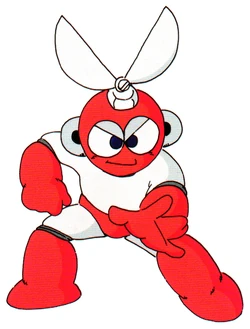

Cut Man, the original hero of the series.

            Originally, the Robot Master that became known as Cut Man was envisioned to be the protagonist of the series. Kitamura imagined being able to use the boomerang-like scissors on his head to cut down enemies and obstacles during progression. Gradually, more and more Robot Masters with varying abilities came to mind, and he decided instead of limiting the player to one power, they should be able to take the ability of all the defeated Robot Masters. A system was then put in place inspired by the game “Rock, Paper, Scissors” where certain Robot Masters would be more vulnerable to the powers of another (or empowered by them, depending). Along with Cut Man, the other featured Robot Masters were Elec Man (electricity), Fire Man (fire), Bomb Man (bombs), Ice Man (ice), and Guts Man (super strength). 8 were originally planned, but memory limitations forced them to stick with 6. Additionally, there were two other robots to face—Yellow Devil and Copy Robot—and a boss rush before getting to Wily himself.

A cavalcade of robots and sceintsits.


            The designs for the robot characters came from anime influences; in particular, Mega Man largely looked like Astro Boy while Roll was based on the titular character from Candy Candy. Mega Man’s initial blue coloring was selected simply because blue had the most variations available on the Nintendo Famicom’s (also known as the Nintendo Entertainment System) limited palette that allowed the sprite’s movements to show clearly, and it was neither an aggressive nor weak color. Matsushima, inspired by Tokusatsu action shows, came up with the idea that Mega Man should change color based on what Robot Master ability he had equipped (after the notion of showing the icon of the weapon on his helmet had to be abandoned). The designs for Dr. Light and Dr. Wily were based on Santa Claus and Albert Einstein, respectively.

Mega Man using Cut Man's ability.


            When coming up with Mega Man’s name, the options of “Mighty Kid”, “Knuckle Kid” and “Rainbow Man” (based on his color changing) were considered. Ultimately, they decided on a music motif for the names (you noticed their names were Rock and Roll, didn’t you?), and called him Rockman. Music was also key in the game’s experience, courtesy of the score composed by Manami Matsumae. She created thematically appropriate songs for each Robot Master’s stage while only limited to three notes at any one time. She was also responsible for creating the game’s sound effects.


            Rockman hit store shelves on December 17, 1987 in Japan. The game was a run and gun side-scrolling platformer where the player had to blast their way through waves of enemies and maneuver across treacherous terrain to reach the Robot Master at the end and acquire their power. Unlike Rock’s primary weapon, the Rock Buster (or Mega Buster), the Robot Master powers had a limited ammunition and needed to be replenished via random item drops by defeated enemies. Players could select any level in any order, and even revisit completed levels. Revisiting Elec Man’s stage, for instance, awarded Rock with a platform generator known as the Magnet Beam. Defeating all 6 Robot Masters unlocked a 7th stage where Rock encountered the Robot Masters again, two new Boss fights, and Wily himself.

The legendarily bad American box art for Mega Man.


            Capcom’s sales department didn’t have faith in Rockman’s ability to sell, but their minds were soon changed by its performance in Japan. An American localization was quickly commissioned, with Capcom’s then-Senior Vice President Joseph Morici having the name changed to Mega Man because he didn’t like the original title, and it was felt American children would be more interested in the game if called that. Additionally, new box art was quickly whipped up within 6 hours that has gained infamy in gaming circles for not only its poor quality, but its inaccuracy. The art featured a wildly disproportioned older Mega Man rather than a boy, in yellow and blue and holding a gun. It would become known as one of the worst game covers of all time, and Inafume has blamed it for the game’s relatively poor North American performance. That, coupled with minimal advertising, meant it relied on word of mouth to eventually become a sleeper hit.


            While sales didn’t meet Capcom’s expectations, they allowed the crew to develop a sequel. Mega Man 2 released on December 24, 1988 in Japan, retaining many of the core elements of its predecessor and beginning the trend of 8 Robot Master bosses. New features included an Energy Tank used to refill Mega Man’s health at any time and a password system that allowed players to save their progress. The game ended up a huge success, going on to sell over 1.5 million copies worldwide and being critically praised by gaming publications. Even the North American release received better-looking box art (although still featuring Mega Man holding a gun).

The ever-expanding Mega Man franchise.

            Mega Man had gone on to become one of Capcom’s top (though often neglected) franchises, boasting 11 entries in his main series along with several spin-off series and appearances in other games. It was only natural that he would soon make his leap into other media—and Saturday mornings…


February 25, 2017

DARKSTALKERS: THE ANIMATED SERIES

DARKSTALKERS: THE ANIMATED SERIES
(UPN, September 30-December 23, 1995)


Graz Entertainment, Capcom USA

MAIN CAST:
Michael Donovan – Demitri Maximoff, Terramon’s ship computer, various
Ian James Corlett – Victor von Gerdenheim, Huitzil, Pyron’s ship computer, various
Zoltan Buday – Anakaris (2 episodes)
Richard Newman – Pyron, Merlin, Terramon


            Emboldened by the success of Final Fight in the arcades, Capcom decided to revisit their Street Fighter concept and try to make it a better game. Street Fighter II: The World Warrior, released in 1991, followed a lot of the same conventions as its predecessor, but it allowed players the options of playing with eight characters each with distinct fighting styles and the ability to chain moves into combos (which came from a bug in the programming). Coupled with brilliantly animated sprites and a soundtrack by Yoko Shimomura, the game became a hit and helped to revitalize the arcade game industry and redefine the fighting genre.

Street Fighter II print ad.

            Over the next few years, Capcom would refine the play mechanics, graphics, character roster and more with a series of updated versions of Street Fighter II in both the arcade and later on home consoles. While each version was better than the last, the endless revisions became a running gag in the video game community. Meanwhile, other game publishers looked to latch on to Capcom’s success and began developing their own fighting games. Soon, there was Mortal Kombat, Killer Instinct, Samurai Showdown, King of Fighters and many others. The fighting genre was beginning to become saturated, and another Street Fighter II revision just wasn’t going to cut it to maintain Capcom’s dominance in the field.

The Darkstalkers universe.

            Capcom decided to use their unique Street Fighter II game engine for a new kind of fighting game. Producer Alex Jimenez suggested making a game involving the Universal Monsters, based on his love of the properties. When Universal Studios denied them the license, Jimenez decided to create their own characters based on those and other monsters; a process which he claimed took about an hour. The resulting game became Darkstalkers: The Night Warriors (known as Vampire: The Night Warriors in Japan). The game was similar to Street Fighter, but was rendered with the most fluid sprite animation yet to convey each character’s distinct personality, gorgeous background level designs, and introduced concepts of midair blocking and extra-powerful attacks that would be integrated into future Capcom fighters.

Character sprites (from top): Demitri, Victor, Raptor, Morrigan, Jon Talbain, Pyron, Sasquatch, Anakaris, Felicia, Bishamon, Rikuo and Huitzil.

            The game was centered on the conflict of supernatural beings known as Darkstalkers who came to inhabit Earth through the gradual merging of the Earth realm with the demon world known as Makai. Cosmic being Pyron came to Earth with the intentions of conquering and devouring it, and only the Darkstalkers stood a chance of stopping him and saving the world. The game featured ten playable characters: Demitri Maximoff, a vampire lord who was banished to Earth from Makai; Morrigan Aensland (named for the Celtic Phantom Queen), a succubus (initially a vampire but changed to add some monster variety) and adopted daughter of Belial, the king of Makai; Felicia, a catwoman (or bakeneko) raised in a nunnery with a desire to become an actress; Jon Talbain (after the character John Talbot from the Wolfman movies), a werewolf struggling to control his animalistic urges through the study of martial arts; Anakaris, a 5,000-year-old resurrected mummy; Bishamon (based on Japanese god of war Bishamonten), a cursed suit of samurai armor that takes over whoever wears it and fills the host with its bloodlust; Rikuo (named after Ricou Browning who played the Gill-man in Creature from the Black Lagoon), a merman whose race was wiped out by the coming of Pyron; Sasquatch, a member of a race of yetis in the Canadian wilderness with a fondness for bananas; Victor von Gerdenheim, a dimwitted Frankenstein monster whose creator died shortly after making him; and Lord Raptor, an Australian speed metal guitarist resurrected as a zombie that could transform his limbs into chainsaws. The two unplayable boss characters were Pyron and his robotic minion, Huitzil (named for the Aztec god of sun and war, Huitzilopochtli). Initially, Jimenez wanted Felicia to be from Africa with the ability to turn into a panther as her special move, as well as the sexy character. Morrigan’s change to a succubus made her the default sexy one, leaving Felicia to become a cute white cat at Capcom’s request.


            The arcade game was released in Japan in early July of 1994 to generally favorable reviews, then worldwide later that month. When it became one of the best-selling fighting games, Capcom was quick to give Darkstalkers the Street Fighter II treatment and released an updated version the following March in Japan, which also saw a North American release in April. Night Warriors: Darkstalkers’ Revenge (Vampire Hunter in Japan) featured new combos, two types of special moves that required different levels of the special gauge to utilize, and made the bosses playable. It also introduced two new characters: Hsien-Ko and Donovan Baine. Hsien-Ko was transformed into a jiangshi, a type of Chinese reanimated corpse, with formidable magical powers. Her sister, Mei-Ling, keeps her in check as the Ofuda (a talisman believed to be imbued with the power of the deities) on Hisen-Ko’s hat. Donovan was a dhampir that wielded a magical sword called “Dhylec” that can channel divine and elemental powers. Donovan traveled with and protected emotionally-detached young girl Anita, who possessed powerful psychic powers. Both Hisen-Ko and Donovan were Dark Hunters and gave the sequel its Japanese name.  

Pyron and Huitzil hold Rikuo captive.

            The series proved popular enough for Capcom to begin marketing it in other media. Graz Entertainment optioned the license to produce an animated series based around the game in North America. Expanding upon the game’s limited story, Pyron (Richard Newman) had returned to Earth to find it teaming with humans. To restore the balance where Darkstalkers ruled them and, in turn, served him, Pyron recruited Demitri Maximoff (Michael Donovan, using a slight Transylvanian accent) and Morrigan Aensland (Saffron Henderson, using an Irish accent) to head up his army.


Morrigan and Demitri take down Victor.

            Demitri used Pyron’s ship’s tractor beam to recruit said army. He awakened Anakaris (Scott McNeil & Zoltan Buday, using an Egyptian accent) from his deep sleep, which seemed to have warped his mind and caused him to speak gibberish at times; Bishamon (Colin Murdock, using a Japanese accent), who was dismayed to discover his curse persisted; and Lord Raptor (McNeil, using a British accent), after resurrecting him from the plane he crashed in while on tour in 1970. He also attempted to recruit Jon Talbain (Lee Tokar) while he was on a hunt; the vain Rikuo (McNeil) as he lamented the loss of his kind while also admiring himself; Victor von Gerdenheim (Ian James Corlett, impersonating Arnold Schwarzenegger) who was dormant in a movie studio prop room; Bigfoot (Sasquatch renamed, voiced by Dale Wilson) as he was with his nephew, Hairball (Laura Harris); and Felicia (Lisa Ann Beley) as she was rejected from yet another stage role. However, they avoided his efforts.

Harry tries to keep Donovan from killing Felicia.

Felicia attempted to find help against Pyron’s forces by heading to the home of Elijah Grimoire; a powerful wizard descended from the legendary Merlin (Newman). Instead, she found young Harry Grimoire (a new character originally named Bobby Bridges meant to serve as an audience surrogate, voiced by Kyle Labine) who had inherited his ancestor’s power, but not the knowledge to use it. Complicating matters were the Darkstalker hunters Donovan Baine (Garry Chalk) and Hsien-Ko (Beley, using a Chinese accent), who attacked without discrimination regardless of their targets’ intent. Felicia and Harry served as the series’ primary protagonists as they sought to increase Harry’s powers and thwart Pyron’s plans by teaming-up with the random Darkstalker they encountered. Likewise, Morrigan and Dimitri served as the primary antagonists with the others appearing every so often.


Jon Talbain, Rikuo, Klaus, Bigfoot, Harry, Felicia and Victor at Victor's castle.

Darkstalkers: The Animated Series premiered on UPN on September 30, 1995. The series was written by Richard Mueller, Christy Marx, Katherine Lawrence, Douglas Booth, Kat Likkel and Brooks Wachtel. Mueller also served as the story editor. Hyun Young Enterprise Co. LTD. handled the animation while William Anderson and Anderson Scores composed the music. Jimenez, Yoshiki Okamoto, Eric Luther, Phillip Reed, and Nobuko Tomita served as consultants on behalf of Capcom.


Anakaris joins a video conference on Pyron's ship.

The show took some liberties with the source material in order to make it more suitable for their intended young audiences. Instead of using the Japanese character designs, the characters’ models were redesigned by Frank Brunner, Patrick Gleason, James Glader and Paula LaFond. As a result, Morrigan and Felicia’s bodies were toned down and covered up a bit more. While still a succubus, Morrigan was made the descendant of legendary enchantress Morgan le Fey (also Henderson). Donovan’s sword was simply called the “spell sword”, and Anita (renamed “Amanda” as she was in the North American versions of the game) absorbed the power of the sword after surviving an attack by Demitri (her origin remained consistent, but the identity of the attacker tended to change between media). Raptor relied on sonic attacks from his guitar rather than transforming his limbs into chainsaws as in the game, and often spoke in song titles. Bishamon’s curse was housed in the sword he possessed rather than in the armor, and once freed from the curse he had to fight on the side of good in order to be reunited with his dead wife. Victor was made a bit more intelligent and was given a manservant in his father’s castle in the form of Klaus Schmendrick (Gerard Plunkett), whose family had always served the von Gerdenheim’s. Similarly, Hsien-Ko was in the service of the goddess Quan Yin (Venus Terzo), who was responsible for her creation and her mission.


The series didn’t perform well with audiences. Many criticized the writing and poor animation, as well as the addition of the annoying lead character, Harry. As a result, the show was cancelled after its single season. A second attempt at a Darkstalkers animated series came when Madhouse and DR Movie produced a four-episode OVA in Japan called Night Warriors: Darkstalkers’ Revenge. McNeil was retained to once again voice Lord Raptor (called Zabel Zarock), while Kathleen Barr, who played Harry’s mother, became the voice of Morrigan. In comparison, the OVA was better received than the North American series.


Concept art for Marvel vs. Capcom 3 (2011) showcasing the Darkstalkers members of the roster.

Following the release of Darkstalkers 3 in 1997, the game series was allowed to stagnate with only revisions and re-releases to sustain it. Lackluster reception to these efforts prompted Capcom to cancel any plans for future installments. However, their representation continued as Morrigan and Felicia, the most popular characters with gamers, would appear in many of Capcom’s later fighting games and merchandise. In comics, the Darkstalkers would appear nearly a decade later in a mini-series by Devil’s Due Publishing, and then in various books published by UDON Comics. 


EPISODE GUIDE:
“Out of the Dark” (9/30/95) – Pyron returns to Earth and summons the Darkstalkers to help him conquer it, and the only one Felicia can find to stop him is the descendent of a powerful sorcerer.

“Donovan’s Bane” (10/7/95) – Harry and Felicia head to Great Britain to find a ring connected to his family, while Morrigan seeks out her own heirloom to take on the Dark Hunter.

“Pyramid Power” (10/14/95) – Morrigan, Demitri and Anakaris travel back in time to find out the fate of an ancient gem while Mrs. Grimoire heads to Egypt to investigate a floating pyramid.

“The Game” (10/21/95) – Pyron pits Morrigan and Demitri against each other to see who can capture the most heroes.

“And the Walls Come Tumblin’ Down” (10/28/95) – Raptor’s guitar, Harry’s ring and Anakaris’ computer all detect something strange that sends their respective owners to investigate.

“Ghost Hunter” (11/4/95) – Raptor investigates a possible Darkstalker to be recruited while Felicia asks Rikuo to look into the mysterious death of a man in Africa.

“Little Bigfoot’s Last Stand” (11/11/95) – Pyron abducts Harry and Hairball, leaving Felicia and the Bigfoot tribe to figure out how to rescue them both.

“My Harry’s in the Highlands” (11/18/95) – It’s a race to retrieve a magical ring from Harry’s ancestor before Morrigan gets her hands on her own.

“Aliens Keep Out” (11/25/95) –Rikuo recuperate in Atlantis after escaping the Dark Hunter, but their rest is cut short when Pyron appears and is captured by an ancient robot.

“Samurai’s Honor” (12/2/95) – Donovan stops Demitri from devouring a young girl and takes her to Felicia and Harry for help, only to discover there’s more to her than there seems.

“There’s No Business Like Dragon Business” (12/9/95) – Harry and Hairball find a dragon in the snow who’s turned against Felicia by Raptor.

“Darkest Before the Dawn” (12/16/95) – Demitri comes to possess a powerful mystical crystal.

“Everyone’s a Critic” (12/23/95) – Pyron is forced to team-up with the heroic Darkstalkers in order to save the world from his brother, Terramon.


Originally posted in 2017. Updated in 2024.