Remember that one day when you could wake up without an alarm? When you would get your favorite bowl of cereal and sit between the hours of 8 and 12? This is a blog dedicated to the greatest time of our childhood: Saturday mornings. The television programs you watched, the memories attached to them, and maybe introducing you to something you didn't realize existed. Updated every weekend.
Along with his brother, Marty, Sid was half of Sid & Marty Krofft
Productions. They began as theatrical puppeteers before moving into television
by designing the characters and sets for The Banana Splits Adventure Hour
for Hanna-Barbera. That allowed them to branch out on their own to create H.R.
Pufnstuf, The Bugaloos, Lidsville, Sigmund and the Sea Monsters, both
versions of Land of the Lost, Far Out Space Nuts, The Lost Saucer, The
Krofft Supershow which included Dr. Shrinker, Electra Woman and Dyna
Girl, Kaptain Kool and the Kongs, Wonderbug, Bigfoot and Wildboy and Magic
Mongo, The Bay City Rollers Show, and Pryor’s Place.
Along with his brother, Sid, Marty was half of Sid & Marty Krofft Productions. They began as theatrical puppeteers before moving into television
by designing the characters and sets for The Banana Splits Adventure Hour
for Hanna-Barbera. That allowed them to branch out on their own to create H.R.
Pufnstuf, The Bugaloos, Lidsville, Sigmund and the Sea Monsters, both versions
of Land of the Lost, Far Out Space Nuts, The Lost Saucer, The Krofft
Supershow which included Dr. Shrinker, Electra Woman and Dyna Girl,
Kaptain Kool and the Kongs, Wonderbug, Bigfoot and Wildboy and Magic
Mongo, and Pryor’s Place.
The Lost Saucer was one of
two space-themed programs being developed by Krofft
Television Productions in 1975; the other being Far
Out Space Nuts. Those two shows marked a departure from the typical
Krofft formula with the toned-down use of puppet characters and the reliance on
guest-stars.
Jerry, Alice, Fi and Fum gathering fruit.
Developed by Dick Morgan, the series
followed the adventures of two bumbling time-traveling androids from the year
2369: Fi (Ruth Buzzi) and Fum (Jim Nabors). They landed their flying saucer on
present-day Earth where they invited a young boy named Jerry (Jarrod Johnson)
and his babysitter Alice (Alice Playten) to check out their craft. However,
when their ship drew crowds the androids became nervous and took off with Jerry
and Alice. The Yearometer—the device that allowed them to travel to a specific
destination in time—ended up damaged, leaving them unable to return Jerry and
Alice to their proper time. The quartet proceeded to travel back and forth
through time, visiting Earth or one of its colonies at different periods and
interacting with the eccentric individuals that lived there. Along for the ride
was the only mascot costumed character, the Dorse (Larry Larsen): a half-dog,
half-horse hybrid who could talk. Nabors and Buzzi also played a dual role as
the creators of the androids, Dr. Locker and Professor Pringle (with Buzzi’s
being reminiscent of her character from Laugh-In).
A newly-hatched Chickophant inside the ship.
The Lost Saucer debuted on ABC on September 6, 1975. The series was written
by Si Rose, Barry E. Blitzer,
John Fenton Murray, William J. Keenan, Larry Markes, John L. Greene, Arthur Phillips, Fred Fox and Seaman Jacobs,
with music by Michael
Lloyd. Each episode dealt with a specific theme and delivered a pro-social
message related to it often through the use of satire. They dealt with topics
such as obesity, blind conformity, wasting resources, narcissism, and
prejudice, among others. Nabors was a huge get for the show, as he had greatly
reduced his television presence following the cancellation of The Jim Nabors
Hour. Although he wasn’t sought after for his singing ability, a few song
numbers managed to be worked in for him. In a twist, Playten was hired
because of her singing ability; specifically, the Kroffts discovered her while
she was recording the theme song for ABC’s Funshine Saturday. To save on the
budget, sets were frequently redressed and reused in various episodes, and
costumes and props were borrowed from other programs. A lot of the futuristic
space technology was shared between Saucer and Space Nuts during
both shows’ productions.
The Lost Saucer VHS.
The Lost Saucer ran
a single season of 16 episodes, during which time Nabors and Buzzi hosted ABC’s
Thanksgiving Funshine Festival in character. It remained on ABC’s schedule until
it was merged into The Kroft Supershow for the following season. The
first six episodes were rerun in slightly shortened versions until Supershow
was decreased to 60 minutes and Saucer was dropped. Saucer’s
first episode was included on Rhino
Home Video’s The
World of Sid & Marty KrofftVHS
collection in 1999, which was subsequently re-released
to DVD in 2002. Rhino also released a single
2-episode VHS of Saucer. In 2005, Rhino released a
stripped-down version of The World of Sid & Marty Krofft as Saturday
Morning with Sid & Marty Krofft.
EPISODE GUIDE:
“894X2RY713,
I Love You” (9/6/75) – In the far future, Jerry and Alice are arrested for not
having numbers and their faces exposed in public.
“The
Tiny Years” (9/13/75) – The saucer lands in a time when everyone is shrunken
and has a mistrust of anyone large.
“My
Fair Robot” (9/20/75) – Helping a bumbling robot leads Fi and Jerry to be
arrested as robot rustlers.
“Transylvania
2300” (9/27/75) – A mad scientist turns Fi and Fum into his slaves.
“Beautiful
Downtown Atlantis” (10/4/75) – The saucer crashes into Atlantis and its ruler
turns it into a TV station and Fi and Fum into the unwilling stars.
“Where
Did Everybody Go?” (10/11/75) – The saucer lands in a place where the ruler’s
paranoia caused him to turn all his people invisible.
“Get
a Dorse” (10/18/75) – In a time of depleted power, three scientists try to get
Dorse to operate a treadmill generator.
“Androids
Come Home” (10/25/75) – When the saucer returns home with Jerry and Alice, Fi
and Fum’s creators decide the androids must be recycled.
“Valley
of the Chickaphants” (11/1/75) – The saucer ends up in a time when people have
reverted to the Stone Age and half-chicken, half-elephant creatures roam.
“Return
to the Valley of the Chickaphants” (11/8/75) – The crew discovers that the
Dorse brought a chickaphant egg on board.
“The
Laughing Years” (11/15/75) – The androids are in trouble when they end up in a
place where not smiling is illegal.
“Fat
Is Beautiful” (11/22/75) – The saucer winds up in a land where physical
activity and being thin are outlawed.
“Planet
of Lookalikes” (11/29/75) – Fi and Fum are arrested for a traffic violation and
discover the civilization is comprised of clones of a narcissistic ruler.
“Fi
Am Woman” (12/6/75) – Fum gets amnesia and falls in love with a beautiful
android.
“Polka
Dot Years” (12/13/75) – The saucer malfunctions in a land where people without
dotted faces are discriminated against.
“Land
of the Talking Plants” (12/20/75) – Looking for food takes the saucer to a land
where plants have learned to speak.
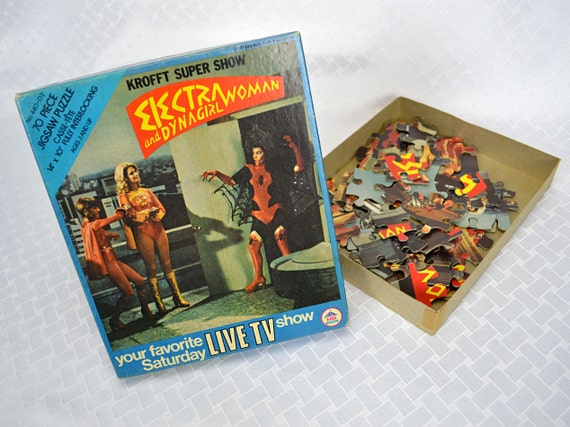
Electra Woman
and Dyna Girl was one of the original segments of the 90-minute umbrella
program, The
Krofft Supershow. Although Krofft was in the name, Sid & Marty Krofft weren’t the
originators of the series. Rather, it was Hanna-Barbera veterans Joe Ruby and Ken Spears, then under
contract with ABC to create and supervise
Saturday morning projects, who created the show as the first in a partnership
with the Kroffts. It was further developed by story editors Dick Robbins and Duane Poole.
Electra Woman, Dyna Girl and Frank in the ElectraBase.
The show was heavily influenced by the live-action Batmantelevision
series, as well as the popularity of Filmation’s The
Secrets of Isis, which led to a greater demand for
strong female characters on Saturday mornings. Electra Woman and Dyna Girl were
actually Lori (Deidre Hall, who was cast in her well-known role on Days
of Our Liveswhile filming
the show) and Judy (Judy Strangis, whose brother worked on Batman), ace reporters for Newsmaker
Magazine. When crime reared its ugly
head, Lori and Judy would “electra-change” into their costumes through a flash
of light, operate out of a high-tech underground headquarters called the
ElectraBase, and pursue their foes in the ElectraCar. The only other person
privy to their secret identities was scientist Frank Helfin (Norman Alden), who
remained in the ElectraBase to operate the CrimeScope computer and relay
information to the duo in the field. Their primary weapons in the war on crime
were the ElectraComs: bulky wrist devices that could perform a variety of
functions depending on a given situation. A narrator (Marvin Miller) would
set-up the episode for the audience and interject at key moments to heighten
the drama, furthering the Batman comparison
along with Dyna Girl’s tendencies to make exclamations beginning with “Electra”
(as opposed to Robin’s
“Holy”).
Ali Baba and his Genie with an evil Dyna Girl.
Electra Woman
and Dyna Girl debuted with the rest of The
Krofft Supershow on ABC on September 11, 1976. Each episode was only around
12-minutes in length, and like Batman ended
on a cliffhanger that would be resolved the following week. The heroes would
find themselves up against a colorful assortment of villains and their
henchmen: The Sorcerer (Michael
Constantine) and his assistant, Miss Dazzel (Susan Lanier); the hypnotic
musician Glitter Rock (John Mark
Robinson); the Empress of Evil (Claudette
Nevins) and her follower, Lucrezia (Jacqueline Hyde); Ali Baba (Malachi Throne, who had played
Falseface on Batman) and his Genie (Sig Haig); the Pharaoh (Peter Mark Richman) and his
Cleopatra (Jane Elliot); and Spider
Lady (Tiffany Bolling),
mistress of disguise. Along with Robbins and Poole, the series was written by Gerry Day, Bethel Leslie and Greg Strangis with music
composed by Jimmy Haskell. Walter C. Miller and Jack Regas directed the series
utilizing a variety of wild camera angles and shots that were used to hide many
of the production flaws and limited special effects that plagued the series.
The 2001 and 2016 reboot attempts for the series.
While The
Krofft Supershow was renewed for a second season, Electra Woman was not. It wouldn’t be until 2001 that the concept
was revisited when The WB
commissioned a pilot for
a sequel series. The show would have been a cynical parody of the original,
showing a disillusioned, bitter, alcoholic and promiscuous Electra Woman (Markie Post) who had retired and
lost her husband to her former partner, Dyna Girl (Anne Stedman). The pilot was
never aired, but has been posted online and included on bootleg DVDs of the
original series. A second
attempt came in 2016 when YouTube
celebrities Grace Helbig and Hanna Hart were cast in a reboot. The film was
initially released in 11-minute webisodes through Fullscreen’s streaming platform that
April while the complete film was released in June through major platforms by Legendary Digital Studios and Sony Pictures Home Entertainment. Sony
released it on DVD
the following month.
“The Sorcerer’s Golden Trick: Part 1” (9/11/76) – The Sorcerer escapes
from prison looking for revenge on the heroes and all the gold in Fort Knox.
“The Sorcerer’s Golden Trick: Part 2” (9/18/76) – The Sorcerer traps
the heroes with a man-eating tiger while he continues his raid on Fort Knox.
“Glitter Rock: Part 1” (9/25/76) – Lori’s former classmate and King of
Touremburg stays with the ladies for their high school reunion and ends up
kidnapped by Glitter Rock and Side Man.
“Glitter Rock: Part 2” (10/2/76) – The heroes rescue King Alex and try
to prevent Glitter Rock from sending up a satellite that will beam hypnotic
music all over the world.
“Empress of Evil: Part 1” (10/9/76) – The Empress of Evil makes her
way into the ElectraBase to challenge Electra Woman and kidnaps Dyna Girl in
the process.
“Empress of Evil: Part 2” (10/16/76) – While the heroes are being
stretched apart, the Empress returns to the ElectraBase and confronts Frank.
“Ali Baba: Part 1” (10/23/76) – Ali Baba and his Genie kidnap a
Russian scientist for his formula that will make good people bad.
“Ali Baba: Part 2” (10/30/76) – Ali Baba uses the formula to turn Dyna
Girl evil and she helps them kidnap Frank from the ElectraBase.
“Return of the Sorcerer: Part 1” (11/6/76) – The Sorcerer and Miss
Dazzle use Merlin’s mirror to steal priceless works of art.
“Return of the Sorcerer: Part 2” (11/13/76) – The Sorcerer
contemplates continuing his crime spree or destroying the mirror that now holds
the heroes captive.
“The Pharaoh: Part 1” (11/20/76) – The Pharaoh and Cleopatra steal a
wooden pyramid from a museum, and in trying to retrieve it the heroes are hit
with a mummifying spray.
“The Pharaoh: Part 2” (11/27/76) – The Pharaoh releases the energy being
Solaris from the pyramid and uses him to hold the city ransom by stealing all
of its power.
“The Spider Lady: Part 1” (12/4/76) – The Spider Lady captures Electra
Woman in order to disguise herself as her and steal the Golden Spider from the
Baklava embassy.
“The Spider Lady: Part 2” (12/11/76) – The Spider Lady uses her
disguise to enter the ElectraBase and set a bomb to destroy the Crimescope.
“Return of the Pharaoh: Part 1” (12/18/76) – The Pharaoh sets his
sights on the Coptic Eye that is part of the recently-transplanted King Tut’s
pyramid.
“Return of the Pharaoh: Part 2” (12/25/76) – The heroes confront the
Pharaoh in the pyramid and end up trapped inside with them.
ABC was looking for
a way to counter NBC and CBS’ new crop of live-action programs. With the
recent success of Sid & Marty
Krofft’s Land of the Lost, ABC decided to hire the Kroffts to produce a 90-minute block of
television for them. The resulting umbrella program was called The Krofft Supershow.
The Supershow line-up.
The Supershow was
comprised of segments featuring all-new 12-minute shows: Dr. Shrinker, Electra
Woman and Dyna Girland Wonderbug.
Rounding out the programming block were reruns of the Krofft’s previous
series, The
Lost Saucer. To fill in the remaining time not taken up by commercial
breaks, the Kroffts teamed-up with the Osmond Family, with whom
they produced the successful variety show The Donny & Marie Show,
to create the series’ mascots: Kaptain Kool and the Kongs.
Turkey, Kaptain Kool, Flatbush, Superchick and Nashville.
Kaptain Kool and the Kongs was a manufactured rock-inspired
band that provided entertainment via skits or musical numbers between the Supershow segments, and served as hosts
by introducing the segments. The band was led by Kaptain Kool (Michael
Lembeck), who wore a colorful quasi-military outfit. The Kongs included the
tall and gangly Turkey (Mickey McMeel), who wore stripes and cartoon eyes on
his clothing; the southern Nashville (Louise DuArt), whose fashion-sense
included butterfly decorations everywhere; the rhyming Flatbush (Bert Sommer),
identifiable by his feather-adorned tri-corner hat; and the wide-eyed Superchick
(Debra Clinger), who was covered in hearts. As was popularized by KISS, the band members also sported
personalized face paint to go with their crazy costumes. Selected more for
their comedic talent than musical skill, most of the music was handled by the
Osmond staff.
Ad for ABC's Saturday line-up.
While The Krofft Supershow would debut on
September 11, 1976, Kaptain Kool and the Kongs made their debut the night
before as part of the Krofft-produced ABC’s
Saturday Sneak Peek. The special was hosted by Jimmy Osmond and featured the rest of his
family, Dick Clark, Marty Allen and ventriloquist Chris Kirby. Allen and Clark
outlined the origin of the Kongs in a musical number, while the rest of the
special was filled by various production numbers and clips from the new shows
joining Supershow on ABC’s schedule.
The World of Sid & Marty Krofft amusement park.
For the first season, the Kaptain Kool segments were
filmed in and around Atlanta, Georgia;
particularly at The
World of Sid and Marty Krofft amusement park. The park was housed in what’s
now known as the CNN Center
and was the first 9-story high-rise amusement park. It was broken up into
different worlds representing the various Krofft productions with characters
working and performing around the park. Unfortunately, attendance was abysmal
(some attribute it to the experience not being worth the price of admission, but
the Kroffts blamed the urban blight that plagued Atlanta at the time), and
coupled with various technical difficulties the park was closed after a mere
six months in November of 1976.
ABC's 1977 Saturday ad.
That same month, ABC’s research department discovered
that while ratings were strong for the first hour of Supershow, they plummeted for the last half hour in favor of CBS’ Ark II and NBC’s Big
John, Little John. In response, by December ABC had Supershow trimmed down to an hour;
reducing the Kongs’ time, eliminating The
Lost Saucer reruns, and filling the new hole in their schedule with reruns
of Super Friends.
Kaptain Kool and the Kongs' new look.
The series was renewed for a second season; however
numerous changes were made. ABC placed it a half-hour later in the schedule,
still with its 60-minute runtime. While Wonderbug
continued, two new segments were produced and aired as part of Supershow: Bigfoot and Wildboy and Magic
Mongo. The Kongs received a makeover, as the producers felt their image was
getting too old too fast. The Kongs shed their rocker looks in favor of a look
more reminiscent of the Bee Gees, trying to
tap into the disco craze. They also shed a member as Flatbush was dropped. The
band’s sequences were taped indoors in front of a live audience and were broken
up into segments such as “Letters to the Kaptain”, which would have Kaptain
Kool dispensing nonsensical advice. The Kroffts and Osmonds had ended their
partnership between seasons, putting the band’s music in the hands of Tommy Oliver, who had also
worked on Donny & Marie.
Promo cartoon for Kaptain Kool and the Kongs.
At the conclusion of the second season, the show was
heavily revamped and moved to NBC as The
Krofft Superstar Hour. There, The Kongs were replaced by the Bay City Rollers
(whose popularity, interestingly enough, resulted in the eventual cancellation
of Donny & Marie); however, the
band was retained for guest-appearances in other Krofft productions, American Bandstandand another ABC Saturday preview
special. Eventually, Clinger and Lembeck went on to other pursuits while McMeel
and DuArt continued working for the Kroffts, resulting in the end of the band.