Showing posts with label anime. Show all posts

June 17, 2023

CARDCAPTORS


CARDCAPTORS

(NHK BS2, April 7, 1998-March 21, 2000 JAP
WB, June 17, 2000-December 14, 2001 US
Teletoon, August 23, 2000-March 8, 2003 CAN)
 
Madhouse, Kodansha (Japanese), Nelvana, The Ocean Group (English)
 
 
MAIN CAST:
Sakura Tange (Japanese) & Carly McKillip (English) – Sakura Kinomoto/Sakura Avalon
Aya Hisakwa (false form, Japanese), Masaya Onosaka (true form, Japanese), Matt Hill (false form, English) & Richard Newman (true form, English) – Cerberus/Keroberos/Kero
Junko Iwao (Japanese) & Maggie Blue O’Hara (English) – Tomoyo Daidouji/Madison Taylor
Tomokazu Seki  (Japanese) & Tony Sampson (English) – Touya Kinomoto/Tori Avalon
Megumi Ogata (Japanese) & Steve Staley (English) – Yukito Tsukishiro/Julian Star/Yue
Motoko Kumai (Japanese), Rhys Huber (season 1) & Jordan Kilik (season 2-3) (English) – Syaoran Li/Li Showron
Yukana Nogami (Japanese) – Meiling Li/Meilin Rae
Nicole Oliver (English) – Meiling Li/Meilin Rae, Maggie


CLAMP is an all-female Japanese manga artist collective, or “circle”, founded in the mid-1980s. Currently comprised of leader and writer Nanase Ohkawa, and artists Mokona Apapa (who just goes by Mokona), Mick Nekoi (now known as Tsubaki Nekoi) and Satsuki Igarashi, they had also featured founding members O-Kyon, Sei Nanao (who both left by 1990), Tamayo Akiyama, Leeza Sei (who both left in 1992), Sōshi Hishika, Kazue Nakamori and Shinya Ōmi (who all left in 1993). The group’s name came from the dictionary when they needed something alphabetically close to “CLUB/Y” to remain seated near a prominent artist at an exhibition. They started out creating dōjinshi (fan comics) of Captain Tsubasa, Saint Seiya, and Jojo’s Bizarre Adventure before pivoting towards original work in 1987. 
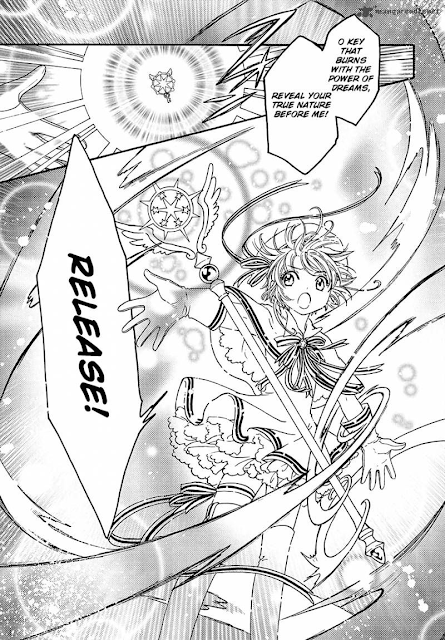

Sakura summoning her wand in the manga.

Their first original project was RG Veda, which got them approached by an editor for Shinshokan’s Wings manga magazine about working for them. RG Veda ended up being serialized in Wings; starting out a single story but expanded when sales and reader response were higher than expected. Over the next decade, they would find themselves published in various magazines and by various publishers. Nakayoshi magazine, published by Kodansha, wanted CLAMP to produce another series for them as their current one, Magic Knight Rayearth, was about to wrap up. Ohkawa wanted to create a magical girl series, despite not being well-versed in the genre, in order to have a character roughly the age of Nakayoshi’s readership (the magazine was targeted towards young girls) that they could relate to. They came up with Cardcaptor Sakura, a title suggested by Nekoi. It debuted in May of 1996 and ran until June of 2000.
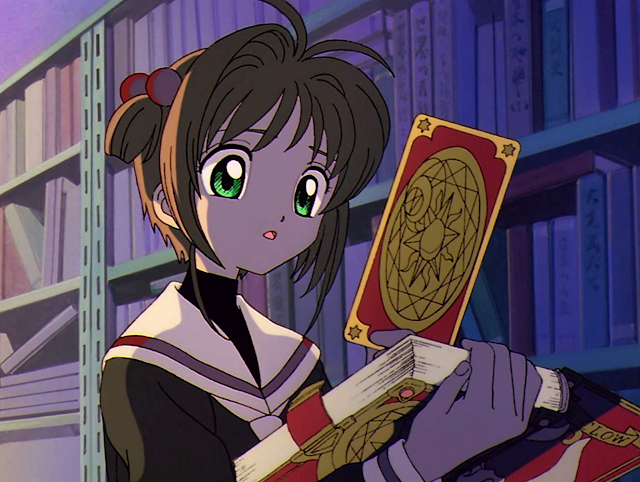

Sakura releases the Clow Cards.


The manga would focus on the titular Sakura Kinomoto, a 10-year-old girl who ended up accidentally releasing 19 magical Clow Cards (named after their former owner, sorcerer Clow Reed) from a book found in her family’s basement and was tasked with retrieving them. It would prove to be different than all of CLAMP’s other series to date as it had a more hopeful feeling to it with the theme of “if you try your best, it’ll work out”. Additionally, there was a focus on various forms of love and relationships between the characters without commentary, which sometimes took center stage over the main plotline in various chapters. Artists Mokona, Nekoi and Igarashi were asked by Ohkawa to use thin and curved lines and to keep the pages light without a lot of ink to give the story a “soft, cute-like” feel. Additionally, a lot of flower imagery was incorporated (while avoiding roses). While the series continued the trope of standard magical girl transformation scenes in the manga, CLAMP wanted Sakura to have different costumes as they felt “it’s pretty sad for a girl to wear the same outfit all the time.” 


The manga’s popularity spurred the production of tie-in media, which included video games, art books and an anime. The anime was produced by Madhouse and directed by Morio Asaka, with Ohkawa serving as head writer and Mokona overseeing costume and card designs. Other writers included Hiroshi Ishii, Jiro Kaneko, Tomoko Ogawa and Tomoyasu Okubo. Katsufumi Hariu handled art direction with Kumiko Takahashi on character designs and Takayuki Negishi on music. It aired 70 episodes across three seasons on NHK BS2 from April 7, 1998-March 21, 2000, as well as two movies released by Bandai that bridged between the first two seasons and served as the series finale. Despite airing in a traditionally poor timeslot, the anime proved popular with viewers and won the Animage Grand Prix award for best anime in 1999. 


As with the manga, the anime centered on elementary school student Sakura Kinomoto (Sakura Tange) and her quest to recover the now 52 Clow Cards, created by half-English, half-Chinese sorcerer Clow Reed (Kazuo Hayashi), before they wreaked havoc in the fictional Japanese town of Tomoeda. She was an extremely sweet and energetic girl who was athletically gifted in sports but a bit clumsy and naïve in life. She was also unaware that she possessed any kind of magical ability until it was revealed that was the only way she could have broken the seal on the Clow Book to free the cards. The cards themselves had their own personalities ranging from good to malicious, as well as an alternate form. They possessed powers typically embodying an elemental force or related to a specific task as well as an ability to float, and could possess objects and control people through them. In order to defeat a Clow Card, their power had to be bound by someone signing their name at the bottom of the card, signifying they are the card’s new owner. Once Sakura captured a card, she was able to use its abilities when needed. Her primary weapon was a staff called the Sealing Wand, which shrank into a key Sakura wore around her neck until a magical chant was recited. It gave the wielder the ability to seal or summon Clow Cards.


Sakura with her wand, Tomoyo with her camera, and Kero being a grump.


Guiding her on her mission was one of the cards’ guardians, Cerberus (Aya Hisakawa), also called “Kero” after the Greek version of his name, Kerberos. His primary form was that of a small winged cat-like cub with a lion-like tail, while his true from (voiced by Masaya Onosaka) was that of a large mountain lion with giant angelic wings and armor. Cerberus was bossy, demanding and gluttonous, but cared about Sakura and believed in her ability to accomplish her quest. Also helping wherever she could was Sakura’s best friend and second cousin, Tomoyo Daidouji (Junko Iwao). She would follow Sakura around with her video camera to record all her exploits, as well as designed new costumes for her to wear into battle and helped cover for her dual identity. Mature for her age, she gave off an air of refinement while still being very sweet and caring. Her ability to sing often made her the target of Voice and Song cards. Additionally, Sakura’s older brother, Touya (Tomokazu Seki), had an ability that allowed him to sense when his sister was in danger and did what he could to protect her, all the while keeping his knowledge of her double life to himself.


Syaoran and Meiling join in on the hunt.


A second Cardcaptor was introduced in the form of Syaoran Li (Motoko Kumai), a cold and cynical boy from Hong Kong who was descended from Reed and a member of the Li clan of sorcerers. He believed he should inherit the cards over Sakura and sought to capture them for himself, often being antagonistic towards her and criticizing her flaws. However, the more time he spent with her, the more he warmed up to and eventually even developed feelings towards her, deciding to work with her in capturing the cards. To find the cards, he utilized a special compass created by Reed. Trying to help Syaoran was his first cousin and betrothed (in Japan, first cousins are allowed to marry), Meiling Li (Nogami Yukana), who was an original character in the anime. She possessed no magical ability herself which often led to her hindering Syaoran more than helping, despite being proficient in martial arts. While in Tomoeda, Syaoran and Meiling were watched over by family butler Wang Wei (Motomu Kiyokawa), who was also created for the anime.
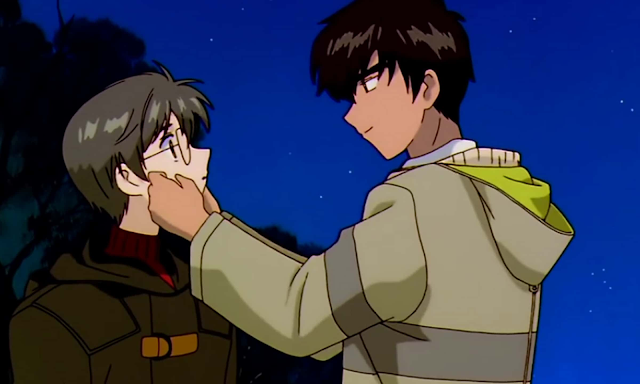

Yukito and Touya: just really good friends.


Additionally, there was Yukito Tsukishiro (Megumi Ogata), who was Touya’s best friend and whom Sakura initially had a crush on. Yukito had a kind and gentle personality, and was very popular in school. He was also a complete lie as it turned out he was unknowingly nothing but a false form for the other card guardian, Yue. Yue had an angelic appearance with dark armor, and was in charge of judging if the next Master of the Clow was worthy. Despite his cold demeanor, he had a kind heart. His powers were reliant on those of his master, and Sakura had to build hers up in order to sustain him. It would be this revelation that would explain Syaoran’s own attraction to Yukito; originally mistaken as being a crush but actually he was drawn towards the magical energies hidden within.


School life.


Other characters included Fujitaka Kinomoto (Hideyuki Tanaka), the widowed father of Sakura and Touya; Nadeshiko Kinomoto (Yūko Minaguchi), the deceased mother of Sakura and Touya who went against the wishes of her family when she married Fujitaka; Sonomi Daidouji (Miki Itō), Tomoyo’s wealthy mother and cousin of Nadeshiko who such deep romantic feelings for her that she considered Fujitaka a rival; Yoshiyuki Terada (Tōru Furusawa & Katsuyuki Konishi), a teacher at the elementary school who taught several classes and often chaperoned trips; Rika Sasaki (Tomoko Kawakami), Sakura’s mature yet shy classmate and friend who regarded Yoshiyuki as a father figure; Takashi Yamazaki (Issei Miyazaki), another classmate who was known for creating highly-detailed fabricated stories on just about any subject; Chiharu Mihara (Miwa Matsumoto), a cheerleader who was close friends with Takashi and often playfully strangled him to stop one of his stories; Naoko Yanagisawa (Emi Motoi), a cheerleader---despite being bad at gymnastics--with a love of fantasy and ghost stories; and Kaho Mizuki (Emi Shinohara), a shrine maiden that dated Touya before leaving to study in England, who returned as a substitute teacher that Sakura developed a crush on and seemed to have some knowledge in regards to the Clow Cards.
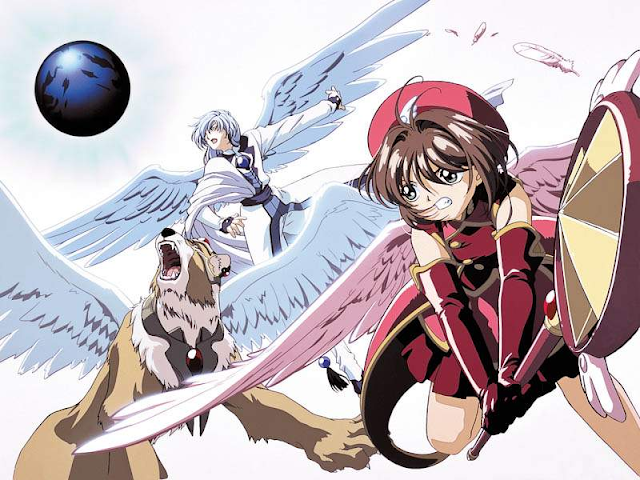

Sakura with Cerberus and Yue.


After Sakura managed to reacquire all of the cards and passed Yue’s judgement, her staff changed from having a bird-like head to a star with wings and give her the ability to convert the Clow Cards into Sakura Cards. Eriol Hiiragizawa (Nozomu Sasaki), the reincarnation of Reed, came to town and created a series of magical disasters in order to force Sakura to do so as the cards could only maintain their power by feeding off of their master’s magic. In the guise of a child, he attended Sakura’s school and befriended her and Takashi. Assisting Eriol were two new guardians he created: Spinel Sun (Yumi Touma), whose borrowed form resembled that of a cat with butterfly wings and true form (Konishi) was that of a panther with butterfly wings and butterfly-shaped armor, and Ruby Moon (Ryoka Yuzuki), who resembled a human-sized fairy with butterfly wings, and assumed the form of high school student Nakuru Akizuki out of boredom. Both were the opposites of their fellow guardians, with Spinel being calm and well-read while Ruby was more chaotic, always teasing Spinel and proving a general nuisance to Touya in school. 


The reincarnation of Clow Reed, Eriol, with guardians Spinel Sun and Ruby Moon.


As the manga was still ongoing at the time, naturally the anime wasn’t a straightforward adaptation and several changes were made. The series began with Sakura’s releasing of the Cards, whereas the manga had depicted it in flashback after she was already on her quest. Along with the number of Clow Cards, their capture happened in a different order and sometimes at different locations and times of day. Cerberus needed both The Earthy and The Firey cards to return to his original form, rather than just the Firey. Syaoran was made able to activate the cards he owned via his sword, took part in Yue’s final judgement, and was no longer living on his own. The fact that Sakura’s father was created from half of Reed’s soul was omitted, eliminating his resistance to the cards’ magic and his ability to see the spirit of his late wife, and making Eriol the only aspect of the sorcerer. The Moon Bell created by Reed to transform Sakura’s staff was meant to help her defeat Yue without hurting him, but was used to give Sakura a second chance to pass his final judgement in the anime. 


Rika and Mr. Terada, gone from a problematic student/teacher infatuation to a father figure.


Several relationships in the anime were altered from their presentation in the manga. Kaho and Eriol were revealed to know each other, but don’t end up together romantically. Rika and Terada’s relationship skewed uncomfortably more towards the romantic in the manga, with the pair planning on getting engaged once Rika was old enough. Sakura was the only one who really knew of their relationship and often came to Rika for advice with her own love life. Chiharu and Takashi’s relationship was left ambiguous, and Tomoyo having unrequited romantic feelings towards Sakura were downplayed. Syaoran confessed his feelings to Sakura immediately after the final battle and tried to hide the fact he was ordered back to Hong Kong by his mother, and he ended up absorbed by The Nothing card when she tried to reciprocate. 


As anime was gaining in popularity outside of Japan, Cardcaptor Sakura was licensed out for localization in other markets. For the English-speaking markets, three different companies created their own dubs independently of each other. Animax Asia’s dub was used for Southeast Asia. The version to air in North America and Australia was handled by Canadian company Nelvana in association with The Ocean Group, which included the first film. The second film, often considered the 25th episode of the third season and the series finale of the anime, was done by Bang Zoom! Entertainment.


Sakura, Cerberus and Syoaran, now known as Li.


Nelvana spent roughly $100,000 per episode on translation by Meredith Woodward, dubbing, and incorporating new music composed by Lenz Entertainment, as well sound effects when the originals couldn’t be isolated from audio tracks. As with other anime imports, a number of changes were made to bring the series more in line with Western sensibilities at the time. For instance, elements of Japanese culture, signage and landmarks were either altered to something more familiar to the target audience or eliminated entirely when possible. All of the children, which were mostly polite and soft-spoken, were made to be far more outspoken; particularly Sakura herself as she was depicted as more assertive. The characters’ names were also mostly Westernized: Sakura became Sakura Avalon (with a different pronunciation for her first name which was only kept because it would have been too difficult to remove all instances of it, voiced by Carly McKillip); Cerberus became Keroberos (Matt Hill using a New York accent, and Richard Newman for his true form) and retained his Kero nickname; Tomoyo became Madison Taylor (Maggie Blue O’Hara, using a valley girl accent instead of the elegant style from the anime); Touya became Tori Avalon (Tony Sampson); Yukito became Julian Star (although Yue’s remained unchanged, both voiced by Samuel Vincent); Syaoran became Li Showron (Rhys Huber & Jordan Kilik); Meiling became Meilin Rae (Nicole Oliver); Reed’s name was pronounced as “klau” instead of “klo” (Dale Wilson); Fujitaka became Aiden Avalon (Brian Drummond), and his wife, Natasha (Janyse Jaud); Sonomi became Samantha Taylor (Venus Terzo); Yoshiyuki was addressed as simply Mr. Terada (Drummond); Rika became Rita (Dina Sherman); Takashi became Zachary Marker (Philip Pacaud); Chiharu became Chelsea (Jocelyne Loewen); Naoko became Nikki (Kelly Sheridan); Kaho became Layla MacKenzie (Linda Rae Jurgens); Eriol became Eli Moon (Bill Switzer); Spinel Sun became Spinner Sun (Colin Murdock); and while Ruby Moon (Willow Johnson) kept her name, her alternate form went by it as well. The town itself was also renamed Reedington. 


Li Showron, elevated to co-protagonist status and thinking Sakura is a joke upon first impressions.


Boys were determined to be the larger demographic for animation, just like it was determined that girls were more likely to watch shows targeted for boys than the reverse. Nelvana’s dub tried to make the show as appealing for boys as possible by toning down anything deemed “girly”. Sakura’s name was removed from the title, becoming simply Cardcaptors; its plurality done to indicate Li’s elevation from a supporting character to a central protagonist alongside Sakura in order to give boys a character they could relate to. The episodes were reorganized so that Li’s debut episode was the first and that more Li-centric episodes aired early on, creating plot holes and inconsistencies in the overall story. While the final episode remained in its correct place chronologically, it was combined with the preceding episode and eliminated most of the romantic moments between him and Sakura. Since Pokémon and Yu-Gi-Oh! were the big shows at the time, it was decided to veer away from cutesy and slice of life moments and put an emphasis on the card collecting (as collecting was the big hook in those other shows) and the action and adventure. 


No longer cousins, so it's okay for Meilin to crush on Li.

That meant romantic entanglements were removed as much as possible, with the central romance between Sakura and Li being drastically downplayed to the point that their love for each other was never confessed and the series ended with Li simply returning home. Problematic relationships were outright eliminated; such as teacher/student relationships like Sakura’s father being a teacher at the high school her mother attended, the remaining traces of Rita and Mr. Terada’s forbidden flirtations, and Tori’s brief fling with student teacher Layla, and ones with an incestuous tone, such as Meilin becoming a childhood friend of Li with a crush on him rather than his cousin. Chelsea was also turned into Zachary’s cousin, removing all possibility of their being a couple and her “strangling” him being given a twinge of sibling energy. Additionally, the price for Sakura failing the final judgement was changed from everyone connected to the cards losing their love for the person they cared for most to everyone’s memory being erased from the time the cards were released. The reason the cards needed to be changed to Sakura Cards (Star Cards in the dub) was altered to their needing a reliable magical source to survive on unless they ran wild looking for one and potentially destroyed the world.


Strong feelings for Julian, or just put off by his personality?


        It particularly meant the elimination of any queer relationships, of which the manga featured many and the anime carried over in some form. Li was no longer attracted to Julian (magical influence or not), with his reactions to him being explained away as being off-put by his general personality. Julian and Tori were no longer attracted to each other and just remained the good friends they were initially depicted as. Madison and Samantha both lost their attractions to their respective cousins. In fact, Natasha’s familial connection to Samantha was removed altogether to make them just friends, and Samantha’s dislike of Aiden came from her feeling like a third wheel when they got together rather than romantic rivalry. Sakura’s crush on Julian, which was prominent throughout the early half of the series, was also downplayed.


Cardcaptors debuted on The WB as part of the Kids’ WB programming block on June 17, 2000 in the United States, while Teletoon (now Cartoon Network) in Canada started airing it on August 23, 2000 (along with a French dub). While all 70 episodes were dubbed, further edits were made to the American version of the program. The series was cut down to only 39 episodes—particularly eliminating ones that didn’t center on Li—with Li’s first episode, the anime’s 8th, being aired first to introduce him right away. Scenes were removed and replaced with ones from other episodes, particularly ones focused on card collecting. To further emphasize Li’s prominence, Kids’ WB’s promotions painted Li as the main character and reduced Sakura to a secondary one. The episode title cards were changed to include a CGI rendering of the Clow Book opening, which was also featured in the original Nelvana intro. The three themes, while simply translated in the original dub, was changed to more of a rocking one about action and adventure performed by Dave Doré. Retained at the end of the episodes was a special short segment called “Leave it to Kero-Chan!”, or “Kero’s Corner” in the dub, where Kero would recap the episode and introduce a character to the audience. 


Gotta catch 'em all!

The episodes “Sakura and Kero’s Big Fight” and “The Summer House” never aired in North America; likely due to the plot of Kero getting drunk being central in the former and Sakura befriending an old man and going over to his house in the latter (despite the fact the old man turned out to be her great-grandfather). Instead, two Kids’ WB-exclusive episodes, “The Past, The Present and the Future” and “A Strange New Beginning” which were combinations of different episodes from the anime, were aired in their place to round out the full 70-episode run. These were the only American episodes to air outside of the country, and were omitted from later reruns of the Nelvana series. The Bang Zoom! dub of the second film would ignore all of Nelvana’s changes and adhered closely to the original Japanese production utilizing a different English voice cast.


Merchandising for the series included a line of toys by Trendmasters. Action figures of Li, Mei Lin and Sakura in different outfits were released alongside fashion dolls of those characters with cloth clothing, figurines of Li, Sakura and Kero, a talking Kero doll, and a set of keychains. Additionally, a roleplaying Clow Book and Clow Cards set and Sakura’s wand were released. Tokyopop produced a series of 10 cine-mangas adapting various episodes using stills from the anime. When they were translated into English, the dub’s names and personalities were carried over and the books were retitled Cardcaptors. Scholastic published several easy-reader adaptations of various episodes, a sticker book and a tattoo scrap book, while Landoll released three punch-out activity books. As part of the promotion for the English dub in 2002, four toys were released through Taco Bell restaurants. Once again, Li was put in a place of prominence as he was the only character physically represented in the toys—the others being Madison’s camcorder with a Sakura sticker and an episode still inside, Li’s compass (called a Lasin Board in the dub), and the Clow book which contained 20 Clow Cards—while Sakura was only seen on the advertising. Kero was featured as a small plush for the younger kids. The restaurant came under fire by religious groups as they felt the Clow Cards looked too close to tarot cards, which represented the occult. Taco Bell issued an apology and ended their distribution shortly after. Pioneer Entertainment released the first 27 episodes of Cardcaptors on 9 VHS and DVD compilations between 2000 and 2002, as well as the first film. A 10th volume was planned but ultimately cancelled. Rhino Entertainment released the album Cardcaptors: Songs from the Hit TV Series in 2001. While the original anime has been made available to stream on Crunchyroll, Netflix, Tubi, Prime, Google Play and Apple TV, the Nelvana dub could only be found from fan uploads on YouTube.


Alternate versions of some of Sakura’s characters appeared in CLAMP’s Tsubasa: Reservoir Chronicle manga in a crossover with some of their other characters. It was published in Weekly Shonen Magazine from May 2003 through October 2009. In 2016, CLAMP began a sequel to Sakura subtitled Clear Card that is, as of this writing, currently ongoing. It follows Sakura, Syaoran and their friends into junior high school as they try to figure out why the Sakura Cards have turned blank, rendering them powerless. As with the original manga, Madhouse adapted the first 28 chapters of Clear Card with the same staff and cast returning; with the exception of Kunihiko Hamda coming on as character designer. A follow-up anime was announced in 2023 that will adapt the rest of the series until its conclusion. Bushiroad and Monster Lab also created a mobile game that was in service from October 2019 through June 2020. 


EPISODE GUIDE (original anime synopses used, translated Japanese titles in parenthesis):
Season 1:
“One Fateful Day (Sakura and the Mysterious Magic Book)” (4/7/98 JAP, 3/7/01 CAN, 6/23/01 US*) – Sakura accidentally releases the Clow Cards from a book in her father’s library, and Cerberus assigns her the task of recapturing them.
*Combined with anime episode 41.
 
“Partners in Crime (Sakura’s Wonderful Friend)” (4/14/98 JAP, 3/11/01 CAN) – Sakura’s best friend learns her secret and her support enables Sakura to fully embrace her role as a Cardcaptor.
 
“Allies (Sakura’s Heart-Racing First Date)” (4/21/98 JAP, 11/18/00 US, 1/14/01 CAN) – A casual aquarium date with Julian turns deadly when The Watery Card attempts to drown Sakura.
 
“An Unexpected Find (Sakura’s Tiring Sunday)” (4/28/98 JAP, 3/18/01 CAN) – Sakura finds two seemingly-dormant Clow Cards in her house that end up turning it into a jungle.
 
“Trouble at Twin Bells (Sakura, Panda, and a Cute Shop)” (4/28/98 JAP, 3/18/01 CAN) – A new shop is unknowingly plagued by a Clow Card.
 
“Seeing is Believing (Sakura and Memories of Her Mother)” (5/12/98 JAP, 4/1/01 CAN) – Investigating a ghostly encounter behind the school leads Sakura to finding the ghost of her mother.
 
“The Mysterious Painting (Sakura’s First Attempt as a Thief)” (5/19/98 JAP, 4/8/01 CAN, 7/7/01 US) – Sakura, Madison and Kero sneak into the art museum to capture The Silent Card inhabiting one of the paintings.
 
“Sakura’s Rival (Sakura’s Rival Appears)” (5/26/98 JAP, 6/17/00 US, 8/23/00 CAN) – Li arrives in Reedington to capture the remaining Clow Cards and take the ones Sakura’s already caught.
 
“Double-Edged Sword (Sakura and the Mysterious Brooch)” (6/2/98 JAP, 7/15/00 US, 8/27/00 CAN) – Rita, Madison and Sakura all buy brooches to cheer Sakura up from her encounter with Li, but Rita’s ends up being The Sword Card and it possesses her.
 
“An Unexpected Reunion (Sakura and the Sports Day of Flowers)” (6/16/98 JAP, 5/27/01 CAN) – Tensions arise on Sports Days as Samantha’s hatred of Adrian over Natasha’s death ignites and the Merry Flower Card causes a downpour of petals.
 
“The Special Box (Sakura. Tomoyo, and a Mansion)” (6/23/98 JAP, 9/9/01 CAN) – Sakura goes to Madison’s house for the first time and learns that The Shield Card has taken control of Samantha’s prized jewelry box.
 
“Time and Again (Sakura’s Never-Ending Day)” (6/30/98 JAP, 6/24/00 US, 9/3/00 CAN) – The Time Card causes Sakura to relive the same day over and over.
 
“Power’s Ploy (Sakura and the Elephant’s Test of Strength)” (7/7/98 JAP, 7/29/00 US, 9/10/00 CAN) – The Power Card terrorizes the zoo but it doesn’t look like Sakura can beat it, even with the help of the zoo’s elephants.
 
“Play Misty for Tori (Sakura, Toya and Cinderella)” (7/14/98 JAP, 9/22/01 CAN) – While visiting the high school, a corrosive mist works its way into the auditorium and into the play being put on by Tori and Julian’s class.
 
“Sakura and Kero’s Big Fight (Sakura and Kero’s Big Fight)” (7/21/98 JAP*) – After an argument, Kero gets himself drunk on liquor-filled chocolate and ends up in the house of a young girl who lives alone with her mother.
*Never aired in North America.
 
“The Summer House (Sakura and the Rainbow of Memories)” (8/4/98 JAP*) – While on a vacation in the countryside, Sakura befriends the old owner of a nearby mansion.
*Never aired in North America.
 
“The Cave (Sakura’s Scary Test of Courage)” (8/11/98 JAP, 7/8/00 US, 9/17/00 CAN) – During a beach trip their classmates all disappear after entering a cave, leading Sakura and Li to believe a Clow Card is nearby.
 
“A Fair to Remember (Sakura, Yukito and the Summer Festival)” (8/18/98 JAP, 9/29/01 CAN) – Sakura’s vision comes true when she and Julian come across glowing lights falling from a tree like snow.
 
“Nothing to Report (Sakura and the Summer Holiday Homework)” (9/1/98 JAP, 4/22/01 CAN) – Sakura and Li work together to capture The Move Card, which has stolen a book they both need to finish their summer assignments.
 
“The New Rival (Transfer Student vs. Sakura)” (9/8/98 JAP, 8/5/00 US, 9/24/00 CAN) – Sakura seeks to protect Tori from a woman challenging people to fights and discovers it’s Meilin in possession of The Fight Card.
 
“The Long Marathon (Sakura’s Long Marathon Race)” (9/30/01) – During a school race, Sakura and Li end up trapped running in circles by The Loop Card.
 
“Practice Makes Perfect (Sakura, Tomoyo and the Wonderful Song)” (9/29/98 JAP, 10/10/01 CAN) – The ghost rumored to be haunting the school’s music room turns out to be The Song Card impersonating Madison’s voice.
 
“No Problem Too Small (Sakura’s Little Adventure)” (10/6/98 JAP, 4/29/01 CAN) – Sakura ends up accidentally shrunken by The Little Card and lost in the backyard.
 
“Double Take (Sakura and One More Sakura)” (10/13/98 JAP, 8/19/00 US, 10/1/00 CAN) – Sakura is confused as to why the town has branded her a trouble maker until she discovers The Mirror card has assumed her form.
 
“No Way Out (Sakura and the Wonderful Teacher)” (10/20/98 JAP, 9/16/00 US, 10/8/00 CAN) – Suspicions surround the mysterious new substitute teacher at school, especially when Li senses strong magical powers from her.
 
“Return to the Future (Sakura and the Shrine of Memories)” (10/27/98 JAP, 10/11/01 CAN) – The Return Card shunts Sakura to the past where she witnesses the relationship between Tori and Layla.
 
“Buyer Beware (Sakura and the Enchanted Cards)” (11/3/98 JAP, 11/4/00 US, 1/3/01 CAN) – A new craze over cards that resemble the Clow Cards results in Meilin unknowingly getting her hands on an actual one.
 
“How Sweet It Is (Sakura’s Sweet Cooking)” (11/10/98 JAP, 3/4/02 CAN) – Sakura and Li’s home economics class project ends up being spoiled by The Sweet Card.
 
“The Race (Sakura and the Injured Card)” (11/17/98 JAP, 8/26/00 US, 10/15/00 CAN) – Sakura is reluctant to capture The Dash Card when upperclassman Rei bonds with it and it helps her on the track team.
 
“Dragon Slayer (Sakura and the Nameless Book)” (11/24/98 JAP, 9/15/00 US, 11/1/00 CAN) – The Create Card takes the guise of a book that brings to life anything Nikki writes in it.
 
“The Switch (Sakura, Kero and Syaoran)” (12/1/98 JAP, 9/23/00 US, 11/5/00 CAN) – While helping Sakura capture The Change Card, Li and Kero end up switching bodies.
 
“Ice Breaker (Sakura’s Freezing Ice Skating)” (12/15/98 JAP, 9/30/00 US, 11/12/00 CAN) – The class trip to the ice skating rink goes cold when The Freeze Card comes out to play.
 
“By the Light of the Full Moon (Sakura, Yukito and the Midday Moon)” (12/22/98 JAP, 3/5/02 CAN) – A journey in the forest during a full moon causes a series of mishaps to befall Sakura and Julian.
 
“The Third Element (Sakura’s Wonderful Christmas)” (12/29/98 JAP, 10/14/00 US, 11/19/00 CAN) – Sakura invites Julian to the amusement park so that she can give him a Christmas present, but duty calls when The Firey Card makes an appearance.
 
Season 2:
“Stormy Weather (Sakura and the Snow New School Term)” (4/6/99 JAP, 11/11/00 US, 1/7/01 CAN) – The 5th grade semester starts off with some unseasonably cold weather as The Snow Card causes a blizzard in April.
 
“The Show Must Go On (Sakura and Tomoyo’s Lost Voice)” (4/13/99 JAP, 3/8/02 CAN) – Madison is all set to sing as the lead in the school choir when The Voice Card steals her voice.
 
“A Berry Strange Day (Sakura’s Fun Strawberry Picking Adventure)” (4/20/99 JAP, 5/6/01 CAN) – On a class trip to a strawberry farm, everyone else gets locked out of the building while Sakura, Madison, Li and Meilin get trapped inside by The Lock Card.
 
“Under the Weather (Sakura’s Dizzy Fever Day)” (4/27/99 JAP, 6/3/01 CAN, 6/30/01 US) – Despite almost collapsing at school, a fever can’t keep Sakura from her duty when The Cloud Card is near.
 
“Dream a Little Dream (Sakura and the Sakura from the Dream)” (5/11/99 JAP, 3/14/02 CAN) – The Dream Card follows Sakura, Madison, Li and Meilin to Tokyo and traps Sakura in a nightmare of the possible future when she faces the Final Judgement.
 
“The Sands of Time (Sakura, Syaoran, and the Sea of Sand)” (5/18/99 JAP, 5/13/01 CAN, 6/23/01 US*) – Sakura gets cast as the prince and Li as the princess in the school production of Sleeping Beauty, but The Sand Card interrupts their rehearsal before they can get to the kissing scene.
*Combined with anime episode 1.
 
“A Strange Intermission (Sakura and the Black Out School Arts Festival)” (5/25/99 JAP, 5/20/01 CAN) – It’s the day of the play and once again the kiss scene is interrupted by The Dark Card, which envelopes Sakura in its darkness.
 
“Meilin’s Story (Sakura and Farewell to Meiling)” (6/1/99 JAP, 12/2/00 US, 1/21/01 CAN) – Meilin is devastated she’s been ordered to return home, so Sakura invites her to a farewell sleepover that turns into a mission when The Twin Card appears.
 
“The Last Card Part 1 (Sakura, Kero and the Mysterious Teacher)” (6/8/99 JAP, 1/28/01 CAN, 7/21/01 US) – Sakura’s dreams become stronger and feature Layla, from whom Kero senses tremendous magical power from.
 
“The Last Card Part 2 (Sakura and the Final Clow Card)” (6/15/99 JAP, 2/4/01 CAN, 7/28/01 US) – Sakura and Kero capture The Earthy Card, transforming Kero into his true form and revealing that Julian has been the guardian Yue the whole time.
 
“The Final Judgement (Sakura and the Final Judgement)” (6/22/99 JAP, 2/11/01 CAN, 7/28/01 US) – Sakura initially fails to defeat Yue and loses the Final Judgement, but Layla uses the Moon Bell to give her another chance.
 
Season 3:
“The New Transfer Student (Sakura and the Mysterious Transfer Student)” (9/7/99 JAP, 8/4/01 US*, 3/15/02 CAN) – New transfer students arrive at the elementary and high schools just as a mysterious rain falls over the town and Sakura finds she’s unable to use her abilities.
*Combined with anime episodes 48 & 58 to form the US episode “The Past, The Present and The Future”, which was also aired in Canada.
 
“Unlocking the Key (Sakura and the Awakened Star Key)” (9/14/99 JAP, 8/4/01 US*, 2/8/03 CAN) – Sakura, Kero, Yue and Madison investigate the strange downpour and end up trapped by the torrents until Sakura is able to create a new incantation that restores her powers.
*Combined with anime episode 47 to form the US episode “A Strange New Beginning”, which was also aired in Canada.
 
“The Dangerous Piano (Sakura and the Dangerous Piano)” (9/21/99 JAP, 3/8/02 CAN) – Eli accompanies Madison on the piano and secretly enchants it to attack the sound of her voice.
 
“The Threads That Bind (Sakura, Syaoran, and the Invisible Threads)” (9/28/99 JAP, 8/25/01 US*, 2/8/03 CAN) – Eli takes control of Li’s body using invisible strings after purchasing several spools from a craft store.
*Combined with anime episode 51 to form US episode “A New Set of Wings”.
 
“Attack of the Teddy Bear (Sakura and the Big Teddy Bear)” (10/5/99 JAP, 8/25/01 US*, 10/5/01 CAN) – Eli helps Sakura make a teddy bear for Julian and enchants it, causing it to grow in size once she gifts it to him.
*Combined with anime episode 50 to form US episode “A New Set of Wings”.
 
“Trouble at the Park (Sakura’s Sheep Warning)” (10/12/99 JAP, 9/1/01 US, 10/7/01 CAN) – Yue reveals to Kero that Sakura’s magic isn’t enough to sustain him for long while Sakura investigates a large hole in the middle of a playground.
 
“Running Out of Time (Sakura and the Panicky Bike)” (10/19/99 JAP, 8/11/01 US, 9/23/01 CAN) – Sakura hastily transforms several Clow Cards into Sakura Cards at once to preserve her magic, causing The Dash Card to flee in panic and possess Tori’s bike.
 
“Calendar of Memories (Sakura and the Calendar of Memories)” (10/26/99 JAP, 2/15/03 CAN) – Sakura sets out to amend the rift between her father and great-grandfather who didn’t approve of his marriage to Natasha.
 
“Sakura in Wonderland (Sakura and Sakura From Wonderland)” (11/2/99 JAP, 12/3/01 US, 3/6/02 CAN) – Eli enchants a leaf he gives to Sakura for a bookmark, causing her to be sucked into her copy of Alice in Wonderland.
 
“Spinning Out of Control (Sakura, Kero and the Sweet Meeting)” (11/9/99 JAP, 9/22/01 US, 10/12/01 CAN) – While hiding nearby in the woods during the school bazar, Kero meets and befriends Spinner and introduces him to sweets—causing him to go on a ravenous eating binge.
 
“Li’s Calling (Sakura Syaoran, and the Elevator)” (11/16/99 JAP, 10/8/01 US & CAN) – The bond between Li and Sakura steadily grows, especially after Eli traps both of them in an elevator together.
 
“Double Trouble (Sakura and Double Trouble)” (11/30/99 JAP, 9/15/01 US, 10/9/01 CAN) – Eli casts a spell that prevents Cerberus and Yue from assuming their alternate forms.
 
“Trapped (Sakura, Tomoyo, and the Ball Trap)” (12/7/99 JAP, 9/22/01 US, 10/13/91 CAN) – Yue confronts Eli and reveals he knows who he really is, while an enchanted basketball warps space within the school and causes Madison to be lost.
 
“Just Like Old Times (Sakura and the Precious Friend)” (12/14/99 JAP, 10/14/01 CAN, 10/15/01 US) – Li is prepared to end his engagement to Meilin as he loves Sakura, but first they must all deal with enchanted penguin statues in the playground.
 
“A Present for the Cards (Sakura, the Cards, and the Presents)” (12/21/99 JAP, 2/15/03 CAN) – Sakura uses The Mirror Card to duplicate herself to go Christmas shopping with Tori while she deals with a pair of enchanted fence bars with Li.
 
“Sakura’s Strange Fortune (Sakura and the Strange Written Fortune)” (1/4/00 JAP, 2/22/03 CAN) – While at the shrine for the New Year’s celebration, Eli gives Sakura a fortune that says a truth will be revealed to her during her first dream of the year.
 
“A Wave of Danger (Sakura, the Pool and the Huge Wave)” (1/11/00 JAP, 2/22/03 CAN) – Eli causes the pools at the indoor water park to rise to dangerous levels, almost drowning Rita in the process.
 
“Slippery Slope (Sakura and the Snowy Ski Class)” (1/18/00 JAP, 12/11/01 US, 3/21/02 CAN) – During a class ski trip, Sakura and Eli go hiking in the mountain when an avalanche threatens to bury the lodge.
 
“Lights, Camera, Vanish (Sakura, Yukito, and the Vanishing Power)” (2/15/00 JAP, 12/10/01 US, 3/7/02 CAN) – When Julian collapses during production of a student film, Tori gives up his abilities to sense Sakura in danger in order to keep him from fading from existence.
 
“The Calm Before the Storm (Sakura, Syaoran, and the Tsukimine Shrine)” (2/29/00 JAP, 3/1/03 CAN) – Sakura and her friends all go to hang out at the shrine where Eli sends a strange-looking horse to cause trouble.
 
“Sakura’s Return to the Past (Sakura, the Past, and Clow Reed)” (3/7/00 JAP, 12/12/01 US, 3/22/02 CAN) – Sakura uses The Return Card to go back in time to consult with Clow Reed, and discovers that he lives in the same house Eli lives in now.
 
“Revelations Part 1 (Sakura Meets Clow Reed)” (3/14/00 JAP, 12/13/01 US, 3/8/03 CAN*) – Eli finally reveals that he’s the reincarnation of Clow Reed and tasks Sakura with transforming the remaining cards or condemn the world to remain in eternal sleep and darkness.
*Combined with anime episode 70.
 
“Revelations Part 2 (Sakura and Her True Feelings)” (3/21/00 JAP, 12/14/01 US, 3/8/03 CAN*) – Eli explains his reasons for the constant attacks, and Sakura sees Li off as he returns to Hong Kong without confessing her feelings for him.
*Combined with anime episode 69.
 
Films:
“The Movie” (8/21/99 JAP, 4/6/22 CAN) – Sakura and her friends go to Hong Kong where a vengeful spirit seeks Clow Reed in order to destroy him.
 
“The Sealed Card” (7/15/00 JAP, 11/18/03 US) – Sakura is ready to tell Syoaran her feelings when he returns to town, but her cards and people she cares about have begun going missing.

April 01, 2023

VIEWTIFUL JOE

VIEWTIFUL JOE
(TV Tokyo, October 2, 2004-September 24, 2005 JAP
The WB, November 5, 2005-May 20, 2006 US)
 
Group TAC, Medianet, TV Tokyo, Capcom, Geneon Entertainment


MAIN CAST:
Tomokazu Seki (Japanese) & Jason Palmer (English) – Viewtiful Joe/Joe Black
Natsuko Kuwatani (Japanese) & Philece Sampler (English) – Silvia Lumière/Sexy Silvia/Go-Go Silvia
Banjou Ginga (Japanese), Bob Papenbrook (as John Smallberries, episodes 1-21) & Paul St. Peter (as George C. Cole) (English) – Captain Blue/Almighty Leader/King Blue
Makoto Tsumura (Japanese) & Katie Leigh (English) – Captain Blue Jr./Junior
Mayumi Asano (Japanese) & Wendee Lee (English) – Sprocket
Shin-ichiro Miki (Japanese) – Alastor
Milton Lawrence (as Ross Lawrence) (English) – Alastor, Gran Bruce


In the late 80s and early 90s, Nintendo enjoyed a monopoly on the video game home console market; their original NES being responsible for reversing the slump of the video game industry after the crash of 1983. This allowed Nintendo to be very selective with third-party developers (one of the underlying causes of said crash), and to compel them to make exclusive content for their systems on their schedule. Nintendo’s restrictions were forced to relax a bit in regards to the SNES when Sega’s Genesis console became a legitimate competitor. However, everything was turned on its head when Nintendo decided to retain a proprietary cartridge-based system for their next console, the Nintendo 64. Turned off by the limited memory and added expense of manufacturing and stocking enough of the cartridges, third party developers turned their attentions towards the disc-based PlayStation that allowed them to avoid those issues.

The GameCube was Nintendo's hope to turn their fortunes around.


The N64 proved popular and performed strongly in its launch year. However, the cartridge format was said to have contributed to a diminished release schedule and higher price point than its competition. Although it continued to outsell the Sega Saturn, it would soon fall behind the PlayStation in the United States. In Japan it was a different story, as the small game library turned off consumers resulting in low sales. Nintendo tried to correct these mistakes with their next system, the GameCube, which had powerful hardware and a disc-based system (although still a proprietary one using mini-discs).

The four surviving members of The Capcom Five.


Unfortunately, the system had its own problems. For starters, the console didn’t offer DVD playback or internet connectivity like its contemporaries. Once again, third-party support was lacking, which meant it didn’t have a wide variety of games available to play at launch. And there was new competition in town as Microsoft had released their Xbox just three days prior. As a result, the GameCube only sold 4.7 million consoles in its first year. Looking to boost sales, Nintendo entered into a partnership with Capcom to produce five exclusive games for the GameCube; a deal Nintendo would hastily announce in November of 2002. Known as The Capcom Five, these games were futuristic third-person shooter P.N.03; shoot ‘em up Dead Phoenix; action-adventure shooter Killer7; the next entry in the hit survival horror franchise, Resident Evil 4; and Viewtiful Joe.

Joe and his super alter-ego.


Viewtiful Joe was developed by Team Viewtiful, a subgroup of Capcom Production Studio 4, directed by Hideki Kamiya and produced by Atsushi Inaba. Originally known as “Red Hot Man” until copyright conflicts arose because of the American rock band Red Hot Chili Peppers, the game was inspired by 1960s and 1970s Japanese costumed tokusatsu programs such as Kamen Rider and Ultraman and combined with the concept of superheroes found in American comic books. The characters were designed by Kumiko Suekane.

Joe taking on Hulk Davidson.


Players took on the role of the protagonist Joe (Dee Bradley Baker), an ordinary guy from Earth who loved movies, comics and action figures. While attending a film starring the aging superhero Captain Blue (Gregg Berger) with his girlfriend, Silvia (Cristina Pucelli), the film’s antagonist seemed to have defeated Blue and then proceeded to kidnap Silvia into the film and into Movieland. Joe was then taken after her by Blue’s giant mecha, Six Majin (or Six Machine), in order to defeat the organization of villains known as Jadow and their Almighty Leader to rescue her. Blue gave him a device known as a V-Watch that allowed Joe to transform into a superhero when he said the word “henshin (transform)”, coming up with his own catchphrase “Henshin-a-go-go, baby!” Joe proceeded to battle through members of the Jadow through various Movieland locations with Blue’s guidance, and came to learn that Silvia was abducted as the Jadow needed “the DNA of the creator” to escape to Earth and avoid forever being forgotten when celluloid becomes obsolete. It was then revealed that Blue was Silvia’s father who had become trapped in his own films and was the real mastermind behind the whole plot, becoming the final boss: a giant robot named King Blue. Upon his defeat, Blue came to his senses, reunited with his daughter, and told Joe he would need to save the world two more times. Silvia requested a V-Watch of her own and together the two of them set out to be heroes.

Joe and his new partner, Sexy Silvia.


Viewtiful Joe was a traditional 2D platform side-scrolling beat ‘em up that was intermixed with 3D cel-shaded graphics to create “stunning visuals and fluid gameplay”. Joe had the ability to double jump, punch, kick and dodge, the latter of which caused enemies to become dazed when performed successfully. He also had three special abilities called Viewtiful Effects (VFX) Power used to combat enemies and solve puzzles: “Slow”, which slowed time and increased Joe’s strength and reflexes; “Mach Speed” allowed Joe to move faster and unleash a flurry of attacks as well as envelope him in a temporary heat shield that protected him from attacks and set enemies on fire; and “Zoom In”, which brings the camera to focus tightly on Joe and granted him more power for his normal attacks, a new set of attacks and paralyzed weaker foes nearby—however, it also meant the amount of damage he took increased as well. Using a VFX Power caused the VFX gauge to drain and revert Joe to his non-super self, leaving him weaker for a time until it refilled over time or by picking up bottles of VFX Juice. Any two VFX Powers could be combined and their gage temporarily expanded by collecting a number of V-Films in a stage. Hamburgers could also be collected to replenish health.

Captain Blue: Hero? Villain? Absentee father?


Each stage was broken up into several interconnected missions, or scenes, which Joe must complete before moving on to the next. Between each stage, players had the chance to purchase upgrades for Joe using V-Points, including abilities, weapons, health items and health increases. V-Points were earned several ways: by collecting coins that appeared when defeating enemies; while using special attacks earning V-Marks or Viewtifuls, which could be converted to V-Points; using combos and long chains of attacks, particularly while using Slow, and increasing the multiplier called X-Bonus; and the player grade at the end of the stage that tallied up the number of V-Points earned, the amount of time past, and how much damage Joe took. Completing the game on various difficulties unlocked new playable characters such as Silvia, Captain Blue and one of the bosses, Alastor (Mikey Kelley), as well as Dante (Drew Coombs) from the Devil May Cry series.


The game was released in Japan on June 26, 2003, with North America getting their release that October. The game was well-reviewed and earned a number of awards and nominations from various magazines, game sites and award shows. Unfortunately, that didn’t translate into sales as only 275,000 copies were sold worldwide. However, as the game was made on a small budget, it ended up being relatively successful commercially enough to warrant a sequel. Team Viewtiful was spun off into its own semi-autonomous production company, Clover Studio, to begin work on it and develop other new intellectual properties for Capcom. This was done in part because of the tensions between Capcom and Shinji Mikami after the console exclusivity of Resident Evil 4 that Mikami touted was undone. The Capcom Five ended up not being as exclusive as Nintendo believed and Capcom seemingly backed-up—a mistake they blamed on poor communication with their parent company—with only one of the four games actually produced, P.N.03, remaining solely on GameCube. The other games, including Joe, were eventually ported to other consoles.

Sexy Silvia getting her licks in this time around.


Viewtiful Joe 2 (given the subtitle Secret of the Black Film in Japan) picked up where the first game left off: with Joe and Silvia (now with the alter-ego of Sexy Silvia) setting out to fend off an invasion of Movieland by the alien organization called Gedow. Their leader, the unseen Black Emperor (Keith Szarabajka), desired to claim the Rainbow Oscars: seven statuettes that contained the power of the happy ending, with Blue being turned into the blue one. The Emperor ended up being Jet Black, Joe’s father, who worked as Captain Blue’s cinematographer and obtained a Black V-Watch after being twisted into evil when he found a cursed piece of celluloid known as the Black Film. While similar to the original game, this time around players could choose between Joe and Silvia and switch between them during gameplay using the “Viewtiful Switch”. Both characters shared health and VFX Power. Instead of Mach Speed, Silvia had the VFX Power “Replay”, which allowed her to record and repeat an event three times in succession but had the same benefits and cost as Joe’s ability. They also had a team-up attack utilizing the Six Machine, in place of an initially-teased co-op feature. An additional gameplay mode, the “36 Chambers of Viewtiful”, was a series of stages designed to test the player’s skills to accomplish set goals.

The Black Emperor.


The game released in Japan on November 18, 2004, with North America’s landing on December 8th. This time it was directed by Masaaki Yamada as Kamiya had signed on to direct Ōkami; although Kamiya contributed to the storyline scenario in order to maintain continuity. Reviews were once again generally positive, but the game still didn’t make a strong impact on the sales charts; selling 270,000 copies in North America and 80,000 copies in Japan, and failing to chart at all in the United Kingdom.


To coincide with the sequel, Clover commissioned the creation of a manga published in V Jump magazine and an anime based on the games. Produced by Group TAC, the anime largely followed the same plot of the games. Joe (Tomokazu Seki & Jason Palmer) had been largely neglectful of his girlfriend, Silvia (Natsuko Kuwatani & Philece Sampler), until she was abducted into the movie screen where they were watching the film of his idol, Captain Blue (Banjou Ginga & Bob Papenbrook until his death, then Paul St. Paul). Joe was brought into Movieland by Captain Blue and his mech (renamed Machine Six in the English dub) and given the V-Watch, turning Joe into a superhero of his own. He set out to rescue Silvia in his own bumbling fashion, dealing with members of Jadow he encountered along the way. Silvia was shown to be proactive while waiting for Joe to rescue her; using her charms on her captors to keep herself somewhat comfortable while she actively looked for a way to escape.

The bad guys (from top): Alastor, Gran Bruce, Charles III, Fire Leo, Hulk Davidson and Another Joe (an alternate form for Alastor).


All of the villains from the game were featured, including Blade Master Alastor (Shinichiro Miki & Milton Lawrence), who wasn’t really loyal to the Jadow cause so much as looking for the ultimate battle, becoming an admirer of Joe’s skills and declaring him his rival (and ultimately gave Joe the “Viewtiful” part of his name when Joe misheard him say “beautiful”); Iron Ogre Hulk Davidson (Akimitsu Takase & Jamieson Price [as Joe Cooker]), a rhino-like strongman who loved to collect motorcycles and sing (badly); Dark Fiend King Charles III (Mitsuru Ogata & Terrence Stone), a bat-like being that spent his time napping in a coffin in his haunted temple; Inferno Lord Fire Leo (Yōji Ueda & Jonathan Lipow), a flaming lion with sharp talons that got annoyed by Joe constantly thinking he’s a dog; Aquatic Terror Gran Bruce (likely named after the animatronic shark featured in Jaws, voiced by Shouto Kashii & Lawrence), a humanoid shark wearing scuba gear with an inability to finish sentences and a limited intellect; and the Biankies (Stone), the legion of faceless, nameless, brainless minions that comprise the bulk of the Jadow’s forces. Biankies came in various forms: the helicopter or jet-powered Verdy, the ballerina Prima, the sword-wielding Red Leader, the elite Jokester, and the cowboy Bianco Billy.

Joe, Silvia and Junior in his eventual powered-up form.


New characters created specifically for the anime included Sprocket (Mayumi Asano & Wendee Lee), the second-in-command of the Jadow who was from Earth as well and was pulled into Movieland with Blue; Captain Blue Jr. (or just Junior, voiced by Makoto Tsumura & Katie Leigh), a fanboy of Captain Blue who was meant to become his successor but instead joined Joe on his quest; and Jefferson Buik, another member of Blue’s film crew who was sucked into Movieland and stumbled upon the Jadow’s plans, making him the most wanted man in the land.

Gran Bruce gets a little over-inflated.


Viewtiful Joe debuted on TV Tokyo in Japan on October 2, 2004. Geneon Entertainment (now NBCUniversal Entertainment Japan) would distribute the anime to The WB on the Kids’ WB! programming block on November 5, 2005. The anime retained the overall cel-shaded look and feel of the games as Inaba and his team provided Group TAC their designs, plus designed the new characters for the anime. Yukiko Oohashi was also credited as a character designer, with Nobuaki Nagano handling the Mecha designs. Animation was done by AniVillage, BUZZ, Digital Engine, EASIA, Hayashi, Hiryu Animation, Meta Studio, Studio Sign and Triple A. The English dub maintained one of the two theme songs performed by SaGa, “Brighter Side”. The rest of the series’ music was composed by Takehiko Gokita and Yuusuke Hayashi.

Sprocket zipping up.


The original anime was translated by Yurika Dennis with Grant Moran writing the new scripts, and Darlene Waddington writing the ADR scripts for the new voice recordings at phuuz entertainment. As with other anime imports, Joe was edited for content deemed a bit to risqué for American audiences. Some of those changes included editing out Joe’s middle finger during his transformation sequences; the amount of cleavage Sprocket displayed and her constantly zipping up her jumpsuit; and Sexy Silvia being renamed Go-Go Silvia. A new sense of comedy was infused by giving the various villain characters over-the-top personalities and filling Joe’s dialogue with a lot of outdated “cool dude” slang. Additionally, jokes about Blue’s weight were frequent. For whatever reason, the first episode aired of the dub was the 5th episode, “Howdy, Partner!”, which introduced Junior. The actual first episodes wouldn’t air until the following month.

Promo art for Red Hot Rumble, featuring some of the season 2 characters.


The anime actually ran for two seasons, however only the first was ever dubbed in English. The series was dropped from the network once it made the branding changeover to The CW, but did air in its entirety in other territories like China and Latin America. As with the second game, the second season focused on the Gedow invasion led by Joe’s father, Jet Black (Jȗrôta Kosugi & Carlos Vitale in the Latin America dub), after he was corrupted by the Black Film and gained his own Black V-Watch. When not under the influence of the Evil King possessing him, Jet would actually aid Joe and his crew, unaware of his role as their foe. Junior gained a transformation of his own by being given V-Yo-Yos, while Blue was turned into a hammer with magical properties. The heroes would chase the Gedow through various film parodies to prevent them from ruining their happy endings, which would allow the Evil King to escape into the real world and control humanity’s dreams. Instead of the Rainbow Oscars from the game (likely for legal reasons), the heroes had to find the White Film—one of the first shot with Captain Blue and imbued with the power of justice.

The new bad guys (clockwise from top): Frost Tiger, Rachel, Dr. Cranken, Flinty Stone, Big John and Cameo Leon.


Along with the former minions from the Jadow, the Gedow came with new foes in the form of Drill Sergeant Big John, a Tyrannosaurus Rex clad in army gear; Blizzard Hazard Frost Tiger, the icy brother of Fire Leo; Cyber Phantom Cameo Leon, a humanoid chameleon capable of turning invisible; Ancient Guardian Flinty Stone (likely a play on The Flintstones), a narcoleptic sentient stone with an Aztec motif; Serial Killer Android Miss Bloody Rachel, an android built with all the data of Joe and Silvia and the ability to turn into other members of the Gedow, but managed to develop a heart and turn against her programming; Dr. Cranken, a squid-like mad scientist that was the Gedow’s second-in-command and responsible for creating most of their weaponry and minions; and Flaties, the foot-soldiers of the Gedow.

Joe drooling over Captain Blue merch while Silvia tries to have a serious discussion with him.


Unless you watched this season as it aired, it’s very hard to come by. It only aired in Japan once, and Cartoon Network, where it was carried in Latin America, aired it during the late-night hours. It also never saw release on home media, with only a few episodes of the Chinese subs, poor-quality recordings of only a few of the early Japanese episodes, and fan-recordings of the Spanish dubs preserving that version in its entirety popping up on video hosting sites on the internet.

The DVDs.


Geneon released the first season across 8 DVDs and UMDs between 2006-07. In a partnership with Kids Foot Locker, copies of the DVDs were included with purchases at the retailers. SaGa released two CD singles of their songs from the anime in 2005, both came with a DVD featuring a music clip while the singles for “Brighter Side” and “And You” featured the opening and ending cinematics with those songs. A full soundtrack of the series’ music was made available on CD, and also packaged with a special edition of the first DVD collection along with a lenticular cover. Using screenshots from the anime, Capcom published five manga-style film books in 2005. In 2006, Jazwares released a single wave of action figure 2-packs featuring Joe in both forms, Captain Blue, Junior, Charles III and a Bianky (however, they were packaged together randomly rather than in any set combination, making it difficult to get a complete set without duplication).

Joe knocking around Captain America on Spider-Man's stage in Marvel vs. Capcom 3.


Although Viewtiful Joe 2 ended with an allusion to another direct sequel, one has not yet been produced. Instead, two spin-off games were released in 2005. Red Hot Rumble, a mission-based platform fighter similar to Super Smash Bros., featured established Joe characters as well as the new characters and footage from the anime; however, the regular game actors reprised their respective roles, with Tara Strong taking over Junior and Vanessa Marshall the additional female roles. Double Trouble!, a Nintendo DS exclusive, was a 2D side-scroller that utilized the console’s touch screen mechanic and introduced Joe’s sister, Jasmine (Hynden Walch), who offered Joe support during gameplay. Clover was shut down in early 2007 after the departures of Kamiya, Inaba and Mikami from Capcom, effectively putting an end to the Joe franchise. Joe, however, has appeared as a playable character in the Wii version of Tatsunoko vs. Capcom: Ultimate All-Stars in 2008 and both versions of Marvel vs. Capcom 3 in 2011. Joe-inspired costumes also appeared in Dead Rising 4 as part of the Capcom Heroes mode, giving protagonist Frank West several of Joe’s moves, and in Street Fighter V Arcade Edition for the character Rashid.


EPISODE GUIDE:
Season 1:
“Just a Dude Named Joe” (10/2/04 JAP, 12/16/05 US) – Silvia is kidnapped into Movieland by minions of Jadow, and Joe is given powers by Captain Blue to rescue her.
 
“What’s-His-Name to the Rescue!” (10/9/04 JAP, 12/16/05 US) – Joe tracks Silvia and her captor down and eventually defeats him, but she ends up abducted again before they can reunite.
 
“Dude, Did You Say Viewtiful?” (10/16/04 JAP, 12/16/05 US) – Silvia is dropped into a new prison while Joe is made to face off against two foes on a deserted island.
 
“Tutus to You, Too” (10/23/04 JAP, 12/23/05 US) – Silvia begins to comfortably adjust to life as a prisoner prompting Sprocket to break her spirits by showing edited footage of Joe losing his fights.
 
“Howdy, Partner!” (10/30/04 JAP, 11/5/05 US) – Joe comes across the home of Captain Blue and defends it from a motorcycle gang, ending up with the Captain’s former protégé in tow.
 
“Junior Sucks it Up” (11/6/04 JAP, 11/12/05 US) – Joe summons Captain Blue’s flying machine in order to deal with Jadow’s aerial assault.
 
“Attack of the Slugoon Platoon” (11/13/04 JAP, 11/19/05 US) – A hot new kid’s product ends up being a ploy by a Jadow goon to take over their minds and turn them into a personal army.
 
“Fire on the Mountain” (11/20/04 JAP, 11/26/05 US) – Joe and Junior encounter and battle Fire Leo as Alastor watches on, curious as to what Silvia sees in Joe.
 
“Roamin’ Holiday” (11/27/04 JAP, 12/3/05 US) – Joe and Junior come across a town with no food, and after a girl gives Joe some bread he ends up promptly arrested.
 
“No Kidding” (12/4/04 JAP, 12/10/05 US) – Charles III, Hulk Davidson and Gran Bruce come together to create an invincible robot to take out Joe.
 
“When Pigments Fly” (12/11/04 JAP, 12/17/05 US) – Joe and Junior must reclaim and restore a town’s color from two Jadow agents.
 
“Dude, Where’s My V-Watch?” (12/18/04 JAP, 1/7/06 US) – Joe gets fooled by a shapeshifting Jadow agent who disguises themselves as Silvia to steal his V-Watch.
 
“The Fugitive From Beyond the Screen” (12/25/04 JAP, 1/14/06 US) – Jefferson Buik stumbles upon the Jadow’s plans and looks for a hero to tell, but he ignores Joe entirely in favor of Junior.
 
“Jadow Greatest Hits Collection” (1/8/05 JAP, 1/21/06 US) – The Jadow agents disobey a direct order and head into the editing room to alter their footage to make themselves look better.
 
“To Have and to Hold Captive” (1/15/05 JAP, 1/28/06 US) – Not only must Joe free a town from Jadow, but he must stop the wedding of Silvia and Alastor!
 
“A Fairy’s Tale” (1/22/05 JAP, 2/4/06 US) – Joe and Junior decide to stick around when they discover a mysterious girl being extremely protective of a mystic flower.
 
“Captain Blue vs. the Squid of Inescapable Doom” (1/29/05 JAP, 2/11/06 US) – Joe and Alastor spar to cheer up a sick kid, but Jadow agents make the show a difficult one.
 
“V-Watch Out!” (2/5/05 JAP, 2/18/06 US) – Joe’s V-Watch ends up in the wash and may not make it through intact.
 
“V is For…Veggie-Burger?!” (2/15/05 JAP, 2/25/06 US) – Entering a new city ends up putting Joe and Junior on the hunt for a runaway girl.
 
“Express Train to Yesterday” (2/19/05 JAP, 3/4/06 US) – Joe, Hulk Davidson, Charles III and Gran Bruce all mysteriously end up on a train bound for Toyland.
 
“Bianco Billy Rides Again” (2/26/05 JAP, 3/25/06 US) – Junior ends up separated from Joe and finds himself forced to deal with a new foe on his own.
 
“Cleanliness is Next to Escape-liness” (3/5/05 JAP, 4/22/06 US) – Silvia discovers some footage from her childhood in the Jadow base, as well as a possible means of escape.
 
“Crush Hour” (3/12/05 JAP, 4/29/06 US) – Joe and Junior save Silvia from a clock tower, but before they can celebrate Alastor challenges Joe to a fight.
 
“Hero Takes a Fall” (3/19/05 JAP, 5/6/06 US) – Joe and Junior must save a town from Hulk Davidson, Gran Bruce and Charles III.
 
“In the Belly of the Jadow Beast” (3/26/05 JAP, 5/13/06 US) – Joe gets help from an unlikely ally in rescuing Silvia from Fire Leo and discovers the true identity of Almighty Leader.
 
“It All Comes Down to a Dude Named Joe” (4/2/05 JAP, 5/20/06 US) – The support from his friends allows Joe to defeat Blue and Silvia is given her own V-Watch to become Joe’s sidekick.
 
Season 2 (aired in Japan only):
“The New Enemy! Gedow’s Invasion” (4/9/05) – The Black Emperor seeks to ruin the happy endings of movies and turns Captain Blue into a hammer.
 
“Junior’s Transformation, Henshin a Yo-Yo” (4/16/05) – Junior gains his own power and joins the heroes while Blue’s former minions join Gedow, currently invading a dinosaur movie.
 
“Silvia and the Woman Who Summons Storms!” (4/23/05) – Gedow corrupts a robot and has her unleash tornadoes on her own film while Silvia comes across a depowered Alastor.
 
“Wild Wild Kick!” (4/30/05) – Gedow spoils a sports movie by making a kids’ soccer team so good that they no longer need their coach for motivation.
 
“The Alien Next Door” (5/7/05) – Joe joins up with a pair of men in black suits to stop a group of aliens the Gedow changed from being peaceful.
 
“Fierceness! The Cannon Race” (5/14/05) – Joe must stop Gedow from sucking the passion out of the racers in a film to save it.
 
“A Lot of Heroes!” (5/21/05) – Joe and his friends must find a way to bring back all the supervillains to a superhero film.
 
“Reclaiming the Black Diamond!” (5/28/05) – Gedow tries to make off with a diamond that will ruin the end of a heist movie, but Joe and his friends are ready to stop it.
 
“A Kind, Mysterious Person from Gedow?!” (6/4/05) – Rachel uses the Blue Hammer to turn a killer robot good, but it calls on Joe for help when the people still fear it.
 
“The Target is Joe!” (6/11/05) – Joe and his friends confront Rachel, who has used Captain Blue to suck all the electricity from a city.
 
“Burning Metal Heart!” (6/18/05) – After defeating Joe and his friends, Rachel suddenly stops taking orders from Gedow and rescues them from their enemies.
 
“Revived lack Wings!” (6/25/05) – Alastor seeks to restore the power to his alternate form while Joe and his friends try to save a town from perpetual Halloween.
 
“Enemy is Captain Blue!” (7/2/05) – Joe and his friends enter the Black Film to investigate appearances of Captain Blue, and discover him within acting very strangely.
 
“Movieland Crumbles!” (7/9/05) – The Black Emperor’s machinations causes Movieland to break and fissure apart.
 
“Courageously Engraving the Earth!” (7/16/05) – Joe and his friends get help surviving in the desert by a man and his son, who happen to be on the run from some knights.
 
“Raw Hook-up! Joe VS Junior” (7/23/05) – Joe and Junior end up on a television show where they’re forced to fight each other.
 
“Sprocket’s Love for Glasses!” (7/30/05) – Sprocket seeks to steal Silvia’s glasses to use them to lead her to the white negative.
 
“The Flaming Lion Returns!” (8/6/05) – Frost Tiger intends to destroy the castle of the ice princess Fire Leo has become infatuated with.
 
“Gedow’s Romantic Operation!” (8/13/05) – Silvia becomes annoyed with Joe ignoring her on their boat trip and then comes across a mysterious object that makes people fall in love.
 
“Rachel’s Trasured Item” (8/20/05) – Dr. Cranken tricks Rachel into accepting a heart that will reawaken her dark side.
 
“Actual Records! Gedow’s Battle is Confirmed!” (8/27/05) – NO SYNOPSIS AVAILABLE.
 
“Fierce Battle! Eternal Rival!” (9/3/05) – As Joe and his friends prepare to leave Movieland, Alastor takes his chance to engage his rival in one final battle.
 
“Triumph! Gedow Destroyed” (9/10/05) – Joe and his friends are joined by their old Jadow enemies in the real world to take on the Black Emperor.
 
“Exhibition! Viewtiful Film Festival” (9/17/05) – Jet is revealed to be the host of the Black Emperor, but he begins to fight back against his darker side.
 
“Tomorrow’s Hero is You!” (9/24/05) – The heroes, rendered powerless, find new power in the first film shot of Captain Blue brimming with the power of justice.