Remember that one day when you could wake up without an alarm? When you would get your favorite bowl of cereal and sit between the hours of 8 and 12? This is a blog dedicated to the greatest time of our childhood: Saturday mornings. The television programs you watched, the memories attached to them, and maybe introducing you to something you didn't realize existed. Updated every weekend.
For the history of Dennis the Menace, check out the post here.
Hank
Ketcham was inspired by the antics of his son, Dennis, to
create the comic strip Dennis the Menace.
The strip followed young Dennis as he inadvertently caused chaos for the
adults in his life through his well-meaning intentions. The strip became
immensely popular, and it wasn’t long before Hollywood came calling.
Dennis with his parents (front) and the Wilsons (back).
The first adaptation of the strip
was a sitcom for CBS,
who were looking to replace Leave it to Beaverafter
losing it to ABC,
produced by Dariell Productions and Screen Gems.
Like the strip, Dennis (Jay
North) was a well-intentioned mischievous boy whose antics
often came at the expense of his long-suffering neighbor, George Wilson (Joseph
Kearns). Dennis, at first, was more directly responsible for
the trouble he caused, but that was toned down at the network’s request to
avoid imitable behavior among younger members of their viewing audience. Herbert
Anderson and Gloria
Henry portrayed Dennis’ parents Henry and Alice, and Sylvia
Field played George’s wife, Martha. Missing was the
Mitchells’ dog, Ruff, who was replaced by the Wilsons’ dog, Fremont. Other
characters included Dennis’ best friend Tommy Anderson (Billy
Booth); Margaret Wade (Jeannie
Russell, cast at North’s suggestion), who had a crush on
Dennis though he found her annoying; Sergeant Harold Mooney (George
Cisar), a local policeman that took great pleasuring in
ruining Mr. Wilson’s day; Otis Quigley (Willard
Waterman), the local grocer; Miss Esther Cathcart (Mary
Wickes), a spinster that threw herself at every man she
could; and Grandma Mitchell (Kathleen
Mulqueen), Henry’s mother who stayed with them briefly while
Alice was away taking care of her father (a cover for Henry being on maternity
leave). Ron
Howard portrayed another of Dennis’ friends, Stewart, for
six episodes before he was cast to star in The Andy Griffith Show.
The replacement Wilsons.
Dennis
the Menace began on October 4, 1959 and ran for a total of four seasons.
North would also reprise the role for appearances on The Donna Reed Show, The Red Skelton Hour,
and in the film Pepe.
After the filming of the 100th episode, Kearns died
suddenly of a cerebral hemorrhage. For the remainder of the third season,
George was said to be out east settling an estate, and his brother, John (Gale
Gordon), was staying in his house as a guest. John,
interestingly enough, bore a stronger resemblance in appearance and personality
to the Mr. Wilson of the comic strip than George did. For the final season, the
original Wilsons were written out as having moved away, with John buying their
house with his wife, Eloise (Sara
Seegar). At the end of the season, CBS ultimately decided to
cancel the show as North, approaching 12-years-old, was getting too old to
believably be involved in the antics of the character. The show entered reruns on
NBC Saturday mornings
later that year before going into syndicated reruns in 1965. In the 1980s, it
began to make the rounds on various cable networks including Nickelodeon,
TV Land
and Antenna TV,
and on the streaming service Hulu.
Hank Ketcham's autobiography featuring him drawing his greatest creation, Dennis.
Hank Ketcham grew
up with a fascination for cartoons; beginning with the comic strips in
newspapers and extending to theatrical shorts. Wanting to draw professionally,
he headed for Los Angeles in
1938 and attempted to join Walt Disney Studios.
Denied, former classmate and animator Vernon Witt got him a job as an
animator for Walter
Lantz Productions. After 14 months, he was finally able to get a job with
Disney and worked on such notable projects as Pinocchio, Fantasia, Bambi, The Adventures of Ichabod
and Mr. Toad and shorts starring Donald Duck. During World War II, Ketcham
was drafted and became a photographic specialist in the U.S. Navy Reserve tasked with
creating sales and training materials for the War Bond program. He created
the character Seaman Hook,
which became the subject of four cartoons (one made by Lantz). With spare time
in the evenings for cartooning, he began a camp newspaper strip called Half Hitch,
which followed a short, lecherous sailor and his friends in pantomime
single-panel gags. The strip ran in The Saturday Evening Post
from 1943-45.
The first strip.
After the
war, Ketcham settled in Carmel,
California with his family and worked as a freelance cartoonist. He first
attempted to create a newspaper strip called Little Joe, which would
have been a multi-panel gag strip about a mischievous little boy. It ultimately
ended up being rejected. He revisited the idea, however, when his first wife,
Alice, burst into his studio declaring “Your son is a menace!” after he trashed
his bedroom instead of taking a nap. He hastily whipped up 12 cartoons based on
his son and Dennis the Menace was born. Ketcham submitted his new strip
to New York-based Post-Hall Syndicate (later Publishers-Hall
Syndicate) and they accepted. The strip made its debut on March 12, 1951,
coincidentally the very same day that a similar yet unrelated strip debuted in
the United Kingdom, also called Dennis
the Menace (however, the UK Dennis was more of a vicious prankster). While
Ketcham drew the daily strip through his entire run, he did employ gag ghost
writers including Bob Harmon, Al Batt, Norman Maurer, Jerry Bendsen, Carson Demmans, Steve Dickenson,
Bob Saylor and Dana Snow. A
full-color Sunday strip debuted that January by request of his editors, done by
artist Al Wiseman
and writer Fred Toole. The strip initially appeared in only 16 newspapers, but
by 1953 that had grown to 193 in the United States and 52 internationally and
seen by over 30 million readers.
The Mitchells: Dennis, Alice and Henry.
Dennis
lived in a middle-class suburb of Wichita,
Kansas (which earned Ketcham the title of honorary Mayor of Wichita) with
his father, aeronautical engineer Henry, stay-at-home mother, Alice, and dog,
Ruff. Ketcham used his family’s names in the strip, giving them the surname
Mitchell, and modeled the parents on his wife and himself. Dennis was full of
youthful energy and enthusiasm and had a good heart—it’s just that he tended to
cause more trouble than he realized with his antics. The frequent victim these
antics was their next-door neighbor, cranky and cantankerous retired mail
carrier George Wilson, whom he considered his adult best friend. George was
driven crazy by Dennis often, although he was secretly fond of the boy. His
wife, Martha, was more openly fond of Dennis and was often oblivious to the
suffering her husband sometime endured.
Mock-up of a strip featuring Dennis and Mr. Wilson.
Dennis had
friends his own age as well. Tommy Anderson was his best friend until he
stopped appearing in the strip. Joey McDonald was Dennis’ timid, loyal, younger
friend who was often an accomplice in Dennis’ schemes. Margaret Wade was a
glasses-wearing redhead who had a self-important demeanor and was certain
she would marry Dennis when they were old enough; much to Dennis’ chagrin. Gina
Gillotti was a fiercely independent tomboy with whom Dennis is unaware he had a
crush on; he just knew he enjoyed her company more than Margaret’s. Jackson was
Ketcham’s attempt at introducing a Black character to the cast in the 1960s;
however, because his design verged on racial caricature, the character was not received
well and resulted in protests in several cities before he eventually
disappeared from the strip.
Dennis delivering a burn to Margaret.
Because the strip was inspired by
Dennis Ketcham, it remained largely grounded and focused on slightly
embellished slice of life stories. The only real deviation was during the
country’s bicentennial
where the Dennis characters were depicted as living in New England in the days leading up to
the American
Revolution.Ketcham eventually retired from the strip in 1994, with
his former assistants Marcus Hamilton
and Ron Ferdinand
taking over its production. They were eventually joined by Scott Ketcham, his son
by his third wife. Ketcham, while exploring other creative endeavors like
painting, remained a consultant on the strip until his death in 2001.
Dennis imparting his wisdom on girls to Tommy.
The strip
won Ketcham a Reuben Award
in 1953. That year, Dennis made the transition into supplemental
original comic books and collections published by Standard Comics/Pines
Comics, Halden-Fawcett,
CBS Consumer Publishing and Marvel Comics through the 1980s. A special
Bible-focused comic series was commissioned by World Books Inc. (now HarperCollins) in 1977. Ketcham and
sculptor Arch Garner
designed The Dennis
the Menace Playground that opened in 1956 in El Estero Park
in Monterey, California. In 1958,
Ketcham established Dennis Play Products, Inc. to distribute toys based on the
strip. Dennis was used in advertising
campaigns for A&W Restaurants
in the 1960s, and then
for Dairy Queen from 1971-2001.
But, most notably, Dennis made the transition to television and later film
beginning in 1959 that would lead him to Saturday mornings…
The Smurfsis a media franchise that began life as a comic
by Belgian artist Peyo (the pen name of Pierre Culliford).In 1947, Peyo started a comic
strip called Johan that was initially published in the newspaper La Derniere Heurebefore moving over to the Editions Dupuis publication Spirou.The strip
was set in an unnamed European kingdom in the Middle Ages and centered on the
titular Johan, young page to the King. Johan was brave and gallant, and always went
headfirst to resolve any kind of trouble with his trusty horse, Bayard. In 1954, Johan was joined by a comedic sidekick named Pirlouit (aka Peewit,
who would become Peyo’s all-time favorite character) and his goat, Biquette (named after Peyo’s
wife’s childhood pet), and the strip was renamed Johan et Pirlouit. Unlike Johan, Peewit was diminutive, cowardly,
and quick to complain about the adventures he and Johan went on. However, he
was loyal to his friend and his King.
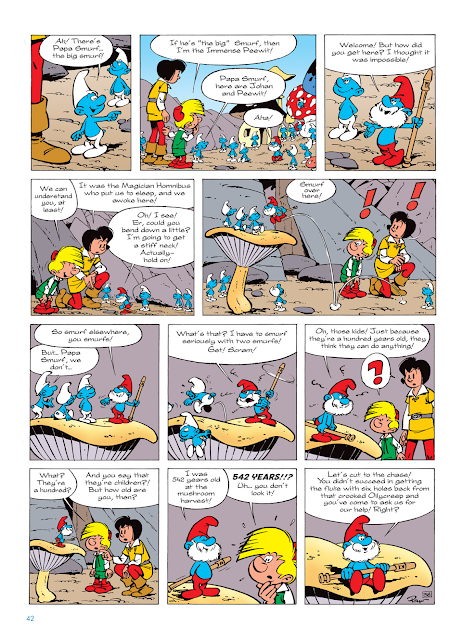
A translated and recolored page of Johan and Peewit meeting the Smurfs.
In October of 1958, the Schrtumpfs (or
Smurfs, as they were translated into by the Dutch and adopted into English)
were introduced, inspired when Peyo saw his daughter playing with a dwarf
figurine. The Smurfs are long-lived (aging centuries) little creatures said to
be “3 apples high” (a literal translation of the description haut comme
trois pommes, which was more akin to the expression “knee-high to a
grasshopper”), and were virtually indistinguishable from each other as they all
had the same blue skin (suggested by his wife, who worked as a colorist on some
of his books) and tails and wore white trousers and a white Phrygian cap. Only
their leader, Papa Smurf (or Grand Schtroumpf), initially had any differences
as he wore red clothing and had a full beard. Originally, they lived in a village in a part of the world called “Le Pays Maudit” (French for “the Cursed Land”) that was peppered with dense forests, deep marshes, a desert and a
high mountain range in houses that resembled large mushrooms, and relied on
storks to transport them to other places. Later, their village would simply be
located in the forest, concealed from discovery by magic unless led there by a
Smurf. Their primary food source was sarsaparilla leaves (suggested by his Spirou
editor-in-chief, partner and translator Yvan Delporte who found the name “magical”) worked into
various dishes.
Peewit gets a lesson in how to speak "smurf".
Their name, Schtroumpf, was said to have been a word Peyo made
up when he had momentarily forgotten the word “salt” while eating with his
friend, André Franquin. He asked, in
French, for his friend to “pass the schtroumpf”, to which Franquin replied: “Here’s
the Schtroumpf—when
you are done schtroumpfing, schtroumpfit back.” This exchange led to the two men
speaking that way for the remainder of the night, and also inspired a Smurf
language meant to help further distinguish them from his human characters. That
language often meant various words were replaced with “smurf”; however, it wasn’t
arbitrary as each “smurf”, while indistinguishable to the human ear, actually
carried different meanings to the Smurfs themselves—explained when Peewit
attempted to speak Smurf and was corrected.
The Smurfs advertised on the cover of Spirou.
The Smurfs proved immensely popular with
readers and soon got their own feature in Spirou in 1959. This led Peyo to
create a studio where he would supervise the production of Smurfs adventures
while he would continue to personally work on Johan and Peewit. Their
stories were fairly simple, dealing with life around their village that often
led to comedic situations with political and social subtext (such as one Smurf declaring himself king of the village in
Papa Smurf’s absence), or put at odds against the evil wizard Gargamel and his cat,
Azrael, who wanted to catch the Smurfs in order to use them as an ingredient to
make gold (or to eat, depending on the story). Initially, none of the Smurfs
had names beyond Papa Smurf, but as the strip continued their names and
personalities (usually related to each other) began to take form, and
individual flourishes were added to their appearance. For instance, Grouchy is
eternally grumpy and is typically seen scowling and announcing what he doesn’t
like; Clumsy is always tripping over or dropping something; Lazy is generally
sleeping while others work; Vanity always had a mirror accessible to stare at
his reflection; Jokey is always laughing and carrying exploding gift boxes; Brainy
is the glasses-wearing know-it-all whose annoying need to be right often
outpaced his good sense; Hefty is the village strongman who carried heavy loads;
Chef was the village cook whose hat resembled a chef’s and also wore an apron;
etc.
The Smurfs meet The Smurfette.
Notably,
all of the Smurfs were male; with any new Smurfs being delivered by stork. In
1966, the first female Smurf was introduced named Smurfette (originally a
designation as THE Smurfette more than a name, defying the naming convention),
with long black hair and a white dress instead of trousers. She was created by
Gargamel from clay to spy on the Smurfs and cause dissent among them with her
feminine charms. Papa Smurf cast a spell to make her a real Smurf, symbolized
by her hair becoming blonde. While she stuck around for a bit, her continued
presence drove the other Smurfs mad with lust and she left of her own volition;
making infrequent appearances in the years following.
A poster of Smurf figurines.
The similar appearances of the Smurfs made
them merchandising darlings as manufacturers had to make very little changes
between the various characters. Smurf figurines have been in production since
1959, only missing two years of releases. This led to the creation of SEPP
International S.A. (la Societe d’Edition, de
Presse et de Publicite) by Freddy Monnickendam to manage the
merchandising of the Smurfs franchise. In 1961, the first animated adaptation
of the comics came from TVA Dupuis and aired on RTB (now RTBF) in Belgium for 6 years. It only featured 9
episodes—direct adaptations of the comics—and was animated using cutouts; with
the final two being in color during RTB’s first year of offering colorized
broadcasts. Five of the episodes would be combined into the 1965 film Les Adventures des Schtroumpfs. A more traditional animated effort came in 1976
with Belvision Studios’ film The Smurfs and the Magic Flute, adapting the Smurfs’ first appearance.
The Belgium animated effort.
The popular account goes that American
media and entertainment entrepreneur Stuart R. Ross discovered the
Smurfs while he was traveling in Belgium that same year. He quickly made a deal
with Dupuis and Peyo to bring the Smurfs to North America. Wallace Berrie and Co. produced various
Smurf merchandise that became widely successful.NBC President Fred
Silverman’s daughter was the possessor of one of those dolls, and he was
convinced they would make a good television series. Despite the reservations of
others at the network, Silverman pressed forward and secured the rights through
Monnickendam and assigned production to his go-to studio, Hanna-Barbera. Gerard Baldwin was put in charge of
overseeing and developing the series.
The animated adaptation of the Smurfs' first appearance.
Baldwin worked with Peyo as
directly as possible, aided by Delporte. Both wanted to keep the Smurfs as
close to the source material as possible, and Peyo held veto power over
anything he didn’t like and contributed designs and ideas. An early problem
arose when many of the story pitches involved money in some form (inheritance,
treasure, selling property, etc.). Money held no value for the Smurf as
everyone had a role to fulfill in the village and did so out of nothing more
than a sense of community. Monnickendam also had his own plans and wanted to
make the show as widely accessible and mainstream as possible to drive
merchandise sales. One of his many proposed changes was to make Jokey Smurf basically
resemble Harpo
Marx.
When he kept meeting with resistance, Monnickendam sought out another property
that would be more receptive, leading to the development of the Snorks series (which Baldwin also headed up and
starred several Smurfs cast members). Baldwin received pushback from the
network for his desire to include classical music in the soundtrack as “kids
didn’t like it” (forgetting that generation was coming up on constant reruns of
Looney Tunes).
Character models.
The Smurfs debuted on NBC on September 12,
1981 and it became a tremendous hit for the network; marking it one of the few
high points of Silverman’s otherwise disastrous tenure. So much so, NBC
expanded it to a full hour for the second season, and then 90 minutes (until it
was scaled back again in season 8), as well as several independent holiday-themed
specials. Although some of that time was supplemented with reruns of previous
episodes, the production soon found themselves making, as Baldwin described,
“the equivalent of a feature film a week” with a six-to-eight-week turnaround
after writing, storyboarding and recording. The network continued to push for
the removal of the classical music, but fortunately there was no money in the
budget to license anything else. The rest of the series’ music, including the
simple-yet-catchy theme, was composed by Hoyt Curtin.
Besieged by the Purple Smurfs.
The show was largely adapted from
the original comics—primarily using the English translations done by Random
House
and Hodder and Stoughton—until they exhausted the material,
necessitating the creation of original plots. Minor changes for American
television were made, such as having the black Smurfs—Smurfs infected with
a disease that changed their color and personality—become purple Smurfs in order to avoid any racial connotations and
the addition of moral lessons to the stories. To reduce instances of imitable
violence, instead of Brainy Smurf being whacked in the head whenever he doled
out one of his know-it-all lectures or became generally annoying, a running gag
was added where he was physically thrown out of the village. The Smurfs’
personalities were also softened from mischievous to easygoing and friendly
with a tendency to break out into song. Papa Smurf (Don Messick) in particular
had his temper, well, tempered to be more patient and father-like to his
“little Smurflings”. Their favorite food was changed to be berries they called
“Smurfberries”, and modern themes began to be incorporated such as neighborhood
projects, awards and modern-esque technology with a medieval flair; the latter
usually courtesy of Handy Smurf (Michael Bell) in an attempt to make the
Smurfs’ lives and chores a bit easier. Additionally, alterations to the stories
occurred in order to have them fit into either a 22 or 11-minute format; both
of which were used throughout the show’s run.
More character models.
Although all of the Smurfs (99+)
were depicted in group shots, the series primarily focused on a select few
rotating in importance between episodes. Additionally, to help them stand out a
bit more from each other, their characters were given additional physical
flourishes that would eventually find their way into the comics themselves. Among
them were Papa, Brainy (Danny Goldman), Clumsy (whose hat was depicted as being
too big, voiced by William Callaway), Farmer (Alan Young), Greedy (who was
combined with Baker and Chef from the comics and ate as much as he cooked,
voiced by Hamilton Camp), Grouchy (Bell), Handy (given coveralls, a brim on his
hat, and a pencil always behind his ear), Hefty (shown with a heart tattoo on
his arm, voiced by Frank Welker), Jokey (June Foray), Lazy (Bell), Harmony
(whose name was ironic as he played his trumpet terribly, voiced by Camp), Painter
(who wore a painter’s coat, large bowtie and a drooped hat, voiced by Callaway
with a French accent), Poet (Welker), Smurfette (Lucille Bliss), Tailor (generally
seen with a tape measure around his neck and pins in his hat, voiced by Kip
King) and Vanity (Alan Oppenheimer). Some of the adapted stories were altered
to include these characters, such as Brainy being the one to become the
aforementioned King Smurf.
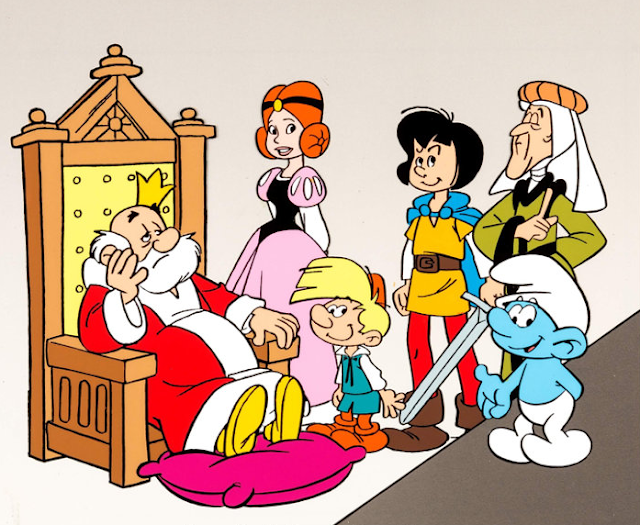
Royal Pals: Johan and Peewit with the King, Princes Sabina and Dame Barbara.
No Smurf is an island, and despite
living in relative secrecy from the rest of the world, the Smurfs managed to
make a number of non-Smurf friends and allies. Among them were old friends
Johan (Bell) and Peewit (Welker), who got their own adventures during the
second season aiding their King (Bob Holt), Princess Sabina (Jennifer
Darling)
and her governess, Dame Barbara (Linda
Gary),
while also sometimes appearing with the Smurfs in their own; Feathers, a large stork that provided the Smurfs with air transportation and
delivered messages; Enchanter Homnibus (Jack Angel), an old human wizard who was a good friends with Papa and
often played games of chess with him; Mother Nature (Foray), the magical woman
in charge of keeping nature running as intended; Father Time (Oppenheimer), a
wise old man with a scythe who was the keeper of time; magical couple Tallulah and Selwyn, who constantly
bickered and attempted to turn each other into various things, that lived in Quarrel Castle with
their ghostly uncle, Fenwick,
and pet gargoyle, Tharp; Gourdy (Marvin Kalplan), a genie freed
from a gourd by Farmer who desires to be helpful with his magic but somehow
manages to foul things up; The Pussywillow Pixies—protective leader Elderberry (Peggy Webber), clumsy Pansy (Susan
Blu),
vain Lilac, young Acorn (Patricia
Parris),
green-clad Bramble and Holly—who initially feared
the Smurfs until they were rescued by them; Laconia, a mute wood elf that used sign language to communicate; Clockwork
Smurf (Welker), a wooden robot built by Handy who gained sentience of his own
and took up residence with the King, eventually joined by a Clockwork Smurfette; and Marina, a beautiful mermaid and Handy’s love interest, among others.
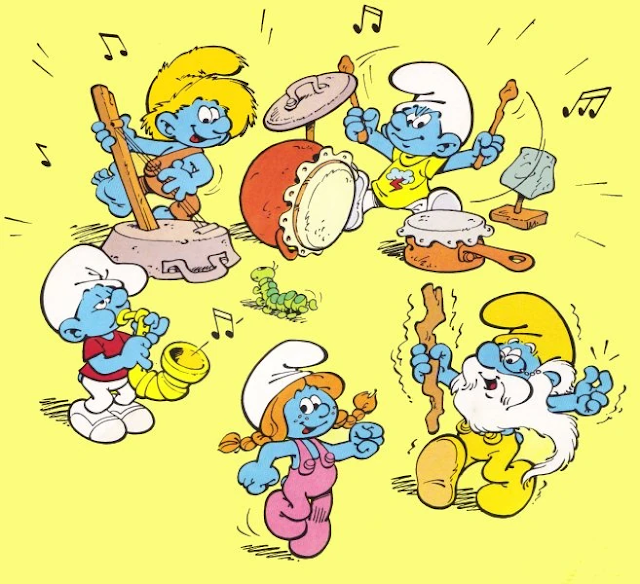
Clockwise from top: Snappy, Grandpa, Sassette, Slouchy and Nat.
As the show went on, all-new new
primary characters were added. In season 3, Baby Smurf (Julie McWhirter) was
delivered by a stork to the village. For a baby, he was very bright and had a
proclivity for magic; although his spellcasting often went unnoticed by the
others. In season 5, three Smurfs were
accidentally de-aged by one of Father Time’s clocks, turning them into the
Smurflings. They were Natural, aka Nat (Joe Camen as adult, Charlie Adler as
Smurfling), a nature lover who communicated with animals; Slouchy (Noelle
North), a laid-back Smurf; and Snappy (Pat Musick), a rambunctious Smurf who
liked to get his own way and be in the middle of the action. Slouchy and Snappy
were the few Smurfs to wear a shirt; with Slouchy’s being red and Snappy’s
yellow with a storm cloud. A fourth Smurfling would later be introduced:
Sassette (McWhirter). She was a sassy tomboy created from the same clay and
spell used by Gargamel to create Smurfette, made by the other Smurflings to
give Smurfette a female friend. That season also introduced Puppy (Taylor &
Welker), who wore a magic locket that contained “the key to all magic” and
could only be opened by one person (which ended up being Baby). He was given to
the Smurfs by Homnibus and was often seen with the Smurflings. Originally,
Puppy was going to be a Smurf-sized pet for Baby, but Peyo rejected the idea
and helped redesign him as a magical being that resembled a dog. In season 6,
Grandpa (Jonathan Winters), Papa’s predecessor, returned to the village after a
500-year journey to find the materials needed to recharge the Long Life Stone: the object that allowed Smurfs to live a long
time. He enjoyed telling stories (although his memory got fuzzy at times) and kept
a cache of items inside his very long beard. In season 7, Wild (Welker) was
discovered having accidentally been lost in the forest when he was delivered to
and raised by a family of squirrels (a pastiche of Tarzan). Brainy took it
upon himself to tutor Wild in the ways of being a Smurf to try and shed his
wild habits. Wild continued to live with the squirrels, his best friend being
one named Chitter (Messick).
Gargamel concocting in his hovel with Azrael sleeping nearby.
The main antagonist of the show was
Gargamel (Paul Winchell), with the aid of his cat, Azrael (Messick). As in the
comics, he was always attempting to catch the Smurfs either to eat or to
complete his formula to create gold and improve his lot in life from his
ramshackle hovel. After season 3, his plans were aided by his Great Book of Spells, which provided him
with magical schemes to use against the Smurfs; however, it could only be
activated on the night of the final phase of the full moon and would only
remain so until the following evening. In season 6, he was given an all-new
nephew character named Scruple (Brenda Vaccaro), who was dumped on Gargamel for
an apprenticeship after he constantly caused trouble at his wizard school.
Gargamel, who had no tolerance for Scruple, usually just made him do chores
instead of actually teaching him. Occasionally, Gargamel’s mother, called
simply “Mummy” (Foray), would drop in unannounced and berate him for his
inability to catch the Smurfs. While not really a malicious antagonist, both
the Smurfs and Gargamel were frequently besieged by a large ogre (a giant in
the comics) named Bigmouth (Lennie Weinrib) who was rude and
oblivious to others’ feelings so long as it led to a chance to stuff his face
with food. Not only did he frequently help himself to the Smurfs’ Smurfberry
harvest, but often dropped in on Gargamel to eat him out of house and home.
Hogatha and Harold.
Newly created was Hogatha (Janet Waldo), a portly and ugly
witch whose main desire was to become attractive enough to have the man of her
dreams fall in love with her. She sometimes snorted like a pig when talked or
laughed and rode around on a vulture named Harold. Occasionally, her plans brought her into conflict with the Smurfs.
Then there was Lord Balthazar (Keene
Curtis),
Gargamel’s godfather who was even more wicked and cruel and a much better
wizard. Chlorhydris (Amanda
McBroom),
was an aging sorceress who became cold and bitter after bad personal
relationships and was determined to make the entire world feel as she did. There
were also several races of brutal humanoid creature—including the toad-like Wartmongers, the fish-like Water Harpies and the pig-like Truffle Trolls—and a variety of one-off villains of human,
mystical and supernatural persuasions.
Miner leading the Smurfs into the Earth.
Despite the large cast of
characters to choose from, Hanna-Barbera created several Smurfs of their own as
situations required. These included Miner (Young with a Scottish accent), who
always had his trusty pickaxe and a candle affixed to his hat; Architect
(Vaccaro); Tracker(Henry Polic II), a red
feather-wearing Smurf whose keen sense of smell helped him live up to his name;
Cobbler (Camp), the resident shoemaker; the depressed introvert Dabbler
(Welker) who could never stick to one vocation; Nobody, who suffered from self-esteem issues; Editor
(Messick), who published the village’s newspaper; an unnamed Smurf who spoke
with a Scottish accent and invented the game of golf; Pushover (Ronnie Schell), whose name says it
all; Tuffy (Pat
Fraley),
who was quick to challenge others to fights (which he would promptly lose); and
Wooly (Dick
Gautier,
using a Texan accent), who acquired the wool needed to make the Smurfs’
clothing and wore a fluffy hat.
Smurfette not quite enjoying having Nanny and Smoogle as roommates.
Bucking the established canon of
the franchise, a new female Smurf named Nanny (Blu) was introduced in the 8th
season. As previously seen, Smurfs were always depicted as male when delivered
by the stork, and previous female Smurfs were all the creation of magic.
However, Nanny was said to have left the village with Grandpa and had been held
as a prisoner in Castle Captor for over 100 years. The character’s design was
recycled from the aged Smurfette in “Smurfquest” and her elderly disguise from
“Smurf Van Winkle”. She was accompanied by Smoogle (Taylor), a marsupial-like animal who only
said “smoogle”—however, everyone seemed to understand what he was saying—and
could replicate noises. A new villain was introduced: the evil wizard Nemesis
(Welker), who became a hideous hiccupping creature after a magical accident and
kept his face hidden by his purple robe’s hood. He was Grandpa’s arch-enemy who
sought the Long Life Stone for his own purposes. They also gained a new ally in
Denisa (Katie
Leigh),
the niece of Lord Balthazar who befriended Sassette.
Behind the scenes, things weren’t
quite so Smurfy. Monnickendam’s bid to match and possibly surpass The Smurfs
resulted in failure, and his having bypassed Dupuis led to the dissolution of
their relationship and the disbandment of SEPP International S.A. with
licensing going over to Lafig S.A. Further, his
relationship with Peyo deteriorated quickly, ending up in lawsuits about the
division of rights and money over The Smurfs. Dupuis came under new
management in 1985 and after fulfilling his obligations to them, Peyo left in
1988 and attempted to start his own publishing effort, Cartoon Creations.
Issues also arose between Peyo and Hanna-Barbera when he learned they were
making moves behind his back; such as going forward with their veiled anti-drug
episode, “Lure of the Orb”, meant to support then-First Lady Nancy Reagan’s anti-drug campaign, that he had expressly vetoed. Production on
the show almost ceased right there until Delporte talked him out of it.
Peyo’s hefty workload that
persisted for most of his professional life began to take its toll on the artist,
and his health was in steady decline. As a result, he loosened his grip on the show
and allowed Hanna-Barbera more creative freedom, leading to the production of
the controversial 9th and final season of The Smurfs. It was
decided to move the Smurfs out of their village and to have them become
stranded in time when they lost the magic key that was used to control their
time crystals and Time Scrolls. As a result, they were jumping from period to
period, attempting to find their way home while encountering new perils, new
friends, and new foes (which were largely period-accurate versions of their
established foes as their own ancestors).
Hefty, Brainy, Wild, Handy, Painter and Papa in the past.
The cast was also severely cut
down, featuring only Papa, Smurfette, Clumsy, Brainy, Lazy, Hefty, Snappy,
Sassette, Greedy, Jokey, Vanity, Painter, Grandpa, Wild, Smoogle, Baby and
Handy on a rotating basis. It was at this time that Winchell left the show,
allegedly being disgusted by the scripts. Any representation of Gargamel’s
character was voiced by Bell for the season. Ratings, which had begun to
steadily decline by this point, went into a freefall. NBC unsurprisingly
cancelled it at the end of the season, leaving it with an unresolved
cliffhanger. During its run, the series was nominated multiple times for Daytime
Emmy Awards, winning for “Outstanding Children’s Entertainment” in 1983. Papa and
Brainy would go on to appear in the anti-drug special Cartoon
All-Stars to the Rescue a few months after the series ended.
Smurfette making use of Handy's washing machine.
Each season had a unique opening
sequence and ending theme. The intros all typically showed different scenes of
the Smurfs engaging in their daily lives before transitioning over to
Gargamel’s attempted capture of them. Prominent new characters introduced
within that season were incorporated. The end of the sequence usually featured
a Smurf or several Smurfs sliding down a hollow log and running over to where
the show’s title was, sitting on top of a mushroom over it while other Smurfs
appeared behind the letters; initially as eyeballs and later popping into full
view. The 1st season’s featured an opening narration introducing the
audience to the world of the Smurfs, while the 2nd season’s had the Smurfs singing actual lyrics to their
theme song. The 8th season intro had more of a
narrative element to it, as Hefty and Sassette were on a mission to bring Papa
Smurf a book from which he would read to the other Smurfs. That book would
serve as the transition to the title screen, bypassing the log sliding portion.
The 9th season’s intro set up the time traveling premise and showed
the Smurfs escaping from some period threats before heading towards a
stone-carved version of the show’s logo. The 4th season intro is
probably the most recognized out of all them as a truncated version was used
for the syndicated rerun series Smurfs’ Adventures.
Beginning in 1986, these syndicated
episodes featured some minor edits and time-compression (which resulted in the
voices sounding a bit higher than normal) in order to allow two stories to run
in a half-hour. For the first four seasons of episodes, the season 4 closing
theme was also used over the end credits. Starting with season 5 episodes, the respective
original ending themes were used. Adventures would air on
various independent stations before going to USA
Network
in the early 1990s, and then to Cartoon
Network,
where it would run throughout the 90s, and Boomerang, remaining until
2022 and eventually returning in 2023. It also aired on Teletoon Retro in Canada.
If Smurfs merchandise was selling
well before, it exploded during the show’s run with things like trading
cards, Halloween costumes,
and breakfast cereals. As with Peyo’s own comics that came out around the same
time, products incorporated the cosmetic changes the cartoon introduced to
various characters, such as Handy and Hefty, and new characters, such as Baby. The
show’s theme was also used in a number of video games
that followed. Random House, along with reprinting the original comics
translated, published a series
of children’s books that coincided with the show. Marvel Comics
acquired the rights to publish a 3-issue
mini-series featuring two stories per issue and
several one-page sketches created by Peyo.
Peyo had overseen the production of
16 comic albums starring his Smurfs before falling to a heart attack in 1992.
His son, Thierry
Culliford, continued production of his comics under the name Peyo and has
released 24 more albums up to 2022. In 2010, Papercutz
became the new American publisher of the translated comics in both their original
album forms and in a series of collected anthologies. Sony Pictures acquired
the rights to produce films based on the franchise and released the first on July
29, 2011, produced by Peyo’s daughter, Véronique Culliford.
Winters and Welker were the only original cast members to return, voicing Papa
and Azrael, respectively. Hank
Azaria led a live-action cast as Gargamel while the Smurfs were computer
animated. The film ended up grossing $563.7 million despite a negative
reception, resulting in a
sequel released on July 31, 2013; Winters’ final performance before his
death. However, that one earned $200 million less and was reviewed even worse,
effectively ending plans for a trilogy. Instead, a completely CGI reboot was
released on April 7, 2017 called Smurfs: The Lost Village,
which introduced a hidden village entirely populated by female Smurfs. Welker was
the only one retained in his role as Azrael. It only earned $197.2 million. Paramount Pictures and Nickelodeon had acquired the theatrical rights
and have planned a movie for 2025. In the meantime, a new Belgian CGI animated
series debuted in 2021—almost 40 years since the Hanna-Barbera series—with Peyo
Productions watching over it carefully to ensure it remained as faithful as
possible to the original comics while allowing some creativity in updating it
for the times. It aired in Beligum on La
Trois before making its way to America on Nickelodeon and Netflix. Despite reportedly taking no direct
influence from the previous series, its legacy continues to live on in the
character designs which have become the default for the Smurfs franchise.
EPISODE GUIDE: Season 1: “The
Astrosmurf” (9/12/81) – The Smurfs help Dreamy achieve his wish of traveling to
the stars by dressing up as aliens and making him think he’s on another planet. “Jokey’s
Medicine / Vanity Fare” (9/12/81) – Getting even with Jokey gets Smurfette,
Greedy and Lazy trapped by Gargamel. / Gargamel hides in a magic mirror in
order to trap the Smurfs. “St.
Smurf and the Dragon” (9/19/81) – A baby dragon wants the glowberries Papa
needs for his invisibility formula. “Sorcerer
Smurf / The Magical Meanie” (9/19/81) – Gargamel disguises himself as a
long-lost Sorcerer Smurf. / Brainy and Clumsy discover a genie who only acts
nicely when a specific magic phrase is uttered. “Bewitched,
Bothered and Be-Smurfed” (9/26/81) – Smurfette finds an amulet that Hogatha
lost that makes her wishes come true. “King
Smurf / The Smurfs and the Howlibird” (9/26/81) – While Papa’s away, Brainy declares
himself king of the village and causes a civil war. / The careless disposal of
a magic formula mutates a small bird. “Soup
a La Smurf” (10/3/81) – When Bigmouth comes looking to eat the Smurfs, Papa
gives him a special soup that turns his skin blue. “All
That Glitters Isn’t Smurf / Dreamy’s Nightmare” (10/3/81) – The Smurfs are
under the impression that Papa has lost his magic. / Dreamy sets out for a trip
around the world only to be captured by Gargamel. “Romeo
and Smurfette” (10/10/81) – Every Smurf competes for Smurfette’s attention. “The
Magic Egg / Smurphony in ‘C’” (10/10/81) – The Smurfs get an egg that grants their
every wish and causes chaos. / Harmony discovers a horn that puts anyone who
hears it into eternal sleep. “Sideshow
Smurfs” (10/17/81) – The Smurfs set out to rescue Clumsy and Smurfette from a
human sideshow. “Supersmurf
/ Paradise Smurfed” (10/17/81) – Brainy tries brute force to recover their
stolen food from Bigmouth. / Lazy’s dreams of a hidden paradise turn into a
nightmare. “Sir
Hefty” (10/24/81) – Hefty becomes a knight to protect the village from a
dragon. “The
Fake Smurf / The Baby Smurf” (10/24/81) – Hogatha uses magic to impersonate a
Smurf. / Gargamel transforms himself into a baby Smurf in order to be taken
into the village. “Painter
and Poet” (10/31/81) – Feeling unappreciated, Painter and Poet decide to leave
the village just as a serious storm is about to hit. “Haunted
Smurf / The Purple Smurfs” (10/31/81) – Searching for food brings the Smurfs to
a castle they think is haunted. / A fly bites Lazy, turning him purple and
causing him to spread the color by biting the others. “The
Fountain of Smurf” (11/7/81) – The Smurfs turn to Gargamel for help restoring a
de-aged Papa to his proper age. “The
Magnifying Mixture / Foul Weather Smurf” (11/7/81) – Brainy accidentally turns
Hefty into a giant. / Handy’s weather-controlling machine causes chaos when
Smurfs fight over the type of weather they want. “The
Hundredth Smurf” (11/14/81) – Vanity’s reflection comes to life and is his
complete opposite. “The
Abominable Snowbeast / Gargamel, the Generous” (11/14/81) – A snow creature
isn’t so abominable when it takes a liking to Smurfette. / Clumsy discovers
diamonds and gets Gargamel’s attention. “The
Smurfette” (11/21/81) – Gargamel creates Smurfette to destroy the Smurfs. “Spelunking
Smurfs / Now You Smurf ‘Em, Now You Don’t” (11/21/81) – The Smurfs discover a
cave full of frozen food and a frozen ogre on guard. / Trolls trick Smurfs with
a crystal ball in order to kidnap whoever touches it. “The
Smurf’s Apprentice / Smurf-Colored Glasses” (11/28/81) – The Smurfs must change
Clumsy back from a dragon. / Handy gives Smurfette magical glasses that end up
letting her see Gargamel as being handsome. “The
Clockwork Smurf” (11/28/81) – Handy creates a mechanical Smurf that ends up saving
the prince from his evil aunt. “Fuzzle
Trouble / Smurfette’s Dancing Shoes” (12/5/81) – A fuzzy creature quickly goes
from being cute to a menace when it keeps multiplying. / The Smurfs seek
magical items to free Smurfette from her dancing shoes and marriage to a troll. “The
Smurfs and the Money Tree” (12/5/81) – Gargamel’s mother plants a golden goodie
tree outside of Greedy’s house that turns him extra greedy. Season 2: “The
Smurf Who Couldn’t Say No” (9/18/82) – Pushover must learn to be assertive when
he and Scaredy have to light a fire to calm a swamp monster. “The
Adventures of Robin Smurf” (9/18/82) – The Smurfs put on a production of Robin
Smurf starring Vanity, Smurfette and Brainy. “The
Cursed Country” (9/18/82) – The Smurfs must rescue slaves from a diamond mine
being guarded by a fire-breathing dragon. “Sister
Smurf / S-Shivering S-Smurfs” (9/25/82) – When Smurfette and a human girl run
away, they end up prisoners of an old hag. / Everyone ignores Tracker’s
predictions of an early snowfall. “The
Black Hellebore” (9/25/82) – An evil wizard uses a flower to put the Smurfs in
a trance. “Revenge
of the Smurfs” (9/25/82) – A group of Smurfs look to get revenge on a human
army that trampled their homes. “The
Three Smurfketeers” (10/2/82) – The Smurfs put on a play of The Three Musketeers. “Heavenly
Smurfs / It Came from Outer Smurf” (10/2/82) – The Smurfs try and trick
Gargamel into thinking he’s dead. / Dreamy’s claim of seeing an alien is
ignored until he turns up with a crystal that creates a windstorm. “The
Sorcrery of Maltrochu” (10/2/82) – Johan, Peewit and the Smurfs help a prince
restore his rule after it was sabotaged by an evil baron. “Squeaky
/ The Kaplowey Scroll” (10/9/82) – Smurfette learns the value of life when her
pet mouse dies. / A magic scroll can make things disappear, and Grouchy uses it
on Jokey. “The
Goblin of Boulder Wood” (10/9/82) – Johan relays to the Smurfs the story of
when he met Peewit. “Gormandizing
Greedy / Waste Not, Smurf Not” (10/9/82) – Greedy learns the value of healthy
eating when he becomes overweight. / Handy’s food processor causes the Smurfs
to waste food. “Johan’s
Army” (10/16/82) – When the army has been disabled, the Smurfs help Johan and
Peewit protect the castle. “The
Lost City of Yore” (10/16/82) – Nosey gets himself, Brainy and Clumsy involved
with two witches and Gargamel searching for the evil Scepter of Yore. “The
Magic Fountain” (10/16/82) – Johan, Peewit and the Smurfs search for a magic
fountain in order to energize an enslaved people. “The
Impostor King” (10/23/82) – A phony king is on the throne, and it’s up to
Johan, Peewit and the Smurfs to find the real one. “For
the Love of Gargamel / The A-Maze-ing Smurfs” (10/23/82) – Tracker’s respect
for life leads him to convince Papa to create a cure for a petrified Gargamel
and Azrael. / The Smurfs meet Malchior the Magnificent inside his maze-like
home. “The
Haunted Castle” (10/23/82) – Johan, Peewit and the Smurfs help a ghost find his
heir. “Smurfs
at Sea” (10/30/82) – Papa relates the adventures of Dreamy when he was on the
seas in order to encourage the Smurfs to continue trying new things. “One
Good Smurf Deserves Another” (10/30/82) – Clumsy wants to repay Handy for
saving his life—whether Handy wants him to or not. “The
Blue Plague / The Last Laugh” (10/30/82) – Brainy’s meal causes the Smurfs to
feel like chickens. / Gargamel’s giggle glitter causes uncontrollable laughter
in the Smurfs. “The
Raven Wizard” (11/6/82) – Peewit must rescue Sabrina when a wizard kidnaps her
to steal her youth. “The
Ring of Castellac” (11/6/82) – Johan, Peewit and the Smurfs must return a
drugged duke to his castle. “The
Sky is Smurfing! The Sky is Smurfing! / Turncoat Smurf” (11/6/82) – Scaredy
warns of danger just as a nearby volcano begins erupting. / Everyone thinks
Brainy a traitor when he accidentally leads Gargamel to the village. “Return
of the Clockwork Smurf” (11/13/82) – When Clockwork is put out of commission,
the king must find his own courage. “The
Littlest Giant” (11/13/82) – Papa reunites a runaway giant with his family. “Bubble,
Bubble, Smurfs in Trouble / Smurf Van Winkle” (11/13/82) – A water sprite gives
Scaredy a magic wand that can encase him in a protective unbreakable bubble. /
The Smurfs trick Lazy into believing he slept his life away, which causes him
to use a de-aging formula on them. “The
Prince and the Peewit” (11/20/82) – Peewit switches places with a prince that
resembles him just as crooks are lurking about to kidnap the prince. “The
Enchanted Baby” (11/20/82) – Johan, Peewit and the Smurfs must return a magical
teleporting baby to his parents. “Clumsy
Smurfs the Future” (11/20/82) – Clusmy finds a magic rock that allows him to
glimpse into the future. “Sleepwalking
Smurfs / Smurf Me No Flowers” (11/27/82) – Gargamel steals a magic flute that
allows him to lure the Smurfs out of their village while they sleep. / When
Lazy believes he’s going to die, he tries some physical feats he never
considered doing before. “The
Good, the Bad and the Smurfy” (11/27/82) – The wizard Mordain kidnaps several
Smurfs in his plot to overthrow the king. “A
Mere Truffle” (11/27/82) – A truffle hunt leads to Tracker to losing his memory
and the other Smurfs captured by the Truffle Trolls. “The
Stuff Dreams Are Smurfed Of / The Box of Dirty Tricks” (12/4/82) – Gargamel
uses a magical crown to invade the Smurfs’ dreams. / Gargamel loses his
sinister box of dirty tricks and it winds up in the Smurfs’ village. “Papa’s
Wedding Day” (12/4/82) – A wood nymph working for Lord Balthazar tricks Papa
into marrying her. “All’s
Smurfy That Ends Smurfy” (12/4/82) – The fairies accuse the Smurfs of stealing
their gold that was actually stolen by Gargamel. Season 3: “Once
in a Blue Moon / All Creatures Great and Smurf” (9/17/83) – When the stork
mistakenly delivers a baby Smurf, Smurfette and Grouchy protest his removal. / Natural
brings Azrael to the village to treat his wounds. “The
Smurf Fire Brigade / The Winged Wizard” (9/17/83) – A fire epidemic leads the
Smurfs to come up with a way to combat them. / Gargamel creates a flying
machine to capture Smurfs. “Every
Picture Smurfs a Story” (9/17/83) – Painter is tricked into doing a portrait of
Papa so that he can switch places with the trapped evil Maestro. “The
First Telesmurf / Handy’s Kite” (9/24/83) – The Smurfs use vines for a new form
of communication, which helps Gargamel find them. / Handy takes several Smurfs
on his kite, leading them to be captured by Lord Balthazar. “The
Magic Earrings” (9/24/83) – Hogatha seduces Gargamel and gets him to give her
magic earrings that grant her super-hearing. “The
Last Smurfberry” (9/24/83) – When Gargamel gets rid of all the smurfberries,
the Smurfs are forced to travel great distances to find more. “A
Little Smurf Confidence / Hogatha’s Heartthrob” (10/1/83) – Papa gives Weakling
a special cream that allows him to grain strength through willpower. / Gargamel
disguises himself as Hogatha’s dream guy in order to get her bird call. “Born
Rotten / The Tear of a Smurf” (10/1/83) – Gargamel sends an egg with a smelly
creature inside to the village to lead him to it. / Priscilla’s beauty can only
be restored through the tears of a Smurf and the whiskers of a cat. “The
Miracle Smurfer” (10/1/83) – The Smurfs get taken in by a conman’s “miracle”
tonic. “The
Smurf Who Would Be King” (10/8/83) – Dreamy dreams about being the king of the
Pookies and having to protect them from the Norf Nags. “How
to Smurf a Rainbow / Smurfette for a Day” (10/8/83) – The Smurfs create a
broken rainbow as Gargamel hunts for gold. / Hefty takes Smurfette’s place with
a troll king. “Peewit
Meets Bigmouth / Lumbering Smurfs” (10/8/83) – Peewit must rescue a prince he
accidentally turned into a chicken from Bigmouth’s stomach. / Clockwork and the
Smurfs protect the royal forest from loggers. “Handy’s
Sweetheart” (10/15/83) – Handy falls in love with a mermaid named Marina. “A
Hovel is Not a Home / Speak for Yourself, Farmer Smurf” (10/15/83) – Gargamel
is motivated to capture the Smurfs in order to get a new home. / Farmer pretends
to be someone else in order to get Smurfette’s attention. “Forget-Me
Smurfs / The Grumpy Gremlin” (10/15/83) – A blooming flower causes the Smurfs
to forget about the dam that’s about to burst. / Peewit accidentally chops down
a gremlin’s home and is forced to find him a new home with his stinky
concoction. “Willpower
Smurfs / Clumsy Luck” (10/22/83) – Jokey is on a mission to test the willpower
of his fellow Smurfs and Gargamel. / Clumsy’s clumsiness allows him to escape
his house before a meteor destroys it. “Baby
Smurf is Missing / The Smurfs’ Time Capsule” (10/22/83) – Thinking him a
leprechaun, a pair of poachers kidnap Baby. / A druid comes to Papa for help
when his moonrock amulet is stolen. “Wedding
Bells for Gargamel / To Smurf a Thief” (10/29/83) – Gargamel is courted by a beautiful
princess whose hope chest contains a map to the Smurf Village. / Papa helps
Homnibus clear the name of a boy accused of thievery. “Greedy
and the Porridge Pot / Harmony Steals the Show” (10/29/83) – Greedy borrows a
magical porridge pot that floods the village after Brainy messes with it. / A
ghost tricks Harmony into signing a contract for help composing his new
symphony. “The
Golden Smurf Award” (10/29/83) – Hogatha disguises herself as a trophy in
Brainy’s popularity contest in order to capture the Smurfs. “The
Moor’s Baby / Hefty’s Heart” (11/5/83) – Baby’s unending tooth pain leads the
Smurfs to discover the Tooth Fairy has been captured. / Gargamel infects Hefty
with a disease that causes him to hate. “A
Hug for Grouchy / The Magic Rattle” (11/5/83) – Grouchy must hug a fairy in
order to restore emotions to the village. / Baby’s rattle ends up exchanged
with a magic one. “The
Smurfs’ Halloween Special (aka All Hallows’ Eve) / The Littlest Witch”
(11/5/83) – Mother Nature mistakenly turns Lazy red which allows him to be
captured by Gargamel. / The Smurfs befriend a young witch and teach her how to
be good. “April
Smurf’s Day / The Magic Stick” (11/12/83) – Papa decides to play a prank on Gargamel
after he disguises himself as a smurfberry bush. / Papa creates a magic stick
to deal with Bigmouth eating all of their crops, but discovers it has been
switched out when he goes to use it. “Baby’s
First Christmas / Beauty is Only Smurf Deep” (11/12/83) – Chlorhydris plans to
put an end to Mr. Nicholas’ spreading of joy for the holidays by making him
feel hate. / Pixie princess Periwinkle sets out to destroy Vanity when her
magic mirror declares him the fairest. “Wolf
in Peewit’s Clothing / A Bell for Azrael” (11/12/83) – Rattner turns Peewit
into a werewolf in order to capture the Smurfs. / Gargamel enchants a bell on
Azrael to only ring when a Smurf is near. “The
Chief Record Smurf / Smurfing in Sign Language” (11/19/83) – When Clumsy gets a
photographic memory, Gargamel seeks to learn an invisibility spell from him. /
Gargamel tests his new potion on Poet, rendering him mute. “A
Chip Off the Old Smurf” (11/19/83) – Every Smurf believes that Baby will take
after them. “A
Gift for Papa’s Day” (11/19/83) – The Smurfs give Papa an ugly new hat that he
continuously tries to get rid of without hurting their feelings. “Good
Neighbor Smurf / The Smurfstone Quest” (11/26/83) – When Brainy’s house is
destroyed, he must stay with the other Smurfs and drives them all crazy. / Hefty,
Handy and Lazy set out to find a magic stone to cure Papa’s gout. “Hats
Off to Smurfs / The Noble Stag” (11/26/83) – Vanity finds a magical hat made by
Gargamel that turns him ugly. / The Smurfs rescue a stag from hunters only to
discover its actually the transformed King Gerard. “Smurfy
Acres / No Time for Smurfs” (11/26/83) – Gargamel uses the Great Book of Spells
to create a luxurious new village in which to trap the Smurfs. / Chasing their
ball into a cave, some Smurfs accidentally break Father Time’s hourglass and
stop all time. Season 4: “Symbols
of Wisdom / Blue Eyes Returns” (9/15/84) – Brainy and Gargamel each figure
something about their appearance is what prevents them from being respected. /
Smurfette calls on Blue Eyes to help when Gargamel’s spell floods the forest. “Secret
of the Village Well / Stop and Smurf the Roses” (9/15/84) – The Smurfs steal a
penny from Gargamel so that Clumsy can make a wish in the well. / Chlorhydris
is determined to capture Laconia and wipe out all of the world’s flowers. “The
Gingerbread Smurfs / Jokey’s Shadow” (9/15/84) – Brainy and Clumsy make living
gingerbread cookies that cause chaos. / Jokey’s shadow comes to life and the
Smurfs all blame him for the pranks it pulls. “Jokey’s
Funny Bone / Tick Tock Smurfs” (9/22/84) – Jokey fakes being hurt in order to
get a lot of attention. / Brainy decides to put the Smurfs on an impossible
schedule. “The
Master Smurf / Tailor’s Magic Needle” (9/22/84) – A magical crown gives Greedy
the power to control others. / Brainy and Tailor create a magic needle to help
Tailor work faster. “The
Traveler / A Pet for Baby Smurf” (9/22/84) – The Smurfs help a Chinese traveler
free the spirit of a dragon. / Just as the Smurfs look to get pets for
themselves, Gargamel turns Azrael into an irresistible creature that becomes
Baby’s pet. “The
Incredible Shrinking Wizard” (9/29/84) – The Smurfs help Gargamel when he’s
accidentally shrunken. “Breakfast
at Greedy’s / The Secret of Shadow Swamp” (9/29/84) – Greedy’s pancakes end up
causing the Smurfs to float. / Grouchy heads to the swamp to avoid his birthday
party and meets an equally grumpy creature who seeks a paradise of solitude. “Smurf
the Other Cheek / The Trojan Smurf” (9/29/84) – Hefty is tricked into taking on
a curse that leaves a red spot on his nose, only transferable by being kicked.
/ Gargamel hides himself in a giant statue of Papa to trick the Smurfs into
bringing him into the village. “A
Float Full of Smurfs / Smurfette’s Sweet Tooth” (10/6/84) – Gargamel and Azrael
disguise themselves as rabbits to try and be selected to pull the float in the
Smurfs’ carnival. / Smurfette enchants herself to turn everything she touches
into smurfberry candy. “Smurf
on Wood” (10/6/84) – The Smurfs believe Clumsy’s wishing tree has turned Papa
into a toad. “The
Smurfomatic Smurfolator / Petrified Smurfs” (10/6/84) – Handy builds a machine
that may get rid of Gargamel’s magic weed growing all over the village. / Peewit
heads out to reverse Brainy’s spell that turned half the forest into stone. “Papa’s
Worrywarts / Lazy’s Slumber Party” (10/13/84) – Papa gets worrywarts that
causes him to constantly worry about everything. / A prank on Lazy causes some of
the Smurfs to be captured by Bigmouth. “The
Pussywillow Pixies” (10/13/84) – The Smurfs help the Pussywillow Pixies escape
capture by the sinister Wartmongers. “The
Big Nose Dilemma / The Smurfbox Derby” (10/13/84) – Vanity casts a spell on his
nose in order to make it special. / A race breaks out when the Smurfs argue
over which of Handy’s smurfmobiles he made for them is better. “A
Circus for Baby” (10/20/84) – Hefty must conquer his fear of heights in order
to save Baby from Lord Balthazar’s castle. “Babes
in Wartland / The Smurfwalk Café” (10/20/84) – Baby becomes King Bullrush’s new
court jester. / Greedy and Handy must set aside their differences in order to
continue making their new smurf cream dessert. “The
Smurfest of Friends / Never Smurf Off Til Tomorrow” (10/20/84) – A falling out
with Clumsy causes Brainy to run away and befriend an imp with sinister
intentions. / A windmill absconds with several Smurfs and ends up in a volcano
about to erupt. “Bigmouth
Smurf / Baby’s Enchanted Didey” (10/27/84) – Gargamel turns Bigmouth into a
giant Smurf. / Tailor unknowingly makes a diaper for Baby out of Gargamel’s
flying carpet. “The
Man in the Moon / Smurfette’s Golden Tresses” (10/27/84) – Feeling neglected
and ignored, the Man in the Moon abandons his post to check out Earth for a
while. / Hogatha decides to steal Smurfette’s hair in order to impress her new
lover. “The
Whole Smurf and Nothing but the Smurf / Gargamel’s Giant” (10/27/84) – Gargamel
gives Smurfette a formula that causes her to lie all the time. / Gargamel
creates a giant out of clay in order to attack the Smurfs’ Village. “The
Patchwork Bear / Hefty and the Wheelsmurfer” (11/10/84) – The Smurfs set out to
find out why the river has been drained. / Handy creates a device that allows Hefty
to get around on his broken leg. “Hopping
Cough Smurfs / The Little Orange Horse with the Gold Shoes” (11/10/84) – Three
groups of Smurfs are sent out to find a cure for the hopping cough Gargamel
gave the others. / Smurfette must help a Pegasus only she can see find his
golden horseshoe. “Monster
Smurfs / The Bad Place” (11/10/84) – Brainy casts a spell that turns all the
Smurfs into Monsters on Spook-A-Smurf Eve. / A family of muddy aliens in need
of spaceship repairs lands in the Smurf Village. “Smurfing
for Ghosts / The Gargoyle of Quarrel Castle” (11/17/84) – Brainy and Clumsy help
Peewit deal with an invasion of Fenwick’s annoying ghostly relatives. / Tharp gets
tired of the bickering at Quarrel Castle and visits the Smurfs, where he
unknowingly plays with a dangerous ball. “Smurfiplication
/ Gargamel’s Miss-Fortune” (11/17/84) – Gargamel creates duplicates of Brainy
which creates more headaches for the Smurfs. / Gargamel tricks a fortune-teller
into helping catch the Smurfs. Season 5: “Stuck
on Smurfs / Puppy” (9/21/85) – Gargamel casts a spell on Clumsy that causes
anyone who touches him to become stuck to him. / Homnibus sends Puppy to the
Smurfs, and Lord Balthazar is interested in his mysterious unopenable magic
locket. “Papa’s
Day Off / The Smurflings” (9/21/85) – Papa feels old when the Smurfs insist he
needs a day off. / Nat, Slouchy and Snappy are accidentally de-aged into
Smurflings when they enter Father Time’s reverse clock. “He
Who Smurfs Last / Baby’s First Word” (9/21/85) – Papa and Baby work to try and
restore humor to the Smurfs after Chlorhydris’ spell took it away. / Gargamel
captures Baby just before he’s due to speak his first word. “The
Masked Pie Smurfer / Sassette” (9/28/85) – Brainy decides to get to the bottom
of the masked Smurf throwing pies at everyone. / The Smurflings decide to
create a female friend for Smurfette, but the clay they used is set to explode by
Gargamel. “Papa’s
Puppy Prescription / Poet’s Writer’s Block” (9/28/85) – Papa prevents the Smurflings
from finding out Puppy is acting like a cat, causing them to think he’s the afflicted
one and cast a counter spell on him. / Poet’s writer’s block prevents him from
rescuing a princess from a curse. “Smurf
a Mile in My Shoes” (9/28/85) – The Smurfs help a cursed imp find the last item
he needs to return to normal. “Dreamy’s
Pen Pals / Papa’s Flying Bed” (10/5/85) – The Smurfs resurrect the Swoofs when
Dreamy wants to pay them another visit. / Gargamel’s spell causes Papa’s bed to
fly away with several Smurfs on it. “Mud
Wrestling Smurfs / The Sand Witch” (10/5/85) – Clumsy becomes a mud-wrestler to
distract the Wartmongers from the Smurfs stopping their river draining. / Papa
must rescue Baby from the Sand Witch. “Kow-Tow,
We Won’t Bow” (10/5/85) – An expedition with Smurfette ends up getting the
Smurflings captured by the Wartmongers. “Bigmouth’s
Friend / Wild and Wooly” (10/12/85) – Bigmouth befriends Clockwork just as
Balthazar wants Clockwork for himself. / The Smurflings help Wooly acquire some
wool, not knowing there’s a wizard amongst the herd. “The
Dark Ness Monster” (10/12/85) – Clumsy must be Brainy’s eyes when he loses his
glasses in Dark Ness Cavern. “The
Grouchiest Game in Town / Queen Smurfette” (10/12/85) – Grouchy must overcome
his lousy gameplaying skills in order to win the Smurfs’ freedom. / For her
birthday, the Smurfs make Smurfette their queen. “Marco
Smurf and the Pepper Pirates” (10/19/85) – Dreamy and his crew rescue Marco
Smurf from the Pepper Pirates. “Educating
Bigmouth / Brainy Smurf, Friend to All the Animals” (10/19/85) – The Smurfs
help Bigmouth win back his love. / Brainy tries to prove he’s as much of an
animal lover as Nat. “The
Comet is Coming” (10/19/85) – An incomplete message from Papa makes the Smurfs believe
the world is coming to an end. “Happy
Unhappiness Day to You / The Great Slime Crop Failure” (10/26/85) – Gargamel chooses
the day the Smurfs force themselves to experience sadness to try and track them
down by their happiness. / The Wartmongers kidnap Farmer and the Smurflings to
care for their slime crop. “Papa’s
Family Album” (10/26/85) – Gargamel plots to steal Mother Nature’s wand to get
the Smurf Village while Papa shows the Smurflings how the Smurfs were in their
younger days. “Love
Those Smurfs / Mutiny on the Smurf” (10/26/85) – Vanity, Brainy and Snappy must
get humble pie to break the others out of Chlorhydris’ vanity spell. / An evil
musician desires the Smurfling’s music but ends up capturing Brainy’s band
instead. “Things
That Go Smurf in the Night / Alamring Smurfs” (11/2/85) – Gargamel sleepwalks
into the Smurf Village. / Feeling ignored, the Smurflings run away with some mementos
causing the others to think there’s a thief on the loose. “Smurfette’s
Rose / The Mr. Smurf Contest” (11/2/85) – Mother Nature gives Smurfette a blue
rose, but at the cost of her own color. / Garamel sneaks into the village as a
Smurf while they hold a competition to be Smurfette’s dance partner for the
evening. “Unsound
Smurfs / Have You Smurfed Your Pet, Today?” (11/2/85) – Brainy casts a spell
that makes everything quiet. / When a new toy causes the Smurflings to forget
to feed Puppy, he runs off and ends up captured by Gargamel. “Gargamel’s
Time Trip / All Work and No Smurf” (11/9/85) – Gargamel goes back in time to
alter his first encounter with the Smurfs. / When Brainy forces several Smurfs
to work on their day off, they transform into the tools they’re working with. “They’re
Smurfing Our Song” (11/9/85) – Sassette and Brainy try to use Woody’s pipe to
make Gargamel feel love, but Gargamel takes it and uses it to make others feel
hate. “Brainy’s
Smarty Party” (11/9/85) – Brainy holds a big party, but the Smurflings aren’t
invited. Season 6: “Smurfquest
(Parts I-IV)” (9/13/86) – Grandpa Smurf returns and several Smurfs help him
restore power to the Long Life Stone, with Gargamel following close behind. “Gargamel’s
New Job” (9/13/86) – Gargamel becomes Prince Theodore’s new court magician just
as the Smurfs visit the castle. “Grouchy
Makes a Splash” (9/20/86) – The Smurfs try to teach Grouchy how to swim. “No
Smurf Is an Island / Don Smurfo” (9/20/86) – After a fight with Hefty, Handy
builds a submarine so he can go live with Marina. / Jokey becomes a storybook
character to win Smurfette’s affection. “The
Prince and the Hopper” (9/20/86) – Smurfette, Sassette and Poet attempt to change
a frog back into a prince. “Smurfette’s
Gift / The Most Popular Smurf” (9/27/86) – While searching for her hidden
birthday presents, Smurfette is captured by an imp. / Annoyed by Jokey’s surprises,
Scruple enchants them so that his boxes now contain actual gifts. “A
Loss of Smurf” (9/27/86) – An imp tricks Vanity and turns him into a Wartmonger. “The
Last Whippoorwill / The Color Smurfy” (9/27/86) – The Smurfs must find a
special egg in order to get rid of insects in their village. / The Smurflings
cause all color but smurfy blue to disappear, making them easy for Gargamel to
spot in the forest. “Lazy’s
Nightmare” (10/4/86) – Lazy’s nightmares are besieged by a dream demon. “All
the Smurf’s a Stage / Smurfs on Wheels” (10/4/86) – When Poet rejects him for a
role in his play, Timid acts like other Smurfs to prove his abilities. / Handy
invents a smurfwagon so the other Smurfs could go on a hike with Grandpa, Papa
and Nat. “The
Littlest Viking” (10/4/86) – Vikings mistake Peewit as a great warrior from
their legends and kidnap him to their island. “Baby’s
New Toy / Bringing Up Bigfeet” (10/11/86) – The Smurfs head to the Toymaker to
find a new toy for Baby. / The Smurflings babysit Bigmouth’s nephew. “Scarlet
Croaker” (10/11/86) – A heroic Wartmonger in disguise rescues several Smurfs
from capture. “Calling
Doctor Smurf / Can’t Smurf the Music” (10/11/86) – When Dabbler becomes a doctor,
Jokey makes every Smurf think they’re sick so he can have some patients. /
Chlorhydris makes all music disappear. “The
Royal Drum” (10/18/86) – A princess with a drum that controls animals arrives
at the village. “It’s
a Puppy’s Life / Sweepy Smurf” (10/18/86) – A spell goes wrong and sticks
Gargamel in Puppy’s body instead of Papa’s. / The Smurflings concoct a
superstition that makes Sweepy popular. “Journey
to the Center of the Smurf” (10/18/86) – Miner digs to the center of the Earth
to find heat for the freezing Smurfs. “The
Tallest Smurf / Essence of Brainy” (10/25/86) – Gourdy tries to grant Slouchy’s
wish to be taller, but instead makes the other Smurfs tiny. / Scruple gets his
hand on an essence-removing gun and uses it on Brainy. “Dr.
Evil & Mr. Nice / The Root of Evil” (10/25/86) – Scruple gives Gargamel a
potion to make him nice, but it causes him to alternate between good and evil.
/ Chlorhydris enchants a plant to make anyone who touches it evil. “Tattle-Tail
Smurfs / Greedy Goes on Strike” (10/25/86) – Brainy puts a spell on the Smurflings
to make their tails grow when they lie. / Tired of criticism over his cooking,
Greedy goes on strike and ends up captured to become the Gnome King’s chef. “Crying
Smurfs / Future Smurfed” (11/1/86) – Papa accidentally spilling his potion on
an onion causes all the Smurfs to cry uncontrollably. / Balthazar kidnaps Father
Time to take over time, causing a dinosaur to emerge in the present. “Gargamel’s
Dummy / Smurf on the Run” (11/1/186) – Gargamel brings Jokey’s dummy of Gargamel
to life. / Sassette and Gargamel end up stuck together on a quest to restore
the balance of truth and deceit. “A
Myna Problem / The Horn of Plenty” (11/1/86) – Clumsy’s myna overhears Scruple’s
spell and starts accidentally turning Smurfs into ducks. / When Mother Nature accidentally
destroys all the food, the Smurfs attempt to get some from the magical horn of
plenty. “I
Smurf to the Trees / Clumsy’s Cloud” (11/8/86) – Gargamel brings all the trees
to life in order to expose the Smurf village. / Clumsy gets stuck with a cloud
that brings bad luck to the Smurfs. “Bookworm
Smurf / Farmer’s Genie” (11/8/86) – Tired of Brainy’s reading lessons, Sassette
makes all the books disappear. / Farmer finds a genie in a gourd in his fields. “Master
Scruple / Scruple’s Sweetheart” (11/8/86) – Farmer wishes Gourdy would find a
new master and he ends up in the control of Scruple. / Little witch Brenda
falls for Scruple, but all he’s interest in is her magic wand. “The
World According to Smurflings / The Enchanted Quill” (11/15/86) – Mother Nature
asks Nat to finish her work, but the other Smurflings end up messing with her
wand. / The Smurflings’ survival test becomes real when Gargamel shows up
looking for a magic quill. “The
Most Unsmurfy Game / Put Upon Puppy” (11/15/86) – Brainy gets himself and the Smurflings
in trouble with the Wartmongers. / The Smurflings train Puppy not to bury
everything, but he’s already buried Gargamel’s tracking bone. “Heart
of Gold / The Village Vandal” (11/15/86) – Gargamel replaces Clockwork’s heart
of gold with a stone one. / Gargamel sends a termite into the Smurf village. “The
Gallant Smurf / Sassette’s Tooth” (11/22/86) – Hogatha wants to capture Grandpa
to use to earn a queen’s permission to marry her son./ Gargamel captures the Tooth Fairy on her
way to Sassette and takes her place. “Snappy’s
Way / Fire-Fighting Smurfs” (11/22/86) – A troll grants Snappy the power to
control adults. / Snappy accidentally causes a forest fire. “Handy’s
Window Vision / Papa Smurf, Papa Smurf” (11/22/86) – Handy creates television
with a strange diamond Miner found. / Papa and Gargamel end up duplicated and
discover they can’t live with themselves. “Jokey’s
Cloak / Papa’s Last Spell” (11/29/86) – Jokey uses an invisibility cloak to
play pranks on the others, but it ends up turning him invisible permanently. /
Gargamel takes away Papa’s magic. “Lure
of the Orb / Smurfette’s Flower” (11/29/86) – Several Smurfs become addicted to
a magic orb that gives them inspiration and energy. / Smurfette finds a talking
flower that ends up being as bad as a parasite. “Reckless
Smurfs / Head Over Hogatha” (11/29/86) – Gargamel turns all the Smurfs except
for Snappy and Brainy reckless. / Cupid’s arrow causes Hogatha to fall for
Gargamel. Season 7: “Smurf
on the Wild Side (Parts I-II)” (9/19/87) – The Smurfs discover Wild Smurf and bring
him home, but he has a hard time acclimating to life in the village. “The
Smurflings’ Unsmurfy Friend / The Smurfstalker” (9/19/87) – The Smurflings befriend
an imp who enjoys playing nasty tricks. / Grandpa must rescue the Smurfs from
Gargamel if for nothing more than to prove he’s not as old as they think. “Poltersmurf
/ Baby’s Marvelous Toy” (9/26/87) – Jokey makes Brainy think his house is
haunted. / Baby’s new toy can transform into anything and he uses it to sneak
out into the forest. “Sleepless
Smurfs / Cut-Up Smurfs” (9/26/87) – Gargamel teams up with a dream demon to
make the Smurfs unable to sleep. / Magic paper brings Sassette’s paper dolls to
life. “Gargamel’s
Sweetheart” (9/26/87) – Gargamel falls in love with an evil witch that’s using
him to get to the Smurfs. “Wild
About Smurfette / Sing a Song of Smurflings” (10/3/87) – Some Smurfs become
jealous of all the time Smurfette spends with Wild. / The Smurflings bring a
create that likes their music back to the village. “Smurfing
for Gold / Jokey’s Joke Book” (10/3/87) – Jokey paints rocks like gold in order
to free Clumsy from Gargamel. / Jokey has a big book of pranks he plans on
using on the other Smurfs. “Poet’s
Storybook / The Fastest Wizard in the World” (10/3/87) – Poet writes a story
into a magic book that causes it to become reality. / Gargamel tries to become
faster than the Smurfs, but Wild always manages to be faster than him. “Dancing
Bear / Gargamel’s Last Will” (10/10/87) – Wild and the Smurflings are captured
by a circus owner. / Scruple plays a trick on Gargamel and tells him Puppy’s
bite will turn him into a dog. “Sassette’s
Bewitching Friendship / Azrael’s Brain” (10/10/87) – Sassette befriends a young
witch whose spells always foul up. / Gargamel’s formula turns Azrael into a
genius. “Castaway
Smurfs / Legendary Smurfs” (10/10/87) – Dreamy smells trouble on the Smurfs’
tropical island holiday. / Gargamel tries to prove the Smurfs’ existence to his
peers by selling them some of Slouchy’s old things. “Smurfing
the Unicorns / Vanity’s Close Friend” (10/17/87) – The Smurfs must find
unicorns to help Puppy after he drinks poisoned water. / Vanity befriends an
imp who has taken up residence on his hat. “Peewit’s
Unscrupulous Adventure” (10/17/87) – Scruple takes Peewit’s job after he’s
fired for suspecting some visitors are after the castle’s gold. “Nobody
Smurf” (10/17/87) – Clumsy attempts to find Nobody a purpose while a goblin
transforms the other Smurfs into goblins based on exaggerations of their names. “Scruple
and the Great Book of Spells / Bouncing Smurf” (10/24/87) – Scruple uses the
Great Book and ends up destroying all of Farmer’s crops. / Clumsy attempts to
add bouncy rubber to his shoes like everyone else and ends up covering his
entire body. “Clockwork
Smurfette / I Was a Brainy Weresmurf” (10/24/87) – Handy makes a girlfriend for
a lonely Clockwork, but she ends up falling for Handy instead. / A plant turns Brainy
into a werewolf. “The
Answer Smurf / Vanity’s Wild Adventure” (10/24/87) – Brainy casts a spell that
makes everyone come to him with their questions. / Fleeing from Gargamel forces
Vanity to spend the night in the woods with Wild and Chitter. “Soothsayer
Smurfette / Crooner Smurf” (10/31/87) – Gargamel gives Smurfette an enchanted dress
that allows her to see the future. / Papa gives Harmony an amulet that improves
his singing and makes him an ideal present for Hogatha to give to the wizard Lizardo. “Papa
for a Day / Flighty’s Plight” (10/31/87) – The Smurfs all get a chance to
assume Papa’s responsibilities for a day. / Flighty ends up having to save
Brainy, Hefty and Sassette from Balthazar. “To
Coin a Smurf / Smurfette Unmade” (10/31/87) – Gargamel turns Sassette, Grandpa
and Brainy into gold coins. / Gargamel reverts Smurfette back to evil. “Foul
Feather Friend / Sassette’s Hive” (11/7/87) – The Smurflings think an egg
belongs to Gargamel after he changes himself into a bird. / Grandpa and the
Smurflings set out to visit some bees, but end up being attacked by evil wasps. “Little
Big Smurf / Locomotive Smurfs” (11/7/87) – Gargamel decides to make a Smurf big
to satisfy his appetite, and immediately ends up regretting that decision. /
Gargamel attempts to use Handy’s new train against the Smurfs. “A
Long Tale for Grandpa / Where the Wild Smurfs Are” (11/7/87) – Grandpa and some
of the Smurfs travel to Thunder Island to find a tree to save their village
from insects. / Hogatha plans to capture Wild’s squirrel friends to make their
tails into hair for herself. “The
Magic Sack of Mr. Nicholas / Swapping Smurfs” (11/14/87) – When his elves take
ill, Mr. Nicholas calls the Smurfs to help him finish making all the toys so
that he can deliver them on time. / A wizard trapped in a well manages to trick
himself into controlling the Smurfs. “Predictable
Smurfs / Hefty’s Rival” (11/14/87) – Gargamel sets a trap timed to go off
during the Smurfs’ annual regatta. / Hefty gets jealous of Wild’s athletic
ability. “Snappy’s
Puppet / Prince Smurf” (11/14/87) – Snappy brings his puppet to life and it
causes trouble around the village. / Hefty is forced to marry a princess after
saving her. “Return
of Don Smurfo” (11/21/87) – A potion falls on a Don Smurfo storybook, bringing
the character to life. “Skyscraper
Smurfs / Bad Luck Smurfs” (11/21/87) – The Smurfs all move into Handy and
Architect’s smurfominium and find nothing but problems. / Gargamel imprisons
Lady Luck and uses her wheel of chance to give the Smurfs bad luck. “Smurfing
Out of Time / A Hole in Smurf” (11/21/87) – When the Smurflings remove the plug
from the river of time, they cause time to speed up. / When the Smurfs invent a
new sport, they forget all about repairing the bridge. “Smurf
Pet / Timber Smurf” (11/28/87) – Scruples steals the Smurflings’ new pet to win
the science fair. / Timber helps the Smurfs gather wood to rebuild the village
after Gargamel sets a storm on it. “The
Smurf Who Could Do No Wrong / Smurfette’s Lucky Star” (11/28/87) – Homnibus
gives Clumsy a charm that allows him to do everything perfectly. / Smurfette’s
lucky star falls to Earth with power enough for only one more wish. “The
Smurfy Verdict / Chlorhydris’s Lost Love” (11/28/87) – When Baby wanders off,
Brainy puts Clumsy on trial for losing him. / Vanity and Sassette must remove
Chlorhydris’ love from stone so that she’ll remove her hate spell from the
Smurfs. “Stop
& Go Smurfs / Poet the Know-It-All” (12/5/87) – Painter asks Papa to put a
spell on Greedy’s bell to freeze the Smurfs for a painting, but the bell ends
up stolen after. / Poet gets an amulet that allows him to see the future. “All
the News That’s Fit to Smurf” (12/5/87) – Reporter Smurfs starts up the village’s
first newspaper and goes a bit overboard with all the facts he deems to print. “Gargamel’s
Quest / Gargamel’s Second Childhood” (12/5/87) – Jokey uses his pranks to lure
Gargamel away from Smurf Village. / Gargamel uses a spell to switch ages with
Scruple and befriend the Smurflings. Season 8: “Lost
Smurf” (9/10/88) – Grandpa leads a rescue mission to save Nanny from Castle
Captor before it disappears again. “Archives
of Evil” (9/10/88) – Nemesis uses the magic of the Archives of Evil to steal
the Smurfs’ Long Life Stone. “Bigmouth’s
Roommate / Bungling Babysitters” (9/17/88) – After Gargamel kicks him out,
Scruple moves in with Bigmouth. / Hogatha kidnaps Baby while the other Smurfs
argue amongst themselves. “Clockwork’s
Powerplay / Clumsy in Command” (9/17/88) – A lightning strikes causes a power
overload in Clockwork. / Clumsy and Brainy make competing teams to see who can
reach the top of a mountain first. “Don
Smurfo’s Uninvited Guests” (9/24/88) – Brainy, Nanny and Snappy get stuck in
Don Smurfo’s book, which threatens to make them disappear after the last page
turns. “Denisa’s
Greedy Doll / Denisa’s Slumber Party” (9/24/88) – Gargamel turns Denisa’s doll
into a voodoo doll that controls Greedy. / Gargamel watches over Balthazar’s
castle on the night Denisa invites Sassette for a sleepover. “Grandpa’s
Nemesis / Grandpa’s Walking Stick” (10/1/88) – The Smurfs must hide the Long
Life Stone when Nemesis reappears. / Brainy sends the Smurflings to the
enchanted forest to replace Grandpa’s walking stick after he accidentally
breaks it. “A
House for Nanny” (10/1/88) – Smurfette distracts Nanny while the others build
her a house. “It’s
A Smurfy Life / Land of Lost and Found” (10/8/88) – When Handy’s devices
unknowingly fail because of Brainy, he runs away after the Smurfs yell at him.
/ The Lord of Lost and Found will trade back Papa’s telescope for Brainy’s
memory, Handy’s handiness, and Hefty’s strength. “Long
Live Brainy” (10/8/88) – Two Trokels overthrow their king and install Brainy as
their puppet king. “A
Maze of Mirrors” (10/15/88) – A visit to the Mansion of Mirrors results in
Vanity getting a number of duplicates. “Memory
Melons / Nanny’s Way” (10/15/88) – Selwyn’s attempt to use memory melons to
convey his feelings to Tallulah ends up making things worse. / Nanny runs away
when the Smurfs rebuke her attempts to help in their tasks. “Pappy’s
Puppy / Shutterbug Smurfs” (10/22/88) – When Puppy ends up with amnesia
Gargamel trains him to be a Smurf catcher. / Handy invents a camera that makes
Painter jealous because of how quickly it produces images. “Smoogle
Sings the Blues / A Smurf for Denisa” (10/22/88) – Smoogle must sing to counteract
Chlorhydris’ raven’s unhappiness spell. / Balthazar’s niece becomes friends
with Sassette. “Smurf
the Presses” (10/29/88) – Reporter believes Gargamel has changed his ways and
takes him back to the village. “Stealing
Grandpa’s Thunder” (10/29/88) – Grandpa worries that his failing memory means
Nanny will take over as storyteller. Season 9: “Smurfs
that Time Forgot” (9/9/89) – The Smurfs go back in time to bring a baby
triceratops home. “Lost
in the Ages / Cave Smurfs” (9/9/89) – While rescuing Clumsy from a caveman, the
Smurfs lose the magic key. / Greedy and Brainy end up taking care of a
prehistoric baby bird. “Hogapatra’s
Beauty Sleep / Mummy Dearest” (9/16/89) – Hefty and Lazy go to retrieve Lazy’s
stolen pillow from Hogapatra. / Gargotec captures the Smurfs and forces them to
finish a pyramid for the god Azra. “Shamrock
Smurfs” (9/16/89) – Greedy becomes a leprechaun after eating shamrock stew. “Karate
Clumsy / Like it or Smurf It” (9/23/89) – Clumsy must learn karate in order to
save his friends from Ninja Rat. / Instead of working, the Smurfs choose to
invent and play a new game. “Papa’s
Big Snooze” (9/23/89) – Papa is threatened with eternal sleep from a bug bite
unless another bug bites him by sunset. “A
Fish Called Snappy / The Smurf Odyssey” (9/30/89) – An angered water sprite
turns Snappy into a fish. / The Smurfs help Hermie become a god on Mount
Olympus. “Trojan
Smurfs” (9/30/89) – The Smurfs hide inside a toy horse in order to rescue
Smurfette from a spoiled princess. “Fortune
Cookie / Imperial Panda-Monium” (10/7/89) – Brainy attempts to write fortune
cookies, but Jokey replaces them with his own. / Snappy stumbles on a plot that
will see a young emperor betrayed by his cousins. “Smurfette’s
Green Thumb” (10/7/89) – After getting pricked by a flower in a magic garden,
everything Smurfette touches becomes a plant. “Hefty
Sees a Serpent” (10/14/89) – Only the evil Angus McGarg believes that Hefty saw
a creature in the Scotland Lake. “Phantom
Bagpiper / Jungle Jitterbug” (10/14/89) – Smurfette becomes a jockey to win a
race and retrieve a ghost’s stolen pony. / Vanity catches a disease that makes
him unable to stop dancing. “The
Clumsy Genie / Scary Smurfs” (10/21/89) – Brainy, Smurfette and Vanity have to
get a genie back to his lamp to free Clumsy from it. / Eating an enchanted
gingerbread house causes the Smurfs to turn into monsters. “Sky
High Surprise” (10/21/89) – Jokey must retrieve the time crystals from babies
on flying carpets. “Gnoman
Holiday” (10/28/89) – Julius Geezer forces Smurfette to marry his son. “Greedy’s
Masterpizza / The Monumental Grouch” (10/28/89) – Greedy helps a human bake the
best pizza when his recipe is stolen. / Painter’s stone statue of Grouchy comes
to life and follows him around. “Curried
Smurfs” (11/4/89) – Gargapouri captures the Smurfs and sells them to a human
that puts them on display. “G’Day
Smoogle / Grandpa’s Fountain of Youth” (11/4/89) – Smoogle must rescue more of
his kind in Australia with his new ability. / Sassette must take care of
Grandpa after he ends up affected by the Fountain of Youth. “Big
Shot Smurfs / No Reflection on Vanity” (11/11/89) – Brainy and Greedy end up
becoming the leaders of tribes of mini Vikings. / Vanity misses his reflection
badly when he loses his mirror in the south pole. “Papa
Loses His Patience / Swashbuckling Smurfs” (11/11/89) – Brainy’s potion causes
Papa to lose his patience and allow it to enter El Gargo. / Some of the Smurfs
are entranced to serve Bluebeak the pirate. “Painter’s
Egg-Cellent Adventure / Small Minded Smurfs” (11/18/89) – Painter helps a human
get his magic chicken to lay painted eggs. / Clumsy and his friend have to find
a cure for the berries that shrunk the others’ heads. “Bananas
Over Hefty / The Smurfs of the Round Table” (11/18/89) – Hefty and the time
crystals are stolen by a large orangutan. / The Smurfs help Sir Lancelot and
Merlin reclaim Camelot. “Wild
Goes Cuckoo / Brainy’s Beastly Boo-Boo” (12/2/89) – Wild gets incorporated into
a clock that stops time. / Brainy accidentally uses magic that turns all the
Smurfs into African animals. “The
Golden Rhino / Hearts ‘n’ Smurfs” (12/2/89) – The Smurfs help a boy rescue his
rhino. / Hefty, Clumsy and Brainy set out to help Cupid spread love when his
wing is hurt, but Van Garg captures Brainy and turns him evil. Specials: “Here
Comes the Smurfs” (6/19/81) – Papa Smurf relays the story of The Smurfette, the
Supersmurf and the Baby Smurf. “The
Smurf Springtime Special” (4/8/82) – Gargamel teams up with Lord Balthazar and
puts a spell on Mother Nature to freeze out the Smurfs in order to capture them
for gold. “The
Smurfs Christmas Special” (12/12/82) – The Smurfs help a family left stranded
in the snow after a stranger causes their sleigh to turn over. “My
Smurfy Valentine” (2/13/83) – Gargamel intercepts Smurfette’s note to Cupid,
which leads to him and Chlorhydris falling in love. “The
Smurfic Games” (5/20/84) – Brainy organizes a series of games where Hefty,
Handy and Clumsy lead teams in competition. “Smurfily
Ever After” (2/13/85) – The Smurfs help Laconia and Woody prepare for their
wedding while Gargamel plans to unleash a device that will make the Smurfs
dance to their doom. “Tis
the Season to Be Smurfy” (12/13/87) – Grandpa and Sassette lead the Smurfs to the
human village to help make an elderly couple’s Christmas better.