Remember that one day when you could wake up without an alarm? When you would get your favorite bowl of cereal and sit between the hours of 8 and 12? This is a blog dedicated to the greatest time of our childhood: Saturday mornings. The television programs you watched, the memories attached to them, and maybe introducing you to something you didn't realize existed. Updated every weekend.
The oldest member of the famous Osmond family of performers, he once voiced
himself in The Osmonds animated series as well as performed on the songs
used on it with his brothers.
The Osmonds
were an American family musical group that were very popular in the 1970s. George Virl Osmond Sr.
and Olive Osmond
resided on a farm in Ogden, Utah, and
were musicians within their church. They had nine children: Virl, Tom, Alan, Wayne, Merrill, Jay,
Donny, Marie and Jimmy.
In 1958,
Alan (9), Wayne (7), Merril (5) and Jay (3) began singing as a barbershop
quartet around the town and during church services as a way to earn money for
hearing aids for their brothers Virl and Tom, both born with severe hearing
impairments, and to finance future church missions. Their
talent and stage presence encouraged their father to take them to an amateur
barbershop singing competition in California. While there, the family took a
trip to Disneyland where the
Osmonds performed with the park’s own barbershop quartet, The
Dapper Dans. Having been seen by Tommy Walker,
Director of Entertainment and Customer Relations, they were hired to perform at
the park the following summer. It also landed them minor roles in the Kurt Russell television series The Travels of Jaimie
McPheeters and an appearance during a segment of the “Disneyland After Dark”
episode of Walt
Disney’s Wonderful World of Color, where Walt Disney
himself took viewers around Disneyland at night and showed off the nighttime
entertainment; complete with numerous entertainment guest stars.
When singer
Andy Williams’ father
Jay saw them at the park, he
encouraged his son to book the Osmonds on his show, The Andy Williams Show.
The Osmond Brothers became regulars on it from 1962-67, earning the nickname
“one-take Osmonds” amongst the staff due to their professionalism and constant
rehearsing. Donny would join the group in 1963, with Marie and Jimmy making
appearances later on and Jimmy eventually joining in 1967 (Marie would be the
last to join up a few years after in 1973). When the show ended in 1967, the
Osmond Brothers were signed to The Jerry Lewis Show
until it was cancelled in 1969; at which point they rejoined The Andy
Williams Show for its second run.
Osmonds LP sleeve featuring The Osmond Brothers and Donny in the middle.
Deciding
they wanted to get away from variety shows and perform as a rock and roll band,
The Osmond Brothers recorded and released their first single, “Flower Music” with the
B-side “I Can’t Stop”,
in 1967 for UNI Records.
Record producer Mike Curb saw the
Osmonds perform and recognized their talent. He signed them to MGM Records and paired
them with producer Rick
Hall. Now known as The Osmonds, they released their first hit single, “One Bad Apple” written
by George
Jackson, in November of 1970, along with their first MGM album, Osmonds. It hit
#1 on the Billboard
Hot 100 and stayed there for five weeks in early 1971. The album itself hit
#14 on the Billboard Top Lps chart and was certified gold later that
year. Their second album, Homemade, was
recorded in just 6 days and released in August of 1971; with the single “Double Lovin’” peaking
at #14 on the Billboard Hot 100. It was certified gold in early 1972.
Osmonds Greatest Hits album featuring Jimmy with the group.
With their
third MGM album, Phase
III in 1972, the Osmonds began writing and performing their own music,
gravitating towards a rock sound. Their fourth album, Crazy Horses,
went even harder
on the rock; going over into heavy metal territory. They wrote all the
songs, played all the instruments, and sang all the vocals. Merrill and Donny
were the co-lead vocalists—with Donny mostly singing the chorus of the
songs—until Donny’s voice began to change, forcing him to drop back to largely
instrumental contributions. The band compensated by progressively lowering the
key until his voice finished changing. While still working with his brothers,
Donny had also engaged on a solo career; releasing his own albums alongside the
group’s. Jimmy would follow suit with his own solo work beginning in 1972.
Rankin/Bass' caricatures of The Osmonds: Jimmy, Donny, Jay, Wayne, Merrill and Alan.
Rankin/Bass
Productions partnered with MGM to bring the Osmonds to Saturday mornings
for ABC; similarly to how they had The Jackson Five the year prior. In fact,
both cartoons were very much identical in their structure and presentation. The
Osmonds would follow the brothers as they embarked on a world tour after
winning a contest to become musical goodwill ambassadors. They traveled on a provided
psychedelic jet plane piloted by Alan, accompanied by their anthropomorphic
dog, Fuji (Paul Frees in 4th wall-breaking internal monologues, using
a Japanese accent). Unlike The
Jackson 5ive where a touring schedule kept the Jacksons too busy to
participate in the show, the Osmonds provided all of their own voices; with
Frees and Iris Rainer doing all the rest. Along with the interesting characters
they met in each new location, trouble usually followed the brothers due to
Jimmy’s immaturity and impetuousness and Donny’s tendency to be girl-crazy. One
girl Donny wasn’t crazy about was his self-proclaimed #1 fan: Hortense
Bird (Frees), an old lady with missing teeth who decided to follow the Osmonds
on their tour.
Dancing through the streets.
The
Osmonds debuted on ABC on September 9, 1972, airing right after The
Jackson 5ive. The series was a showcase for the music of the Osmond
brothers, with two songs being worked into every episode accompanied by a
music-video like sequence. All of the songs--with the exception of “Getcha Goin’ My Way”,
which wouldn’t be released until 2012--were taken from the albums Osmonds,
Homemade, Phase III and Crazy Horses;the Donny solo albums The Donny Osmond
Album, To You with
Love, Donny, Portrait of DonnyandToo
Young; and the Jimmy solo album Killer
Joe. “One Bad Apple” was used as the series’ theme, with episode titles
appearing at the end of the intro in an apple shape. Maury Laws provided the rest of
the music, and Curb served as an executive producer. The show was written by
Rainer, Earle
Doud, William
J. Keenan, Claire Merrill
and Romeo
Muller, and animated by Halas
and Batchelor. This was the second—and last—series to feature Rankin/Bass’
new and improved laugh track; which had better modulated laughs than their
previous one and benefitted from better timing by the sound engineers. It only
ran a single season of new episodes, with a second season comprised entirely of
reruns on Sunday mornings. Several episodes would be released to VHS in
the early 1990s by The ABM
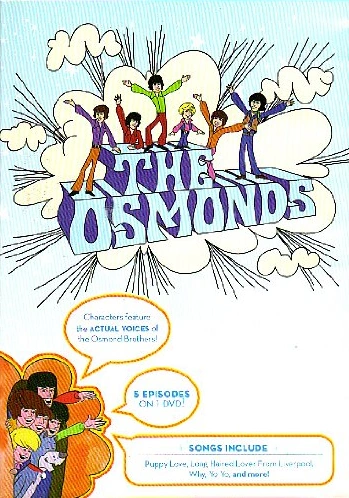
Group, and Donny would release a DVD
compilation of 5 episodes through his website in 2007. While the complete
series has never been released, episodes have been uploaded to YouTube by fan accounts.
The
Osmonds’ popularity began to decline following the release of their ambitious
1973 album, The
Plan, which carried a strong religious message and a progressive rock
sound. Within three years, the band put out music in a variety of genres
including bubblegum pop, hard rock and easy listening, giving them an
inconsistent sound and took them away from the pop music that made them popular
in the first place. Not helping matters was Donny’s voice change taking away
their younger fans and his tendency to cover oldies on his solo albums. Alan,
Wayne and Merrill had all gotten married between 1973 and 1974, which led to
the band reducing their touring schedules to spend more time with their
families. Finally, the Osmond brand had gotten diluted with Donny, Marie and
Jimmy emerging as solo artists, and Donny and Marie recording duets together.
By 1976, album sales were slumping and The Osmonds had only one last Top 40 hit
with “The Proud One”,
a cover of a Frankie Valli
minor hit.
Donny & Marie billboard during their residency at the Flamingo.
The Osmonds all together for Marie's 60th birthday.
Alan,
Wayne, Merril and Jay returned to The Osmond Brothers to earn money for their
debts. A handful of their songs just missed breaking the top 40, and their
record sales were reduced by their unwillingness to tour and desire to only
promote their music through music videos, but they were able to pay off their
debts by 1983. They continued to perform with various line-ups, including their
children, as well as independently with other performers. Alan retired from the
group in 2007 and Wayne in 2012 after a stroke left him unable to play guitar;
although they played one more performance with them in 2018 and again
in 2019 for Marie’s 60th birthday. Merril planned to retire in
2022, but continued on for a limited run in 2024. Jay continues to perform with
Alan’s son, Nathan,
and they plan
to begin a residency in Branson,
Missouri in October of 2024. Jimmy suffered a second stroke in 2018 and had
dropped out of showbusiness to recover, with Merril hoping he’d eventually
return to the group.
EPISODE GUIDE:
“And Away They Go” (9/9/72) – The Osmonds have a chance to
audition for a world tour, but Jimmy and Fuji ruin their chances.
He co-founded Rankin/Bass Productions with Arthur
Rankin Jr., who are probably best-known for their collection of holiday stop-motion
animated specials. He was involved in the making of The King KongShow, The
Smokey Bear Show, The Reluctant Dragon & Mr. Toad Show, Tomfoolery Show,
The Jackson 5ive, Kid Power, The Osmonds and several episodes of The ABC
Saturday Superstar Movie. He was also credited as a consulting producer on ThunderCats
Roar; his first work in television since the death of Rankin in 2014.
He was an animator that worked continuity for King Kong (1966) and provided animation for The Jackson
5ive, The Osmonds and several episodes of Sesame Street.
A notable television and film composer, he created the music for The King Kong Show and four episodes of the ABC Saturday
Superstar Movie, and served as the musical director for The Jackson 5ive, The Osmonds and Kid Power.