August 15, 2015

THE AMAZING CHAN AND THE CHAN CLAN

THE AMAZING CHAN AND THE CHAN CLAN
(CBS, September 9-December 30, 1972)


Hanna-Barbera Productions


MAIN CAST:
Keye Luke – Charlie Chan
Robert Ito – Henry Chan
Brian Tochi – Alan Chan
Debbie Jue (original) & Beverly Kushida – Nancy Chan
Jay Jay Jue (original) & Gene Andrusco – Flip Chan
Leslie Kawai – Mimi Chan (original)
Virginia Ann Lee – Suzie Chan (original)
Cherylene Lee – Mimi Chan, Suzie Chan
Leslie Kumamota (original) & Jodie Foster – Anne Chan
Michael Takamoto (original) & John Gun – Tom Chan
Robin Toma (original) & Michael Morgan – Scooter Chan
Stephen Wong (original) & Lennie Weinrib – Stanley Chan
Don Messick – Chu Chu

Ron Dante – Singing voice


            Earl Derr Biggers had an idea for a detective novel he wanted to call The House Without a Key in 1919, but it took him four years to start it. He couldn’t find any inspiration until reading about Chang Apana and Lee Fook, two detectives on the Honolulu police force. Biggers was inspired by them to create a Chinese police officer to star in his book, as a counter to the rampant Yellow Peril stereotypes he encountered when he came to California. 

The first Charlie Chan novel.

            That police officer was Charlie Chan, a character depicted as being heavyset with a dainty step in order to appearing non-threatening compared to other Chinese characters at the time. He was a widower with ten children that were the only other family members ever mentioned. Many critics over the years have both praised Chan’s progressive characterization while others felt he still exemplified many of the stereotypes attributed to the Chinese. Regardless, the character was a success and appeared in a total of six books published by The Bobbs-Merrill Co. before Biggers’ death in 1932.

George Kuwa getting his make-up applied.

            In 1926, Pathè Studios produced the first film adaptation of Biggers’ character and work in the serial The House Without a Key. Chan was portrayed by George Kuwa. The following year, Universal Pictures produced The Chinese Parrot starring Kamiyama Sojin. Both actors were Japanese.  In 1929, Fox Film Corporation licensed the character and made Behind That Curtain, this time starring Korean actor E.L. Park. Unlike the novels on which they were based, Chan’s role was significantly minimized; more so in Fox’s production where Chan only appeared in the last ten minutes. The films were poorly received.

Charlie Chan Carries On poster.

            In 1931, the Chan film series found success with the casting of Swedish actor Warner Oland, who played the character as more gentle and self-effacing than he had been portrayed in the books. Oland brought a warmth and gentle humor to the role that made him popular with audiences. Beginning with Charlie Chan Carries On (which was simultaneously produced with a Spanish version using the same sets), Oland starred in fifteen films before his death in 1938; usually alongside Keye Luke as his “Number One Son” Lee Chan. The movies, when translated and shown in China, were the most popular American films at the time due to their unusually positive portrayal of a Chinese character. What would have been Oland’s final film in the series, Charlie Chan at the Ringside, was rewritten and had additional footage added to make it Mr. Moto’s Gamble; part of Fox’s Mr. Moto series which featured a Japanese secret agent played by Peter Lorre. Fox recast the role with white actor Sidney Toler who portrayed the character as less mild-mannered than Oland’s interpretation, bringing it closer to his portrayal in the books. Toler made eleven films with Fox, and his sidekick was his annoying “Number Two Son” Jimmy Chan, played by Victor Sen Yung. When Fox stopped producing Chan films, Toler bought the rights himself and produced ten more films with Monogram Pictures until his death in 1947. Roland Winters assumed the role for six more outings, rejoined by Luke for the last two.

The Charlie Chan comic strip.

            While the films were being made, the Chan character appeared in serialized radio shows, newspaper comic strips, comic books and even a television series. In 1970, Hanna-Barbera Productions acquired the rights to bring Charlie Chan to animation. Made by Eric Porter Studios, the series focused on Charlie Chan (voiced by Luke, making him the first actual Chinese actor to assume the role), a prolific detective and father of ten who frequently traveled with his children. Although Chan (whose first name was never given outside of episode titles) would work on solving mysteries on his own, his children often launched their own investigation in order to help. Luke’s portrayal of the character was also the first time Chan spoke in complete sentences, rather than the stereotypical broken English featured in other adaptations. Although it was a typical mystery/chase series that Hanna-Barbera would become known for following the success of Scooby-Doo, the series changed it up a bit by making it more of a “howdunnit?” than a “whodunnit?” in that the clan had to figure out how a crime was committed more than who did the actual theft.

Hanna-Barbera's Charlie Chan.

Like most other programs that followed The Archie Show, Hanna-Barbera incorporated a band element into the program in order to attempt to score a musical hit as well as a televised one like Filmation Associates did with their fictional band, The Archies. Chan’s children had their own band called The Chan Clan, whose music was supervised by Don Kirshner and performed by Ron Dante; both of whom were involved in making The Archies the success they were. Every episode featured a song from the Clan, either played on screen by the band or over the action. Hoyt Curtin provided the rest of the series’ incidental music.

The Chan Clan in the Chan Clan.

For added authenticity, Chan’s children were originally portrayed by Asian actors. But it was deemed that their thick accents would be too confusing for children to understand. As a result, most of their roles were recast with American actors, several of whom were Hanna-Barbera staples, and the earliest episodes redubbed. Henry Chan (Robert Ito) was the oldest son and the leader of his siblings in his father’s absence, as well as the band’s drummer. Stanley Chan (Stephen Wong & Lennie Weinrib) was the second eldest, often donned some sort of crazy disguise, and delivered the show’s catchphrase: “Wham-Bam; somebody’s in a jam!” Suzie Chan (Virginia Ann Lee & Cherylene Lee) was the eldest daughter and the band’s tambourine player. Suzie liked to knit and always had sore feet. Alan Chan (Brian Tochi) was a genius inventor who created whatever gadget the clan might need to solve a crime; notably the van they always traveled in which could transform into other vehicles. Originally seen playing the drums in the first episode, for the rest of the series Alan played the oboe. Anne Chan (Leslie Kumamota & Jodie Foster) was a feminist tomboy who alternated between guitar and percussion for the band. Tom Chan (Michael Takamoto & John Gun) was the most intellectual of the children and often spoke in scientific terms, and played the trombone in the band. Flip Chan (Jay Jay Jue & Gene Andrusco) was the natural leader amongst the younger siblings, and often the most enthusiastic at wanting to help their father on a case. Nancy Chan (Debbie Ju & Bevery Kushida) was the most accident-prone of the children and heavy-set due to her constantly being hungry. Mimi Chan (Leslie Kawai & Lee) was the youngest daughter and frequently bossed Scooter around. Scooter Chan (Robin Toma & Michael Morgan) was the youngest of the children and was fiercely loyal to Flip, calling him “chief.” Rounding out the clan was their dog, Chu Chu (Don Messick). Chu Chu aided the family in solving cases and an expert in making sound effects; notably a police siren to allow their van to get through traffic quickly.

The whole clan: Charlie, Henry, Stanley, Susie, Alan, Anne, Tom, Flip, Nancy, Mimi, Scooter and Chu-Chu.

Charlie Chan and the Chan Clan debuted on CBS on September 9, 1972. and was rerun again for the following season. Amongst one of the series’ writers was future M*A*S*H star Jamie Farr, who was hired alongside Eddie Carroll during the series’ early production stages (notably, a few of the original actors also appeared on M*A*S*H). Other writers included Willie Gilbert, Max Hodge, Mark Kammerman, Dennis Marks, Sidney Morse, Ray Parker, Henry Sharp and Harry Winkler. Gold Key Comics produced a four issue series based on the show with art by William Tufts. The first issue was an adaptation of the first episode and featured Mark Evanier’s first English-language comic book script to see publication. In 2009, “Scotland Yard” was included on Saturday Morning Cartoons: 1970s Volume 1 and the 2018 compilation collection, along with a short documentary about the making of the show. In 2012, Warner Archive released the complete series to DVD as part of their Hanna-Barbera Classics Collection. During the show’s run, Whitman produced a puzzle, board game and coloring book, Larami a cork gun set, and Thermos two lunch boxes.


The Chan Clan as Shoyu Weenie on Harvey Birdman.

Chan returned to the small screen in The Return of Charlie Chan, a 1979 film starring Ross Martin. Another theatrical attempt was made in 1981 with Charlie Chan and the Curse of the Dragon Queen, but it was a complete failure at the box office. Hanna-Barbera’s version, however, made a return n a 2002 episode of Harvey Birdman, Attorney at Law as the band Shoyu Weenie (in the episode of the same name); who only spoke Japanese and was lorded over by their tyrannical manager and father. Mimi Chan was featured as one of Kevin Whitney’s (Alberto Ghisi) classmates in Krypto the Superdog, while Susie Chan appeared as one of the background students in Scooby-Doo! Mystery Incorporated.


EPISODE GUIDE:

“The Crown Jewel Caper” (9/9/72) – Chan is hired to catch the thief of the Burmese Crown Jewel and his children defy his wishes to attempt to help.

“To Catch a Pitcher” (9/16/72) – At the World Series, Chan’s sons witness player Boo Blew being kidnapped.

“Will the Real Charlie Chan Please Stand Up?” (9/23/72) – The clan has to find out who’s committing burglaries disguised as Charlie.

“The Phantom Sea Thief” (9/30/72) – The clan has to locate a stolen painting before their cruise ship docks.

“Eye of the Idol” (10/7/72) – A crook steals a Jade Buddha Idol as it arrives in a shipyard.

“The Fat Lady Caper” (10/14/72) – A trip to the circus turns into an investigation of sabotage by a rival circus seeking to buy them out.

“Captain Kidd’s Doubloons” (10/21/72) – Attending Buccaneer Days in Trinidad leads to the search for stolen Doubloons belonging to the relative of Captain Kidd.

“The Bronze Idol” (10/28/72) – An idol is stealing everything a small island’s residents have.

“Double Trouble” (11/4/72) – During a race, Prince Hareem is kidnapped and replaced with a double.

“The Great Illusion Caper” (11/11/72) – The clan go to see the final performance of a magic troupe, one of whom is wanted for stealing a ruby.

“The Mummy’s Tomb” (11/18/72) – The pharaoh Ramosses’ mummy disappears after he appears to warn an archaeological dig of his curse.

“The Mardi Gras Caper” (11/25/72) – The clan attends Mardi Gras as Marie Antoinette’s ring goes missing.

“The Gypsie Caper” (12/2/72) – A group of visiting gypsies ends up blamed when the village’s most treasured possession goes missing.

“The Greek Caper” (12/9/72) – The clan witnesses the theft of a priceless Greek statue and its replacement by a plaster replica.

“White Elephant” (12/16/72) – While visiting an old friend in India, Charlie has to help the Sultan find his white elephant lest he lose his power.

“Scotland Yard” (12/30/72) – Charlie assists Scotland Yard in locating the stolen coronation stone, the Stone of Scone.


Originally posted in 2015. Updated in 2020.

August 08, 2015

REVIEW: MY LITTLE PONY: FRIENDSHIP IS MAGIC #32

Warning: may contain spoilers.

MY LITTLE PONY: FRIENDSHIP IS MAGIC #32

Release Date: July 22, 2015
Writer: Thom Zahler
Letters: Neil Uyetake
Editors: Bobby Curnow
Covers: Tony Fleecs (regular, Larry’s, Baltimore, Comics World, Convention), Thom Zahler (subscription), Mary Bellamy (incentive), Amy Mebberson (Hot Topic)


Remnants from the battle between Princess Celestia and Nightmare Moon had finally made their way to Equestria and brought the apples at Sweet Apple Acres to life. Now, the apples are amassing an army and enslaving ponies to take over the entire world…starting with Ponyville.


GRADE: A+. Since IDW began publishing this series in 2012, this was probably the best issue yet. Thom Zahler takes previously established continuity and uses it to his advantage to craft a story that’s absolutely fun. The villains are so insanely silly, right down to their leader having a mustache. The mane six are perfectly represented, and Pinkie Pie steals the show after her transformation (which was spoiled by one of the variant covers). It was just a fun and funny romp from cover to cover, perfectly brought to life by Tony Fleecs and Heather Breckel.

This issue came with 2 covers, seen below. What did you think of this issue? Let us know in the comments or on our Facebook page.


REVIEW: BATMAN BEYOND (2015) #2

Warning: may contain spoilers.


BATMAN BEYOND #2

Release Date: July 1, 2015
Writer: Dan Jurgens
Letters: Dave Sharpe
Editors: Dan Didio & David Pina
Covers: Bernard Chang & Marcelo Maiolo (regular), Andy Kubert & Brad Anderson (variant)


Brother Eye knows Tim Drake is in his internment camp. Eye sends his forces, including the mercenary Inque, to retrieve him so that Eye can learn the location of Neo-Gotham.

Maxine Gibson and Barbara Gordon help Tim Drake stay ahead of Brother Eye.

GRADE: C+. A bit more of the Beyond universe gets incorporated this issue, with Commissioner Barbara Gordon (given red hair like her father) and Maxine Gibson having larger roles and the introduction of series villain Inque. Unfortunately, the series continues to be Beyond in name and costume only as we delve deeper into the apocalyptic future Brother Eye has been allowed to create, with nothing tremendously new added since the last issue or Future’s End.

You've got some Inque on your suit.


Dan Jurgens manages to continue the seeming DC Comics edict that all their books be completely devoid of joy in its attempt to rebrand itself as a darker, grittier force to be reckoned with since its attempt to do so through countless reboots hasn’t quite hit the mark. Even Jurgens’ signature character, Booster Gold, lost any of the fun about him that made fans clamor for him to get a series pre-New 52.


Bernard Chang’s artwork continues to be the high point of the series, taking Beyond designs and updating them to fit into the more realistic DC Universe and the grim future being crafted. Marcel Maiolo’s colors are, as always, uniquely done as he renders some panels in red and white in order to emphasize them in relation to the rest of the story. It almost replaces that flash that would come across the screen whenever someone was hit in DC’s 90s cartoons (from which this series finds its genesis).

This issue came with 2 covers, seen below. What did you think of this issue? Let us know in the comments or on our Facebook page.


REVIEW: SAVED BY THE BELL (ROAR) #1

Guest review by Eileen G. O’Neill.
Warning: may contain spoilers.


SAVED BY THE BELL #1

Release Date: February 5, 2014
Colors: Lisa Moore
Letters: Steve Wands
Cover: Cynna Clugston Flores


Saved by the Bell was a popular teenage sitcom that aired from 1989-1993, spawning two made-for-TV movies and two spin-offs. The series was the crown-jewel of the NBC Saturday morning line-up, prompting them to drop all animated programming in favor of more teen-oriented fare. In 2014, Lion Forge Comics picked up the license for Bell as part of their Roar Comics imprint and began producing a series of digital comics.


Zack tries to ask Kelly for a date--which Kelly doesn't realize is a date and invites everyone else.

It’s the first day of high school, and Zack Morris only has one thing on his mind: ask out Kelly Kapowski. Unfortunately, he gets intercepted by friends and a new attractive stud in town, A.C. Slater. Zack sets out to fix it so Slater never gets the chance to be alone with Kelly, and ends up fixing them both.

Alone at last? Nope!

GRADE: C. While it’s understandable that the publishers of this series are trying to introduce it to a new generation of followers, this attempt somehow falls flat. They do capture the original spirit of the characters: Zack, the mischievous troublemaker; Kelly, the sweet girl next door; Jessie, the brainiac feminist; Lisa, the fashionista; Screech, the goofball sidekick; and Slater, Zack’s antagonist.  

Zack levels the playing field to have Kelly's undivided attention.

This issue brings the characters back to their freshman year of high school and the familiar Zack/Slater/Kelly storyline that opened up the original television show. Unfortunately, the characters come across as much older than freshmen and it ruins the storyline. If they had started the series with the characters in their second or third year it might have worked better.  Bottom line, readers who are new to the series might enjoy this more than fans of the original show.


What did you think of this issue? Let us know in the comments or on our Facebook page.


REVIEW: SONIC BOOM #10

Warning: may contain spoilers.

SONIC BOOM #10

Release Date: July 29, 2015
Writer: Ian Flynn
Pencils: Tyson Hesse
Inks: Jim Amash
Colors: Matt Herms
Letters: Jack Morelli
Assistant Editor: Jonathan H. Gray
Covers: Patrick “Spaz” Spaziante (regular), Reilly Brown (epic crossover explosion), Ben Bates (covers unite)


Sigma sends his legions out to various worlds to place a Unity Engine in order to feed Sigma’s final transformation. The Unified Army follows them to those worlds, taking down Sigma’s troops and engines with the help of those worlds’ heroes, and recruiting them for the final battle against Sigma to save all of reality.


GRADE: B+. Part 10 of the 12-part event spanning the entire Archie Action! line of comics. This issue takes the characters to various worlds of Sega and Capcom games. Many are well-known, others more obscure that only long-time and hardcore gamers will remember or recognize. Outside of recruiting for the Unified Army, not much happens story-wise, but again Ian Flynn seems to effortlessly balance all the characters featured (and there are many) in what amounts to an all-too-brief space for each. Sticks is quickly becoming the Deadpool of the Archie world, with her ability to break the fourth wall, know she’s a work of fiction, and even to simultaneously be on two teams in two different worlds. The artwork by Tyson Hesse, Jim Amash and Matt Herms accurately brings out the Japanese origins of the featured characters, giving them a hint of manga styling and keeping them true to their character models.

This issue came with 3 covers, seen below. What did you think of this issue? Let us know in the comments or on our Facebook page.


REVIEW: SONIC BOOM #9

Warning: may contain spoilers.


SONIC BOOM #9

Release Date: July 1, 2015
Writer: Ian Flynn
Pencils: Edwin Huang
Letters: John Workman
Assistant Editor: Jonathan H. Gray
Covers: Patrick “Spaz” Spaziante (regular), Brent McCarthy (evil friends), Ben Bates (covers unite)


It’s an all-out battle as Sonic, Mega Man and Mega Man X’s combined forces take on the minions of the Rogue Maverick Hunter Sigma. But, the tides turn when all the good robots come under the control of the bad guys and turn on their allies.

The only actual Sonic Boom characters.

GRADE: B. Although they describe what has transpired before on the first page, the simple fact is unless you’re reading Sonic the Hedgehog, Sonic Universe and Mega Man in conjunction with this series, you’re not getting a whole lot of story for your buck. This issue was basically one big brawl after another. The only real plot advancement came when Sticks the Badger (one of the three actual stars of this particular title featured in the crossover) got knocked into a Genesis Portal and landed in an alternate world, setting up the recruitment of additional worlds into the conflict (as revealed by early promo art).

Mega Man and Rush, Sonic, Break Man, Mega Man X, Zero and Sticks fighting Sigma's hordes.

 Nonetheless, as said before, these tie-in issues are a welcomed improvement over the regular storyline which is just too silly and clearly meant for an even younger demographic than Archie usually courts. Ian Flynn does an excellent job balancing all these characters and personalities, the art by Edwin Haung, Gary Martin and Gabriel Cassata is excellent and vibrant.


This issue came with 3 covers, seen below. What did you think of this issue? Let us know in the comments or on our Facebook page.


REVIEW: GHOSTBUSTERS: GET REAL #2

Warning: may contain spoilers.

GHOSTBUSTERS: GET REAL #2

Release Date: July 29, 2015
Writer: Erik Burnham
Letters: Neil Uyetake
Editor: Tom Waltz
Covers: Dan Schoening & Luis Antonio Delgado (regular), Evan “Doc” Shaner (subscription)


As the two sets of Ghostbusters attempt to figure out why they were targeted by Proteus, Proteus unleashes two hounds to try and find where the Real team wound up in order to deal with them properly.

The Extreme team.

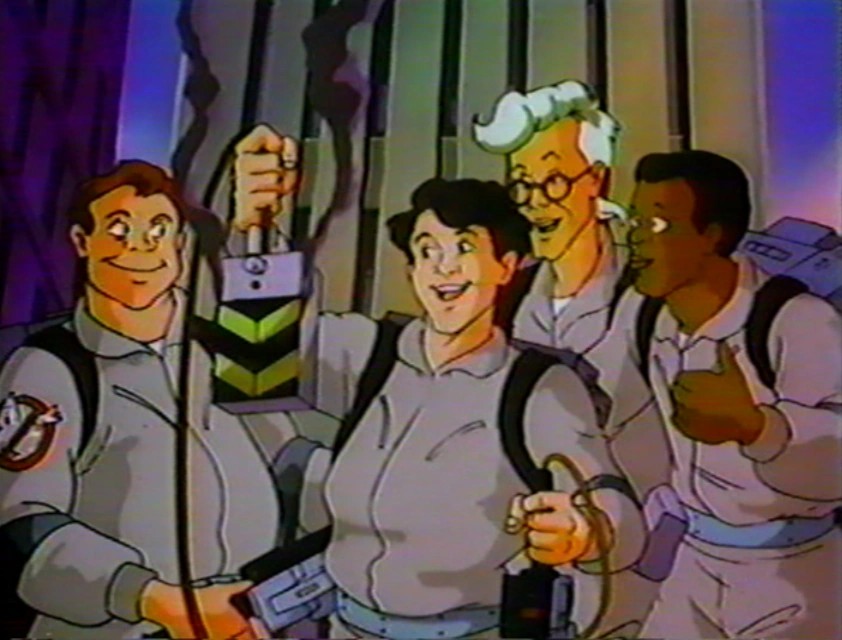
GRADE: A. A lot of talking going on in this issue, but none of it was ever boring. Erik Burnham has managed to make pseudo-science interesting to read as the two teams of ‘busters interact with each other. This issue opened with a cameo scene by the Extreme Ghostbusters in one of the first alternate universes Proteus investigated looking for the Real team, which is sure to please a lot of fans of that short-lived follow-up series to the original cartoon.

Talking to yourself is perfectly healthy; especially if you're actually there to talk to.

But, probably the best part in the issue was the two-page spread featuring alternate versions of the guys in various universes. Amongst them were the original designs and later Slimer! designs for the Real team, several versions of how the team appeared in various video games over the years, the Peoplebusters from the “Flip Side” episode of Real, the Filmation version, the anime version from Tokyo ESP episode 3, a shot from the “Ghost Wrestlers” episode of Hulk Hogan’s Rock ‘n’ Wrestling, and Dan Aykroyd’s original concept designs.

From top: Ghost Smashers concept, Rock 'n' Wrestling, Peoplebusters, Sanctum of Slime, Ghostbusters II Sega and NES versions, Filmation, Ghostbusters Pachinko, Tokyo ESP, original Real concept, Ghostbusters: The Video Game stylized versions, Slimer!

As always, Dan Schoening’s artwork was spot-on, making every character seem like it jumped off the screen and into the comic. For the hardcore fans paying attention, scenes were littered with references to the various facets of the franchise making fun little Easter eggs to find. And without Luis Delgado’s excellent coloring to set the tone for each scene, none of that would matter. The only negative was Delgado made a bit of a goof and colored in Real Ray’s jumpsuit with Real Peter’s colors, but you could probably write that off as an acknowledgement of the frequent bloopers found in the cartoon episodes.

This issue came with 2 covers, seen below. The Subscription Cover was based on EC's Vault of Horror #25, part of a theme of classic covers re-imagined for that month. What did you think of this issue? Let us know in the comments or on our Facebook page.


LANCELOT LINK, SECRET CHIMP

LANCELOT LINK, SECRET CHIMP
(ABC, September 12, 1970-January 2, 1971)


Sandler-Burns-Marmer Productions

MAIN CAST:
Voices:
Dayton Allen – Lancelot Link, Commander Darwin, Dr. Strangemind, Ali Assa Seen
Joan Gerber – Mata Hairi, Dragon Woman, The Duchess
Bernie Kopell – Baron von Butcher, Creto, Wang Fu
Malachi Throne – Narrator
Steven Hoffman – Evolution Revolution singer

Apes:
Tongo – Lancelot Link
Debbie – Mata Hairi

            It was the end of the 60s. People were still enamored with spies, thanks to the James Bond series and the comedic stylings of Get Smart. And people were always in love with the human-like chimp. So, Stan Burns and Mike Marmer decided to combine the two to create their next show: Lancelot Link, Secret Chimp.

Lancelot Link and Mata Hairi on the case.

            The long-time writing duo pitched the series to ABC as a spy spoof using chimpanzee characters instead of humans. Because of their credits on The Carol Burnett Show and the aforementioned Get Smart, ABC bought it and gave it an unprecedented $1 million budget. That budget came in handy, because Burns and Marmer weren’t making a cartoon; they were using real, live chimps. Most of the budget went into set construction, training the chimps with Frank Inn, costume design and props. The sets proved especially tricky, as a new lighting technique had to be developed in order to not lose the darkly-colored chimps’ faces to shadows on film. 


The logos of the rival spy agencies.


Lancelot Link revolved around the Agency to Prevent Evil (or A.P.E.) in their quest to keep the world safe from rival agency Criminal Headquarters for the Underworld’s Master Plan (or C.H.U.M.P.). A.P.E.’s top agents were Lancelot Link (played by Tongo and voiced by Dayton Allen) and his partner, Mata Hairi (a play on Mata Hari, played by Debbie and voiced by Joan Gerber), under the leadership of Commander Darwin (after Charles Darwin, also voiced by Allen, who would often deliver information as theories). C.H.U.M.P. was led by Baron von Butcher (voiced by Bernie Kopell, whose character Siegfried from Get Smart inspired the character and the voice impression), distinguished by the monocle he always wore. While C.H.U.M.P. had an assortment of colorful agents at its disposal, their primary agents were Dragon Woman (based on Dragon Lady from Terry and the Pirates), The Duchess (both voiced by Gerber), Wang Fu (a play on Kung-Fu), the Baron’s chauffer Creto (a play on the word “cretin” and Kato from The Green Hornet, both voiced by Kopell), Ali Assa Seen (a play on “assassin”), and scientist Dr. Strangemind (inspired by Dr. Strangelove, both voiced by Allen with the latter’s voice patterned after Bela Lugosi). Malachi Throne served as the series’ narrator, delivering his lines with a mock seriousness.

Darwin issuing orders.

Although scripts were written for the show, it was impossible to get the chimps to mouth the words exactly as needed. As a result, much of the dialogue was improvised on set. Lines were either changed to match the chimps’ movements, or fluffed out by breaking into song or nursery rhymes after their dialogue for no apparent reason. Also taking a cue from Get Smart, everyday common objects often hid a communication device for the characters such as a banana, a tennis racket, etc.


After the fictional band created for The Archie Show proved a roaring success, every network followed suit by either incorporating a band or musical numbers into their programs in the hopes of finding the next crossover hit. Link was no different, with producer Allan Sandler asking for both elements to be incorporated into the series. The result was the all-chimp band The Evolution Revolution. It featured Link and Mata playing with Blackie and “Sweetwater Gibbons” in music video-styled segments filmed after the songs were composed. Each musical number was introduced by Ed Simian (a parody of Ed Sullivan) and served as a means to deliver secret codes to A.P.E. agents. Most of the songs were co-written and performed by Steve Hoffman, with series score composer Bob Emenegger contributing some songs for the band to play. The chimps were all over the place until the music came on, and they instinctively took to pretending to play the instruments along with it.

Born to be wild?

Lancelot Link, Secret Chimp debuted on ABC on September 12, 1970. Each episode, except the first, was broken up into two different 10-minute story segments. For its original run, the series was an hour long and featured Warner Bros. cartoon shorts from their animation division’s final years. Despite high ratings, the series was never produced beyond the first season. ABC did rerun it for a second season in a half-hour format without the shorts, as it also ran later on in syndication. ABC/Dunhill Records released an LP featuring the music from the Evolution Revolution, as well as the single “Sha-La-Love You”, which was originally intended for The Grass Roots. Unfortunately, the album didn’t sell well. Among other Link merchandise was a View-Master set, a coloring book, and two lunchboxes by Thermos. In 1971, a year after the initial run, Gold Key produced an 8-issue comic book series based on the show. 
The complete series.

In 1999, Diane Bernard and Jeff Krulik made a short documentary I Created Lancelot Link, where they reunited the show’s creators who regaled them with anecdotes about the show’s production. In 2004, Lancelot Link was featured in statue form on the episode “Milhouse Doesn’t Live Here Anymore” on The Simpsons in the Museum of Television and TV’s “Things That Shouldn’t Talk, But Do” exhibit. In 2006, Image Entertainment finally brought 12 episodes of the series to home video with a 2-DVD set, while the complete series would be released six years later by SBM Productions and Film Chest. The set featured interviews with Sandler, Emenegger and Tongo and the documentary as bonus features.

EPISODE GUIDE:
“There’s No Business Like Snow Business” (9/12/70) – Link and Mata head to the Big Mountain Ski Resort to intercept the theft of the Star of Karachi Diamond.

“The Lone A.P.E. / Missile Beach Party” (9/19/70) – Lance heads to a chicken ranch to foil a chicken rustling plot. / Lance has to stop the destruction of missiles.

“The Mysterious Motorcycle Menace / The Great Beauty Contest” (9/26/70) – CHUMP’s motorcycle gang steals APE’s payroll. / Lance has to help a Soviet beauty queen defect.

“C.H.U.M.P. Takes A Holiday / To Tell the Tooth” (10/3/70) – Lance invades a CHUMP convention to steal their codes. / A CHUMP dentist hides transmitters in the teeth of military officials.

“The Great Brain Drain / The Great Double Double Cross” (10/10/70) – Lance ends up ingesting a formula that reduces the drinker to a child while intercepting it. / Baron and Dragon Woman disguises themselves as Lance and Mata and infiltrate APE headquarters.

“Lance of Arabia / The Doctor Goes A.P.E.” (10/17/70) – APE agent Reginald Ressis searches for CHUMP’s gold horde, but he’s captured by Ali Assa Seen. / Lance and Mata have to retrieve a microfilm CHUMP obtained of all the APE agents.

“The Surfin’ Spy / The Missing Link” (10/24/70) – Lance hides out on the beach to find out how Dragon Woman and Wang Foo are smuggling in silver. / CHUMP kidnaps Lance’s uncle Mortimer.

“Bonana / The Greatest Chase in the World” (10/31/70) – Lance and Mata go undercover at a dude ranch. / Lance and Mata follow CHUMP all around the world.

“The Reluctant Robot / The Royal Foil” (11/7/70) – Dr. Strangemind’s robot assassin proves to be defective. / Lance and Mata are assigned to protect a visiting king.

“The Great Great Race / The Great Plane Plot” (11/14/70) – APE challenges CHUMP to a race. / Mata goes undercover to prevent the abduction of a visiting dignitary.

“Landlubber Lance / The Temporary Thanksgiving Turkey Truce” (11/21/70) – Lance goes undercover on Dragon Woman’s boat to save Darwin. / Lance’s holiday is disrupted by a search for microfilm.

“The Dreaded Hong Kong Sneeze / The Great Bank Robbery” (11/28/70) – Baron plans to unleash an Asian virus on the world. / Lance steals back stolen money.

“The Sour Taste of Success / The Baron’s Birthday Suit” (12/5/70) – Secret data is hidden in a lemon. / Lance ends up attending the Baron’s birthday bash.

“The Golden Sword / The Chilling C.H.U.M.P. Chase” (12/12/70) – CHUMP plans to steal an Arabian symbol of authority. / Lance and Mata infiltrate CHUMP to steal back nuclear power pills.

“The Spy Who Went Out in the Cold / Too Many C.H.U.M.P.S.” (12/19/70) – Lance pretends to defect to CHUMP. / Lance and Mata target Dragon Woman’s junk to prevent the arrival of new CHUMP agents.

“The C.H.U.M.P. Code Caper / Weather or Not” (12/26/70) – CHUMP figures out The Evolution Revolution broadcasts secret codes through their music. / Dr. Strangemind invents a weather-manipulation machine.

“The Evolution Revolution / The Great Water Robbery” (1/2/71) – CHUMP deciphers the band’s code. / CHUMP takes the city water supply hostage.


Originally posted in 2015. Updated in 2020.