Showing posts with label Donkey Kong Jr.. Show all posts

June 12, 2021

SATURDAY SUPERCADE


SATURDAY SUPERCADE

(CBS, September 17, 1983-December 1, 1984)


Ruby-Spears Enterprises


MAIN CAST:

Billy Bowles – Q*bert
Robbie Lee – Q*tee, Q*val
Dick Beals – Q*bit
Frank Welker – Q*ball, Q*mungus, Coily, Ugg, Wrongway, Slick, Sam, Donkey Kong Jr. (season 1), Bongo, Fred (both season 2), various
Julie McWhirter – Viper
Bart Braverman – Bones (season 1)
Bob Sarlatte – Frogger (season 1)
Marvin Kaplan – Shellshock “Shelly” Turtle (season 1), Sidney Squirrel (season 2)
B.J. Ward – Fanny Frog (season 1)
Ted Field, Sr. – Tex Toadwalker (season 1)
Robert Ridgely – Pitfall Harry (season 1)
Noelle North – Rhonda (season 1)
Kenneth Mars – Quickclaw (season 1)
Jim Piper – Space Ace (season 2)
Sparky Marcus – Dexter (season 2)
Nancy Cartwright – Kimberly (season 2)
Peter Renaday – Space Marshall Vaughn (season 2)
Arthur Burghardt – Borf, Mr. Friendly (both season 2)
David Mendenhall – Joey Kangaroo (season 2)
Mea Martineau – Katy “K.O.” Kangaroo (season 2)


            By the time the 1980s rolled around, the American video game market was booming. Arcades were experiencing a Golden Age with rapid advancement in technology and growing cultural impact beginning with the release of Space Invaders in 1978. Likewise, home consoles were entering their second generation thanks to the affordability of new microprocessor technology, with the Atari 2600 leading the charge. This resulted in a combined revenue of $11.8 billion for the video game industry by 1982.

Hanging out at the arcade.


            Television and studio executives were not ones to let a popular trend go by without finding a way to capitalize on it. ABC and Hanna-Barbera struck first: adapting the highly successful arcade game Pac-Man into a hit animated series. TBS was next with a game show that utilized arcade games, Starcade. CBS, looking to compete, decided to hedge their bets by not just licensing one hit game, but several from both the arcades and home consoles.

The stars of Supercade: Donkey Kong, Donkey Kong Jr., Q*bert, Pitfall Harry and Frogger.


            Among the chosen properties was the game that saved Nintendo of America from bankruptcy, Donkey Kong, and its sequel, Donkey Kong Jr.; Gottlieb’s most successful game, Q*bert; Konami’s hit Frogger; and Activision’s home console smash, Pitfall! These five entries were combined under the banner Saturday Supercade where they would air four segments over the course of an hour every Saturday (Q*bert and Pitfall! would alternate weeks). Naturally, as video games at the time were a bit limited in their story and presentation, some liberties were taken in adapting them for the small screen; such as making Frogger (Bob Sarlatte) an investigative reporter or setting Q*bert in a pastiche of the 1950s in a town dominated by cube shapes.

Character models for Donkey Kong's Pauline and Mario.


            Saturday Supercade debuted on CBS on September 17, 1983. The series was produced by former Hanna-Barbera employees Joe Ruby and Ken Spears through their company, Ruby-Spears Productions. Despite sharing screen time in the intro and during commercial bumpers, and that both Donkey Kong and Donkey Kong Jr. were set in the same universe, none of the shows or characters crossed over or interacted with each other. Jack Enyart, Gary Greenfield, Gordon Kent and Michael Maurer served as story editors, while Haim Saban and Shuky Levi composed the series’ theme. Dean Elliott handled the rest of the series’ music.


            Supercade was renewed for a second season; however, there were some changes. Donkey Kong Jr., Frogger and Pitfall! were dropped from the line-up. In their place came Sun Electronics’ (aka Sunsoft) hit arcade Kangaroo, and the second game from notable Disney animator Don Bluth, Space Ace. Richard Merwin, Cliff Roberts and David Villaire served as story editors this season. CBS also expanded their video game offerings with a series based on the racing game Pole Position, but as it was by DiC Entertainment it was kept separate from Supercade. Supercade continued on until December of 1984, and then left the airwaves forever. 

Article published during Atari's decline.


One of the contributing factors to its cancellation was that it was unable to compete with the powerhouse Smurfs over on NBC. The other factor was that during the show’s production, the video game industry was hit by the crash of 1983: too many consoles, too many similar games of questionable quality through the establishment of third-party publishers, plus the rise of the home computer meant that there was a lot more product than consumers. Arcades fared no better as there really hadn’t been any major innovation in game design and they were blamed for instances of delinquency in their vicinity. Video games had lost their luster for Americans and wouldn’t begin to rebound until Nintendo imported their revamped Famicom as the Nintendo Entertainment System in 1986. The console wars began anew when Sega entered the fray, challenging the 8-bit Nintendo console with its high-speed 16-bit Genesis. With this new era in gaming came new attempts to adapt them for the screen, but those are stories told in their own entries.

A revived console war meant a new lease on life for video games--and new shows based on them.

        Because Sony owned Q*bert through Columbia Pictures’ previous ownership of Gottlieb, it remains the only entry in Supercade to have seen a home video release. The Best of Q*bert came out in 2015 to coincide with the release of their film Pixels, which featured the character. Warner Archive announced via their Facebook page in 2010 that plans were underway to release Supercade to DVD since they currently own the Ruby-Spears library, but because of rights issues with the various game properties the project needed extensive research before it could happen. Segments from Space Ace have appeared as filler between programs on Boomerang and Toonami, but otherwise the various segments have only become viewable through recorded uploads on sites like YouTube.


February 18, 2017

DONKEY KONG JR. CEREAL

DONKEY KONG JUNIOR CEREAL


Ralston

            Following the incredible success of arcade hit Donkey Kong, Nintendo commissioned the creation of a sequel. Donkey Kong Jr. hit arcades in 1982 and followed the son of Donkey Kong as he set out to rescue his father from the clutches of Mario (in his only turn as a videogame villain). Ralston, having already produced a cereal for Donkey Kong, quickly snatched up the license to Jr. and created a cereal based around that.


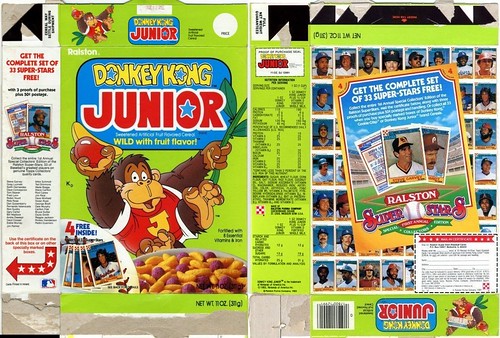
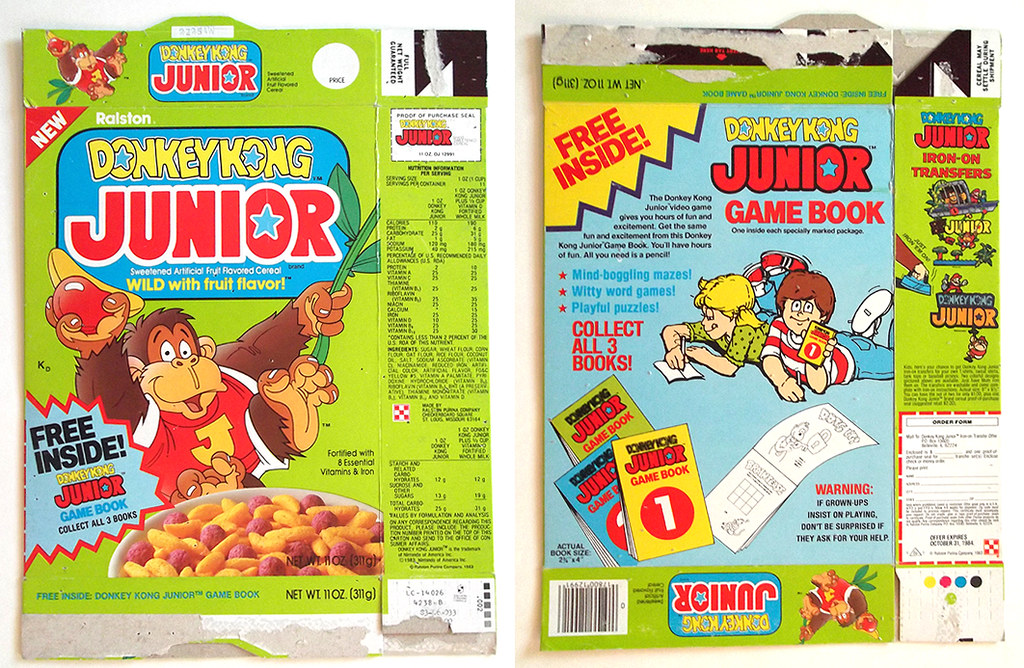
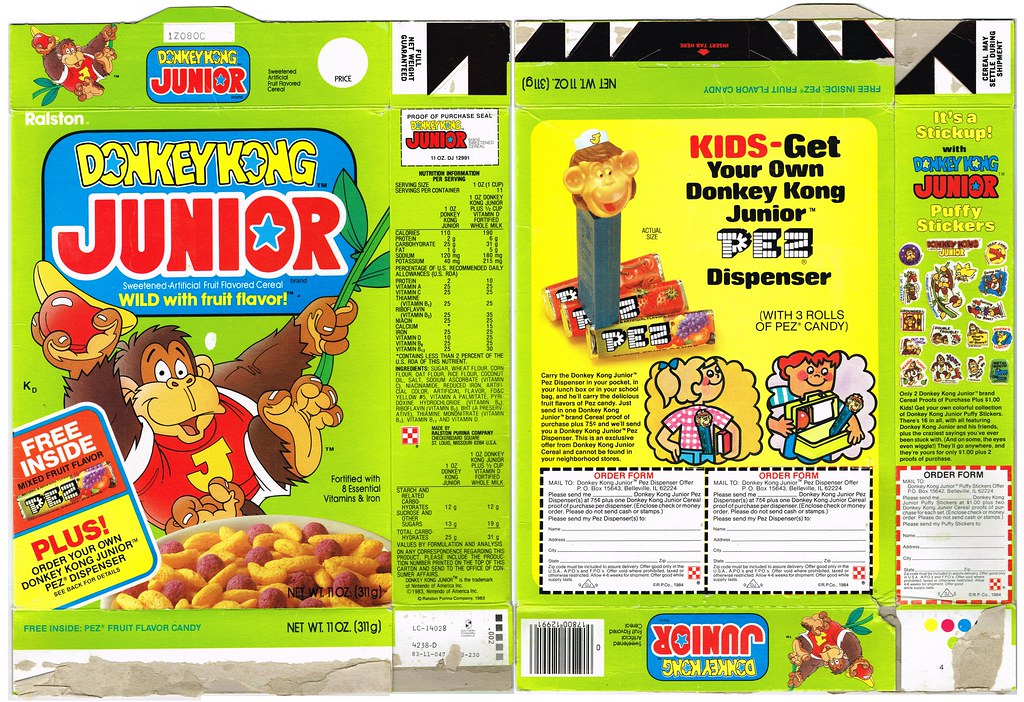
            Unlike Donkey Kong Cereal, Donkey Kong Junior Cereal was fruit-flavored and featured shapes reminiscent of bananas and apples. The commercials for the cereal featured two kids sitting down to breakfast, then becoming immersed in an animated jungle once they start pouring the cereal into their bowls. Unlike how he appeared in the game art, Junior wore a full-body red outfit with a yellow “J” and white cuffs. The cereal offered several premiums, including baseball cards, three different game books, free fruit flavored Pez, and a mail-away offer for a Junior Pez dispenser (which was just their standard gorilla dispenser with a “J” stuck onto its hat).  

SATURDAY SUPERCADE: DONKEY KONG JR.

DONKEY KONG JR.
(CBS, September 17-December 10, 1983)


Ruby-Spears Productions

MAIN CAST:


            After the major success of the arcade hit Donkey Kong, Nintendo was eager to duplicate that success and commissioned the creation of a sequel. The game’s creator, Shigeru Miyamoto, went to work on the first of many entries into the franchise: Donkey Kong Jr.


            Jr. was the culmination of ideas Miyamoto had for Donkey Kong but was unable to incorporate due to graphical limitations of the time. It was a departure from the previous game, as it focused on Donkey Kong’s son, Junior, who had to rescue his captured father from Mario. This marked the first and only time that Mario was a villain in a video game. The reason Junior was made the star was because Miyamoto wanted the player to be able to play as Donkey Kong, but again graphical limitations prohibited the use of such a large character in an action game. The style of platforming was also different as this time around Junior had to climb a series of vines in order to reach Donkey Kong’s cage at the top while knocking objects onto enemies to destroy them. Like its predecessor, it featured four distinct levels repeated with increasing difficulty. The game would end after the player lost all their lives or reached the level 22 kill screen.


            Donkey Kong Jr. was released to arcades in August 1982, just weeks apart in both Japan and North America. The game proved as successful as its predecessor, earning the 1984 Arcade Award for “Best Video game Audio-Visual Effects”. It was selected among five arcade games for history’s first official video game world championship in January of 1983, filmed at Twin Galaxies in Ottumwa, Iowa by ABC reality program That’s Incredible! Like its predecessor, Jr. was ported to the home consoles, with the Coleco Adam version gaining an exclusive fifth stage, and to the Game & Watch series of handheld games which reproduced the first level. The third and fourth levels of the game were reproduced in the follow-up, Donkey Kong II.  Jr. also had its own direct sequel in the form of educational game Donkey Kong Jr. Math for the Nintendo Entertainment System. The game, however, was poorly received and future entries in the series were quickly cancelled.


1983 ad for the CBS line-up.

In 1983, CBS was looking to get in on the video game craze and to combat ABC’s Pac-Man produced by Hanna-Barbera. Figuring to hedge their bets, they licensed several gaming properties and commissioned former Hanna-Barbera employees Joe Ruby and Ken Spears to handle it through their company Ruby-Spears Productions. The resulting series was Saturday Supercade. Making up the Supercade every week were segments based on Frogger, Donkey Kong and Donkey Kong Jr., while Q*bert and Pitfall! rotated weekly. 


Junior and Bones.

Donkey Kong Jr. aired concurrently to Donkey Kong and featured Junior (Frank Welker) travelling from the jungle to see his father, Donkey Kong (Soupy Sales), in the circus. Learning of his escape and desperate to find him, Junior partnered with clumsy biker, Bones (Bart Braverman), and took off on Donkey Kong’s trail. Ken Boyer and Patrick A. Ventura created the character models that adapted the cabinet artwork easily animated television stars. The theme music was composed by Shuki Levy and Haim Saban.


Height comparison character model sheet.

            Junior and Bones would often end up following a false lead and instead find some kind of trouble they would get involved with; be it foiling a robbery or protecting children from bullies. Junior was the most headstrong of the pair, always charging forward into situations and even taking over the operation of Bones’ own motorcycle. Bones generally stood to be the voice of reason and usually ended up taking the fall when Junior’s schemes went awry. Junior’s battle cry was “Monkey Muscle!”, which he exclaimed whenever they were about to encounter a problem or felt Bones needed a bit of encouragement. 


Bones' motorcycle.

            Although the Supercade ran for two seasons, Jr. wasn’t carried over and ended after its 13-episode run. It, along with Frogger and Pitfall!!, were removed and replaced with Space Ace and Kangaroo. Like most of the Supercade, rights issues regarding the various properties have prohibited much in the way of home media releases, although Warner Archive had reportedly begun investigating the possibility of doing so back in 2010. While Junior in his established form wouldn’t be a starring character again, he was continually featured as a character in compilations and re-releases of Donkey Kong and other Nintendo games, such as Super Mario Kart. However, it has been heavily implied that the Donkey Kong that debuted in the Donkey Kong Country series of games was a grown-up Junior or the son of Junior.


EPISODE GUIDE:
“Trucknapper Caper” (9/17/83) – NO SYNOPSIS AVAILABLE.

“Sheep Rustle Hustle” (9/24/83) – Junior and Bones help protect a ranch from sheep rustlers.

“Rocky Mountain Monkey Business” (10/1/83) – An escaped convict and his pet bear sets their sights on a park ranger to help them find stolen loot they buried somewhere in the forest.

“Magnificent 7-Year-Olds” (10/8/83) – Junior and Bones end up in a conflict with bullies stealing bikes from all the local kids.

“The Ventriloquist Caper” (10/15/83) – NO SYNOPSIS AVAILABLE.

“The Great Seal Steal” (10/22/83) – NO SYNOPSIS AVAILABLE.

“The Jungle Boy Ploy” (10/29/83) – NO SYNOPSIS AVAILABLE.

“Junior Meets Kid Dynamo” (11/5/83) – Trying to stop a robbery leads Junior and Bones to encounter real-life superhero, Kid Dynamo.

“Amazing Rollerskate Race” (11/12/83) – Crooks hide stolen gold as roller skate wheels on skates accidentally given to a team of kids.

“A Christmas Story” (11/19/83) – NO SYNOPSIS AVAILABLE.

“Gorilla Ghost” (11/26/83) – A gorilla ghost kidnaps animals from the zoo where Junior’s uncle lives in a plot to use them to steal some gold.

“Teddy Bear Scare” (12/3/83) – Babysitting at a carnival leads to Junior winning a teddy bear stuffed with stolen loot.

“Double or Nothing” (12/10/83) – When his cousin Lucy Belle ends up abducted, Bones disguises himself as her to attend the reading of a will.


Originally posted in 2017. Updated in 2020.