Remember that one day when you could wake up without an alarm? When you would get your favorite bowl of cereal and sit between the hours of 8 and 12? This is a blog dedicated to the greatest time of our childhood: Saturday mornings. The television programs you watched, the memories attached to them, and maybe introducing you to something you didn't realize existed. Updated every weekend.
The final entry in what
would become the Sam RaimiSpider-Man
film trilogy came with 2007’s Spider-Man 3. Written by Raimi, his
brother Ivan, and Alvin Sargent, the film became
the victim of studio interference and more characters began being added than
could adequately be managed in a single film. Along with Sandman (Thomas Haden Church), there was
Harry Osborn’s (James Franco) transformation
into a new kind of Green Goblin and Peter Parker’s
(Tobey Maguire) new work
rival Eddie Brock
(Topher Grace) becoming the
symbiotic villain Venom. Also thrown in was Gwen Stacy
(Bryce Dallas Howard) to
create a love-triangle for Peter and Mary Jane (Kirsten Dunst). Sony Pictures released the film on May
4, 2007, and despite less-than-favorable reviews when compared to the first two
films, it ended up grossing a series high of $890.9 million; becoming the 3rd
highest of the year and setting a worldwide single-day record of $104 million.
Replacing Kellogg’s as the food tie-in partner of the
franchise, General Mills released Spider-Man
3 cereal. They chose to represent the cereal with red and blue ball puffs
that had a fruity flavoring. The back of the box was taken up by a single large
maze game set in a spider’s web. Like Kellogg’s, General Mills included tie-in
premiums in their other cereals in the form of squirt
toys in the shape of Spidey and the film’s three villains.
SPIDER-MAN / SPIDER-MAN 2 / THE
AMAZING SPIDER-MAN CEREAL
Kellogg’s
The comic book movie
revolution from campy novelty to summer blockbuster may have quietly begun four
years prior with Bladeand later X-Men,
but with 2002’s Spider-Manit was in full (pardon the pun) swing.Written by David Koepp
and directed by Sam Raimi, Spider-Man
presented a slightly modified origin for the titular
character (Tobey Maguire)
and his arch-nemesis, the Green
Goblin (Willem Dafoe),
as fate and circumstances brought the two to a head in a climactic battle.
Released by Sony Pictures on May 3,
2002, it became an instant hit. It was the first film to pass $100 million in
its opening weekend and the fastest to surpass that mark. By the end of its
run, it had grossed $821.7 million.
The back and side of the Spider-Man cereal box.
That September, Kellogg’s announced its partnership with Marvel Comics and Sony Pictures to release
Spidey-themed food items, including a cereal (which they mistakenly touted as
the first, ignoring Ralston’s
1994 offering). The limited-edition Spider-Man cereal featured
“web”-shaped cereal pieces with artificial berry flavoring. While some of the
webs were naturally colored, others alternated between red and blue coloring.
Adorning the boxes was a foil-stamped logo and eyes in Spidey’s mask on the
front, a story on the back with some stock drawings of Spidey in various poses,
and a trivia game related to the story on the side panel. Later, when the film
was released onto home video, the boxes came with a small blurb advertising it
and a picture of the DVD set.
As part of their
promotional campaign, other cereals in the Kellogg’s line came with premiums
related to the film. Amongst them were glow-in-the-dark stickers, temporary
tattoos, and a web-shooter
water squirter. They also teamed-up with America’s
Dairy Farmers to offer a send-away promotion for a free Spidey CD-ROM game
(which was essentially the 2000 Spider-Manvideo
game with the character model altered to resemble the film’s suit and other
minor tweaks).
After such a
successful film, there was no doubt that a sequel was in order. Spider-Man
2, written by Alvin Sargent,
introduced Doctor
Octopus (Alfred
Molina); a scientist who became bonded to four-mechanical arms he invented
to aid in his scientific experiments and became mad with a desire to see his
experiment through at the risk of the city. Released on June 30, 2004, the film
was as well-received as the first and shattered its opening day record.
However, it ended up grossing about $40 million less with a total of $783.8
million.
The back of the Spider-Man 2 box.
Kellogg’s was once again on board and re-released
their Spider-Man cereal. The cereal was essentially the same, except it
came in a new yellow orange box with Spidey in a new pose, and only on the back
was the Spider-Man 2 title present. For a time, the foil-stamped logo
and eyes also made a return before being replaced with standard art later in
its run (excluding the international box, which had no foil and came with a blue background). The back of the box this time was adorned with several Spidey-themed
games, including a trivia game, crossword puzzle, a maze, a match game, a
hidden item search, and a word scramble. This time, tie-in premiums included
web-shooter-like laser pointers that projected one of four different designs.
The Raimi film series would gain one more
less-welcomed entry in Spider-Man 3, but it was General Mills who made a cereal for
that one. Ultimately, Marvel and Sony decided to scrap Raimi’s proposed Spider-Man
4 in favor of rebooting the franchise with a new direction and a new cast.
Written by James Vanderbilt
and directed by Marc Webb, The
Amazing Spider-Man took Peter Parker (Andrew Garfield) back to high
school as he explored a mystery involving his parents, which took him to Oscorp
where, like in the original films, he was bitten by a genetically modified
spider and gained his powers. Meanwhile, Dr. Curt Connors
(Rhys Ifans) had transformed
himself into the monstrous Lizard in an attempt to stop his former boss (Irrfan Khan) from using ins
imperfect serum on unknowing test subjects. Ultimately, that led to his wanting
to transform all of New York into lizard people like him and forcing Spidey to
stop him.
The Amazing Spider-Man cereal back.
The film was released on July 3, 2012 to generally
favorable reviews. Like the Raimi series, it managed to pull in a box office of
$757.9 million; becoming the 7th-highest grossing film of the year. As
part of the film’s promotion, Kellogg’s also rebooted their Spider-Man cereal
as The Amazing Spider-Man cereal. This time, the web pieces were all
colored red and two-toned green marshmallows were added to represent the
Lizard’s face. The back of the box featured a word, trivia and maze game.
Toy Storybecame the
first full-length completely computer-generated animated feature to hit
theaters in 1995, pulling in an impressive box office, igniting interest in
others studios for computer animation, and beginning the long-standing
relationship between Disney and Pixar Studios. The film centered on a world in
which toys came to life whenever people weren’t around. Woody (Tom Hanks), the pull-string
cowboy doll that was once the favorite in a group of toys, found himself
replaced by the newer, electronic talking Buzz Lightyear (Tim Allen) action figure. This
led to many quarrels fueled by Woody’s jealousy until Woody came to accept Buzz
and welcomed him into the group. Toy Story became a media franchise,
spawning sequels, specials, books, games and even a Buzz
Lightyear animated series.
In 2002, as part of a
multi-year deal with Disney, Kellogg’s
released three cereals based on Disney characters. One of them was Buzz Blasts
cereal, centered on the Buzz character. The timing of this release was
interesting as the animated series was currently in syndicated reruns at this
time and the next Toy
Story sequel was 8 years away.
Buzz Blasts featured
cereal pieces in the shape of flying saucers, the Little Green Men toys featured
in the movies and the cartoon, space ships and Buzz’s face. The pieces were
done in Buzz’s purple and green color scheme, with all the pieces being purple
and the flying saucers having an extra green ring as well as blue flecks. The
cereal actually had a long life, running until 2005. The initial box featured a
foil-stamped embossed logo and a game where you had to find the different space
ship amongst three different fleets. At one point, a music CD with an
exclusive song about Buzz was included as a premium. Another premium involved 3-D
glasses to use with a new game on the back panel.
The Polar Express is
a 2004 3D computer animated film based on the 1985
children’s book by Chris
Van Allsburg. The film followed the adventures of a young boy (Daryl Sabara) who boarded a
mysterious train that pulled up outside of his house. The train was taking him
and several other children to the North Pole to visit Santa Claus (Tom Hanks) as he prepared for his
annual delivery. Co-written, co-produced and directed by Robert Zemeckis, the film
utilized live-action motion capture animation to create all the characters.
Hanks, who also served as executive producer, played six roles in the film and
provided the motion capture for the boy. It was also entered into the Guinness World Recordsfor
being the first all-digital capture film in 2006.
To promote the film, Post
acquired the rights to produce a limited-edition cereal based on it to coincide
with the film’s release. The Polar Express cereal featured
chocolate-flavored snowflake cereal pieces and marshmallows in the shapes of
bells, trains, mountains, snowflakes and reindeer. The back of the box featured
a simple maze game, three stills from the movie, and an ad for The Polar Express Train
Adventuregame that was featured on Post’s now-defunct
Postopia.com website, home to various Flash games based on Post’s cereal. Each
box came with a code inside for use in the game. The inside also featured
movie-themed gift tags that could be cut out, colored-in and used on Christmas
presents.
Kicking off
Phase 3 of the Marvel Cinematic Universe was the third Captain America film, Captain America: Civil War. Loosely
based on the comic story of the same name, the film deals with the fallout from
Avengers:
Age of Ultronas governments decide to create
legislature to regulate how and when the Avengers do their heroing. Captain America (Chris
Evans) doesn’t feel they can
be as effective while they wait for permission to act, while Iron
Man (Robert
Downey, Jr.) believes it’s
the only way to prevent further disasters. Add to the fact that Cap’s
long-believed-deceased sidekick, Bucky Barnes (Sebastian Stan), was alive and well and seemingly bombed a
political conference, and the Avengers became split down the middle in a
conflict over whose ideals were right and how Bucky would be brought to
justice. Directed by Joe
and Anthony Russo off a script by Christopher
Markus and Stephen
McFeely, Civil War opened on May 6, 2016 and pulled in over $1.1 billion at
the box office.
Kellogg’s once again created a limited-edition cereal
to tie into the promotion for the film. In fact, they made two different cereals
for it. The first, Captain America: Civil
War cereal, was actually a repackaged version of their Age of Ultron Cereal from the previous year. However, this time the
marshmallow bits were changed to either red or blue with a white star shape in
the middle. The most interesting part of this cereal, however, was its box. On
one side was Cap, and on the other was Iron Man. When the two sides were put
together, they lined up perfectly to create a split image of the two heroes. On
the side panel showed the two about to clash over a bowl of their cereal.
Meanwhile,
outside of North America, there came a cereal called simply Avengers Cereal. It came with “choc
reactors” (after the arc reactor technology that powers Iron Man’s suit) and “crunchy shield”
pieces. The reactors were a grouping of three chocolate-flavored rings while
the shields were reminiscent of Krave Chocolate cereal pieces (and didn’t really represent
Cap’s round shield). Once again, Iron
Man and Cap were featured on either side of the box, with Hulk and Thor joining
them on the side panel. However, this time around instead of using images of
the film’s actors, the characters were drawn and shown in representations of
their more recent comic costume designs.
In 2012, Marvel Studios accomplished what until that
point seemed to be impossible: they produced a movie starring SEVERAL
characters from different film franchises.
Following several more solo hero movies, the second Avengers movie was released on May 1,
2015. Avengers: Age of Ultron followed
the Avengers as they retrieved Loki’s scepter and Tony Stark and Bruce Banner
discovered an artificial intelligence inhabiting the scepter’s gem. They
decided to use it to complete Stark’s Ultron Global Defense Program, designed
to protect the world from another invasion threat. However, Ultron (James Spader) gained
independent sentience and decided the best way to protect the world was to
eliminate all of humanity. Written and directed again by Whedon, the film ended
up earning just a few million less than its predecessor but still earned a
mostly positive reception.
Kellogg’s,
opting not to miss the bandwagon again, decided to produce a limited-edition
tie-in cereal for the film. Avengers: Age
of Ultron Cereal has largely been compared to Lucky Charms as it had sweetened oat
pieces with marshmallow bits. The bits were two-colored round pieces that were
meant to replicate the main color schemes of Iron Man, Captain America, Hulk
and Thor. Each box came with a special code printed inside that could be put
into an indicated website to unlock a free ticket to see the movie. The back of
the box featured the instructions for the codes, as well as a hidden message
that had to be deciphered using a symbol key. Interestingly enough, the box
came labeled as “Hero Edition” for an unspecified reason. There has been no
indication or witnesses to a “Villain Edition” having ever been released.
Before there was a Marvel
Cinematic Universe, there were a few independent attempts at adapting Marvel Comics properties to the big screen.
One of the more divisive ones was Ang
Lee’s Hulk.
Hulk centered
on the origin of the character, with Dr. Bruce Banner
(Eric Bana) becoming exposed
to an overdose of gamma radiation during an experiment mishap that turned him
into a giant, green, rage monster. The military, led by General Ross (Sam Elliott), relentlessly
pursued Banner to put a stop to his alter-ego, as did his biological father (Nick Nolte) who wanted to use
his son’s new powers for his own ends. The film opened on June 20, 2003 to
mixed results. Lee chose to make his film more of a psychological drama with
elements of a Greek tragedy and utilized a style reminiscent of comic book
panels. While its ambition was praised, the bleak tone, pacing, lack of action
and poor CGI were heavily criticized. Despite becoming a box office success
with over $245 million, the next outing for the Hulk would come as the 2008
reboot, The Incredible Hulk.
As part of several food tie-in promotions for the
film, Post released a
limited-edition Hulk Cereal. The
cereal was largely similar to Kellogg’s
Corn Pops with added marshmallow bits in the shape of Hulk, a beaker, a
brick and an explosion. The box featured Hulk clobbering the cereal while the
back had stills from the film and Hulk trivia.
In the early 1980s, Hallmark
Cards wanted to break into the licensing business with the creation of
characters marketed towards children. Garry Glissmeyer, Vice President of
Creative/Licensing, and Lanny Julian, Vice President of Sales and Marketing,
were tasked with overseeing the creation of Hallmark’s franchise. Glissmeyer
came up with the concept of a young girl who had power over nature, which
gradually evolved into her being responsible for all the colors of the
universe.
1983 stickers featuring Rainbow Brite and the Sprites.
A team of artists led by Cheryl Cozad, along with
Editorial Director Dan Drake, fleshed out the characters and concepts behind
the idea. G.G. Santiago
developed the final look for the character that would become Rainbow Brite. Hallmark
introduced the character on their cards and other merchandise in 1983. With
style guides completed for all future licensing opportunities, it was time to
bring Rainbow Brite and her friends to the masses. Julian selected Mattel to produce toys
based on the character, while DiC Entertainment
would create a syndicated animated series to promote the toys.
Hallmark writer Mary Loberg and freelance television
writer Woody Kling worked
with DiC to develop the storylines for the series. The premise followed a young
girl named Wisp (Bettina Bush) who found
herself in a gray, desolate land. She found the legendary color belt which
allowed her to rescue the trapped seven Color Kids: Red Butler (Mona Marshall), Lala Orange (Robbie Lee), Canary Yellow
(Marshall), Patty
O’Green (also Marshall), Buddy Blue (Pat Fraley), Indigo (Lee) and Shy Violet (also
Lee). Together, they defeated the King of Shadows and brought color back to the
land, with Wisp being made the leader of the Color Kids and renamed Rainbow
Brite.
The Rainbow
Brite series made its debut with a primetime special, “Peril in the Pits”,
on June 27, 1984. It was followed by two more two-part adventures before going
on a year-long hiatus. To bridge the gap, a theatrical film, Rainbow Brite and the Star Stealer, was
also produced by DiC and released by Warner
Bros. on November 15, 1985. The film focused on The Dark Princess
(Rhonda Aldrich) attempting to steal the Spectra gem, diminishing the Color
Kids’ powers and causing Rainbow to be unable to change the seasons on Earth.
It was poorly reviewed and largely dismissed as nothing more than a long
commercial for the toys.
Ralston
acquired the license to produce a cereal as part of the promotion for the film.
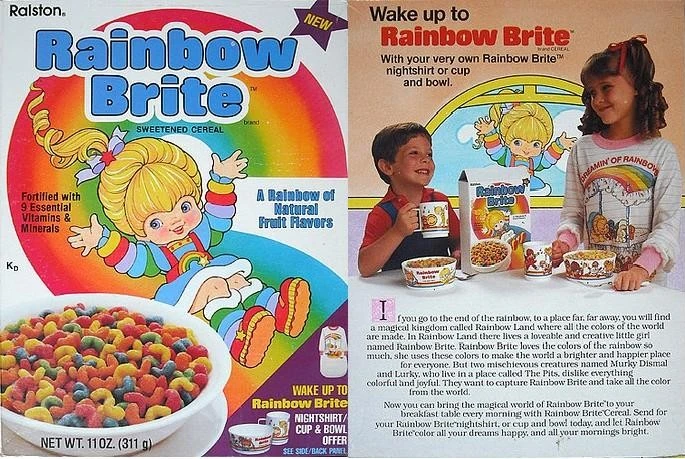
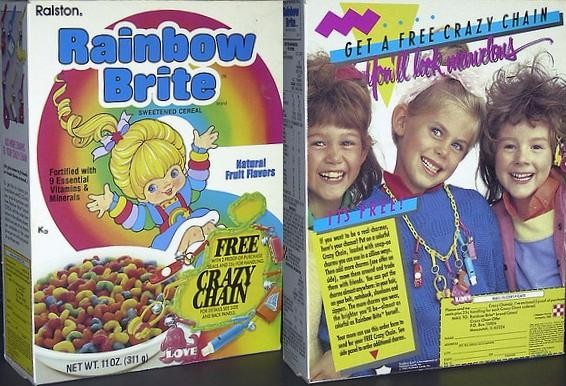
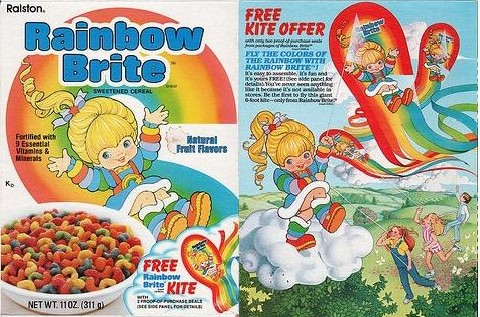
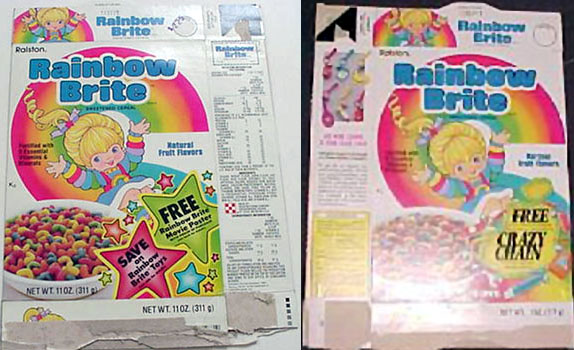
Rainbow Brite Cereal featured fruity-flavored pieces in the shapes of monotoned
rainbows. The original box introduced the world of Rainbow Brite to the eater
on the back panel. Subsequent panels featured the various promotions and
premiums the cereal had including stickers,
a night
shirt and bowl set, a Crazy Chain that
featured plastic goofy charms, a kite, a
poster and savings
on toys. The cereal had an impressive lifespan for a licensed cereal,
staying on shelves for five years before it was discontinued.
DiC produced a commercial for the cereal using the
same animation style as a typical episode of the Rainbow Brite series. It featured series villains Murky (Peter Cullen) and Lurky (Fraley)
attempting to remove the color from Rainbow’s new cereal as she enjoyed it with
Brian (Scott Menville), the only human
that could see Rainbow and her friends. But, the cereal proved too powerful and
left the villains covered in color instead.
Chris Columbus got the
inspiration to for Gremlinsafter
hearing what sounded like a “platoon of mice” in his loft scurrying about. He
wrote the script as a show of his skills for potential employers. The idea to
actually make it a film didn’t happen until Steven
Spielberg got ahold of the script and felt it was the most original thing
he’d seen in a long time. Tapping Joe
Dante to direct and Warner Bros.
to produce the film along with his Amblin Entertainment,
the film was a horror-comedy centered around a family’s acquisition of a mogwai:
a cute, furry little creature. That is, as long as three rules were followed: 1)
don’t expose it to strong light, 2) don’t let it get wet, and 3) never feed it
after midnight. Of course, these rules get violated and a horde of ugly, savage
gremlins end up on the loose; terrorizing the small town of Kingston Falls. Gremlins opened on June 8, 1984 and
became a box office hit.
As part of the promotion for the
film, Ralston
licensed the right to make a cereal based on it. Gremlins Cereal came with
pieces in the shape of the film’s star, Gizmo (Howie Mandel), who
also graced the box and was featured in the commercial for it. Incidentally,
the commercial also starred Jonathan
Ward as one of the kids eating the cereal, who would go on to appear in a
Dante-directed Twilight Zonerevival
episode. With two proofs of purchase from the box and $9.95, people could send away for a plush Gizmo doll.
Each box also included one of 11 different collectible stickers. The cereal was
a limited edition and stayed on the shelves about as long as the film’s
original theatrical run.