Remember that one day when you could wake up without an alarm? When you would get your favorite bowl of cereal and sit between the hours of 8 and 12? This is a blog dedicated to the greatest time of our childhood: Saturday mornings. The television programs you watched, the memories attached to them, and maybe introducing you to something you didn't realize existed. Updated every weekend.
The player takes control of an
unseen being whose job it is to tend to a neglected piece of land on Piñata Island.
Using a variety of gardening tools,
they get the plot ready for the planting of various kinds of plants and
erection of structures and habitats. When certain requirements are met, the
garden will attract any one of 60 species of Piñatas to come visit (based on
real animals, but in wild colors and given cute designations). Meeting further
requirements would result in that Piñata becoming a resident. If two Piñatas of
the same species take up residence (they have no gender) and their requirements
for mating are met, they will perform a “romance dance” that will lead to an
egg being delivered by Storkos
(a superpowered human woman who retrieved the eggs from Egg Mountain,
which the Piñatas had trouble doing themselves). The player can then hatch the
egg or send it off to another player. The ultimate goal is to keep the Piñatas
happy and healthy.
Professor Pester and the Ruffians.
The game isn’t just all gardening
and mating, however. To add a challenge there are antagonists in the form of
Ruffians led by the masked human Professor Pester and Sour Piñatas,
all of whom want to wreak havoc on your garden or harm your resident Piñatas.
Pester and his Ruffians can be chased off by purchasing certain items or
siccing a particular Piñata on them, while Sours could additionally be trapped
and tamed into being good Piñatas. Another threat comes from the natural food chain
of the island, known as the “doughnut of life”. Some Piñatas are predator and
prey to each other and must be eaten for a requirement. If both types are
residents, however, they won’t do that unless told, but fights between them
could still break out. And what gardening game would be complete without the
constant threats of weeds popping up and destroying your hard work?
Piñata Island.
Viva Piñata was developed by
British studio Rare,
who was responsible for hit Nintendo
games like Donkey Kong Country until Microsoft
purchased them outright. Co-founder Tim Stamper
came up with the idea of the game for the handheld Pocket PC
platform in 2002 and started up a development team on it. After the studio’s
acquisition, development moved to the Xbox
and eventually the Xbox
360
for its enhanced graphics. Wanting a unified style, the developers settled on
the piñata motif which excited them not only because piñatas were rare in their
home country, but the idea of their being filled with candy opened up all-new
gameplay possibilities. Microsoft’s only instruction to the team was to keep it
family-friendly, as they sought to make it the Xbox’s signature franchise and
use it to increase its market appeal.
The game was released on November 9,
2006. In order to meet their deadline, Rare ended up having to cut partial
ideas leaving the game incomplete in their eyes. However, the game was
well-received by players and performed within the company’s expectations,
making it an internal success. In promotion of the system and the game,
Microsoft collaborated with Six
Flags Mexico to build a 48-foot (15m) tall and 52-foot
(16m) long Piñata modeled after a Horstachio
(a horse); the largest-recorded
piñata ever built. Microsoft greenlit a sequel, which Rare
saw as an opportunity to make a more definitive version of the original. They
built upon the work they had already done, adding in a new cooperative
multiplayer mode, Xbox Live Vision
Camera support, more types of Piñatas and areas to catch
them, a new plot, fashion show and racing minigames and the ability to teach
the Piñatas tricks. Trouble
in Paradisewas released on September 2, 2008 to generally favorable
reviews that praised the additions but felt it was too similar to its
predecessor.
As part of their franchising,
Microsoft sought to bring their properties to television. They partnered with 4Kids
Entertainment and offered them several options from their
library. Seeing potential in Viva Piñata, 4Kids selected it before the
game was even released. 4Kids worked closely with Rare in making the show;
basing the character designs on the 3D models used in the game, including tips on
how to interact with the in-game Piñatas into the stories, and having original project
lead Gregg
Mayles approve each script for their applicability to the
game.
Langston in Piñata Central.
Like the game, the series was set on
Piñata Island, home to sentient Piñatas. The Piñatas went about their days
munching on candy and gardening until they reach their full Candiosity,
which was detected by a Candiosity
Meter that operated like a scale, or their own personal Piñatameter
that resembled a smart phone. The meter was monitored by Piñata
Central, which fielded requests for Piñatas at human parties.
Once full of their limit of candy, a Piñata was loaded into the Cannoñata
(a massive cannon) and fired to a party where they were smashed open by the
guests. Upon returning to the island, the Piñata was reassembled by robots and
they resumed their life until the next time they’re full. Certain Piñatas were
exempt from attending parties, such as royalty like King Roario (a lion, voiced
by Dan Green) or older more fragile Piñatas in retirement.
Promo art featuring Franklin, Simone, Paulie, Les, Fergy and Hudson.
The show focused on a primary set of
inhabitants: Hudson Horstachio (Green), one of the most popular and famous Piñatas
on the island whose ego often needed to be reigned in; Paulie Preztail (Brian
Mallard), a red-tailed fox that was clever and no-nonsense with a skill for
cooking and a dislike of parties; Fergy Fudgehog (David Wills), a hedgehog who
loved candy but had a deathly fear of parties and did whatever it took to get
out of them; Franklin Fizzlybear (Marc Thompson using a surfer accent), a laid
back grizzly bear who loved to surf and draw portraits of the others; Tina and
Teddington Twingersnap (Kathleen Delaney and Jamie McGonnigal, respectively), a
two-headed serpent that had sub-par gardening skills and always argued with
each other; Ella Elephanilla (Rbecca Soler), an elephant who suffered from
short-term memory loss and loved ballet; Les Galagoogoo (Eric Stuart, who also
served as voice director), a Galago whose intelligence was often overshadowed
by the fact his words came out as high-pitched gibberish (although the others
seemed to understand him, they just ignored him); and Langston Lickatoad (Mike
Pollock), a toad who was the representative of Piñata Central and responsible
for getting a full Piñata to the Cannoñata.
The Sours.
As in the game, the Piñatas were
often accosted by Professor Pester (David Brimmer) who concocted a variety of
plans to trap and break open the Piñatas in order to get at the candy they
contained. His plans were often ruined by his bumbling henchmen, the Ruffians
(Stuart), who also led to Pester accidentally creating the Sours. Another
antagonist was the Great Bonboon,
a baboon that pretended to be an all-knowing guru and tried various schemes to
steal the other Piñatas’ candy. Other characters included Chortles
Chippopotamus (Sean Schemmel),
a hippopotamus that believed himself to be a comedian; Pecky Pudgeon (Stuart),
a gossiping photojournalist pigeon; Simone Cinnamonkey (Soler), Hudson’s
resourceful monkey agent; Prewitt
Profitamole (Mike MacRae),
a mole who was the only mechanic on the island and an inventor, and who
performed repairs on Piñatas; Dr.
Quincy Quackenberry, a duck and the resident psychologist
called on to cure everything that ailed the others; Hailey
Horstachio, Hudson’s biggest rival; and Beverly
Badgesicle, a badger that was Hudson’s biggest and most
obsessive fan.
Ella squishing Paulie.
Viva Piñata debuted on FOX on August 26, 2006 as
part of the 4Kids
TV
programming block. The series was developed by Norman Grossfeld
and Lloyd
Goldfine, and was a co-production between 4Kids, Microsoft, YTV (where it would air in
Canada), and Bardel Entertainment,
who animated it. Each episode consisted of two segments written by Anne D. Bernstein,
David Steven Cohen,
Robert David,
Randolph Heard,
John T. Reynolds,
Eric Scott
and Mike
de Seve. The characters’ designs were adapted for the show
Ryan Cummings, Jason Cheng, Edmond Mai, Shayan Naziripour, and Carolyn Wong.
The series’ music was composed by John Siegler,
Mike Brady, Lou Cortelezzi, Sue Shufro, Elik Alvarez, Peter Lurye, Matt
McGuire, Ralph Schuckett, Freddy Sheinfeld, Dan Stein and Russell Velázques,
with Siegler and Grossfeld doing the theme.
The first 20 episodes of season one
aired on FOX until April 28, 2007. The remaining 6 episodes aired in the weeks
leading up to the debut of the second season in November, complete with a new intro. However, after three
episodes the new ones stopped airing in the United States. By this time, the
relationship between 4Kids and FOX was dissolving due to 4Kids’ failure to pay
the network for the air time and the network’s inability to guarantee that
affiliates would even carry the block. Ultimately, FOX would abandon Saturday
morning programming altogether. In the meantime, the series continued to air on
YTV. 4Kids brought the show back onto their CW4Kids
programming block on The
CW
in September of 2008, but took it off again after 6 episodes; leaving 16
episodes unaired in the United States. Viva Piñata finished out its run
on YTV in May of 2009, and continued airing reruns through June of 2011. Across
both seasons, Viva Piñata aired in over 107 different countries and was
translated in 27 languages.
Microsoft commissioned a video game
based on the show, making use of its characters—Hudson, Paulie, Fergy, Franklin
and their female counterparts that appeared in various episodes—and voices.
However, as Rare was working on Trouble in Paradise (whose plot was
influenced by the show, although not as directly as this game), Microsoft
outsourced its production to Australian Krome
Studios. Unlike the other Viva Piñata games, Party Animals was
comprised of minigames in what is known as a party game, a genre popularized by
the Mario
Partyseries. It was framed like a game show where contestants competed
against each other with colorful commentary provided by announcers, followed by
a racing game and random challenge games. The winner was determined by which character
ended up with the most Candiosity. Although Microsoft expressed the utmost
confidence in Krome to help keep the franchise—and the 360—successful, the end
result was a game that was poorly received. Many criticized the fact it leaned
towards a much younger audience, and that the minigames felt far too similar to
each other. Rare would go on to make only one more Viva Piñata game in
2008: Pocket Paradisefor the Nintendo DS.
While maintaining the original gameplay mechanics. Pocket Paradise would
make use of the cartoon’s characters and clips both within the game and for its
marketing.
One of the DVD covers.
The segments “Chewnicorn in the
Garden” and “Horstachio of a Different Color” were released for free download
on the Xbox Live Marketplace
as a kind of preview before the show’s debut. The latter was also later
included on a bonus disc included with the Special
Edition of the game. In 2009, Shout!
Factory released the first 10 episodes across two DVD collections: The
Piñatas Must be Crazy and Other Storiesand Lights,
Camera, Action!Imavision
Canada would release three
volumes in Canada containing 4 episodes each. In the United Kingdom, Walt
Disney Pictures released 15 episodes across 3 DVDs: Hudson’s Better
Half, Invasion of the Boogie Snatchers!, and A Match Made in Court! On
the UK releases, segments were mixed up and not paired with their originally
aired partners. In Australia and New Zealand, Magna Pacific
and Warner
Bros. released 12 different episodes across 3 collections. EPISODE
GUIDE (some airdates vary by source and may not be entirely accurate): Season
1: “Cocoadile
Tears / Candiosity” (8/26/06) – Tina and Teddington need Cocadile tears to
improve their garden. / Fergy tries to decrease his Candiosity so he won’t have
to go to the party. “Queen
for a Day / A Chewnicorn in the Garden” (8/26/06) – The Buzzlegums grow tired
of Beatrice and make Franklin their leader. / Fergy and Franklin try to
convince Paulie that Chewnicorns are real. “Legs
/ Horstachio of a Different Color” (8/26/06) – Fergy has to borrow Chuckles’
legs when he loses his during dance practice. / A new rival turns Hudson off of
entering the Spring Fair Horstachio Competition. “Whirlm
with a Dream / The Crush” (8/26/06) – Wilson’s stature keeps him from going to
a party. / Ella accepts invitations to the dance from Fergy and Paulie, causing
problems between them. “Trojan
Horstachio / The Piñatas Must Be Crazy” (9/23/06) – Professor Pester and his
minions disguise themselves as a female Horstachio to lure Hudson into a trap.
/ Great Bonboon convinces everyone that a balloon animal is a supreme being. “Franklin
Can’t Dance / Les Saves the Day..Again!” (9/30/06) – Franklin’s friends talk up
his the skills at dancing he doesn’t have to help him impress a girl. / No one
can understand Les’ warnings about the erupting volcano. “Sick
Day / Lights, Camera, Action!” (10/7/06) – Fergy takes care of the sick Piñatas
in the hopes of catching their cold. / Professor Pester disguises himself as a
movie director and everyone wants to be in his film, except Paulie. “Mad
Mongo / Hudson’s Biggest Fan” (10/21/06) – Franklin attempts to tame a Sour
Macaraccoon. / Beverly Badgesicle loves Hudson so much that she just won’t
leave him alone. “Mission:
ImPiñatable / My Little Fergy” (11/11/06) – Professor Pester captures Hudson,
who takes a liking to Pester’s lair. / Fergy’s mother comes to visit and he’s
embarrassed at never having been to a party like he’s written to her that he
has. “The
Great Gob Rush / Hero” (11/4/06) – Fergy stumbles upon a cave full of golden
caramel clusters. / When Franklin saves Hudson’s life Fraklin has trouble with
his newfound fame and Hudson has trouble being overshadowed by him. “On
a Sour Note / Pig Out Mountain” (11/18/06) – Sour joining the Piñata’s band
makes them a success. / Paulie and Fergy join Roary Rashberry’s gang on a trek
for a location supposedly loaded with food, which they plan on moving to. “Piñatapartyphobia
/ Royal Visit” (2/17/07) – Dr. Quackberry tries to cure Fergy’s party phobia. /
Fergy attempts to get knighted by King Roario so he won’t have to go to any
parties. “The
Wraisins of Wrath / Piñata Island Idol” (2/17/07) – A raisin pie turns the Piñatas
into their personality opposites. / The Piñatas attempt to raise funs to
rebuild the dance hall. “To
Catch a Piñata / Invasion of the Boogie Snatchers” (2/24/07) – Fergy becomes
the new Piñata wrangler. / Professor Pester hypnotizes the Piñatas to get all
of their candy. “Cannibalism
/ Pecky Pudgeon, Private Eye” (3/3/07) – Fergy is charged with cannibalism
after he eats a chocolate Bunnycomb he said was his cousin. / Pecky searches
for the missing Ella. “Rocket
to Nowhere / Twingersnapped!” (3/10/07) – Bonboon offers to send Fergy to
another planet for all of his candy. / Teddington and Tina split into two after
they get lost in the jungle. “Franklingestion
/ Confetti-it is” (3/17/07) – Franklin can’t remember a party he went to, or
figure out why he’s spitting up vegetables. / Franklin’s coat falls out when he
contracts Confetti-it is and goes to Dr. Quackberry for a cure. “Soil
and Green / I, Pretztail” (3/24/07) – Fergy and Paulie discover a Whirlm that
can make plants grow anywhere he digs. / Paulie learns he was mistaken about
his origins due to a misplaced file. “Free
the Piñatas / For My Next Trick” (4/7/07) – Professor Pester convinces the Piñatas
to destroy the Cannonata in Piñata Central. / Professor Pester sets his sights
on Franklin’s new magic wand. “Treasure
of Piñata Madre / Between a Flock and a Hard Place” (4/21/07) – Professor
Pester seeks to claim a found treasure chest. / When Goobaa rampages his flock
through the gardens, Teddington gets the blame. “High
Plains Drafter / Pester’s Party” (10/13/07) – A caricature artist visits the
town and destroys the confidence of the Piñatas. / Professor Pester changes the
Cannonata’s coordinates to launch the Piñata’s to his party trap. “Mouse
Flap / Snow Place Like Home” (10/20/07) – Monty Mousemallow gets angry when
Franklin accidentally sits on him. / Paulie and Fergy’s retirement destination
ends up being in the Arctic. “The
Abominable Jeli / Mirror Shmirror” (10/27/07) – Franklin, Fergy, Hudson and Les
find themselves in the middle of a snowball war. / Franklin falls into another
dimension and encounters an evil dictator version of himself. “My
Pal Langston / Snail’s Pace” (10/27/07) – Fergy and Paulie plot to become
Langston’s friends so he won’t send them to any parties. / Fergy’s soccer team
must overcome their handicaps to deal with suddenly facing off against a team
of Sours. “Hudson
on Hudson / Wild Horstachios” (11/3/07) – Hudson’s puppet show starring a
puppet of himself gives him a crisis of ego. / Hudson ends up living in the
wild for the first time with a group of Horstachios. “My
Sweet Sours / Six Million Dollar Piñata” (11/10/07) – Professor Pester
reminisces about the beginnings of his sinister plans. / Fergy gets a bionic
upgrade and has trouble controlling his new abilities. Season
2: “A
Terrible Tribute / Pester the Piñata” (11/17/07) – Hudson is placed on a show
where he meets Piantas from his past. / Professor Pester gets amnesia and
believes he’s a Piñata. “Fudge
Match / Hudson’s Holiday” (11/24/07) – Fergy becomes jealous of a visiting
Fudgehog and challenges him to a race. / Hudson is forced to take a vacation on
a deserted island. “Hudson
Tells All / Langston’s Jameleon Cousins” (12/1/17) – Hudson’s talking doll
records a rant and offends the other Piñatas. / Langston’s cousins visit and
pull pranks on him. “The
Fudgetive / She Stomps at Night” (2/17/08 CAN, 9/13/08 US) – Fergy tricks the Piñatas
into believing he’s been captured by a vacationing Professor Pester. /
Professor Pester attempts to lure a sleepwalking Ella to his lair. “Les
the Jet Setter / Slayin’ em at the Sands” (2/24/08 CAN, 9/20/08 US) – Fergy
uses Les’ jetpack to avoid parties. / Professor Pester puts on a comedy routine
to make Paulie’s cousins lose their candy. “Crimes
of Passion Fruit / The Antlers are Blowin’ in the Wind” (3/2/08 CAN, 9/27/08
US) – Thinking the big boss of Piñata Central—a bowl of fruit—is ignoring him.
Fergy smashes him with a stapler. / Paulie and Fergy are joined by Machi Moojoo
in their attempts to avoid parties. “Sumo
Tsumani / Recipe for Disaster” (3/9/08 CAN, 10/4/08 US) – Fergy becomes a sumo
wrestler so that he can gorge. / Fergy and Paulie enter a cooking contest to
win a lifetime supply of candy. “Mr.
Unbustable / Too Many Fergys” (3/30/08 CAN, 10/11/08 US) – Fergy plots to work
out hard to make himself unbreakable. / Fergy ends up in a time portal that
sends him back to yesterday. “Party
Parasite / Hibernation Nation” (11/4/06) – Hudson learns a parasite is eating
all of his candy. / Franklin invites his friends to a hibernation party. “The
Old Piñatas Home / Shirley Sells Out” (4/6/08 CAN, 10/18/08 US) – Fergy and his
friends decide to spruce up his uncle’s retirement home. / Professor Pester
gives Shirley a potion that changes her into a Sour. “The
Transparent Trap / To Catch A Pester” (6/8/08 CAN) – Great Bonboon convinces
Fergy that a tonic turned him invisible. / The Piñatas lock up Professor Pester
in their new jail, but he turns out to be an annoying houseguest. “My
Sweet Swanana / Ella Forgets to Forget” (12/8/07) – Fergy and Paulie set Rory
up on a date in an effort to get him out of Paulie’s house. / Fergy uses Ella’s
forgetfulness as a service, but she ends up beginning to remember the secrets
she’s told. “Motivational
Break / Bringing up Cluckle” (4/20/08 CAN) – Langston enlists a drill sergeant
to get Fergy and Paulie ready for parties. / Joining a big brother program puts
Hudson in charge of a mother Cluckle’s three kids. “Beauty
and the Beasts / The Talented MR. Hck” (4/27/08 CAN) – Disliking the entrants
he has to judge for the Miss Piñata pageant, Hudson has Fergy, Franklin and
Paulie enter disguised as women. / Hudson’s hiring of a double backfires when
the double really does try to take his place. “De-Mock-Racy
/ Her Royal Forgetfulness” (5/18/08 CAN) – Hudson takes the lead in the vote to
replace Langston. / Fergy takes advantage of Ella’s new status of being a queen
to play her husband and get out of parties. “The
Wrong Stuff / Piñatametermania” (5/25/08 CAN) – Hudson is sent to a party on
the moon that ends up being a trap by Professor Pester. / A mix-up at the
theater leaves the Piñatas with the wrong Piñatameters and jobs as a result. “Heads
and Tails / Speechless” (6/22/08 CAN) – A faulty repair robot puts Hudson’s
head on Fergy’s body and he ends up put into a circus. / Teddington takes
advantage of Tina’s laryngitis to engage in his terrible singing without her
complaints. “Good
Cop, Bad Cop / Announce This” (6/29/08 CAN) – Hudson becomes a cop and arrests
everyone on the island—even himself. / Hudson, Pierre and Pecky compete to be
the announcer for the Party Animals Championship Challenge. “Ruffians
On Strike / Zip It Good” (9/7/08 CAN) – Hudson helps the Ruffians strike
against Professor Pester…now he needs to get them back to him. / Hudson
takes a vow of silence. “Tabloid
for Two / All Spun Out” (9/14/08 CAN) – Rivals Hudson and Hayley are forced
into a wedding when their agents promote their having a relationship. /
Professor Pester opens a nightclub to lure in the Piñatas and steal their
candy. “Arctic
Invasion / Say Uncle Hoofy” (1/11/09 CAN) – Hudson and Langston work together
to get rid of the sensational new visiting band. / Hudson and Fergy fight over
who’s the favorite son when Fergy’s mother and Hudson’s uncle get married. “A
Match Made in Court / Hudson’s Better Half” (1/18/09 CAN) – Beverly takes
Hudson to court and is awarded the right to be within 10 feet of him at all
times. / Hayle and Hudson’s teams compete in an obstacle course that both want
to lose. “Hudsonly
Ever After / Hudson Who-Stachio?” (9/8/07) – Hudson tells his dummy a bedtime
story to help him sleep and inserts himself into it. / When Hudson is ignored
at a party he falls into a personal crisis. “The
Horstachio Who Never Was / Fergy Drops Out” (9/15/07) – Hudson creates a new
identity for himself that the others like more than his original one. / Fergy
and Paulie flee a party re-education course and Fergy finds himself named the
master of a group of party-rejecting Chocstriches. “Super
Hero Hudson / The Amazing Hudini” (9/22/07) – Hudson gains super powers and
becomes a hero, but ends up taking things too far. / Hudson attempts to revive
his career by becoming a stunt performer. “Variations
on a Theme Park / Masters of Klutz Fu” (5/18/09 CAN) – Hudson prevents Rodney
from building his theme park. / Fergy and Paulie decide to create their own
martial art to fend of kids at parties.
He had the recurring role of Mr. Harrington and the one-time role of Mr.
Spalding in Saved by the Bell: The New Class, which he also directed.
Additionally, he directed every episode of City Guys.
New Gottlieb programmer Warren Davis was
looking for ways to practice his craft; particularly randomness and gravity
mechanics. He came across artist Jeff
Lee’s doodles of characters and concepts he had been drawing since
childhood and asked if he could use them in his efforts.
The resulting game is what would
eventually be known as Q*bert. The player controlled the titular
character, a round creature with no arms and a long nose, as they moved him
diagonally around various pyramids comprised of cubes designed to give the
illusion of being in 3-D, inspired by the works of M.C. Escher. The player was tasked with
changing each cube to a target color by jumping on them—a suggestion from vice
president of engineering Ron
Waxman—while avoiding enemies and jumping off of the pyramid into the black
void that filled up the rest of the screen.
Flyer describing Q*bert and its characters.
Those enemies included Coily, a
purple snake that hatched from an egg that bounced down the pyramid and
actively pursued Q*bert; Ugg and Wrongway, two purple creatures that moved up
the sides of the pyramid to the top until they fell off; and Slick and Sam (a
play on “spick and span”), two green creatures that descended on the pyramid
and reverted the colors of blocks Q*bert already changed. Additionally, there
were bouncing balls: a red one that would kill Q*bert on contact, and a green
one that would immobilize enemies for a brief period. Additional help came in
the form of multi-colored discs located near the bottom of the pyramids that
could bring Q*bert quickly back to the top in order to escape enemies (if Coily
was close enough, this would cause him to leap off the pyramid in pursuit).
Whenever Q*bert ran into something that hurt him, a word balloon would appear
with “@!#?@!” in it accompanied by a gibberish voice sample designed by audio
engineer David Thiel when
he was unable to create coherent English phrases on the synthesizer he was
using (meant to be gibberish, not swearing). Falling deaths were
accompanied by a thud created by a pinball machine spring hitting the inside of
the game cabinet; a contribution from technician Rick Tighe.
Flyer touting Q*bert's success.
Davis began working on the game in
April of 1982, and several months later it became an official Gottlieb project.
Most of the decisions in the crafting of the game came from Davis’ desire to
keep it simple for himself, as well as try to keep it simple for players. He
championed his unusual directional controls against strong opposition, feeling
players would appreciate their simplicity. While initial test audiences did
find it difficult at first, many were able to adapt. The battle Davis lost,
however, was in the game’s challenge level as Gottlieb had him make it slower
and easier. The biggest hurdle, however, was the game’s name. Throughout its
development it was given the unofficial title “Cubes”. Lee wanted to call it Snots
and Boogers after the original concept of Q*bert firing “mucus bombs” from
his nose, which Davis did away with because of its complexity to program. It,
along with a list of suggestions from various employees, was discarded. Vice
president of marketing Howie Rubin pushed for @!#?@! to become the
official name, with some test cabinets being released emblazoned
with it. This was rejected as a silly notion as nobody could pronounce it.
Eventually, it was decided to name it after the character, with “Hubert”
becoming a strong contender. The name was ultimately combined with “Cubes” to
become “Cubert”, and art director Richard Tracy stylized it as “Q-Bert”, with
the hyphen eventually giving way to the asterisk.
Attempting to expand the Q*bert empire.
Q*bert
was
officially released between October and December of 1982, becoming Gottlieb’s
fourth title and only critical and commercial success with the sale of around
25,000 cabinets. It was among the 13
highest-grossing arcade games of 1983, and was widely merchandised with the
character appearing on coloring
books, board games
and toys.
A flyer
released by Gottlieb boasted that the game was included on over 125 different
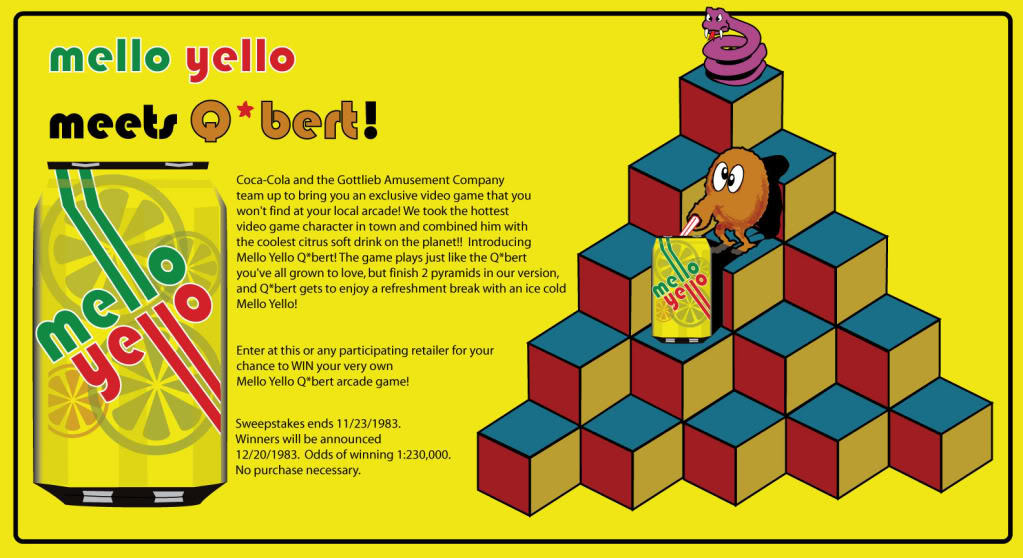
products. A variant version of the game cross-promoting Mello Yello, Mello Yello
Presents Q*bert, was released as a sweepstakes
prize; with Gottlieb hosting a competition that would net a player 5 cases
of the soda if they finished the game 10 times and sent a picture of Q*bert
drinking it in the new cutscene. Gottlieb, at the time, was owned by Columbia Pictures
who in turn was owned by Coca-Cola,
the makers of Mello Yello. Gottlieb would also translate the game into a
pinball machine called Q*bert’s Quest, but that only performed well in
Japan.
Q*bert with Q*tee and Q*ball in the car, Slick and Sam, and Q*bit.
Q*bert saw the titular
character (Billy Bowles) as a high schooler—with arms!—in the town of Q*burg. It
was a 1950’s-inspired world full of cube shapes (food, plates, records, even
the buildings were cubes stacked on cubes) with names either containing the
word “cube” or beginning with “Q*” (the asterisk was often replaced visually by
the original hyphen). He was joined by a cast of new characters: his
girlfriend, Q*tee (Robbie Lee); his little brother, Q*bit (Dick Beals); his
laid-back and constantly hungry friend, Q*ball (Frank Welker); Valley girl
Q*val (Lee); and monstrously-strong Q*mungus (Welker).
Coily with Wrongway, Ugg and Viper.
While
the town was primarily populated by “nosers”, there were some that stood out;
particularly snake Coily (Welker) and his gang of bullies: dim-witted Ugg and
Wrongway (Welker) and his girlfriend, Viper (Julie McWhirter, impersonating Mae West). Coily and Ugg were
dressed like greasers,
while Wrongway wore tattered clothing and looked ferociously monstrous. Slick
and Sam (both Welker) were also present, but they were more well-meaning
troublemakers and friends of Q*bert’s rather than enemies (although, with
friends like those…).
Wrongway and Ugg always causing trouble.
Most
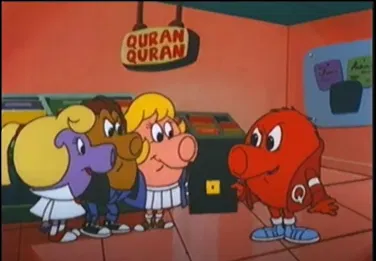
stories centered around Q*bert and his friends hanging out at school, Cube
Pizza or the Sweet Shoppe (complete with a row of arcade games) and engaging in
various activities with each other and around town while Coily and his gang
always sought to disrupt their fun or show them up through underhanded means
and pranks. Reintroduced was the original concept of Q*bert firing projectiles
from his nose; in this case his “Slippy-Doos”, black balls that turned into oil
slicks and tripped up enemies. In keeping with the games, the rainbow discs
were present as the equivalent of skateboards (or, more accurately, the hoverboards
eventually seen in Back
to the Future Part II) and the surface of objects changing color when Q*bert
bounced on them during a chase (although an explanation for the color change
was ever given, nor acknowledged). Also, whenever Q*bert ended up hurt or
annoyed, he would get his signature word balloon and the gibberish dialogue
would be played.
Hanging out at the music story with Q*val.
Q*Bert
made
its Saturday Supercade debut on October 1, 1983 after two episodes of Pitfall!
aired in a row. It was primarily written by story editor Gary Greenfield, with
additional writing from Tony
Benedict and Kayte Kuch.
The Supercade theme was composed by Haim Saban
and Shuki Levy,
while the Q*bert theme was done by John Bahler
and Rick
Segall. When Supercade was renewed for a second
season, Q*bert was the only returning feature along with Donkey Kong.
The other three segments were replaced by adaptations of Kangarooand
Space
Ace.
Q*ball should know better than to hit on the girlfriend of Q*jock.
Despite
the initial marketability of the original game, follow-up efforts hadn’t
received as much fanfare. The reception of the home ports by Parker Brothers
varied from system to system. Bowles would reprise his role in animated commercials for
them. The sequel, Q*bert’s
Qubes, was released under Gottlieb’s new name, Mylstar
Electronics, in 1984 and utilized free-floating rotating cubes and new
enemies. It went beneath the public’s notice. Konami,
who handled Gottlieb’s international distribution, produced their own Q*bertin 1986 for MSX computers
utilizing the Qubes mechanic with Q*bert replaced by a dragon. Future
home releases of the original would update the game to
include new levels and visuals, while a cancelled version more in line with
Davis’ original vision called Faster Harder More
Challenging Q*bertwas released by him onto the internet in 1996.
Q*bert on DVD.
To
date, Saturday Supercade hasn’t seen any form of release on home media. Warner
Archive announced via their Facebook page
in 2010 that plans were underway to release Supercade
to DVD, but because of rights issues with the various game properties the
project needed extensive research before it could happen. However, unlike the
other parts of Supercade, the rights to Q*bert remained with
Columbia after they sold off Gottlieb, and came under the ownership of Sony with the rest of the studio. To coincide
with the release of the Sony film Pixelsin 2015,
which featured an appearance by Q*bert (Billy West) along with a variety
of other video game characters, Sony
Pictures Home Entertainment released The
Best of Q*bertonto DVD. The title
alluded to the fact that only 17 of the 19 episodes were available to transfer
onto the disc for release, preventing it from being the complete series.
EPISODE GUIDE:
Season 1:
“Disc
Derby Fiasco” (10/1/83) – Coily steals Q*bert’s new disc so he can’t win the
upcoming derby.
“The
Great Q*tee Contest” (10/15/83) – Coily plots to spoil Q*tee’s chances to win a
teen contest and make Viper the winner.
“Q*bowl
Rigamarole” (10/29/83) – Coily plans to cheat his way into becoming a star
quarterback.
“Crazy
Camp Creature” (11/12/83) – After Q*bert makes Coily look like a coward, he
plans to crash their campout and return the favor.
“Thanksgiving
for the Memories” (11/26/83) – Q*bert’s class gets a history lesson about the
first Thanksgiving in Q*Burg.
“Dog
Day Dilemma” (12/10/83) – Q*bert and Coily intern at a dog groomer for the
hopes of winning a permanent position.
Season 2:
“Take
Me Out to the Q*game” (9/8/84) – Worried about his father’s job if they beat
Q*boss in the father/son ball game, Q*bert tries to convince his friends to
help him lose.
“Noser
P.I.” (9/15/84) – Q*bert and his friends have to find who took Q*Puppy before Q*Ball
ends up expelled.
“Hook,
Line and Mermaid” (9/22/84) – Q*bert accidentally hooks a mermaid on a cruise,
and Coily plots to capture her and sell her to the zoo.
“Q*historic
Days” (9/29/84) – Taking refuge from a storm in a cave, Q*bert translates some
cave paintings for his friends to pass the time.
“Q*bert’s
Monster Mix-Up” (10/6/84) – Q*ball is accidentally turned into a monster and
joins Coily’s gang.
“Game
Shoe Woe” (10/13/84) – NO SYNOPSIS AVAILABLE.
“The
Wacky Q*bot” (10/20/84) – Q*bert and his friends try to help a klutzy robot
prove he’s useful to prevent his being sent back to the factory and dismantled.
“Q*beat
It” (10/27/84) – Q*bert and his friends are making a music video to win a
contest, and Coily plans to sabotage them so that his group’s video will win.
“Q*urf’s
Up” (11/3/84) – A trip to Q*waii gets interrupted by bullies who challenge
Q*bert to a surfing contest.
“Little
Green Nosers” (11/10/84) – Q*bert and his friends accidentally get launched
into space and encounter aliens that want them for scientific experiments.
“Rebel
Without a Q*ause” (11/17/84) – Q*bert and Viper have to join forces with their
friends to get their stuff back from Q*bully and his gang.
“Looking
for Miss Q*right” (11/24/84) – The gang tries to help Q*ball get a date for the
dance.
“The
Goofy Ghostgetters” (12/1/84) – Q*bert and his friends set out to ensure three
troublesome ghosts are sent back to the afterlife from whence they came.
By the time the 1980s rolled around,
the American video game market was booming. Arcades were experiencing a Golden
Age
with rapid advancement in technology and growing cultural impact beginning with
the release of Space
Invadersin 1978. Likewise, home
consoles were entering their second
generation thanks to the affordability of new microprocessor
technology, with the Atari
2600
leading the charge. This resulted in a combined revenue of $11.8 billion for
the video game industry by 1982.
Hanging out at the arcade.
Television and studio executives
were not ones to let a popular trend go by without finding a way to capitalize
on it. ABC
and Hanna-Barbera
struck first: adapting the highly successful arcade game Pac-Maninto
a hit animated series. TBS
was next with a game show that utilized arcade games, Starcade.CBS, looking to compete,
decided to hedge their bets by not just licensing one hit game, but several from
both the arcades and home consoles.
The stars of Supercade: Donkey Kong, Donkey Kong Jr., Q*bert, Pitfall Harry and Frogger.
Among the chosen properties was the
game that saved Nintendo
of America from bankruptcy, Donkey
Kong, and its sequel, Donkey
Kong Jr.; Gottlieb’s
most successful game, Q*bert;
Konami’s
hit Frogger;
and Activision’s
home console smash, Pitfall!These
five entries were combined under the banner Saturday Supercade where
they would air four segments over the course of an hour every Saturday (Q*bert
and Pitfall! would alternate weeks). Naturally, as video games at
the time were a bit limited in their story and presentation, some liberties
were taken in adapting them for the small screen; such as making Frogger (Bob
Sarlatte) an investigative reporter or setting Q*bert in a pastiche of
the 1950s in a town dominated by cube shapes.
Character models for Donkey Kong's Pauline and Mario.
Saturday Supercade debuted on
CBS on September 17, 1983. The series was produced by former Hanna-Barbera
employees Joe
Ruby
and Ken
Spears through their company, Ruby-Spears Productions.
Despite sharing screen time in the intro and during commercial bumpers, and
that both Donkey Kong and Donkey Kong Jr. were set in the same
universe, none of the shows or characters crossed over or interacted with each
other. Jack
Enyart, Gary
Greenfield, Gordon
Kent
and Michael
Maurer served as story editors, while Haim Saban
and Shuky Levi
composed the series’ theme. Dean Elliott
handled the rest of the series’ music.
Supercade was renewed for a
second season; however, there were some changes. Donkey Kong Jr., Frogger and
Pitfall! were dropped from the line-up. In their place came Sun Electronics’
(aka Sunsoft) hit arcade Kangaroo,
and
the second game from notable Disney
animator Don
Bluth, Space
Ace. Richard Merwin,
Cliff Roberts
and David
Villaire served as story editors this season. CBS also
expanded their video game offerings with a series based on the racing game Pole
Position, but as it was by DiC Entertainment
it was kept separate from Supercade. Supercade continued on until
December of 1984, and then left the airwaves forever.
Article published during Atari's decline.
One
of the contributing factors to its cancellation was that it was unable to
compete with the powerhouse Smurfsover on NBC. The other factor was
that during the show’s production, the video game industry was hit by the crash
of 1983: too many consoles, too many similar games of
questionable quality through the establishment of third-party publishers, plus
the rise of the home computer meant that there was a lot more product than
consumers. Arcades fared no better as there really hadn’t been any major
innovation in game design and they were blamed for instances of delinquency in
their vicinity. Video games had lost their luster for Americans and wouldn’t
begin to rebound until Nintendo
imported their revamped Famicom as the Nintendo
Entertainment System in 1986. The console wars began anew when
Sega
entered the fray, challenging the 8-bit Nintendo console with its high-speed
16-bit Genesis.
With this new era in gaming came new attempts to adapt them for the screen, but
those are stories told in their own entries.
A revived console war meant a new lease on life for video games--and new shows based on them.
Because Sony owned Q*bert through
Columbia
Pictures’ previous ownership of Gottlieb, it remains the only
entry in Supercade to have seen a home video release. The
Best of Q*bertcame out in 2015 to
coincide with the release of their film Pixels,
which
featured the character. Warner
Archive announced via their Facebook page
in 2010 that plans were underway to release Supercade
to DVD since they currently own the Ruby-Spears library, but because of
rights issues with the various game properties the project needed extensive
research before it could happen. Segments from Space Ace have appeared
as filler between programs on Boomerang
and Toonami,
but otherwise the various segments have only become viewable through recorded
uploads on sites like YouTube.
He was an animator that worked continuity for King Kong (1966) and provided animation for The Jackson
5ive, The Osmonds and several episodes of Sesame Street.