
In 1988 Nintendo released Super Mario Bros. 3 for
the Famicom
in Japan, while the American release for the Nintendo
Entertainment System was delayed until early 1990 due to a shortage
of ROM chips. For American audiences, it was a return to the classic
gameplay established in the original as the American version of Super Mario Bros. 2 was
a reskinned version of the unrelated game Yume Kojo: Doki Doki Panic. That game allowed players to use
Princess Toadstool and her loyal attendant Toad along with the brothers—each
with a unique attribute—and featured a mechanic of plucking items out of the
ground to toss at enemies, rather than simply jumping on their heads. Nintendo
felt the true sequel,
which was more of an expansion pack for the first than an entirely unique new
game, was too difficult for them; although it would eventually see a release in
America as The Lost
Levels.
Mario 3 sees Mario and Luigi
back in their pallet-swapped glory attempting to save the Mushroom Kingdom from the
forces of Bowser and his
minions. Once again, two players were able to play by alternating turns each
level as Mario or Luigi. It was also the first game in the series to feature an
overworld map where players could select a stage to play, rather than just
proceed into each successive level upon the previous one’s completion. However,
this time around, Bowser is joined by some new allies: his children, the Koopalings. The Koopalings resemble
shorter versions of Bowser, each with their own personality, fashion sense and
hair style to distinguish them.
 |
| Iggy, Lemmy, Ludwig, Morton, Wendy, Larry and Roy. |
Originally unnamed, Nintendo
of America gave them names based on musicians and celebrities: Larry, with
a Mohawk, was named after Larry Mullen, Jr.;
Morton, who had a white head with a star over one eye, was named after Morton Downey, Jr.; Wendy O.,
with feminine accessories including a polka-dotted bow, high heels, bracelets
and lipstick, was named after Wendy O.
Williams; Roy, with sunglasses and no visible hair, was named after Roy Orbison;
Lemmy, with a rainbow Mohawk, crazy eyes, and balancing on a ball, was named
after Lemmy Kilmister; Ludwig Von, with a
single fang and Beethoven-style hair, was named after Ludwig van
Beethoven; and Iggy, with large glasses and a Mohawk, was named after Iggy Pop. Each Koopaling served as the boss of
one of seven worlds, with Bowser as the eighth and final. Their primary weapons
were magic wands that fired out different harmful spells, but could also attack
with their shells after they were jumped on.
 |
| New power-ups! |
While all of the familiar power-ups returned—including the size-increasing Super
Mushroom, fire throwing Fire
Flower and invincibility-granting Starmen—a
new assortment was provided for the Mario Brothers. The Super Leaf gave them raccoon
ears and a tail that allowed them to attack with it, fly up a great distance
with a running charge, or slow their descent. The Tanooki Suit gave them the
same abilities as the Super Leaf, but also allowed them to briefly turn
themselves into invulnerable (and immobile) statues. The Frog Suit gave them greater speed
and maneuverability in the water, as well as a higher jump. The Hammer Suit turned them into
versions of The Hammer
Brothers, allowing them to fling hammers at enemies. Finally, the P-Wing granted them indefinite
flight for an entire level until an enemy made contact or another power-up was
grabbed. A less-common power-up was the Goomba Shoe; a large green
shoe with a wind-up key that could be taken from the Goomba riding in it and worn to
prevent damage from spikes and spiked enemies. Power-ups could also be won in
mini-games and saved for later use in one of three slots accessible on the map,
allowing a player to begin a level with their chosen power-up active.
 |
| King Koopa surveys things from his Doom Ship. |
A hit in Japan, the game
was adapted into three direct-to-video
OVAs by Studio Juno. Anticipating it would have the same reception in
America, production began on a new Mario Bros. cartoon developed by Bruce and Reed Shelly
called The Adventures of Super Mario Bros. 3. Once again produced by DiC Entertainment,
the series served as a sequel to their previous one that aired
in syndication as part of the syndicated The Super Mario
Bros. Super Show!, which was in production at the same time. That meant
that Mario and Luigi retained their respective original red and green coveralls,
despite the games having swapped the colors between them and their shirts (Mario’s
hair would become brown as it had in artwork for the game). However, when using
fire powers, they assumed the orange and red color scheme of the game rather
than the white hats and coveralls of the previous version. Bowser was also once
again replaced by King Koopa, and the tone of the show skewed a bit more
serious than the Super Show entries.
 |
| From plumbers to janitors as the brothers try to clean up Brooklyn. |
Opting for an entirely Canadian voice cast, Harvey Atkin was retained as
Koopa’s voice, as was John Stocker as Toad, while Walker Boone replaced Captain Lou Albano as the voice
of Mario, Tony Rosato replaced Danny
Wells as Luigi, and Tracey Moore replaced Jeannie Elias as Princess
Toadstool, ruler of the Mushroom Kingdom. Sei Young
Animation Co., Ltd. was again retained to handle the animation, however
this time around they were joined by Italian studio Reteitalia
S.P.A., resulting in slightly different character models. Because
production on the series began before the game was released in America, the
Koopalings were given different names based on their personalities: Larry
became Cheatsy (James Rankin); Morton became Big Mouth (Dan Hennessey); Wendy
became Kootie Pie (Tabitha St. Germain); Lemmy and Iggy became Hip and Hop,
respectively (both Tara Strong); Roy became Bully (Gordon Masten); and Ludwig
became Kooky Von (Michael Stark). Concept art for Big
Mouth and Kootie
Pie had them looking a bit closer to their game appearances than the ones
that ended up used on the show.
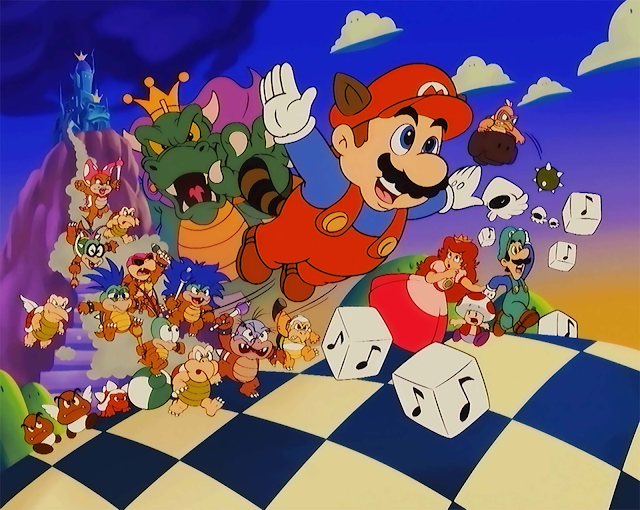 |
| Promo image for Super Mario Bros. 3. |
As with the previous series, Super Mario Bros. 3 made liberal use
of music, elements, locations and sound effects from the game. Each episode was
comprised of two segments whose title screens were modeled after the game’s
with a curtain that rose up from a stage. The background of the title would be
an image of the overworld map with the game’s music by Koji Kondo. Scene
transitions would mimic entering a level in the game with the same sound
effect. Koopa’s primary transportation was his Doom
Ship, which was based on the airships where
you would encounter each Koopaling in the game. Further, his throne room had a
collection of magic wands whose functions were dictated by the needs of a
particular episode. Despite the presence of Question Mark Blocks in the
game, the cartoon almost exclusively used the newly-introduced Note Blocks—a white block with
a musical note depicted on it that allowed a player to jump higher when jumping
on it—as repositories for the Mario Bros.’ power-ups. The only power-up
excluded was the Tanooki suit despite concept
art for it existing; likely due to its similarity in function to the Super
Leaf and to save on changing character models. An all-new element exclusive to
this show was the characters’ ability to travel freely back and forth from the
Mario Bros.’ home on Earth via warp pipes; known as the “Real World” by the
characters. This often led to plots dealing with the Koopas attempting to
conquer Earth or Earthlings finding their way into the Mushroom Kingdom on
accident or via kidnapping.
 |
| Kootie Pie with Milli Vanilli. |
The Adventures of Super Mario Bros.
3 debuted on NBC on September 8, 1990. It
originally aired in an hour-long block alongside the second season of fellow
Nintendo-based program Captain N: The Game Master as Captain
N & The Adventures of Super Mario Bros. 3. It remained that way until
Weekend
Today split the shows apart
on the schedule. It was written by Doug Booth, Martha Moran, Matt Uitz, Rowby Goren, Phil Harnage, Perry Martin, Sean Roche, David Ehrman, Steven J. Fisher, Steve Hayes, Heidi Holicker, Rick Holicker, Michael Maurer and Ted Pedersen, with Lori Crawford serving as script
supervisor. Five episodes—“Frog
Feats” featuring Mario trapped in a frog suit; “Kowabunga Koopa!” dealing
with Koopa attempting to win a surfing contest by force; “Lotto Trouble” and “Millionaire
Mushroom” both dealt with Toad’s inability to handle becoming suddenly
wealthy; and “You Bet Your Lasagna!” had Mario and Koopa competing to determine
who left the Mushroom Kingdom forever—were proposed but never produced. The
series’ music was composed by Michael
Tavera, but for its initial run it featured some licensed songs in several
episodes. The episode “Kootie Pie Rocks” not only used Milli Vanilli
songs, but the actual duo made an appearance; having been kidnapped from the
Real World for Kootie’s pleasure (the episode was later pulled from syndication
following their lip-synching
scandal). For rebroadcasts and most home releases, the licensed music was
replaced by the song “Mega
Move” from Captain N. Following
its sole season, Mario 3 was included in the syndication package Capin N & The Video
Game Masters. Reruns followed on The Family Channel (now Freeform) from 1992-93, USA Network in 1995, PAX Network (now ion) in 1999, and Starz Encore Kids
& Family from 2016-20.
 |
| The animated Koopalings. |
The series was translated for 29 different languages. Notably, the Danish
dub featured original live-action bookending segments starring Lennart Johannessen and Jørn Rosenville, as well as the
original song, “Mario
Rap”, composed by Johannessen and Dennis Dehnhardt. The Korean, Cantonese
and Arabic dubs used unique title cards, while the Sinhala dub omitted them
entirely. The Korean dub also featured an original song, “Super Mario”
composed by Kim Kwang
Seok, before the opening narration played over several clips. The Italian
dub replaced most of the songs with longer instrumental versions, while a
Brazilian Portuguese and Latin American Spanish dub replaced the original music
with compositions by Japanese electronic and classical musician Isao Tomita. Despite wide
distribution and some home media releases, a good number of the translations
are considered lost media with only a couple of episodes, clips or still images
surviving; including the Danish, Croatian, German, Hungarian, Turkish and
Bulgarian dubs, among others.
In 2003, the complete series was released by MRA Entertainment, Europe for
Australia; one volume of which was released in Germany. Disky Entertainment released three
volumes of 6 episodes each in the United Kingdom and the Netherlands. Sterling Entertainment Group released a 6
episode VHS collection called King Koopa Katastrophe for the United States. In 2004, General Mills teamed up with DiC and
offered DVDs on various boxes of cereal that contained episodes from DiC’s
various programs. One disc featured an episode of Mario 3 and two episodes of Heathcliff.

 |
| The DVD box (below) modeled after the game box. |
In 2007, Shout! Factory and Vivendi Entertainment released the complete
series on its own and in a double
pack with The Adventures of Sonic the Hedgehog volume
1 as a promotional tie-in for the release of Mario & Sonic at the Olympic Games. NCircle
Entertainment re-released King Koopa Katastrophe as a DVD under the Super Show! title and is the only DVD to feature the original
licensed music on three of the six episodes. In 2009, NCircle released two more
collections titled The Trouble With Koopas and What A Wonderful Warp, and a third in 2010 called Koopas Rock! In 2013, they re-released the complete series as a special
collector’s edition, although the cover art for it features Cape Mario from the sequel
game and series Super Mario World.
A decade later in 2023, NCircle re-released the complete series again—this time featuring Yoshi from World on the packaging—but
without any of the special features from their last one. WildBrain,
the current rights holders of the DiC library, have uploaded the entire series
to YouTube on their official channel. Additionally,
the series has been made available to stream on Paramount+, Amazon
Prime Video, The Roku Channel, and Tubi. It was also available to view on the Super Mario Bros. FAST channel on LG
Channels and Pluto TV in the United Kingdom, Roku in the US, and Samsung
TV Plus in Australia, New
Zealand, the Philippines, Singapore and Thailand. In 2026, the series returned to television
on retro animation network MeTV Toons in rotation with the other Mario shows as a tie-in to The Super Mario Galaxy Movie releasing that same week.
Originally posted in 2015. Updated in 2026.


No comments:
Post a Comment